
Vitamin A isn’t a single molecule — it’s a family of retinoids and carotenoids that your body uses differently. Pick the wrong form and you get poor absorption, digestive upset, or simply zero benefit for the specific goal you actually have, whether that’s sharpening night vision, calming acne-prone skin, or shoring up your immune defenses.
I’m Mohammad Maruf — the founder and writer behind Drink4Good. I analyze hundreds of supplement labels and bioavailability studies each year to isolate which delivery formats actually survive digestion and reach your tissues.
This guide breaks down preformed retinyl palmitate versus provitamin A carotenoids so you can choose the best form of vitamin a for your body’s unique needs — without guessing, wasting money on poorly absorbed pills, or risking toxicity from stacking the wrong dose.
How To Choose The Best Form Of Vitamin A
The single most important fork in the road is deciding between preformed vitamin A (retinyl palmitate or acetate) and provitamin A carotenoids (beta-carotene). Retinyl palmitate is biologically active and ready for immediate use by your eyes, skin, and immune cells. Beta-carotene must first be cleaved by an enzyme in your intestinal lining into retinaldehyde, then converted again — a multi-step process that varies dramatically from person to person based on genetics, gut health, and thyroid function.
Preformed Vitamin A (Retinyl Palmitate) — Targeted Speed
If your goal is correcting a known deficiency or supporting established vision health, preformed retinyl palmitate delivers a known quantity of active retinol to your system with zero conversion loss. The Carlson products in this guide (15,000 IU and 25,000 IU) both use this form. Because it is fat-soluble and already active, you absorb it efficiently with a meal containing dietary fat. The trade-off is a narrower safety margin — preformed A accumulates in the liver, making dose stacking with other retinol sources (cod liver oil, fortified foods, acne medications) a real risk.
Provitamin A (Beta-Carotene) — Regulated Conversion
Beta-carotene functions as a regulated reservoir. Your body converts only what it needs, and excess remains stored in your fat tissue or skin as a harmless (though temporarily yellowing) pigment. This built-in safety valve makes it the smarter choice for long-term daily supplementation, especially for individuals who want immune and antioxidant support without worrying about upper limits. The Horbaach and Swanson offerings in this list are both beta-carotene based and carry a vastly wider safety margin.
IU vs. mcg RAE — Reading the Label Correctly
International Units (IU) are an older, less precise measure based on biological effect. mcg RAE (Retinol Activity Equivalents) accounts for the real bioavailability difference: 1 mcg RAE equals 1 mcg of preformed retinol or 12 mcg of dietary beta-carotene. A 25,000 IU beta-carotene softgel provides roughly 7,500 mcg RAE — only about half the usable vitamin A as 25,000 IU of preformed retinyl palmitate. Always compare RAE, not IU, when weighing one product against another.
Quick Comparison
On smaller screens, swipe sideways to see the full table.
| Model | Category | Best For | Key Spec | Amazon |
|---|---|---|---|---|
| Carlson Vitamin A 25,000 IU | Preformed Retinyl Palmitate | Night vision & skin repair | 7,500 mcg RAE preformed/softgel | Amazon |
| Solaray Food Carotene | Plant Beta-Carotene | Long-term daily immune support | 10,000 IU natural carotenoid complex | Amazon |
| Carlson Vitamin A 15,000 IU | Preformed Retinyl Palmitate | Moderate-dose active retinol | 4,500 mcg RAE preformed/softgel | Amazon |
| Horbäach Beta Carotene | Provitamin A | Budget-friendly bulk supply | 25,000 IU (7,500 mcg)/softgel | Amazon |
| Swanson Beta-Carotene 3‑Pack | Provitamin A | Long-term value & pantry stock | 25,000 IU (7,500 mcg) per softgel | Amazon |
In‑Depth Reviews
1. Carlson – Vitamin A, 25,000 IU (7,500 mcg RAE) – 250 Softgels
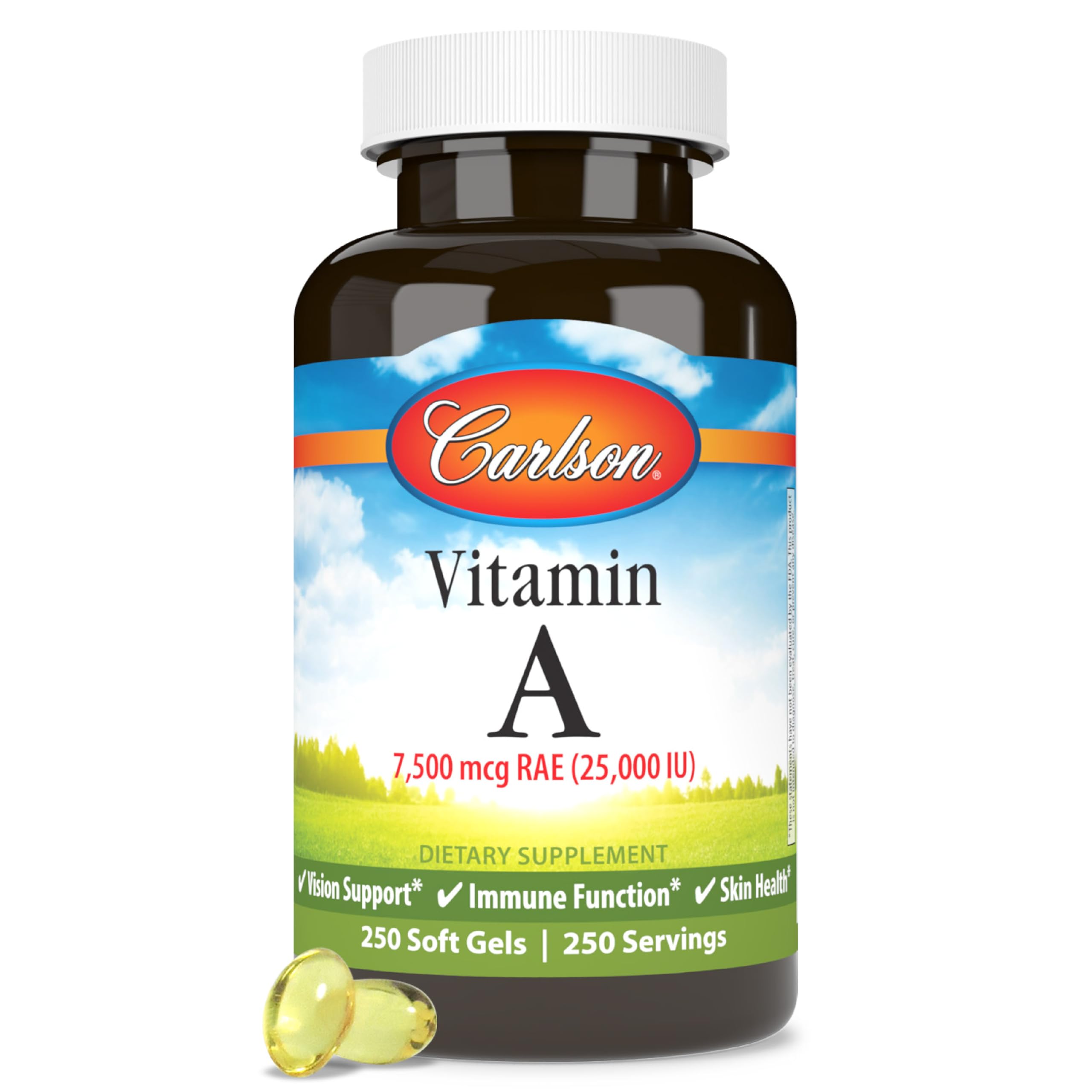
Carlson’s 25,000 IU softgel uses pure retinyl palmitate — the most bioavailable preformed form of vitamin A — suspended in a base of soybean oil for immediate absorption. Each softgel delivers 7,500 mcg RAE of active retinol that your liver can store and your eyes can utilize without needing conversion. This is the same molecular form found in cold-water fish liver oils and fortified dairy, making it the closest thing to a whole-food preformed dose you can get in a capsule.
Users consistently report noticeable improvements in night vision and skin integrity within four to six weeks of daily use. The softgels are easy to swallow and the 250-count bottle provides an eight-month supply at a once-daily serving. The manufacturer guarantees potency through the labeled expiration date, and third-party testing has repeatedly verified the stated IU levels.
The main consideration here is the relatively high per-softgel dose. At 25,000 IU, this exceeds the Tolerable Upper Intake Level for adults, so it is not suitable for daily stacking with other retinol sources or for anyone on prescription retinoids. Take it two to three times per week rather than daily if you are eating liver or fortified foods regularly.
Why it’s great
- Delivers active retinol without conversion loss
- Long-standing brand reputation with verified shelf potency
- Eight-month supply in a single bottle
Good to know
- Exceeds daily UL — must be dosed carefully when stacking other retinol sources
- Soybean oil base may not suit those with soy sensitivities
2. SOLARAY – Food Carotene Vitamin A, 10,000 IU – 200 Softgels

Solaray’s Food Carotene is 100% plant-sourced beta-carotene with a full carotenoid complex that includes alpha-carotene, cryptoxanthin, and zeaxanthin — not just isolated synthetic beta-carotene. At 10,000 IU of provitamin A per softgel, the usable retinol activity is roughly 1,667 mcg RAE, making this a gentle, safety-first option for daily use over many months without risk of accumulation.
Several long-term reviewers note that their hair growth accelerated noticeably after switching to this formula, likely because the full carotenoid profile supports keratinocyte differentiation in hair follicles. The softgels are small enough to swallow without water and produce no fishy aftertaste, which is a common complaint with cod liver oil–based vitamin A products. Solaray manufactures in its own facility and confirms potency through in-house lab analysis.
The lower RAE per capsule means you need to take two softgels to match a typical preformed dose for deficiency correction. If you have a diagnosed low vitamin A level, this form will work more slowly than an equivalent IU of retinyl palmitate due to the multi-step conversion required in the gut.
Why it’s great
- Whole-food carotenoid complex beyond just beta-carotene
- Extremely safe dosing window for long-term use
- No soy, gluten, or artificial additives
Good to know
- Lower RAE conversion — requires higher pill count for therapeutic retinol levels
- Individuals with low thyroid function may convert beta-carotene poorly
3. Carlson – Vitamin A, 15,000 IU (4,500 mcg RAE) – 240 Softgels

This is the same Carlson retinyl palmitate formula as the 25,000 IU version but stepped down to 15,000 IU (4,500 mcg RAE) — a dose that sits near the daily UL for most adults and functions as a maintenance level rather than a high-potency intervention. It is ideal for individuals who want the bioavailability of preformed retinol without exceeding the safe threshold when also eating vitamin-A-rich foods.
One reviewer references a Massachusetts Eye and Ear study linking this specific dose to macular health preservation in people with degenerative eye conditions, suggesting that 15,000 IU of preformed A may be the actual therapeutic window used in clinical vision research. The bottle holds 240 softgels, which at one per day equals eight months of supply. Multiple users report taking this product for years without issues.
The 15,000 IU dose provides roughly 60% of the active retinol per capsule compared to the 25,000 IU version, yet the price difference is minimal. If you are already confident you need preformed A rather than beta-carotene, this is the safer daily option that still delivers meaningful RAE without creeping into toxicity territory.
Why it’s great
- Daily-safe preformed dose for most adults
- Backed by clinical vision study references
- Eight-month bottle life at one softgel per day
Good to know
- Price per IU is slightly higher than the 25,000 IU version
- Still requires fat co-consumption for optimal absorption
4. Horbäach – Beta Carotene 25,000 IU (7,500 mcg) – 400 Softgels

Horbäach packages 400 quick-release softgels of beta-carotene at 25,000 IU each, delivering 7,500 mcg of provitamin A per serving. The per-softgel cost is among the lowest in this category, making it the clear choice for households supplementing with vitamin A on a tight budget. The softgels are notably small and easy to swallow, with no repeat aftertaste.
Beta-carotene from this product is non-GMO, gluten-free, and free of artificial flavors and sweeteners. The quick-release softgel format means the carotenoids begin dissolving in the stomach rather than passing through undigested, which partially compensates for the lower bioavailability of provitamin A compared to retinyl palmitate. Customers who had difficulty finding beta-carotene in local stores report satisfaction with the consistent stock and reliable delivery.
The bottle size is bulky — 400 softgels in a wide container — and the label does not specify the source of the beta-carotene (synthetic versus natural algae-derived). Most budget-priced beta-carotene at this volume is synthetic, which lacks the supporting carotenoid cofactors found in whole-food sources like Solaray’s.
Why it’s great
- Extremely low cost per softgel
- Small, easy-to-swallow capsule geometry
- Non-GMO and free of common allergens
Good to know
- Likely synthetic beta-carotene without carotenoid cofactors
- Large bottle takes up significant pantry or counter space
5. Swanson – Beta-Carotene Vitamin A, 25,000 IU – 300 Softgels (3‑Pack)
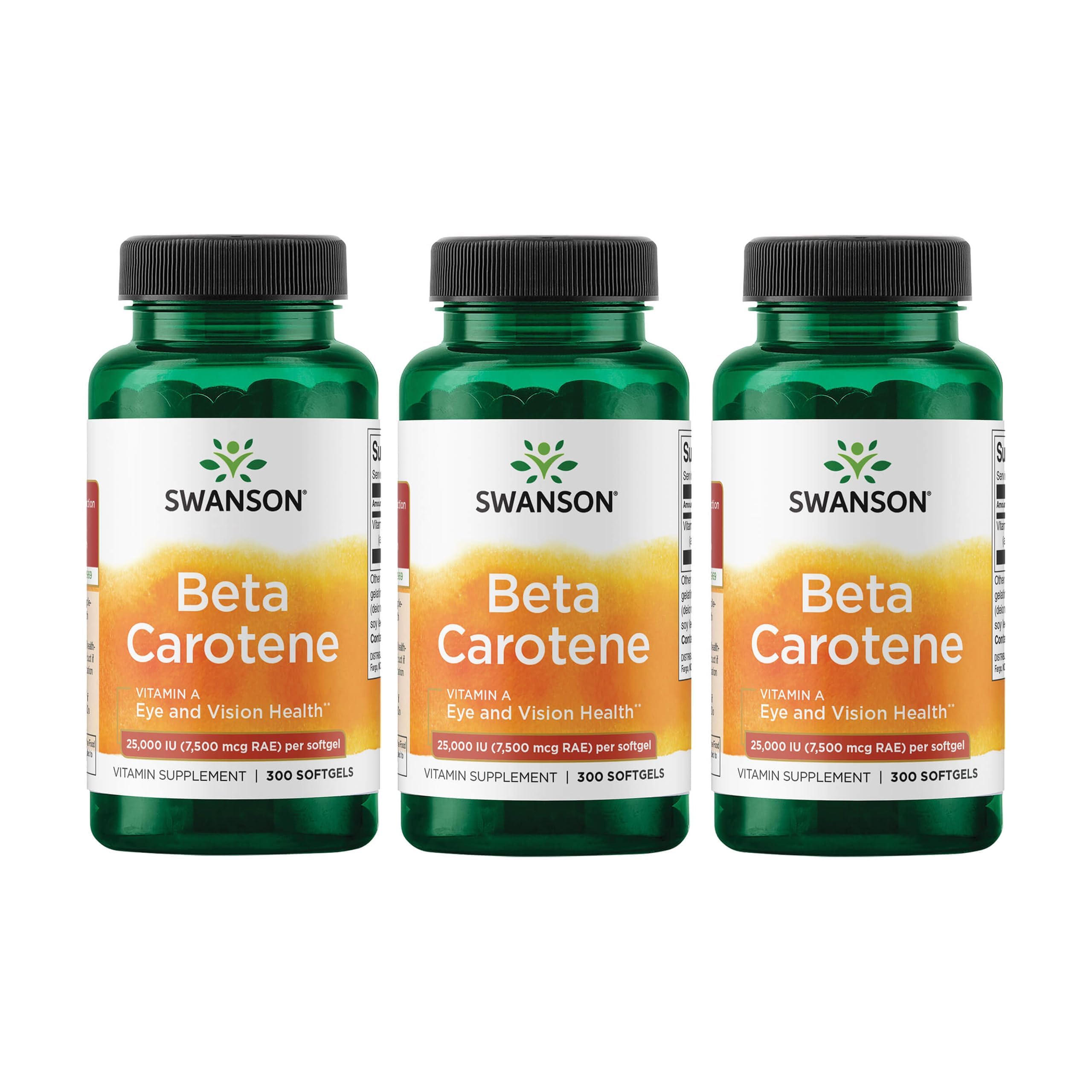
This Swanson bundle provides three separate 300-softgel bottles of beta-carotene at 25,000 IU each, totaling 900 softgels. At roughly 2.5 years of supply if taken at one per day, this is purely a bulk-storage play for committed users who know they want provitamin A for the long haul. The per-softgel cost undercuts even Horbäach on a unit basis.
Swanson’s beta-carotene is manufactured in cGMP-compliant facilities and tested for potency. The softgels are flavorless and chewable without bitterness, which is a safety net for anyone who struggles with large capsules. The package includes clear labeling of the 7,500 mcg RAE conversion, so you can compare apples to apples against retinyl palmitate products from Carlson.
The obvious downside is commitment. At 900 softgels, you are tied to a single form and dosage for over two years. Beta-carotene supplements stored in warm or humid conditions can oxidize and lose potency, so you must keep the unopened bottles in a cool, dark cupboard. If your vitamin A needs change, you are stuck with a large supply of a form that may no longer suit you.
Why it’s great
- Best unit economics in the category for bulk buyers
- Flavorless softgel can be chewed if needed
- Separate bottles preserve freshness better than a single jar
Good to know
- Two-plus-year commitment to one form and dose
- Requires cool, dark storage to prevent carotenoid oxidation over time
FAQ
Can I take preformed vitamin A and beta-carotene together without exceeding safe limits?
Why do some vitamin A softgels list only IU and not mcg RAE on the front label?
Does the soybean oil base in Carlson softgels affect absorption compared to other carrier oils?
Final Thoughts: The Verdict
For most users, the best form of vitamin a winner is the Carlson 25,000 IU because preformed retinyl palmitate eliminates the conversion gamble and delivers a dependable 7,500 mcg RAE per softgel — ideal for anyone serious about vision support or immune function. If you want long-term daily safety with a wider tolerance margin, the Solaray Food Carotene provides natural beta-carotene with a full carotenoid cofactor complex. And for bulk provitamin A on the leanest possible budget, nothing beats the Swanson Beta-Carotene 3‑Pack.