
Fractional input delay separates a pixel-perfect flick from a whiffed shot. In PC first-person shooters, the controller’s polling rate, stick tension, and trigger actuation define your ceiling. A standard gamepad leaves milliseconds on the table—time opponents use to land headshots.
I’m Mohammad Maruf — the founder and writer behind Drink4Good. I’ve spent years dissecting controller hardware specifications, from Hall Effect and TMR sensors to latency figures, to find the gear that actually improves reaction times on the battlefield.
After stress-testing adjustable tension joysticks, 8000 Hz polling rates, and dual-mode triggers, I have a clear verdict on which pad excels. This guide evaluates seven top contenders for the best fps controller for pc based on measurable competitive performance.
How To Choose The Best FPS Controller For PC
Winning in competitive shooters demands gear that minimizes input lag and maximizes control. Choosing the right controller means understanding the specific hardware components that translate your thumbs into in-game actions.
Polling Rate: The Speed of Your Inputs
Measured in Hertz (Hz), this is how often the controller reports its position to the PC. Standard controllers run at 125 Hz (8 ms delay). Premium FPS controllers hit 1000 Hz (1 ms) or even 8000 Hz (0.125 ms). A higher polling rate directly reduces visible stick lag, making your aim feel more connected and responsive.
Stick Technology: Drift vs. Durability
Traditional analog sticks use potentiometers that wear down, causing the dreaded stick drift. Hall Effect sticks use magnets to eliminate physical contact for near-infinite lifespan. TMR (Tunneling Magneto-Resistance) sticks are a newer magnetic iteration offering even finer sensitivity and lower power draw. For FPS, magnetic sticks are non-negotiable for long-term accuracy.
Additional Controls: Back Buttons and Trigger Stops
Back paddles or buttons let you jump, slide, and reload without removing your thumbs from the sticks. Trigger stops shorten the physical pull distance, allowing faster shots in semi-automatic and single-fire weapons. These features aren’t luxuries—they are mechanical advantages that reduce your time-to-kill.
Quick Comparison
On smaller screens, swipe sideways to see the full table.
| Model | Category | Best For | Key Spec | Amazon |
|---|---|---|---|---|
| Razer Wolverine V3 Pro | Premium | Competitive PC Esports | 8000 Hz Polling Rate / TMR Sticks | Amazon |
| GameSir G7 Pro 8K | Mid-Range | High-Performance Value | 8000 Hz Polling Rate / TMR Gen-2 | Amazon |
| FLYDIGI Apex 5 | Premium | Adaptive Trigger Immersion | ForceAdapt Triggers / 3ms Latency | Amazon |
| PlayStation DualSense Edge | Premium | PlayStation & PC Dual Users | Swappable Stick Modules | Amazon |
| NYXI Imperial | Mid-Range | Multi-Platform Wireless | 40-80gf Adjustable Tension TMR | Amazon |
| FLYDIGI Vader 5S | Budget | Adjustable Tension on a Budget | 40-100gf Forceflex Sticks / Hall Effect | Amazon |
| Xbox Wireless + USB-C | Budget | Simple, Reliable Entry Point | Textured Grip / 40-Hour Battery | Amazon |
In‑Depth Reviews
1. Razer Wolverine V3 Pro 8K

The Razer Wolverine V3 Pro sets the benchmark for PC competitive controllers. Its 8000 Hz polling rate over wired or 2.4 GHz wireless delivers the lowest input latency of any controller on this list—a tangible advantage in gunfights where who shoots first wins. The TMR thumbsticks offer anti-drift precision without the stickiness sometimes found in Hall Effect sensors, and the rubberized handles keep the 235-gram frame planted in your palms during long sessions.
Every control element feels esports-tuned. The mecha-tactile PBT face buttons provide a satisfying, crisp actuation that prevents accidental double-clicks. The four mouse-click back paddles are positioned identically to the Xbox Elite Series 2 layout, making muscle memory transfer seamless for anyone upgrading. The Pro HyperTriggers let you toggle between a hair-trigger mouse-click mode for rapid-fire weapons and full analog pull for vehicles—all mid-match.
The trade-off is a lighter, more plastic-feeling chassis compared to the DualSense Edge, and the complete absence of rumble motors keeps weight down but eliminates haptic feedback. Battery life hovers around 8 hours at 8K polling, which demands nightly charging. For pure competitive FPS performance on PC, the V3 Pro remains the gold standard.
Why it’s great
- True 8000 Hz polling in wired and wireless modes
- Four back paddles with perfect ergonomic placement
- Anti-drift TMR sticks with swappable caps
Good to know
- No rumble motors or RGB features
- Feels lighter and less premium than competitors
- Software (Synapse) required for full customization
2. GameSir G7 Pro 8K PC, Aimlabs Edition
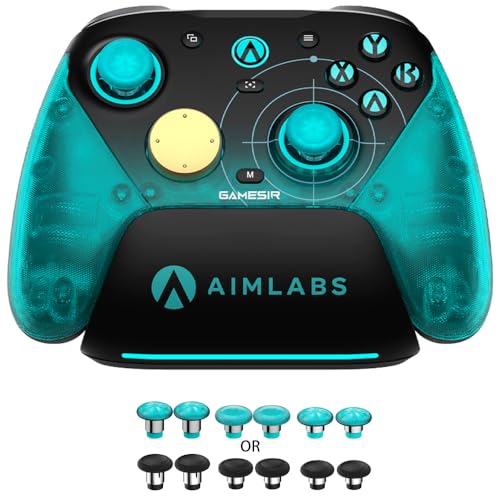
GameSir achieves the near-impossible: matching the 8000 Hz polling rate of a controller at roughly half the price. The G7 Pro 8K uses GameSir’s second-generation Mag-Res TMR sticks, which combine magnetic drift-proof reliability with incredibly smooth, linear movement ideal for tracking targets in games like Apex Legends or Overwatch. The optical micro-switch face buttons actuate faster than standard membrane pads, registering every tap without mushiness.
The body includes two back buttons and two mini shoulder bumpers, each capable of recording 32-step macros. The dual-mode triggers switch between linear Hall Effect for precise throttle control and clicky micro-switch stops for instant response in shooters. The 1200 mAh battery powers a comfortable 15-hour session, and the charging dock keeps the 2.4 GHz dongle stored neatly inside. The swappable magnetic faceplate adds a layer of personalization.
One downside: the included D-pad, while improved over earlier GameSir revisions, still shows slight input bleed in precise fighting games. The Bluetooth performance lags slightly behind the 2.4 GHz mode, so serious players should stick to the included wireless dongle. For raw competitive specs at a mid-range price, the G7 Pro is the smartest buy on this list.
Why it’s great
- 8000 Hz polling across both wired and 2.4 GHz modes
- Hall Effect analog triggers with micro-switch stops
- Four programmable buttons with 32-step macro support
Good to know
- D-pad still has minor cross-input issues
- Bluetooth mode less stable than 2.4 GHz
- Rubberized grip coating may wear over time
3. FLYDIGI Apex 5
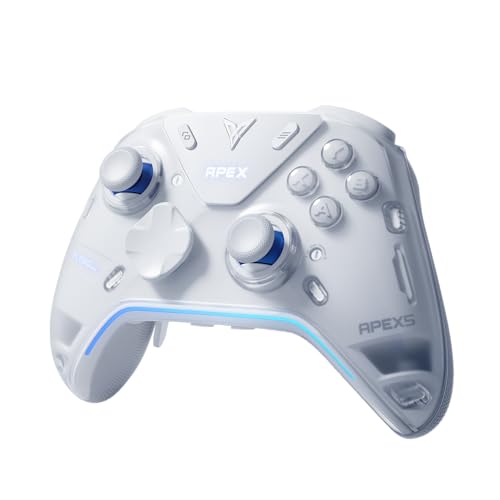
The FLYDIGI Apex 5 brings an unprecedented level of force feedback to PC controllers. Its ForceAdapt triggers dynamically adjust resistance based on in-game events—a rifle shot sends a sharp snap through the trigger, while a vehicle’s throttle applies smooth analog pressure. This haptic layer, paired with a four-motor stereo vibration system, provides immersive cues that can sharpen your reaction timing during chaotic gunfights.
The Forceflex Joystick 2.0 offers a tension range from 30 gf to 100 gf, the widest adjustment window on this list. This allows precise tuning from a loose floaty feel for sniping to a stiff, heavy resistance for close-quarters spray control. The 3 ms wired stick latency and the full-color LCD screen for in-hand profile switching make this a self-contained powerhouse that doesn’t require software mid-match.
Wireless stability has been a pain point for some units, with reports of disconnects on the 2.4 GHz dongle. The face buttons require very little force to actuate, which may cause misfires for users with heavier thumbs. The Apex 5 is not compatible with Xbox, so PC and Switch are your only options. If you want the most sensory feedback available, this is the controller.
Why it’s great
- ForceAdapt triggers provide real-time haptic resistance
- 30-100 gf joystick tension range is industry-leading
- Onboard LCD screen for quick profile changes
Good to know
- Wireless connectivity can be unreliable on some units
- Not compatible with Xbox consoles
- Face buttons have a light, short throw that feels cheap
4. PlayStation DualSense Edge Wireless Controller

The DualSense Edge is the most console-integrated option here, designed primarily for PlayStation 5 but fully functional on PC via USB. Its standout feature is the replaceable stick modules—when a stick develops drift or wear, you swap the entire module rather than the whole controller, dramatically extending its lifespan. For PC players who also own a PS5, this dual-ecosystem compatibility is convenient.
The adjustable trigger travel distances are excellent for different FPS scenarios: a short pull for semi-automatic rifles, a longer travel for analog-controlled scopes. The rear paddles (two swappable sets) and the Fn button assignable to system controls reduce hand movement. The rubberized grip and slightly heavier weight (including a braided 2.9 m USB-C cable) give a premium, sturdy feel during intense matches.
The battery life is the worst in this comparison—approximately 3 to 4 hours under heavy use. This forces wired play for almost all competitive sessions. The on-board profile system is limited to three custom profiles, and remapping is restricted to existing buttons rather than adding new ones. If battery life isn’t a concern and you want the PlayStation layout for PC, the Edge is a solid upgrade.
Why it’s great
- Replaceable stick modules solve drift permanently
- Excellent ergonomics and premium build weight
- Trigger travel adjustment is intuitive and physical
Good to know
- Battery life is severely limited (3-4 hours)
- No back paddle support for adding new inputs
- Only three customizable onboard profiles
5. NYXI Imperial
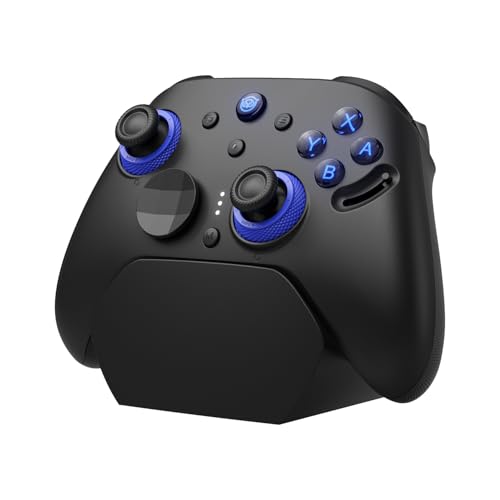
The NYXI Imperial prioritizes versatility and battery life. Its 1200 mAh battery lasts up to 15 hours, and the included magnetic charging dock keeps the controller topped off without fumbling with cables. The TMR joysticks offer a 40 gf to 80 gf stepless tension adjustment, allowing you to dial in the perfect resistance for tracking versus flicking. The 1000 Hz polling rate via 2.4 GHz wireless ensures low latency.
Triple-mode connectivity (2.4 GHz, Bluetooth, wired) makes this a multi-platform workhorse, compatible with PC, Switch, Android, and TV. The dual-mode triggers include a hardware toggle for micro-switch hair-trigger mode and linear Hall Effect travel. You can also swap the ABXY buttons between Nintendo Switch and PC/Xbox layouts, which is a thoughtful touch for players who switch ecosystems.
Build quality is solid, but the plastic body lacks the premium weight and grip texture of Razer’s or GameSir’s offerings. The two programmable back buttons are limited compared to the four-paddle competition. While the smart dock is convenient, the controller uses a proprietary magnetic connection, so you cannot charge it with a standard cable. For multi-platform players who want long battery life and tension control, the Imperial covers a lot of ground.
Why it’s great
- Long battery life with smart magnetic charging dock
- Stepless adjustable joystick tension (40-80 gf)
- Works across PC, Switch, and Android wirelessly
Good to know
- Only two programmable back buttons
- Proprietary magnetic charging connector
- Plastic shell feels less premium than competitors
6. FLYDIGI Vader 5S
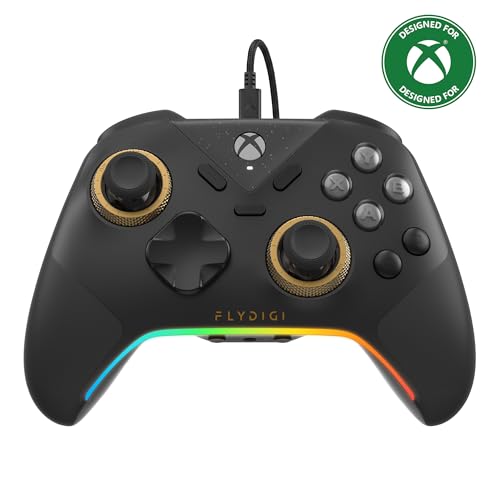
The FLYDIGI Vader 5S brings adjustable stick tension to the budget category without sacrificing core features. Its Forceflex system allows you to tweak the joystick resistance between 40 gf and 100 gf, a range that directly impacts accuracy in fast-paced shooters. The Hall Effect sensors guarantee zero drift and a 10-million-cycle lifespan, making this a durable entry point for competitive play.
Six programmable buttons (two rear paddles, two mini shoulder buttons, and two CZ face buttons) provide ample remapping options for typical FPS actions like jump, crouch, and reload. The dual-mode triggers switch via a physical button between micro-switch hair-trigger and Hall Effect linear modes. The controller feels nearly identical to an official Xbox Series controller in hand, which helps ease the transition from a standard gamepad.
Steam recognition sometimes stumbles during initial setup, requiring driver tweaks. The microphone on the 3.5 mm jack stopped working for one reviewer after the cable was partially unplugged, indicating a sensitive port. The software suite has a reputation for update loops and wonky settings. For the price, you get an impressive feature set, but you may have to troubleshoot some early connection quirks.
Why it’s great
- Adjustable joystick tension (40-100 gf) at this price point
- Six programmable buttons for essential remapping
- Hall Effect sticks and triggers for drift-free durability
Good to know
- Software can have update loop and connection issues
- 3.5 mm audio jack may lose function after cable strain
- Some Steam recognition issues on first connection
7. Xbox Wireless Gaming Controller + USB-C Cable
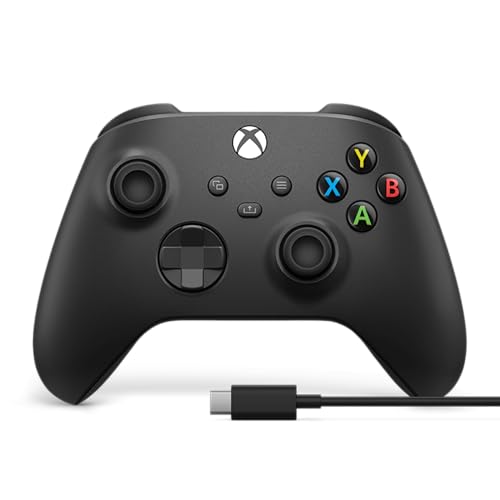
The standard Xbox Wireless Controller is every PC gamer’s fallback for a reason: it works instantly, fits most hands well, and is widely supported by every game on Steam and Game Pass. The Carbon Black bundle includes a 9-foot USB-C cable, so you can play wired with zero latency or pairing hassle. The textured grip on the triggers, bumpers, and back case helps prevent slipping during sweaty matches.
The refined ergonomic geometry and hybrid D-pad represent a solid evolution from earlier Xbox designs. Button feel is snappy, and the 3.5 mm audio jack supports direct headset audio. Battery life reaches up to 40 hours on two AA batteries, which is more than any rechargeable internal battery on this list. The Xbox Accessories app allows basic button remapping.
This controller lacks every FPS-focused feature: no back paddles, no trigger stops, no Hall Effect sticks, and no high polling rate. Reports of stick drift after six months are common. It is the baseline—everything else on this list represents an upgrade for competitive play. If you are on a tight budget and just want to start playing, the Xbox controller serves its purpose, but it will hold you back in ranked games.
Why it’s great
- Universal PC compatibility with no setup required
- Excellent battery life on AA batteries (40 hours)
- Comfortable ergonomic design for all hand sizes
Good to know
- No back paddles or trigger stops for FPS advantage
- Standard analog sticks prone to drift over time
- Limited to basic button remapping via Xbox Accessories
FAQ
Does a higher polling rate always improve my aim?
Are TMR sticks better than Hall Effect for FPS?
Can I use a PlayStation controller on PC without issues?
Do I need back paddles for competitive shooters?
Final Thoughts: The Verdict
For most users, the best fps controller for pc winner is the Razer Wolverine V3 Pro because its 8000 Hz polling rate, TMR sticks, and four paddle layout leave nothing on the table for competitive shooters. If you want near-identical performance at a lower price point, grab the GameSir G7 Pro 8K. And for the ultimate sensory experience with adaptive trigger feedback, nothing beats the FLYDIGI Apex 5.