
The gap between a warbird that glides on rails and one that spirals into a crash landing often comes down to a single component: the gyro stabilization system. For anyone new to the hobby, the wrong FPV plane can turn a promising afternoon into an expensive lawn dart in seconds. The right one, however, delivers that cinematic first-person view without the constant anxiety of losing control.
I’m Mohammad Maruf — the founder and writer behind Drink4Good. My approach to this guide involved sifting through hundreds of hours of build logs, crash reports, and spec sheets to identify which FPV-ready airframes actually deliver on their promises for pilots at every skill level.
Whether you are looking for a backyard trainer to learn the basics or a premium rig to capture sweeping aerial footage, the best fpv plane for you balances airframe durability, flight time, and gyro-assisted stability without exceeding your skill ceiling.
How To Choose The Best FPV Plane
The right FPV plane hinges on three pillars: your skill level, the plane’s stabilization system, and the airframe’s ability to survive inevitable first flights. Forget glossy marketing — a warbird’s cockpit details mean nothing if the receiver fails at 200 feet.
Gyro Stabilization: The Beginner’s Safety Net
A 6-axis gyro (like the Xpilot system) constantly adjusts control surfaces to keep the plane level. In beginner mode, it limits bank angles and automatically recovers from dives and spins. This is the difference between a plane that teaches you and one that punishes every mistake. Every entry-level FPV plane on this list includes a multi-mode gyro — look for at least three levels of assist.
Airframe Material and Durability
EPP (Expanded Polypropylene) foam is the gold standard for trainers. It flexes on impact rather than shattering. Compare this to cheaper EPS foam, which crumbles. Carbon-fiber rod reinforcements add rigidity without weight. A good rule: if the product description doesn’t specify the foam type, assume it is the brittle kind.
Motor Type and Power System
Brushed coreless motors are cost-effective but wear out after 10-15 hours of flight. Brushless motors deliver higher RPM, better thrust-to-weight ratios (>1.2:1), and significantly longer lifespans. For an FPV plane carrying a camera and transmitter, a brushless motor is strongly recommended for consistent climb performance.
Wingspan and Visibility
Larger wingspans (1.1 meters and up) produce more lift and are easier to see at distance. Smaller 500mm-class warbirds are portable but require sharper eyes and calmer winds. If you plan to fly at a park with moderate wind, a 1.1m wingspan is the sweet spot for stability without needing a full runway.
Quick Comparison
On smaller screens, swipe sideways to see the full table.
| Model | Category | Best For | Key Spec | Amazon |
|---|---|---|---|---|
| HobbyZone AeroScout S 2 1.1m | Trainer / High-Performance | First-time pilots & instruction | 1.1m wingspan / SAFE technology | Amazon |
| VolantexRC TrainStar 500mm Brushless | Brushless Sport | All-skill sports flying | Brushless motor / ~30 min flight | Amazon |
| Emax Tinyhawk RTF Micro | Micro FPV Racer | Indoor FPV flight training | FPV goggles included / 35 mph | Amazon |
| HobbyZone Carbon Cub S 2 1.3m | Scale Trainer | Realistic flying & bush flying | 1.3m wingspan / Optional LAS | Amazon |
| DJI Avata 2 Fly More Combo | Cinematic FPV | Immersive cinematic flying | 4K/60fps / built-in propeller guard | Amazon |
| ANTSIR BF109 4CH | Beginner Warbird | WW2 warbird fans learning 4CH | 3 batteries / 6-axis gyro | Amazon |
| VolantexRC FW190 Fighter | Beginner Warbird | Stable entry-level warbird flying | 3 flight modes / ~20 min flight | Amazon |
| DEERC F35 EDF Jet | EDF Jet | Advanced pilots wanting jet performance | 7400KV brushless / 20 min flight | Amazon |
| RoofWorld P51D Mustang | Budget Trainer | Absolute beginners on a tight budget | 6-axis gyro / durable EPP foam | Amazon |
In‑Depth Reviews
1. HobbyZone AeroScout S 2 1.1m RTF Basic

The HobbyZone AeroScout S 2 is the gold standard for new pilots because of its exclusive SAFE (Sensor Assisted Flight Envelope) technology. This system automatically prevents stalls and over-banking, dramatically reducing the learning curve. The 1.1m wingspan provides excellent visibility at altitude, while the pusher propeller design protects the prop during belly landings — a common beginner mistake.
Under the hood, a brushless outrunner motor and Spektrum AR631 receiver deliver reliable DSMX control and enough power for basic aerobatics in Expert mode. The flight modes — Beginner, Intermediate, and Experienced — are switchable mid-flight via the included DXS transmitter, allowing pilots to progress without buying new equipment. Flight times average 15-20 minutes on a compatible 3S 2200mAh LiPo battery.
The downside: the ‘RTF Basic’ designation means you must supply your own battery and charger, and the included DXS transmitter lacks an LED screen for telemetry. Also, at 3.47 kg, it is heavier than smaller foamies and requires a larger open field or groomed runway for takeoffs. Experienced pilots may find the Beginner mode too restrictive, but that’s precisely the point — it is a trainer designed to prevent crashes, not win races.
Why it’s great
- SAFE technology prevents stalls and over-banking, ideal for first flights
- Brushless motor offers reliable power and ~20 min flight times
- Rear pusher prop stays intact on belly landings
Good to know
- Battery and charger sold separately (RTF Basic)
- Included transmitter lacks telemetry screen
- Large size requires a spacious field for takeoffs and landings
2. VolantexRC TrainStar 500mm Brushless
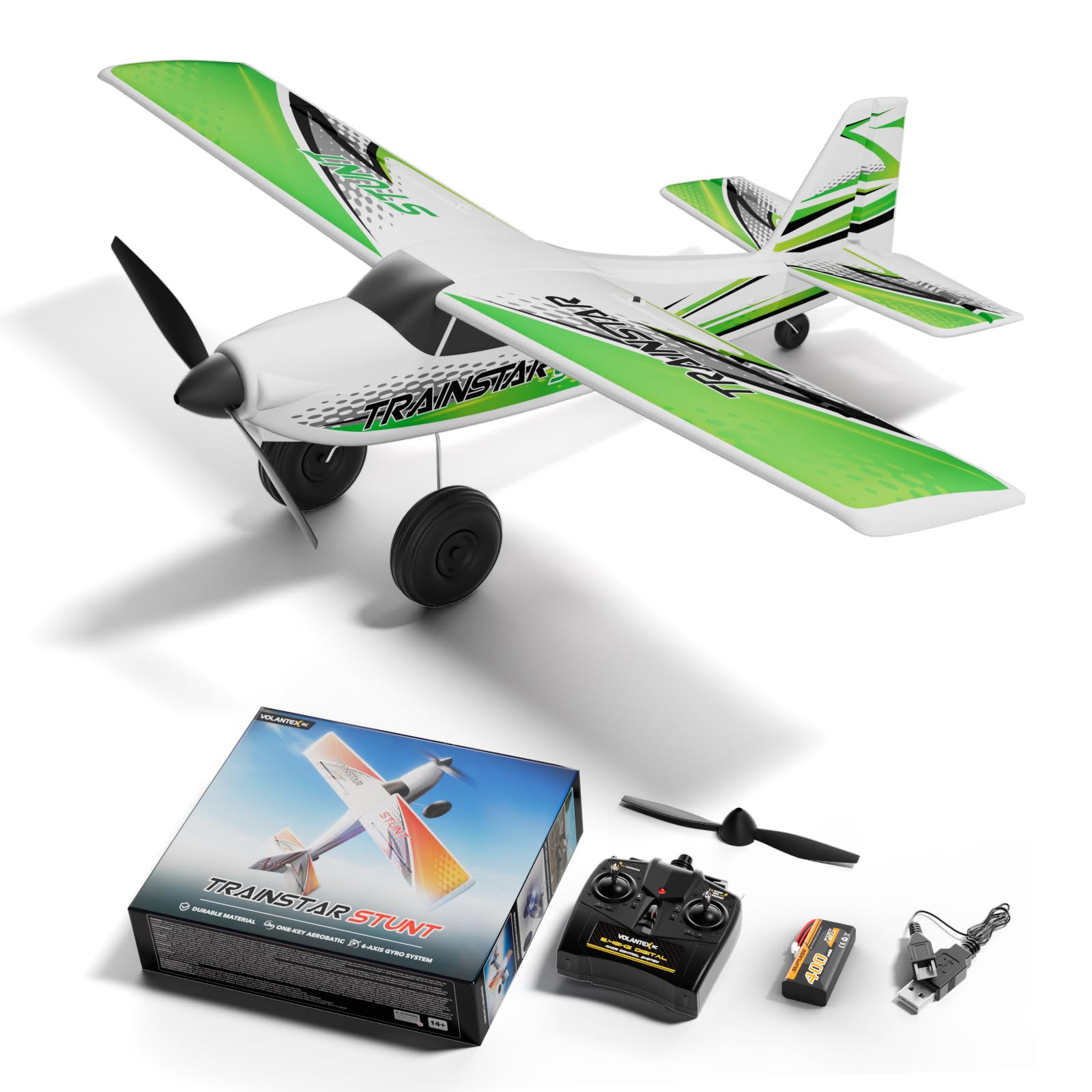
The VolantexRC TrainStar 500mm Brushless bridges the gap between a beginner trainer and a sport flyer. Its compact 500mm wingspan makes it highly portable, but it’s the brushless motor that sets it apart — delivering a thrust-to-weight ratio that allows rapid climbs and snappy aerobatics. The Xpilot gyro stabilizer offers three levels of assist: Beginner (full auto-leveling), Intermediate (partial assist), and Expert (manual), making it a single-airframe solution for pilots looking to progress.
Unlike many small warbirds, the TrainStar features spring-loaded landing gear with a rear wheel steering clutch for ground handling. The included two 2S batteries provide a combined flight time of roughly 30 minutes, which is impressive for its size. The detailed cockpit, 3D pilot figure, and two-blade propeller add a level of scale realism that enhances the flying experience.
The trade-off is that replacement propellers are notoriously hard to find, and the propeller guard design occasionally ejects the prop entirely on impact — which can be lost in grass. Some users report the landing gear is too delicate for anything but smooth pavement. Despite these quirks, its brushless power and gyro-assisted flight envelope make it one of the most capable compact FPV planes available.
Why it’s great
- Brushless motor delivers responsive power and longer lifespan than brushed equivalents
- Compact 500mm wingspan fits in a small backpack
- Three flight modes allow pilots to progress without buying a second plane
Good to know
- Replacement propellers are difficult to source
- Landing gear is better suited for paved surfaces than grass
- Propeller guard can eject props on hard impact, risking loss
3. Emax Tinyhawk RTF Micro Indoor Racing Drone

The Emax Tinyhawk RTF is the fastest path to true first-person-view flight because it includes everything you need — the drone, a set of FPV goggles, and a controller — ready out of the box. Unlike WiFi-based FPV systems, the Tinyhawk uses analog video transmission for low-latency, real-time video up to 200 feet. It is extremely durable, capable of surviving hundreds of indoor crashes, and can even withstand a full water submersion after proper drying.
Its 450mAh LiPo battery delivers about 4-5 minutes of flight time, and the drone can reach speeds of 35 mph in acro mode. The all-in-one design makes it the ideal tool for learning FPV skills like proximity flying, flips, and rolls without the risk of damaging an expensive airframe. The kit also easily connects to Betaflight for tuning, supported by a massive online community.
The main limitation is battery life — 4 minutes is short, and the included charger is basic. The goggles, while functional, are slightly heavy and lack the resolution of premium models. Some units are reported to be fragile with repeated hard impacts, though most users find it exceptionally tough. Overall, for pure FPV skill development, this is the most cost-effective entry point.
Why it’s great
- Complete RTF kit with goggles, controller, and drone — no extra purchases needed
- Extremely durable for indoor learning, survives repeated crashes
- Low-latency analog video transmission for real-time FPV
Good to know
- Very short flight time (~4-5 minutes per battery)
- Included goggles are functional but not the most comfortable
- Some units may experience durability issues with hard impacts
4. HobbyZone Carbon Cub S 2 1.3m BNF Basic

The HobbyZone Carbon Cub S 2 is the most versatile scale trainer on this list. Its 1.3m wingspan and large 3-inch wheels handle grass runways with ease, making it perfect for bush flying. The SAFE technology provides the same beginner-friendly envelope protection as the AeroScout, but the Carbon Cub adds an optional Landing Assist Sensor (LAS) that automatically levels the plane for smoother touchdowns.
This is a Bind-N-Fly (BNF) model, meaning you need your own Spektrum-compatible transmitter. It is capable of basic aerobatics like loops, rolls, and inverted flight, and larger batteries like the Spektrum 3200mAh 3S fit in the battery tray for extended flight sessions. The airframe is robust enough to survive bad landings, though the landing gear fairings are known to pop off on rough grass.
The lack of included transmitter and battery increases the initial investment if you are not already in the Spektrum ecosystem. Assembly is required, taking about an hour, and the paint is prone to scratching from handling. However, for pilots who want a realistic RC plane experience with room to grow into floats, GPS, and aerobatics, the Carbon Cub is unmatched in its versatility.
Why it’s great
- Large 3-inch wheels excel on grass runways
- Optional Landing Assist Sensor simplifies landings for beginners
- Capable of basic aerobatics and supports floats for water flying
Good to know
- BNF Basic — requires a separate Spektrum transmitter and battery
- Landing gear fairings can pop off during rough landings
- Paint is easily scratched with normal handling
5. DJI Avata 2 Fly More Combo (1 Battery)

For the pilot who wants an immersive cinematic experience without soldering or tuning, the DJI Avata 2 is the premium choice. It is an FPV drone, not a fixed-wing plane, but it delivers an unparalleled first-person view with the DJI Goggles 3 and the intuitive DJI RC Motion 3 controller. The 155° FOV 4K/60fps camera captures stunning low-altitude footage, and the built-in propeller guard adds durability for flying in tight spaces.
The Avata 2 is extremely beginner-friendly out of the box. The motion controller translates hand gestures into flight commands, requiring no thumb stick coordination. It also performs easy acrobatics like flips, rolls, and 180° drifts with a single button press. The battery provides approximately 23 minutes of flight time, and the airframe is FAA Remote ID compliant, making it legal to fly in most areas.
The obvious trade-off is the high entry cost and the closed ecosystem: batteries, chargers, and spare parts are DJI-specific and expensive. The goggles, while high-resolution, have a separate battery that needs recharging. For pure FPV cinematic flying and content creation, the Avata 2 is arguably the most polished product on the market, but it is a serious financial commitment.
Why it’s great
- Stunning 4K/60fps video with 155° wide-angle field of view
- Intuitive motion controller makes FPV accessible to beginners
- Built-in propeller guard and durable airframe for confident flying in tight spaces
Good to know
- High price point requires a significant budget
- Proprietary ecosystem with expensive replacement parts
- Goggles have a separate battery that adds to charging complexity
6. ANTSIR BF109 4CH RTF
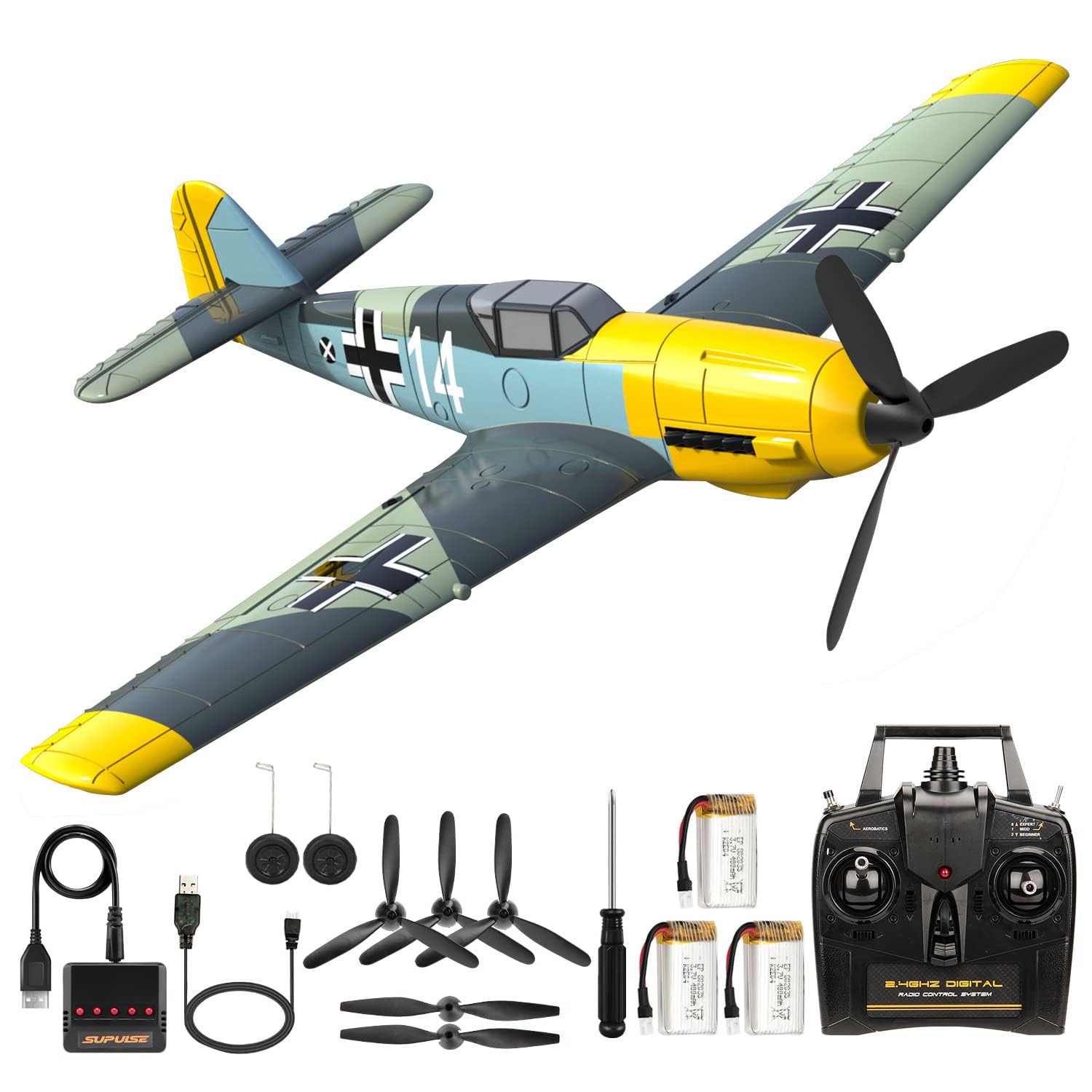
The ANTSIR BF109 provides an authentic WWII warbird experience in a beginner-friendly package. Its 6-axis gyro stabilization system offers three distinct flight control levels, allowing new pilots to learn takeoffs, turns, and landings with the safety net of auto-leveling. The inclusion of three rechargeable 3.7V 300mAh LiPo batteries in the box is a standout feature, enabling multiple flight sessions without waiting for charging.
The 4-channel control (throttle, rudder, elevator, ailerons) gives full three-axis control for scale maneuvers and basic aerobatics. The EPP foam airframe is lightweight and crash-resistant, though some users report that the adhesive holding the wings fails after repeated hard landings. The reserved FPV antenna expansion port on the receiver makes it easy to add a simple camera and transmitter for true FPV flying.
This model does have some quality control issues, including reports of receivers failing to bind and reversed aileron controls. The battery compartment hatch is also prone to breaking. Despite these flaws, when properly assembled, it offers an impressive entry into 4CH warbird flying at a cost that includes three batteries and a spare propeller.
Why it’s great
- Comes with three rechargeable batteries for extended flying sessions
- Reserved FPV expansion port makes it easy to add a camera
- EPP foam construction survives many hard landings
Good to know
- Quality control issues with binding and control surface alignment are not uncommon
- Battery compartment hatch is fragile and can break easily
- Some assembly and adjustments may be required out of the box
7. VolantexRC FW190 Fighter 4CH RTF

The VolantexRC FW190 is a highly polished beginner warbird that emphasizes ease of use with features like one-touch auto-takeoff and a hover function. The Xpilot gyro system stabilizes the plane even in 20+ mph winds, making it a reliable choice for breezy park flying. The gearbox-driven motor system provides excellent thrust and extends flight time to approximately 20 minutes on a single battery.
The three flight modes (Beginner, Intermediate, Expert) allow the pilot to gradually increase control authority. The RTF package is fully assembled, requiring only AA batteries for the transmitter before the first flight. Its 2.4GHz radio system offers a range of 656 feet, strong enough for small flight club gatherings.
The main drawback is the inconsistent build quality reported by some buyers — one review noted the plane veered left due to mismatched landing gear. The controller, while functional, is basic and the “X-Pilot” system can be confusing to calibrate. However, for the feature set and price point, the FW190 delivers a stable, feature-rich first warbird experience.
Why it’s great
- One-touch auto-takeoff and hover functions simplify launching
- Gearbox system delivers efficient thrust and ~20 min flight times
- Stable in windy conditions thanks to the gyro stabilizer
Good to know
- Some units may have build quality inconsistencies
- Controller is basic and lacks telemetry display
- Propellers can break on hard impacts and replacements may be hard to find
8. DEERC F35 4CH Brushless EDF Jet

The DEERC F35 is the only Electric Ducted Fan (EDF) jet on this list, offering a completely different flying experience than propeller-driven warbirds. Its 7400KV brushless motor delivers a thrust-to-weight ratio of 1.2:1, meaning it can climb vertically. The sleek F-35 stealth fighter design with radar-absorbing camouflage coating adds visual authenticity, though the airframe is made from lightweight EPP foam that is surprisingly durable.
It includes two 550mAh LiPo batteries for a combined flight time of up to 20 minutes. The control range is 500 feet, and the plane supports both hand-throw and runway takeoff. For advanced pilots, the 4-channel system enables 3D flips, mirror flight, 360° spins, and falling-leaf maneuvers.
The durability is a mixed bag: the foam survives crashes well, but the propellers break easily and are not always easy to source. There are reports of wires breaking off the motor and a lack of manufacturer support when that happens. The battery charging system can also be problematic. This is a jet for pilots who have mastered a trainer and want the speed and response of an EDF platform — not a beginner’s first plane.
Why it’s great
- EDF jet design provides a unique, fast-flying experience distinct from prop planes
- Brushless motor delivers excellent thrust-to-weight ratio for vertical climbs
- Realistic F-35 scale appearance with camouflage coating
Good to know
- Propellers break easily and replacements are hard to find
- Motor wire failures reported; manufacturer support may be limited
- Not a beginner plane — requires experience with 4CH flying
9. RoofWorld P51D Mustang 4CH RTF
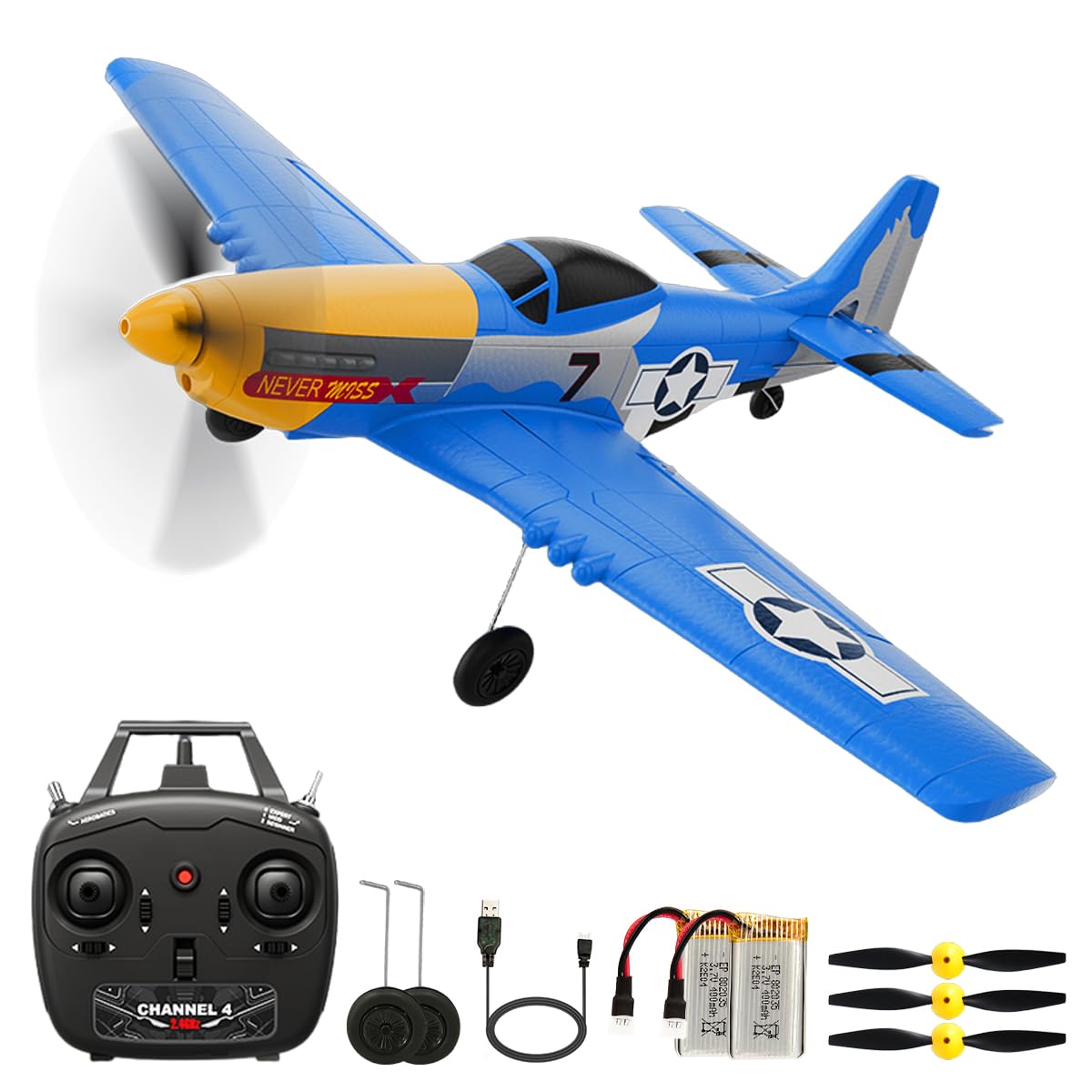
The RoofWorld P51D Mustang is the most affordable true 4CH warbird on this list, making it a critical entry point for cost-conscious beginners. It uses a 6-axis gyro with Xpilot stabilization and three-level flight control assist (Beginner, Moderate, Expert). In Beginner mode, the plane auto-levels and limits bank angles, allowing the pilot to learn orientation and throttle management without the risk of a spiral dive.
The EPP foam airframe is reinforced with carbon fiber rods, which explains why users report it surviving crashes into trees and the ground with only minor damage. The rear-mounted propeller design is a smart choice — it prevents prop strikes on landing and protects the drive system during the inevitable nose-ins. The package includes everything needed for the first flight (except AA batteries for the transmitter) and the model arrives fully assembled.
Experienced pilots note that the center of gravity (CG) is too far rearward, requiring a small amount of nose weight for stable flight. The control horns may also need adjustment for proper sensitivity. The range is rated at 656 feet, which is adequate for park flying but not for long-distance FPV. Despite these minor fixes, it is arguably the most beginner-friendly and crash-resistant budget warbird available.
Why it’s great
- Extremely durable EPP and carbon fiber construction survives hard crashes
- Rear propeller design protects the prop during belly landings
- Three-level flight assist helps beginners progress step-by-step
Good to know
- Needs nose weight to correct rearward center of gravity
- Control horns may need adjustment out of the box
- Limited range compared to higher-end systems
FAQ
Can I add a camera to any of these planes for true FPV flying?
What does “RTF” mean and why should it matter for a beginner?
How much wind can an FPV plane handle before it becomes dangerous to fly?
Final Thoughts: The Verdict
For most users, the best fpv plane winner is the HobbyZone AeroScout S 2 1.1m because its SAFE technology actively prevents the two most common beginner mistakes — stalling and over-banking — while its brushless motor and large wingspan provide room to grow into expert flying without needing a second plane. If you want a compact brushless sport flyer that fits in a backpack, grab the VolantexRC TrainStar 500mm Brushless. And for truly immersive cinematic FPV without any technical assembly, nothing beats the DJI Avata 2.