
Storing nutrition and tools on a road bike means choosing between jersey pockets that bounce and saddle bags that swing. A frame bag solves both problems by locking gear inside the bike’s main triangle, keeping weight centered and your back pocket free for a phone. The trick is finding a shape that doesn’t rub your knees out of the saddle and a mount that won’t shift during a hard sprint.
I’m Mohammad Maruf — the founder and writer behind Drink4Good. I’ve spent thousands of hours analyzing frame bag geometry, zipper durability, and real-world fitment data from competitive cyclists and long-distance tourers to separate the stable storage solutions from the knee knockers.
Whether you’re packing gels for a gran fondo or tools for a self-supported tour, choosing the right frame bag for road bike comes down to three things: measuring your triangle space, selecting the right material for your climate, and ensuring the bag sits tight without interfering with your pedaling motion.
How To Choose The Best Frame Bag For Road Bike
A road bike frame bag isn’t a one-size-fits-all accessory. The wrong shape catches wind, the wrong zipper leaks grit into your electronics, and a loose mount shifts weight every time you stand on the pedals. Here are the three most important factors to evaluate before you click “add to cart.”
Measure Your Frame Triangle First
The internal triangle formed by the top tube, down tube, and seat tube dictates exactly how much bag you can fit. Measure the length of your top tube from the head tube to the seat tube, and the height from the top tube straight down to the down tube. A bag that extends too far rearward hits the seat tube and bulges into your thigh swing, while one that’s too long forward crowds the stem. Most road frames under 56cm work best with bags under 8 inches on the top tube dimension.
Zipper Quality and Weather Protection
Road spray, sweat, and sudden rainstorms hit the down tube area hardest. Look for YKK water-resistant zippers and TPU-laminated fabrics rather than basic nylon with a DWR coating. A bag advertised as “water resistant” usually keeps out light mist, but a bag with RF-welded seams and waterproof zippers is mandatory if you ride in wet conditions and carry a phone or wallet in the main compartment.
Mounting Security and Knee Clearance
Three-point strap systems — two around the top tube and one around the head tube or down tube — stop the bag from sliding forward under braking. Check that the straps are long enough to wrap around aero-shaped tubes or oversized carbon frames. More importantly, sit on your bike and simulate an out-of-saddle sprint before buying. A bag that sits too high or too far forward will contact your knees, creating a distraction that no amount of storage capacity can justify.
Quick Comparison
On smaller screens, swipe sideways to see the full table.
| Model | Category | Best For | Key Spec | Amazon |
|---|---|---|---|---|
| Osprey Escapist Frame Bag | Premium | Full-day wet-weather rides | RF-welded seams, waterproof zippers | Amazon |
| Blackburn Outpost Bike Frame Bag | Mid-Range | Bikepacking with hydration bladder | 11L expandable capacity | Amazon |
| Topeak Fuel Tank Top Tube Bag | Premium | Electronics charging on the go | 0.75L with cable pass-through | Amazon |
| LEZYNE Energy Caddy | Mid-Range | Gravel and triathlon training | 0.7L, 125g aero design | Amazon |
| Moosetreks Touring Frame Bag | Entry-Level | Commuting and light touring | 6.5L ripstop TPU construction | Amazon |
| XLAB 100 Bag Stealth Pocket | Budget | Minimalist race-day storage | 0.3L triathlon aero shape | Amazon |
| Topeak MidLoader Frame Bag | Premium | Triangle fit for bikepacking | 4.5L dual-side water-resistant | Amazon |
In‑Depth Reviews
1. Osprey Escapist Biking Frame Bag

The Osprey Escapist uses RF-welded seams and a fully waterproof zipper system that kept contents dry during a full day of riding in steady rain. The fabric is a stiff 70-denier ripstop nylon that holds its shape even when the bag isn’t packed to capacity, which prevents the sag that can lead to knee interference on tight road frames.
Three sizes fit a wide range of frame geometries, and the double-ended right-side zipper allows you to access the main compartment from either end without contorting your arm. The internal divider splits storage into a large main pocket and a slim organizer slot for a phone or tool roll. Reflective hits on the outer fabric improve low-light visibility without adding bulk.
Velcro straps secure around the top tube and down tube, but the hook material can snag delicate bib shorts or winter tights if you brush against it while mounting. The bag is also stiff out of the box, requiring a few rides to conform to a curved top tube on smaller frames.
Why it’s great
- RF-welded seams and waterproof zippers keep gear bone dry in heavy rain
- Double-ended zipper allows easy access from front or back while seated
- Internal divider organizes a phone and tools separately from bulkier items
Good to know
- Velcro hook material can snag Lycra and wool cycling clothing
- Stiffer fabric requires a break-in period to conform to curved frame shapes
2. Blackburn Outpost Bike Frame Bag
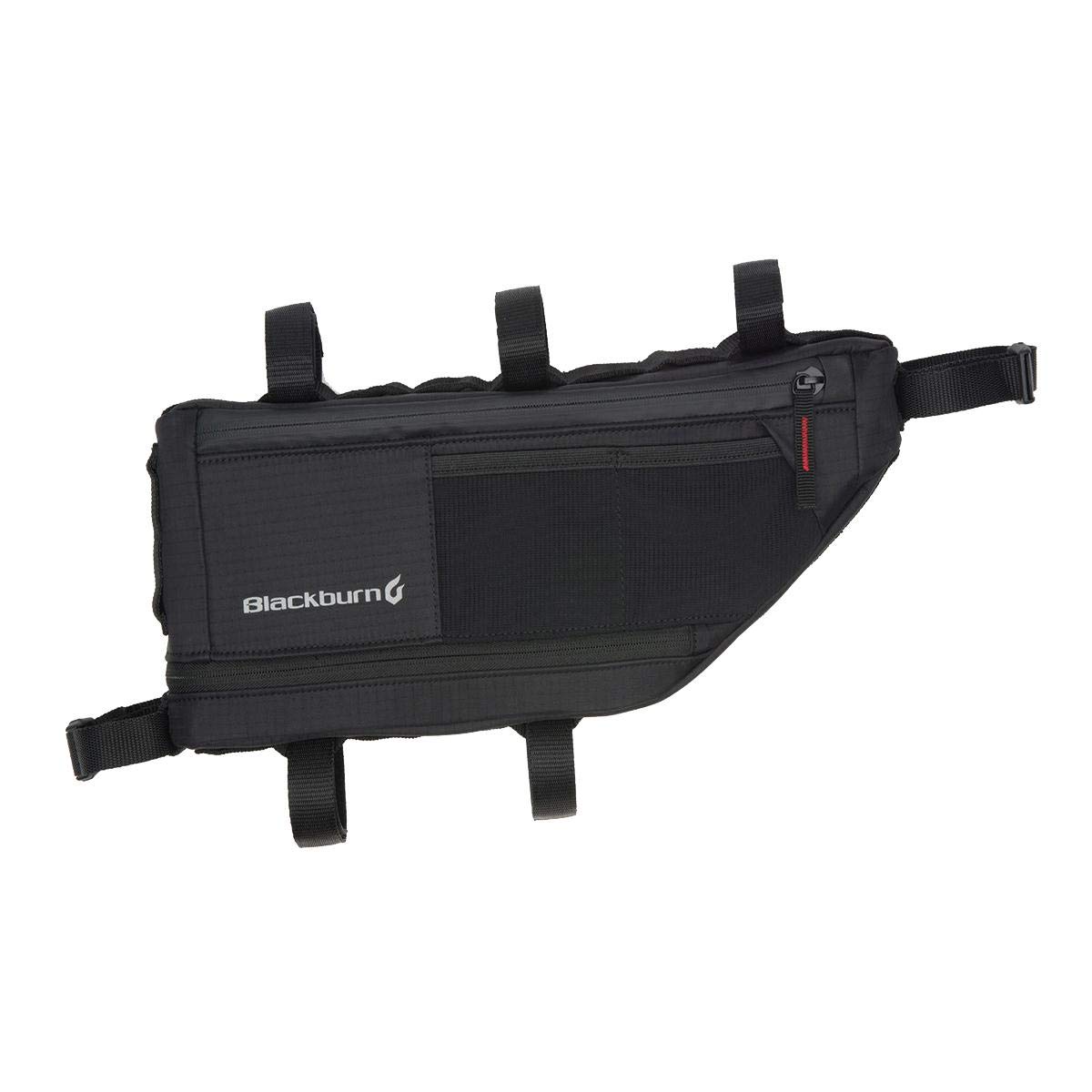
Blackburn’s Outpost bag provides 11 liters of expandable volume in the large size, making it one of the most spacious non-custom options for a road touring or bikepacking setup. The coated 70D ripstop nylon exterior sheds road spray effectively, while the polyurethane-coated zippers add an extra layer of moisture protection that performs well in light to moderate rain.
The bag includes a hose port that accommodates a 3-liter hydration bladder, which is rare for a frame bag at this price point. A removable internal divider lets you separate a wet rain jacket from your food stash, and the mesh side pockets are deep enough to hold a lock or an extra water bottle on the downtube side.
Fitment is best on bikes with a top tube length of 19 inches or more, and the medium version may feel tight on a 52cm road frame. The bag also blocks access to frame-mounted bottle cages, so you’ll need to rely on side-entry cages or reevaluate hydration strategy on longer rides.
Why it’s great
- 11-liter expandable capacity fits a hydration bladder and touring gear
- Integrated hose port feeds a drinking tube through the bag
- Mesh side pockets provide quick-access storage for snacks or a lock
Good to know
- Large size only fits frames with at least 19-inch top tube length
- Obstructs frame bottle cages; plan hydration around side-entry or fork mounts
3. Topeak Fuel Tank Top Tube Bag

The Topeak Fuel Tank is built around one feature that sets it apart: an integrated charging cable hole that lets you run a cable from a battery pack inside the bag to a GPS or phone mounted on the stem. The 0.75-liter compartment fits a standard power bank, a smartphone, and a bar wrapper without excessive bulging, and the Velcro divider keeps the battery separated from softer items.
The 420-denier nylon with PVC coating holds up to abrasion from gravel spray and trailside brush, and the front strap cinches down onto a fuzzy panel that prevents the bag from sliding forward during hard braking. The one-hand zipper opens smoothly and the sides stay open wide enough to dig into the bag without using your second hand.
The large size runs long at 9.4 inches, which can cause knee contact on smaller frames or aggressive geometry. Many riders find the medium size works better for road bikes under 56cm. The bag also lacks waterproof zippers, so a rain cover or dry bag is recommended for electronics in heavy downpours.
Why it’s great
- Cable pass-through port powers a handlebar GPS or phone while riding
- 420-denier PVC-coated nylon resists gravel abrasion and dirt
- One-hand zipper stays open for easy single-handed access to contents
Good to know
- Large size may contact knees on road frames under 56cm
- Non-waterproof zippers require a dry bag for electronics in rain
4. LEZYNE Energy Caddy
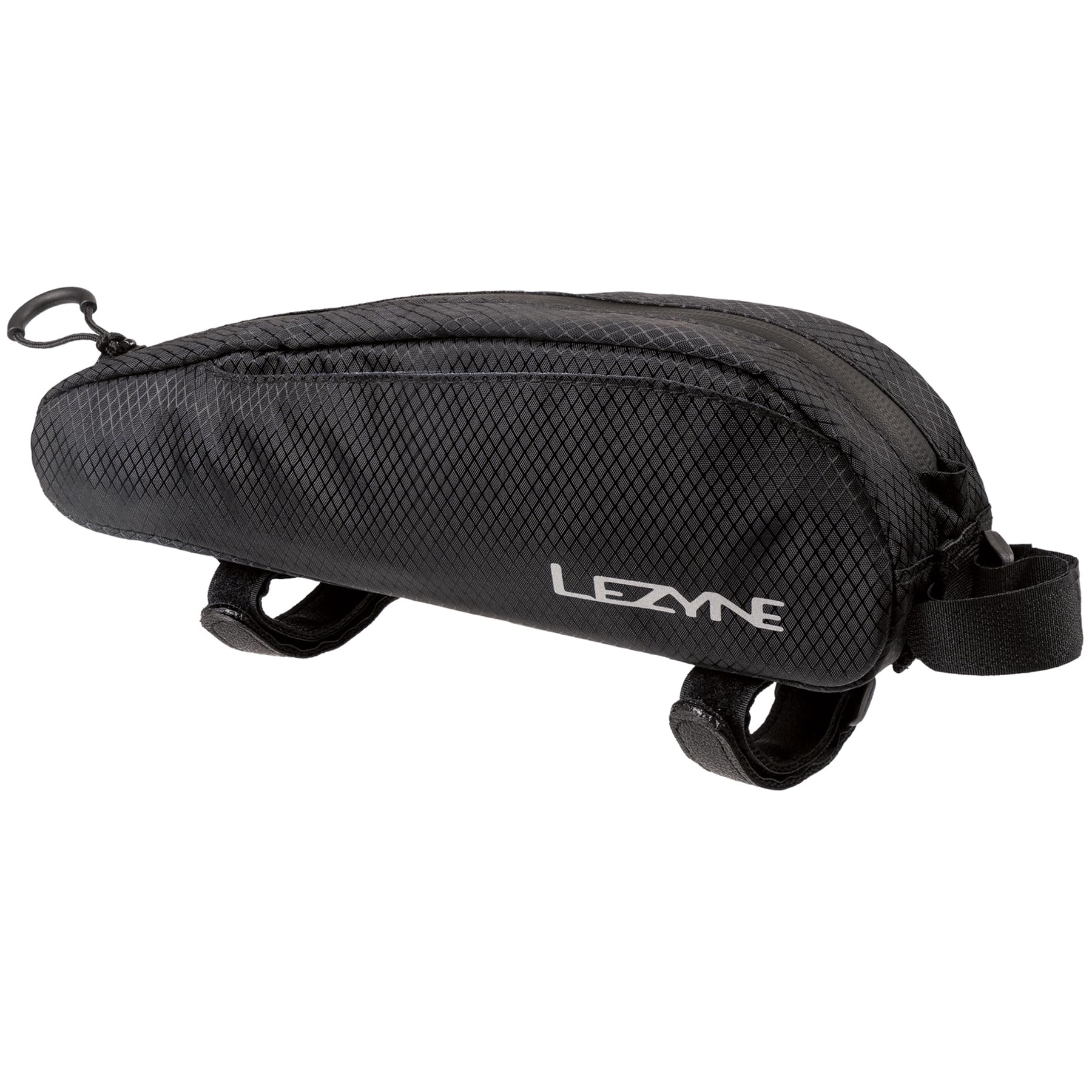
At just 125 grams, the LEZYNE Energy Caddy is the lightest top tube bag in this lineup, designed specifically for riders who want to minimize aerodynamic drag without sacrificing quick access to nutrition. The 0.7-liter compartment holds up to nine Maurten gels or a slim smartphone, and the updated zipper orientation faces forward to eliminate knee rub during out-of-saddle efforts.
Three Velcro straps attach around the top tube and head tube, and the bag sits tight enough to stay stable on rough gravel descents. An expandable side pocket lets you stash gel wrappers or electrolyte tablets without unzipping the main compartment, which is a thoughtful touch for race-day efficiency.
The smaller footprint means the bag won’t fit a tube, multi-tool, and pump simultaneously — you’ll still need a saddle bag for repair gear. The bottom strap can be too short for oversized top tubes on some gravel bikes, requiring a zip-tie or strap extension for a truly secure mount on frames with thick carbon downtubes.
Why it’s great
- Ultralight 125g construction minimizes weight and aerodynamic drag
- Updated front-facing zipper design avoids knee contact on aggressive frames
- Expandable side pocket keeps gel wrappers accessible without opening main zipper
Good to know
- Too small to carry repair tools or a spare tube
- Bottom strap may be too short for oversized top tubes on certain gravel bikes
5. Moosetreks Touring Frame Bag

The Moosetreks Touring Frame Bag delivers impressive volume for the entry-level price point, with the small size offering 6.5 liters of storage that easily swallows a laptop, a change of clothes, and lunch for a daily commute. The ripstop nylon is laminated with thermoplastic polyurethane for genuine water resistance, not just a spray-on DWR coating that wears off after a few wet rides.
Two zippered compartments separated by a removable divider let you keep electronics away from tools or food. The YKK zippers are a meaningful upgrade over the generic zippers found on most budget bags, and the company has a reputation for replacing first-gen units with improved designs when production issues arise. The velcro straps are long enough to wrap around thick or oddly shaped tubes on step-through frames.
This bag is sized to fill the entire frame triangle, so it blocks access to both bottle cages. The large version at 14 liters runs big and can puff out awkwardly on smaller frames, making measurement critical before ordering. Older units had zipper durability issues, though current production uses the reinforced YKK zippers.
Why it’s great
- 6.5-liter entry size fits a laptop and lunch for commuters
- TPU lamination provides genuine water resistance beyond basic DWR sprays
- YKK zippers and responsive customer service address past durability concerns
Good to know
- Fills the entire triangle and blocks access to frame bottle cages
- Large version can puff out and look bulky on smaller road frames
6. XLAB 100 Bag Stealth Pocket

The XLAB Stealth Pocket is a micro frame bag built for one purpose: carrying exactly enough nutrition for a race without adding detectable aerodynamic drag. At just 1.76 ounces and 8.4 inches long, it sits flush against the top tube and stem, using a 72-degree front angle that follows the line of the head tube to reduce turbulence from stem spacers.
The low-skin-friction woven material and insulated side panels keep gels cooler than a bare jersey pocket, which matters on hot days when chocolate bars turn into puddles. The interior is tight, fitting three bars and a few gel shots, but the stiff construction allows one-handed zipping without the bag collapsing — a small detail that matters during a fast feed zone stop.
The bag is too small for a phone, a spare tube, or a multi-tool, so it works best as a supplement to a saddle bag or jersey pockets. The straps are intentionally long and must be trimmed after installation, and the bag can shift slightly off-center over time if not tightened periodically.
Why it’s great
- Ultra-compact aero profile reduces drag caused by headset spacers
- Insulated sides keep nutrition cooler than exposed jersey pockets
- Stiff construction allows one-handed zipping without bag collapse
Good to know
- Cannot fit a phone, spare tube, or multi-tool
- Straps require trimming and the bag may shift off-center over time
7. Topeak MidLoader Frame Bag

The Topeak MidLoader uses the frame triangle efficiently, offering 4.5 liters of storage without bulging out far enough to interfere with your knees. The polyethylene-lined nylon fabric resists mud and water well enough for wet gravel rides, and the dual-side zippers let you access gear from either side of the bike — a feature that’s valuable when the bag is pressed against a fence or another bike during a rest stop.
Adjustable hook-and-loop straps accommodate top tubes from 45 to 66 millimeters and down tubes from 38 to 70 millimeters, covering nearly all road and gravel frame shapes. The bag is light enough at 0.4 pounds to go unnoticed on climbs, and the flat profile keeps the load balanced low in the frame for stable handling on descents.
The zipper openings are cut shorter than the full length of the bag, making it difficult to insert long items like an ebike battery or a bulky pump. On some larger frames, the bag may slightly press against a vertically mounted bottle cage, requiring a side-entry cage or a slight repositioning of the bag on the straps.
Why it’s great
- Flat 4.5-liter profile fits the frame triangle without knee interference
- Dual-side zipper openings provide flexible access from either side of the bike
- Adjustable straps accommodate a wide range of top and down tube diameters
Good to know
- Zipper opening is shorter than the bag length, limiting access to long items
- May press against vertically mounted bottle cages on some frame sizes
FAQ
Will a frame bag rub the paint off my top tube?
Can I use a frame bag on a carbon road bike frame?
Final Thoughts: The Verdict
For most users, the frame bag for road bike winner is the Osprey Escapist because its RF-welded seams and waterproof zippers provide genuine all-weather protection while the internal divider keeps your phone separate from tools. If you need a hydration-compatible option for bikepacking, grab the Blackburn Outpost for its 11-liter expandable capacity and hose port. And for minimalist race-day storage that won’t disrupt your aero position, nothing beats the XLAB 100 Stealth Pocket.