
When you drop below the surface, the wrong mask turns a serene descent into a fight for comfort. A freediving mask demands more than just a watertight seal — it requires an internal volume so minimal that equalizing happens without a pinched pinch, and a field of view wide enough to keep your bearings in open blue water.
I’m Mohammad Maruf — the founder and writer behind Drink4Good. My research focuses on mask geometry, skirt material science, and how low-volume frame designs directly affect equalization ease at depth across multiple brands and price tiers.
After analyzing dozens of models for their real-world internal volume, lens quality, and seal mechanics, I’ve narrowed the market to the seven masks that earn their place. This guide delivers the full breakdown you need to choose the correct best freediving mask for your face shape, diving style, and budget — without the guesswork.
How To Choose The Best Freediving Mask
Choosing the right mask for breath-hold diving goes far beyond trying on the most comfortable frame at the shop. You need a mask that sits close to your face, pinches your nose pocket easily with one hand, and provides the lowest possible internal volume to minimize air consumption during equalization.
Internal Volume and Equalization
Internal volume, typically measured in cm³ or in², determines how much air you must blow into the mask to equalize pressure. A high-volume mask forces you to waste precious breath-hold air. Look for masks with an internal volume under 100 cm³ — this makes the pinch and equalization motion feel natural and effortless even below 30 meters.
Skirt Material and Face Seal
The skirt is your primary seal. Pure silicone (hypoallergenic) is superior to rubber or plastic blends because it remains supple in cold water and molds to your facial contours without hard pressure points. Some premium skirts use a double-feathered or dimpled edge to reduce surface tension against the skin, preventing leaks on narrow nose bridges or pronounced cheekbones.
Lens Configuration and Field of View
Dual-lens masks typically offer lower volume and better hydrodynamic profile, making them the default choice for spearfishing and competitive freediving. Single-lens masks provide a wider panoramic view (some approaching 180 degrees), which helps with situational awareness in open water but often increases internal volume slightly. Single-lens masks are favored by recreational freedivers and scuba crossovers.
Quick Comparison
On smaller screens, swipe sideways to see the full table.
| Model | Category | Best For | Key Spec | Amazon |
|---|---|---|---|---|
| Cressi Nano | Premium | Competitive freediving | 12.86 in² internal volume | Amazon |
| ScubaPro Spectra | Premium | All-day comfort, mustache | Push-button buckles | Amazon |
| Aqualung Sphera X | Premium | Panoramic 180° view | Plexisol polymer lens | Amazon |
| TUSA M-1001 Freedom HD | Premium | Large faces, wide vision | Double feathered edge skirt | Amazon |
| Mares Viper | Mid-Range | Spearfishing, no inner border | 0.15 kg weight | Amazon |
| Cressi Matrix | Mid-Range | Versatile scuba-to-freedive | Inclined inverted teardrop lens | Amazon |
| OCTOMASK | Mid-Range | GoPro hands-free filming | Integrated aluminum mount | Amazon |
In‑Depth Reviews
1. Cressi Nano

The Cressi Nano is widely recognized as the gold standard for pure freediving performance, boasting the lowest internal volume on the market at 12.86 in² (83 cm²). Three Cressi patents were registered specifically for this mask — a Dual Frame Technology that bonds two rigid frames to shrink the air space without sacrificing structural integrity. The result is a mask that sits almost flush against the face, requiring minimal air to equalize even during rapid descents.
The soft hypoallergenic silicone skirt is praised by divers for its ability to fit regular and very slim facial profiles without leaving painful marks after hours underwater. The inverted teardrop lens shape, patented by Cressi (US 6272693), improves downward visibility — critical for checking your dive computer or spotting a fish below without tilting your head. The buckle system is fully flexible and virtually indestructible, a practical relief for anyone who has snapped a plastic buckle on a rocking boat.
Weight comes in at 150 grams, making it one of the lightest masks you can wear on long apnea sessions. The only trade-off is that the extreme low volume means the nose pocket is smaller than some divers expect — if you have thick fingers, practice the pinch before a deep competition dive.
Why it’s great
- Industry-record low internal volume for effortless equalization
- Patented Dual Frame technology reduces drag and weight
- Hypoallergenic silicone leaves no facial marks after long sessions
Good to know
- Small nose pocket requires precise finger placement for pinch
- Premium pricing reflects its specialized competition-grade design
2. ScubaPro Spectra

The ScubaPro Spectra is the bridge between scuba-diving comfort and freediving low-volume requirements. Its EZ Equalize nose pocket is contoured to make the pinch motion natural even with gloves, and the push-button buckle system allows micro-adjustments on the fly without removing the mask — a feature spearfishers appreciate when surfacing and diving repeatedly.
Dual tempered-glass lenses deliver a wide field of view, and the mirrored lens variant cuts surface glare for shallower hunting. The skirt uses a universal design that ScubaPro claims fits a broad range of face shapes, and customer feedback confirms excellent seal reliability even on divers with mustaches — a notoriously difficult fit challenge. The mask weighs 0.5 pounds, slightly heavier than pure freediving models, but the added structure translates to a durable frame that ScubaPro backs with a two-year warranty.
Included in the package is a protective plastic storage case, a surprisingly valuable accessory for keeping the tempered glass scratch-free during travel. The Spectra is not the absolute lowest-volume mask available, but for divers who split time between scuba and breath-hold, it offers a balance that few competitors match.
Why it’s great
- EZ Equalize nose pocket designed for gloved hands
- Push-button buckles allow quick on-the-fly adjustments
- Excellent leak resistance for mustache-wearing divers
Good to know
- Slightly heavier than dedicated freediving masks
- Internal volume is moderate, not ultra-low like Cressi Nano
3. Aqualung Sphera X
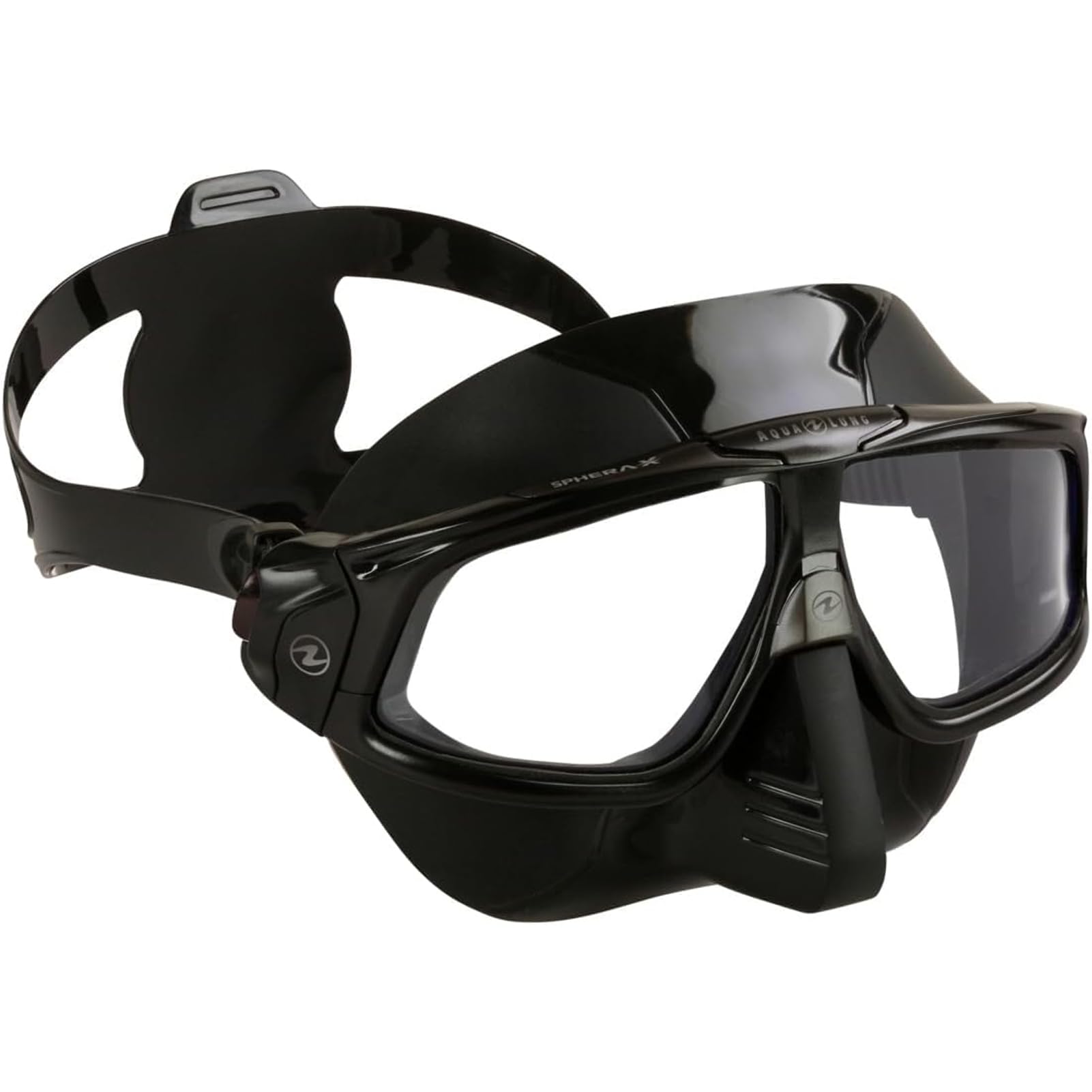
The Aqualung Sphera X redefines what a low-volume mask can offer in terms of peripheral awareness. Its single curved polymer lens provides a 180-degree wide-angle field of view — a genuine advantage for freedivers who need to track the horizon, dive buddies, or fish movement without turning their head. The Advanced Fit Technology (AFT) in the silicone skirt adapts to facial contours dynamically, improving seal integrity as ambient pressure increases during descent.
The Plexisol polymer lens is lighter than tempered glass and treated with an anti-fog coating that holds up well in warm water. However, this same polymer is significantly more prone to scratching than glass — multiple owners warn that the Sphera X must be stored in its included zippered EVA case at all times to prevent minor scuffs that degrade clarity over time. The micro buckle system is low-profile and integrates with a head-hugging strap that prevents the mask from shifting during high-mobility spearfishing.
At 200 grams, it remains lightweight, and the single-lens design makes clearing quick and intuitive. The fit tends to favor narrower facial profiles, including many Asian face shapes that struggle with larger nose pockets — a specific advantage noted repeatedly in user reviews.
Why it’s great
- 180-degree panoramic view for unmatched situational awareness
- AFT skirt adapts to facial contours under pressure
- Excellent fit for narrow face shapes and low nose bridges
Good to know
- Polymer lens scratches far easier than tempered glass
- Case is mandatory for transport to avoid lens damage
4. TUSA M-1001 Freedom HD
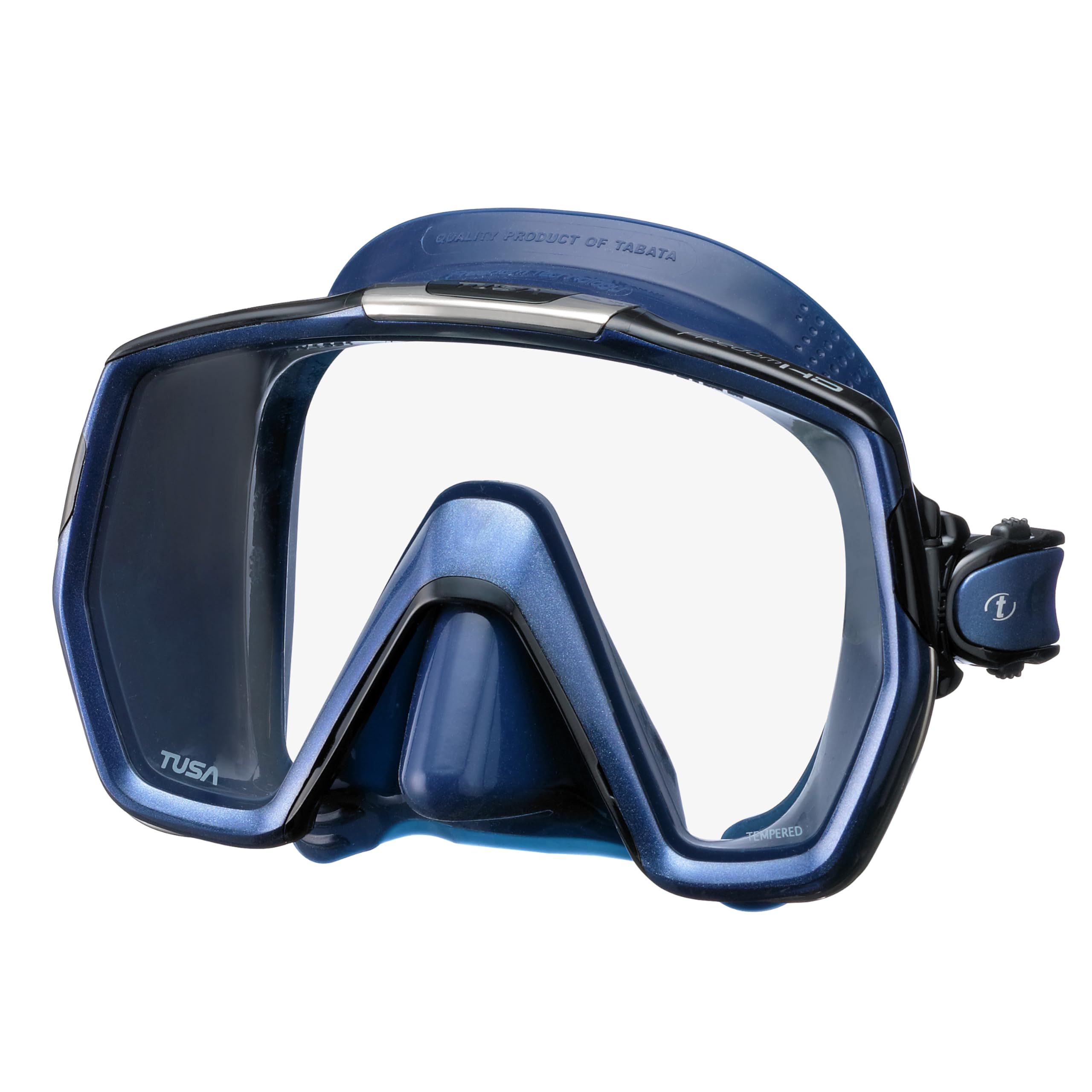
TUSA’s Freedom HD is engineered with larger facial profiles in mind, offering a low-profile single-lens design that feels spacious without appearing oversized. Its proprietary Freedom Technology uses a dimpled skirt surface with varied silicone thicknesses and stability ridges that grip the face securely, preventing the mask from hydroplaning during active head movements. The double feathered edge skirting along the fitting line reduces friction on the skin — a thoughtful detail for long days of repetitive diving.
The single-lens format gives divers a clean, unobstructed field of vision that feels similar to looking through a car windshield. Clearance is straightforward, and the low internal volume keeps equalization snappy even though the lens spans a wider area than most dual-lens freediving masks. The strap is wider than average and distributes tension evenly across the back of the head, reducing slippage on wet hooded heads.
The TUSA ships with a storage box, and owners consistently report that the build quality justifies the premium placement. The one genuine caveat is that the skirt’s silicone is stiffer than softer alternatives like Cressi — this can create a break-in period of a few dives before the seal feels custom to your face.
Why it’s great
- Wide single lens with no obstruction for panoramic vision
- Dimpled skirt with stability ridges prevents shift during movement
- Designed for larger facial profiles without excess volume
Good to know
- Stiffer skirt requires a break-in period for optimal seal
- Heavier at 1.05 pounds than ultra-low-volume competitors
5. Mares Viper

The Mares Viper is built with a specific goal: serve the spearfisher who needs the lowest possible drag and the widest downward gaze while remaining perfectly hydrodynamic. Its internal volume is minimal, though not quite as extreme as the Cressi Nano, and the single-lens configuration offers a clean sightline without center-frame distraction. At 0.15 kg (150 grams), it matches the Nano for weight while providing a slightly larger nose pocket for easier pinch equalization.
The defining feature of the Viper is its anatomical skirt design without an internal border. Most masks have a raised ridge around the inside edge that can press into the skin; Mares eliminates this entirely, creating a smooth interior surface that conforms to the cheekbones and nose bridge without leak-prone gaps. The ergonomic strap uses easy-adjust buckles that remain operable with cold hands.
The trade-off is peripheral vision. Because the Viper prioritizes low volume and a close-to-face fit, the side-to-side field of view is approximately 90-93% of what a standard scuba mask provides — an acceptable compromise for spearfishing where straight-ahead and downward vision matter most. Some divers find the nose bridge pressure painful during dry fitting, though this usually resolves once the skirt warms to body temperature in the water.
Why it’s great
- Smooth internal skirt eliminates pressure ridges on cheeks
- Extremely lightweight at 150 grams for all-day apnea
- Large nose pocket for easy pinch equalization
Good to know
- Peripheral vision is slightly narrower than full scuba masks
- Dry fitting can feel tight until silicone warms underwater
6. Cressi Matrix

If you are entering freediving from a scuba background, the Cressi Matrix offers a familiar dual-lens frame with low internal volume that rivals dedicated freediving masks. The patented inverted teardrop lens design (US 6272693) angles downward to let you see your BCD, dive computer, or the seafloor without tilting your chin — a feature that has made it a favorite among scuba instructors and freediving learners alike.
The Matrix is one of the most face-compatible masks on the market. Reviews consistently mention that it fits a wide range of people, including a six-year-old child and a 200-pound adult, thanks to the generous hypoallergenic silicone skirt that provides a broad sealing surface. Weight is just 6.4 ounces, making it only marginally heavier than the Nano, and the tempered glass dual lenses are far less scratch-prone than polymer alternatives.
Field of view is particularly wide laterally and in the lower quadrant — perfect for reef exploration and shallow spearfishing. The one limitation for competitive freedivers is that the internal volume, while low, is not in the same sub-100 cm³ territory as the Nano. For a mask that also serves comfortably for scuba, however, this is an intelligent compromise.
Why it’s great
- Inverted teardrop lenses improve downward visibility significantly
- Fits an exceptionally wide range of face shapes and sizes
- Tempered glass is far more scratch-resistant than polymer lenses
Good to know
- Internal volume is low but not the absolute minimum
- Silicone strap can loosen over time; occasional adjustment needed
7. OCTOMASK

The OCTOMASK solves a specific problem: how to film your freediving and scuba sessions without holding a camera or strapping a mount to your head. An integrated aluminum thumbscrew mount sits above the dual-lens frame and accepts every GoPro Hero model including the Hero 10, making it the definitive hands-free filming solution for underwater content creators.
The skirt uses ultra-soft silicone that seals effectively on a variety of facial contours, though users with narrower bridges may experience minor leakage during active smiling or nose-pinching. The clearance model provides wide peripheral vision that is similar to standard scuba masks, while the tempered glass lenses maintain scratch-free clarity over many dives. The strap is thin but functional, and the aluminum mount holds the camera securely without rotational drift even during rapid ascents or current swimming.
OCTOMASK offers a 100% mask fit guarantee, which mitigates the risk of ordering blind. The most consistent feedback from experienced freedivers is that the mask itself is solid but the GoPro mount adds noticeable forehead pressure when cinched tightly — a point to consider if you plan long filming sessions. For the freediver who prioritizes content capture alongside performance, this is the only mask that does double duty without requiring a separate mounting rig.
Why it’s great
- Integrated aluminum GoPro mount works with all Hero models
- 100% fit guarantee reduces blind purchase risk
- Ultra-soft silicone skirt seals well on most face shapes
Good to know
- GoPro mount can create forehead pressure during long dives
- Thin strap may feel less secure than wider competition straps
FAQ
What is the ideal internal volume for a freediving mask for dives below 20 meters?
Can I use a low-volume freediving mask for scuba diving?
How do I stop my freediving mask from fogging during a long dive session?
Final Thoughts: The Verdict
For most users, the best freediving mask winner is the Cressi Nano because it combines the lowest internal volume on the market with a patent-protected dual-frame design that eliminates drag and keeps equalization effortless at extreme depths. If you want wider panoramic vision and have a narrower face shape, grab the Aqualung Sphera X. And for hands-free filming of your dives, nothing beats the OCTOMASK with its integrated GoPro mount.