
A freediving watch isn’t just a waterproof wrist accessory—it’s your primary safety partner. Accurate depth readings, surface interval tracking, and customizable alarms separate a tool you can trust from a simple stopwatch that leaves you guessing. The wrong choice risks missing critical ascent warnings or logging incomplete data after your deepest drop.
I’m Mohammad Maruf — the founder and writer behind Drink4Good. I’ve spent hundreds of hours analyzing freediving computer specifications, comparing algorithms, battery chemistries, and display technologies across every meaningful model currently available, from dedicated apnea-only units to hybrid dive computers with freedive modes.
Whether you train in a pool, hunt in open water, or compete at depth, finding the right freediving watch depends on matching specific features like surface recovery time calculators and customizable alarm profiles to your exact underwater goals and typical dive depths.
How To Choose The Best Freediving Watch
Choosing the right freediving watch means matching a series of highly specific technical features to your diving environment and personal goals. The wrong pick can result in inaccurate depth readings, inadequate safety warnings, or a screen that’s unreadable at the depths you push to. Here’s what separates a capable freediving companion from a compromise.
Dedicated Freedive Algorithm vs. Multi-Mode Computers
The core software running your watch determines how it handles surface intervals, recovery times, and repetitive dive management. A watch built specifically for freediving—like the Cressi Nepto—includes a dedicated algorithm that calculates Taravana risk and pulmonary edema prevention, features you won’t find in a general-purpose scuba computer with a freedive mode tacked on. If freediving is your primary activity, a purpose-built unit offers safety logic that generic multi-mode models lack.
Alarm Customization and Data Logging
Every freediver has a different profile: depth targets, surface interval goals, and personal safety limits. Look for watches that let you set multiple distinct alarms for depth, dive time, and surface interval. A robust logbook that stores hundreds of dives with depth profiles, water temperature readings, and timestamps is essential for tracking progress. The ability to sync that logbook to a smartphone or computer via Bluetooth or IR interface is a major convenience for reviewing performance.
Display Readability and Button Ergonomics
Underwater conditions degrade visibility quickly. A high-contrast monochrome display, like those used by Garmin and Shearwater, often outperforms color AMOLED screens at depth when water clarity is low. Button size and tactile feedback matter more than you’d expect—small, round steel buttons can leave dents in your fingers without gloves, while oversized buttons are easier to operate with neoprene-covered hands. Test the interface by imagining you’re 20 meters down with cold, shaky fingers.
Battery Life and Charging Approach
Battery chemistry and charging method directly affect how often you need to intervene. Replaceable coin-cell batteries (CR2430, CR3450) can last a year or more of regular use but require a tool to swap. Rechargeable lithium-ion packs in premium models offer weeks of daily wear but demand a proprietary cable or wireless charging pad. For expedition travel, a watch with replaceable batteries avoids the need to carry chargers and find power outlets. For daily training, rechargeable units with fast charging are far more convenient.
Quick Comparison
On smaller screens, swipe sideways to see the full table.
| Model | Category | Best For | Key Spec | Amazon |
|---|---|---|---|---|
| Cressi Nepto | Dedicated Freedive | Pure freediving with Taravana protection | Taravana & Edema Algorithms | Amazon |
| Garmin Descent G1 | Hybrid Dive/Smartwatch | Diving + daily activity tracking | 25h Dive Battery Life | Amazon |
| Shearwater Peregrine AE | Premium Scuba/Freedive | Multi-mode with wireless charging | 2.2″ LED LCD Display | Amazon |
| Suunto Ocean | GPs Multisport/Dive | Underwater route tracking | 40h Dive Mode Battery | Amazon |
| Mares Quad Ci | Advanced Scuba/Freedive | Tech diving with air integration | 8-Color MIP Display | Amazon |
| Shearwater Teric | Premium Wrist Computer | Tech & freedive with transmitter | Bühlmann ZHL-16C + AI | Amazon |
| Cressi Goa | Beginner Scuba/Freedive | Entry-level with freedive program | 120m Water Resistance | Amazon |
| Cressi Donatello | Entry-Level Scuba | Recreational scuba with freedive mode | Single-Button Interface | Amazon |
| Garmin Forerunner 965 | Fitness/Smartwatch | Surface training & apnea prep | AMOLED + Training Readiness | Amazon |
In‑Depth Reviews
1. Cressi Nepto Freediving Watch Computer

The Cressi Nepto is purpose-engineered for freediving, not scuba with a freedive mode added as an afterthought. Its proprietary algorithm actively calculates Taravana risk and pulmonary edema prevention—safety logic that no generic dive computer provides. The high-contrast 35mm display delivers depth, dive time, and surface interval data at a glance, and the compact 48mm case sits comfortably even on smaller wrists.
Eight conservatism settings, a dedicated dive planner, and bloodshift training mode give you granular control over your sessions. The logbook with PC interface stores detailed profiles, while the customizable interval alarms and dual timer keep your surface recovery disciplined. The two-button menu system uses short and long presses, which takes some practice but avoids cluttering the interface with unnecessary functions.
One user reported the steel buttons leave dents in bare fingers—consider this if you dive without gloves. The pressure sensor can also collect fine debris if you hit muddy bottoms, though compressed air clears it. Battery life is typical for a coin-cell unit, and the CR3450 is replaceable without tools. For anyone serious about freediving safety and data logging, the Nepto is the reference standard in its class.
Why it’s great
- Dedicated Taravana and edema prevention algorithms
- Compact, comfortable 48mm case with high-contrast display
- Eight conservatism levels and bloodshift training mode
Good to know
- Steel buttons can be uncomfortable without gloves
- Two-button menu requires memorizing press sequences
- Pressure sensor can trap fine debris in silty conditions
2. Shearwater Research Teric Wrist Computer with Transmitter

The Shearwater Teric is the gold standard for divers who need a wrist computer equally capable in technical scuba and freediving. Its bright AMOLED display is legible under direct sunlight and at depth, and the Bühlmann ZHL-16C algorithm with configurable gradient factors gives you full control over decompression conservatism. The optional wireless tank pressure transmitter integrates seamlessly for real-time gas monitoring.
Freediving mode on the Teric is straightforward: it logs depth, time, and temperature, and provides switchable audible and vibration alerts. The sapphire crystal and stainless steel case make it exceptionally durable, and the four-button menu is widely regarded as the most intuitive in the industry. Battery life supports about a week of daily diving, with two weeks of standby.
At this tier, the price reflects the build quality and proprietary algorithm—compromises are minimal. The bezel is slightly larger than typical watch-style computers, but it fits small wrists thanks to a low-profile case. The included 22mm strap can be swapped with any standard band. For the freediver who also runs technical dives and wants one computer to rule both worlds, the Teric is unmatched.
Why it’s great
- Brilliant AMOLED screen with sapphire crystal
- Configurable Bühlmann algorithm for tech and freedive modes
- Wireless air integration with optional transmitter
Good to know
- Premium price point reflects top-tier engineering
- Slightly larger bezel than pure watch-style computers
- Battery lasts a week of daily diving, not a month
3. SUUNTO Ocean Dive Computer

The Suunto Ocean is the only dive watch in this list that logs your underwater route in 3D via dual-band GNSS. For freedivers who explore offshore reefs, caves, or drift locations, that single feature transforms post-dive analysis from guesswork into precision mapping. The 1.43-inch AMOLED touchscreen is exceptionally bright, and the active brightness adjustment keeps it readable at depth.
Freedive mode, snorkel mode, and even mermaid diving mode are included, alongside single and multigas scuba profiles. The Bühlmann 16 GF algorithm powers decompression calculations, and it supports wireless tank pressure pods for air integration. Battery life reaches 40 hours in dive mode, and fast charging fills the unit in about an hour—critical for multi-day trips.
The interface has drawn mixed reviews: some find it intuitive with touch and buttons, others report it’s tedious and lacks customizable action buttons. The default tank size was set to HP100 instead of AL80 in one unit, requiring a manual adjustment. It’s also expensive, landing firmly in premium territory. For the freediver who wants GPS underwater tracking in a fully featured sports watch, the Ocean is unique.
Why it’s great
- 3D underwater route tracking via dual-band GNSS
- 40-hour dive battery life with fast charging
- AMOLED touchscreen with excellent brightness
Good to know
- Interface can be tedious and not fully customizable
- High price point with some software quirks
- Heart rate monitor functionality reported as inconsistent
4. Garmin Descent G1

The Garmin Descent G1 bridges the gap between a dedicated dive computer and a full-featured smartwatch without inflating the price to premium levels. Its monochrome MIP display is easier to read in low-visibility water than color screens, and the sapphire lens resists scratches. Up to 25 hours of dive mode battery covers a full week of boat diving, while 21 days in smartwatch mode means you never have to charge it nightly.
Freedive mode on the G1 logs depth, time, and temperature, and includes safety stop timers and ascent rate warnings. GPS/GLONASS/Galileo support marks entry and exit points, so you can see exactly where you started and ended each dive. Over 30 built-in sports apps, wrist-based heart rate, Pulse Ox, and Body Battery monitoring make it a legitimate daily fitness tracker too.
The main limitation is the lack of air integration—you can’t pair wireless tank pressure transmitters. The monochrome display, while legible, lacks the visual polish of AMOLED competitors. It also doesn’t offer the Taravana-specific algorithms that dedicated freediving computers like the Nepto provide. For the freediver who wants one watch for diving, running, and sleep tracking, the G1 delivers exceptional value.
Why it’s great
- Rugged build with sapphire lens and silicone bands
- 25-hour dive battery and 21-day smartwatch battery
- GPS surface marking for dive entry/exit points
Good to know
- No wireless air integration support
- Monochrome display less visually rich than AMOLED
- Lacks freedive-specific Taravana algorithm
5. Shearwater Peregrine Adventures Edition

The Shearwater Peregrine Adventures Edition offers a massive 2.2-inch LED LCD display that’s widely praised as one of the most readable dive screens on the market. It uses the same Bühlmann ZHL-16C algorithm with gradient factors found in the premium Teric, but in a simplified, scuba-focused package that also supports freediving mode. Wireless charging eliminates the need for fiddly USB ports.
Battery life reaches about 30 hours at medium brightness—ample for a week of intensive diving. The two-button interface is state-aware, meaning the menus adapt to your current context, reducing confusion underwater. Vibration alerts for safety stops and ascent rate warnings work well even through thick wetsuit hoods. It’s compatible with Bluetooth for logbook syncing.
The Peregrine does not support wireless air integration, which is the main compromise versus the Teric. The Adventures Edition band is lighter-colored, which shows dirt faster than darker options. For freedivers who also run scuba dives and want the legendary Shearwater algorithm and build quality at a significantly lower price point than the Teric, this is the smart middle-ground choice.
Why it’s great
- Large, vivid 2.2-inch LED LCD display
- Wireless charging for hassle-free power
- Bühlmann ZHL-16C algorithm with gradient factors
Good to know
- No wireless air integration support
- Light-colored Adventure band shows dirt easily
- Two-button interface may feel limited to some users
6. Mares Quad Ci Wrist Dive Computer

The Mares Quad Ci is a fully featured wrist computer built around the customizable Bühlmann ZH-L16C algorithm, supporting air, nitrox, and trimix profiles alongside a dedicated freedive mode. Its 8-color MIP display provides excellent underwater contrast, and the integrated full-tilt digital compass and stopwatch add navigation and timing precision. Hoseless tank pressure integration supports up to five wireless transmitters.
Bluetooth connectivity syncs logs and firmware updates via the Mares app. Battery life is strong at roughly 15 to 20 hours of dive time per charge, and the interface supports multiple gradient factor settings for personalizing decompression conservatism. The display has a bright mode for low-visibility conditions, though the maximum brightness setting is software-locked.
The Quad Ci is bulkier than pure freediving watches, and its menu system is dense—it’s clearly designed for scuba tech divers first. Freedive mode functions adequately but lacks the dedicated safety algorithms of the Cressi Nepto. For the diver who splits time between technical scuba and freediving and wants air integration in a single wrist unit, the Quad Ci delivers remarkable capability.
Why it’s great
- Customizable Bühlmann algorithm with gradient factors
- 8-color MIP display with excellent underwater visibility
- Hoseless tank integration for up to 5 transmitters
Good to know
- Bulkier case not ideal for pure freediving
- Menu system dense; requires manual study
- Maximum display brightness is software-restricted
7. Cressi Goa Dive Watch Computer
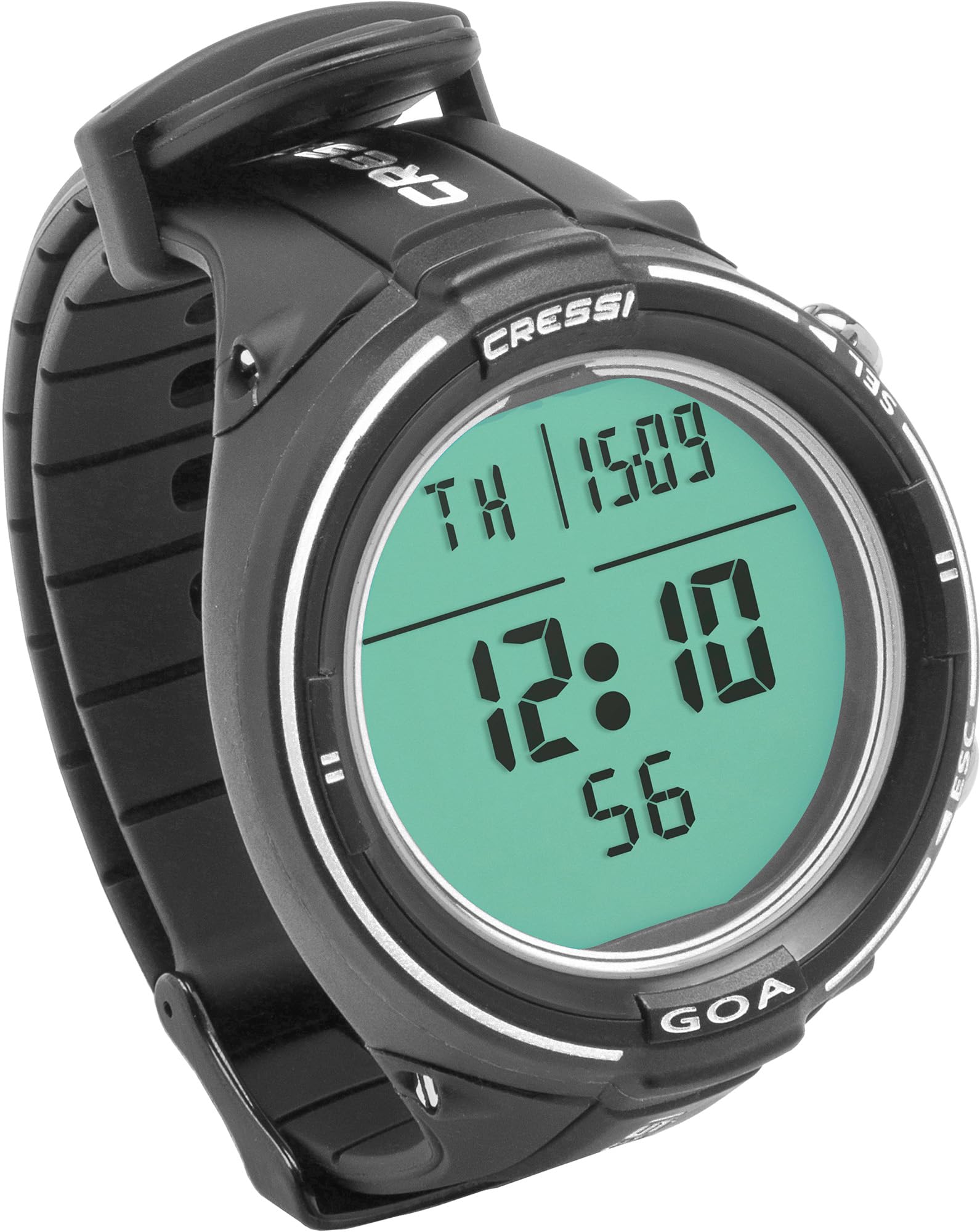
The Cressi Goa is a compact entry-level computer with dedicated air, nitrox, freedive, and gauge programs, all driven by the RGBM algorithm. The 48mm case with mineral glass and steel buttons is rated to 120 meters, and the high-contrast display keeps data readable across a range of lighting conditions. The two-button menu is simple enough for beginners to master quickly.
Freedive mode lets you customize depth and time alarms, and includes an off mode to suppress unnecessary beeps while snorkeling or swimming on the surface. Data sampling is four times faster than previous Cressi computers: every five seconds during scuba and every two seconds during freediving. Temperature data is logged alongside depth, helping you track thermoclines.
Some users report difficulty setting the two-button interface without repeated manual review, and one review documented a strap failure upon first wear. The optional HAL 9000 docking station is required for PC logbook downloads. For recreational divers who freedive occasionally and want a simple, affordable computer with Italian engineering, the Goa offers reliable baseline performance.
Why it’s great
- Compact 48mm case with steel buttons and mineral glass
- Freedive mode with customizable alarms and off mode
- Four programs (Air, Nitrox, Freedive, Gauge) in one package
Good to know
- Two-button interface requires manual memorization
- Occasional reports of strap durability concerns
- PC logbook requires separate HAL 9000 docking station
8. Cressi Donatello Wrist Dive Computer

The Cressi Donatello is the most straightforward entry point in this guide, built around a single-button interface and a high-definition display optimized for underwater clarity. It supports air and nitrox modes, with user-selectable deep stops and adjustable measurement units (imperial/metric). The CR2430 replaceable battery is simple to swap, and battery life indicators keep you informed.
While the Donatello is primarily a scuba computer, its freedive capability is basic—depth display and time logging without the advanced safety algorithms or customizable alarms found on dedicated freediving units. The optional IR interface enables Bluetooth or USB data transfer to Windows and Mac computers, useful for tracking your dive history.
Several users praised its performance as a recreational scuba computer, noting it outlasted an Apple Watch Ultra on multiple dives. The single-button interface limits menu depth, making it less suitable for freedivers who need interval tracking and multi-alarm configurations. For the budget-conscious diver who scuba dives mainly and wants a basic freedive reference, the Donatello is a capable but limited choice.
Why it’s great
- Simple single-button interface for hassle-free operation
- Replaceable CR2430 battery with clear indicator
- Optional IR interface for PC/Mac logbook transfer
Good to know
- Freedive mode is basic with no advanced safety algorithms
- Single-button menu limits customization options
- Primarily designed for scuba, not dedicated freediving
9. Garmin Forerunner 965

The Garmin Forerunner 965 is not a dive computer, but it earns a place here as the premier surface training watch for freedivers who need to track recovery, heart rate variability, training load, and sleep quality during the buildup to a deep-water session. Its bright AMOLED display and multi-band GPS provide precise route tracking for dynamic apnea walks and CO2 tolerance tables.
Training readiness scores, HRV status, and Body Battery energy monitoring help you decide whether your body is primed for a deep day or needs a rest day—data that directly influences freediving safety. The battery lasts up to 23 days in smartwatch mode and up to 31 hours in GPS mode, so you’ll never be caught with a dead watch before a dive. The lightweight titanium bezel and silicone band are comfortable for 24/7 wear.
The Forerunner 965 has no underwater depth sensing or freedive-specific algorithms. It’s not a substitute for a dive computer. But for the freediver who trains seriously on land and wants to optimize physiological readiness for apnea, this watch provides recovery insights that no dive computer can match. Think of it as your pre-dive preparation companion, not your in-water tool.
Why it’s great
- Training readiness and HRV monitoring for dive prep
- Brilliant AMOLED display with multi-band GPS
- Excellent 23-day battery life in smartwatch mode
Good to know
- No underwater depth sensing or dive computer function
- Cannot replace a dedicated freediving computer
- Primarily a fitness watch, not a dive tool
FAQ
Can I use a scuba dive computer in freedive mode for serious apnea training?
How does Taravana protection work in a freediving watch?
What depth rating do I actually need for freediving?
Final Thoughts: The Verdict
For most users, the freediving watch winner is the Cressi Nepto because it combines a purpose-built Taravana protection algorithm, customizable alarms, and a compact 48mm case that’s comfortable for all-day wear—all at a mid-range price point that avoids the premium tax of hybrid dive computers. If you want a watch that also tracks your daily fitness and GPS location topside, grab the Garmin Descent G1. And for the tech diver who needs a freediving-worthy wrist computer that also manages trimix decompression with wireless air integration, nothing beats the Shearwater Teric.