
The crackle of a real fire is hard to beat, but a freestanding wood stove that struggles to heat your space, smokes up the room, or burns through logs in two hours is a fast track to regret. Choosing the right wood stove means matching British Thermal Unit (BTU) output to your square footage, understanding firebox volume for burn time, and knowing whether cast iron or steel best fits your needs. This guide cuts through the noise to help you find a dependable heat source for your home, cabin, or workshop.
I’m Mohammad Maruf — the founder and writer behind Drink4Good. My approach to this guide involved analyzing customer feedback across dozens of models, cross-referencing BTU ratings with real-world coverage claims, and evaluating build materials and firebox designs to surface the most reliable options for wood heat buyers.
Whether you need a primary heat source or supplemental warmth for a weekend cabin, finding the right freestanding wood stove means understanding BTU output, firebox size, and burn efficiency before you buy.
How To Choose The Best Freestanding Wood Stove
Not all wood stoves heat the same way. BTU output determines raw heat potential, but firebox size dictates how long a single load burns. Construction material affects weight, heat retention, and longevity. Understanding these three specs first will prevent the frustration of a stove that can’t keep up with your space.
BTU Output and Square Footage
BTU (British Thermal Unit) is the standard measure of heat output. A general rule is 20 to 30 BTUs per square foot of space, but ceiling height, insulation quality, and window drafts all affect real-world performance. A stove rated for 54,000 BTUs can heat roughly 900 to 1,100 square feet under normal conditions, while a 42,000 BTU model covers up to 2,200 square feet in mild weather. Oversizing a stove leads to short burn cycles and overheating, while undersizing forces constant refueling.
Firebox Volume and Burn Time
Firebox volume is measured in cubic inches and determines how long a full load of wood lasts. A 2.0 cubic foot firebox can hold logs up to 18 or 19 inches long and typically burns 6 to 8 hours on a full load. For overnight burns, look for a firebox of at least 2.5 cubic feet and a stove with adjustable primary and secondary air controls. Smaller fireboxes under 1.5 cubic feet require refueling every 2 to 3 hours, which is manageable for daytime use but disruptive overnight.
Construction Material: Cast Iron vs. Steel
Cast iron stoves are heavy, retain heat longer after the fire dies, and offer classic styling. They are more prone to cracking if overfired or shocked by cold water. Steel stoves heat up faster, weigh less, and withstand thermal stress better, making them more portable and durable for workshop or camping use. Stainless steel (304 grade) resists corrosion in outdoor or high-humidity environments. For permanent home installation, cast iron provides superior heat retention; for portability or heavy-duty use, steel is the better choice.
Quick Comparison
On smaller screens, swipe sideways to see the full table.
| Model | Category | Best For | Key Spec | Amazon |
|---|---|---|---|---|
| Comfortbilt HP22-N | Pellet | Whole-home primary heat | 80 lb hopper, 50,000 BTUs | Amazon |
| Freedom Stoves PS21 | Pellet | Off-grid backup heating | Battery backup, Wi-Fi control | Amazon |
| Cleveland Iron Works PS130W | Pellet | Large hopper convenience | 130 lb hopper, Wi-Fi | Amazon |
| Comfortbilt HP50S | Pellet | Compact high coverage | 42,000 BTUs, 47 lb hopper | Amazon |
| Castle Serenity 41278 | Pellet | Programmable home heating | Smart controller, 40 lb hopper | Amazon |
| Duluth Forge FDSR25 | Gas | Vent-free room heating | Dual fuel, 99.9% efficient | Amazon |
| CAMPJOURNEY M8 Rose Gold | Stainless Steel | Camping with oven | 2100 cu in firebox, 304 SS | Amazon |
| CAMPJOURNEY M6 Silver | Stainless Steel | Portable tent heating & cooking | 2100 cu in firebox, 304 SS | Amazon |
| ProCom Ventless Fireplace | Gas | Small space gas heating | 25,000 BTUs, vent-free | Amazon |
| Cleveland Iron Works H090 | Cast Iron | Workshop or cabin heating | Cast iron, 18″ log capacity | Amazon |
| US Stove US1269E | Cast Iron | Budget entry-level wood heat | 54,000 BTUs, 130 lbs | Amazon |
In‑Depth Reviews
1. Comfortbilt HP22-N Pellet Stove

The HP22-N sits at the top of the premium pellet stove category with an 80-pound hopper and a 50,000 BTU output that heats up to 2,800 square feet. Multiple owners report maintaining 74-77°F across a 1,900 square foot home even when outside temperatures dropped to 11°F. The auto-ignition and programmable thermostat make daily operation nearly hands-off, and the heavy steel construction weighs 320 pounds, giving it a solid feel that resists vibration from the blower. The firebox burns cleanly with minimal smoke inside the room when properly installed.
The primary trade-off is the hopper design — the opening is smaller than ideal, which makes pouring pellets from 40-pound bags a bit awkward. The instructions are poorly translated, though the stove itself is straightforward to set up if you have basic DIY skills. Users note that the hopper tends to leave about 10 pounds of pellets stuck in the corners, so plan on occasionally clearing the residual dust that can bind the auger. Pellet quality matters significantly; low-grade pellets produce more ash and require more frequent cleaning of the burn pot.
At the lowest setting, the HP22-N still outputs substantial heat — some owners found it too warm for a 1,200 square foot drafty home on setting 1. This makes the stove better suited for larger spaces where the heat can disperse. The deep cleaning cycle takes about 45 minutes weekly, and many owners recommend buying a spare parts kit ahead of time. For buyers wanting a serious primary heat source with enough capacity to handle harsh winters, this stove delivers consistent performance that justifies its position.
Why it’s great
- Massive 80 lb hopper runs 20+ hours on low
- 50,000 BTUs heats up to 2,800 sq ft
- Auto-ignition and programmable thermostat simplify daily use
Good to know
- Hopper opening is small for easy filling
- Poorly translated instruction manual
- Leaves ~10 lbs of pellets stuck in hopper corners
2. Freedom Stoves Independence PS21
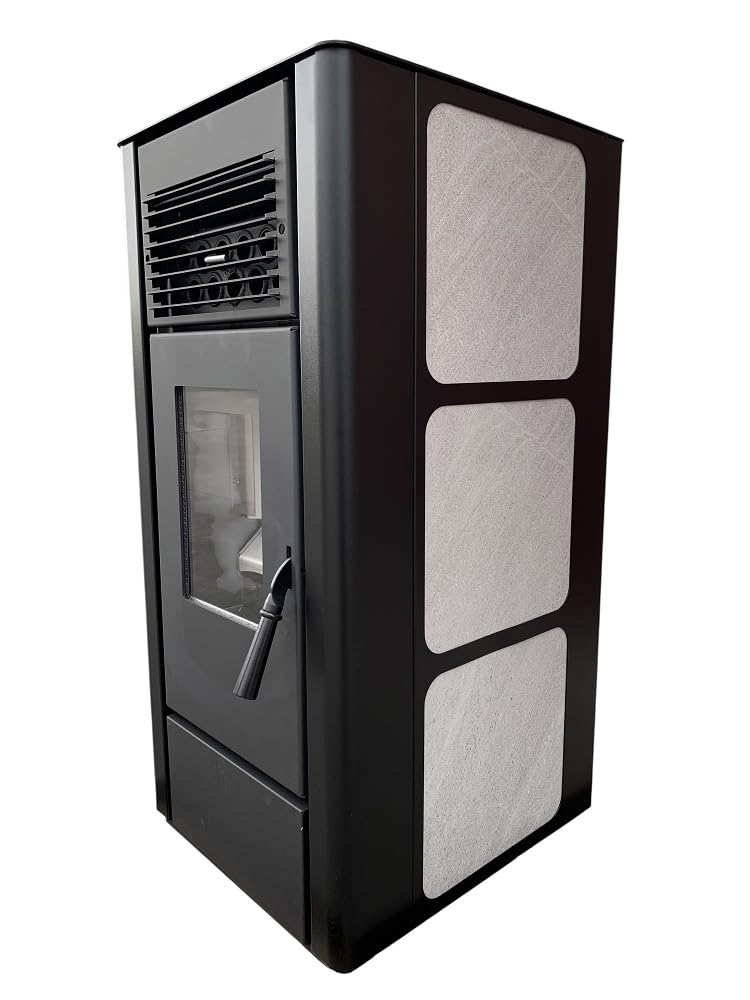
The PS21 stands apart from other pellet stoves because of its integrated battery backup system. Running on two 12V batteries (sold separately), the 24V DC system delivers over 40 hours of runtime during a power outage — a critical feature for off-grid cabins or storm-prone regions. The stacked tube heat exchanger boosts thermal efficiency, and users report heating a 2,500 square foot tri-level home to 70°F on setting 2 through a New Hampshire winter. The Sandstone Grey finish with swappable 12×12 tile side panels lets you match the stove to your room decor.
The Wi-Fi connectivity and touchscreen control panel are ambitious, but several users found the interface complicated and the app unreliable. The thermostat sensor is mounted on the stove body, meaning it reads the immediate stove temperature rather than the ambient room temperature — this can cause the stove to shut off before the room is fully heated unless a separate fan circulates air. The five feed settings are fewer than some competitors offer, and the startup cycle tends to overfeed pellets, dirtying the glass more quickly than expected.
Customer service from Pellethead is consistently praised, with responsive U.S.-based support and a 5-year limited warranty that covers the core components. For buyers who prioritize power-outage resilience and are comfortable working through a somewhat finicky control interface, the PS21 offers a unique value proposition. The battery backup alone makes it a compelling choice for anyone who cannot risk losing heat when the grid goes down.
Why it’s great
- Battery backup provides 40+ hours of heat during outages
- Heats 1,800 to 2,500 sq ft effectively
- Customizable tile side panels fit any room style
Good to know
- Wi-Fi and touchscreen interface can be glitchy
- Thermostat reads stove temp, not room temp
- Only five feed settings limit fine-tuning
3. Cleveland Iron Works PS130W Pellet Stove
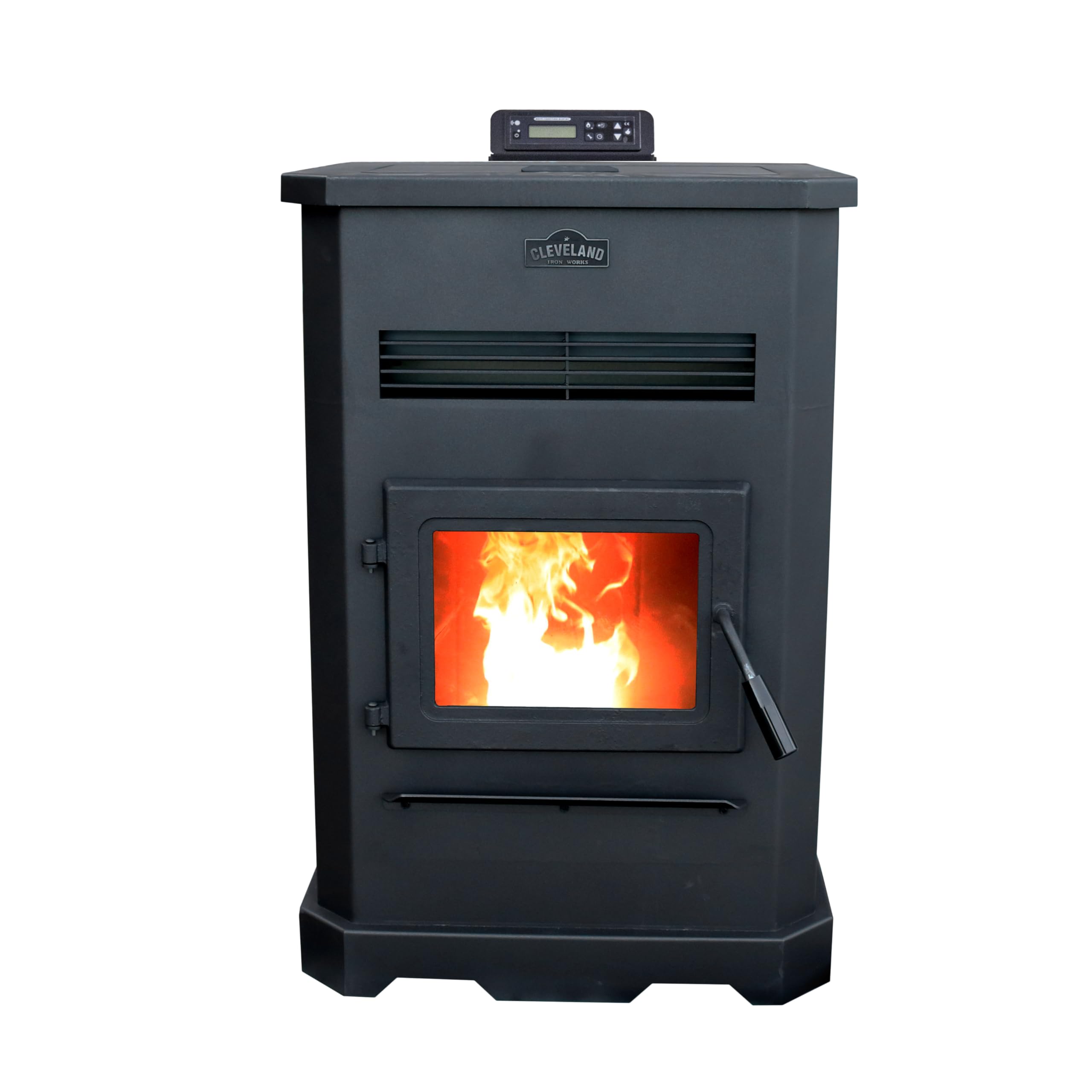
The PS130W’s 130-pound hopper is the largest in this roundup, holding three full 40-pound bags of pellets without refilling. For very large spaces between 2,000 and 3,000 square feet, this stove can run for days on a single load. The built-in Wi-Fi lets you monitor and adjust the stove from a phone, and users report the setup is straightforward. The stove maintains consistent room temperature without overheating, and the glass stays relatively clear with minimal daily buildup.
The control panel has drawn mixed reviews — some users find the interface confusing and the instructions insufficient. A few units arrived with cosmetic damage (dents) from shipping, though Cleveland Iron Works offered exchanges or discounts in those cases. The 210-pound weight means installation requires two people, and the stove needs proper floor protection as it radiates significant heat downward.
For anyone heating a large open-plan home, workshop, or commercial space, the PS130W eliminates the daily chore of pellet refilling. The Wi-Fi capability allows you to preheat the space before arriving at a cabin. The main risk is the control panel reliability: if the electronics fail, the stove becomes non-functional, and customer support has been inconsistent according to some reports. Stick with this model if hopper capacity is your top priority and you are comfortable with basic troubleshooting.
Why it’s great
- 130 lb hopper holds 3 full bags of pellets
- Covers 2,000 to 3,000 sq ft easily
- Wi-Fi enables remote temperature control
Good to know
- Control panel is unintuitive for some users
- Shipping damage reported in some units
- Heavy at 210 lbs; needs two people to install
4. Comfortbilt HP50S Pellet Stove

The HP50S packs 42,000 BTUs into a compact frame that fits smaller spaces while still claiming up to 2,200 square feet of coverage. That coverage number assumes mild winter conditions, but in practice, this stove handles 1,500 to 1,800 square feet effectively. The 47-pound hopper provides about 20 hours of continuous burning on the lowest setting, and the five power settings give decent flexibility. Users praise the one-button start and stop operation for its simplicity, and the Arctic White finish offers a clean alternative to the standard black.
The room blower is powerful but loud — it runs at a single speed, so you cannot dial down the fan noise during quieter hours. Professional installation is recommended because the stove requires its own venting system, and the 264-pound weight makes maneuvering difficult. Some owners found that the heat exchanger design works best when the stove is placed in a central location, as the blower pushes heat directionally rather than radiating evenly in all directions.
Daily cleaning is required to maintain efficiency, and the burn pot needs attention every 24 hours of operation. The stove is EPA and CSA certified, meeting federal emission standards. For a compact stove that provides substantial heat output without taking up too much floor space, the HP50S is a strong mid-range option — just account for the noise and make sure the room layout works with the directional blower.
Why it’s great
- Compact footprint with up to 42,000 BTUs output
- Runs 20+ hours on one fill at lowest setting
- One-button start and stop operation
Good to know
- Room blower is loud with single speed only
- Needs professional vent installation
- Weight of 264 lbs requires careful placement
5. Castle Serenity 41278 Pellet Stove

The Serenity 41278 offers four operating modes — Manual, Thermostat, Weekly, and Eco — controlled via a smart controller and remote. Eco mode automatically toggles the stove on and off to maintain the set temperature, which saves pellets during shoulder seasons. The 32,000 BTUs heat up to 1,500 square feet, and the 40-pound hopper provides roughly 18 hours of burn time on low. Cleaning is genuinely easy with no tubes, corrugations, or hidden chambers to access.
The main critique involves the auger design. The vertical auger configuration causes fly ash to circulate more than horizontal alternatives, leading to messier cleaning and faster glass sooting. Some users report that the auger fails to empty the hopper completely, leaving a quarter of a bag stuck. The built-in thermostat reads inaccurately — one owner found the set point of 70°F resulted in an actual room temperature of 85°F. The remote only works within two feet of the control panel, limiting its convenience.
For the price point, the Serenity delivers decent heating performance, but the design flaws make it less reliable than more established competitors. The stove works well after tuning the exhaust blower and air inlet settings, but expect to spend time adjusting it for your specific altitude and pellet brand. Buyers who want a programable pellet stove and are willing to tinker will find value here, but those seeking out-of-the-box perfection should consider alternatives.
Why it’s great
- Four operating modes for flexible scheduling
- Easy cleaning design with no hidden chambers
- Eco mode saves pellets by cycling on/off
Good to know
- Vertical auger causes fly ash and messy cleaning
- Inaccurate built-in thermostat
- Remote control range is very limited
6. Duluth Forge FDSR25 Dual Fuel Gas Stove

The FDSR25 runs on either natural gas or liquid propane with a simple conversion, and its 99.9% efficiency means nearly all the fuel turns into heat rather than going up a chimney. The 26,000 BTUs cover up to 1,200 square feet, and the thermostat remote control maintains the room temperature within 1°F of the set point. Users report keeping a 1,400 square foot house at 68°F even when outside temperatures hit 19°F, with the central heat never kicking on. The hand-painted ceramic fiber logs and matte black finish give a realistic fireplace look without the mess of wood.
The vent-free design eliminates the need for a chimney or flue, making installation much simpler than a traditional wood stove. However, the oxygen depletion sensor (ODS) can be sensitive — if the unit is placed in a very airtight room, the ODS may shut the stove down before the room is fully warm. A few units have had pilot light issues where the flame won’t stay lit, though this seems to be a manufacturing defect rather than a design flaw. The top of the stove stays cool enough to touch, which is a safety bonus for households with pets.
This is not a wood stove in the traditional sense — it burns gas, not logs — but for buyers who want the look of a stove without wood handling, ash cleanup, or chimney installation, the FDSR25 is an efficient alternative. Running costs depend on local propane or natural gas prices, but the 99.9% efficiency ensures minimal waste. The remote control is a genuine convenience, allowing temperature adjustments from across the room.
Why it’s great
- 99.9% efficient — nearly all fuel converts to heat
- Dual fuel runs on natural gas or propane
- Remote thermostat maintains temp within 1°F
Good to know
- Not a wood stove — burns gas only
- ODS can shut down in airtight rooms
- Pilot light defects reported in some units
7. CAMPJOURNEY M8 Rose Gold Tent Stove
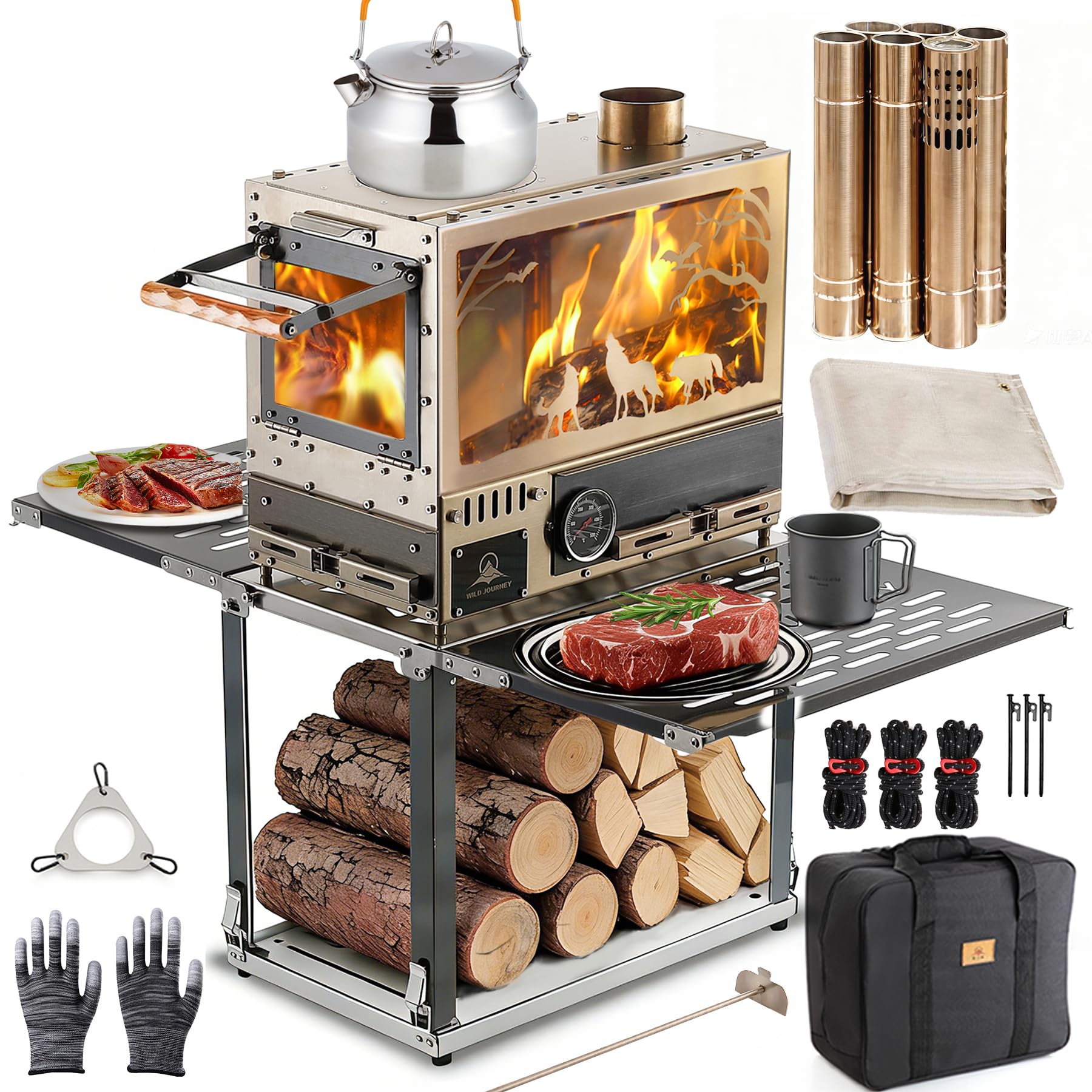
The M8 combines a 2100 cubic inch firebox with a built-in drawer-style oven, turning your tent or RV into a mobile kitchen. The 304 stainless steel construction uses a 4.8mm thick top plate and 1.8mm body, making it far more durable than budget steel stoves. The 6-section chimney reaches 104 inches and includes a damper for burn rate control. Users report heating a 14×14 tent to 61°F with hickory wood, and the oven can reach 500°F for baking. The foldable stainless steel base elevates the stove to a comfortable cooking height with side panels for utensils.
The oven thermometer is inaccurate out of the box — it may read 100°F when the actual temperature is 500°F, requiring an independent oven thermometer for reliable baking. The oven drawer can warp on first use, though it straightens as it cools. The glass window is fragile; closing the door on slightly oversized wood can crack it, filling the tent with smoke. At 50.7 pounds, this stove is heavy for backpacking but manageable for car camping or RV use.
The pull-out ash drawer simplifies cleanup, and all accessories store inside the firebox for compact transport. The M8 supports both wood and pellet fuel (with a separately sold pellet burner). For campers who want hot meals beyond simple stovetop cooking, the built-in oven is a genuine differentiator — just be prepared to manage the glass and thermometer quirks. Buying from a seller with a good return policy is strongly advised given the glass breakage reports.
Why it’s great
- Built-in oven for baking while camping
- Heavy-duty 304 stainless steel construction
- 2100 cu in firebox provides all-night burns
Good to know
- Oven thermometer reads inaccurately
- Glass door can crack with oversized wood
- Heavy at 50.7 lbs; not for backpacking
8. CAMPJOURNEY M6 Silver Tent Stove

The M6 Silver is the M8’s more streamlined sibling. It shares the same 2100 cubic inch firebox and 4.8mm thick 304 stainless steel top plate, but comes with an IGT (Integrated Gear Table) instead of a built-in oven. This makes it a better option for campers who want a flat cooking surface and a stable base for meal prep. The 6-section chimney extends to 98 inches with a spark arrestor and wind stability kit, making it safe for tent use. Users confirm the stove burns 6+ hours on a single load of 13-inch logs.
The M6 weighs 50.7 pounds fully loaded with accessories, and all components store inside the firebox for transport. The foldable legs collapse for compact storage. Like the M8, the glass window is vulnerable to thermal shock or impact from oversized wood — handle the door gently. The included fireproof gloves, mat, and storage bag add value for the price point.
Performance-wise, the M6 heats a tent or small cabin effectively, and the large surface area supports rapid boiling of 1.4L of water. The stove is compatible with a pellet burner (sold separately). For winter camping, ice fishing, or hunting trips where portability and reliability matter, the M6 provides a solid solution. The main caution is the glass: treat it as a consumable item and carry a spare if possible.
Why it’s great
- 2100 cu in firebox for 6+ hour burns
- IGT table provides stable cooking surface
- Complete kit includes chimney, gloves, mat, bag
Good to know
- Glass window can crack under thermal stress
- Heavy for backpacking at 50.7 lbs
- Unusual 2.76″ chimney pipe size
9. ProCom Ventless Dual Fuel Fireplace

The ProCom delivers 25,000 BTUs of vent-free heat, covering up to 1,100 square feet without needing a chimney or flue. The dual-fuel design runs on either liquid propane or natural gas, and the Piezo ignition makes startup easy. The hand-painted concrete logs and cast iron body mimic the look of a real wood fire. Users report that on the low setting, the unit heats a 1,500 square foot ranch home to an average of 61°F using 50-55 gallons of propane per month.
Vent-free combustion releases moisture into the room — owners in humid climates or tightly sealed homes may need a dehumidifier or ventilation fan alongside this unit. Some units arrived with loose internal wires or sheet metal construction that feels less premium than the cast iron exterior suggests. The thermostat-controlled operation works well, and the top surface stays cool enough to be safe around children and pets.
Installation is genuinely DIY-friendly for anyone comfortable with gas fittings, but the unit requires a 3/8-inch flare fitting and proper thread tape. The first burn-in produces a noticeable smell as manufacturing oils burn off. For buyers who want the visual appeal of a stove without wood cutting, ash removal, or chimney cleaning, the ProCom offers a practical entry point — just confirm your room has adequate air exchange before going vent-free.
Why it’s great
- Vent-free design eliminates chimney installation
- Dual fuel runs on propane or natural gas
- Thermostat control maintains consistent room temp
Good to know
- Produces moisture from combustion
- Some units have loose internal components
- Gas connection requires 3/8-inch flare fitting
10. Cleveland Iron Works H090 Single Burn Rate Stove

The H090 is a traditional cast iron wood stove built by a company with generations of experience in Franklin-style stoves. It heats up to 900 square feet and holds logs up to 18 inches long. The heavy-duty cast iron construction with a high-temperature matte black finish delivers the classic wood stove aesthetic, and the 2-piece safety handle stays cool while the stove is burning. The ceramic rope gasket ensures an airtight seal, and the single burn rate control is simple to operate.
At 77 pounds, the H090 is lighter than many cast iron stoves, making it easier to move into a workshop or cabin. Assembly is quick and straightforward. Reviewers highlight the sealed fire chamber as a key safety feature — it prevents ember escape, making the stove safe to leave unattended. The 6-inch flue exhaust connects to standard stovepipe, and the stove can accommodate cooking pots on the top surface.
Some users note that the stove performs best with dry, seasoned hardwood and that burn time is around 4-6 hours on a full load, depending on draft conditions. The 1-year warranty is shorter than some competitors offer. For a traditional wood-burning experience at a budget-friendly price point, the H090 delivers reliable heat with minimal complexity. It works particularly well in workshops, barns, and small cabins where appearance matters but advanced features are unnecessary.
Why it’s great
- Traditional cast iron construction with matte finish
- 2-piece safety handle stays cool during use
- Airtight ceramic rope gasket prevents smoke leaks
Good to know
- Burn time is 4-6 hours with seasoned wood
- 1-year warranty is shorter than premium options
- Requires 6-inch flue for proper venting
11. US Stove Company US1269E Cast Iron Stove

The US1269E is an affordable cast iron stove rated for 54,000 BTUs and 900 square feet of coverage. It accommodates logs up to 19 inches long, reducing the frequency of cutting trips. The 2-piece safety handle stays cool to the touch, and the heavy-duty cast iron body brings a classic look. Standing 23 inches tall and 33 inches wide, it fits into smaller cabins and structures without dominating the room.
Performance reports are mixed. Several users praise the stove’s efficiency, noting it burns oak wood 24/7 in tiny spaces with zero indoor smoke. The cast iron retains heat well after the fire dies. However, critical reviews mention poor quality control: legs may break off, the flue collar might require grinding to fit, and the stove can fail to draw, causing smoke to fill the room. Some buyers found the stove smaller than expected, requiring thin-split logs to fit the 19-inch capacity.
This stove represents the most accessible price point for entry into wood heating, and US Stove Company’s customer service generally responds well to damage claims. But the quality control variability means buying from a retailer with a solid return policy is essential. For budget-conscious buyers willing to inspect the unit thoroughly upon arrival and handle potential fitment issues, the US1269E can provide adequate heat — just budget extra time for potential adjustments.
Why it’s great
- 54,000 BTUs heats up to 900 sq ft
- Fits logs up to 19 inches long
- Cool-touch safety handle
Good to know
- Quality control issues reported with legs and flue
- Some units fail to draw, causing smoke in room
- Smaller firebox than many competitors
FAQ
Can a freestanding wood stove heat an entire house?
What size flue does a freestanding wood stove need?
How often do I need to clean a wood stove chimney?
What is the difference between a wood stove and a pellet stove?
Should I buy cast iron or steel for a cabin wood stove?
Final Thoughts: The Verdict
For most users, the freestanding wood stove winner is the Comfortbilt HP22-N because it combines a massive 80-pound hopper with 50,000 BTUs and auto-ignition for near-effortless whole-home heating. If you need power-outage resilience, grab the Freedom Stoves PS21 with its battery backup. And for campers who want to bake bread in a tent, nothing beats the CAMPJOURNEY M8 Rose Gold with its built-in oven and heavy-duty stainless steel build.