
Your peach tree’s leaves are curling, the apples have black spots, and the citrus looks pale. You need a targeted solution that stops fungal disease, wipes out pests, and is safe for edible crops. That is the role of a well-chosen formula applied at the right time with the right coverage.
I’m Mohammad Maruf — the founder and writer behind Drink4Good. I spend my time breaking down the active ingredients, concentration ratios, and label claims of garden products so you can buy with confidence, not confusion.
This guide compares five highly-rated sprays built for home orchards, from broad-spectrum synthetics to organic biofungicides. After reading, you will know exactly which fruit tree spray fits your disease pressure, pest load, and gardening philosophy.
How To Choose The Best Fruit Tree Spray
Choosing the wrong spray is a waste of money and can burn your foliage or leave harmful residues on your harvest. You have to match the active ingredient to the problem and the plant.
Identify Your Target: Fungus, Insect, or Mite
Look at the damage. Powdery white coating on leaves screams fungus. Tiny webs and stippled leaves point to spider mites. Chewed fruit and curled leaves usually mean insects. An all-in-one product like Captain Jack’s Orchard Spray covers all three, while a pure biofungicide like Southern Ag only targets fungal pathogens.
Check the Re-Entry and Pre-Harvest Intervals
Every label states how many days must pass between spraying and picking fruit. Some synthetic sprays require a 14-day or longer waiting period, while organic options like Bonide Revitalize allow same-day harvest. This matters most for trees that fruit continuously, such as citrus and figs.
Decide Between Concentrate and Ready-to-Use
Concentrates cost less per gallon of finished spray and let you adjust the dose for different infestation levels. Ready-to-use bottles, like the Garden Safe Fungicide3, are heavier to ship and more expensive per application, but they save you the measuring step. For an orchard with multiple trees, a concentrate is almost always the smarter buy.
Quick Comparison
On smaller screens, swipe sideways to see the full table.
| Model | Category | Best For | Key Spec | Amazon |
|---|---|---|---|---|
| Captain Jack’s Orchard Spray | Fungicide/Insecticide | All-in-one orchard protection | 32 oz concentrate, multi-target | Amazon |
| Bonide Revitalize Biofungicide | Organic Fungicide | Disease prevention on edible crops | 16 oz concentrate, organic | Amazon |
| Southern Ag Biological Fungicide | Biological Fungicide | Root drench and foliar disease control | 16 oz, bacillus-based | Amazon |
| Garden Safe Fungicide3 | Neem Oil Spray | Light infestations on ornamentals | 1 gal RTU, neem oil | Amazon |
| Hi-Yield Malathion Spray | Synthetic Insecticide | Heavy pest infestations | 32 oz, 55% Malathion | Amazon |
In‑Depth Reviews
1. Bonide Captain Jack’s Citrus, Fruit & Nut Orchard Spray

This is the Swiss Army knife of the orchard. Captain Jack’s combines a fungicide, insecticide, and miticide in one concentrated pint that dilutes to over six gallons of finished spray. Users report visible greening of apple tree foliage within days, and the formula tackles everything from powdery mildew and brown rot to fruit flies, caterpillars, and spider mites.
The 2.3-pound bottle mixes easily and can be applied with any tank or hose-end sprayer. It is labeled for use up to one day before harvest, giving you a short pre-harvest interval that few multi-purpose products match. The sulfur component can leave a slight powdery residue on leaves, but that dissipates quickly and does not affect fruit quality.
If you have a mix of apple, cherry, citrus, and nut trees and want one bottle to handle the entire season, this is the most cost-effective and reliable option on the list. Reapply after heavy rain considering its non-persistent nature, and you will see a dramatic reduction in leaf spots and beetle damage.
Why it’s great
- Covers fungus, insects, and mites in one mix
- Short pre-harvest interval of 1 day
- Concentrate yields over 6 gallons of spray
Good to know
- Leaf residue from sulfur can be visible
- Needs reapplication after rain
2. Bonide Revitalize Biofungicide

Revitalize triggers the plant’s own immune response rather than directly killing the pathogen. This biological mode of action makes it effective against blight, anthracnose, powdery mildew, and black spot without harming beneficial insects or pollinators. It is approved for organic gardening and can be used right up to harvest day with zero waiting period.
The 16-ounce concentrate mixes with water for foliar sprays or soil drench applications. Multiple users have confirmed it stopped septoria leaf spot on tomatoes and controlled fungal issues on houseplants, though one noted the strong smell during mixing. The scent dissipates after application and is a small trade-off for the organic certification.
For growers who want disease prevention without synthetic chemicals, this is the cleanest path. It works best as a preventive or early-stage treatment rather than a rescue cure for heavily infected trees.
Why it’s great
- Biofungicide triggers plant immunity
- Approved for organic gardens, same-day harvest
- Works as foliar spray or soil drench
Good to know
- Strong odor during mixing
- Best used preventively
3. Southern Ag Garden Friendly Biological Fungicide

This product uses a beneficial bacterium that colonizes the root zone and leaf surfaces, outcompeting pathogenic fungi. It is the same active ingredient found in Hydroguard but at a much higher concentration, making it far more economical. Users in high-disease regions like the Florida panhandle report it darkening grape leaves and revitalizing peach trees hit by spider mites.
The 16-ounce bottle is a concentrate, and reviewers warn that the bottle opening can cause dribbling during measurement. Use a dedicated measuring cup to avoid waste. It works as both a soil drench to protect roots from rot and a foliar spray to control leaf miners and tomato hornworms on fruit trees.
If you struggle with root rot in water propagation or want a non-toxic way to control soil-borne diseases in your orchard, this is the most potent option. It requires multiple applications for best results, but the bio-fertilizer effect is a strong bonus.
Why it’s great
- High-concentration bacillus for root health
- Acts as a bio-fertilizer too
- Non-toxic and safe for edibles
Good to know
- Bottle opening design causes dribbles
- Requires multiple applications
4. Garden Safe Brand Fungicide3
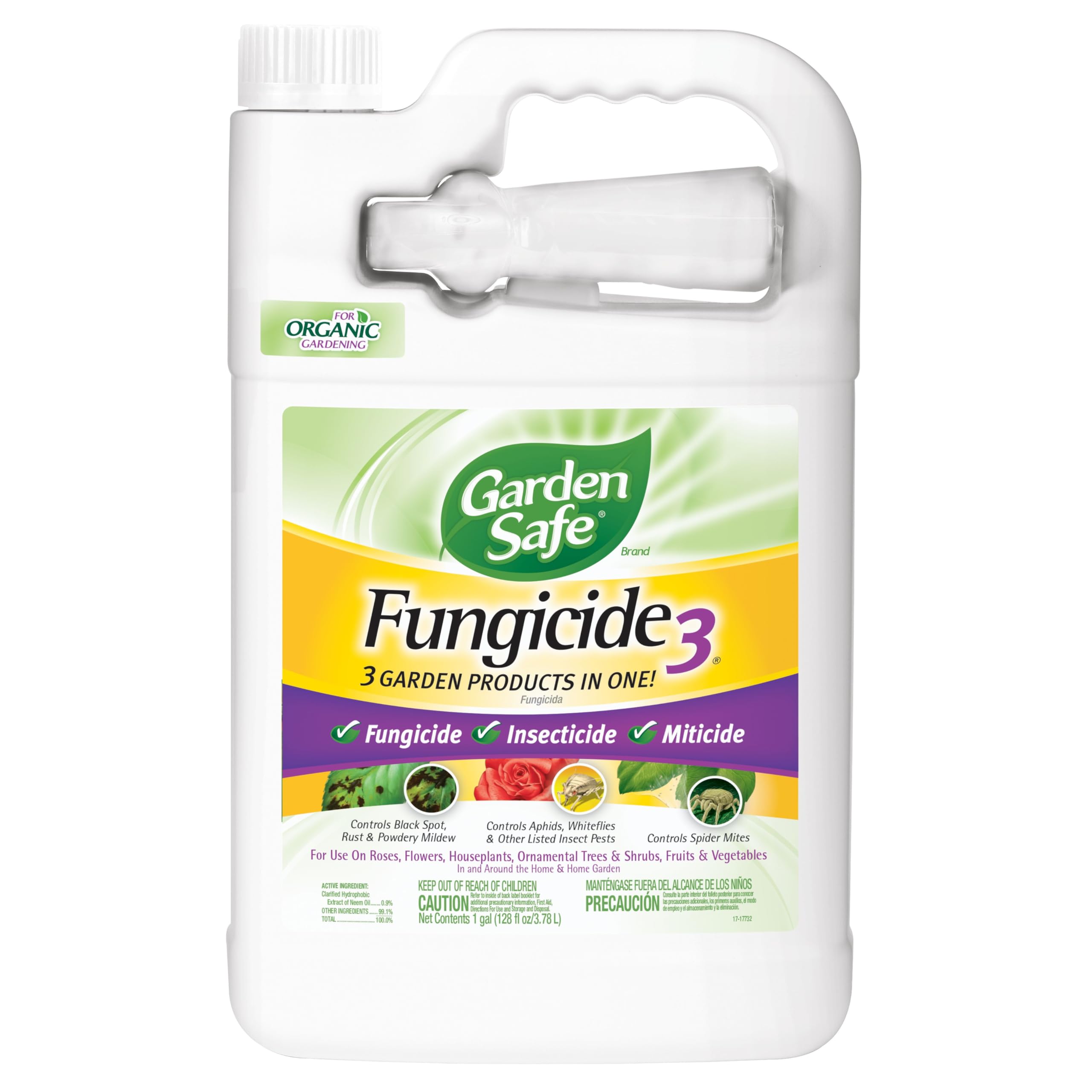
This ready-to-use gallon delivers clarified hydrophobic neem oil as its active ingredient, making it a versatile triple threat: fungicide, insecticide, and miticide. It kills eggs, larvae, and adult stages of aphids, whiteflies, and spider mites while preventing black spot, rust, and powdery mildew. The neem oil base is organic and safe for vegetables and fruit trees.
The convenience of a jug with an attached sprayer is real — no mixing, no measuring, just point and spray. However, the built-in sprayer is a weak point; several users report the hose is too short and the trigger mechanism fails after a few uses.
For small orchards or gardeners who hate mixing concentrates, this is the fastest path to coverage. The neem oil also leaves a pleasant earthy scent rather than a chemical smell, and weekly use has been shown to eliminate powdery mildew on blueberries and roses.
Why it’s great
- Ready-to-use, no mixing needed
- Organic neem oil base with broad coverage
- Kills eggs, larvae, and adults
Good to know
- Included sprayer is low quality
- Can burn leaves in direct sun
5. Hi-Yield 55% Malathion Spray
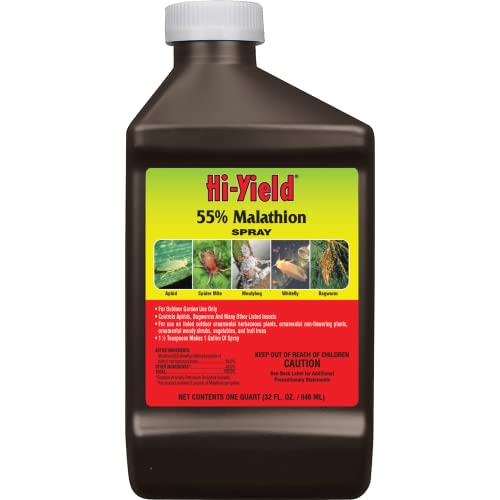
Malathion is an organophosphate with a reputation for stopping the toughest infestations. This 55% concentrate is the nuclear option for spider mites, scale, aphids, thrips, and mosquitoes. Growers who had persistent mite problems on dahlias and fruit trees found that this was the only product that finally worked after neem and other botanicals failed.
There is a significant trade-off: the manufacturer and many users strongly recommend full protective gear due to its toxicity. It is a suspected carcinogen and can harm beneficial insects and aquatic life. Never spray it near water sources or in windy conditions. The odor is strong, and the label calls for avoiding application when rain is forecast for 24 hours.
This belongs in the arsenal of an experienced orchardist who has a severe outbreak of scale or red spider mites that nothing else touches. Use it as a last resort, follow the label exactly, and consider hiring a licensed professional for the first application if you are unfamiliar with concentrated organophosphates.
Why it’s great
- Extremely effective on severe infestations
- Broad spectrum: scale, mites, mosquitoes
- High 55% concentration
Good to know
- Toxic; requires full protective gear
- Harms beneficial insects and aquatic life
FAQ
Can I spray fruit tree fungicide and insecticide at the same time?
Yes, many orchard sprays are formulated as a combination product. Captain Jack’s Citrus, Fruit & Nut Orchard Spray is a multi-purpose concentrate that covers fungus, insects, and mites in one application. Always check the label for tank-mixing compatibility if you are combining separate products, and never mix copper-based fungicides with sulfur products.
What is the spraying schedule for fruit trees in the spring?
Start with a dormant oil spray before bud break to suffocate overwintering eggs. Apply a fungicide at pink bud stage (just before flowers open) to prevent blossom blight. After petal fall, switch to a multi-purpose spray every 10 to 14 days, especially during wet weather. Always stop spraying during bloom to protect bees.
How long does neem oil last on fruit trees?
Neem oil breaks down in about 5 to 7 days in full sun and can wash off in heavy rain. It has no residual activity, so it kills only the insects that are directly coated or that ingest it within a few hours. For ongoing protection, reapply every 7 to 14 days or after a rain event. It is safe to use up to the day of harvest.
Is Malathion safe to use on bearing fruit trees?
Malathion is labeled for use on fruit trees, but it has a pre-harvest interval of 7 to 14 days depending on the crop. It is highly toxic to bees and aquatic life, so never apply during bloom or near ponds. Wear gloves, goggles, and a respirator during mixing and application. For heavy infestations, it is often the only effective option.
Why does my biological fungicide smell bad?
The smell is normal and comes from the live bacterial cultures in products like Bonide Revitalize and Southern Ag Biological Fungicide. The bacteria break down organic matter and produce a distinct earthy or sulfur-like odor during fermentation. The smell does not affect the product’s effectiveness and usually dissipates within an hour of application.
Final Thoughts: The Verdict
For most users, the fruit tree spray winner is the Bonide Captain Jack’s Citrus, Fruit & Nut Orchard Spray because it combines fungicide, insecticide, and miticide in one economical concentrate that covers everything your orchard needs. If you want organic disease control without synthetics, grab the Bonide Revitalize Biofungicide. And for severe pest infestations where nothing else works, nothing beats the Hi-Yield 55% Malathion Spray.