
Nothing kills the peace of a campsite or the calm of a backup plan quite like a generator that drinks fuel faster than a lifted truck. You brought the inverter to power the essentials, but you end up babysitting a gas can, listening to a roaring engine that burns through five dollars an hour. The real challenge of owning a portable power station isn’t peak wattage—it’s runtime, throttle discipline, and how few trips to the pump a single tank will buy you.
I’m Mohammad Maruf — the founder and writer behind Drink4Good. I’ve analyzed hundreds of hours of real-world fuel consumption data, decibel readings, and engine specs to isolate the generators that actually deliver on their efficiency promises without sacrificing the power you need.
Whether you are prepping for hurricane season, equipping an RV for cross-country travel, or running essential appliances during an outage, the right best fuel efficient generator can cut your gas consumption in half while keeping your sensitive electronics humming clean and safe.
How To Choose The Best Fuel Efficient Generator
Fuel efficiency in a generator is not just a sticker claim—it is a direct result of engine displacement, inverter circuitry, and how the throttle responds to your load. Choosing the right unit requires looking past peak wattage to understand how much fuel each watt costs you over a full day of use.
Inverter vs. Conventional: The Efficiency Gap
An inverter generator converts raw AC to DC and back to clean AC, which allows the engine to throttle up and down based on demand. That variable-speed engine is why inverter models typically consume 20-40% less fuel than open-frame conventional generators running at a fixed 3600 RPM. Every generator on this list is an inverter model for that reason.
Eco Mode: The Hidden Throttle
Eco Mode or Economy Mode reduces engine RPM to idle when the electrical load drops, then ramps up when you plug in a device. This feature can extend runtime by 30-50% during light use—like running a few LED lights, a laptop, and a refrigerator. If you plan to run your generator at partial load most of the time, a unit with a reliable Eco Mode is non-negotiable.
Runtime Per Gallon as a Real Metric
Ignore the manufacturer’s “up to X hours” claim unless you know the load percentage. Most brands quote runtime at 25% load. For a realistic estimate, look at the fuel tank capacity in gallons and divide by the generator’s fuel consumption at 50% load. A generator that runs 10 hours at 25% load might only last 4 hours at 50% load. Seek out units that provide both figures.
Quick Comparison
On smaller screens, swipe sideways to see the full table.
| Model | Category | Best For | Key Spec | Amazon |
|---|---|---|---|---|
| Westinghouse iGen2550 | Inverter | Quiet RV boondocking | 52 dBA / 12 hr runtime at 25% load | Amazon |
| Honda EU2200ITAN1 | Inverter | Ultra-reliable sensitive electronics | 50 dBA / 8.1 hr runtime at rated load | Amazon |
| WEN DF360iX | Dual Fuel Inverter | Fuel flexibility with propane option | 2900W gas / 2600W propane / 49 lb | Amazon |
| WEN 56360i | Inverter | Lightweight camper power | 3600W surge / 46 lb / fuel shutoff | Amazon |
| ERAYAK 4500P | Inverter | Clean power for sensitive electronics | 1.2% THD / 0.21 gal/hr at 25% load | Amazon |
| Pulsar PG2300iS | Inverter | Budget-friendly essentials | 1800W running / 80cc / 39.2 lb | Amazon |
| PowerSmart DB5068 | Inverter | Whole-camper backup | 3200W running / 59 dBA / 52 lb | Amazon |
| Pulsar PGD40ISCO | Inverter | Compact mid-range power | 4000W peak / 47.3 lb / 145cc | Amazon |
| AIVOLT 4300W | Inverter | Feature-packed portable | 3450W running / 51 lb / LCD display | Amazon |
| Westinghouse WGen12500 | Open Frame | Whole-home backup | 12500W peak / 457cc / remote start | Amazon |
| AIVOLT 11250W | Dual Fuel Inverter | Heavy-duty RV & home backup | 9000W gas / 8540W propane / 50A RV | Amazon |
In‑Depth Reviews
1. Westinghouse iGen2550

The Westinghouse iGen2550 hits the sweet spot between fuel efficiency and useful power output. With 2550 peak watts and 1900 running watts, it can handle a small RV AC unit with a soft start, charge batteries, and run lights for up to 12 hours on a 1.16-gallon tank. The dual-fuel capability gives you the option to run it on propane when gasoline is scarce, and the inverter technology keeps total harmonic distortion under 3%.
At 42.4 pounds, this unit is genuinely easy to carry one-handed. The Economy Mode is the key to its fuel efficiency—it lets the engine idle when the load drops, which means you can run a refrigerator overnight without burning through a quarter tank. The built-in CO sensor adds peace of mind when camping or using it near living spaces.
Some buyers report that the breaker can trip with RV AC units unless a soft start is installed. The documentation is also inconsistent between the quick-start guide and the full manual. But for the price, it delivers Honda-level runtime at a fraction of the dollar investment.
Why it’s great
- Up to 12 hours runtime at quarter load
- Dual fuel flexibility (gas and propane)
- Extremely quiet at 52 dBA
- Lightweight at only 42.4 pounds
Good to know
- May need soft start for RV AC units
- Propane valve guard is unguarded during transport
- Service panel clips feel fragile
2. Honda EU2200ITAN1
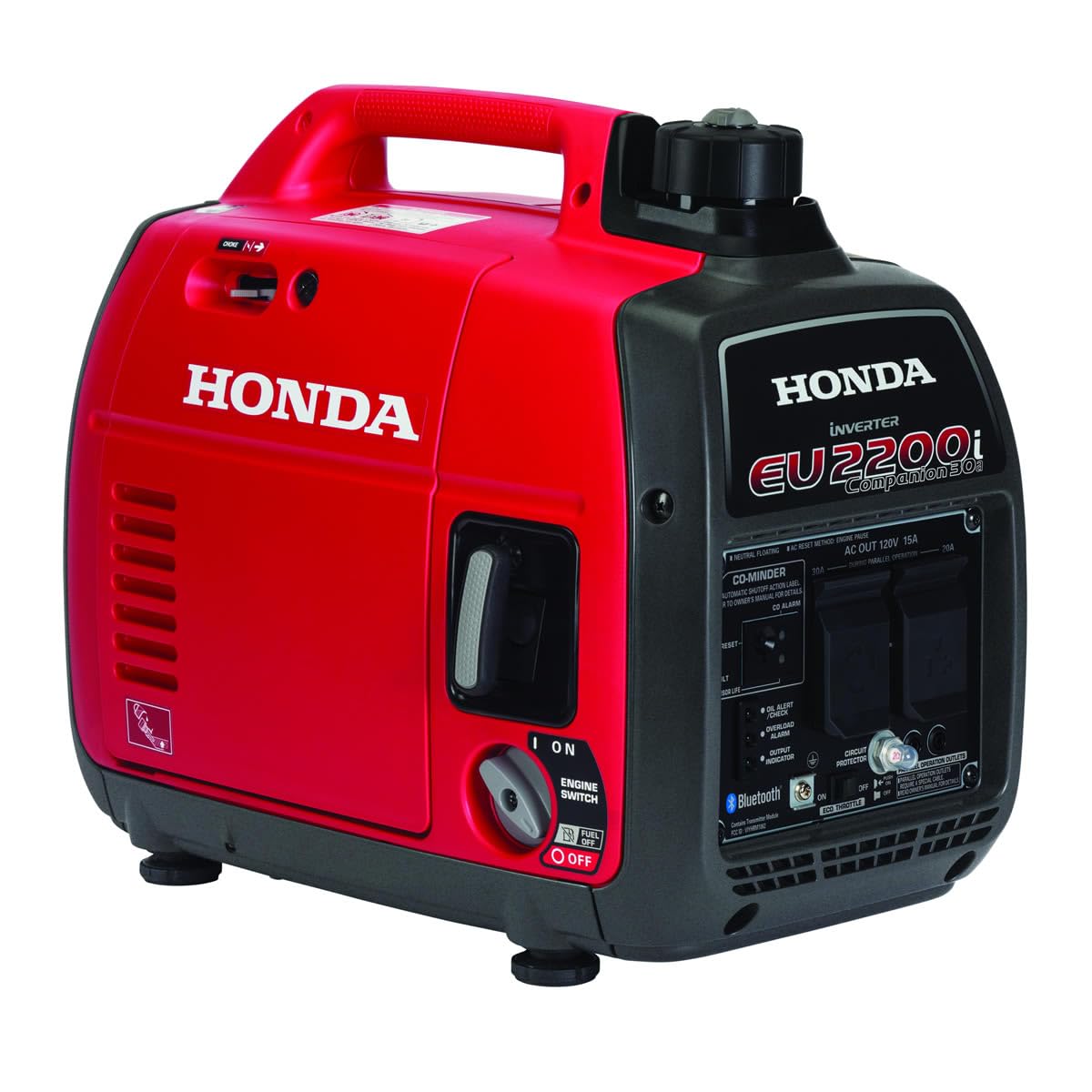
The Honda EU2200ITAN1 is the benchmark for fuel efficiency in the portable inverter generator space. With a 121cc GX series engine, it delivers 2200 peak watts and 1800 running watts while sipping fuel at an industry-leading rate. At 25% load, it can run for over eight hours on a single gallon of gasoline. The 50 dBA noise level is quieter than a conversation, making it the first choice for campgrounds with strict noise ordinances.
What separates the Honda from cheaper alternatives is its consistent first-pull start reliability and the Eco-Throttle system, which automatically matches engine speed to the load. Owners report using it for years without any carburetor issues, thanks to the fuel shutoff valve that lets the carburetor run dry before storage. The companion model also allows you to parallel two units for 4400 watts of peak power.
The premium construction is reflected in the price, which sits at the top end of the mid-range tier. It also lacks a built-in fuel gauge and the standard outlets include only two 120V household receptacles. For pure fuel efficiency and long-term reliability, however, no other generator in its class competes.
Why it’s great
- 8+ hours runtime on one gallon at light load
- Industry-leading 50 dBA quiet operation
- Honda reliability with decades of proven engine performance
- Companion model enables parallel capability
Good to know
- Premium price point
- No built-in fuel gauge
- Limited outlet selection (no RV TT-30R)
3. WEN DF360iX

The WEN DF360iX brings dual-fuel flexibility to the mid-range inverter generator market without sacrificing fuel efficiency. It delivers 3600 surge watts and 2900 running watts on gasoline, and 3500 surge watts with 2600 running watts on propane. The 149cc engine includes a fuel shutoff mechanism that drains the carburetor before the generator stops, extending the life of the fuel system and reducing maintenance.
Owners consistently praise the integrated WEN Watchdog CO Shutdown Sensor, which automatically kills the engine if carbon monoxide levels become unsafe—a feature that makes it suitable for use near campers or in partially enclosed areas. The unit weighs just 49 pounds, which is notably light for a dual-fuel inverter with this power output. The LCD display provides real-time readouts of voltage, frequency, runtime, and load percentage.
The two 20A household outlets on this unit hold plugs somewhat loosely, which has been confirmed in multiple reviews. It also lacks a 30A RV outlet, so you will need an adapter for direct RV cord connection. But for fuel efficiency across two fuel types, this WEN is hard to beat.
Why it’s great
- Dual fuel with tool-free LPG quick connector
- Fuel shutoff extends carburetor life
- CO Watchdog auto-shutdown for safety
- Full information LCD display
Good to know
- 20A outlets hold plugs loosely
- No TT-30R RV outlet included
- Propane regulator can be damaged in shipping
4. WEN 56360i

The WEN 56360i packs 3600 surge watts and 2900 running watts into a frame that weighs just 46 pounds—one of the lightest generators in its power class. The 149cc engine features a fuel shutoff valve that drains the carburetor automatically before the generator turns off, preventing fuel varnish and gum buildup that typically kills small engines. The inverter technology produces clean power suitable for laptops, phones, and other sensitive electronics.
Real-world tests from owners show this unit can run a 13,000 BTU RV air conditioner plus a few lights for about 4 hours on a full tank. At partial load, that runtime extends significantly. The fuel efficiency is further enhanced by the quiet engine, which produces a gentle purr rather than the harsh drone of open-frame generators. The included TT-30R RV receptacle means you can connect directly to your camper without an adapter.
The carburetor fuel shutoff is the standout feature for maintenance-conscious buyers. Without it, leaving gasoline in the carb for weeks can lead to blockages. The engine also lacks an oil filter, so oil changes every 25 hours are necessary. But for the weight-to-power ratio, few units compete.
Why it’s great
- Only 46 pounds for 3600 watts surge power
- Fuel shutoff extends engine life
- TT-30R RV receptacle is built in
- Quiet enough to be inaudible inside the house
Good to know
- No oil filter—requires changes every 25 hours
- Not powerful enough for large power tools
- Fuel tank is 1.2 gallons, limiting runtime at high load
5. ERAYAK 4500P

The ERAYAK 4500P is a 4500 peak watt, 3500 running watt inverter generator that focuses on delivering exceptionally clean power with total harmonic distortion as low as 0.2% to 1.2%. That makes it safer than many competitors for running CPAP machines, laptops, and medical devices without risk of power fluctuations. The fuel consumption stats are clearly stated: 0.21 gallons per hour at 25% load, and 0.56 gallons per hour at full load.
Weighing 55 pounds with a compact 20x12x19-inch footprint, it fits easily into the back of an SUV. The 50A parallel-ready capability means you can pair two units for up to 9000 peak watts. Owners report that the Eco Mode reduces both noise and fuel consumption noticeably, and the unit starts easily on the first or second pull even after extended storage. The built-in TT-30R and USB-C ports add modern convenience.
Some units have exhibited early failures around the 350-hour mark, and the manufacturer support is based in China, which complicates warranty claims. The pull start is reliable but lacks the refinement of electric start models. For buyers who prioritize THD ratings and low fuel consumption over long-term brand support, this generator offers strong value.
Why it’s great
- THD as low as 0.2% for sensitive electronics
- 0.21 gal/hr at quarter load
- 50A parallel ready for expansion
- USB-C outlet included
Good to know
- Reported early failures around 350 hours
- Support based overseas
- No electric start—pull start only
6. Pulsar PG2300iS

The Pulsar PG2300iS is a compact 80cc inverter generator that delivers 2300 peak watts and 1800 running watts at a price point that undercuts most competitors by a significant margin. It includes Automatic Voltage Regulation (AVR) and a stable sine wave, making it safe for sensitive electronics. At 39.2 pounds, it is one of the lightest units on this list and easy to carry in one hand.
Owners report that with Eco Mode engaged, the unit sips fuel and can run small appliances for hours without noticeable consumption. Many use it as a emergency backup for a refrigerator and a few lights during multi-day outages. The recoil start typically catches on the first pull, and the low oil shut-off protects the engine from neglect. The parallel capability allows you to add a second unit later for more power.
The noise level sits around 65-75 dB, which is noticeably louder than premium units like the Honda but acceptable for most camping scenarios. The power output has been reported as inaccurate for high-surge appliances like 13.5K BTU RV AC units without a soft start. It is best viewed as a capable light-duty companion, not a primary whole-home solution.
Why it’s great
- Very light at 39.2 pounds
- First-pull start with reliable AVR
- Eco Mode saves significant fuel
- Parallel capable for future expansion
Good to know
- Louder than premium inverter generators
- Power output may not handle large RV AC
- Small fuel tank limits long runtime
7. PowerSmart DB5068
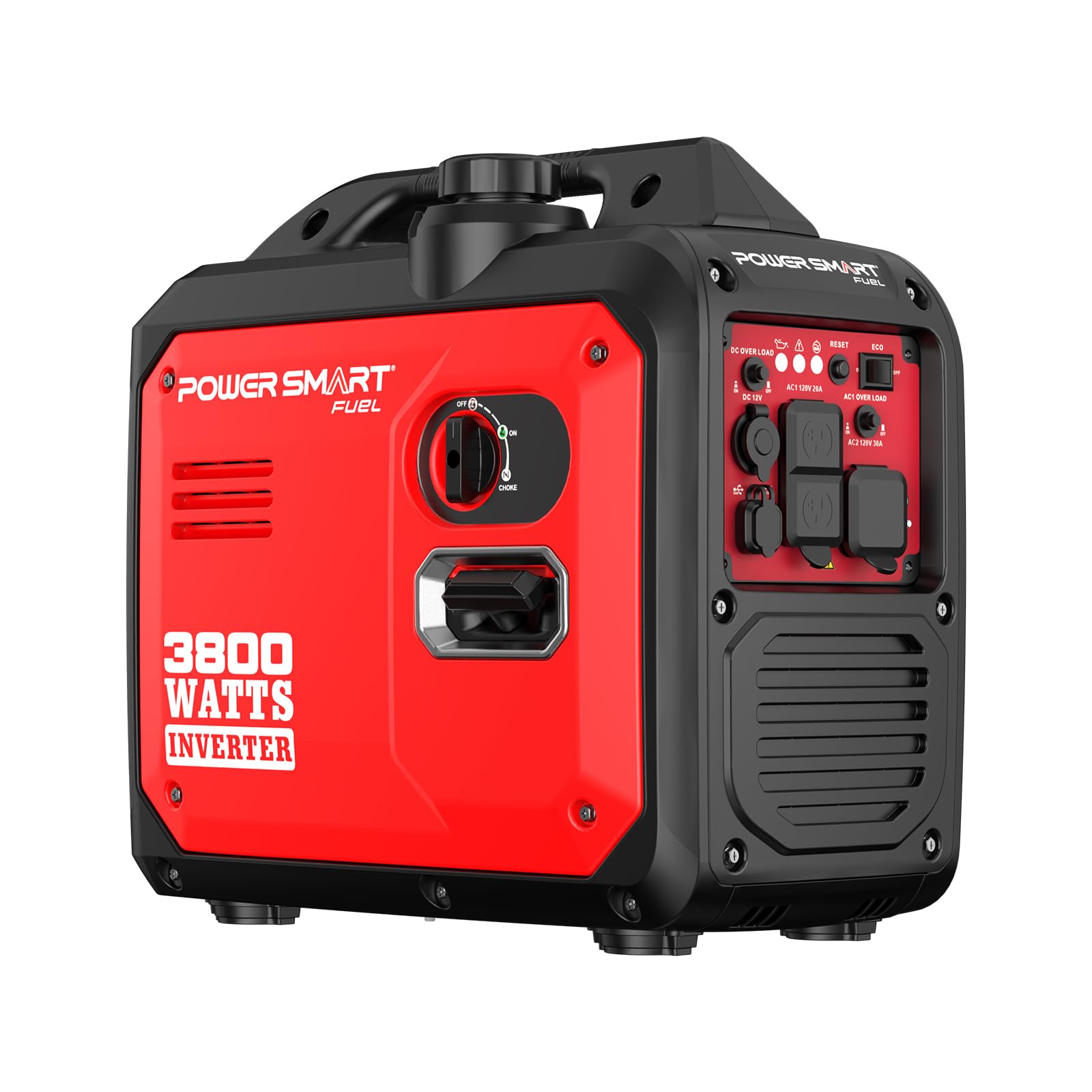
The PowerSmart DB5068 delivers 3800 surge watts and 3200 running watts from a 143cc OHV engine, with a noise rating of just 59 dBA at 23 feet. That makes it one of the quietest options in the 3000-watt class, suitable for RV parks with strict sound limits. The 1.19-gallon fuel tank provides up to 4.5 hours of runtime at 50% load, and the Economy Mode extends that significantly during lighter use.
Owners note that this generator starts easily without choke and runs smoothly from the first pull. The compact body and folding handle make it easy to roll around, though it lacks wheels—you will need to carry it or add a mobility kit. Real-world runtime is reported at around 6.5 hours per tank at partial load, which is competitive for the displacement. The parallel-ready design lets you pair two units for up to 6400 rated watts.
The unit has no fuel shutoff, so the carburetor will still contain gasoline after shutdown unless you manually drain it. This can lead to clogging if stored for long periods without use. The included accessories are minimal—just a wrench and a spark plug tool. But for the runtime-per-gallon ratio and the noise profile, it is a solid mid-range investment.
Why it’s great
- Very quiet at 59 dBA
- Easy pull start without choke
- 6.5+ hours runtime at partial load
- Parallel ready for power doubling
Good to know
- No fuel shutoff valve
- No wheels included
- Minimal included accessories
8. Pulsar PGD40ISCO

The Pulsar PGD40ISCO is a 4000 peak watt, 3200 running watt inverter generator built around a 145cc engine. It features a 1-gallon fuel tank rated for 4 hours of runtime at half load, which translates to roughly 8 hours at quarter load. At 47.3 pounds, it is lighter than many 3000-watt competitors and easier to maneuver without wheels. The 59 dB noise rating is consistent with the quietest units in this class.
Owners report that this generator handles 13,500 BTU RV air conditioners with a soft start, and it can simultaneously run an AC and a microwave without bogging. The white color scheme makes it easy to spot at night and reflects heat better than dark cases. The parallel-ready circuit allows you to chain two units together for up to 6400 running watts. The carburetor has been shown to vapor lock in high heat, requiring the fuel cap to be cracked open occasionally.
The real-world noise level is slightly louder than premium brands like Honda, but owners who have clocked 300+ hours report consistent performance with only basic maintenance. The pull start requires genuine effort on cold starts, and the lack of electric start can be inconvenient for users with limited mobility. For the price, the fuel efficiency and output balance is impressive.
Why it’s great
- Light at 47.3 pounds for 3200W running
- Reliable first-pull start with stable power
- Parallel capable for higher output
- Handles 13.5K BTU RV AC with soft start
Good to know
- No wheels—must be carried
- Fuel cap can vapor lock in heat
- No electric start option
9. AIVOLT 4300W
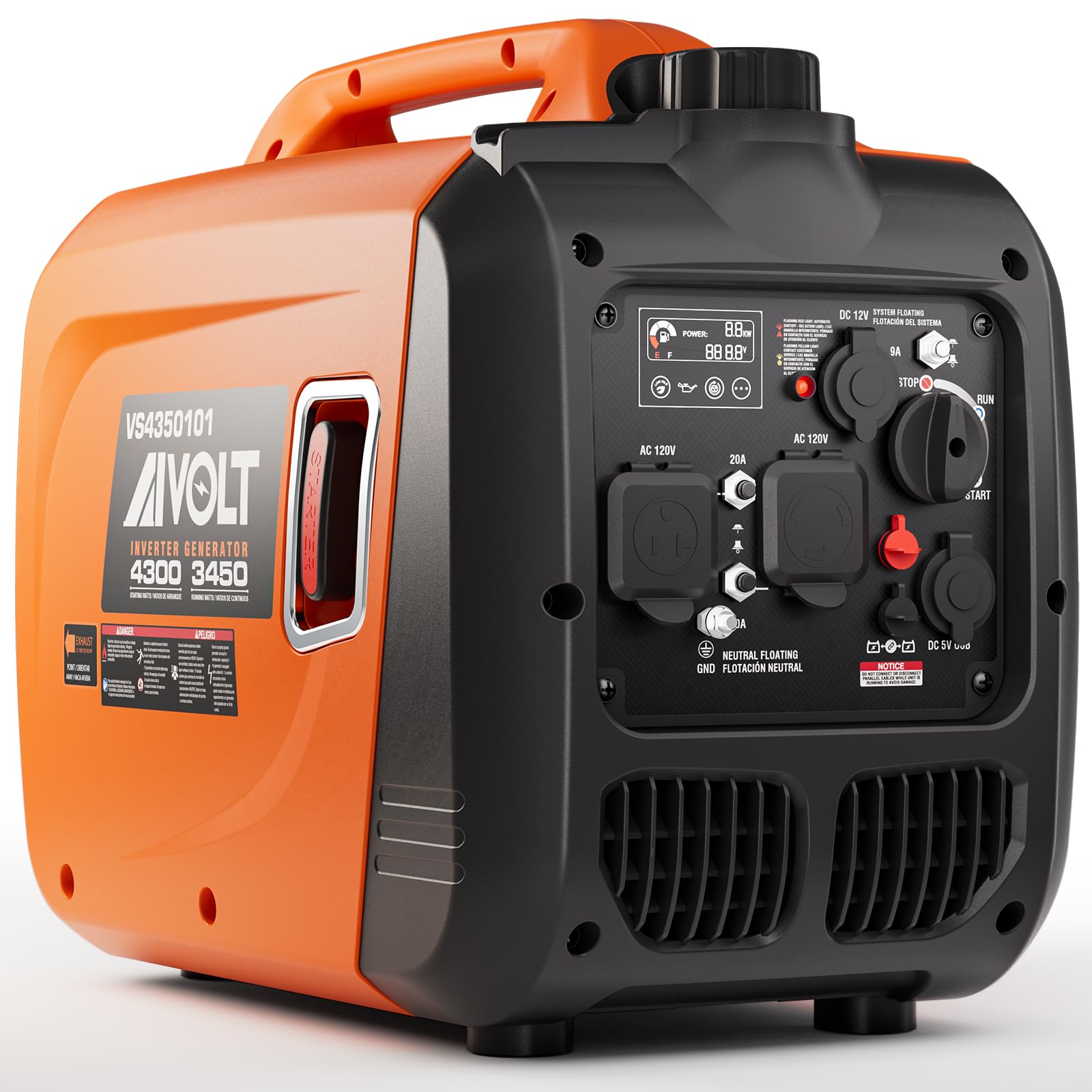
The AIVOLT 4300W inverter generator produces 4300 starting watts and 3450 running watts from a 149cc copper winding engine. It includes a 5-in-1 LCD display showing oil level, fuel level, overload warnings, voltage, and runtime—a level of instrumentation rare at this price point. The Eco Mode automatically adjusts RPM, and the 60 dBA noise level is within the conversational range.
The control panel offers a versatile outlet selection: one 20A household outlet, one 30A locking outlet, one 12V DC port, plus USB-A and USB-C ports. The built-in CO Alert shuts the generator down automatically if carbon monoxide reaches unsafe levels, and the low-fuel automatic shutdown protects the engine. Owners report the unit can handle a 1500W startup load for a portable AC and then run it for 8+ hours on a tank.
Some units have exhibited a safety lockout issue where the generator will not restart until it has cooled for up to an hour after a hot shutdown. The fuel efficiency is good but not exceptional—real-world runtime at 25% load is around 5.5 hours. For the feature density, however, it is a strong contender for buyers who want all the modern safety and convenience touches.
Why it’s great
- LCD display shows oil, fuel, load, and runtime
- CO Alert plus low-oil and overload shutdown
- USB-A and USB-C for direct device charging
- Copper winding engine for durability
Good to know
- Hot shutdown can trigger a cooldown lockout
- Noisier than stated (72-73 dB at 5 ft)
- Engine oil not included
10. Westinghouse WGen12500

The Westinghouse WGen12500 is a conventional open-frame generator designed for serious home backup, not lightweight portability. With 12,500 peak watts and 9,500 running watts on gasoline (11,200/8,500 on propane), it can power an entire home—well pump, water heater, refrigerator, and lights simultaneously. The 457cc cast-iron sleeve engine is built to last, and the remote start key fob lets you start it from inside the house.
Fuel efficiency on a unit this large is measured in gallons per hour rather than hours per gallon. The 6.6-gallon tank provides up to 12 hours of runtime at 50% load. That works out to roughly 0.55 gallons per hour, which is actually efficient for a 9.5kW open-frame generator. The dual-fuel capability means you can switch to propane during extended outages or when gasoline is unavailable. The included 50A RV outlet makes it suitable for large RVs and food trucks.
Weighing 212 pounds, this is not a generator you move easily. The wheels and handle make rolling it around a flat driveway possible, but loading it into a truck requires serious effort. The noise level is also significantly higher than inverter generators—this is a tradeoff for output. It works best as a stationary backup for a home transfer switch.
Why it’s great
- 12,500 watts peak powers entire home
- Remote start from inside the house
- Dual fuel with 12-hour runtime on gas
- Transfer switch ready with 50A outlet
Good to know
- Very heavy at 212 pounds
- Loud compared to inverter generators
- Eco Mode is not available despite manual mention
11. AIVOLT 11250W
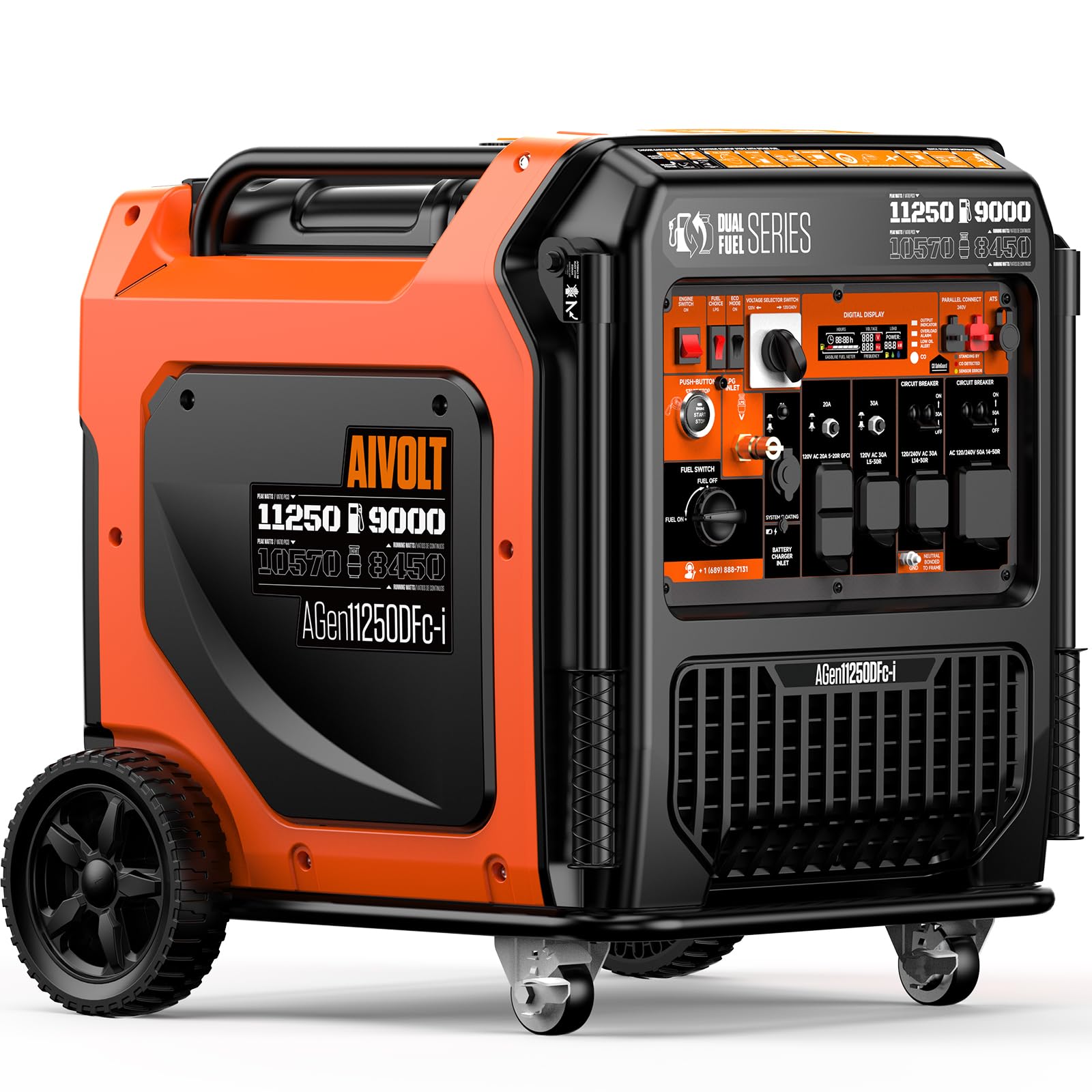
The AIVOLT 11250W is a dual-fuel inverter generator that delivers 11,250 peak watts and 9,000 running watts on gasoline, with a propane rating of 10,570 peak and 8,540 running watts. It features three start methods—remote, electric, and recoil—so you can always get it going regardless of battery status. The Eco Mode extends runtime past 19 hours at light loads, which is exceptional for a generator in this power class.
The 50A RV outlet lets you plug directly into a large motorhome or fifth wheel, and the unit is CARB compliant for sale in California. Owners report that it handles 7,000+ watt loads without issue, including a dryer, computers, TV, and lights simultaneously. The LCD display provides fuel level, voltage, and runtime at a glance. The included remote key fob lets you start and stop the generator from inside your RV or house without walking outside.
The unit has shown reliability concerns in some early units, with one report of complete failure after one hour of use. Support is based in China, which can make warranty claims slow. Some owners also note that the generator must cool down completely before restarting if it has been run hard and then shut off. For the price and feature set, it is a compelling option for those who need high-output inverter power with fuel efficiency.
Why it’s great
- 19+ hour runtime at light load with Eco Mode
- Remote, electric, and recoil start options
- 50A RV outlet for direct motorhome connection
- CARB compliant for 50-state use
Good to know
- Early failure reported in some units
- Support based overseas
- Can require cooldown period before restarting
FAQ
How many hours will a fuel efficient generator run on a single tank of gas?
Is a dual fuel generator more fuel efficient on propane or gasoline?
Does Eco Mode really save fuel or is it just a marketing feature?
Can I run a fuel efficient generator on propane indefinitely?
Why does my generator use more fuel than the manual claims?
Final Thoughts: The Verdict
For most users, the best fuel efficient generator winner is the Westinghouse iGen2550 because it combines dual-fuel flexibility with class-leading 52 dBA noise and 12-hour runtime in a lightweight 42-pound package. If you want the ultimate reliability and lowest fuel consumption per watt, grab the Honda EU2200ITAN1. And for whole-home backup with exceptional fuel economy for its class, nothing beats the AIVOLT 11250W with its remote start and 19-hour runtime at partial load.