
The moment you melt that first joint of leaded solder, a plume of rosin flux vapor rises straight toward your face. That isn’t just an unpleasant smell — it’s a mix of volatile organic compounds and particulates that you definitely don’t want settling in your lungs. A dedicated fume extractor is the only way to pull that contaminated air away from your breathing zone before it gets anywhere near your mouth or nose.
I’m Mohammad Maruf — the founder and writer behind Drink4Good. I’ve spent years comparing the airflow, filter media, and motor specs of soldering fume extractors to help hobbyists and professionals alike find a unit that actually clears the air.
To find the right unit, you need to look past the marketing claims and focus on CFM ratings, filter type, and the physical distance between the extraction hood and your iron tip. That’s exactly what this guide to the best fume extractor for soldering is designed to help you do.
How To Choose The Best Fume Extractor For Soldering
Choosing a fume extractor isn’t about picking the biggest fan you can find. You need to match the unit’s airflow and filtration to the kind of soldering you do — fine-pitch SMD work under a microscope generates less total fume volume than hand-soldering through-hole components with heavy flux, and the extraction requirements differ accordingly.
Suction Power and Static Pressure
Fan speed in RPM matters, but it’s secondary to CFM (cubic feet per minute) and static pressure. A high-RPM fan with low static pressure won’t overcome the resistance of a thick carbon filter layer or a long hose. Look for units that list both CFM and static pressure — at least 50 CFM with 100 mmH2O static pressure is a solid benchmark for bench-top units.
Filter Media: Carbon vs. HEPA
Activated carbon is the standard for soldering fume extraction because it adsorbs the volatile organic compounds (VOCs) in rosin and flux smoke. HEPA filters capture airborne particulates but do little for gas-phase contaminants. Some premium units accept both — carbon for odor/VOC removal and HEPA for particulate capture. Pre-filters also prolong the life of the primary filter by trapping larger debris before it clogs the carbon bed.
Physical Reach and Hose Design
The distance from the intake to your soldering tip is the single biggest variable in real-world performance. A unit with a flexible hose and an adjustable hood lets you position the intake inches from the joint. Fixed-front units — common on budget and mid-range extractors — require you to bring the work piece close to the machine, which isn’t always practical for large assemblies or rework tasks.
Quick Comparison
On smaller screens, swipe sideways to see the full table.
| Model | Category | Best For | Key Spec | Amazon |
|---|---|---|---|---|
| KOTTO Strong Suction Smoke Absorber | Premium | Flexible hose fume capture | 52 CFM, 6000 RPM | Amazon |
| Hakko FA400-04 | Premium | Multi-position bench use | 80% odor absorption with carbon filter | Amazon |
| Weller WSA350 | Mid-Range | Active flux fume removal | 20 watts, 120V motor | Amazon |
| Valtcan Solder Fume Extractor | Mid-Range | Adjustable tilt intake hood | 0.4 in thick carbon filter | Amazon |
| SainSmart Solder Fume Extractor | Mid-Range | Flexible magnetic helping hands | 3300 RPM, 15050 pure copper motor | Amazon |
| WEP 948DQ-III | Budget-Friendly | 2-in-1 fume extractor & soldering station | 3.9 in max suction distance | Amazon |
| KOTTO Solder Smoke Absorber | Budget-Friendly | Compact bench-top smoke removal | 0.4 in thick carbon filter, 3000 RPM | Amazon |
In‑Depth Reviews
1. KOTTO Strong Suction Smoke Absorber for Soldering, Welding, 3D Printing

The KOTTO Strong Suction model bridges the gap between bench-top fans and ducted extraction systems. Its 52 CFM airflow at 6000 RPM, driven by a 40W motor with 125 mmH2O static pressure, overcomes the resistance of both its carbon and optional HEPA filters. The 24-inch flexible hose with an adjustable hood lets you place the intake directly over your solder joint, which is the single most effective way to capture fumes before they spread.
The unit ships with a pre-attached hose and a replacement carbon filter — no assembly required. The fan speed is adjustable, so you can dial it down for quiet through-hole work or ramp it up for heavy flux applications. At 55 dB on high, it’s audible but not disruptive in a home workshop environment.
Durability is solid: the manufacturer rates the fan motor for 50,000 hours of continuous operation. The 12V DC power supply keeps you safe from line-voltage exposure inside the chassis. Users who added a separate HEPA filter reported effective fume removal even for laser engraving and 3D printing applications.
Why it’s great
- 24-inch flexible hose with adjustable hood provides pinpoint fume capture
- 52 CFM and 125 mmH2O static pressure handle thick carbon filter resistance
- Accepts both carbon and HEPA filter media for versatile contaminant control
Good to know
- At maximum speed, the 55 dB noise level may be noticeable in very quiet rooms
- The cardboard filter frame inside the unit feels less durable than the metal exterior suggests
2. Hakko FA400-04 Smoke Absorber

The Hakko FA400-04 is the reference standard for bench-top fume absorbers for good reason. It operates in both vertical and low-profile (laying down) orientations, so you can position it flat on the workbench or mount it vertically to save footprint. Its standard A1001 activated carbon filter captures up to 80% of vapor-phase odor, and an optional HEPA filter (part number 999-198) removes up to 90% of airborne particulates when you need particulate control.
Real-world performance is best within 8-10 inches of the intake face. Professional reviewers consistently note that the fan is quiet enough for classroom or lab environments, and the switch feels crisp with no annoying vibration. The plastic chassis is lightweight but sturdy, and the overall weight of 3 pounds makes it easy to reposition as your work moves.
The biggest practical limitation is the suction range — beyond 10 inches, the capture efficiency drops sharply, so you must work relatively close to the unit. An optional articulating arm mount can position the unit above your work for an overhead extraction angle, which solves the distance problem for most bench setups.
Why it’s great
- Dual orientation (vertical or horizontal) adapts to tight or open workspaces
- Optional HEPA filter upgrade for 90% particulate removal
- Very quiet operation suitable for classrooms and shared labs
Good to know
- Effective suction range drops off sharply beyond 10 inches from the intake
- The included power cord is stiff and can make positioning a bit awkward
3. Weller Genuine 120v Bench Top Smoke Absorber | WSA350

Weller’s WSA350 is built specifically for workspaces that use more active fluxes — the kind that generate heavy, acrid fumes during long soldering sessions. Its 20-watt motor produces enough airflow to pull flux vapors from stained-glass and pyrography workpieces, and the ESD-safe construction means you can place it directly on a static-sensitive workbench without worry.
The unit ships with one WSA350F replacement carbon filter, and replacement filters are widely available and inexpensive. The intake angle is fixed, but the fan is notably quiet — reviewers consistently mention it adds less background noise than competing units at similar price points. The 2-pound weight and compact footprint make it easy to move between workstations.
Where the WSA350 falls short is in raw suction power for heavy rework. If you are doing large-scale production soldering with multiple through-hole joints in rapid succession, you may want to look at the KOTTO or Hakko units for higher CFM. For the hobbyist who solders a few times a week, though, the combination of low noise and solid build quality makes this an easy pick.
Why it’s great
- Exceptionally quiet fan for shared or noise-sensitive environments
- ESD-safe body protects sensitive electronics during work
- Replacement filters are cheap and widely stocked
Good to know
- Suction power is modest — best for occasional or medium-duty soldering
- Fixed intake angle limits placement flexibility compared to adjustable hoods
4. Valtcan Solder Fume Extractor Fan Smoke Absorber

The Valtcan VALT921 punches above its price tier by including an adjustable tilt intake hood — a feature usually reserved for more expensive units. This lets you angle the face directly at your work piece, capturing fumes that would otherwise rise past a fixed-front fan. The 24-watt pure copper motor delivers adequate CFM for hobbyist soldering, and the three included 0.4-inch thick activated carbon filters mean you won’t need to buy replacements for months.
The unit is made from ESD-safe plastic that feels lightweight but not flimsy. The on/off switch is located on the top rear of the chassis, which is easy to reach but not as convenient as an inline cord switch. Dimensions of 9.5 x 6 x 11 inches make it larger than the KOTTO compact models, but the extra size allows for a larger filter surface area that improves airflow.
Users report effective fume capture at 8-12 inches from the intake, and the noise level is noticeably lower than many similarly-priced fans. The main drawback is that the plastic body may not hold up as well as the metal-framed SainSmart or the steel-chassised KOTTO units if you move it frequently.
Why it’s great
- Adjustable tilt hood directs suction exactly where it’s needed
- Three thick 0.4-inch carbon filters included in the box
- Quiet motor operation at up to 12 inches from the intake
Good to know
- Plastic chassis may feel less durable than metal-framed competitors
- Top-mounted switch is less convenient than a cord-mounted power button
5. SainSmart Solder Fume Extractor Smoke Absorber

SainSmart’s extractor stands out for its sturdiness — the housing is built from ESD-safe metal instead of thin plastic, which gives it a premium feel and prevents the unit from sliding across the bench during high-speed fan operation. The 15050 pure copper motor spins at 3300 RPM and generates enough static pressure to pull fumes from 7.9 inches away, which tests show is about 30% better than some similarly-priced plastic units.
The real differentiator here is the pair of flexible magnetic helping hands that attach to the metal frame. These 360-degree rotating arms hold small PCBs, wires, or components directly in the extraction zone, so you don’t need a separate third-hand tool. The package also includes three extra activated carbon filter pads plus the one pre-installed, giving you four total — enough for a full year of regular replacement.
The major trade-off is fan noise. Users consistently describe it as noticeably louder than the Valtcan or Weller units, though the sound is described as a “soothing” or “non-disruptive” fan noise rather than a high-pitched whine. The power switch is located on the cord rather than the unit itself, which some users find inconvenient for quick on/off access.
Why it’s great
- Rigid ESD-safe metal frame prevents sliding and provides stable grip
- Two flexible magnetic helping arms hold components in the fume path
- Four total activated carbon filters included for long-lasting use
Good to know
- Fan noise is higher than most competing units at the same price point
- Power switch on the cord is less convenient than one on the chassis
6. WEP 948DQ-III Fume Extractor Double Filtering with 110W Soldering Iron Station
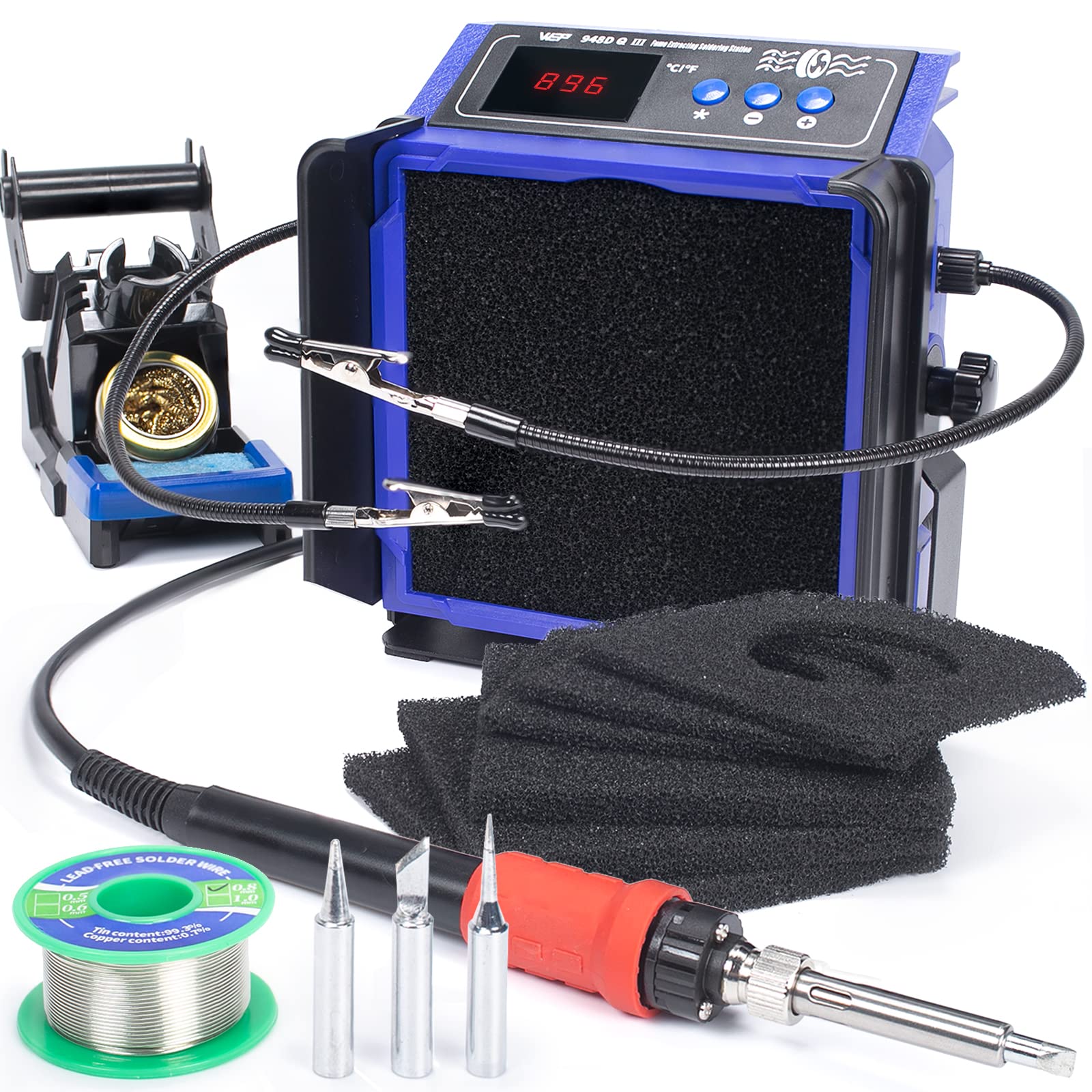
The WEP 948DQ-III is a 2-in-1 system that combines a fume extractor with a 110W soldering station — both sharing a single compact chassis. The fume extractor side uses eight filtration adsorbers positioned on both the front and rear intakes, and the maximum effective suction distance is listed at 3.9 inches. The soldering station features PID temperature control with an LED display, Fahrenheit/Celsius conversion, a 10-minute sleep mode, and auto-shutdown.
For space-constrained workbenches, the integrated design is a major advantage: one power cord, one footprint, and no extra tool storage needed. The iron holder, tip cleaner, three soldering tips, and 35 grams of solder wire are all included in the kit. The fume extractor and soldering iron have individual power switches, so you can run the fan alone for pre-heating or post-soldering fume clearing.
The trade-off is that the extractor’s suction is inherently limited by its compact size — you need to solder within 4 inches of the intake for effective capture. Owners of the unit report that the 3A fast-blow fuse is not user-replaceable without modification, though the seller’s customer support addresses fuse failures promptly. For small electronics projects and light hobbyist use, the convenience factor is hard to beat.
Why it’s great
- True 2-in-1 integration saves bench space and reduces cable clutter
- PID temperature control with sleep mode and auto-shutdown for safety
- Individual power switches for the fan and iron for independent use
Good to know
- Suction is limited to about 4 inches, requiring close proximity to work
- The internal fuse is non-user-serviceable, though support is responsive
7. KOTTO Solder Smoke Absorber Remover Fume Extractor

The base-model KOTTO solder smoke absorber is a no-nonsense, compact solution that prioritizes simplicity and reliability. Its 3000 RPM fan pulls fumes from 5-6 inches away, and the 0.4-inch thick activated carbon filter traps the bulk of VOCs from rosin flux. The flat, rectangular body measures just 5 x 5 x 3 inches — small enough to tuck into a toolbox or sit beside a microscope without blocking your view.
Four non-slip rubber feet anchor the unit firmly to the bench, and the built-in carrying handle makes it easy to reposition. The included replacement filter means you get immediate value without needing to buy consumables on day one. Power consumption is a modest 30 watts, so it can run continuously without significantly impacting your electricity bill.
The fan is not silent — users describe it as audible but not irritating — and the maximum effective range is around 8-10 inches for light smoke. For small PCB soldering and occasional repair work, this unit delivers everything you need and nothing you don’t. The black foam pad on the intake side does offer some pre-filtration, but the primary carbon filter is doing the heavy lifting for gas-phase contaminants.
Why it’s great
- Ultra-compact footprint fits into tight workshop or toolbox spaces
- 30-watt motor with 3000 RPM provides reliable suction at close range
- Comes with one spare filter right out of the box
Good to know
- Suction drops significantly beyond 6 inches from the intake
- Fan noise is present at all speeds, though not piercing
FAQ
How often should I replace the activated carbon filter in my fume extractor?
Can a fume extractor handle smoke from lead-based solder?
Do I need a HEPA filter for soldering, or is carbon enough?
How close should I place the fume extractor to my soldering iron?
Final Thoughts: The Verdict
For most users, the best fume extractor for soldering winner is the KOTTO Strong Suction Smoke Absorber because its 52 CFM motor and flexible 24-inch hose give you pinpoint fume capture where other units force you to work directly against a fixed intake. If you want a proven quiet performer with vertical/horizontal flexibility, grab the Hakko FA400-04. And for the budget-conscious buyer who wants a compact footprint and a spare filter included from day one, nothing beats the KOTTO Solder Smoke Absorber.