
That browning, expanding ring in your St. Augustine lawn is the hallmark of Rhizoctonia solani, the fungus behind brown patch. It strikes when night temperatures climb above 70°F and humidity hangs heavy, turning your lush turf into a patchwork of dead, sunken circles. The margin between saving the lawn and losing it is measured in days, not weeks.
I’m Mohammad Maruf — the founder and writer behind Drink4Good. I’ve spent thousands of hours dissecting fungicide labels, cross-referencing active ingredient performance trials, and tracking user results to separate the products that actually halt brown patch from those that just stain the grass green for a day.
This guide delivers the hard data you need to select the right fungicide for brown patch in st. augustine without wasting money on sprays that wash off in the first rain or fail to reach the crown where the fungus lives.
How To Choose The Best Fungicide For Brown Patch In St. Augustine
Brown patch in St. Augustine is caused by the fungus Rhizoctonia solani, which attacks the leaf sheaths near the soil line. The first symptom is a water-soaked, dark lesion on the leaf blade that quickly expands into a large, sunken tan patch. Because St. Augustine is a warm-season grass with a thick thatch layer, the fungicide must have systemic movement to reach the crown and stop the fungus from colonizing new tissue.
Active Ingredient Priority
Propiconazole is the most common go-to for brown patch because it moves upward through the xylem and accumulates in new growth, giving you a 14- to 28-day window of protection. Azoxystrobin is a strobilurin that moves in both the xylem and translaminarly, meaning it penetrates the leaf blade and moves to the opposite side. For curative applications when the patch is already visible, a product with a dual mode of action — either a tank mix or a pre-mix of a triazole and a strobilurin — is preferred.
Formulation Type
Liquid concentrates (emulsifiable concentrates or suspension concentrates) allow you to dial in exact rates per 1,000 square feet and are better for spot-treating active patches. Granular fungicides, like those on a coated fertilizer carrier, provide even broadcast coverage and are ideal for preventative programs. For St. Augustine, which has a dense canopy, liquid sprays must be applied with enough water volume (2 gallons per 1,000 sq ft minimum) to reach the thatch zone where the fungus resides.
Application Timing and Weather Resistance
Brown patch is most active when overnight temperatures stay above 68°F and the leaf blades remain wet for longer than 10 hours. Once applied, the fungicide must resist wash-off from rain or irrigation for at least 24 hours. Microemulsion formulations (MEC) and suspension concentrates (SC) typically have better rainfastness than older emulsifiable concentrates because the active ingredient particles are smaller and adhere more evenly to the waxy St. Augustine leaf surface.
Quick Comparison
On smaller screens, swipe sideways to see the full table.
| Model | Category | Best For | Key Spec | Amazon |
|---|---|---|---|---|
| Atticus Artavia 2 SC | Azoxystrobin SC | Total-plant curative control | 22.9% Azoxystrobin | Amazon |
| The Andersons Prophesy | Granular Propiconazole | Preventative coverage on large lawns | 25 lb bag / 10k sq ft | Amazon |
| Dow Eagle 20EW | Myclobutanil EW | Professional-grade spot treatment | 19.7% Myclobutanil | Amazon |
| Atticus Gravex 20EW | Myclobutanil EW | Curative on ornamentals and turf | 19.7% Myclobutanil | Amazon |
| Atticus Gunner 14.3 MEC | Propiconazole MEC | Low-odor liquid preventive | 14.3% Propiconazole | Amazon |
| Quali-Pro Propiconazole 14.3 | Propiconazole MEC | Value propiconazole for brown patch | 14.3% Propiconazole | Amazon |
| Monterey Complete Disease Control | Bacillus-based biofungicide | Organic garden application | 16 oz liquid concentrate | Amazon |
In‑Depth Reviews
1. Atticus Artavia 2 SC Azoxystrobin Fungicide
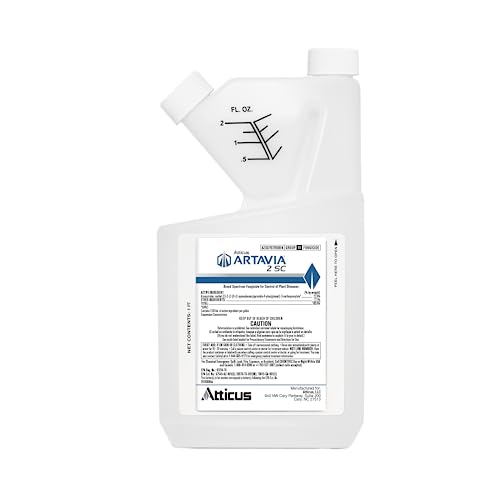
Azoxystrobin at 22.9% active gives you the full strobilurin punch against Rhizoctonia solani. This suspension concentrate is absorbed by both the leaf and the root, then moves upward and downward through the xylem and across the leaf blade via translaminar movement. That means a single spray covers the top of the blade, the underside where spores land, and the soil-borne infection court simultaneously.
With application intervals up to 28 days for brown patch, Artavia 2 SC lets you extend between sprays during the worst heat of summer. The suspension concentrate formulation mixes cleanly with water and stays suspended without constant agitation, though the integrated measuring cap on the bottle is imprecise — use a dedicated measuring cup for accurate dosing. Users report it kills active root rot in new sod and stops wood-routing mushrooms on contact.
Low odor is a real advantage when spraying near patios or open windows. If you want a product that works both preventatively and curatively with the longest residual window on the market, this is the one to reach for first.
Why it’s great
- True systemic movement in both directions for total plant coverage
- Up to 28-day residual protection reduces spray frequency
- Very low odor compared to triazole fungicides
Good to know
- 16 oz bottle is small; large lawns may need multiple bottles
- Bottle cap measurement is unreliable; use a separate measuring cup
- Not available for sale in Alaska, Hawaii, or Vermont
2. The Andersons Prophesy Propiconazole on DG Pro
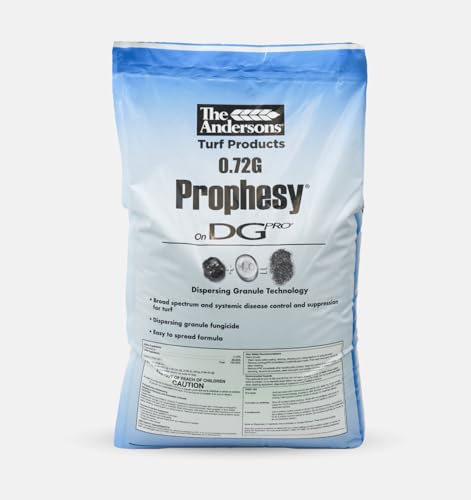
This is the only granular option in the lineup, and it is a strong one for preventative brown patch programs. The patented DG Technology carrier delivers 50% more particles per square foot than standard fertilizer-based granules, which means the propiconazole is distributed more evenly across the dense St. Augustine canopy. Each pellet breaks down quickly after watering-in to release the active ingredient into the thatch layer where Rhizoctonia lurks.
Users with lawns that developed resistance to consumer-grade fungicides like Scotts Disease Ex report that Prophesy knocked out red thread and necrotic ring spot in a single application. The 25-pound bag covers 10,000 square feet at the standard preventative rate, making it the most economical choice for a full-lawn blanket treatment. It works best when applied just before the summer humidity spike, giving you systemic protection that lasts through the brown patch window.
The tradeoff is speed of action — granular products need one to two days and a good watering-in before the active ingredient is bioavailable. For a curative rescue on an active infection, a liquid concentrate will act faster. But for a “set it and forget it” spring protocol, this is the most efficient option.
Why it’s great
- Even particle distribution prevents hot spots and streaks
- One bag covers an entire medium-to-large lawn preventatively
- Works when other fungicides fail due to resistance buildup
Good to know
- Requires water activation — not effective if left dry on the blade
- Slower curative action compared to liquid concentrates
- Price has risen significantly, pushing it into the premium tier
3. Dow AgroSciences Eagle 20EW Fungicide

Eagle 20EW is the name that golf course superintendents and professional landscapers have trusted for decades. Myclobutanil is a sterol-inhibiting triazole that stops fungal cell wall formation, and at 19.7% it is one of the highest concentrations available in a consumer-sized package. The emulsifiable concentrate formulation moves upward through the xylem and concentrates in new growth, which is exactly where brown patch establishes first on St. Augustine.
Users in zone 7 and above report it as their go-to for powdery mildew on ornamentals, but the label also clearly covers brown patch, dollar spot, spring dead spot, and zoysia large patch. The 16-ounce bottle treats a significant area because the use rate is low — 1 to 2 ounces per 1,000 square feet depending on disease pressure. It has a strong agricultural odor, and mixing rates are given in ounces per acre, so you will need to do some math to down-convert for a residential lawn.
This is not a beginner-friendly product, but if you need proven curative power and are comfortable with PPE, it is one of the most effective formulations for stopping an active brown patch infection in its tracks.
Why it’s great
- Highest myclobutanil concentration in this tier for maximum potency
- Proven track record on golf courses and commercial turf
- Concentrates in new growth where brown patch attacks first
Good to know
- Mixing instructions require calculation for residential lawns
- Strong chemical odor during application
- Full PPE (respirator, gloves) recommended
4. Atticus Gravex 20EW Fungicide
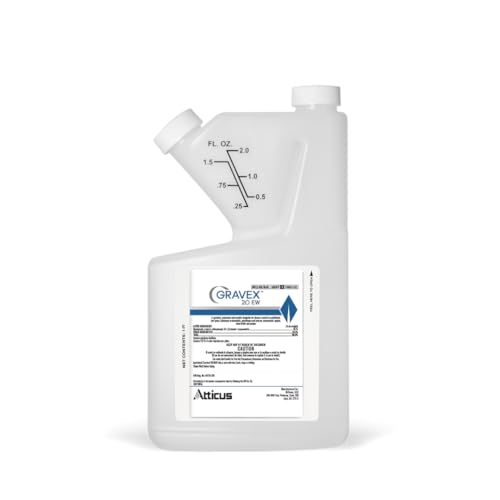
Gravex 20EW is Atticus’s generic equivalent of Eagle 20EW, using the exact same 19.7% myclobutanil active ingredient in an emulsifiable concentrate. It carries both curative and preventive claims for brown patch, red thread, anthracnose, and spring dead spot, and it is labeled for turfgrass, ornamentals, and fruit trees. The upward systemic movement means new tender growth is protected as it emerges, which is critical for St. Augustine that is actively putting out runners in summer.
Users have reported that a single application stopped brown rot on peaches two weeks before harvest, and that spot treatment on zinnias eliminated powdery mildew in 24 hours on potted plants. For turf, the typical rate is 0.6 to 1.2 fluid ounces per 1,000 square feet, making the 16-ounce bottle economical for multiple spot treatments or a full lawn spray. The bottle includes a measuring spout that users find helpful for accurate dosing.
The odor is noticeable but less offensive than some older triazoles. My main caveat is the registration restriction — not available in New York, Alaska, DC, Puerto Rico, or Vermont — so check your state label before ordering.
Why it’s great
- Same active ingredient as Eagle 20EW at a lower cost per ounce
- Residual protection up to 28 days on labeled diseases
- Broad label covers turf, ornamentals, and fruit trees
Good to know
- Strong chemical smell during mixing and spraying
- Not registered for sale in several states
- Requires careful handling and full PPE
5. Atticus Gunner 14.3 MEC Propiconazole
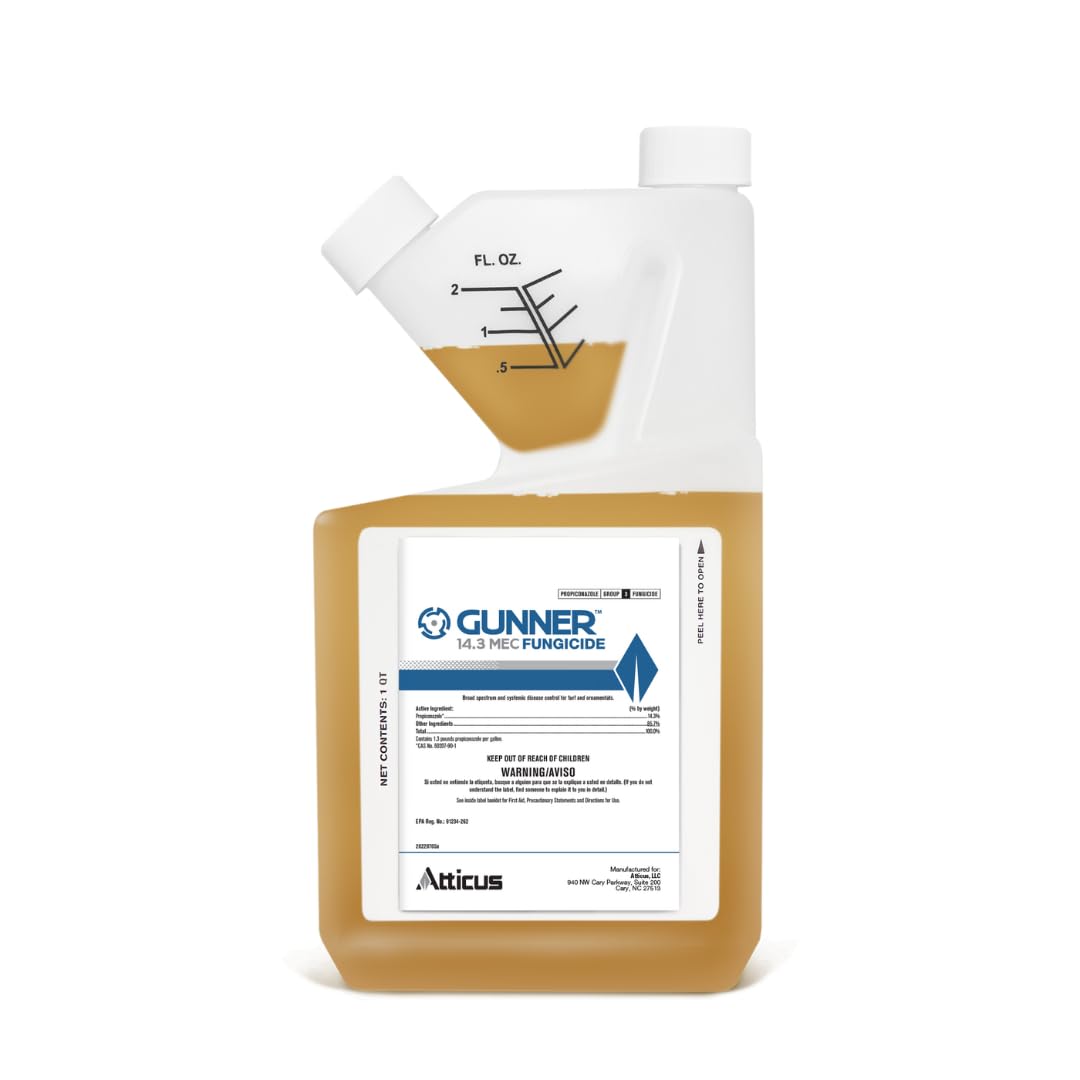
Gunner 14.3 MEC uses a microemulsion concentrate formulation that makes the propiconazole particles tiny enough to stay evenly suspended in the spray tank without separating. This matters for brown patch on St. Augustine because even coverage — especially on the lower leaf blades near the thatch — is where the battle is won or lost. Once dry, this formulation resists wash-off from rain and irrigation much better than standard ECs.
The low-odor profile is a genuine advantage for homeowners who need to spray near living areas. Users treat up to 12,000 square feet with the 32-ounce bottle at the standard preventative rate of 2 ounces per 1,000 square feet. It enters the plant through root uptake and stem absorption, delivering systemic protection that lasts up to 28 days. It also tank-mixes well with other fungicides if you want to add a second mode of action for heavy disease pressure.
The 14.3% concentration is slightly lower than some competitors, but the MEC formulation’s superior suspension stability and rainfastness mean more of the active ingredient actually stays on the leaf. For a straightforward, low-fuss preventative spray, this is one of the cleanest options to work with.
Why it’s great
- MEC formulation stays suspended without constant agitation
- Excellent rainfastness once dry — resists wash-off
- Very low odor compared to typical triazole sprays
Good to know
- 14.3% propiconazole is lower than some concentrated alternatives
- Not for sale in Alaska, DC, Hawaii, Puerto Rico, or Vermont
- Requires two-week intervals between applications for curative use
6. Quali-Pro Propiconazole 14.3 Fungicide

Quali-Pro is a solid generic propiconazole 14.3 MEC that gets the job done without the brand markup. The microemulsion formulation gives it the same rainfastness and tank stability as the Atticus Gunner, and the active ingredient is identical. It controls brown patch, dollar spot, gray leaf spot, anthracnose, and summer patch on both cool and warm season grasses. It’s labeled for ornamentals and trees too, so you can use the same bottle for rose black spot and lawn fungus.
Real-world results on St. Augustine are well-documented. Users have posted before-and-after photos showing visible new growth within a week of application and significant recovery in one month. The 32-ounce bottle covers a similar area to the Gunner at the same use rates, and the 2-pound weight includes the bottle and product combined. The instructions are printed small on the label, so you may want to use a magnifier or look up the PDF label online for mixing ratios.
For the price, this is the most accessible entry point into professional-grade propiconazole. If you are on a budget and just need to hit the brown patch before it spreads across the whole lawn, this is the best value-to-performance ratio in the list.
Why it’s great
- Lowest cost per ounce of propiconazole in this comparison
- Broad label covers all major St. Augustine diseases
- Microemulsion formulation ensures even mixing and coverage
Good to know
- Label print is very small and hard to read
- Some users report better results on St. Augustine with azoxystrobin
- Not as effective as strobilurins for curative rescue on active infections
7. Monterey Complete Disease Control
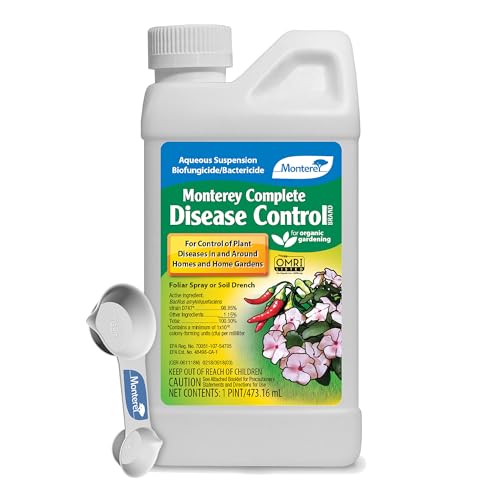
Monterey Complete Disease Control is a biological fungicide based on a bacillus strain that colonizes root hairs and outcompetes pathogenic fungi. OMRI-listed for organic gardening, it works by taking up residence on the root surface and creating a living barrier against Rhizoctonia and other soil-borne pathogens. It can be used as a foliar spray or a soil drench, which gives you flexibility for both prevention and early-stage suppression.
For St. Augustine, it is best used as a preventative drench at the start of brown patch season. Users report good results on tomatoes and peach trees, but the biology is the same on turf — the bacillus needs time to establish a colony before disease pressure hits. It will not cure an advanced brown patch infection, but it can slow the spread when caught early. The 16-ounce pint bottle makes about 24 gallons of spray solution, covering a modest area for spot treatment.
The advantages are zero chemical odor, no PPE requirement, and the ability to apply to edible plants without a harvest interval. The disadvantage is speed and potency — compared to synthetic triazole or strobilurin fungicides, this is slower-acting and less effective on established infections. For the organic gardener maintaining a healthy lawn as a primary strategy, it is a good complement.
Why it’s great
- OMRI Listed for certified organic gardening
- Root colonization prevents disease establishment at the source
- Safe for use on edibles; no harvest interval
Good to know
- Much less potent than synthetic fungicides on active brown patch
- Best results require early application before disease pressure
- Small bottle size may require multiple purchases for large lawns
FAQ
Can I use a granular fertilizer fungicide for curative treatment of brown patch?
How often should I apply fungicide to St. Augustine for brown patch during summer?
Final Thoughts: The Verdict
For most users, the fungicide for brown patch in st. augustine winner is the Atticus Artavia 2 SC because its dual-direction systemic azoxystrobin provides the fastest curative action and longest residual of the liquid options. If you want a no-spray broadcast solution for a full-lawn preventative program, grab The Andersons Prophesy. And for a professional-grade spot treatment on an active infection that the strobilurins cannot stop alone, nothing beats the knockdown power of Dow Eagle 20EW.