
Wet, humid weather turns a healthy lawn into a breeding ground for brown patch, dollar spot, and rust. The difference between stopping these outbreaks in a weekend and fighting them all season comes down to one thing: the active ingredient and the delivery method you choose.
I’m Mohammad Maruf — the founder and writer behind Drink4Good. I track lawn care formulations year-round, comparing active ingredient percentages, particle distribution, and the difference between preventative and curative coverage across dozens of brands so you don’t have to guess.
Whether you’re dealing with a small patch of St. Augustine or several thousand square feet of Kentucky bluegrass, finding the right fungicide for grass means matching the formulation to your specific disease, turf type, and season.
How To Choose The Best Fungicide For Grass
Not all lawn fungicides work the same way. A product that obliterates powdery mildew on ornamentals may do nothing against gray leaf spot on St. Augustine. The key is matching the active ingredient to the specific disease cycle in your lawn.
Active Ingredient: The Core of Control
Propiconazole is the workhorse of turf disease management — it is a systemic triazole that moves through the plant to protect new growth and treat existing infections. Azoxystrobin, found in products like Heritage G, offers a different mode of action that targets fungal respiration. Rotating between these two chemistries prevents resistance from building up in the fungal population.
Formulation: Liquid vs. Granule
Liquid concentrates like Quali-Pro Propiconazole require a sprayer and thorough coverage but enter the plant faster, making them ideal for curative treatment. Granular options like Bonide Infuse or The Andersons Prophesy use a spreader for even distribution and work well as preventative applications, releasing the active ingredient slowly as you water them in.
Coverage Area and Cost Per Square Foot
A 25-pound bag of granules may cover 10,000 square feet, while a 32-ounce liquid concentrate treats the same area multiple times. Calculate your lawn size before buying — a product that covers 5,000 square feet is perfect for a small suburban front yard but requires multiple bags for a larger property.
Quick Comparison
On smaller screens, swipe sideways to see the full table.
| Model | Category | Best For | Key Spec | Amazon |
|---|---|---|---|---|
| Bonide Infuse Lawn & Landscape | Granule | Preventative lawn care | 5,000 sq ft coverage | Amazon |
| Atticus Gunner 14.3 MEC | Liquid | Broad-spectrum curative | 14.3% propiconazole | Amazon |
| Quali-Pro Propiconazole 14.3 | Liquid | Professional-grade control | 14.3% propiconazole | Amazon |
| Dow AgroSciences Eagle 20EW | Liquid | Persistent disease issues | Systemic EW formulation | Amazon |
| The Andersons Prophesy | Granule | Large area prevention | 25 lbs, 10,000 sq ft | Amazon |
| Syngenta Heritage G | Granule | Stubborn lawn diseases | 0.31% azoxystrobin | Amazon |
| Monterey Complete Disease Control | Liquid | Organic gardens | OMRI Listed | Amazon |
In‑Depth Reviews
1. Bonide Infuse Lawn & Landscape Systemic Disease Control

Bonide Infuse stands out because it works systemically from the inside out. The 7.5-pound bag of granules covers 5,000 square feet, making it a perfect fit for the average residential lawn. It targets dollar spot, brown patch, rust, powdery mildew, leaf spot, and snow mold, which covers nearly every common cool and warm season grass disease.
The granular format means you apply it with a standard spreader and water it in — no mixing, no sprayer calibration, no drift concerns. It works on all major turf types including Bentgrass, Bluegrass, Bermudagrass, Fescue, Ryegrass, St. Augustinegrass, and Zoysiagrass. Users report effective control lasting 2-3 months per application.
One reviewer noted it stopped a camellia die-off that had already cost hundreds in replacement plants, and multiple users confirm it outperforms spray-on alternatives for general lawn maintenance. The upfront cost is higher than some liquid concentrates, but the ready-to-use convenience saves time and eliminates equipment cost.
Why it’s great
- Systemic action provides 2-3 months of protection
- Compatible with all cool and warm season grasses
- No mixing or spraying equipment required
Good to know
- Not effective against gray leaf spot without rotation
- Requires watering in for activation
2. Quali-Pro Propiconazole 14.3 Fungicide

Quali-Pro delivers the same 14.3% propiconazole found in professional golf course formulations, packaged for residential use. The microemulsion concentrate stays mixed in the tank without settling, which means consistent coverage across the entire application. It controls rusts, snow molds, gray leaf spot, Zoysia patch, dollar spot, summer patch, anthracnose, leaf spot, brown patch, and powdery mildew.
Users report dramatic results against brown patch in St. Augustine and Bermuda grass. One reviewer applied 2 ounces per gallon per 1,000 square feet and saw visible new grass growth after one week, with full recovery after a second application 14 days later. The bottle goes a long way — a 32-ounce bottle can last multiple seasons for a moderate-sized lawn.
The microemulsion formulation produces less odor than older emulsifiable concentrate products, which is a practical advantage when treating areas near patios or play areas. It requires a sprayer and protective gear during mixing, but the control speed is unmatched for curative applications.
Why it’s great
- Same active ingredient as professional turf products
- Microemulsion stays mixed and has low odor
- Fast systemic action for curative treatment
Good to know
- Requires PPE and sprayer equipment
- Avoid application during extreme heat
3. Atticus Gunner 14.3 MEC Fungicide
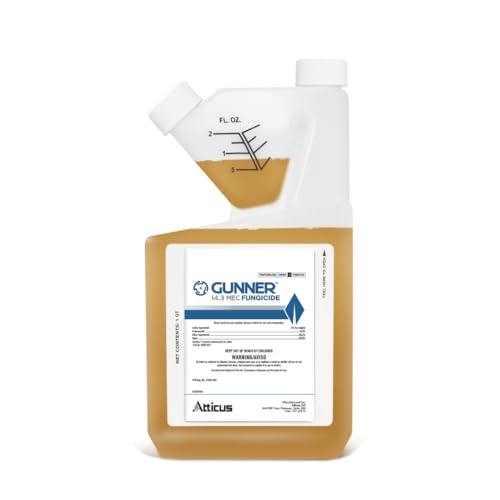
Atticus Gunner matches the same 14.3% propiconazole concentration as Quali-Pro but in a microemulsion concentrate (MEC) formulation designed for superior tank-mix stability. It resists washing off after rains once dried, which matters for lawns in regions with unpredictable summer storms. The low-odor formula means you won’t smell chemical residue after application.
Protection lasts up to 28 days per application, which aligns well with a monthly spray schedule during peak disease season. It controls brown patch, dollar spot, blights, powdery mildew, and rusts — the core diseases that plague most home lawns from June through September. The 32-ounce bottle treats the average 12,000-square-foot lawn multiple times.
Users appreciate that the MEC formula does not settle or separate in the sprayer, eliminating the need to remix during application. One reviewer specifically noted they bought a second bottle after the first worked — a strong indicator of repeat satisfaction. It is not registered for sale in several states including Alaska, Hawaii, and Vermont, so check local regulations.
Why it’s great
- Microemulsion resists rain wash-off after drying
- Low odor during and after application
- Lasts up to 28 days per treatment
Good to know
- Not available in all states
- Label instructions are printed very small
4. Dow AgroSciences Eagle 20EW Fungicide

Eagle 20EW from Dow AgroSciences is a heavy-duty systemic fungicide formulated as an emulsifiable concentrate. It controls more than 15 fungal diseases including dollar spot, brown patch, anthracnose, spring dead spot, necrotic ring spot, red thread, leaf spot, powdery mildew, rusts, and Zoysia large patch. This is the product you reach for when standard treatments fail.
The 16-ounce container is smaller than most, but the concentration means it treats a significant area when mixed correctly. Users report it saved red oaks from blight and eliminated powdery mildew on ornamentals that copper fungicides could not touch. It is well tolerated by popular turf and ornamental species, working from the inside out to protect new growth.
This is a professional-grade product that requires careful mixing and full protective gear. One user mixed it with imidacloprid and liquid fertilizer for a deep root treatment on a 66-inch girth oak tree. It is powerful but demands respect for the label directions — this is not a casual spray-and-go product.
Why it’s great
- Controls over 15 different fungal diseases
- Systemic action protects new growth
- Effective where other fungicides fail
Good to know
- Requires full PPE and careful mixing
- Small 16 oz bottle, needs accurate measuring
5. The Andersons Prophesy Propiconazole on DG Pro
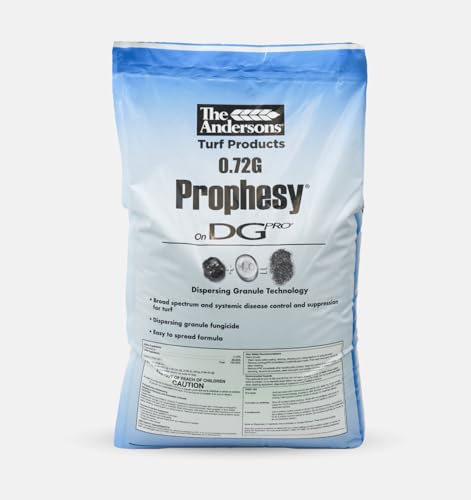
The Andersons Prophesy uses patented DG (Disperible Granule) Technology to deliver propiconazole with superior particle distribution. The 25-pound bag treats up to 10,000 square feet, making it the best option for large lawns where liquid spraying becomes impractical. It provides broad-spectrum systemic control of brown patch, dollar spot, snow mold, and more.
Users consistently report fast results — one reviewer noted that necrotic ring spot that had been worsening for months cleared up after one application combined with lawn topsoil. Another review mentioned the same active ingredient as products selling for more than double the price, calling it a professional-grade solution at a fair price.
The granular format works as both a preventative and a curative treatment. You apply it with a standard broadcast spreader, then water it in to activate the systemic uptake. The main drawback is that the price has increased noticeably with inflation, though it still delivers more active ingredient per square foot than most bagged alternatives.
Why it’s great
- DG technology provides even particle distribution
- 10,000 sq ft coverage from one bag
- Cured necrotic ring spot in one application
Good to know
- Requires spreader calibration for best results
- Price has increased significantly
6. Syngenta Heritage G Fungicide

Syngenta Heritage G is built around azoxystrobin, a strobilurin fungicide that targets fungal respiration through a different biochemical pathway than propiconazole. This makes it an essential rotation partner — using it alternately with a triazole prevents the fungal population from developing resistance. At 0.31% azoxystrobin, the 30-pound bag is designed for golf courses, athletic fields, and large residential lawns.
Users with bluegrass lawns in Colorado report it saved their turf from melt-out, a common August problem when heat and dry conditions stress the grass. One reviewer tried multiple store brands with zero success before Heritage G solved the problem. Another user cured four different fungus types on their bluegrass lawn with two applications spaced 30 days apart.
The primary concern is that azoxystrobin is toxic to birds and aquatic life, so runoff management is critical. The granular form is safer from a drift perspective than liquid sprays, but you still need to keep it away from waterways. Apply after mowing and water the granules thoroughly per the label directions.
Why it’s great
- Different mode of action than propiconazole for rotation
- Extremely effective on stubborn lawn diseases
- Large 30 lb bag covers extensive areas
Good to know
- Toxic to birds and aquatic life if runoff occurs
- Premium price point
7. Monterey Complete Disease Control
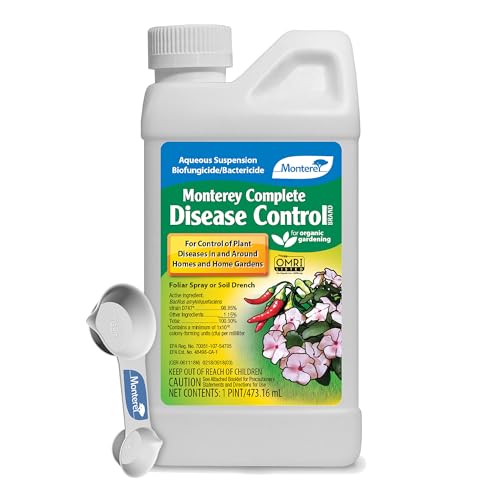
Monterey Complete Disease Control is an OMRI Listed bio-fungicide that works through a unique mechanism — it colonizes root hairs to prevent disease-causing fungi and bacteria from establishing. It controls powdery mildews, rust, leaf blight, brown rot, leaf spots, anthracnose, and gray mold on vegetables, fruits, nuts, ornamentals, and lawns. The 1-pint bottle comes with a measuring spoon for accurate mixing.
Users in the southeastern U.S. report it as a lifesaver for tomatoes in rainy seasons, and another reviewer confirmed it works on peach leaf curl with multiple spring applications. It can be applied as a foliar spray or as a root drench, giving you flexibility depending on the disease location. The concentrated liquid form is more cost-effective than pre-mixed spray bottles.
The important caveat is that this product controls and suppresses disease — it does not cure an established infection. One indoor gardener with persistent leaf spot noted it slowed the spread on new leaves but did not eliminate the problem entirely. It is best used as a preventative program rather than a rescue treatment for advanced lawn disease.
Why it’s great
- OMRI Listed for organic gardening
- Can be used as foliar spray or root drench
- Safe for vegetables, fruits, and ornamentals
Good to know
- Controls and suppresses, does not cure
- Best used as a preventative treatment
FAQ
How often should I apply fungicide to my lawn?
Can I mix propiconazole and azoxystrobin together?
What is the best time of day to apply lawn fungicide?
Final Thoughts: The Verdict
For most users, the fungicide for grass winner is the Bonide Infuse Lawn & Landscape because it combines systemic propiconazole with the convenience of ready-to-use granules that cover 5,000 square feet without mixing or spraying equipment. If you need a fast-acting liquid for an active brown patch outbreak, grab the Quali-Pro Propiconazole 14.3. And for large properties where broadcast spreading makes sense, nothing beats the The Andersons Prophesy for value and coverage area.