
When leaf spots turn black, shoots wilt, and bark oozes, your tree is sending a distress signal about a fungal or bacterial infection. Identifying the right treatment means acting before the disease moves from the canopy to the roots, where recovery becomes much harder. The wrong choice wastes a season of growth or, worse, accelerates the spread of the pathogen.
I’m Mohammad Maruf — the founder and writer behind Drink4Good. I’ve spent hundreds of hours analyzing the chemical formulations, treatment protocols, and real-world performance data of tree fungicides to help you select the precise product for your specific tree and disease.
Whether you’re protecting a historic oak, a young fruit tree, or an ornamental maple, choosing the right fungicide for trees depends on matching the active ingredient to the pathogen and understanding how systemic versus contact formulas work in different weather conditions and tree sizes.
How To Choose The Best Fungicide For Trees
Selecting a tree fungicide isn’t about picking the strongest chemical. It’s about identifying whether the disease is fungal or bacterial, whether the infection is active or dormant, and whether the tree species tolerates the active ingredient. A systemic fungicide like propiconazole moves through the vascular system to protect new growth from the inside out, while a contact fungicide like copper only protects the surfaces it coats at the time of application.
Identify the Disease First
Powdery mildew appears as white powder on leaves; anthracnose creates dark, sunken lesions on leaves and stems; rust forms orange pustules on the underside of leaves; brown rot mummifies fruit on stone trees. Each disease responds to a different class of chemistry. Propiconazole and myclobutanil excel against powdery mildew, rust, and leaf spot. Copper fungicides handle bacterial leaf spot and fire blight. Captan is the go-to for brown rot and scab on fruit trees.
Match the Formulation to the Tree Size
For a 50-foot mature oak, a liquid concentrate that mixes into a backpack sprayer or a soil drench works better than a small ready-to-use spray bottle. Large trees require higher volume coverage, so a gallon of concentrate like the Propiconazole 14.3 at 128 fluid ounces provides the economy and potency needed for full coverage. For small ornamental trees and shrubs, a 1-pint concentrate or a ready-to-use neem oil blend may be sufficient.
Consider the Environment and Timing
Copper fungicides are rainfast after drying but can cause phytotoxicity in hot weather. Systemic fungicides like Eagle 20EW need to be applied before the tree starts new growth in spring for maximum protection. Organic options like Monterey Complete Disease Control colonize root hairs and provide preventive protection without harsh residues, but require more frequent applications during wet seasons.
Quick Comparison
On smaller screens, swipe sideways to see the full table.
| Model | Category | Best For | Key Spec | Amazon |
|---|---|---|---|---|
| Quali-Pro Propiconazole 14.3 | Systemic | Large trees with brown patch or oak wilt | 32 oz concentrate treats up to 16,000 sq ft | Amazon |
| Southern Ag Liquid Copper | Contact | Fruit trees with bacterial blight or moss | 31.4% Copper Ammonium Complex | Amazon |
| Eagle 20EW | Systemic | Stubborn powdery mildew on ornamentals | 16 oz treats up to 8,000 sq ft | Amazon |
| Southern Ag Captan | Contact | Brown rot on stone fruit trees | 8 oz wettable powder | Amazon |
| Ferti-lome Triple Action | Neem Oil | Small fruit trees with soft insects and mildew | 32 oz neem oil concentrate | Amazon |
| Monterey Complete Disease Control | Organic | Sensitive plants needing gentle prevention | 16 oz liquid concentrate | Amazon |
| Propiconazole 14.3 (1 Gal) | Systemic | Large acreage and professional use | 128 oz treats up to 64,000 sq ft | Amazon |
In‑Depth Reviews
1. Quali-Pro Propiconazole 14.3 Fungicide

The Quali-Pro Propiconazole 14.3 delivers the most versatile systemic protection for a wide range of tree species and turf. With 14.3% propiconazole in a microemulsion formulation, it provides less odor than older emulsions and superior tank stability, meaning you can mix it with other fungicides or fertilizers without clumping. A single 32-ounce bottle treats up to 16,000 square feet, making it an economical choice for home orchards with multiple large trees.
Real-world performance on oak trees infected with suspected oak wilt shows that a single application of 4 ounces mixed in 4 gallons of water halted spread and prevented new leaf scorch. On blackberry bushes with orange rust, three sprays applied on a 14-day interval eliminated the fungus for the entire growing season. On Bermudagrass with white-patch disease, one treatment stopped spread within 2 weeks of consistent rain.
The locally systemic mode of action moves through the leaf tissue and provides long-lasting residual control, but you need full PPE—respirator, goggles, gloves—during mixing and spraying. Reapply every 14 days during active outbreaks. It works on rusts, snow molds, gray leaf spot, dollar spot, anthracnose, brown patch, and powdery mildew across trees, shrubs, flowers, and turf.
Why it’s great
- Broad-spectrum systemic control for over 15 common tree diseases
- Microemulsion format mixes cleanly and reduces odor
- Excellent value per treatment area at 32 oz
Good to know
- Requires full PPE and careful mixing
- Not labeled for direct consumption of fruit within one year of last spray
- Effectiveness on St. Augustine grass can be weaker than on Bermuda
2. Southern Ag Liquid Copper Fungicide

Southern Ag Liquid Copper Fungicide is the standard for organic fruit tree treatment, containing 8% metallic copper equivalent from a copper ammonium complex. It controls bacterial and fungal diseases including fire blight, peach leaf curl, powdery mildew, and rust, and it also suppresses moss and algae on tree bark and fence lines. The 1-gallon size is much more economical than smaller copper sprays, and it stores well over winter without degrading.
For pepper leaf blight and tomato diseases, users report that a thorough spray stops dark-spot progression within days. On pine trees, annual applications keep needle cast and tip blight away while neighbors’ untreated trees decline. On fruit trees, it’s widely considered the top choice for spring and fall dormant sprays to prevent fungal spores from overwintering.
Copper is a contact fungicide, meaning it only protects surfaces that are directly coated at the time of spraying. You must apply it before rain or infection to form a protective barrier. Over-application or mixing with other chemicals can cause leaf burn, especially in hot weather. The copper ammonium complex is non-toxic to animals and bees once dry, but avoid spraying open blossoms.
Why it’s great
- Controls both fungal and bacterial diseases
- 1-gallon size gives the best per-treatment value
- Safe for organic gardening and non-toxic to animals when dry
Good to know
- Contact-only chemistry requires thorough coverage
- Can cause phytotoxicity at high temperatures
- Advertisement states 31% strength; received product may be 27%
3. Dow AgroSciences Eagle 20EW Fungicide

Eagle 20EW from Dow AgroSciences is a potent systemic fungicide that prevents and controls over 15 fungal diseases on turf, ornamentals, and fruit trees. The active ingredient myclobutanil penetrates leaf tissue and moves upward through the xylem to protect new growth from the inside out. It is especially strong against powdery mildew, shot-hole disease, and rusts on hydrangeas, peonies, stone fruits, and hardwood trees.
One user in the North Bay area of San Francisco used it to eliminate peach leaf curl after copper fungicide had failed. Another user saved a 66-inch girth red oak from blight by mixing 4 ounces of Eagle 20EW with imidacloprid and liquid fertilizer, applying it as a soil drench—the tree showed no blight or insect damage over a year later. On Zoysia grass in Connecticut, two applications 30 days apart eliminated clover completely.
This is a strong agricultural-grade product. Mixing requires careful calculation in ounces per 100 gallons of water or per 1,000 square feet. The label demands PPE including chemical-resistant gloves, goggles, and a respirator. It is not OMRI-listed for organic gardening, but it is EPA-registered and widely used by arborists and turf managers for its reliability.
Why it’s great
- Systemic protection for new growth against 15+ fungal diseases
- Proven to save large trees like oaks from blight
- Useful for turf, ornamentals, and fruit trees
Good to know
- Must be mixed by specific oz per 100 gal ratio
- Full PPE is mandatory during handling
- Not suitable for organic gardening
4. Southern Ag Captan Fungicide

Southern Ag Captan is a wettable powder that has been a trusted contact fungicide for orchardists for decades, particularly for controlling brown rot and blossom blight on stone fruit trees like peaches, plums, and cherries. The active ingredient captan prevents spore germination on fruit, leaves, and blossoms, which directly reduces the incidence of mummy rot and russeting on developing fruit.
For a Montmorency tart cherry tree battling yellow leaf mold, regular applications of Captan at the labeled rate kept the disease under control throughout the growing season. On peach trees, users report that proper timing—applying during bloom and again before fruit ripening—nearly eliminated the brown rot that ruined previous harvests. The powder mixes easily with water and sprays on well with a pump sprayer or hose-end applicator.
Captan is a contact fungicide that must be reapplied every 7 to 10 days during wet weather. It does not penetrate plant tissue, so complete coverage of all fruit, leaves, and stems is essential. It has a 24-hour reentry interval for workers and can irritate skin and eyes during mixing. The 8-ounce bottle treats a substantial number of trees for a very low cost per use.
Why it’s great
- Proven control of brown rot and mummy rot on stone fruit
- Wettable powder mixes easily and doesn’t settle quickly
- Very economical per treatment
Good to know
- Requires frequent reapplication in wet weather
- Contact-only chemistry demands thorough coverage
- Not labeled for edible crops without pre-harvest interval
5. Ferti-lome Triple Action
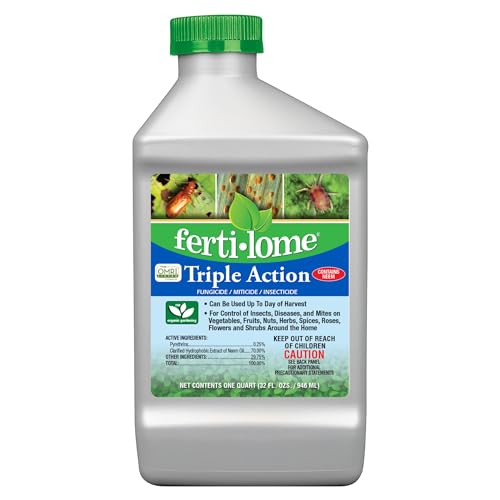
Ferti-lome Triple Action is a neem oil-based concentrate that works as an insecticide, miticide, and fungicide all in one bottle. For small fruit trees like apple and pear, it controls aphids, spider mites, leafminers, and armyworms on the insect side, while preventing powdery mildew, rust, and leaf spot on the fungal side. The 32-ounce bottle concentrates at a rate of 1 to 2 tablespoons per gallon of water, making it stretch across a season of weekly sprays.
Users with apple trees report using it for years as a regular spring and summer spray to keep both codling moth damage and apple scab under control. On roses and ornamental shrubs, it stops black spot without the harsh chemical smell of synthetic fungicides. The neem oil smothers fungal spores and soft-bodied insects on contact, but it also acts as a systemic repellent when absorbed by the leaves.
Because neem oil breaks down quickly in sunlight, you need to reapply every 7 to 14 days for continuous protection. Avoid spraying when temperatures exceed 85°F to prevent leaf burn. Neem oil is toxic to bees when wet, so spray in the early morning or late evening when pollinators are inactive. It is OMRI-listed and safe for use around pets and children once the spray has dried.
Why it’s great
- Triple action: fungicide, insecticide, and miticide in one product
- Organic ingredients safe for edibles with proper timing
- Proven effective against apple scab and powdery mildew
Good to know
- Requires frequent reapplication every 7-14 days
- Can cause leaf burn in hot weather above 85°F
- Must avoid spraying during bloom to protect bees
6. Monterey Complete Disease Control
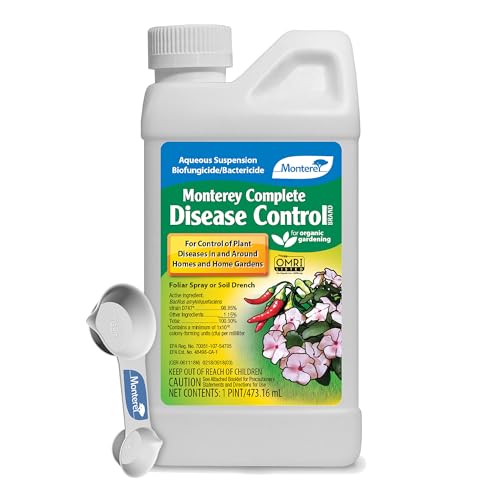
Monterey Complete Disease Control is an OMRI-listed organic fungicide and bactericide that prevents and stops powdery mildew, rust, leaf blight, brown rot, leaf spot, anthracnose, and gray mold. Unlike synthetic systemic fungicides, it works by colonizing the root hairs of the plant, which helps prevent disease-causing fungi and bacteria from establishing themselves in the first place. It can be used as a foliar spray to treat active infections or as a soil drench for root-level prevention.
For tomato plants in humid southern climates, users report that using it as a drench absorbed through the roots provides internal protection that keeps blight at bay even during heavy rain. On peach trees with leaf curl, spring applications at leaf emergence effectively reduced the symptom severity. On cucumbers, it slowed the spread of anthracnose but did not cure existing lesions, emphasizing that it works best as a preventive measure.
Mix 1 teaspoon per gallon of water and apply as a spray to fruit and foliage or as a drench to the root zone. It is safe to use on vegetables, fruits, nuts, ornamental trees, shrubs, and houseplants. The product is non-toxic to beneficial insects and bees, but you should still wear skin and eye protection during mixing. It requires more frequent applications than synthetic alternatives, especially during wet seasons.
Why it’s great
- OMRI-listed organic formula safe for edibles and ornamentals
- Works as both a foliar spray and a root drench
- Non-toxic to bees and beneficial insects when used as directed
Good to know
- Controls but does not cure severe, established infections
- Requires more frequent applications than synthetic options
- Needs careful mixing at 1 tsp per gallon
7. Propiconazole 14.3 (1 Gallon)

This 1-gallon jug of 14.3% propiconazole is the same active ingredient as the Quali-Pro but in a bulk format designed for large-scale use across plantations, turf grasses, ornamental beds, conifer farms, and nurseries. At a rate of 0.5 ounces per gallon of water to treat 1,000 square feet, a single gallon bottle treats up to 64,000 square feet—enough for multiple seasons of treatment on a property with many mature trees.
For peach leaf curl control in the Pacific Northwest, it is a cheaper alternative to Spectracide and highly effective when applied before bud break. On roses and fruit trees, users spray in the early morning or late evening to avoid sun damage, and the systemic action keeps new growth protected for weeks. On turf, it eliminates the brown and black dust on shoes from fungus without discoloring the grass.
This is a professional-grade concentrate that requires a sprayer calibrated to deliver the correct amount per 1,000 square feet. The product is not for organic gardening, and users must follow the same PPE protocol as other systemic triazole fungicides. It stores well in a cool, dry location and maintains its potency from one season to the next. The 128-ounce size is the most cost-effective way to protect a large orchard or landscape.
Why it’s great
- Best per-ounce value for large properties and professional use
- Treats up to 64,000 sq ft per gallon
- Widely effective on fruit tree fungus, turf diseases, and ornamentals
Good to know
- Not suitable for small gardens or infrequent use
- Requires a calibrated sprayer for accurate application
- Full PPE is mandatory during mixing and spraying
FAQ
Can I use a turf fungicide on my fruit trees?
How often should I apply fungicide to trees during a rainy season?
What is the difference between copper fungicide and copper ammonium complex?
Final Thoughts: The Verdict
For most users, the fungicide for trees winner is the Quali-Pro Propiconazole 14.3 because it combines broad-spectrum systemic control, excellent value for the coverage area, and proven effectiveness on oak wilt, powdery mildew, and brown patch across multiple tree species. If you want a heavy hitter for stubborn powdery mildew and shot-hole disease, grab the Eagle 20EW. And for organic gardeners who need a safe, effective preventive spray that won’t harm bees, nothing beats the Southern Ag Liquid Copper.