
A fusion splicer that delivers 0.01dB splice loss consistently across 5,000 burns without the price tag is no longer a fantasy — it’s the new standard for field engineers who take their loss budgets seriously. The days of choosing between a precision instrument and a solvent bank account are over, because six-motor core alignment technology has finally trickled down to the kits that working technicians actually buy.
I’m Mohammad Maruf — the founder and writer behind Drink4Good. My approach to this guide is built on correlating real-world field reports with hard technical specs: I analyze every stated splice loss, electrode lifespan, heating time, and motor configuration to separate genuine six-motor core alignment machines from glorified cladding-aligners dressed in touchscreens.
Whether you are wiring dense FTTH subdivisions, restoring failed mainline trunks, or outfitting a crew with multiple workstations, selecting the right best fusion splicer determines both your splices per day and your annual return on investment.
How To Choose The Best Fusion Splicer
Buying a fusion splicer is a multi-year investment in your splice loss ceiling. A bad cleaver costs you a sleeve. A bad splicer costs you every fiber in the tray. Focus on the motor count and alignment method first, then work down to battery life and electrode longevity. Manufacturers love to brand their menus — ignore the interfaces and interrogate the mechanics.
Motor Count and Alignment Type
The number of motors driving the fiber clamps and V-grooves determines whether the splicer actively centers the core or simply pushes the cladding together. Six-motor core alignment machines measure the concentricity of the core itself and physically nudge both fibers until the optical axes overlap — this is mandatory for anything beyond simple drop cable. Four-motor or passive cladding-alignment units introduce splice loss variability that shows up on the OTDR trace as a spike you cannot erase.
Electrode Lifespan and Field Replacement
Every 2,000 to 5,000 arcs erode the tungsten tips enough that arc power becomes inconsistent. Machines with tool-less electrode swaps let you change tips in 15 seconds on the tailgate without recalibrating the gap. If the electrodes are buried inside the chassis and require soldering or factory service, the machine becomes e-waste the moment the arc count passes the manufacturer’s recommended interval.
Battery Capacity in Watt-Hours, Not Marketing Cycles
A 7,800mAh lithium pack at 14.4V delivers roughly 112 watt-hours — enough for about 400 continuous splice-and-heat cycles in a six-motor machine. Less honest listings quote “battery cycles” based on splicing only without heating. Field splicing always includes heat-shrink sleeving, so demand a battery that can sustain 250 combined cycles and still hold enough charge to read the OTDR trace at quitting time. Removable batteries also matter: swappable packs turn a 90-minute wall-charge stop into a 10-second battery swap.
Quick Comparison
On smaller screens, swipe sideways to see the full table.
| Model | Category | Best For | Key Spec | Amazon |
|---|---|---|---|---|
| Komshine FX39 (B09L7XKPL2) | Premium | Production Splicing | 5000+ burns per electrode set | Amazon |
| Signal Fire AI-9 (B07SDNVP3T) | Premium | Versatile Field Work | 5s splice / 15s heat cycle | Amazon |
| ZHUOSHI AI-9 (B0D61RQF1T) | Mid-Range | Harsh Environments | Auto-focus + 320x magnification | Amazon |
| QIIRUN-6481B | Premium | Tight Access Splicing | Bidirectional fiber feed | Amazon |
| Komshine FX39 (B0B18KLWQQ) | Mid-Range | FTTH & Mainline Combo | 7800mAh battery (400 cycles) | Amazon |
| D YEDEMC Ai-9 (B07CNQVK4W) | Mid-Range | FTTH Drop Splicing | 0.025dB (SM) splice loss | Amazon |
| QIIRUN AI-9 (B07TXYX83J) | Budget Entry | First-Time Buyers | 5″ touchscreen + 7800mAh | Amazon |
In‑Depth Reviews
1. Fiber Fusion Splicer FX39
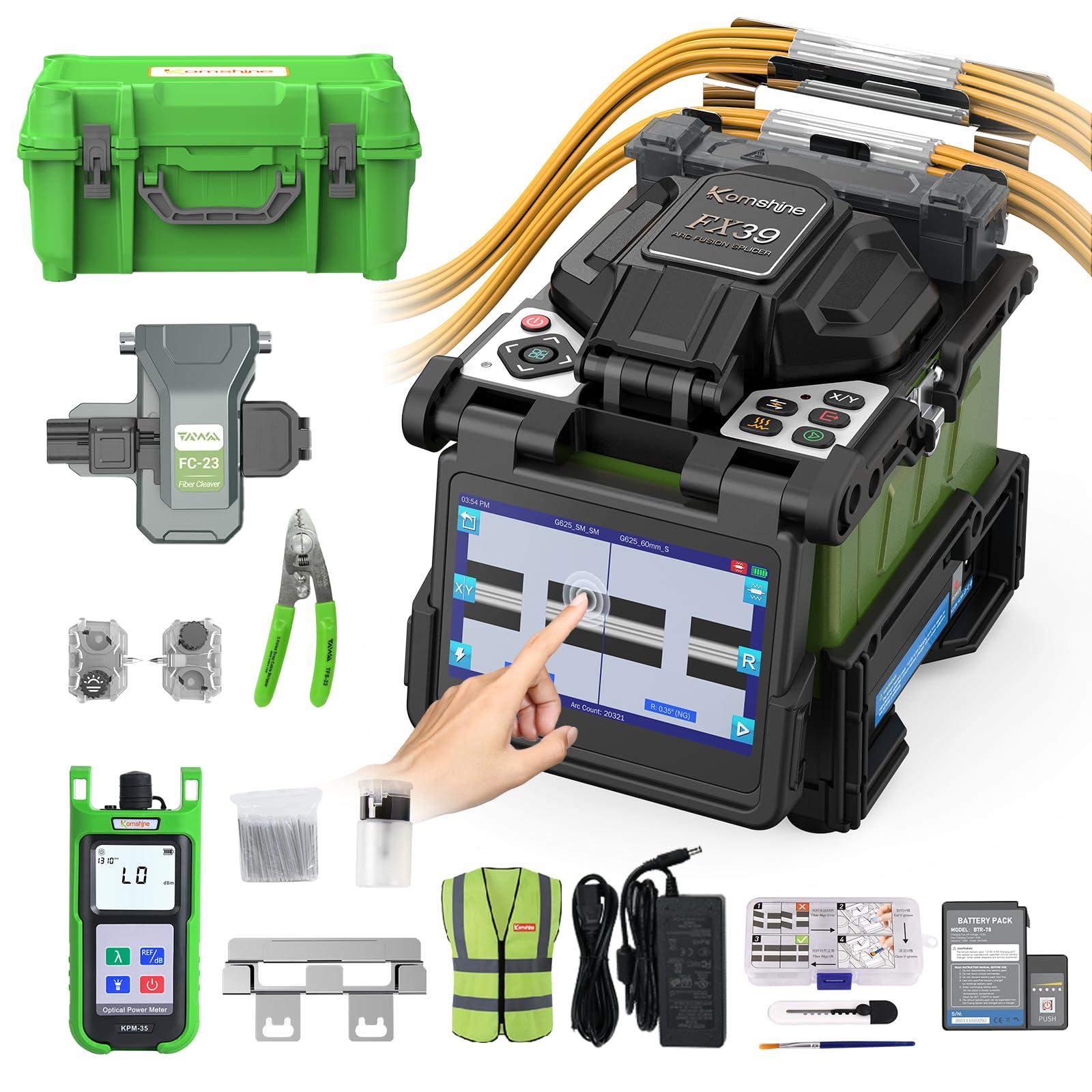
This is the machine that rewrites the budget-premium equation. Real world users report 5,000+ burns on a single electrode set and consistent 0.01dB splice loss across extreme temperature swings, humidity, and dust — conditions that would send a loose-tolerance unit into arc failure within 200 cycles. The six-motor core alignment system tolerates imperfect cleaves far better than the Fujikura 90s it gets compared against, which is the single most important reliability metric for a field engineer who cannot re-cleave every fiber three times.
The 7,800mAh battery delivers 400 combined splice-and-heat cycles on a single charge, which is enough to cover back-to-back 12-hour shifts without reaching for a charger. Tool-less electrode replacement means you can swap tips in the truck bed without breaking out a soldering iron, maintaining 0.01dB consistency through the electrode’s entire life. The included optical power meter covers seven common wavelengths from 850nm to 1625nm, saving you from carrying a separate OPM for link-loss verification.
The built-in cleaver is mediocre and causes occasional recleaving — nearly every professional user pairs this splicer with a Fujikura CT-50 or equivalent high-end cleaver, after which the machine delivers flawless sub-0.02dB performance. The carrying case is bulky for its content volume, but it holds the full kit of strippers, VFL, and spare electrodes without modification.
Why it’s great
- 5000+ electrode life with consistent 0.01dB loss across extremes of temperature, dust, and humidity.
- 7,800mAh battery supports 400 splice-and-heat cycles — full-shift operation without charging.
- Tolerates imperfect cleaves better than competing premium units, reducing field rework rate.
- Includes OPM covering 850/980/1300/1310/1490/1550/1625nm, eliminating need for separate power meter.
Good to know
- Included cleaver causes recleaving; pairing with a Fujikura CT-50 is strongly recommended for optimal results.
- Carrying case is larger than necessary relative to the kit contents, adding minor bulk in transit.
- User interface lacks the full automation polish of Sumitomo or Fujikura flagship models, though no field functionality is compromised.
2. QIIRUN-6481B Fiber Optic Fusion Splicer

The unique value proposition here is bidirectional fiber feeding — a feature absent from every other splicer in this class. When you are inside an underground cable conduit, an equipment rack interior, or an aerial closure box where fiber can only enter from one direction, a standard single-direction splicer physically cannot reach. This machine lets you insert the fiber from either side, effectively doubling your reach in confined installations without rotating the entire splicer body.
Real-world users report over 2,000 burns with core alignment still holding 0.02dB loss, and one technician exceeded 1,400 splices over a year with the machine performing like new. The 6,800mAh battery delivers 220 continuous splice-and-heat cycles, which outlasts the typical 160-cycle competing models by 38% — a meaningful gap when you are the last truck on a rural FTTH build and the nearest wall outlet is 15 miles away. The 5mm short cleave length minimizes fiber waste in high-density splice closures where fiber length is scarce.
The 4.3-inch touchscreen UI is graphical and intuitive, but several users note that the menu system occasionally requires an extra tap to find the heating-time adjustment. The water-resistant and dust-resistant body is field-graded, but the lack of a tool-less electrode access door means that swapping electrodes requires a small Phillips driver and more time than the Komshine FX39’s pop-out design.
Why it’s great
- Bidirectional fiber feed enables splicing in conduit interiors, rack gaps, and aerial closures where single-direction machines cannot access.
- 220-cycle battery outlasts standard 160-cycle competitors by 38%, reducing charge stops in remote field work.
- 5mm short cleave length conserves fiber in high-density trays and repair scenarios with limited slack.
- 2,000+ burn longevity reported by multiple field users maintaining 0.02dB loss throughout.
Good to know
- Electrode replacement requires a small Phillips screwdriver rather than tool-less removal — adds about 90 seconds to field swap.
- Touchscreen UI occasionally requires an extra menu tap for heating-time adjustments, though core splicing functions remain one-tap accessible.
- Heater latch is less robust than the main chassis, requiring careful closing to prevent fiber sleeve pinching.
3. Signal Fire AI-9 Fusion Splicing Machine

The Signal Fire AI-9 is the speed king of this lineup, delivering a 5-second fusion splice and a 15-second heat-shrink cycle that shaves roughly 30% off the total per-splice time compared to 7-second machines. Over a 200-splice day, that time saving adds up to nearly an hour of reclaimed daylight — meaningful when you are racing sunset on an outside plant project. The six motors use core alignment with a quad-core CPU that handles autofocus automatically, so the operator only needs to place the fibers and tap the screen.
Field technicians report reliable operation past 1,000 splices with regular arc calibration, and many users achieve sub-0.01dB splices after appropriate cleaver upgrades. The 7,800mAh battery supports roughly 260 combined splice-and-heat cycles per charge, which covers a standard shift but falls short of the all-day capacity of the Komshine FX39. The transparent heating slot auto-closes and includes a cooling disc that lets you queue multiple fiber sets while the previous sleeve finishes cooling.
The heater lacks an auto-close lid at the top, so the operator must manually lower the lid before starting the heat cycle — a minor workflow step but one that can pinch the fiber sleeve if forgotten. The included cleaver requires regular maintenance and is the first component users typically upgrade. The mobile app for data export is functional but most operators still prefer the touchscreen UI for day-to-day parameter adjustments.
Why it’s great
- 5-second splice with 15-second heat — fastest combined cycle in this roundup, saving nearly an hour per 200-splice day.
- Autofocus with quad-core CPU handles fiber identification automatically, minimizing operator intervention.
- 7800mAh battery with 260-cycle capacity covers most single-shift workloads without a swap.
- Transparent heating slot with cooling disc enables multi-set continuous workflow without pausing for sleeve cooling.
Good to know
- Heater lid requires manual closing — must be remembered each cycle to avoid fiber sleeve pinching.
- Electrode and cleaver maintenance schedule is tighter than the Komshine; regular cleaning needed to maintain 0.01dB consistency.
- Battery capacity of 260 cycles is adequate for standard shifts but falls short of the 400-cycle FX39 for overtime or double-shift days.
4. ZHUOSHI AI-9 Fiber Fusion Splicer
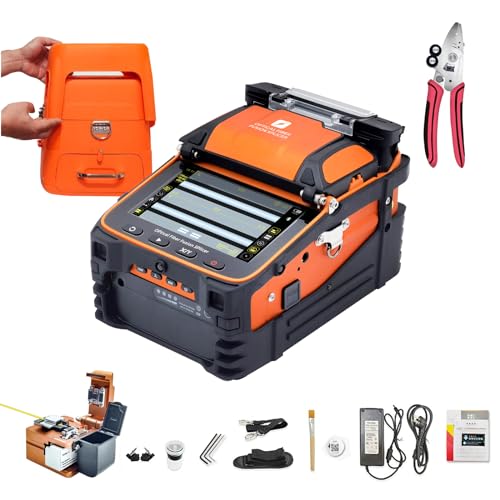
The ZHUOSHI AI-9 is explicitly built for harsh environments — altitudes above 3,000 meters, desert heat, and sub-zero cold are called out in its design specs, and field reports confirm it operates reliably in direct sunlight and cold-weather conditions. The six-motor core alignment system uses autofocus technology that automatically identifies fiber type and adjusts the focus to 320x maximum magnification, which is the highest magnification in this review and critical for inspecting bad cleave angles before committing to an arc.
The built-in optical power meter is unusually comprehensive, covering ten wavelengths including 980nm, 1270nm, 1577nm, and 1650nm — wavelengths that many competing OPMs skip. Combined with the 15mW visual fault locator that supports 2Hz flashing and steady-on modes, this machine functions as a combination splicer, OPM, and VFL in a single chassis. The 7,800mAh battery delivers roughly 260 cycles per charge, which is on par with the Signal Fire AI-9 but below the FX39.
Multiple user reviews note that the cleaver is less ergonomic than a dedicated Fujikura unit and that splices occasionally fail when fiber ends are not perfectly clean — a reminder that no six-motor system can arc through dirt. The mobile app for data access is functional but slightly less polished than the dedicated apps from Signal Fire and Komshine. The overall build quality is excellent for the segment, with a durable black-and-orange chassis that inspires confidence on the job site.
Why it’s great
- Rated for extreme environments — high altitude, desert heat, and sub-zero temperatures without performance degradation.
- 320x magnification — highest in this roundup — enables detailed inspection of cleave angles before arcing.
- OPM covers 10 wavelengths including 980nm, 1270nm, 1577nm, and 1650nm for specialized link certification.
- Robust build with reinforced chassis; operators report reliable outdoor operation in sunny and cold conditions.
Good to know
- Cleaver is less ergonomic than dedicated units; upgrading to a CT-50 or similar improves splice success rate.
- Battery life of 260 cycles is adequate for single shifts but requires a mid-day charge for extended overtime work.
- Mobile app has slightly less polish than competing apps; most operators choose the touchscreen UI for daily use.
5. Komshine FX39 Fusion Splicer
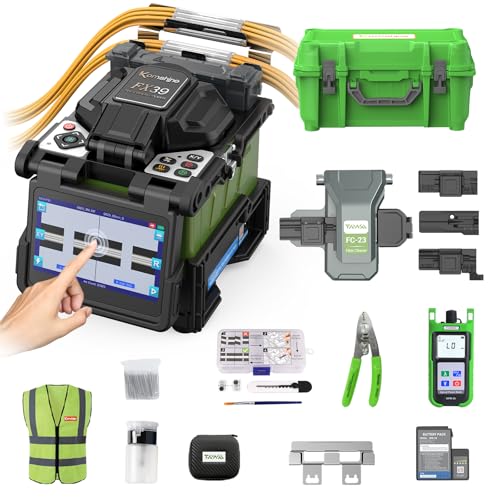
This variant of the FX39 is essentially the same core hardware as the first FX39 reviewed but sold through a different listing and with slightly different bundled accessories. The six-motor core alignment platform, 0.01dB typical splice loss, 7,800mAh battery, and 5,000-electrode life are identical. The differentiating factor here is the included accessories: this listing emphasizes the inclusion of a 3-in-1 fiber holder that accommodates SM, MM, bare fiber, pigtail, rubber-insulated, and multi-fiber cable without adapter changes.
Field reports highlight the same strengths — the machine splices SOC, BUDI, and mainline cans with consistent low loss, and the easy V-groove alignment reduces operator fatigue during long splice sessions. One technician reported that the trolley motor stuck after roughly 300 burns, and the seller shipped a replacement the next day — demonstrating that Komshine’s customer support is responsive despite being based in East Asia. The 400-cycle battery is the best in class for all-day field work, and the included OPM with -70~+10dBm range covers common FTTH wavelengths.
The same caveats apply: the included cleaver is mediocre and is the primary source of splice failures reported across reviews. Users consistently recommend pairing this machine with a high-end cleaver from Fujikura or Sumitomo. The documentation is minimal, but the machine’s intuitive menu system means most operators are splicing within 10 minutes of unboxing with no manual reading required.
Why it’s great
- Same 400-cycle battery and 5,000-electrode life as the first FX39 variant in a well-priced hardware package.
- Stellar field performance across SOC, BUDI, and mainline splice closures with consistent low-loss output.
- Seller support is responsive — replacement parts shipped next day after a trolley motor failure report.
- Intuitive menu system allows unboxing-to-splicing in under 10 minutes without reading a manual.
Good to know
- Included cleaver is the weakest link in the kit; upgrading to a dedicated cleaver transforms splice reliability.
- Customer support operates on East Asia time, requiring patience for email responses from Western time zones.
- Battery is non-removable, so a failed cell means sending the entire machine in for service rather than swapping packs.
6. D YEDEMC Ai-9 SM&MM Six Motor Core Alignment Fusion Splicer
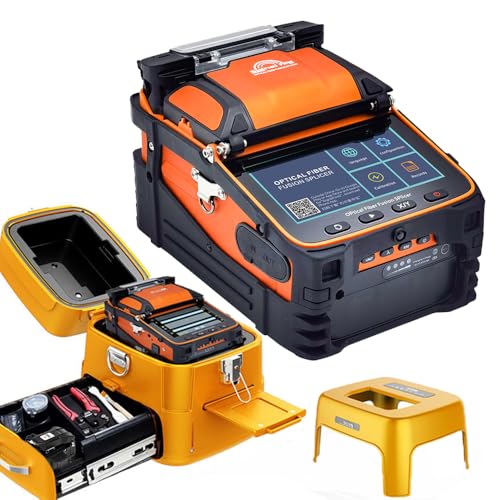
The D YEDEMC Ai-9 is the most clearly positioned splicer in the lineup — it is a FTTH drop cable specialist, and its manufacturers explicitly recommend it only for drop and FTTX applications, not mainline trunk splicing. This honest positioning is refreshing because it means the machine is optimized for the specific demands of fiber-to-the-home deployment: fast cycles, simple operation, and low cost per splice rather than the absolute precision required for long-haul trunk lines.
The machine delivers a 5-second splice and an 11-second heat time, making it the fastest heating cycle in this roundup. Users report that it is comparable to entry-level Fujikura units in build quality and splice consistency, with one technician noting that his company bought eight of these machines for the price of a single Fuji flagship and used them all for daily drop cable work without issues. The built-in OPM covers six wavelengths from 850nm to 1625nm, and the VFL has a 15km range that covers residential and suburban distribution networks.
The 4.3-inch touchscreen with 380x magnification provides excellent fiber visualization, though the yellow chassis is less professional-looking than the black-orange signal Fire or the black Komshine. The machine is not recommended for mainline trunk splicing because its arc calibration and alignment consistency are optimized for the shorter spans and lower loss budgets of FTTH rather than the sub-0.01dB requirements of regional transport networks. Several users note that the included cleaver is functional but basic — adequate for drop work but not up to production-grade standards.
Why it’s great
- Fastest heating cycle in the group at 11 seconds, perfect for high-throughput drop cable installations.
- Honest manufacturer positioning — explicitly designed for FTTH and FTTX, not misrepresented as a mainline splicer.
- 380x magnification provides clearly detailed fiber visualization for inspecting cleaves before arcing.
- Outstanding value — eight units can be purchased for the price of one flagship Fujikura, enabling multi-crew deployment.
Good to know
- Not suitable for mainline trunk splicing — arc calibration is optimized for shorter FTTH spans and lower precision budgets.
- Yellow chassis finish may not meet some contractors’ equipment fleet aesthetic standards.
- Included cleaver is functional for drop work but should be upgraded for any application requiring consistent sub-0.02dB losses.
7. QIIRUN AI-9 Fusion Splicer Kit
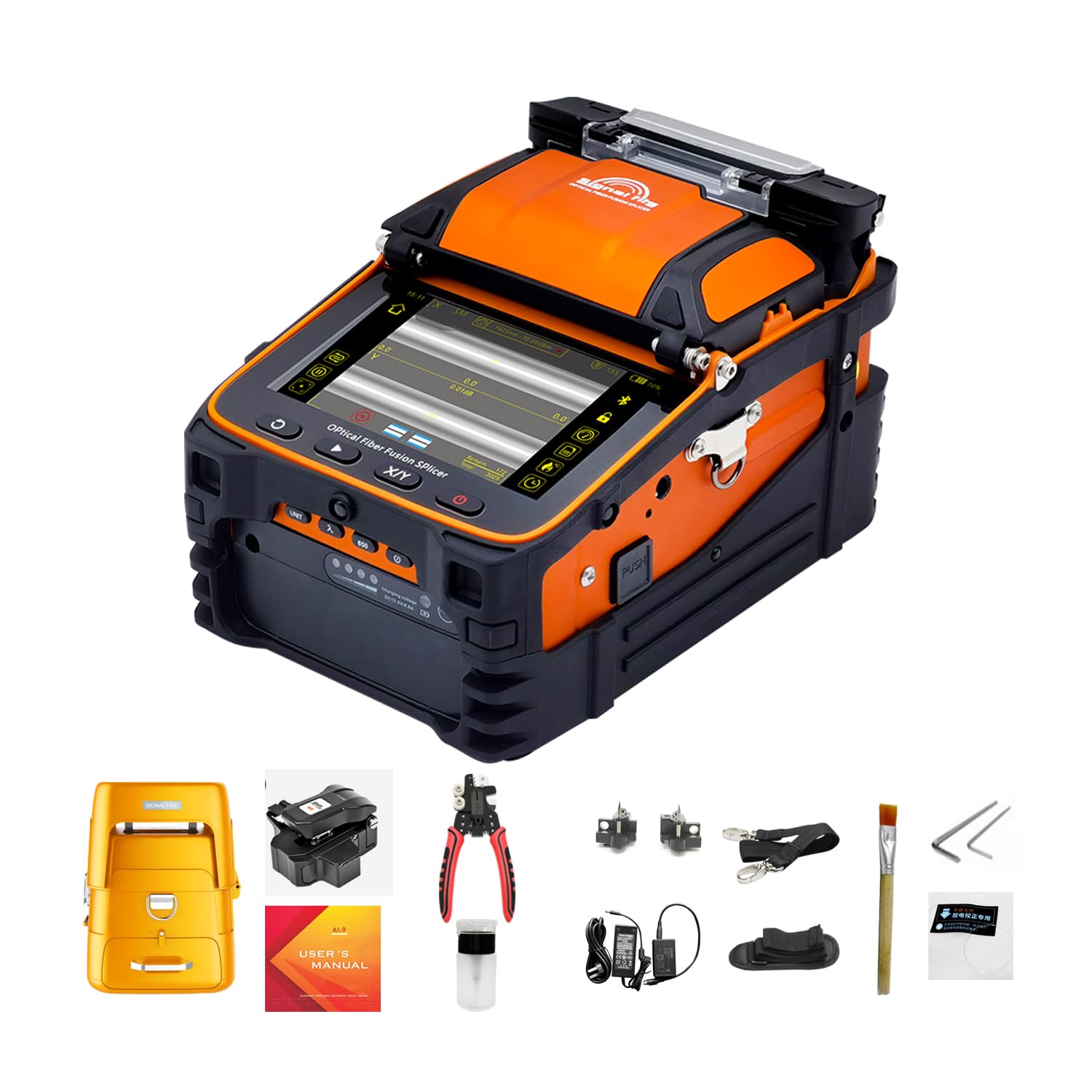
The QIIRUN AI-9 is the most beginner-friendly splicer on this list, featuring a 5-inch HD touchscreen that is the largest display in the roundup and a dedicated mobile app with tutorial videos. The 3-in-1 fiber holder accommodates SM, MM, drop cable, pigtail, and rubber-insulated fiber without any adapter swaps.
Real-world feedback is overwhelmingly positive from first-time users, with several reviewers noting they were splicing successfully within 20 minutes of unboxing with zero prior experience. The built-in OPM covers 10 wavelengths from 850nm to 1650nm with a range of -70 to +6 dBm, and the 15mW VFL reaches 10-15km for fault location. The unique two-layer toolbox design allows the user to work without removing the splicer from the case, saving roughly 50% of setup time compared to systems that require unpacking the machine before each session.
The heater flaps are a known weak point — multiple users report that the plastic hinges are not robust enough for heavy daily use and can cause fiber damage if they fall closed during the heat cycle. The machine is not recommended for mainline trunk splicing; its alignment system is optimized for FTTH and enterprise LAN applications rather than long-haul transport. The 200-cycle battery capacity is the lowest in this roundup, meaning operators working 10-hour shifts will need a mid-day charge or a spare battery pack.
Why it’s great
- Largest 5-inch touchscreen with intuitive UI and tutorial videos — best choice for first-time fusion splicer operators.
- Two-layer toolbox design allows splicing without removing the machine from the case, saving 50% setup time.
- 10-wavelength OPM and 15mW VFL integrated into a single chassis, eliminating the need for separate test equipment.
- Included cleaver is actually functional out of the box, performing clean cuts that exceed typical budget cleaver quality.
Good to know
- Heater flap hinges are fragile and can fall closed during the heat cycle, potentially damaging the spliced fiber.
- 200-cycle battery capacity is adequate for standard shifts but requires mid-day charging or spare battery for long days.
- Not recommended for mainline trunk splicing — alignment precision is calibrated for FTTH and LAN applications.
FAQ
What is the difference between six-motor and four-motor core alignment in a fusion splicer?
How many splice-and-heat cycles does a 7800mAh battery deliver in real field conditions?
Can I repair a mainline trunk fault with a budget FTTH fusion splicer?
What is the practical effect of 320x magnification versus 150x on splice quality?
Final Thoughts: The Verdict
For most users, the best fusion splicer winner is the Komshine FX39 because it delivers genuine six-motor core alignment with 0.01dB loss across 5,000 electrode burns, a 400-cycle battery, and field tools compatibility that outclasses the premium brands at a fraction of the investment. If you need bidirectional fiber feed for confined-space conduit and rack work, grab the QIIRUN-6481B. And for the fastest per-splice cycle time in a rugged outdoor chassis, nothing beats the Signal Fire AI-9.