
A game camera that costs too little often delivers blurry night shots and dead batteries after a single rainy week, while one that costs too much locks you into a cellular plan you didn’t want. The sweet spot sits between a fast trigger that catches a buck mid-stride and a durable build that survives a season of weather without a visit to swap batteries. That balance defines which trail cam is actually worth mounting on a tree.
I’m Mohammad Maruf — the founder and writer behind Drink4Good. I’ve spent hundreds of hours analyzing trail camera specifications, comparing trigger speeds, night vision ranges, and cellular connectivity options across dozens of models to find the best value for real outdoor use.
Whether you are scouting public land, monitoring a food plot, or keeping an eye on a remote corner of your property, finding the right game camera for the money means matching sensor performance and power management to your specific hunting or security scenario.
How To Choose The Best Game Camera For The Money
Every trail camera buyer faces the same tension: pay more for cellular connectivity and higher resolution, or save cash with a simpler model that requires you to walk to the SD card. The choice hinges on how often you can visit the camera, what animals you are tracking, and whether you want real-time alerts or a batch download at the end of the season.
Trigger Speed and Detection Zone
The single most important spec for capturing wildlife is trigger speed measured in seconds. A camera with a 0.1-second trigger can freeze a walking deer, while one slower than 0.5 seconds often catches an empty frame or a tail disappearing into the brush. Pair that with a detection angle of at least 60 degrees and a detection range of 80 to 100 feet to cover a food plot or game trail without gaps.
Night Vision Type and Range
Low-glow infrared emits a faint red glow that animals notice but still produces sharp black-and-white images out to 65 or 100 feet. No-glow infrared uses a different wavelength that is invisible to both humans and wildlife, making it better for skittish game but often with slightly shorter range and softer edges at the same price point. Budget models typically top out at 50 to 65 feet, while premium units push past 100 feet.
Power Management and Connectivity
A camera that drains eight AA batteries in two weeks is not a value at any price. Look for solar-ready or built-in solar models that trickle charge during daylight hours. Cellular cameras demand more power because they transmit images over LTE, but they eliminate the need to retrieve an SD card. Non-cellular and non-WiFi cameras run far longer on a single set of batteries — sometimes an entire season — making them the best option for remote areas you can only reach monthly.
Quick Comparison
On smaller screens, swipe sideways to see the full table.
| Model | Category | Best For | Key Spec | Amazon |
|---|---|---|---|---|
| MAXDONE Solar Trail Camera | Solar WiFi | Low-maintenance year-round scouting | 0.1s trigger, 65ft night vision | Amazon |
| VIDVIS Solar Trail Camera | Solar WiFi | Compact solar camera with WiFi | 0.2s trigger, 65ft night vision | Amazon |
| Misstech Solar Trail Camera | Solar WiFi | App-based viewing with solar charging | 0.1s trigger, MapPin location | Amazon |
| SPYPOINT Flex-Plus | Cellular LTE | Remote image transmission on a budget | 36MP, 1080p, dual-SIM LTE | Amazon |
| GardePro E5S | Non-Cellular | Maximum battery life with no connectivity | 0.1s trigger, 100ft night vision | Amazon |
| Moultrie Edge 2 Pro | Cellular LTE | On-demand images with AI false trigger filtering | 40MP, 1440p, 100ft detection | Amazon |
| Tactacam Reveal X 3.0 | Cellular LTE | Reliable multi-carrier connectivity and easy setup | 4K photo, 1080p, GPS enabled | Amazon |
In‑Depth Reviews
1. MAXDONE Solar Trail Camera WiFi Bluetooth

The MAXDONE balances all the features a hunter needs — solar charging, WiFi and Bluetooth app control, 4K video, 64MP stills, and a 0.1-second trigger — at a price that undercuts most competitors with similar specs. The built-in 5200mAh rechargeable battery paired with the solar panel keeps the camera running indefinitely in partial sun, eliminating the recurring cost of alkaline batteries. The 65-foot low-glow LED array produces clean night images without spooking deer, and the 100-degree detection angle covers a wide corridor on a food plot or trail.
Setup is straightforward through the Trailcam Go app via Bluetooth for initial configuration, then WiFi hotspot for image previews within about 55 feet. The unit comes with a pre-installed 32GB TF card, so it works out of the box without additional purchases. The IP66 housing handles rain and dust, and the time-lapse mode works well for observing field patterns over weeks. Motion sensitivity is adjustable, which helps reduce false triggers from swaying grass in open areas.
The main limitation is the WiFi hotspot design — it creates its own network rather than connecting to your home WiFi, so you must be within Bluetooth range during first setup and within WiFi range to view photos remotely. There is no cellular option, so you still need to retrieve the card for full access if you are more than 50 feet away. Some users note the camera body feels slightly lighter than premium-grade units, but the performance-to-cost ratio is hard to beat for year-round scouting.
Why it’s great
- Solar panel maintains battery without manual swaps
- Fast 0.1s trigger rarely misses passing animals
- Pre-installed 32GB card saves immediate setup cost
- WiFi preview lets you check images without removing the card
Good to know
- WiFi hotspot range limited to about 55 feet
- No cellular connectivity for remote areas
- Plastic housing feels less rugged than premium metal-shell cameras
2. VIDVIS 4K 64MP Solar Trail Camera
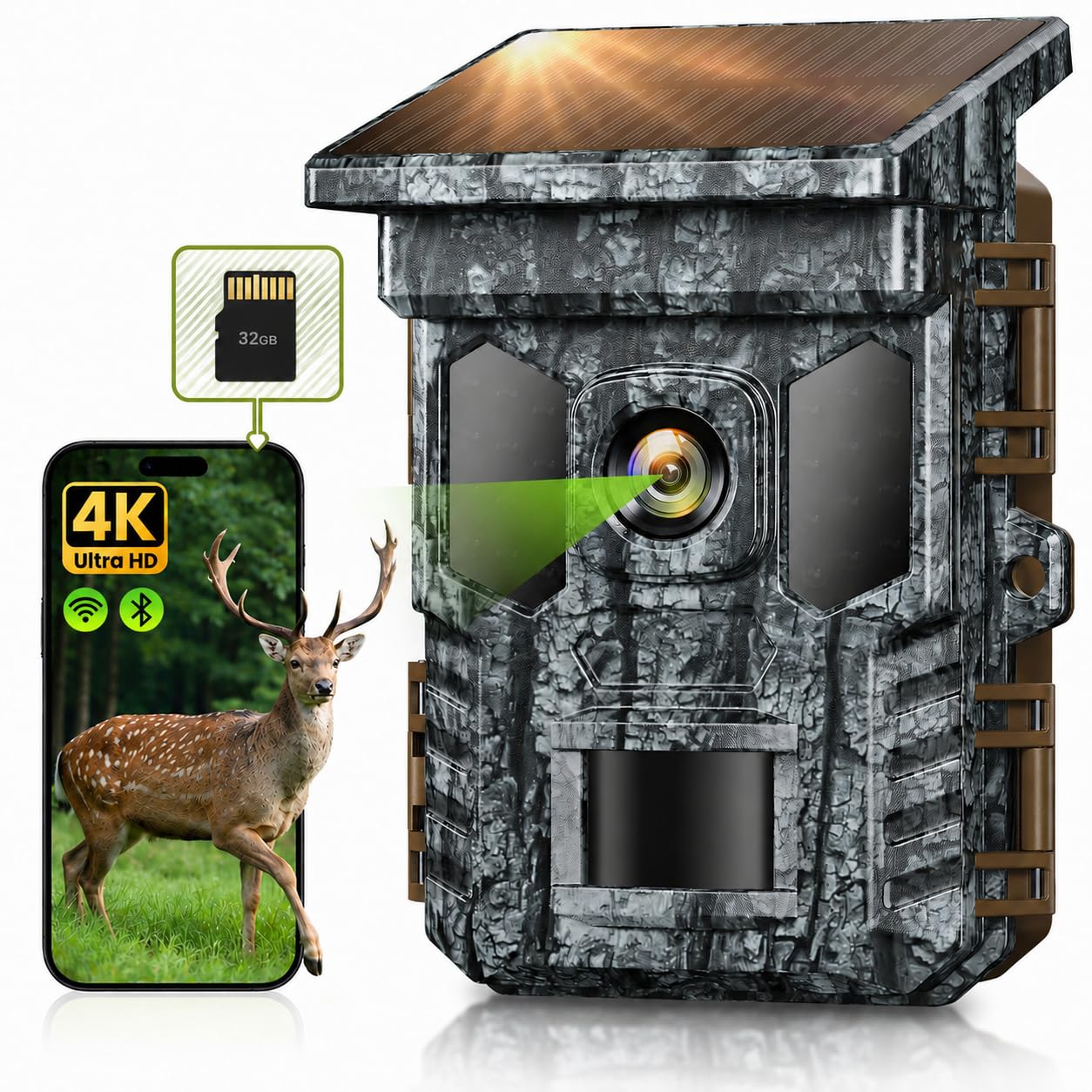
The VIDVIS offers the same core feature set as the MAXDONE — 64MP photos, 4K video, solar charging, and WiFi hotspot connectivity — with a slightly slower 0.2-second trigger speed and a grey-green camouflage body that blends well into wooded environments. The camera supports three charging methods: the built-in solar panel, USB-C cable, and backup via four AA batteries, giving you flexibility if the camera is placed under heavy canopy where solar gains are minimal. The 850nm low-glow infrared produces clear night images without the bright flash that alarms wary animals.
Image quality is consistent both day and night, with daytime shots showing accurate color and nighttime captures maintaining usable detail out to the full 65-foot range. The included 32GB Micro SD card is enough for thousands of 4K clips before loop recording begins. The Trailcam Go app works reliably for previewing and downloading photos within WiFi range, and the camera’s compact footprint makes it easy to mount discreetly on smaller trees or posts without drawing attention.
Documentation is sparse — the manual omits several menu functions, and the app interface lacks clear labels for some advanced settings like detection zone boundaries. First-time users may need to experiment with sensitivity levels to avoid too many false triggers from wind or passing cars. The 0.2-second trigger is still fast enough for most game, but a running animal at the edge of the frame may leave partial captures compared to the 0.1-second competition.
Why it’s great
- Triple charging method (solar, USB-C, AA backup) for shady locations
- Compact body fits discreetly on small trees
- Daytime image quality and color accuracy are excellent at this price
- Quiet operation with no audible shutter clicks
Good to know
- Instruction manual is incomplete and lacks detail on menu settings
- 0.2s trigger can miss the center of fast-moving shots
- App connection range is shorter than advertised in heavy brush
3. Misstech 4K UHD Solar Trail Camera
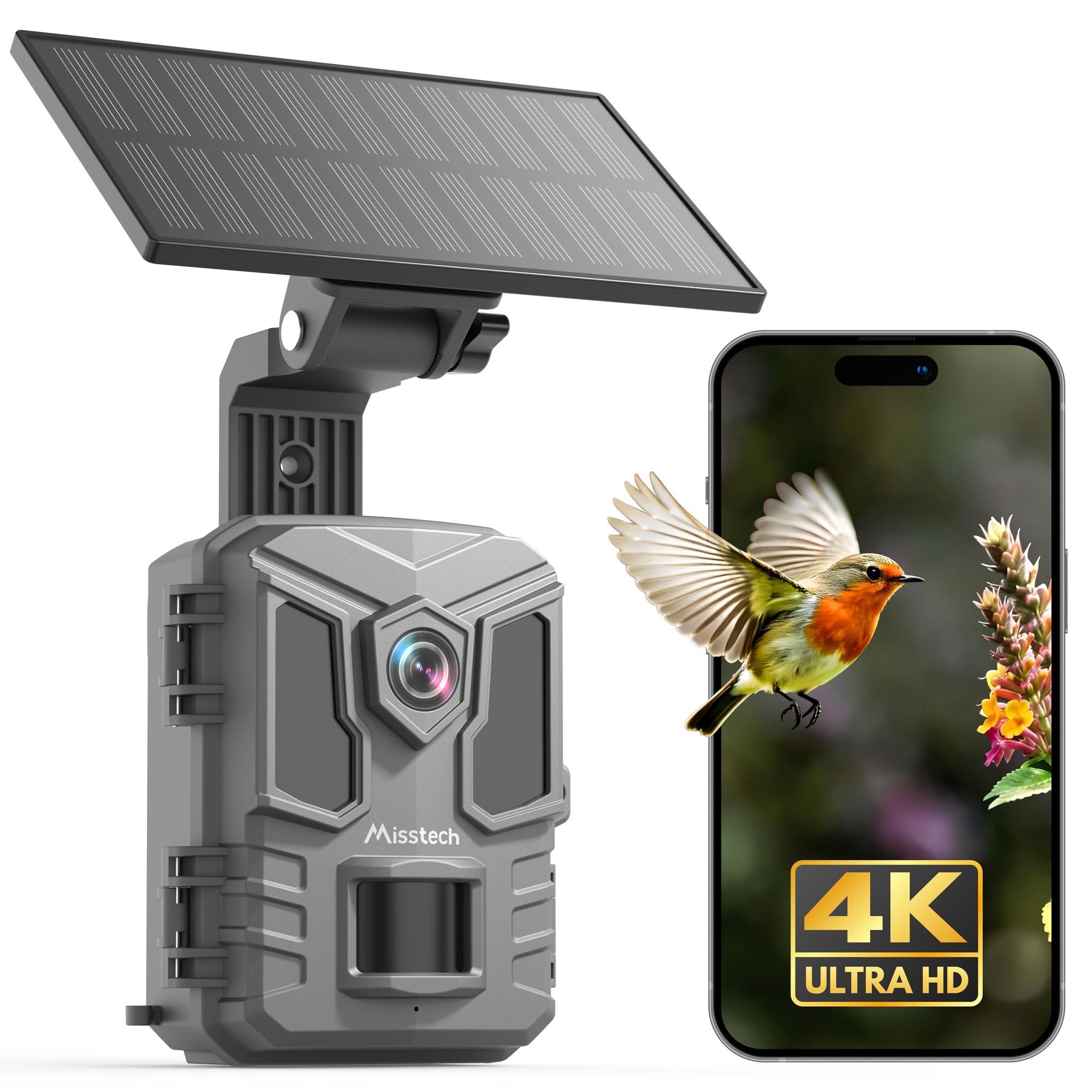
The Misstech stands out for its unusually fast 0.1-second trigger speed combined with an f/1.6 wide-aperture lens that pulls in more light at dawn and dusk, when most trail camera images degrade into motion blur or underexposed shadows. The built-in 8GB card is smaller than what competitors bundle, but the camera supports expansion up to 128GB, and the loop recording mode ensures you never run out of space during active periods. The MapPin feature in the app marks your camera’s GPS location so you never lose track of which tree it is on — a small touch that becomes invaluable on large properties or public land.
The “Trailcam Go” app provides live view capability within about 100 feet in open terrain, letting you frame the shot properly without walking back and forth. The solar panel charges slowly but steadily, and the internal battery holds charge through multiple overcast days before needing direct sun to recharge. The camera automatically stamps each image with moon phase, temperature, and time, which helps you correlate animal movement with environmental conditions without manual logging.
The Bluetooth-to-WiFi range can be inconsistent in thick timber — some users report losing connection beyond 30 feet even though the theoretical range is higher. The 30-second video clip limit with a 5- to 10-second pause between recordings means you might miss sequential action like a buck chasing a doe through the frame. Customer support is reportedly very responsive, with several users noting replacement units shipped within 24 hours when hardware issues arose.
Why it’s great
- f/1.6 wide aperture produces cleaner low-light images than most rivals
- MapPin location feature prevents losing cameras on large properties
- Moon phase, temperature, and time stamps on every image for behavior analysis
- Responsive customer support with rapid replacements
Good to know
- Only 8GB internal card included; upgrade to 32GB+ for extended use
- 30-second clip limit with pause can miss fast events
- Bluetooth/WiFi range is inconsistent in dense woods
4. SPYPOINT Flex-Plus Cellular Trail Camera

The SPYPOINT Flex-Plus delivers the lowest entry point for a genuine cellular trail camera with a free monthly plan that transmits up to 100 photos at no charge. The dual-battery tray doubles the runtime compared to single-tray cellular cameras, and the Instant Mode lets you request an on-demand photo from the app to check current conditions without waiting for animal movement to trigger a shot. The dual-SIM configuration automatically switches between carriers to maintain signal in marginal coverage zones, a critical feature for cameras placed on remote ridges or hollows.
Resolution tops out at 36MP stills and 1080p video with sound, which is sufficient for identifying individual deer, antler points, and human activity but falls short of the 4K clarity found on similarly priced non-cellular models. The 100-foot flash and detection range covers most clearings, and the 50-degree field of view is narrower than many WiFi cameras, requiring careful placement to avoid missing animals passing just outside the cone. The SPYPOINT app handles image management well, organizing photos by camera and allowing easy batch saving to your phone’s gallery.
Battery life is excellent for a cellular camera — some users report 60% remaining after three months using the first battery tray alone, with the second tray in reserve. The free plan is genuinely free with no hidden fees, though heavy users will need to upgrade to a paid tier for more than 100 photos per month. A small number of users experienced firmware update issues that required manual camera reboots, but overall reliability is high for the price point.
Why it’s great
- Free plan sends up to 100 photos per month with no subscription fees
- Dual-battery tray dramatically extends field time between swaps
- Dual-SIM automatically picks the strongest LTE signal
- Instant Mode provides on-demand photo requests from the app
Good to know
- Still images max at 36MP, not 4K resolution
- 50-degree field of view requires precise positioning
- Occasional firmware issues may need manual reboot in the field
5. GardePro E5S Trail Camera

The GardePro E5S targets hunters who prioritize battery life and reliable detection over remote connectivity. It uses no WiFi, no Bluetooth, and no cellular link — just a passive sensor that triggers on motion and captures 64MP stills or 1296p HD video onto an SD card that you retrieve later. The three-PIR sensor array enables a 0.1-second trigger speed with a 120-degree detection angle, giving it one of the widest coverage zones in this price bracket. The no-glow IR LEDs are invisible to animals, keeping even pressured deer calm around the camera.
Run time is the standout metric here. On eight lithium AA batteries, many users report the camera running an entire hunting season (four to six months) without replacement, because there is no transmitter draining power for image uploads. The IP66 housing shrugs off rain, snow, and dust, and the 1/4-inch-20 threaded mount works with standard tripods or tree mounts. The 100-foot night vision range is the longest in this roundup, delivering usable identification-level images at distances where most budget cameras produce only dark silhouettes.
The trade-off is convenience. You must physically retrieve the SD card to see photos, which means weekly or biweekly visits to the camera location. There is no app, no remote settings adjustment, and no real-time alert. The small onboard LCD screen lets you review a few images in the field, but it is impractical for bulk review. The video resolution is 1296p rather than true 4K, though most users find it sharp enough for antler scoring and identifying individual animals.
Why it’s great
- Four- to six-month battery life on lithium AAs is best-in-class for non-cellular
- No-glow IR does not spook pressured game animals
- 120-degree detection angle covers wide trails and clearings
- 100-foot night vision range is the longest in this budget pool
Good to know
- No WiFi, Bluetooth, or cellular means manual SD card retrieval is mandatory
- 1296p video is good but not true 4K resolution
- Small onboard screen is impractical for reviewing large numbers of images
6. Moultrie Edge 2 Pro Cellular Trail Camera

The Moultrie Edge 2 Pro elevates cellular trail camera capability with AI-driven false trigger elimination that filters out swaying grass and passing clouds, sending only animal and human detections to your phone. The 40MP photos and 1440p HD video with audio capture more detail than the SPYPOINT Flex-Plus, and the 100-foot detection range matches the GardePro E5S while adding cellular transmission. The Live Aim feature in the Moultrie Mobile app provides real-time camera preview, so you can align the field of view precisely without walking back and forth — a massive time saver when you are hanging multiple cameras across a property.
Built-in 8GB memory eliminates the need for an SD card, and unlimited cloud backup means you never lose images even if the camera is stolen or damaged. Integration with the onX Hunt app lets you view trail camera photos directly on your scouting maps, which is a competitive edge for serious hunters who already use onX for property boundaries and wind direction. The camera accepts up to 16 AA batteries or a rechargeable battery pack, and multi-carrier LTE connectivity auto-connects without SIM swapping.
The subscription cost is the main consideration. Data plans start at per month, and while the features justify the expense for active hunters, casual users may prefer the free-plan SPYPOINT or a non-cellular alternative. The field of view is limited to approximately 50 degrees — similar to the SPYPOINT — requiring precise aiming to cover a desired corridor. Battery consumption is higher than non-cellular models, and some users report needing a solar panel or rechargeable pack for full-season deployment without mid-season visits.
Why it’s great
- AI false trigger elimination saves storage and data plan allowance
- Live Aim feature in the app ensures perfect camera alignment the first time
- onX Hunt integration keeps scouting photos on your mapping app
- Built-in 8GB memory plus unlimited cloud backup prevents data loss
Good to know
- Requires a +/month data plan for cellular functionality
- 50-degree field of view is narrow and needs careful aiming
- Battery drain is higher than non-cellular models; solar panel recommended for full season
7. Tactacam Reveal X 3.0 Cellular Trail Camera
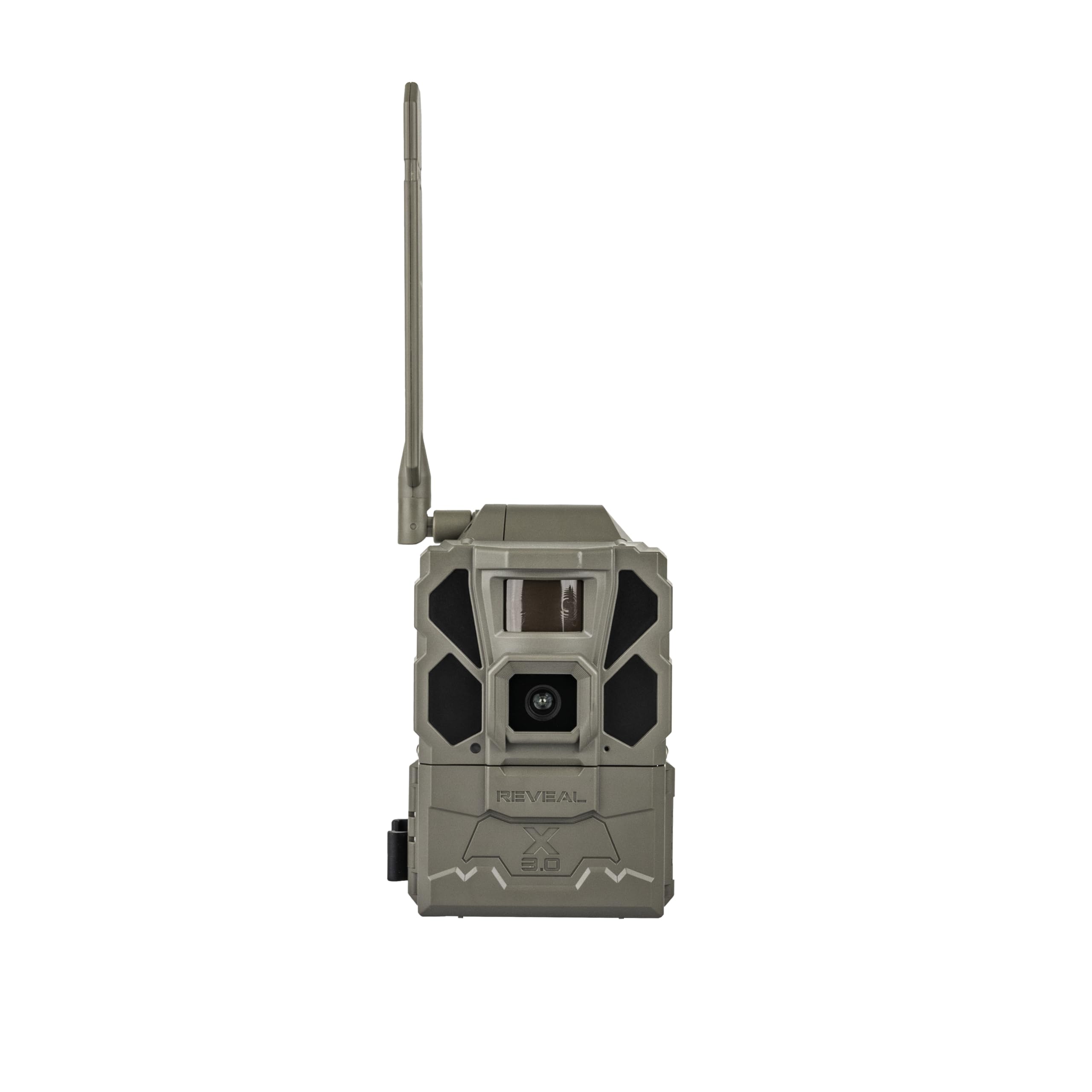
The Tactacam Reveal X 3.0 has earned a reputation as one of the most reliable cellular trail cameras on the market, combining a pre-activated multi-carrier SIM that auto-connects to AT&T or Verizon with a setup process that most users complete in under ten minutes. The 4K photo resolution captures exceptional detail for large prints or digital zoom, while 1080p video with audio provides enough clarity for behavior analysis. The sub-half-second trigger with 3-shot burst mode ensures at least one well-centered image even when an animal moves through the frame quickly.
Built-in GPS tracking pinpoints the camera’s location in the REVEAL app, which is helpful for managing multiple cameras across a large property or if a camera gets moved by wildlife or trespassers. The camera does not require an SD card — photos are stored internally and transmitted directly to the app, removing the risk of card failure or lost data. The pre-installed antenna and SIM mean there is nothing to assemble in the field, and the extra-durable antenna withstands the bumps and branches of remote deployment better than flimsier designs.
Battery life is best-in-class among cellular cameras, with independent testing showing over six months on a single set of lithium batteries when paired with the optional lithium cartridge or solar panel. The trade-off is the upfront cost, which is the highest in this lineup, along with a required cellular subscription that starts at roughly per month for basic plans. The 60-degree field of view is wider than some cellular rivals but still narrower than the 120-degree coverage of the non-cellular GardePro E5S, so positioning matters more.
Why it’s great
- Fast setup with pre-installed SIM and antenna — under ten minutes to first photo
- Six months of battery life is industry-leading for a cellular camera
- GPS tracking prevents losing cameras on large properties
- No SD card required; photos store internally and transmit to the app
Good to know
- Highest upfront cost in this guide; budget shoppers should consider alternatives
- Requires a monthly cellular subscription for image transmission
- 60-degree field of view needs careful aiming to avoid missed coverage
FAQ
Do I need a cellular plan for a game camera?
What trigger speed is fast enough for deer?
How long do game camera batteries actually last?
What does low-glow versus no-glow night vision mean for hunting?
Can I use a game camera for home security?
Final Thoughts: The Verdict
For most users, the game camera for the money winner is the MAXDONE Solar Trail Camera because it delivers solar charging, fast trigger response, 4K video, and WiFi preview at a price that undercuts similar offerings. If you need cellular image transmission without a subscription headache, grab the SPYPOINT Flex-Plus for its free 100-photo monthly plan and dual battery trays. And for maximum battery life on a remote property you only visit every few months, the GardePro E5S runs an entire season without a battery swap and captures reliable imagery with invisible no-glow IR.