
The brain thrives on novelty, pattern recognition, and sustained challenge — yet most daily routines numb it with repetition. Deliberate cognitive play, from sequencing light patterns to solving wooden logic puzzles, actively strengthens neural pathways and builds mental reserve. The right game doesn’t just pass time; it forces your brain to forge new connections under pressure, improving processing speed and memory recall.
I’m Mohammad Maruf — the founder and writer behind Drink4Good. I have spent years analyzing the mechanics of cognitive training tools, evaluating how specific game designs translate into measurable mental engagement and neuroplasticity across different age groups and cognitive baselines.
This guide evaluates five distinct products across memory sequencing, tactile logic, and analytical reasoning to help you find the most effective games for brain health that deliver genuine mental stimulation rather than passive entertainment.
How To Choose The Best Games For Brain Health
Not every activity sold as a “brain game” offers meaningful cognitive load. The most effective options force your working memory to hold sequences, your logic centers to break down constraints, and your attention to sustain focus without passive crutches like timers or automated hints.
Sequence Memory vs. Logic Deduction
Games built on recall — like repeating a growing sequence of lights or tones — target short-term and working memory directly. Logic puzzles, such as disentanglement rings or Tower of Hanoi, exercise executive function and strategic planning. Choose based on whether your priority is memory capacity or problem-solving endurance.
Progressive Difficulty
A game that stays easy after three rounds does nothing for neuroplasticity. Look for built-in escalation: sequences that lengthen, puzzles with more rings or pieces, or multi-tier booklets that ramp up in complexity. The load must increase as your skill improves to sustain cognitive gains.
Physical Engagement and Screen Independence
Handheld tactile games and physical puzzles engage proprioception and fine motor coordination alongside mental effort, creating richer neural activation. Screen-based apps often encourage quick swiping rather than deep sustained focus. Physical formats also naturally limit distraction, keeping your mind locked on the problem at hand.
Quick Comparison
On smaller screens, swipe sideways to see the full table.
| Model | Category | Best For | Key Spec | Amazon |
|---|---|---|---|---|
| Hasbro Gaming Simon | Memory Game | Working memory & attention | Sequence length increases with correct input | Amazon |
| Wettarn Metal Puzzles | Logic Puzzle Set | Concentration & spatial reasoning | 9 stainless steel disentanglement puzzles | Amazon |
| BSIRI Hanoi Tower | Logic Puzzle | Strategic planning & patience | 9-ring solid wood tower | Amazon |
| RLYLF 30pc Puzzle Set | Mixed Puzzle Set | Variety & group play | 30 wooden + metal puzzles | Amazon |
| Keep Your Brain Stronger for Longer | Cognitive Workbook | Cognitive rehab & mild impairment | 201 illustrated brain-teasing exercises | Amazon |
In‑Depth Reviews
1. Hasbro Gaming Simon

Simon remains the gold standard for sequential memory training because its core mechanic — repeating a light-sound pattern that grows one step longer each round — directly exercises working memory under increasing pressure. The delay between rounds creates retrieval effort, and the auditory cue adds a cross-modal encoding layer that strengthens memory consolidation. Players report that focus intensifies as the sequence length pushes past eight or nine steps, exactly where the cognitive load becomes meaningful.
Build quality is solid for the price point, with responsive buttons and clear LED feedback. The multicolor pads correspond to distinct tones, so even slight colorblindness does not hinder play. Adjustable volume and multiple skill levels accommodate both children and adults. The handheld form factor means you can train memory anywhere without a screen or internet connection, reinforcing sustained attention rather than divided attention.
Customer feedback consistently highlights its effectiveness for young children with attention challenges and for older adults seeking a fun memory maintenance tool. A few users note the newer version feels slightly less sturdy than vintage models, but battery life remains strong and the game holds up well to repeated daily use. For pure sequential recall training with proven difficulty escalation, Simon delivers the most cognitive load per minute of any product on this list.
Why it’s great
- Progressive difficulty forces working memory adaptation
- Cross-modal encoding (light + sound) strengthens recall
- No screen required; portable and distraction-free
Good to know
- Plastic housing feels lighter than vintage versions
- Requires 3 AA and 3 AAA batteries, not included
2. Wettarn 9 Pcs Metal Brain Teaser Puzzles
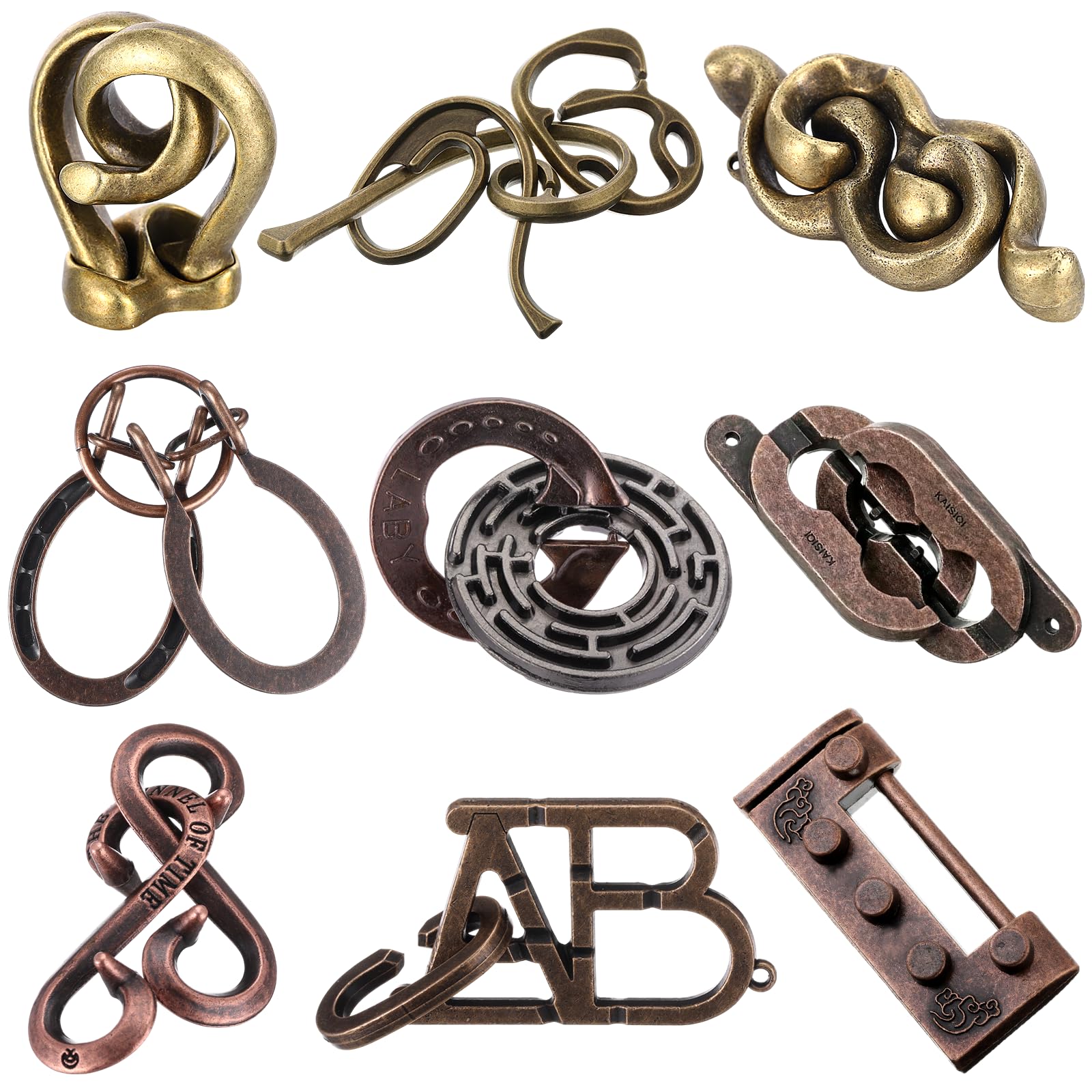
This set of nine stainless steel disentanglement puzzles offers progressive spatial reasoning challenges that require you to visualize geometric pathways and apply counter-intuitive moves. Each puzzle demands a different unlocking strategy, forcing your brain to abandon one approach and adopt a new one — a crucial flexibility skill that generalizes to real-world problem solving. The hardest puzzles in this set require sustained concentration for several minutes, building mental stamina.
The steel construction is smooth and sturdy with no sharp edges, so it feels satisfying to handle and holds up to repeated assembly and disassembly. The variable difficulty ensures that even experienced puzzlers find genuine challenges, while beginners can start with the simpler rings and progress upward. The tactile feedback of metal pieces sliding and locking into place provides a sensory anchor that deepens focus, unlike clicking a screen.
Reviewers consistently praise the set’s ability to pull both teenagers and adults away from screens for extended sessions. The frustration-triumph cycle inherent in these puzzles triggers dopamine release upon solution, which reinforces persistence and resilience. A few users note that some puzzles are easier than expected, but the overall assortment still offers sufficient depth to occupy a curious mind across multiple sittings. For tactile logic training with genuine spatial complexity, this set outperforms most plastic alternatives.
Why it’s great
- Stainless steel construction offers satisfying weight and durability
- Progressive difficulty across nine distinct puzzle geometries
- Promotes frustration tolerance and flexible thinking
Good to know
- Some puzzles are smaller than traditional versions
- Not all puzzles challenge experienced solvers equally
3. BSIRI Fun Puzzle Board Games Hanoi Tower (9 Rings)

The Tower of Hanoi is one of the most studied puzzles in cognitive science because its recursive nature directly activates the prefrontal cortex — the region responsible for planning, inhibition, and working memory. Moving nine rings from one rod to another following the constraint that no larger ring may sit on a smaller ring requires you to hold multiple future moves in mind before executing any action. This forward-chaining logic is exactly the kind of exercise that strengthens executive function.
This version is handcrafted from natural, hypoallergenic wood with no chemical odor, making it safe for frequent handling. The rings are sized to provide a satisfying manual challenge without being fiddly. The puzzle doubles as an attractive desktop decoration, which invites spontaneous play during moments of mental downtime. The lack of batteries or electronics means zero distraction — just you and the recursive structure.
Customer feedback notes that the pegs may fit slightly loosely in the base, but a small piece of tape or a gentle vise squeeze resolves this easily. Users describe solving the puzzle as meditative, with the repetitive logic creating a calming rhythm that paradoxically sharpens focus. For beginners, starting with just four rings is recommended before scaling up to the full nine. This is an excellent choice for developing patience, sequential reasoning, and the ability to hold multiple variables in mind simultaneously.
Why it’s great
- Recursive structure directly exercises executive function and planning
- Handcrafted natural wood is safe, attractive, and tactile
- Meditative rhythm encourages sustained deep focus
Good to know
- Pegs may require slight modification to fit snugly
- Single puzzle format limits variety compared to sets
4. RLYLF 30pcs Brain Teaser Puzzles Game

This collection of thirty wooden and metal puzzles offers the broadest cognitive variety of any product on this list, spanning disentanglement, interlocking, 3D assembly, and sequential unlock mechanisms. The sheer diversity means your brain can never settle into a single solving pattern — each new puzzle demands a fresh cognitive strategy, from spatial visualization to deductive elimination. This variety prevents the skill plateau that occurs when you master a single game.
The puzzles are well-constructed with smooth wooden edges and thick metal pieces that resist bending. The included cheat sheet provides solutions without making them trivial, so you can unstick yourself when frustration peaks. The lightweight, portable design means you can carry several puzzles in a bag for on-the-go mental training. This set naturally functions as a group activity, encouraging verbal reasoning and collaborative problem solving during family gatherings or office breaks.
Customers report that the hardest wooden puzzles, particularly those requiring reassembly, pose significant challenges even for experienced puzzlers. The medium difficulty ratings for most pieces make this set accessible to beginners while still engaging advanced users. One reviewer noted a price increase over time, but the total value across thirty puzzles remains strong. For anyone wanting to rotate cognitive tasks without buying multiple separate products, this set provides unmatched breadth of mental exercise in a single purchase.
Why it’s great
- Thirty puzzles prevent cognitive skill plateau through rotation
- High-quality wood and metal pieces withstand repeated use
- Collaborative format encourages verbal reasoning and social play
Good to know
- Some puzzles are smaller than expected
- Pricing has fluctuated above original launch price
5. Keep Your Brain Stronger for Longer

This workbook, written by cognitive health specialists, provides 201 brain-teasing exercises specifically designed for individuals with mild cognitive impairment or those wanting to proactively maintain cognitive function. Unlike generic puzzle books that market childhood-level activities as “brain training,” this book offers age-appropriate, mature challenges including math logic problems, pattern copying, sequencing tasks, and categorization exercises that recruit multiple cognitive domains simultaneously.
Each exercise is structured to feel achievable yet effortful, building confidence while providing genuine cognitive load. The variety across the 304 pages means you can target different skills on different days — verbal reasoning, numerical logic, visual-spatial processing, and executive function. The spiral-bound format lies flat for comfortable writing, and the paper quality supports repeated erasing and redoing for ongoing practice.
Clinical feedback from customers is notably positive: individuals recovering from stroke, managing chemotherapy-related brain fog, or diagnosed with mild cognitive impairment report meaningful improvements in processing speed and mental clarity after consistent use. The main caveat is that the standard print size may challenge seniors with significant vision loss, and some exercises require a cognitive baseline that exceeds severe impairment. For anyone seeking a structured, non-digital cognitive maintenance program backed by clinical logic, this workbook fills a unique gap that puzzle collections cannot match.
Why it’s great
- Clinical-grade exercises for mild cognitive impairment and recovery
- Mature, age-appropriate content that respects user intelligence
- Multiple cognitive domains exercised in a single book
Good to know
- Print size may be too small for users with significant vision impairment
- Some exercises require a relatively sharp cognitive baseline
FAQ
How often should I play brain games to see cognitive benefits?
Are digital brain training apps more effective than physical puzzles?
Can brain games help with age-related cognitive decline?
Final Thoughts: The Verdict
For most users, the games for brain health winner is the Hasbro Gaming Simon because its progressive sequence-length mechanic directly trains working memory under escalation, delivering measurable cognitive load in a portable, screen-free format. If you want tactile spatial reasoning with steel durability, grab the Wettarn 9-piece metal puzzle set. And for clinical-grade cognitive maintenance targeting mild impairment, nothing beats the structured depth of Keep Your Brain Stronger for Longer.