
Finding meaningful activities for a loved one with dementia requires a careful balance — the activity must be simple enough to avoid frustration, yet engaging enough to provide a sense of purpose and calm. Many standard games move too fast, require complex rules, or rely on sharp short-term memory, all of which can create anxiety rather than relaxation.
I’m Mohammad Maruf — the founder and writer behind Drink4Good. My deep market research focuses on analyzing activity designs, print clarity, and tactile usability for cognitive support products.
A well-chosen activity can provide moments of connection, pride, and gentle mental stimulation. This guide cuts through the noise to recommend the best games for dementia, focusing on what truly matters for comfort, ease, and genuine engagement for your loved one.
How To Choose The Best Games For Dementia
Choosing the right activity requires focusing less on traditional “fun” and more on the specific cognitive and sensory needs of the individual. The goal is always comfort, success, and a positive emotional interaction.
Focus on Large Print and Visual Contrast
Standard puzzle books often use tiny fonts that are impossible to read for those with vision decline, a common companion to aging. Look for books and cards with bold, high-contrast text and images on thick, matte paper to minimize glare and make the activity accessible and inviting.
Prioritize Reusability for Repetition
Repetition is therapeutic and reassuring for many individuals with dementia. Games that can be wiped clean and played again, like dry-erase crosswords or sturdy flash cards, provide comfort and allow the activity to become a familiar, calming ritual rather than a one-time challenge.
Match the Challenge to the Stage
An activity that is too hard causes agitation; one that is too easy feels belittling. For early stages, look for activity books with diverse puzzles and memory prompts. For middle stages, simple large-piece jigsaw puzzles or matching card games with a 1:1 reference poster work best. The right “just manageable” challenge is critical.
Quick Comparison
On smaller screens, swipe sideways to see the full table.
| Model | Category | Best For | Key Spec | Amazon |
|---|---|---|---|---|
| Go Together Flash Cards | Matching Game | Speech & cognitive therapy | 50 realistic photo cards | Amazon |
| Keeping Busy Crossword | Reusable Puzzles | Repetitive word play | 6 dry-erase sheets | Amazon |
| Stress Relief Activity Book | Activity Book | Variety & memory prompts | 155 pages, 8.5 x 11 inch | Amazon |
| WSCXSC 24-Piece Puzzles | Jigsaw Set | Visual-spatial engagement | 0.1 inch thick pieces | Amazon |
| WSCXSC 16-Piece Puzzles | Easy Jigsaw Set | Very early-stage dexterity | 16 pieces, 5 inches each | Amazon |
In‑Depth Reviews
1. Go Together Flash Cards
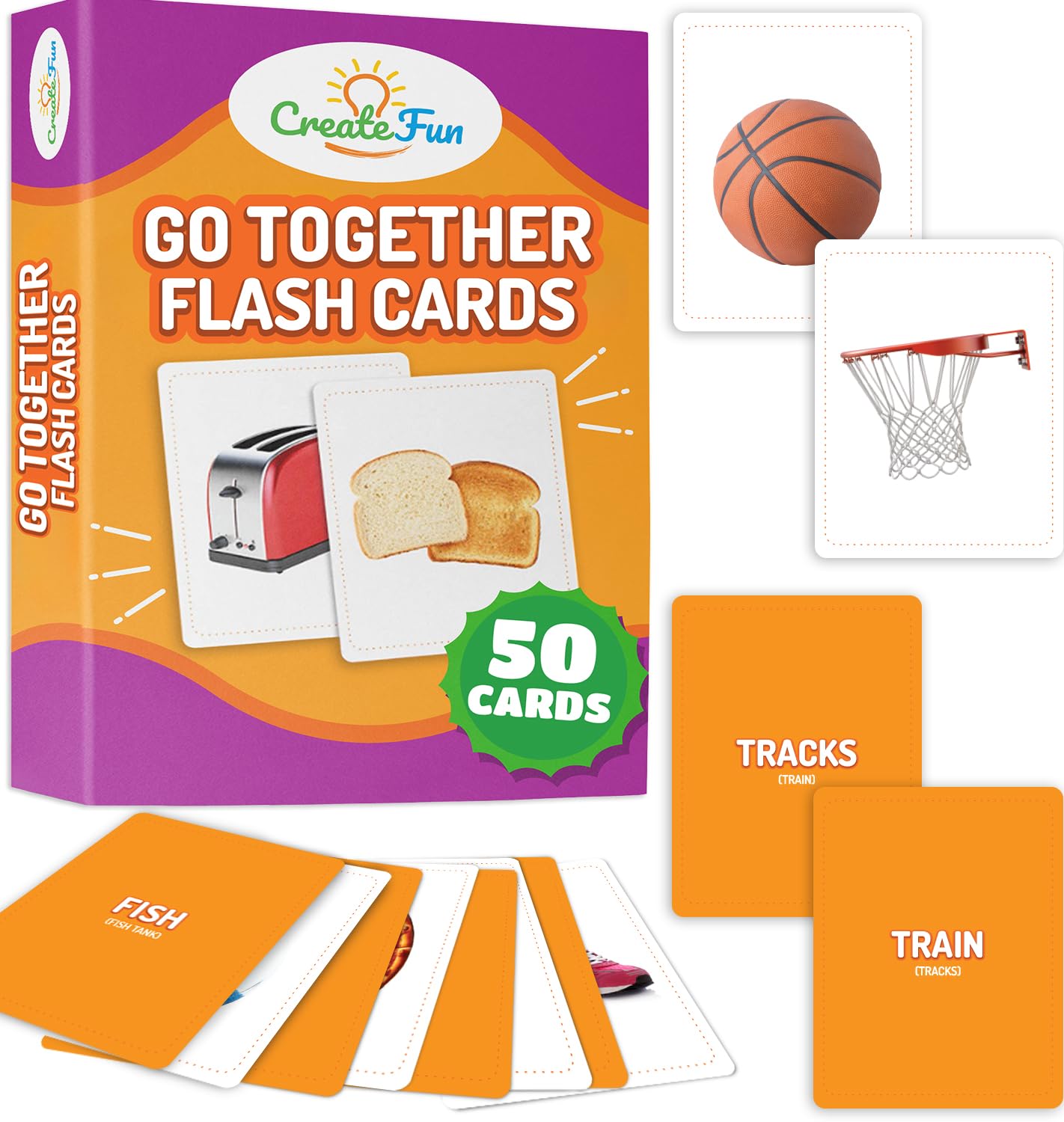
This set of 50 durable, smudge-proof cards stands out because it uses real, high-contrast photographs rather than cartoon drawings. The realistic imagery helps ground the activity in the real world, making it easier for someone with dementia to recognize objects, make associations, and engage in meaningful conversation with a caregiver.
The “Go Together” matching format (e.g., matching a toothbrush with toothpaste) is intuitive and taps into long-term logical associations that often remain intact far longer than short-term memory. This makes the activity consistently achievable, building confidence rather than frustration.
Beyond matching, caregivers can use the cards for simple naming exercises, sorting by category, or creating simple memory chains. Their pocket-sized box makes them easy to bring to a doctor’s appointment or use in a common area, offering a portable, quiet, and highly adaptable source of cognitive stimulation.
Why it’s great
- Realistic photos aid object recognition
- Highly durable, smudge-proof coating
- Versatile for matching, naming, and sorting
Good to know
- Better suited for 1-on-1 interaction
- Small card size, not ideal for very unsteady hands
2. Keeping Busy Crossword Dementia Activities

This crossword set solves the biggest limitation of activity books: finality. The six reusable dry-erase sheets allow the game to be completed, wiped clean, and played again. This repetition is not a bug but a feature — familiarity with the puzzles can be a source of comfort and pride for someone with memory loss.
The large-print clues and word list ensure the puzzle is accessible even for those with significant vision challenges. The option to use or ignore the word list lets the caregiver adjust the difficulty in real-time, providing as much or as little support as needed to keep the experience positive and successful.
The seasonal themes (winter, spring, summer, fall) add a subtle temporal orientation exercise to each round. The included dry-erase marker glides smoothly and wipes clean quickly, making setup and cleanup nearly effortless — a crucial detail for maintaining a calm, low-friction activity session.
Why it’s great
- Fully reusable for repeated, familiar play
- Large print with included word list for support
- Seasonal themes add gentle cognitive prompts
Good to know
- Limited to 6 specific crossword puzzles
- Marker should be stored cap-down for longevity
3. Stress Relief Memory Activity Book For Seniors

This 155-page book is a budget-friendly powerhouse of variety. It goes far beyond simple crosswords, offering word searches, Sudoku, and — most valuably — pages that ask users to recall and write about their favorite memories. This open-ended, gentle prompt can unlock moments of clarity and spark wonderful conversations between the user and their caregiver.
The large 8.5 x 11 inch format provides plenty of writing space, and the activities are clearly separated by difficulty. Some are trivially easy for a confidence boost, while others offer a modest challenge for those in the earlier stages of cognitive decline. This range allows the caregiver to pick and choose pages that match the user’s current state.
Because the content is printed in a standard book, it is not reusable like the dry-erase option. However, the sheer volume and diversity of activities provide weeks of engagement. The focus on favorite memories makes this more than just a puzzle book — it transforms into a personal journal and a valuable tool for reminiscence therapy.
Why it’s great
- Huge variety of puzzle types for sustained interest
- Memory-prompting pages encourage conversation
- Large, easy-to-read print throughout
Good to know
- Not reusable once pages are filled
- Some Sudoku puzzles may be too difficult for late-stage
4. WSCXSC 24-Piece Jigsaw Puzzles (6 Pack)
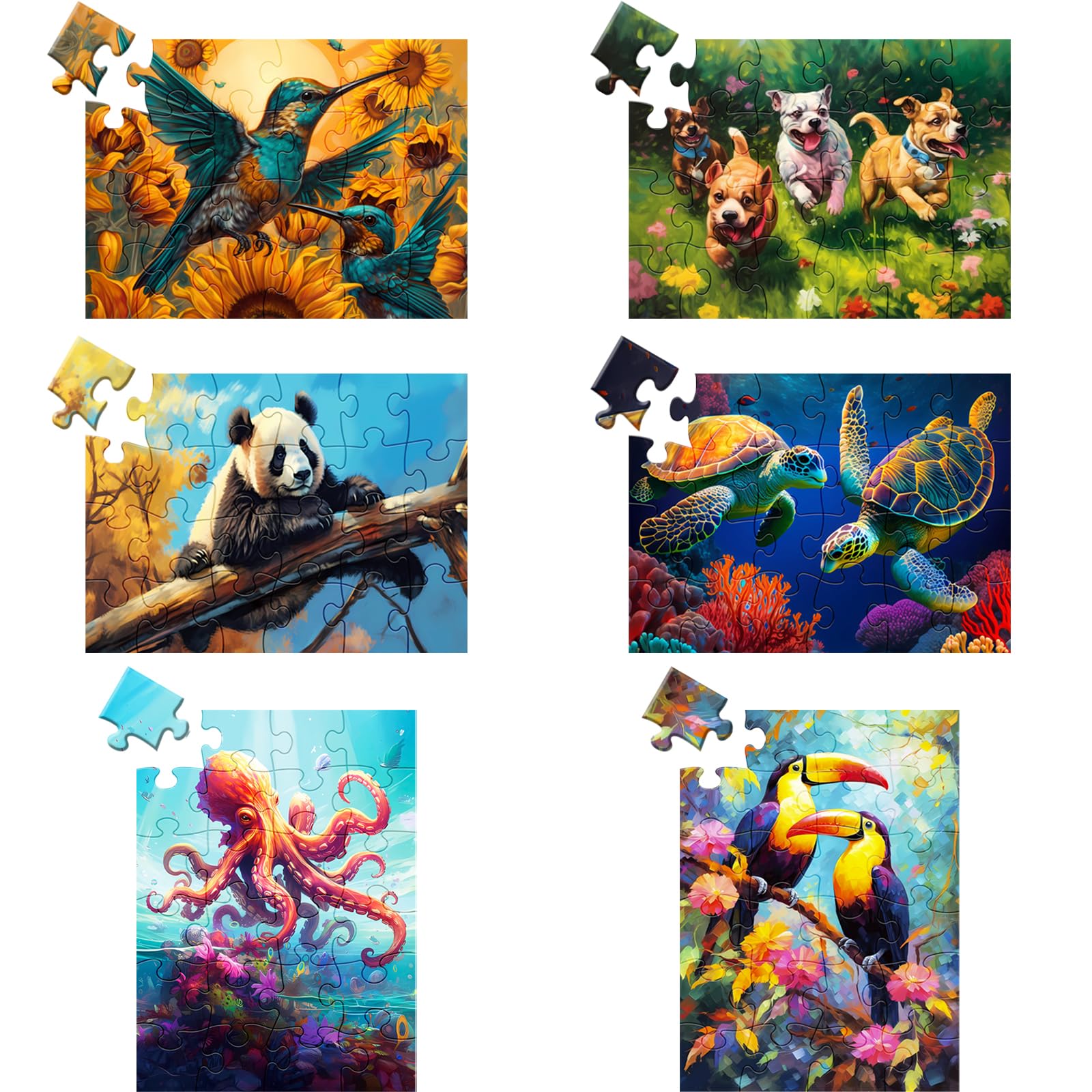
These 24-piece jigsaw puzzles feature beautiful, high-contrast animal images (hummingbird, turtle, dog, panda) printed on large, 0.1-inch thick pieces that are easy for unsteady hands to grip and manipulate. The thick cardstock resists bending and tearing, making them durable enough for repeated assembly — a critical feature for an activity meant to be revisited.
Each puzzle comes with a full-size 1:1 poster, a feature that caregivers praise. This allows the user to build the puzzle directly on top of the poster, dramatically simplifying the visual-spatial task. This reduces the struggle of “which piece goes where” and lets the user focus on the satisfying act of finding and placing a piece.
The 24-piece count provides a meaningful but not overwhelming challenge, ideal for those in the early to middle stages of dementia. The set includes six different puzzles, providing a variety of scenes to hold interest. The packaging does not mention dementia, preserving the user’s dignity and making it a thoughtful, discreet gift.
Why it’s great
- Thick, easy-grip pieces ideal for reduced dexterity
- Full-size 1:1 poster simplifies assembly
- Non-childish, beautiful imagery and discreet packaging
Good to know
- 24 pieces may be too many for late-stage dementia
- Puzzles need table space for assembly
5. WSCXSC 16-Piece Jigsaw Puzzles (6 Pack)
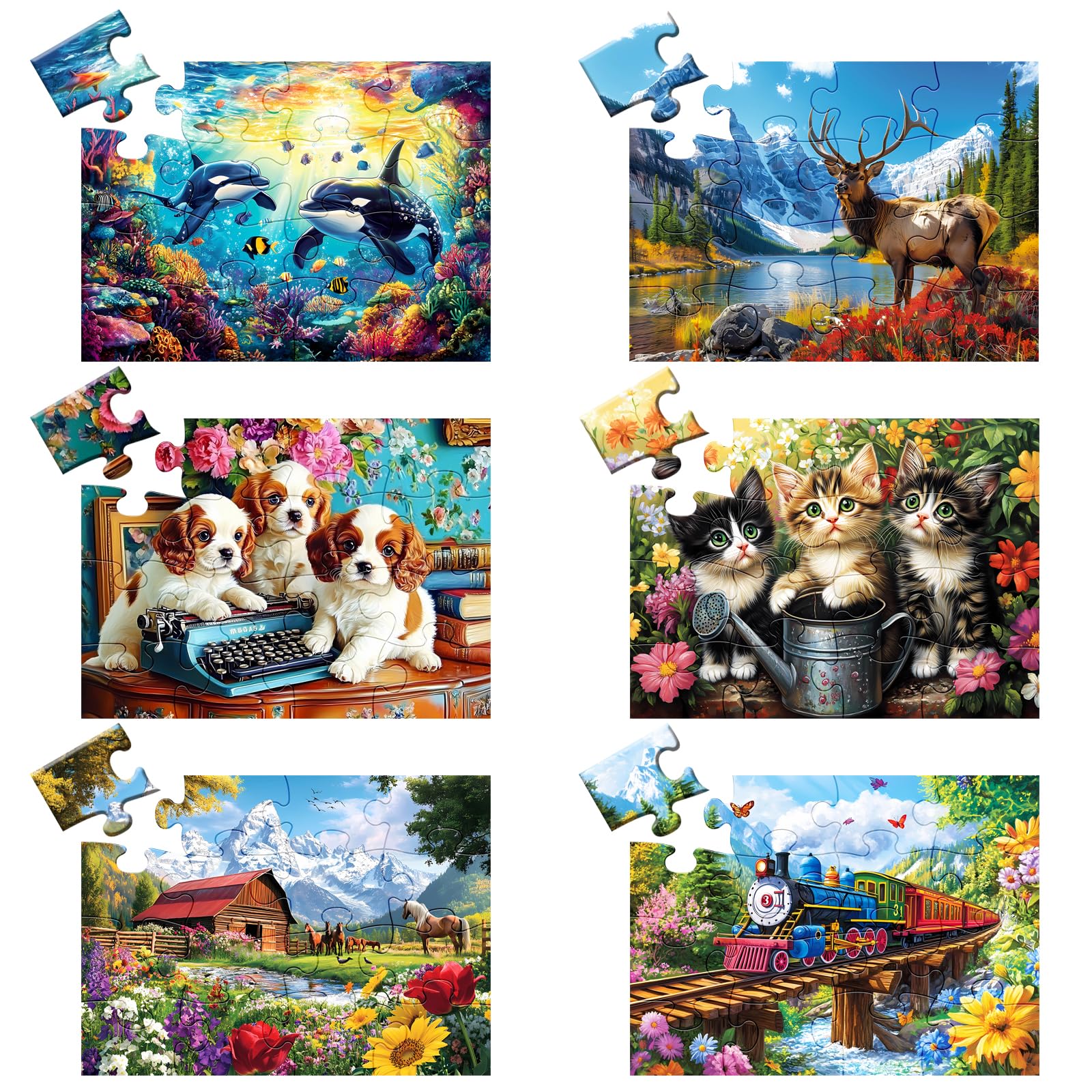
For those who find a 24-piece puzzle intimidating, this 16-piece version is the perfect entry point. Each piece measures approximately 5 inches in length, making them exceptionally easy to see, pick up, and place. The generous piece size drastically reduces fine motor demands, allowing the user to focus on the cognitive reward of finding the right match.
The puzzles feature serene scenes like a deer in a snowy mountain forest, using an embossing process that adds texture and grip. This tactile feedback is surprisingly helpful for hands that may not feel or grip as well as they once did. The pieces lock together firmly, yet are easy to take apart, preventing the frustration of jamming or breaking.
Like its 24-piece counterpart, this set includes a 1:1 poster for each of the six puzzles and comes in discreet packaging. It is a fantastic tool for building confidence, providing nearly guaranteed success that reinforces a sense of capability and calm. Caregivers report it being a hit for 1-on-1 sessions in nursing homes.
Why it’s great
- Extra-large pieces for maximum ease of handling
- Embossed texture improves grip for unsteady hands
- Very low frustration, high success rate
Good to know
- May be too simple for those in early-stage dementia
- Large pieces require a big work surface
FAQ
What is the best type of game for someone in the early stages of dementia?
Why are large-piece puzzles better for seniors with dementia than standard puzzles?
How do I know if a memory activity book is appropriate for my loved one?
Final Thoughts: The Verdict
For most users, the games for dementia winner is the Go Together Flash Cards because of their unmatched versatility, use of realistic photography, and durable design that supports repetitive, therapeutic play. If you want a reusable word-based activity, grab the Keeping Busy Crossword set. And for a gentle, highly accessible spatial challenge, nothing beats the WSCXSC 16-Piece Jigsaw Puzzles for building calm confidence.