
Five-year-olds live in a world of pure momentum — they bounce between counting cereal pieces and pretending a cardboard box is a castle. The right board game captures that energy without turning into a meltdown over complex rules. These picks focus on short play sessions, simple turn-taking, and physical interaction that keeps small hands busy.
I’m Mohammad Maruf — the founder and writer behind Drink4Good. I’ve spent years analyzing early childhood game mechanics and observing which play patterns actually hold a five-year-old’s attention past the first five minutes.
This guide breaks down the five board games that hit the sweet spot for skill-building, laughter, and replayability. After testing dozens of options, these are the best games for five year olds that parents and kids actually enjoy together.
How To Choose The Best Games For Five Year Olds
At five, a child’s cognitive leap is enormous — they can count to twenty, recognize patterns, and follow two-step instructions — but their patience still maxes out around fifteen minutes. The best games meet them right at that developmental edge without tipping into frustration. Look for three things: a simple objective they can explain to you, a physical or tactile hook (plastic bugs, a cranky dinosaur tongue, a dice popper), and a playtime that wraps up before their attention wanders.
Focus on Physical Interaction, Not Reading
Five-year-olds are pre-literate or early readers. A game that demands reading cards will stall before it starts. The strongest contenders rely on color matching, image-based cards, dice rolling, and physical actions like tong grabbing or launching a tongue. These mechanics let kids participate fully without adult intervention every turn, building independence.
Watch the Player Count and Game Length
Games listed for 2–4 players work best — anything with more than four creates long waits between turns. Look for an estimated playing time around 15–20 minutes. A game that drags past 25 minutes usually loses its audience. The best setup is one you can pull off the shelf, explain in under a minute, and finish before the juice box runs dry.
Quick Comparison
On smaller screens, swipe sideways to see the full table.
| Model | Category | Best For | Key Spec | Amazon |
|---|---|---|---|---|
| Numberblocks Race to Pattern Palace | Educational | Pattern recognition & counting | 40 pattern cards (2 difficulty levels) | Amazon |
| My First Dragon Adventure | Fantasy Action | Imaginative story-driven play | Image-based cards, no reading needed | Amazon |
| Snack-O-Saurus Rex | Interactive | Physical/dino-themed chaos | Magnetic retractable tongue mechanism | Amazon |
| Bed Bugs Board Game | Classic Action | Color matching & fine motor skills | Motorized vibrating bed + 36 bugs | Amazon |
| Big Discoveries Dumpster Dice | Fast Dice Game | Quick 5–10 min rounds | 80 dice in 4 colors, 5 game variations | Amazon |
In‑Depth Reviews
1. hand2mind Numberblocks Race to Pattern Palace

This game takes the globally beloved Numberblocks characters and turns pattern recognition into a race across a colorful board. The core mechanic is elegantly simple: players roll the dice popper, move their Numberblock pawn, and use colored bridge tiles to copy, extend, or create patterns shown on the cards. The two-tier card deck means you start with basic ABAB patterns and graduate to more complex sequences, making this one of the few games that actually ages with your child.
The components are noticeably sturdy — thick cardboard bridges, chunky plastic pawns, and a dice popper that adds a satisfying tactile pop. At an estimated 20-minute playtime, it fits neatly into a post-dinner slot. The pattern cards are image-based, so pre-readers can participate without help. Parents report that kids who watch the show stay engaged for multiple rounds, and the pattern-building translates directly into early math readiness skills.
Where this game stands out is its ability to teach a cognitive skill (pattern recognition) without feeling like a lesson. The competitive element — being first to reach Pattern Palace — drives motivation, and the Six’s Tricks cards add just enough unpredictability to prevent boredom after the fifth playthrough. It’s the most educationally dense game on this list without sacrificing fun.
Why it’s great
- Two difficulty levels extend replay value well beyond age 5
- Sturdy components survive enthusiastic play
- Teaches pattern creation, color recognition, and counting simultaneously
Good to know
- Only works if your child is familiar with Numberblocks characters
- Dice popper can be loud on hard surfaces
2. My First Dragon Adventure Board Game

Designed by a small family-owned team, My First Dragon Adventure wraps counting and strategic movement inside a fantasy rescue narrative. The premise — the castle’s s’mores fire has gone out, and players must convince a dragon to re-light it by racing through enchanted lands — hits every five-year-old’s sweet spot. Movement is governed by numbered and image-based cards, so no reading is required, and the board’s detailed illustration invites storytelling between turns.
The game shines in its ability to keep adults genuinely entertained. The varied scoring options — basic movement for younger kids, more complex point-tracking for older siblings — mean the same box works for a mixed-age group (ages 5 through 8). Reviewers consistently note that the game holds up after dozens of plays, partly because the core “race to the dragon” objective is open to house rules and scenario tweaks.
Components include a large folded board, durable player tokens, and themed dragon tiles. At roughly 20 minutes per round, it’s long enough to feel like a real game but short enough to reset for another round. The only trade-off is that younger fives may need help shuffling the larger card deck, but the image-based system keeps them independent during actual play.
Why it’s great
- Narrative-driven gameplay encourages imagination and role-play
- Adults enjoy it as much as kids — rare for this age bracket
- Flexible scoring rules accommodate ages 5 to 8 in the same session
Good to know
- Base rules may feel simplistic after 8–10 plays without house rules
- Board is large; needs a clean table surface
3. Spin Master Games Snack-O-Saurus Rex

Snack-O-Saurus Rex is pure kinetic delight — a plastic T-Rex with a magnetic tongue that launches forward to snatch snack tokens off the board or knock competitor cavepeople back to start. The dino rotates on a rock platform, and pressing its tail button fires the tongue. The objective is straightforward: collect two pairs of matching snacks (taco-dactyl, prehistoric pizza) while dodging the tongue. The physical gag — watching the tongue miss your piece and eat a rival’s snack — generates consistent giggles.
The gameboard is bidirectional (no finish line), meaning players move forward and backward across the board, collecting and losing snacks. This non-linear structure keeps the outcome uncertain until the final moments. Parents report that the setup is child-friendly — the 4-year-olds in reviews could assemble the dino and board independently. The 20-minute playtime feels brisk, and the magnetic tongue mechanism is durable enough to withstand enthusiastic pulling, though some units may experience slight tongue misalignment over time.
Beyond the fun, this game builds fine motor coordination (aiming the dino), turn-taking patience, and basic counting. Speech-language pathologists have adopted it for therapy sessions because the interactive element keeps children engaged for directed play. The only real drawback is that the tongue occasionally fails to retract fully if pulled at an extreme angle — an easy fix by guiding it back manually.
Why it’s great
- Magnetic tongue mechanism creates genuine surprise each round
- Bidirectional movement keeps every player in the game until the end
- Highly durable components survive drops and tugging
Good to know
- Tongue may not retract fully if pulled hard at an angle
- No finish line — some kids prefer a clear winner mechanic
4. Hasbro Gaming Bed Bugs Board Game
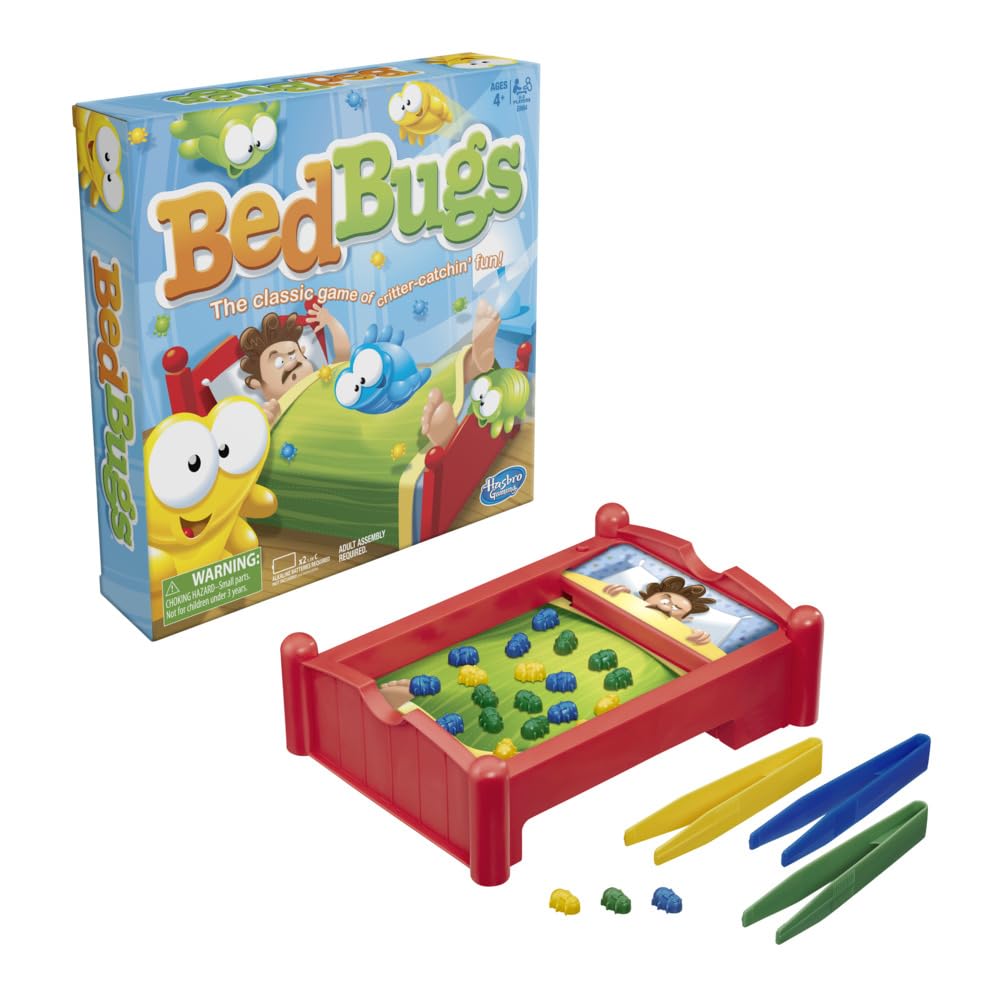
Bed Bugs is a near-perfect entry-level action game: a motorized gameboard “bed” vibrates, making plastic bugs bounce and hop across its surface. Players use color-coded tongs to grab bugs matching their assigned color. The first to clear all their matching bugs wins. The motor adds an element of unpredictability — bugs fly in random directions, requiring quick hand-eye coordination. It’s essentially a reflexes game disguised as critter-catching.
The 36 plastic bugs come in three colors (blue, yellow, green) and are chunky enough for small hands to grip with tongs. The game plays in roughly 15 minutes, which is ideal for the 4–6 age window. Multiple customer reviews highlight that the game naturally builds counting skills — kids count how many bugs they’ve caught versus how many remain — and the competitive element stays friendly because rounds are short enough to reset immediately.
One limitation is the 2–3 player cap, meaning larger families or playdates will need to rotate. The vibration mechanism works reliably but can stop if the bed is pressed down too hard — something to monitor with enthusiastic players. On the plus side, the components are durable enough to survive a 4-year-old’s grip strength, and the game has been on shelves for years, proving its staying power.
Why it’s great
- Motorized bed creates unpredictable bug movement every round
- Tongs build fine motor skills and hand-eye coordination
- Short 15-minute rounds hold attention spans
Good to know
- Only supports 2–3 players, not ideal for larger groups
- Vibration stops if the gameboard is pressed too hard
5. Big Discoveries Dumpster Dice
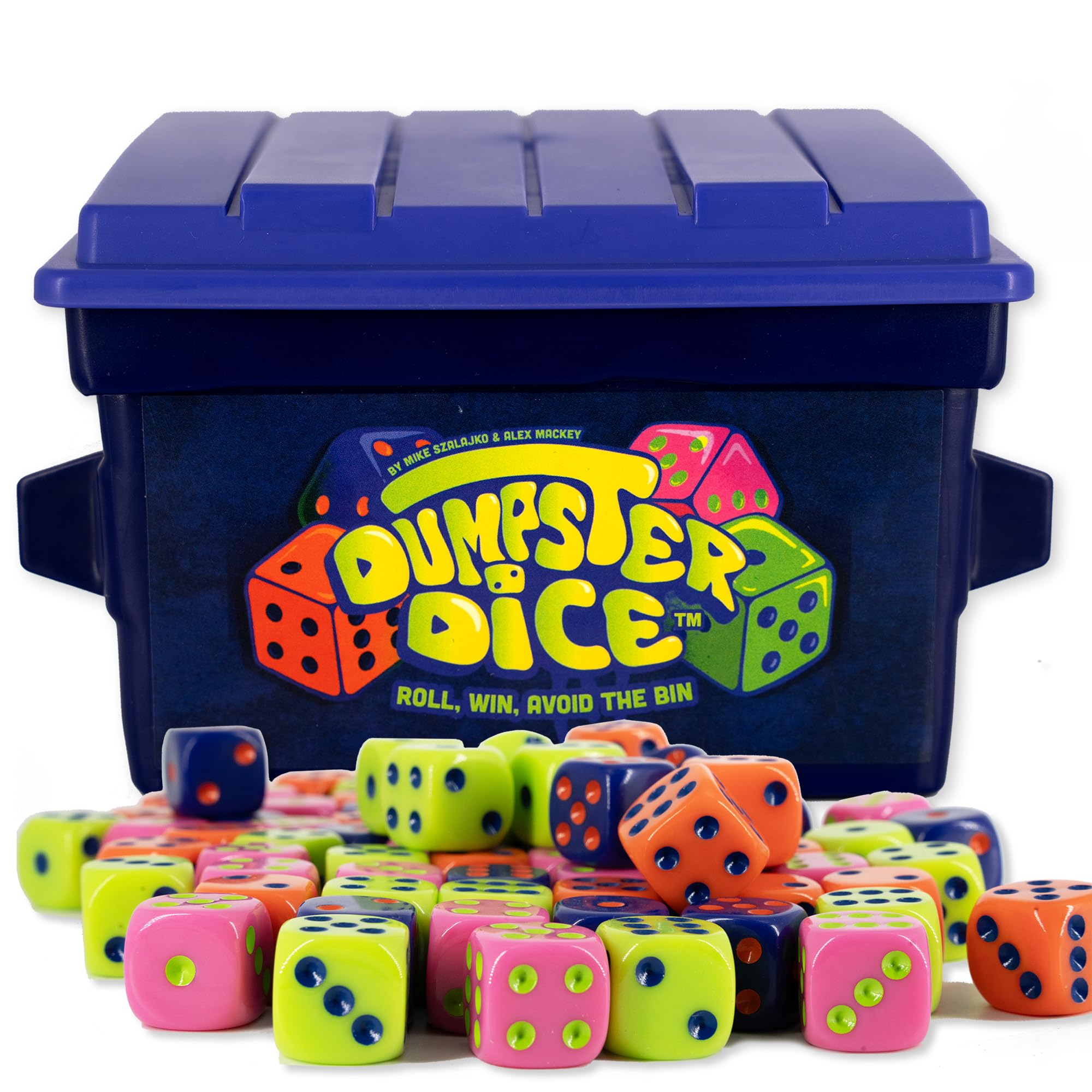
Dumpster Dice strips the game down to its purest form: roll dice, collect a 1–6 set, avoid duplicates, and win before the dice pile grows. The gimmick — a miniature plastic dumpster that holds the dice and doubles as the game board — is both practical and thematically charming for kids who love construction vehicles. The 80 colorful dice (20 per player in four colors) create a visual chaos that five-year-olds find intrinsically motivating.
What makes this game effective for the age group is its blistering pace. Each round lasts 5–10 minutes, which means you can play three games in the time it takes to finish one round of a traditional board game. The included rule sheet offers five gameplay variations, so you can adjust difficulty by switching from basic number matching to more strategic “avoid the duplicate” modes. The portable tin — roughly 6 x 5 inches — fits in a backpack, making it a strong candidate for restaurant waits or travel.
At entry-level pricing, the components are sturdy ABS plastic that withstands drops and rough handling. The dice are large enough that a 3-year-old can grip and roll them, but the game officially recommends age 6+ due to small pieces. Families with younger siblings note that a 3-year-old can participate by simply rolling and matching numbers 1–6, while older kids engage with the competitive variations. The main limitation is strategic depth — this is a luck-driven dice game, not a strategy game, so it works best as a filler activity between longer games.
Why it’s great
- Ultra-fast 5–10 minute rounds suit short attention spans
- Five gameplay variations extend replayability
- Compact tin design makes it highly portable
Good to know
- Purely luck-based; limited strategic decision-making
- Small dice pieces require adult supervision for very young children
FAQ
What game mechanic works best for a five year old who struggles with losing?
Can I use these games in a classroom or speech therapy setting?
Final Thoughts: The Verdict
For most families, the best games for five year olds winner is the hand2mind Numberblocks Race to Pattern Palace because it combines educational pattern recognition with a familiar TV property and genuinely sturdy components. If you want pure physical chaos and dinosaur laughs, grab the Snack-O-Saurus Rex. And for the most portable budget-friendly option that works in 5-minute bursts, nothing beats the Big Discoveries Dumpster Dice.