
A four-year-old’s brain is a whirlwind of questions, wiggles, and a desperate need to touch everything. The right game channels that energy into focus, fine motor control, and the pure joy of figuring something out. Choosing poorly results in scattered pieces, short attention spans, and parental sighs.
I’m Mohammad Maruf — the founder and writer behind Drink4Good. I’ve spent years analyzing early childhood development products, studying how specific materials and mechanics support or hinder a child’s natural learning trajectory at this critical age.
Every game on this list was chosen for its ability to engage a four-year-old’s specific developmental stage. Whether you need a quiet travel activity or a raucous family game night staple, this guide to games for four year olds zeroes in on the options that actually work with your child, not against them.
How To Choose The Best Games For Four Year Olds
Four-year-olds are not small babies nor big kids. They are in a unique pocket where fine motor control is emerging, but frustration tolerance is still low. The best games for this age group balance a clear, achievable goal with a tactile experience that builds dexterity without demanding adult-level patience.
Prioritize Open-Ended Physical Manipulation
The most successful games for four-year-olds require them to use their hands in varied ways — threading, stacking, pinching, twisting. Look for components that reward repeated practice, like lacing beads or stacking blocks. Games that only require pressing a button or flipping a card miss the core developmental opportunity of this age.
Match the Number of Players to the Social Skill
At four, turn-taking is a learned skill, not a given. Simple two to three player games with short rounds are ideal. Avoid games with elimination mechanics; being “out” too early can derail the entire experience. Cooperative or parallel-play designs where every child is actively engaged for the full duration work best.
Evaluate Durability for Real-World Handling
A four-year-old’s idea of “gentle” is different from yours. Cardboard without lamination will bend. Thin plastic pieces will snap. Prioritize games with thick wooden components, tear-resistant laminated pages, or chunky plastic that can survive being dropped, sat on, or accidentally launched across the room. The material choice directly dictates the lifespan of the game.
Quick Comparison
On smaller screens, swipe sideways to see the full table.
| Model | Category | Best For | Key Spec | Amazon |
|---|---|---|---|---|
| Hieoby Wooden Beads Set | Montessori | Pattern Recognition & Fine Motor | 25 wooden beads + 8 pattern cards | Amazon |
| MORECOLL Workbook | Educational | Pre-Writing & Letter Practice | 62 reusable pages, 16 activities | Amazon |
| Hasbro Bed Bugs Game | Action Game | High-Energy Family Play | Motorized vibrating bed | Amazon |
| LeapFrog 100 Words Book | Electronic | Vocabulary & Quiet Independent Play | 100+ words, bilingual audio | Amazon |
| TALGIC Solar System Puzzle | Floor Puzzle | Independent Problem Solving | 70 round pieces, 10×10 inches | Amazon |
In‑Depth Reviews
1. Hieoby Montessori Wooden Beads Sequencing Toy Set

This set packs an incredible amount of developmental value into a single box. The 25 colorful wooden beads come in 11 distinct shapes and 12 colors, accompanied by a wooden stand, two laces, and eight double-sided pattern cards. It functions as a stacking game, a lacing activity, a color and shape sorter, and a simple memory challenge — all without batteries or screens.
What makes this a standout for four-year-olds is the graduated difficulty. A child can start by simply threading beads onto the laces, then progress to copying a pattern from a card onto the stand, and eventually create their own sequences. The wooden components are lightweight enough for small hands to grasp but sturdy enough to withstand daily use. The laces include a small wooden stick tip, which significantly reduces the frustration of threading.
Customer reviews consistently highlight the multi-faceted learning opportunities, from building fine motor skills and hand-eye coordination to fostering logical thinking and left-to-right visual scanning. Some parents note the beads are smaller than expected, so supervision is recommended for younger three-year-olds, but for a four-year-old, the size is ideal for precise manipulation.
Why it’s great
- Three distinct play modes (stacking, lacing, pattern matching) extend replay value significantly.
- High-quality solid wood construction with non-toxic finish feels durable and safe.
- Pattern cards introduce early STEM concepts like sequencing and problem solving.
Good to know
- Beads are small enough to pose a choking hazard for children under three — not suitable for younger siblings.
- The wooden stand is compact; some larger bead shapes stack less securely than others.
2. MORECOLL Preschool Learning Activities Educational Workbook
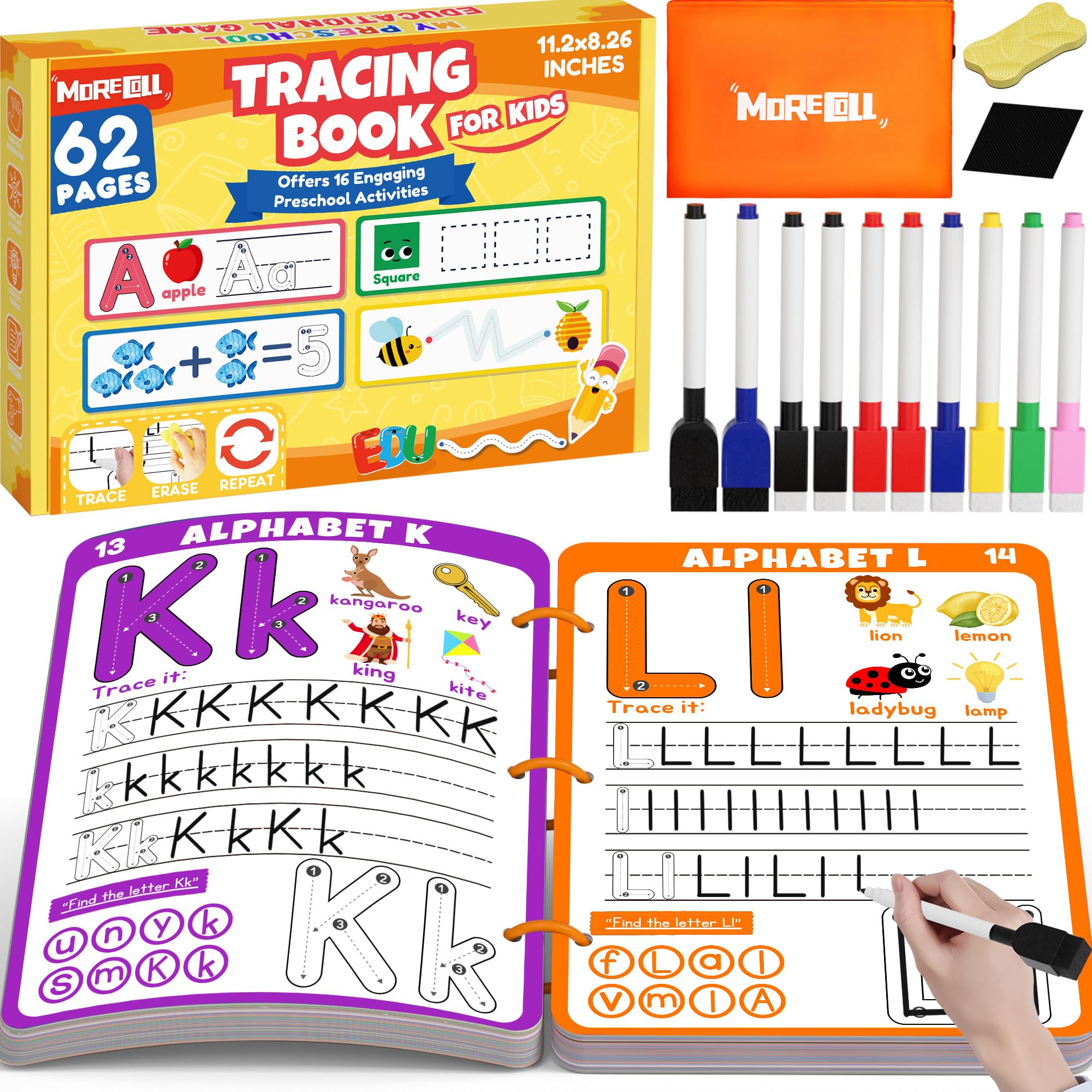
This is not a game in the traditional sense, but it functions as the perfect quiet-time activity for a four-year-old who craves independence. The spiral-bound workbook contains 62 thick, waterproof, tear-resistant pages covering 16 distinct activities: letter tracing, number practice, shape tracing, pen control, simple math, spot-the-difference, and even sections on emotions and family members.
The genius of this workbook is its write-and-wipe reusability. The dry-erase markers (included) wipe clean easily from the glossy pages, meaning a child can practice tracing the letter “A” dozens of times until they nail it. The removable rings allow parents to customize the page order or remove completed sections, reducing overwhelm. For four-year-olds with autism or language delays, the structured repetition and clear visual cues are particularly effective.
Parents report that the colorful design and variety keep children engaged for surprisingly long stretches, making it a go-to for restaurant trips or quiet afternoons. The included storage bag solves the “where do I put all these markers” problem. While it isn’t a social game, it excels at building pre-writing confidence and fine motor control in a low-pressure format.
Why it’s great
- Truly reusable — wipe clean and start over, which is excellent for repetitive practice.
- Exceptionally broad curriculum covering letters, numbers, shapes, emotions, and logic.
- Pages are thick, laminated, and resistant to toddler bends and rips.
Good to know
- Markers must be recapped tightly to prevent drying out; replacements can be bought separately.
- Not a group game — better suited for individual quiet play or one-on-one instruction.
3. Hasbro Gaming Bed Bugs Board Game
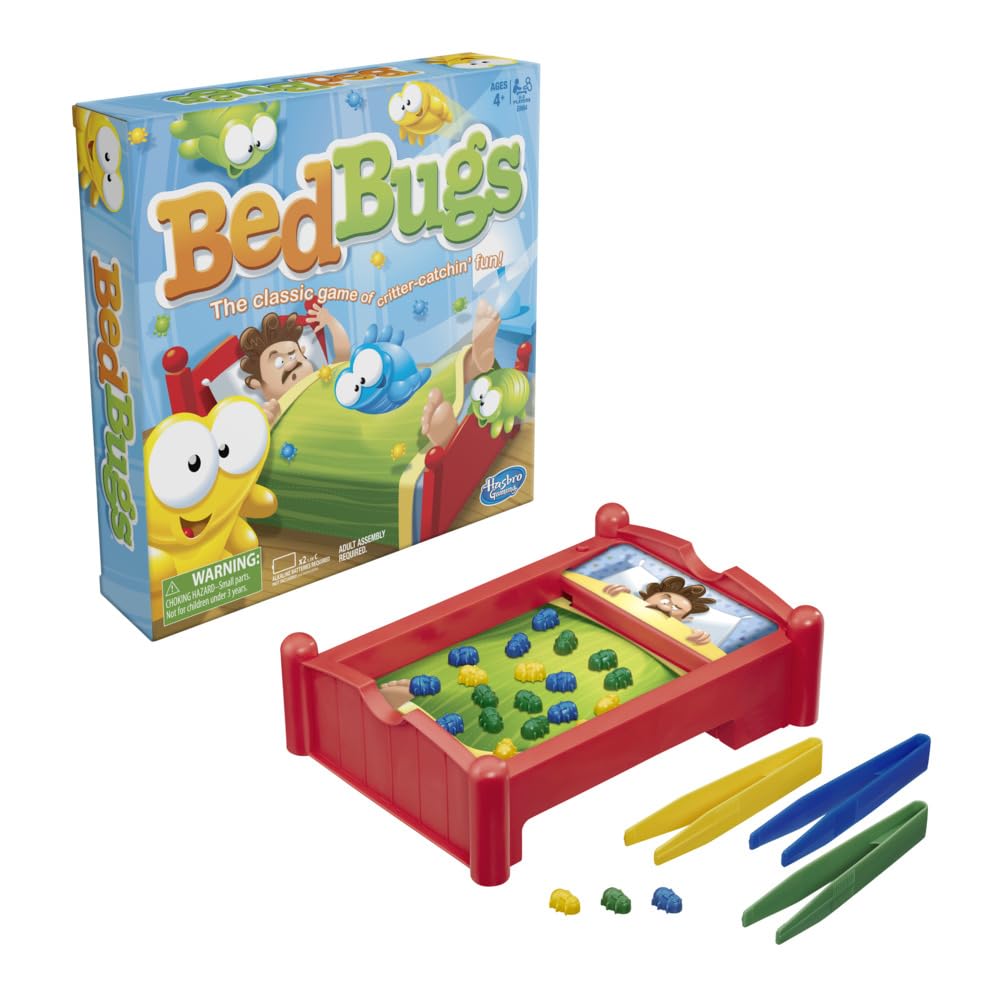
If your four-year-old has energy to burn, this is the game to pull out. The plastic “bed” vibrates, sending 36 plastic bugs bouncing and hopping across the surface. Each player grabs a colored tong and races to catch all the bugs of their matching color. First one to clear their color wins. It’s absurd, loud, and absolutely captivating for this age group.
The physical mechanics here are excellent: the tongs require a pincer grip that directly strengthens the same hand muscles used for holding a pencil. The vibrating bed adds a sensory element that holds attention longer than a static game board. Rounds are short — roughly 20 minutes — which aligns perfectly with a four-year-old’s attention window. The game teaches color matching and quick decision-making under gentle pressure.
Some families note that pressing too hard on the bed can stop the vibration, and the game can feel repetitive after consecutive rounds. But for playdates or family game nights, the sheer physical silliness of chasing bouncing bugs is a guaranteed hit. Parents appreciate that it includes counting practice naturally — kids count their bugs to see who won.
Why it’s great
- The vibrating motorized bed provides unique sensory input that standard board games lack.
- Pincer grip on the tongs directly develops fine motor skills needed for writing.
- Simple color-based rules mean zero reading required — kids can play independently immediately.
Good to know
- If kids press the bed surface too hard, the vibration mechanism can pause temporarily.
- Limited to 2-3 players; larger groups will need to take turns.
4. LeapFrog Learning Friends 100 Words Book

This electronic book is a powerhouse of vocabulary building, and it feels like a toy, not a lesson. Each page features bright, friendly illustrations organized by category — pets, food, mealtime, opposites, activities, outside. When a child touches a picture, the book speaks the word aloud, plays a relevant sound effect, and delivers a short fun fact. A light-up star button plays the Learning Friends theme song.
What elevates this for four-year-olds specifically is the bilingual mode. The toggle switches between English and Spanish, exposing children to a second language naturally through play. The thick plastic pages are remarkably durable — parents report them surviving drops, throws, and enthusiastic page-turning over months of use. The adjustable volume is a lifesaver for car trips and quiet times.
The book is designed for ages 18 months and up, but its value really shines for four-year-olds who are ready for the fun facts, the song lyrics, and the more nuanced categories like “opposites” and “activities.” It works beautifully for independent play and also serves as a shared activity where an adult can ask follow-up questions about the images.
Why it’s great
- Full bilingual support (English and Spanish) introduces second-language learning effortlessly.
- Extremely durable construction with thick plastic pages that resist tearing and bending.
- Touch-sensitive pages are highly responsive and easy for small fingers to activate.
Good to know
- Requires 2 AA batteries; demo batteries are included but will need replacement.
- No expandable content — once the 100 words are memorized, novelty may fade.
5. TALGIC Solar System Floor Puzzle

This 70-piece round floor puzzle offers a rare combination: it is challenging enough for a four-year-old to feel proud of completing, but not so difficult that it causes tears. The pieces are large and sturdy, designed for small hands to grip and maneuver. The finished puzzle forms a 10-inch diameter circle depicting the solar system, with vibrant illustrations of the planets.
The round shape is a clever design choice. Unlike standard rectangular puzzles, the circular format requires a different kind of spatial reasoning, and the edge pieces are uniformly curved, which simplifies the starting process. Children learn planet names and relative positions through repeated assembly. The thick cardboard pieces are laminated for durability and resist peeling at the corners.
Parents note that this puzzle works well as both a solo activity and a collaborative family project. The 70-piece count hits the sweet spot for four-year-olds — enough to provide a real sense of accomplishment without being overwhelming. Some children enjoy finishing it multiple times in one sitting, while others return to it daily. The space theme taps into the natural curiosity many children have about planets and rockets.
Why it’s great
- The round shape and large piece size reduce frustration and encourage independent assembly.
- Teaches solar system facts in a hands-on, screen-free format that sparks curiosity.
- Sturdy, non-toxic laminated cardboard withstands repeated use and rough handling.
Good to know
- Pieces are not oversized floor puzzle size — they are large for jigsaw pieces but still require a clean, flat surface.
- Once mastered, some children may lose interest without additional challenge variations.
FAQ
How many pieces should a puzzle for a four-year-old have?
Are electronic learning books better than physical games for this age?
Final Thoughts: The Verdict
For most users, the games for four year olds winner is the Hieoby Montessori Wooden Beads Sequencing Toy Set because it packs three distinct play modes into one durable, screen-free package that grows with the child’s skills. If you want a high-energy family activity that gets everyone laughing, grab the Hasbro Bed Bugs Game. And for quiet independent learning and pre-writing practice, nothing beats the MORECOLL Educational Workbook.