
Finding an activity that clicks without causing frustration is a real challenge when memory fades. The right puzzle feels like a small triumph — a calm moment of focus, a familiar image that sparks a smile, and hands that stay busy instead of restless. That’s the quiet power of a well-chosen set of large-piece puzzles designed for gentle cognitive engagement.
I’m Mohammad Maruf — the founder and writer behind Drink4Good. I’ve spent countless hours analyzing the specific needs behind dementia-friendly products, from piece size and tactile feedback to the balance between challenge and achievable success, ensuring each recommendation respects both dignity and ability.
This guide breaks down the five strongest options I’ve found, each chosen for how it handles the delicate line between engagement and overwhelm, so you can confidently pick the right games for people with dementia that bring genuine comfort and joy.
How To Choose The Best Games For People With Dementia
Dementia-friendly games aren’t about complexity or speed — they’re about the right kind of cognitive touch. Every element, from piece thickness to image contrast, either invites participation or creates a wall. Knowing which specs matter for which stage of memory loss changes everything.
Piece Count and Stage Suitability
Early-stage dementia can handle 63 to 100 pieces if the image is clear and not too busy. Mid-stage often needs 16 to 35 large pieces with a matching template. Late-stage benefits most from 6 to 12 extra-large pieces that can be completed in minutes. Matching the count to the person’s current ability — not where they used to be — prevents overwhelm and builds confidence.
Guided Completion Systems
The best puzzles for dementia include a built-in guide: a picture printed on the inside lid, a box bottom that doubles as the workspace, or a full-size template sheet. This visual reference eliminates the guesswork of “where does this piece go?” and turns the activity into a satisfying matching exercise rather than a frustrating spatial puzzle.
Physical Piece Design
Large pieces (1.5 to 3 inches wide) are easier to grip for arthritic hands or reduced fine motor control. Thickness matters too — 2mm cardboard resists bending and stays flat on the table. Avoid puzzles with shiny finishes that cause glare; matte surfaces reduce visual confusion and make the image easier to read.
Quick Comparison
On smaller screens, swipe sideways to see the full table.
| Model | Category | Best For | Key Spec | Amazon |
|---|---|---|---|---|
| Relish Farmers Market | Premium | Guided solo play | 63 pcs, box-bottom build space | Amazon |
| Keeping Busy Town | Mid-Range | Mid-stage engagement | 35 giant pcs, color-coded bags | Amazon |
| GoodDay Aquamarine | Mid-Range | Low-frustration start | 16 pcs, 2–3x standard piece size | Amazon |
| Relish Sunset Paris | Premium | Early-stage challenge | 100 pcs, 1.38″ wide pieces | Amazon |
| LELEMON Animal 6-Pack | Budget | Variety and rotation | 24 pcs each, 6 themes | Amazon |
In‑Depth Reviews
1. Relish 63 Piece Farmers Market Dementia Jigsaw Puzzle
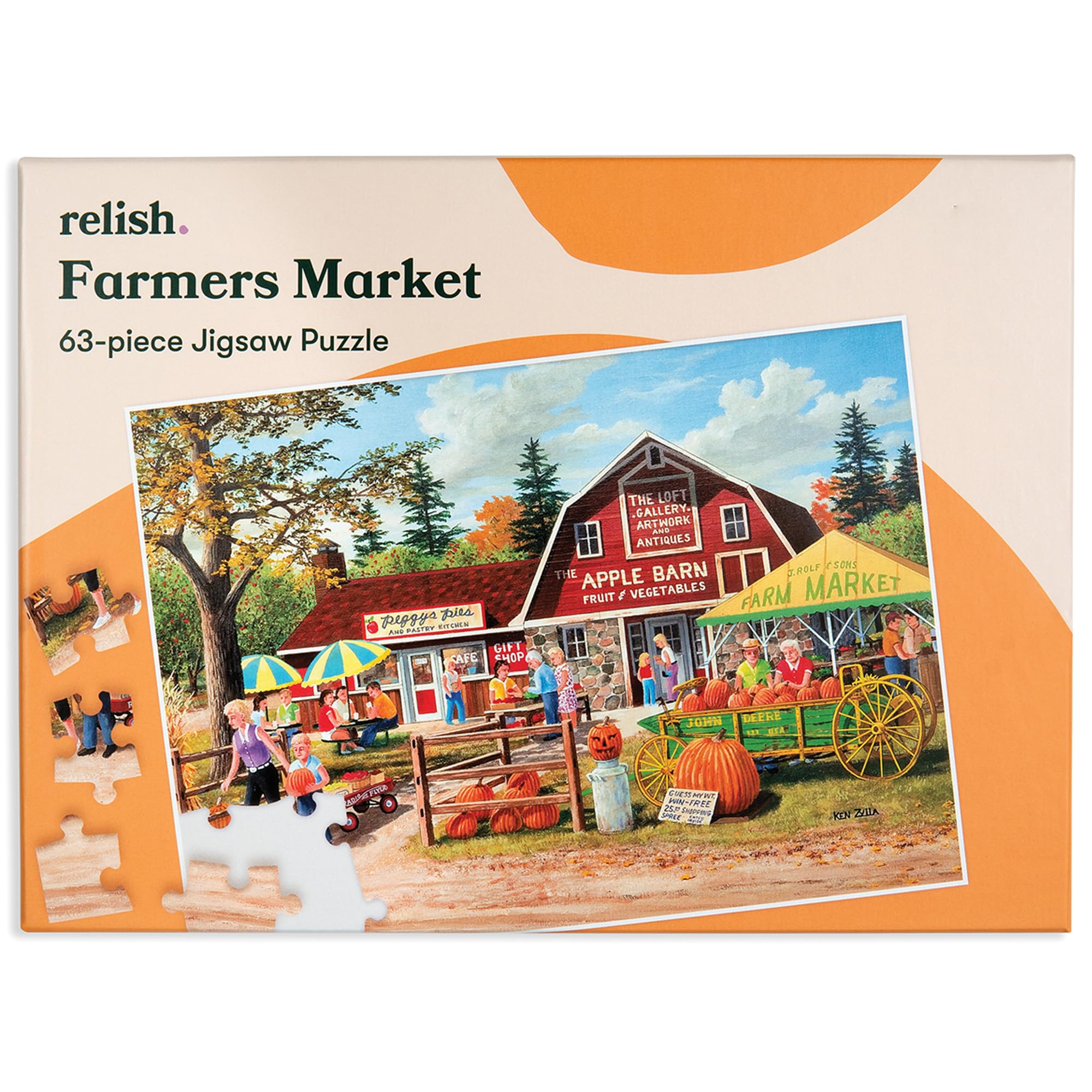
Relish has been designing dementia-specific activities since 2011, and it shows in every detail of this Farmers Market puzzle. The 63 pieces are 35mm wide and 2mm thick — large enough for arthritic hands to grip comfortably, and sturdy enough to withstand being picked up and placed repeatedly without fraying edges. The image shows a colorful market scene with distinct color blocks (bright red tomatoes, green lettuce, yellow corn) that naturally guide the user toward piece placement without requiring complex spatial reasoning.
The guided completion system is the star here: the puzzle is assembled directly inside the box bottom, with the completed image printed on the inside lid for constant reference. This eliminates the need to shift a fragile puzzle from table to storage — it stays in the box, upright, ready for the next session. Included conversation prompts encourage caregivers to talk about farmers markets, fresh food, and seasonal memories, turning a solitary activity into a shared moment of connection.
Caregivers report that the 63-piece count hits a sweet spot — challenging enough for early to mid-stage dementia users who are still seeking mental stimulation, but structured enough that completion in a single afternoon is realistic. The packaging contains no mention of dementia or Alzheimer’s, making it a thoughtful gift that preserves dignity. The only minor drawback is that pieces ship loose inside the box rather than in a sealed bag, so checking for all pieces upon arrival is wise.
Why it’s great
- Box-bottom design means zero lifting or transferring of the puzzle
- Conversation prompts deepen caregiver interaction beyond just puzzling
- 63 pieces provide real cognitive engagement without being overwhelming
Good to know
- Pieces not sealed in a bag inside the box — verify contents on arrival
- Best for early to mid-stage dementia; may be too challenging for later stages
2. Keeping Busy Town Dementia Puzzles Activities for Seniors
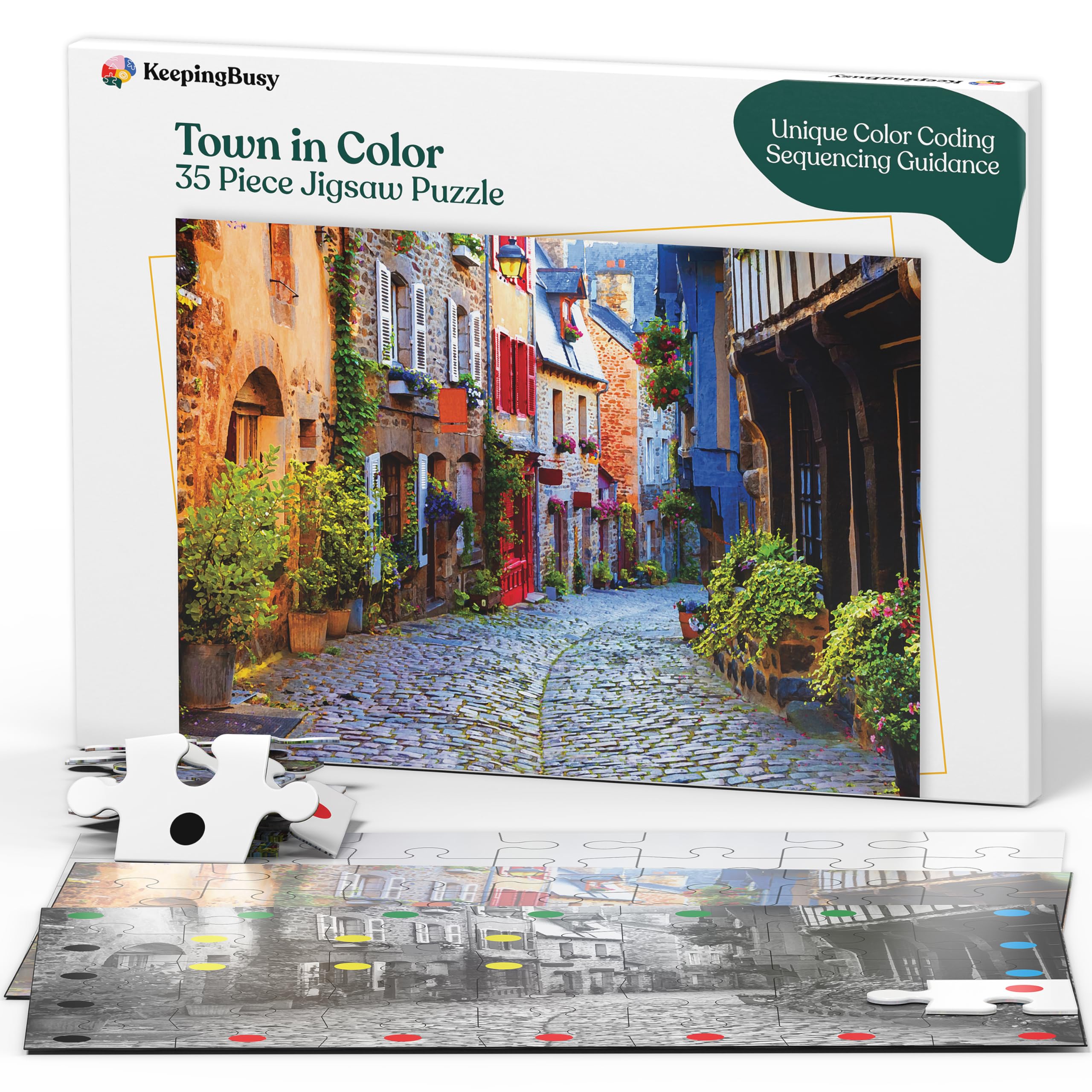
The Keeping Busy Town puzzle rethinks the jigsaw format from the ground up for dementia care. Its 35 pieces are truly giant — measuring larger than standard adult puzzle pieces — and each piece has a colored dot on the back that corresponds to one of three included template sheets. This dual guidance system means the user can sort pieces by color first, then match them to the outline on the template, drastically reducing the working memory load required to complete the image.
Beyond the puzzle itself, this kit includes three separate puzzle guides and a full-color photograph of the finished scene. The colored bags that come with the set double as a sorting activity — the user can group pieces by bag color before starting, adding an extra layer of cognitive exercise without pushing into frustration. The town scene itself (a cheerful street with a bakery, flower shop, and houses) is designed to spark discussion and reminiscing, and a dedicated discussion guide is included to help caregivers steer those conversations.
Reviewers with mid-stage Alzheimer’s users consistently report that this puzzle holds attention for 30 to 45 minutes — a significant stretch of focused engagement. The laminated mats and thick piece construction withstand repeated daily use without delamination. One reviewer noted that the high proportion of single-color areas (like a large brown section above kittens) can occasionally confuse users, but the color-coded back system compensates for this during sorting.
Why it’s great
- Three-tier guidance system (color dots, templates, full photo) reduces overwhelm
- Colored sorting bags add a secondary matching activity
- Thick, laminated pieces hold up to daily use without damage
Good to know
- Large single-color areas in the image can be confusing for some users
- 35-piece count may feel too simple for early-stage dementia with higher ability
3. GoodDay Puzzles Large Piece Jigsaw Puzzle – 16 Pieces – Aquamarine

GoodDay’s 16-piece Aquamarine puzzle is the ideal entry point for someone who hasn’t touched a puzzle in years or who is in mid to late-stage dementia. The pieces are 2 to 3 times the size of standard jigsaw pieces, making them trivially easy to pick up, rotate, and place — even for users with significant vision loss or advanced arthritis. The image is a calm, simple scene with high-contrast color blocks and minimal detail, so there’s no visual noise to cause confusion.
The build-in-box design works beautifully here: the puzzle is assembled directly inside the box, and the box bottom itself has printed outlines showing exactly where each piece belongs. This transforms the activity from “figure out where this goes” to “match the piece to its shadow,” which requires far less cognitive load. The slim profile of the box makes it easy to store on a shelf or slide under a bed, and the matte finish on the pieces eliminates glare under overhead lighting.
Caregivers report that users who initially resisted puzzles due to past frustration were able to complete this one independently on the first try. That sense of success often builds momentum — reviewers note moving from this 16-piece set to the 48-piece version from the same brand within weeks. The only limitation is the single image option per purchase; rotating through multiple themes requires buying additional sets. The cardboard quality is solid but not laminated, so it may show wear sooner than premium options with daily handling.
Why it’s great
- 16 extra-large pieces are nearly impossible to lose or misplace
- Box-bottom outlines create a foolproof matching system
- Matte finish eliminates glare and visual confusion
Good to know
- Not laminated — edges may fray with heavy daily use
- Only one image per purchase; variety requires buying additional boxes
4. Relish 100 Piece Sunset in Paris Dementia Jigsaw Puzzle

Relish’s 100-piece Sunset in Paris puzzle is built for the user who still has strong cognitive reserves and is looking for genuine mental stimulation. The pieces measure 1.38 inches wide — substantially larger than a standard adult puzzle piece — and are cut from durable 2mm thick cardboard that can withstand repeated assembly without warping. The image depicts the Eiffel Tower at sunset with bold purple, orange, and pink gradients that create natural visual dividers for piece sorting.
Unlike many dementia puzzles that sacrifice beauty for simplicity, this one is genuinely lovely to look at. The scene of Paris inspires conversation about travel, landmarks, and personal memories — the kind of reminiscence therapy that dementia experts recommend. Relish carefully chooses each image to spark communication, and the lack of any dementia or Alzheimer’s labeling on the box means it can be given as a gift without stigma. The puzzle fits comfortably on a standard serving tray, making it easy to move from table to lap if needed.
Reviewers consistently praise the 100-piece count as the right level for early-stage users who want a real challenge but can still complete it in one or two sessions. The customer service reputation is strong — one reviewer reported missing pieces and received a prompt replacement without hassle. The main trade-off is that 100 pieces may be too many for mid-stage users; at this level, frustration can build quickly if the user loses track of their place. Also, like other Relish puzzles, the pieces ship loose in the box rather than sealed, so a quick inventory check is recommended.
Why it’s great
- Beautiful, high-contrast image designed to spark memory and conversation
- Durable 2mm thick pieces resist bending and hold shape over time
- No dementia labeling on packaging preserves dignity when gifting
Good to know
- 100 pieces may overwhelm mid-stage users — best for early dementia
- Pieces not in a sealed bag; verify all are present when opening
5. LELEMON 6 Packs 24 Large Piece Puzzles for Seniors
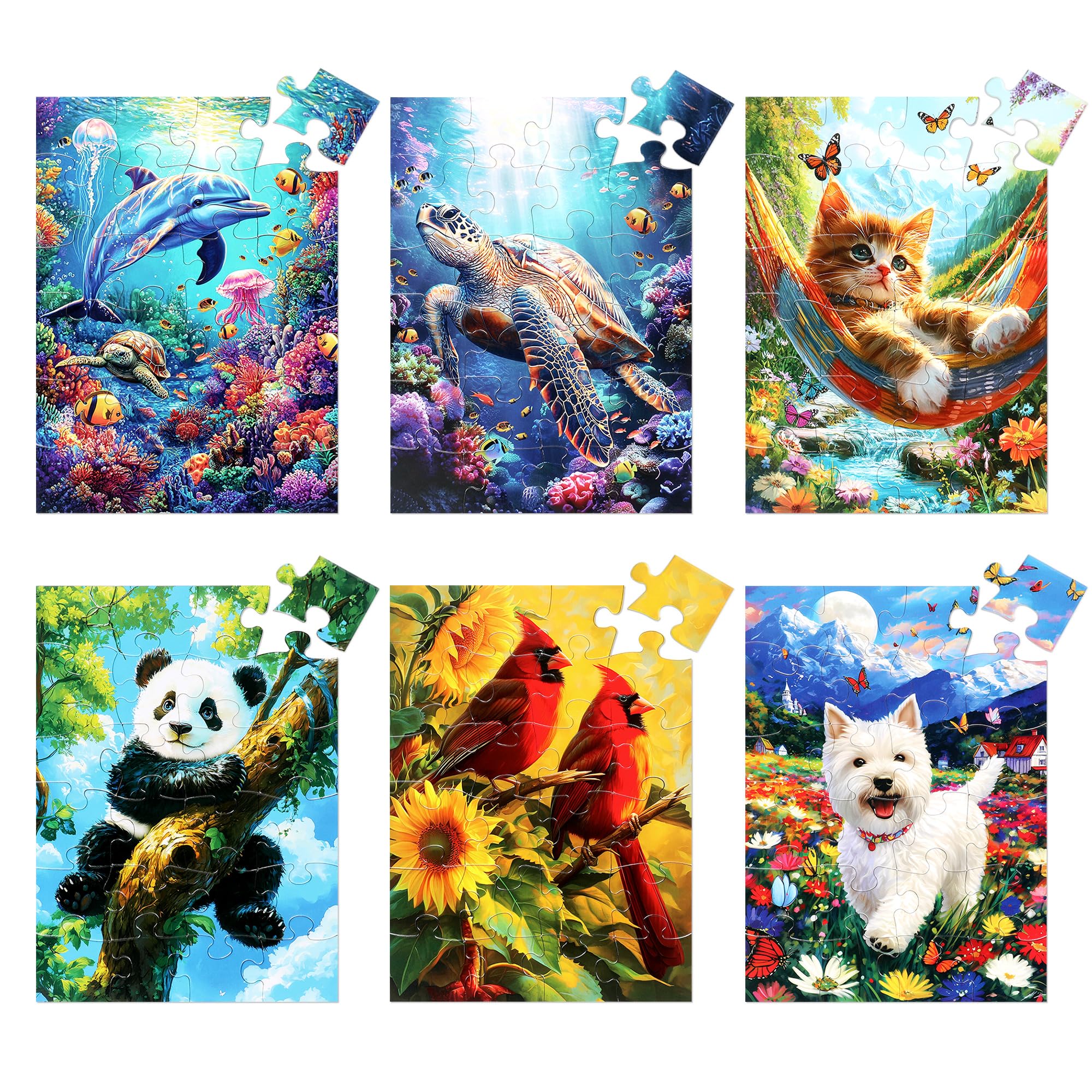
LELEMON’s six-pack of 24-piece animal puzzles offers unbeatable variety for the price — you get a turtle, panda, cat, dolphin, bird, and dog, each in its own storage bag inside a cardboard box. The 24-piece count is a comfortable middle ground: low enough that a mid-stage dementia user can finish one in a sitting, but high enough that early-stage users still feel engaged. The animal themes are universally recognizable and tend to trigger positive emotional responses — many seniors have owned pets or have strong feelings about animals.
Each puzzle is made from non-toxic, tasteless cardboard with a smooth, easy-to-clean surface. The pieces are precision-cut so they fit snugly without forcing, which reduces the frustration of pieces that seem to fit but don’t. The six separate storage bags are a practical touch — they prevent mixed pieces and allow the caregiver to offer a single animal puzzle at a time, controlling the level of choice and potential overwhelm. The box itself is portable enough to bring to a dining table, bedside table, or even outdoors on a calm day.
While the piece quality is good for the price point, the cardboard is thinner than premium options like Relish or Keeping Busy — expect some edge wear after several completions, especially if the user tends to press hard when placing pieces. The images, while clear, are somewhat simpler in composition than specialist dementia puzzles, which means less visual guidance for piece placement. Still, for a family wanting multiple options to rotate through at a low entry cost, this six-pack is hard to beat.
Why it’s great
- Six different animal themes prevent boredom through rotation
- Individual storage bags let caregivers control piece set size
- Non-toxic, smooth surface is easy to wipe clean after use
Good to know
- Cardboard is thinner than premium options — edge wear appears faster
- Simpler images provide less visual guidance for piece placement
FAQ
Can the same puzzle be used every day or will it become boring?
What should I do if a piece gets lost or damaged?
Final Thoughts: The Verdict
For most caregivers and families, the best games for people with dementia start with the Relish Farmers Market 63-Piece Puzzle because its guided box system and conversation prompts turn a simple puzzle into a rich shared activity. If you need a lower-frustration starting point for a mid-stage user, the GoodDay 16-Piece Aquamarine Puzzle offers the gentlest possible entry. And for early-stage users who still crave real cognitive challenge, the Relish 100-Piece Sunset in Paris Puzzle provides beautiful, stigma-free engagement that sparks memory and conversation alike.