
Finding group activities that balance mental engagement with genuine social fun can be a challenge, especially when playing across multiple generations. A game that is too simple fails to hold attention, while one with overly complex rules creates frustration rather than connection.
I’m Mohammad Maruf — the founder and writer behind Drink4Good. After reviewing hundreds of product specifications and analyzing user feedback for social games, I focus on the concrete details that determine whether a game actually gets played repeatedly rather than sitting on a shelf.
This guide breaks down five carefully selected options to help you find the right fit for your specific needs. We evaluated each game based on rule complexity, round length, tactile quality, and player count to build our list of the best games for seniors that prioritize accessibility and lasting fun.
How To Choose The Best Games For Seniors
Not every popular game transitions well to a social setting with older adults. The best choices pair simple, clear rules with enough strategic depth to stay interesting after dozens of rounds. Here are the core factors to weigh before making a purchase.
Rule Complexity and Learning Curve
The perfect game for this demographic can be explained in under two minutes and understood after a single demonstration round. Games that require memorizing multiple exceptions or referencing a rulebook mid-play often cause frustration. The most successful titles use a core mechanic that is intuitive—matching numbers, completing a simple sequence, or avoiding a specific card—allowing players to focus on social interaction rather than remembering procedures.
Playing Time and Player Count
A game round that lasts 15 to 30 minutes is the sweet spot. Rounds that are too short feel unsatisfying, while longer sessions can lead to fatigue and reduced attention. Also consider the player count: games that accommodate 2 to 8 players offer the most flexibility for different group sizes, from a quiet evening for two to a larger family gathering. Low-stakes team play can also reduce pressure for individual players.
Tactile Quality and Physical Ease
The physical components matter just as much as the game play. Larger, thick tiles are easier to pick up and arrange than standard playing cards. Cards with clear, high-contrast printing reduce eye strain. Components that are durable and feel good in the hand—like weighted chips or smooth-finish tiles—make the act of playing more satisfying and accessible. Avoid games with tiny pieces that are difficult to handle or see.
Quick Comparison
On smaller screens, swipe sideways to see the full table.
| Model | Category | Best For | Key Spec | Amazon |
|---|---|---|---|---|
| Pressman Rummikub | Tile Game | Pattern Recognition | Thick, stackable tiles | Amazon |
| SEQUENCE | Board & Card Game | Large Group Strategy | Folding board (19.75 x 15.25) | Amazon |
| magilano SKYJO | Card Game | Light Math & Estimation | 150 cards, 1 notepad | Amazon |
| Exploding Kittens | Card Game | Quick, Humorous Rounds | 15 minute playing time | Amazon |
| Elimino | Card Game | Multi-Generational Play | 0.23 kilogram card weight | Amazon |
In‑Depth Reviews
1. Pressman Rummikub

Pressman Rummikub has sold over 55 million units for good reason: its tile-based rummy mechanic is incredibly intuitive to learn while offering deep strategic play. The set includes thick, tactile tiles that are easy to handle—each piece measures roughly 1 inch square with a satisfying weight that makes them simple to pick up and arrange in the included stackable holders. This accessibility factor directly addresses the physical ease-of-use that many card games lack for players with reduced dexterity.
Gameplay involves drawing and placing numbered tiles into runs or groups, which reinforces pattern recognition and sequencing skills without feeling like a math exercise. The lack of a board simplifies setup and cleanup, and the rulebook can be explained in under a minute. With a standard round lasting 20 to 30 minutes, it fits comfortably into a social gathering without overstaying its welcome.
User feedback consistently highlights that Rummikub serves as a reliable bridge between generations. Grandchildren can compete on a level playing field with grandparents because success depends on strategic arrangement rather than speed or physical reaction time. The tile holders keep each player’s hand visible and organized, eliminating the need to fan out playing cards.
Why it’s great
- Large, thick tiles are easy to see and handle
- Teaches pattern recognition through natural gameplay
- Quick setup and clear, simple rules
Good to know
- Limited to a maximum of four players per set
- Requires a flat surface for tile placement
2. SEQUENCE by Jax
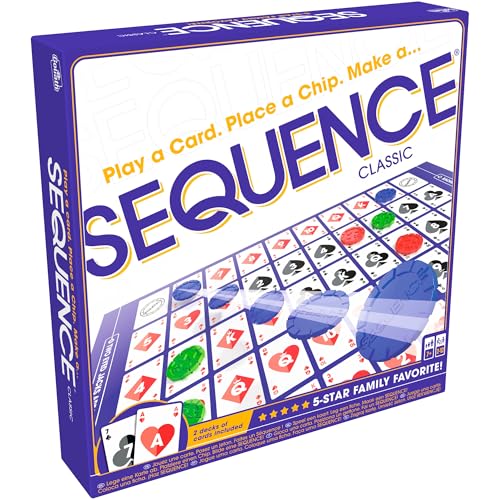
SEQUENCE blends a standard card game with a board game to create a hybrid that works exceptionally well for larger groups. The folding board measures 19.75 by 15.25 inches and features a grid of playing card faces. Players draw a card from their hand and place a colored chip on the matching space on the board; the first player or team to create a five-chip sequence wins. This simple pairing of card match and spatial strategy takes about three minutes to learn.
The inclusion of 135 chips in three colors and two full decks of cards provides enough physical components for up to 12 players operating in teams. Team play is a particularly strong feature for this demographic because it distributes the decision-making load and creates a collaborative atmosphere rather than an isolated, turn-based experience. The chips are large and easy to pick up, and the board lies flat without issues.
Customer reviews emphasize the game’s durability—the board is thick and well-laminated, and the cards hold up well to frequent shuffling. The major advantage is its scalability: a simple two-player game is just as engaging as a raucous team match with eight or more people. This makes it a staple for family reunions or group gatherings where different age ranges are present.
Why it’s great
- Supports up to 12 players in team format
- Combines luck and strategy with very fast rules
- Durable board and chip construction
Good to know
- Board surface can be reflective under bright light
- Some users report slight chip color imbalances
3. magilano SKYJO

SKYJO is a German-designed card game that uses a low-point scoring system to encourage thoughtful play without punishing mistakes too harshly. The goal is simple: collect as few points as possible by strategically replacing cards in your layout. With 150 cards in the box, the game supports up to 8 players and includes a dedicated notepad for tracking scores, which is a surprisingly useful addition for groups that play multiple rounds.
What makes SKYJO particularly well-suited for older players is its gentle cognitive load. It exercises estimation and probability without requiring quick arithmetic or intense concentration. The cards are thick with a high-quality finish that makes them easy to shuffle and handle, and the box dimensions are compact enough for travel or storage. A typical 30-minute round allows for meaningful social interaction without dragging.
Reviews from families consistently note that the game bridges age gaps effectively. Users report that players from age 10 to 75 enjoyed the game on equal footing, largely because the luck element keeps anyone from dominating too heavily while the strategic card swaps reward thoughtful play. The scoring system includes negative numbers, adding an interesting twist that rewards risk-taking without being overly punishing.
Why it’s great
- Gentle cognitive exercise with low stress per round
- High card quality with easy-to-read printing
- Very portable for travel or social visits
Good to know
- Scoring can be confusing for some players initially
- Notepad runs out over many play sessions
4. Exploding Kittens Original Edition

Exploding Kittens is a high-stakes elimination card game where the goal is to avoid drawing the Exploding Kitten card. Each player uses action cards like Defuse, Skip, and Shuffle to manipulate the deck and survive. The core mechanic is simple enough to explain in 30 seconds, and a full game averages just 15 minutes, which makes it one of the shortest-round options in our review.
The cards feature artwork by The Oatmeal, with humorous illustrations that add an element of levity to the experience. The physical cards measure 2.5 by 3.5 inches and have a high-quality laminate that feels good in the hand. However, the text on the action cards is relatively small, which may be a consideration for players with significant visual impairments. The strategy element comes from the tension of a shrinking deck, which creates a survival-game feel without being stressful.
User feedback is overwhelmingly positive regarding its ability to get a group laughing quickly. The fast rounds mean that eliminated players only wait briefly before the next game starts. It works best as a casual icebreaker or a quick palate cleanser between longer games, rather than a dedicated evening centerpiece.
Why it’s great
- Extremely fast 15-minute rounds prevent fatigue
- Humor and light tone keeps atmosphere playful
- Portable box fits easily in a bag
Good to know
- Small card text may be hard for some to read
- Elimination mechanic can leave players sitting out
5. Elimino Family Card Game
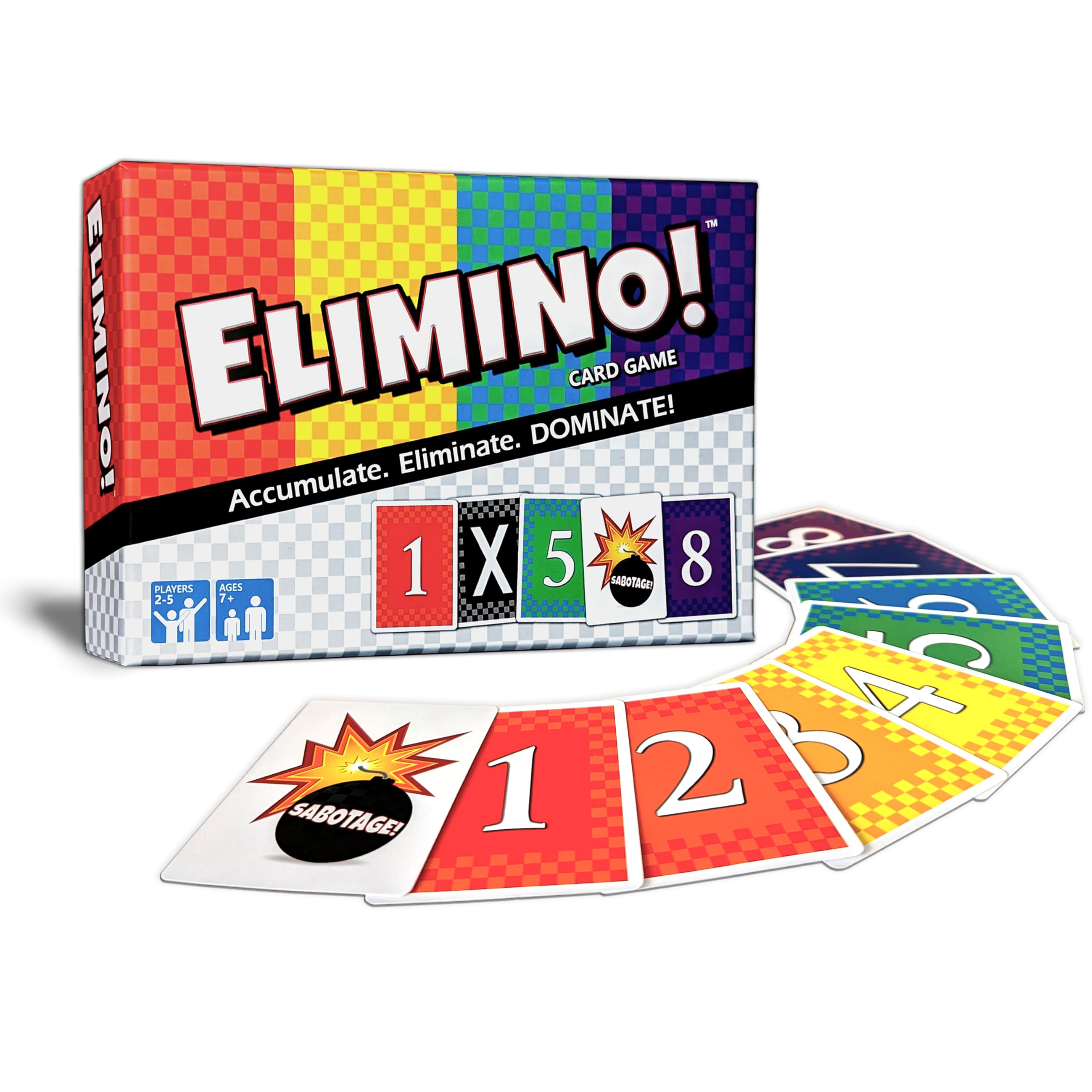
Elimino is a relatively new entrant from a family-run company, inspired by the classic Garbage or Trash card game but expanded with interactive sabotage cards. The premise involves racing to complete specific card layouts while using special cards to steal opportunities from opponents or block their progress. The rules are simple enough for a seven-year-old to grasp, yet the sabotage element introduces a layer of playful strategy that keeps adults engaged.
The game includes 56 cards with a durable finish, packed in a box measuring 6.25 by 4.5 by 1.5 inches, making it highly portable. The design philosophy emphasizes inclusivity—the rules explicitly encourage players to help each other learn, and the company supports charitable causes as part of its mission. The compact form factor and light card weight of 0.23 kilograms make it an ideal choice for trips or visits.
Player reviews highlight the game’s ability to encourage conversation and playful banter, partly because the sabotage mechanic feels more like teasing than an aggressive strategy. Rounds are short enough that players can chat while playing, and the luck element keeps outcomes unpredictable even when skill levels vary. It is a good option for someone looking for a fresh alternative to traditional card games with a modern twist.
Why it’s great
- Encourages social interaction with playful sabotage
- Very compact and travel-friendly box size
- Simple rules explained in under two minutes
Good to know
- Cards are standard size with minimal text
- Sabotage elements may frustrate very competitive players
FAQ
What is the ideal round length for a senior game night?
Are card games or tile games easier for players with arthritis?
Final Thoughts: The Verdict
For most users, the best games for seniors winner is the Pressman Rummikub because its large, easy-to-handle tiles combine intuitive pattern-building rules with genuine strategic depth. If you want a game that can accommodate a large multi-generational gathering, grab the SEQUENCE by Jax for its flexible team-based format. And for a portable, low-stress option that works in nearly any setting, the magilano SKYJO offers the ideal balance of cognitive engagement and social relaxation.