
A quiet evening at home, a round at the coffee shop, or the final moment of a game night with friends—the best two-player games prove that the most memorable tabletop experiences need only two chairs. The problem is finding a title that doesn’t devolve into one player dominating or, worse, feels like a solo activity while the other waits. The category has exploded with dedicated dueling mechanics, cooperative landing procedures, and relationship-building prompts that make every move matter equally.
I’m Mohammad Maruf — the founder and writer behind Drink4Good. I’ve spent years analyzing market trends, reading hundreds of rulebooks, and studying crowd-sourced feedback to identify which two-player designs deliver lasting replayability versus those that fizzle after a single playthrough.
Whether you want deep strategy, cooperative tension, or silly bonding prompts, this guide highlights the best games for two players that respect your time, your shelf space, and your need for an equally matched opponent.
How To Choose The Best Game For Two Players
The best two-player games aren’t just “good” games that happen to work with two—they’re designed specifically for the dynamic of a head-to-head or cooperative duo. Before you pick one, consider how you and your partner actually want to interact. Competitive players want direct conflict and balanced asymmetry; cooperative duos need systems that prevent one player from dictating every move. A game that works at three or four players can feel thin at two. Dedicated two-player designs, like the ones on this list, tune every rule for exactly two minds at the table.
Cooperative vs. Competitive: Know Your Duo
A cooperative game like Sky Team forces both players to work silently toward a shared goal, which builds trust and tension but requires a partner who doesn’t take over the strategy. On the flip side, a competitive game like Splendor Duel pits you directly against each other—every gem you draft denies the opponent an option. If one of you hates losing, a co-op might keep the peace. If you both love trash talk and direct competition, lean into a duel-style game.
Playtime and Setup Complexity
A 20-minute game like BOOP works as a warm-up or a weeknight closer, while a 30-minute game like Duel for Middle-Earth asks for a little more table time. Look at the estimated playtime realistically—some games with quick rounds encourage “one more game” syndrome. Also check setup time; a box with a dozen token types can feel like a barrier when you just want to play. The games on this list all set up in two minutes or less, which is the sweet spot for casual two-player sessions.
Replayability Through Variable Setup
The worst feeling is a game that reveals all its secrets after two plays. Top-tier two-player games build replayability into the core: variable starting boards, modular scenarios, or a deck that changes every game. Splendor Duel shuffles its development cards differently each time, while Sky Team offers twenty distinct airport scenarios with special rules. If you plan to play the same game repeatedly, look for that structural variety rather than relying on expansions later.
Quick Comparison
On smaller screens, swipe sideways to see the full table.
| Model | Category | Best For | Key Spec | Amazon |
|---|---|---|---|---|
| Sky Team | Co-op | Silent tension & trust-building | 20 Scenarios, no talking rule | Amazon |
| Splendor Duel | Competitive | Head-to-head gem drafting | 25 plastic gem tokens | Amazon |
| Duel for Middle-Earth | Competitive | Thematic asymmetric duel | 3 win conditions | Amazon |
| The Ultimate Date Night Game | Party | Relationship bonding prompts | 200 prompt cards, spinner | Amazon |
| BOOP | Abstract | Quick tactical fun | 32 wooden cat pieces | Amazon |
In‑Depth Reviews
1. Sky Team

Sky Team won the 2024 Spiel des Jahres for good reason — it’s a two-player cooperative game where you and your partner land a commercial airplane using only dice placement and silence. The core loop is simple: after a brief planning phase (the only time you can talk), you place your dice simultaneously on the cockpit board. No pointing, no table-talking, no quarterbacking. You trust your co-pilot or you crash. That mechanic forces genuine shared decision-making and creates tense, memorable moments in less than 20 minutes.
The production is lean and immersive. The box includes a control panel board, an airplane axis disc, eight custom dice, player screens, altitude and approach tracks, and seventeen tokens. The art is clean and thematic, and the coffee tokens let you mitigate bad rolls by re-rolling a die. The twenty airport scenarios escalate the challenge with unique rules like kerosene leaks, ice on the tarmac, or a new intern who adds chaos. Setup takes roughly two minutes, and the rulebook teaches you in under ten.
Crowd-sourced feedback consistently praises the tension-to-time ratio. Players report that a single game feels like a white-knuckle ten-minute flight, and the variety of scenarios keeps the game fresh for dozens of sessions. The only real downside: if you’re not into the theme of aviation, the cockpit conceit might not grab you. But as a pure, well-tuned cooperative experience for two, Sky Team is the standard-setter.
Why it’s great
- Eliminates quarterbacking with silent dice placement
- 20 varied scenarios provide high replay value
- Fast setup and teach in under 10 minutes
Good to know
- Aviation theme may not appeal to everyone
- Cooperation required — not for competitive duos
2. Splendor Duel
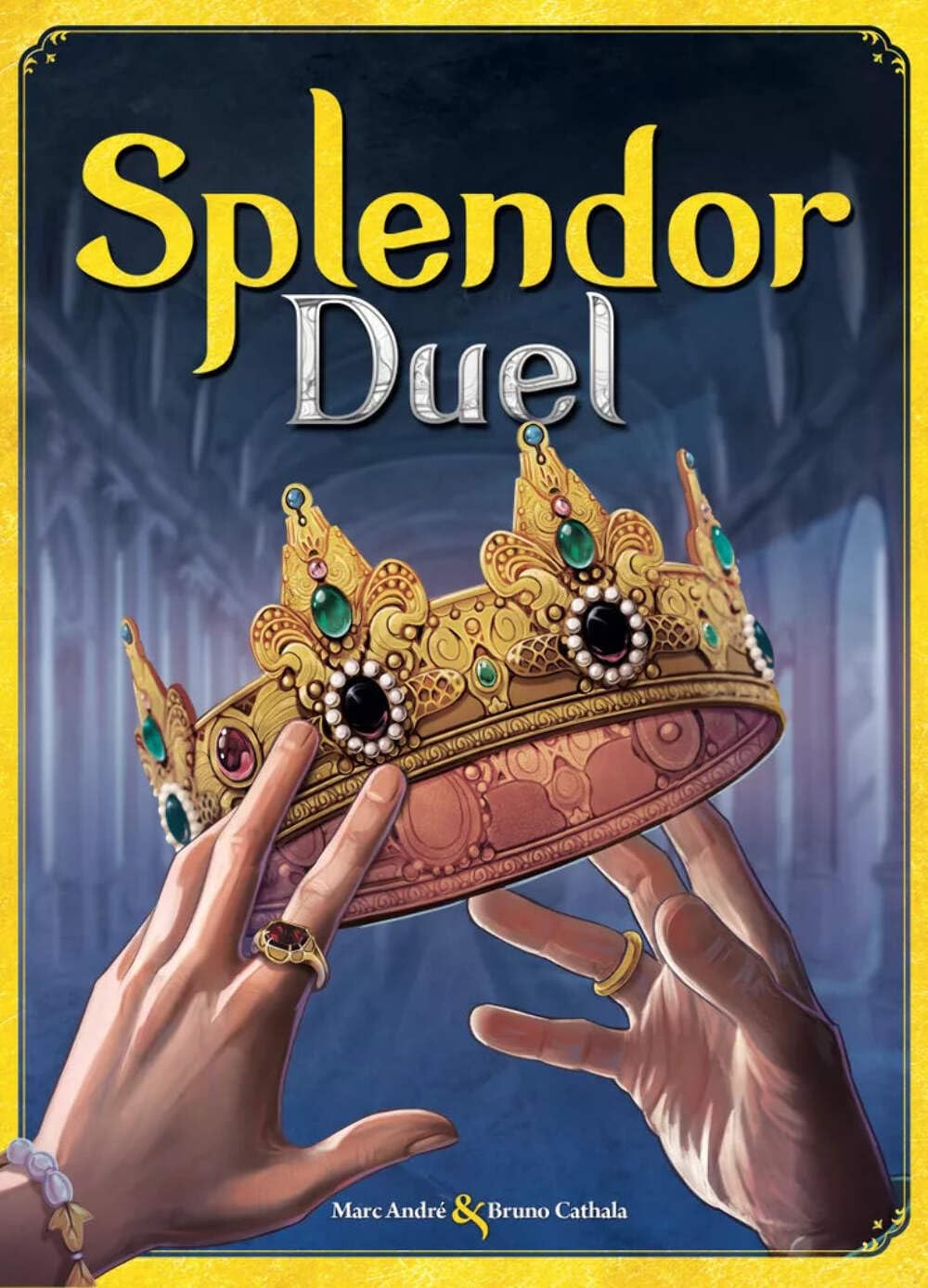
Splendor Duel is the dedicated two-player retooling of the classic Splendor engine, and it fixes every problem the original had at two players. Instead of sharing a marketplace with a neutral third player, the gem tokens (now solid plastic coins) sit on a shared board in a specific layout, and each card you take physically removes options from the opponent. The result is a tight, aggressive, zero-sum race where every move matters. A typical game runs about 30 minutes, and three ways to win keep you guessing: highest prestige points, three royal tiles, or a specific noble tile.
The component quality is immediately noticeable. The jewel cards are thick and linen-finished, the gem tokens have satisfying weight, and the box is compact enough for a backpack. The new mechanics—pearls as a neutral fifth gem, privilege scrolls that provide re-rolls, and a victory tile that awards bonus points—add depth without bloat. The bag draw for the tokens introduces a touch of luck, but seasoned players will tell you it rewards adaptability over perfect planning.
Reviews highlight the game’s “one more round” energy. After a close loss, you want an immediate rematch because you saw exactly where you went wrong. The variable starting layouts and shuffled development cards mean no two games unfold identically. The only caution is that Splendor Duel is purely competitive—if one player is significantly more skilled, the game can feel lopsided. For evenly matched duos, it’s a nearly perfect strategic duel.
Why it’s great
- Direct conflict with no “3rd player” dilution
- Three victory conditions add strategic variety
- High-quality components that feel premium
Good to know
- Skill disparity can make games feel one-sided
- Pure competition — not for co-op fans
3. The Lord of the Rings: Duel for Middle-Earth

The Lord of the Rings: Duel for Middle-Earth adapts the acclaimed 7 Wonders Duel system into J.R.R. Tolkien’s world, and the result is a game that feels both familiar and fresh. The core is a card-drafting tug-of-war played over three chapters, representing the phases of the War of the Ring. The Fellowship player races to destroy the Ring via a hidden track, while Sauron builds armies and conquers territories through area control. Three distinct win conditions—Ring quest completion, alliance with six peoples, or military domination—keep both players on edge every turn.
The production is where this game shines. The cards feature stunning original artwork that captures the tone of Middle-earth without relying on movie stills. The 44 pawns, 30 coins, and 18 tokens feel substantial, and the two-sided player boards offer asymmetric starting powers via different leaders. The rules are accessible in about ten minutes, but the strategic depth reveals itself over multiple games: knowing when to pivot from military to quest, when to sacrifice a card to deny the opponent, and how to use the High Places (special action spaces) for maximum efficiency.
Player feedback consistently notes the 30-minute playtime feels brisk but satisfying. The game rarely overstays its welcome, and the “choose a card, then your opponent chooses” mechanism creates constant interaction. The only trade-off is the box size: it’s compact but packed, and the rulebook could be clearer on edge cases. For fans of the lore and tight two-player strategy, Duel for Middle-Earth is a top-tier choice that respects both the source material and the need for balanced gameplay.
Why it’s great
- Asymmetric sides offer high replay value
- Three different win paths create tension
- Beautiful, thematic artwork and components
Good to know
- Rulebook could be clearer on edge cases
- Requires 30-minute commitment per game
4. The Ultimate Date Night Game

The Ultimate Date Night Game from the makers of Let’s Get Deep is a card-based couples’ activity designed to spark conversation and playful connection. The box holds 200 cards divided into five categories, plus a spinner that determines which category you draw from. Prompts range from silly and lighthearted to more intimate reflections, and the goal is simply to be the first to collect 25 cards by completing the challenges or answering the questions. There’s no complex strategy—the game is about engagement, not winning.
The cards themselves are heavyweight and durable, with a smooth matte finish that resists wear after repeated shuffling. The spinner is a simple plastic arrow with a suction cup base, and the rulebook fits on a single page. The estimated playtime of 45 minutes feels about right for a full session, but many players report using the prompts as a casual conversation starter over dinner, ignoring the spinner entirely. The age warning is 17+, and the content skews toward romantic partners rather than friends.
User feedback is split on longevity. Some couples love the variety of prompts and report using the deck for months, while others note that after three or four sessions the prompts begin to feel repetitive. The game works best when taken slowly—a few cards a night rather than burning through the whole deck. It’s also an excellent gift for new couples or as a Valentine’s gesture. If you’re looking for a structured way to have better conversations with your partner, this is a solid choice, but the gameplay itself is more of a framework than a competition.
Why it’s great
- Prompts range from silly to deep, flexible for mood
- Durable heavyweight cards resist wear
- Great as a gift for new couples
Good to know
- Prompts can feel repetitive after a few sessions
- More of a conversation tool than a game with rules
5. BOOP

BOOP is the most physically satisfying game on this list. It’s a two-player abstract strategy game where you place knitted-looking wooden cat pieces onto a soft quilted fabric board. The twist: when you place a kitten, it pushes every adjacent piece one space away. That “boop” mechanic creates chain reactions, blocking the opponent’s line while opening your own. The goal is to line up three cats in a row, but the board is never static—every move reshuffles the entire layout. Games last under 20 minutes, and the rules take about three minutes to explain.
The components are the star here. The 32 wooden pieces are chunky and satisfying to hold, painted in two distinct pastel colors. The board is a soft, quilted fabric that feels like a small cat bed, and the overall production has a whimsical, high-end feel well above the entry-level price. The box is compact enough to throw in a bag, making it an ideal travel game or café companion. The recommended age is 10+, but the tactile nature and simple rules make it accessible to younger players with minimal supervision.
Player feedback is nearly universally positive, with frequent mentions of the “one more game” trap. Because BOOP is so fast, you’ll find yourself playing three or four rounds in a row. The only downside is that the strategic ceiling is lower than a pure abstract like chess—once both players understand the push mechanics, the game can feel solved after a dozen plays. But for its intended purpose—a quick, adorable, and engaging two-player warm-up—it’s nearly unbeatable for the price.
Why it’s great
- Unique “boop” push mechanic creates dynamic tension
- Beautiful wooden pieces and soft quilted board
- Fast 20-minute games enable multiple rounds
Good to know
- Strategic depth may plateau after repeated plays
- Pure abstract — no theme beyond the cat aesthetic
FAQ
Can I play any of these games with a non-gamer partner?
Which of these games has the highest replay value?
Are any of these games suitable for travel or small spaces?
Final Thoughts: The Verdict
For most users, the best games for two players winner is the Sky Team because it offers unmatched cooperative tension, high replayability through twenty scenarios, and a clever silent mechanic that prevents any one player from dominating the experience. If you want direct head-to-head competition with premium components, grab the Splendor Duel. And for a quick, adorable, and budget-friendly tactical warm-up that plays in 20 minutes, nothing beats the BOOP.