
The idea of playing modern titles at 1080p without a dedicated graphics card once seemed like a pipe dream. Yet the latest generation of accelerated processing units has flipped that script entirely, delivering integrated graphics that can rival entry-level discrete GPUs for a fraction of the total system cost. This shift opens up a viable path for budget-conscious builders, small-form-factor enthusiasts, and anyone looking to repurpose a compact machine into a gaming rig.
I’m Mohammad Maruf — the founder and writer behind Drink4Good. I spend my weeks buried in benchmark spreadsheets, analyzing thermal design power limits, memory controller performance, and iGPU clock frequencies to separate the APUs that actually deliver playable frame rates from those that fall short.
Whether you are building a new rig from scratch or upgrading an older AM4 platform, finding the right best gaming apu requires understanding how core count, memory speed, and integrated GPU architecture interact to determine real-world performance.
How To Choose The Best Gaming APU
An APU is not just a budget CPU — it is a balancing act between processing cores and an integrated graphics engine that shares the same memory bus. Picking the wrong one can leave you with a processor that bottlenecks itself before you even launch a game. Focus on these three areas to make the right decision.
Integrated Graphics Architecture Matters Most
The iGPU on an APU is defined by its compute units (CUs), architecture generation (Vega, RDNA 2, RDNA 3), and clock speed. RDNA 3-based graphics, found in the Ryzen 7000G series and the Ryzen 8000G series, deliver roughly 30–40 percent more performance per CU than the older Vega architecture. An APU with RDNA 3 can often handle esports titles at high settings and AAA games at low-to-medium settings, where a Vega-based APU would struggle at the same resolution.
Memory Speed Is Your Performance Lever
Because the iGPU has no dedicated VRAM, it borrows from system memory. Running a single stick of RAM cuts iGPU bandwidth in half, crushing frame rates. For any gaming APU, you absolutely must run two sticks in dual-channel mode, and faster memory (DDR4-3600 or DDR5-6000) can lift performance by 15 percent or more compared to base speeds. This single upgrade often makes the difference between a game being playable and unplayable.
Socket Compatibility and Upgrade Path
Socket AM4 APUs like the 5600G and 5600GT let you drop a powerful iGPU solution into an older, affordable motherboard, while AM5 APUs like the 8700G give you access to DDR5 memory and a future upgrade path to higher-end Ryzen CPUs. If you plan on eventually adding a discrete GPU, an AM5 platform offers more headroom. For a pure budget build that may never see a dedicated card, AM4 remains the most cost-effective entry point.
Quick Comparison
On smaller screens, swipe sideways to see the full table.
| Model | Category | Best For | Key Spec | Amazon |
|---|---|---|---|---|
| AMD Ryzen 7 8700G | Premium Desktop | 1080p medium gaming | RDNA 3 (12 CUs) at 2900 MHz | Amazon |
| GMKtec K8 Plus | Premium Mini PC | AAA games at 1080p low | Radeon 780M (12 CUs) at 2700 MHz | Amazon |
| Intel Core i9-12900K | High-End Desktop | Light gaming on UHD 770 | Intel UHD 770 (32 EUs) at 1.55 GHz | Amazon |
| AMD Ryzen 9 7900X | High-End Desktop | Productivity plus light games | RDNA 2 (2 CUs) at 2200 MHz | Amazon |
| AOOSTAR GEM12 MAX | Mid-Range Mini PC | 1080p AAA gaming | Radeon 780M (12 CUs) at 2700 MHz | Amazon |
| FIREBAT A6 7735HS | Mid-Range Mini PC | Esports and retro gaming | Radeon 680M (12 CUs) at 2200 MHz | Amazon |
| KAMRUI Hyper H1 | Mid-Range Mini PC | Home theater and indie games | Radeon 680M (12 CUs) at 2200 MHz | Amazon |
| AMD Ryzen 5 5600GT | Budget Desktop | 1080p esports gaming | Vega 7 (7 CUs) at 1900 MHz | Amazon |
| AMD Ryzen 5 5600G | Budget Desktop | Budget all-in-one builds | Vega 7 (7 CUs) at 1900 MHz | Amazon |
In-Depth Reviews
1. AMD Ryzen 7 8700G

The Ryzen 7 8700G sits at the apex of the desktop APU market, pairing eight Zen 4 cores with a Radeon 780M iGPU that packs 12 RDNA 3 compute units clocked at 2900 MHz. This combination delivers playable frame rates in AAA titles at 1080p with low-to-medium settings, reaching around 32–65 FPS in demanding games like Cyberpunk 2077 while sipping only 65W under load. That performance level brings it within striking distance of a discrete GTX 1650, all without occupying a PCIe slot.
The AM5 socket means you get DDR5 memory support and PCIe 5.0 lanes, offering a clear upgrade path to a future discrete GPU if you ever want more horsepower. The bundled Wraith Stealth cooler handles stock operation fine, though aftermarket cooling helps maintain boost clocks during extended sessions. Dual-channel DDR5-6000 memory is the sweet spot for feeding the iGPU enough bandwidth to stretch its legs.
One note: some retail units ship with the 65W Wraith Stealth cooler rather than the advertised Wraith Spire, so double-check your box contents if that matters for your build. For the buyer who wants the absolute best integrated graphics performance on a desktop platform today, this is the chip to beat.
Why it’s great
- RDNA 3 iGPU rivals entry-level discrete GPUs
- AM5 platform with DDR5 and PCIe 5.0 support
- 8-core CPU handles productivity tasks easily
Good to know
- Requires fast dual-channel DDR5 for best iGPU performance
- Included cooler may not match the advertised model
- Base cost is higher than AM4 alternatives
2. GMKtec Gaming Mini PC K8 Plus

The GMKtec K8 Plus proves that a mini PC can pull double duty as a workstation and a gaming machine. Its Ryzen 7 8845HS processor, built on Zen 4, hits boost speeds up to 5.1 GHz, while the integrated Radeon 780M with 12 RDNA 3 compute units delivers enough graphics power to run Fortnite at 1080p medium settings smoothly and even tackle Cyberpunk 2077 at low settings. The dual 2.5G Ethernet ports and OCuLink connector for external GPU upgrades add unusual flexibility for such a small chassis.
With 32GB of dual-channel DDR5-5600 memory and a 1TB PCIe 4.0 SSD out of the box, this unit is ready to game immediately without any RAM upgrade guesswork. The dual-fan vapor-chamber cooling system keeps noise levels low even under sustained load, and the three adjustable BIOS modes let you prioritize silence, balance, or raw performance up to 70W. Quad 4K display support via USB4, HDMI 2.1, and DisplayPort 2.1 makes it equally capable as a multi-monitor productivity hub.
The unit includes Windows 11 Pro pre-installed, and GMKtec’s support team is responsive — one reviewer noted a Windows key issue resolved via email quickly. Just be aware that initial setup may involve downloading drivers from the manufacturer’s website rather than relying on Windows Update for everything. For a compact form factor that genuinely games, this is a top-tier choice.
Why it’s great
- 32GB dual-channel DDR5 provides ample iGPU bandwidth
- OCuLink port for future external GPU expansion
- Dual 2.5G LAN and Wi-Fi 6E for networking flexibility
Good to know
- Pre-installed software may need cleanup
- Some users report fan noise at peak performance mode
- Higher price point than bare-bones mini PCs
3. Intel Core i9-12900K

The Intel Core i9-12900K occupies an unusual position in the APU landscape: its integrated UHD 770 Graphics cannot compete with AMD’s RDNA 3 offerings for gaming, but the processor’s 16-core hybrid architecture (8 Performance-cores plus 8 Efficiency-cores) delivers monstrous multi-threaded performance for productivity workloads. If your primary need is video editing, 3D rendering, or software compilation, and you only play lightweight or older titles in your spare time, this chip makes sense.
The iGPU handles media playback, multiple 4K monitor outputs, and less demanding esports games like League of Legends or CS2 at low settings without issue. Many builders use the UHD 770 as a dedicated output for secondary monitors, reserving their discrete GPU for the primary gaming display. The chip runs surprisingly cool for its class — reviewers report idle temps around 30°C and gaming loads staying in the 38–47°C range with a 360mm AIO cooler.
You need an LGA1700 motherboard with a 600- or 700-series chipset, and power draw can exceed 200W under full multi-core load, so a quality cooler is essential. The i9-12900K is a beast for productivity that happens to have an iGPU for basic display tasks, not a dedicated gaming APU. Buy it for the CPU power first, treat the graphics as a bonus.
Why it’s great
- Class-leading multi-core performance for productivity
- Hybrid architecture balances power and efficiency
- Integrated GPU handles multi-monitor setups easily
Good to know
- iGPU is not suitable for modern AAA gaming
- High power draw requires robust cooling
- DDR5 and Z690/Z790 boards add platform cost
4. AMD Ryzen 9 7900X

The Ryzen 9 7900X is a 12-core Zen 4 powerhouse that delivers exceptional multi-threaded performance for photo editing, 3D rendering, and software compilation. Its integrated RDNA 2 graphics, however, are limited to just 2 compute units — this is not a gaming APU. The iGPU exists primarily for display output, video playback, and troubleshooting without a discrete card. You can run lightweight games at 720p or 1080p very low settings, but do not expect a playable experience in anything released after 2020.
Where this processor truly shines is in CPU-bound workloads. Cinebench multi-core scores around 28,745 points are achievable with proper cooling, and the chip boosts up to 5.6 GHz on a single core. The AM5 platform gives you access to DDR5 memory and PCIe 5.0, making this a future-proof foundation for a system that will eventually house a dedicated GPU. Pair it with a 360mm AIO or a high-end air cooler — this chip runs hot at full load.
Several reviewers note that underclocking to 4.6 GHz drops idle temperatures from 52°C to the high 30s without sacrificing meaningful gaming performance once paired with a discrete GPU. The 7900X is a productivity-first purchase; the iGPU is a convenience feature rather than a gaming tool.
Why it’s great
- 12 Zen 4 cores handle heavy multi-threaded workloads
- High boost clock for single-threaded performance
- AM5 platform offers DDR5 and PCIe 5.0
Good to know
- Integrated graphics is too weak for gaming
- Runs very hot under full load
- Requires premium cooling solution
5. AOOSTAR GEM12 MAX Mini PC

The AOOSTAR GEM12 MAX takes the Ryzen 7 8745HS — an eight-core Zen 4 processor without the NPU found in the 8845HS — and pairs it with a Radeon 780M iGPU that delivers strong 1080p gaming performance. The 12 RDNA 3 compute units at 2700 MHz handle modern esports titles with ease and can push through AAA games at low-to-medium settings. The unit supports three BIOS modes ranging from 45W silent operation up to 75W in performance mode, giving you control over the thermal and noise trade-off.
Connectivity is a highlight: dual USB4 40Gbps ports, an OCuLink port for external GPU attachments, dual 2.5G LAN, and support for four simultaneous 4K displays via HDMI, DP, and USB4. The vapor chamber cooling system keeps the chassis quiet even during gaming sessions, and the compact 13cm x 13cm footprint fits easily behind a monitor or under a TV. The bare-bones configuration (no RAM or SSD) lets you choose your own components, though it requires sourcing DDR5 SODIMM sticks.
One important catch: the unit may ship with a single stick of DDR5 memory, which cripples iGPU performance by forcing single-channel operation. If you buy the bare-bones version, plan for a matched pair of DDR5-5600 SODIMMs from the start. A reviewer noted that adding a second stick transformed the gaming experience. For DIY builders who want mini PC performance with full control over memory configuration, this is an excellent value.
Why it’s great
- Radeon 780M delivers strong 1080p gaming
- OCuLink port allows external GPU attachment
- Multiple display outputs and fast USB4 ports
Good to know
- May ship with single RAM stick — buy dual-channel
- No NPU for AI tasks
- Wi-Fi performance reported as inconsistent
6. FIREBAT Mini Gaming PC A6 7735HS
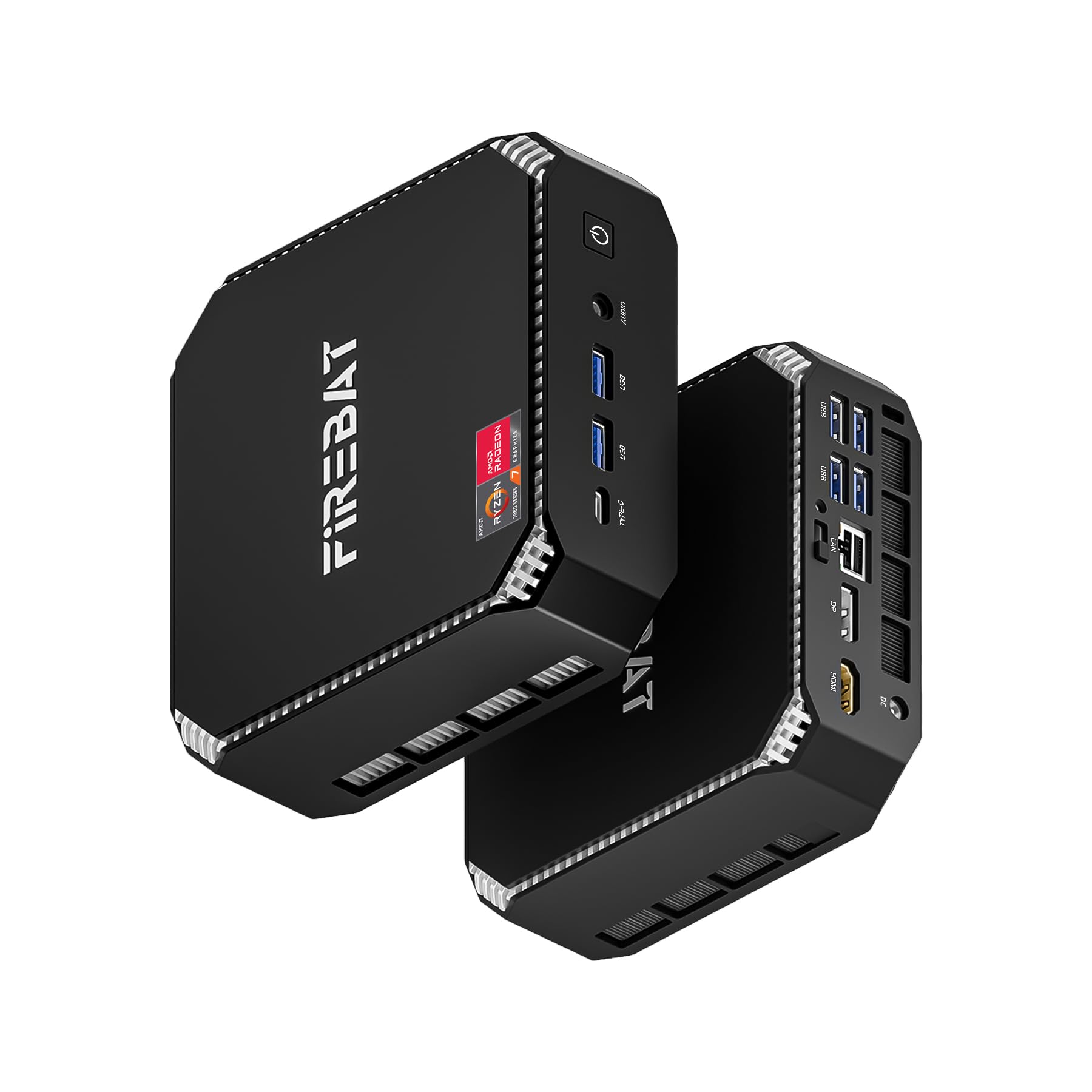
The FIREBAT A6 offers a balanced mid-range mini PC package built around the Ryzen 7 7735HS, an eight-core Zen 3+ processor with a Radeon 680M iGPU featuring 12 RDNA 2 compute units. While the 680M does not match the 780M in raw throughput, it still runs older Call of Duty titles smoothly and handles esports games like Overwatch 2 at 1080p high settings without issue. The 54W TDP keeps power consumption and heat in check, making this a quiet desktop companion.
This unit comes with 16GB of single-channel LPDDR5 memory and a 512GB PCIe 3.0 SSD. The single RAM stick is a notable limitation — adding a second stick would require replacing the RAM entirely since the LPDDR5 is soldered. That said, the dual M.2 slots support PCIe 4.0 SSDs, so storage expansion is straightforward. Triple 4K display output via USB-C, DP, and HDMI makes it suitable for productivity setups as well.
Customer support from FIREBAT appears responsive, with one reviewer noting that an issue with a missing USB4 port was resolved with a partial refund. Build quality is solid, the cooling system is effective and quiet, and Windows 11 Pro comes pre-installed. For a compact machine that handles light gaming and office work without breaking a sweat, the A6 is a strong contender at its price tier.
Why it’s great
- Radeon 680M handles 1080p esports gaming well
- Compact, quiet, and power-efficient design
- Triple 4K display support for productivity
Good to know
- Single-channel RAM limits iGPU performance
- LPDDR5 is soldered and not upgradable
- SSD is PCIe 3.0, not 4.0
7. KAMRUI Hyper H1 Mini Gaming PC
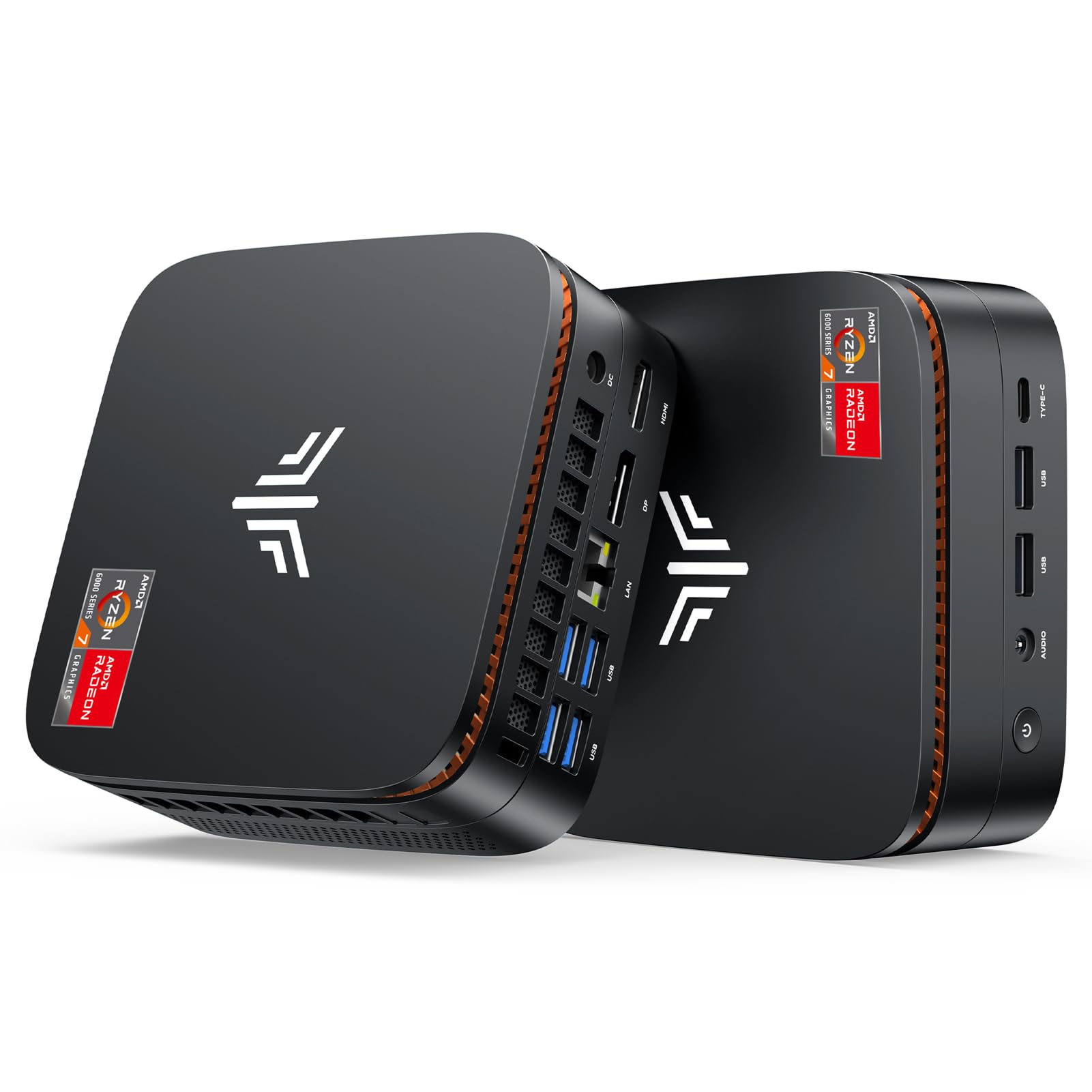
The KAMRUI Hyper H1 positions itself as an all-in-one hub for work and light entertainment, powered by the Ryzen 7 7735HS and its integrated Radeon 680M graphics. With 24GB of LPDDR5 memory and a 512GB NVMe SSD, the system handles home office tasks, 4K streaming, and emulation up to PS2 and GameCube era without breaking a sweat. The 680M iGPU can manage Steam indie games and older AAA titles at reduced settings, though modern demanding titles will require lower resolution and quality presets.
Connectivity is well-thought-out: dual HDMI ports, Wi-Fi 6, Bluetooth 5.2, and 2.5G Ethernet provide flexible networking and display options. The unit is nearly silent during operation and includes a VESA mount for sleek attachment behind a monitor. Many owners use it as a living room PC connected to a 4K TV for streaming and retro gaming, where the compact form factor and low power draw shine.
A handful of reviewers report issues with HDMI compatibility on certain LG monitors — using the DisplayPort output resolved the problem. More concerning is a reliability report where the unit stopped working shortly after the return window, with hard-to-reach customer support. Overall, the Hyper H1 delivers good value for home theater and light gaming use cases, but the mixed reliability feedback suggests buying with a credit card that extends warranty coverage.
Why it’s great
- 24GB RAM handles multitasking without hiccups
- Near-silent operation for living room use
- Excellent emulation performance up to PS2
Good to know
- Some reports of units failing after a month
- HDMI may have compatibility issues with LG displays
- Customer support can be difficult to reach
8. AMD Ryzen 5 5600GT

The Ryzen 5 5600GT is the refined version of the already-popular 5600G, offering the same six-core Zen 3 architecture and Vega 7 iGPU but at a slightly lower price point. The 7 Vega compute units clocked at 1900 MHz provide enough horsepower for 1080p esports gaming — think Valorant at high settings or Fortnite on medium — and can handle lighter fare like Minecraft and Rocket League without issue. For AAA titles, expect to drop to 720p low settings for playable frame rates.
Socket AM4 compatibility means you can drop this into an existing B350, B450, or B550 motherboard with a BIOS update, making it one of the most cost-effective upgrades available. The bundled Wraith Stealth cooler keeps temperatures around 70°C under gaming loads, and the unlocked multiplier allows overclocking for those who want to squeeze out extra performance. Pairing with DDR4-3600 memory in dual-channel configuration makes a noticeable difference in iGPU throughput.
Several reviewers note that the 5600GT is effectively a 5600G with a refined bin, performing identically in most scenarios. If you are building an ultra-budget system or upgrading an aging first-gen Ryzen PC, this APU gives you a complete computing and gaming solution for under . It is the reigning champion of the budget segment for a reason.
Why it’s great
- Excellent value for 1080p esports gaming
- Compatible with affordable AM4 motherboards
- Unlocked for overclocking with included cooler
Good to know
- Vega 7 cannot match RDNA 3 iGPUs in AAA games
- Requires fast dual-channel DDR4 for full performance
- No upgrade path to AM5 without new board
9. AMD Ryzen 5 5600G

The original Ryzen 5 5600G remains a staple in the budget PC building community for good reason. Its six-core Zen 3 CPU paired with Vega 7 iGPU creates a balanced package that can handle streaming, web browsing with fifteen open tabs, and light gaming without any slowdown. The iGPU delivers playable 1080p frame rates in popular esports titles and can even run demanding games like Star Wars Outlaws at 1080p low settings if your expectations are tempered.
Socket AM4 compatibility with B350, B450, and B550 motherboards means this APU slots into an enormous installed base of affordable boards. The included Wraith Stealth cooler is adequate for stock operation, though upgrading to an aftermarket cooler and enabling Precision Boost Overdrive can push the chip further. Like all APUs, dual-channel DDR4-3600 memory is strongly recommended to feed the Vega iGPU enough bandwidth.
Multiple verified buyers describe this as the perfect starter CPU for a first build, and many have used it as a stepping stone before adding a discrete GPU later. The 5600G lacks PCIe 4.0 support — its PCIe lanes are gen 3 — but that does not affect integrated graphics performance. For the absolute lowest entry cost into PC gaming, this APU still sets the standard.
Why it’s great
- Proven budget performance for years
- Works with inexpensive AM4 motherboards
- Handles everyday tasks and light gaming easily
Good to know
- PCIe 3.0 only — limits fast NVMe drives
- Vega 7 shows its age against RDNA 3 alternatives
- Stock cooler runs warm under extended load
FAQ
Can a gaming APU run modern AAA titles at 1080p?
How does dual-channel RAM affect gaming APU performance?
What is the difference between a Ryzen 5 5600G and a 5600GT?
Final Thoughts: The Verdict
For most users, the best gaming apu winner is the AMD Ryzen 7 8700G because it combines eight Zen 4 cores with a Radeon 780M iGPU that genuinely plays AAA games at 1080p without a discrete card. If you want a turnkey compact system with the same iGPU performance, grab the GMKtec K8 Plus. And for a budget-friendly entry into PC gaming that leaves room for future GPU upgrades, nothing beats the AMD Ryzen 5 5600GT.