
The gap between a close loss and a dominant victory often comes down to what sits in front of you. A gaming big screen TV that can’t keep up with a 120Hz signal introduces lag, smears fast motion, and crushes shadow detail — turning split-second reactions into missed shots. This guide digs into the specific hardware that actually makes a difference for console and PC gaming.
I’m Mohammad Maruf — the founder and writer behind Drink4Good. For this guide, I analyzed refresh rate certifications, HDMI 2.1 bandwidth capabilities, local dimming zone counts, and real-world input lag measurements across eleven TVs to separate the genuine gaming performers from the marketing claims.
Whether you’re chasing the perfect black level for horror games or need a 144Hz native panel for competitive shooters, the right gaming big screen tv demands specific hardware — and this breakdown shows you exactly what to look for.
How To Choose The Best Gaming Big Screen TV
Gaming on a large screen introduces challenges that casual viewing doesn’t. High input lag, motion blur, and poor HDR tone mapping can ruin a session. To avoid these, you need to focus on a few non-negotiable specs that define a TV’s gaming capability.
Native Refresh Rate and HDMI 2.1
A native 120Hz or 144Hz panel is required for smooth 4K gaming on PlayStation 5, Xbox Series X, and high-end PCs. Without HDMI 2.1 ports, you cannot send a 4K 120Hz signal with HDR. Look for TVs that explicitly state native refresh rate — “effective” or “motion” ratings are not the same. Each HDMI 2.1 port should support full 48Gbps bandwidth for uncompressed signals.
Variable Refresh Rate (VRR) Range
VRR synchronizes the TV’s refresh rate to the console or PC frame rate, eliminating screen tearing and stuttering. The wider the VRR range (e.g., 48-120Hz or 48-144Hz), the more effective it is. HDMI Forum VRR and AMD FreeSync Premium Pro are the most common standards. Ensure the TV supports VRR over HDMI 2.1, not just over DisplayPort.
Display Technology: OLED vs Mini-LED QLED
OLED panels deliver per-pixel lighting for perfect blacks and infinite contrast, ideal for dark room gaming. Mini-LED QLED sets use thousands of local dimming zones to approach OLED-like black levels while achieving much higher peak brightness — important for bright rooms and HDR highlights. OLED wins on response time (sub-1ms), but Mini-LED avoids burn-in risk and provides better sustained brightness for long sessions.
Input Lag and Auto Low Latency Mode (ALLM)
Input lag below 10ms in Game Mode is essential for competitive play. ALLM automatically switches the TV into low-latency mode when a game console is detected, so you don’t have to manually change settings. Check that ALLM works with both HDMI 2.1 sources and that Game Mode doesn’t disable VRR or 120Hz support.
Quick Comparison
On smaller screens, swipe sideways to see the full table.
| Model | Category | Best For | Key Spec | Amazon |
|---|---|---|---|---|
| Hisense 65″ U7 Mini-LED | Premium | High-FPS Competitive Gaming | Native 165Hz, VRR 330 | Amazon |
| Toshiba 75″ Z670 Mini-LED | Premium | PC Gaming + Console Combo | Native 144Hz, Game Mode Pro | Amazon |
| TCL 75″ QM8K Mini-LED | Premium | HDR Gaming + Bright Room | Game Accelerator 288 VRR | Amazon |
| LG 65″ OLED evo G5 | Premium | Competitive + Cinematic Gaming | 0.1ms Response, 120Hz Native | Amazon |
| Samsung 77″ OLED S90C | Premium | QD-OLED Color Gamut | Motion Xcelerator Turbo Pro 144Hz | Amazon |
| Sony 65″ OLED BRAVIA 8 | Premium | PS5 Exclusive Features | XR OLED Motion, PS5 Auto HDR | Amazon |
| Samsung 75″ Neo QLED QN90C | Mid-Range | Bright Room + Sports + Gaming | Quantum Matrix Mini-LED, 120Hz | Amazon |
| Roku 75″ Pro Series Mini-LED | Mid-Range | Casual Gaming + Streaming | FreeSync Premium Pro, VRR | Amazon |
| Sony BRAVIA 2 65″ LED | Mid-Range | PS5 Gaming + Movie Viewing | Motionflow XR, PS5 Features | Amazon |
| LG 83″ OLED G3 | High-End | Home Theater + Gaming | Brightness Booster Max, MLA | Amazon |
| TCL 115″ QM89 QD-Mini LED | Flagship | Ultimate Immersion + Size | 20,000 Dimming Zones, 240Hz VRR | Amazon |
In‑Depth Reviews
1. Hisense 65″ U7 Mini-LED ULED 4K (65U7SG)
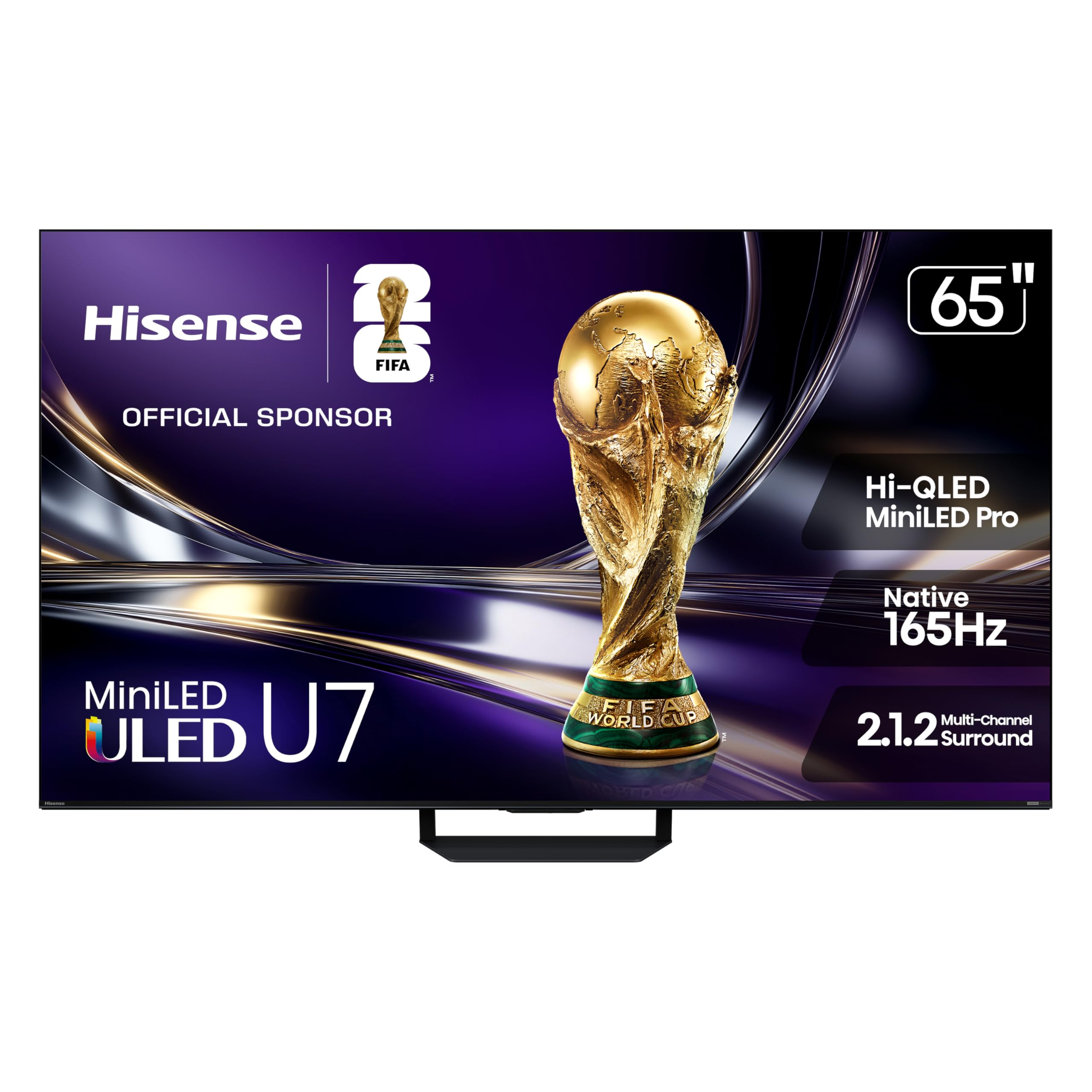
The Hisense U7 is a rare find in the gaming TV space — a Mini-LED panel with a native 165Hz refresh rate that actually delivers on its promise. With up to 3,000 local dimming zones and 3,000 nits peak brightness, this set handles HDR gaming with stunning precision. Dark scenes in games like Alan Wake 2 retain deep blacks while highlights from flashlights or explosions punch through without blooming. The 330 VRR range is unusually wide, meaning even when frame rates fluctuate wildly, the TV keeps up without tearing.
Built around Google TV, the interface is responsive and integrates well with console ecosystems. The Hi-View AI Engine Pro handles real-time scene adjustments, which helps in games with sudden lighting shifts — think moving from a cave into direct sunlight in Horizon Forbidden West. Input lag in Game Mode is imperceptible, and the panel supports 4K at 165Hz over HDMI 2.1, a spec that only a handful of TVs in this class achieve.
The anti-reflection coating is genuinely effective, making it a solid choice for rooms with ambient light. The built-in 2.1.2 channel audio has decent separation, though pairing with a soundbar unlocks the full Dolby Atmos experience. For gamers who want high refresh rates without stepping into OLED territory, this is the standout option in the mid-premium segment.
Why it’s great
- Native 165Hz refresh rate with 330 VRR range
- 3,000 nits peak brightness with deep black levels
- Effective anti-glare coating for bright rooms
Good to know
- Google TV interface can feel cluttered with preloaded apps
- Built-in sound is good but benefits from a separate soundbar
2. Toshiba 75″ Z670 Mini-LED 4K (75Z670R)

The Toshiba Z670 brings a compelling package for PC gamers who need a large canvas. The native 144Hz panel combined with AMD FreeSync Premium and VRR up to 144Hz means that high-frame-rate titles like Call of Duty or Overwatch 2 run buttery smooth. The Mini-LED backlight with full array local dimming delivers strong contrast — not quite OLED-level blacks, but close enough that most players won’t feel they’re missing out, especially given the 75-inch real estate.
The REGZA Engine ZRi Gen3 handles upscaling well, which matters when you’re feeding it lower-resolution content from a Nintendo Switch or older PC titles. Dolby Vision IQ and HDR10+ Adaptive mean the TV adjusts brightness and color tone based on room lighting, reducing the need to fiddle with settings between day and night sessions. The Game Mode Pro includes ALLM, so switching from a movie to a game triggers low-latency mode automatically.
Fire TV built-in means Alexa integration is seamless, and the interface is snappy. The REGZA Power Audio Pro with a built-in bass woofer produces room-filling sound — rare for a TV at this size. The main trade-off is that at 75 inches, you need significant viewing distance to avoid eye strain during fast-paced shooters. For mixed-use households where gaming and movie watching share the screen, this is a versatile performer.
Why it’s great
- Native 144Hz with AMD FreeSync Premium and VRR
- Mini-LED with deep blacks and bright highlights
- Built-in bass woofer delivers strong audio
Good to know
- Large 75-inch size requires ample viewing distance
- Fire TV interface includes ads on the home screen
3. TCL 75″ QM8K Mini-LED QLED (75QM8K)
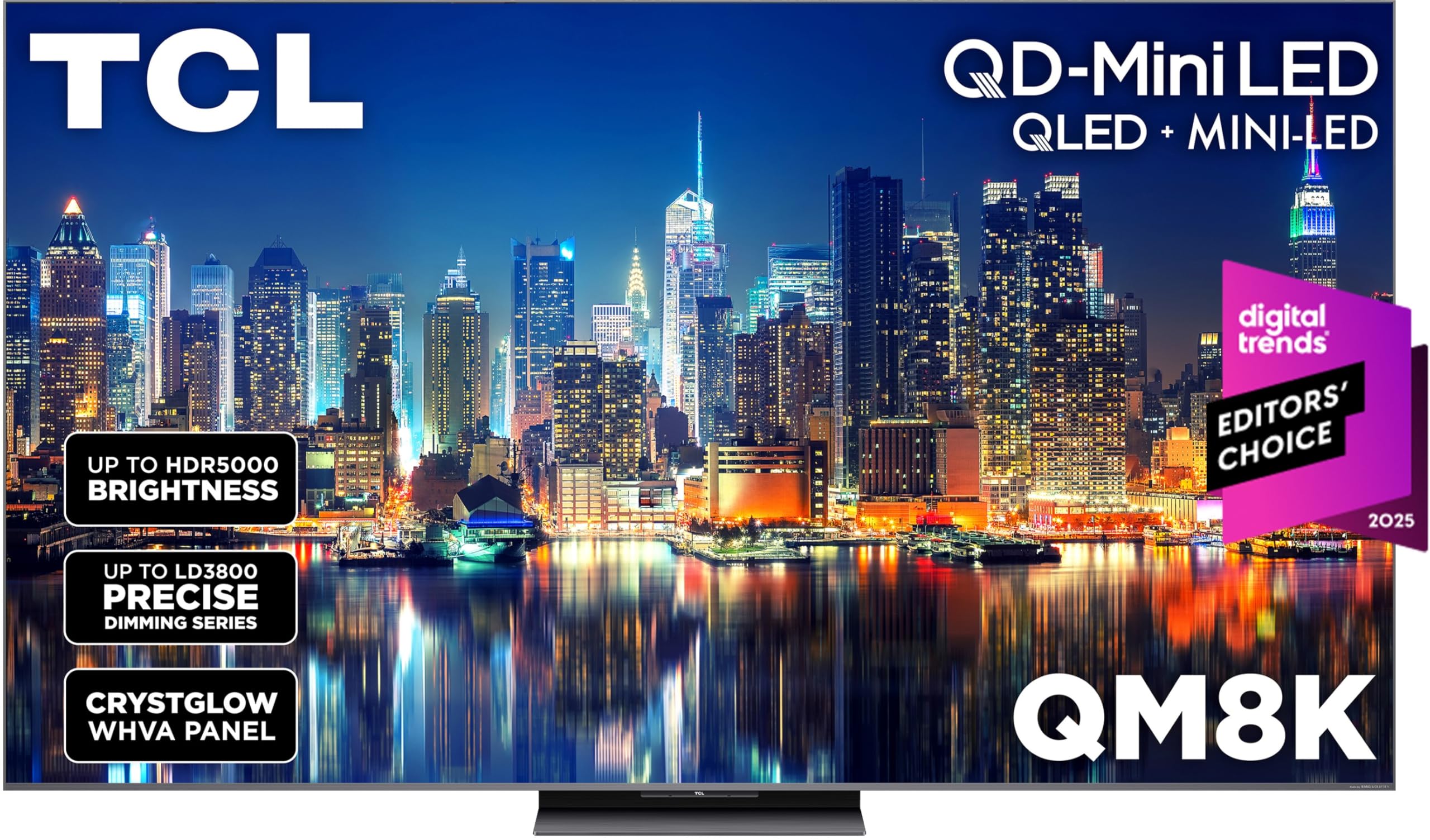
TCL’s QM8K is the brightest TV in this lineup, and it uses that brightness to great effect in HDR gaming. The Game Accelerator 288 provides up to 288Hz VRR at lower resolutions, while 4K 144Hz is fully supported over HDMI 2.1. The CrystGlow WHVA panel with anti-reflective coating means you can game in a sunlit living room without losing detail in shadows or highlights. For games like Cyberpunk 2077 with neon-soaked night scenes, the QD-Mini LED backlight ensures that every sign and headlight pops without washing out the surrounding darkness.
The TCL Halo Control System manages 2,000+ local dimming zones with minimal blooming — impressive for a Mini-LED set at this price. The Google TV platform is fast and includes hands-free voice control. The backlit premium voice remote is a nice touch for dark room gaming sessions. Bang & Olufsen audio tuning provides clear dialogue and decent bass, though serious gamers will still want a dedicated sound system.
The 120Hz native panel with 144Hz VRR makes it compatible with both current-gen consoles and high-refresh PC gaming. Input lag in Game Mode is under 7ms, and ALLM works reliably across HDMI inputs. The main downside is that to hit 288Hz, you need to drop to 1440p — but that’s still a fantastic option for competitive PC shooters on a 75-inch screen.
Why it’s great
- Extremely high brightness with excellent anti-glare
- Game Accelerator 288 VRR for competitive play
- Bang & Olufsen audio tuning with clear dialogue
Good to know
- 288Hz mode requires 1440p resolution
- Some streaming apps show occasional menu lag
4. LG 65″ OLED evo G5 (OLED65G5WUA)

The LG G5 represents the pinnacle of OLED gaming performance. With a 0.1ms response time, motion blur is virtually nonexistent — a critical advantage in fast-paced shooters and fighting games. The Brightness Booster Max technology pushes the OLED evo panel to over 2,000 nits peak brightness, addressing the traditional OLED weakness in bright rooms. The UL Discomfort Glare Free certification means you can game near a window without fighting reflections.
Four full HDMI 2.1 ports support 4K 120Hz with VRR, making it easy to connect a PS5, Xbox Series X, and a gaming PC simultaneously. NVIDIA G-Sync and AMD FreeSync Premium are both supported, covering the full range of GPU ecosystems. The Alpha 11 AI Processor Gen2 handles AI Super Upscaling, which improves image quality on older games or lower-resolution content without adding perceivable latency.
The One Wall Design leaves virtually no gap when wall-mounted, and the included bracket makes installation straightforward. webOS with LG Channels provides plenty of free content for non-gaming use. The remote lacks backlit buttons, which is a minor frustration in dark rooms. For competitive gamers who also appreciate single-player visual fidelity, this is the most balanced high-end option available.
Why it’s great
- Near-instant 0.1ms response time eliminates motion blur
- Four HDMI 2.1 ports with full bandwidth
- Over 2,000 nits peak brightness with perfect blacks
Good to know
- Remote control is not backlit
- Burn-in risk remains with static HUD elements over long sessions
5. Samsung 77″ OLED S90C (QN77S90C)

The Samsung S90C uses QD-OLED technology, which combines the perfect blacks of OLED with quantum dot color volume. This means colors remain vibrant even at high brightness levels — a key advantage for HDR gaming where saturated reds and greens need to pop without clipping. The Neural Quantum Processor 4K upscales lower-resolution content impressively, so older PC games or Switch titles look clean on the 77-inch screen.
Motion Xcelerator Turbo Pro supports 4K at 120Hz natively and up to 144Hz with compatible PC content. All four HDMI ports are 2.1 with 48Gbps bandwidth, allowing multiple high-bandwidth devices without port limitations. FreeSync Premium Pro is supported, and the Game Bar provides quick access to settings like aspect ratio and mini-map zoom — genuinely useful for competitive games.
The LaserSlim design is only 4mm thick, making it one of the most aesthetically pleasing TVs on the market. The Solar Cell Remote is a nice sustainability touch, though it lacks dedicated number buttons. The S90C does not support Dolby Vision, relying instead on HDR10+ — a limitation if your game library heavily uses Dolby Vision metadata. For pure gaming color performance, however, this is the best QD-OLED you can buy today.
Why it’s great
- QD-OLED delivers best-in-class color volume and brightness
- All four HDMI ports are full 48Gbps 2.1
- Ultra-slim 4mm design with nearly bezel-less screen
Good to know
- No Dolby Vision support; uses HDR10+ instead
- Some units report a “pink corner” issue after extended use
6. Sony 65″ OLED BRAVIA 8 (K-65XR80)

The Sony BRAVIA 8 is built with the PlayStation 5 in mind. Exclusive features like Auto HDR Tone Mapping and Auto Genre Picture Mode ensure that when you connect a PS5, the TV automatically optimizes HDR brightness and switches to Game Mode — no manual adjustment needed. The XR Processor handles motion interpolation superbly with XR OLED Motion, keeping fast-paced racing games and shooters blur-free without introducing soap opera effect artifacts.
Acoustic Surface Audio+ uses the OLED panel itself as a speaker, creating sound that comes directly from the screen. This is genuinely impressive for positional audio in games — footsteps sound like they’re coming from the correct on-screen location. Dolby Vision and Atmos support mean that cinematic games like The Last of Us Part I look and sound as intended.
The Google TV interface is clean and integrates well with streaming services. Sony Pictures CORE provides included movie credits, a nice bonus for non-gaming use. The main drawbacks are that only two HDMI 2.1 ports are available, and the Google OS has been reported to have intermittent sound drops in some units. For PS5 owners who want a seamless experience, this is the most integrated option available.
Why it’s great
- Exclusive PS5 Auto HDR and Genre Picture Mode
- Acoustic Surface Audio+ creates screen-based sound
- XR OLED Motion for blur-free fast action
Good to know
- Only two HDMI 2.1 ports
- Google OS occasionally has audio sync issues
7. Samsung 75″ Neo QLED QN90C (QN75QN90C)

The Samsung QN90C is a strong mid-range option that excels in bright rooms. The Quantum Matrix with Mini LEDs provides excellent brightness and contrast, and the anti-glare coating with ultra-wide viewing angle means that group gaming sessions around a coffee table don’t result in washed-out colors for side viewers. Motion Xcelerator Turbo+ supports 4K at 120Hz, making it fully compatible with PS5 and Xbox Series X.
Samsung Gaming Hub is integrated directly into the Tizen interface, allowing cloud gaming from Xbox Game Pass or NVIDIA GeForce NOW without a console — a useful feature if you rely on cloud streaming. Object Tracking Sound+ creates directional audio that follows on-screen action, adding immersion without needing a separate soundbar. Q-Symphony 3.0 lets the TV speakers work in sync with a Samsung soundbar for a fuller soundstage.
The Neural Quantum Processor 4K upscaling is effective with 1080p content, which is helpful for older games or streaming. The Solar Cell Remote is rechargeable and includes Disney+ and Prime Video direct buttons. The Tizen interface can feel ad-heavy, and some users report input switching quirks with complex AV receiver setups. For a balanced bright-room performer under the premium tier, this is a solid choice.
Why it’s great
- Excellent brightness and anti-glare for bright rooms
- Samsung Gaming Hub for cloud gaming integration
- Object Tracking Sound+ enhances directional audio
Good to know
- Tizen interface includes prominent ads
- Input switching can be problematic with AVR systems
8. Roku 75″ Pro Series Mini-LED
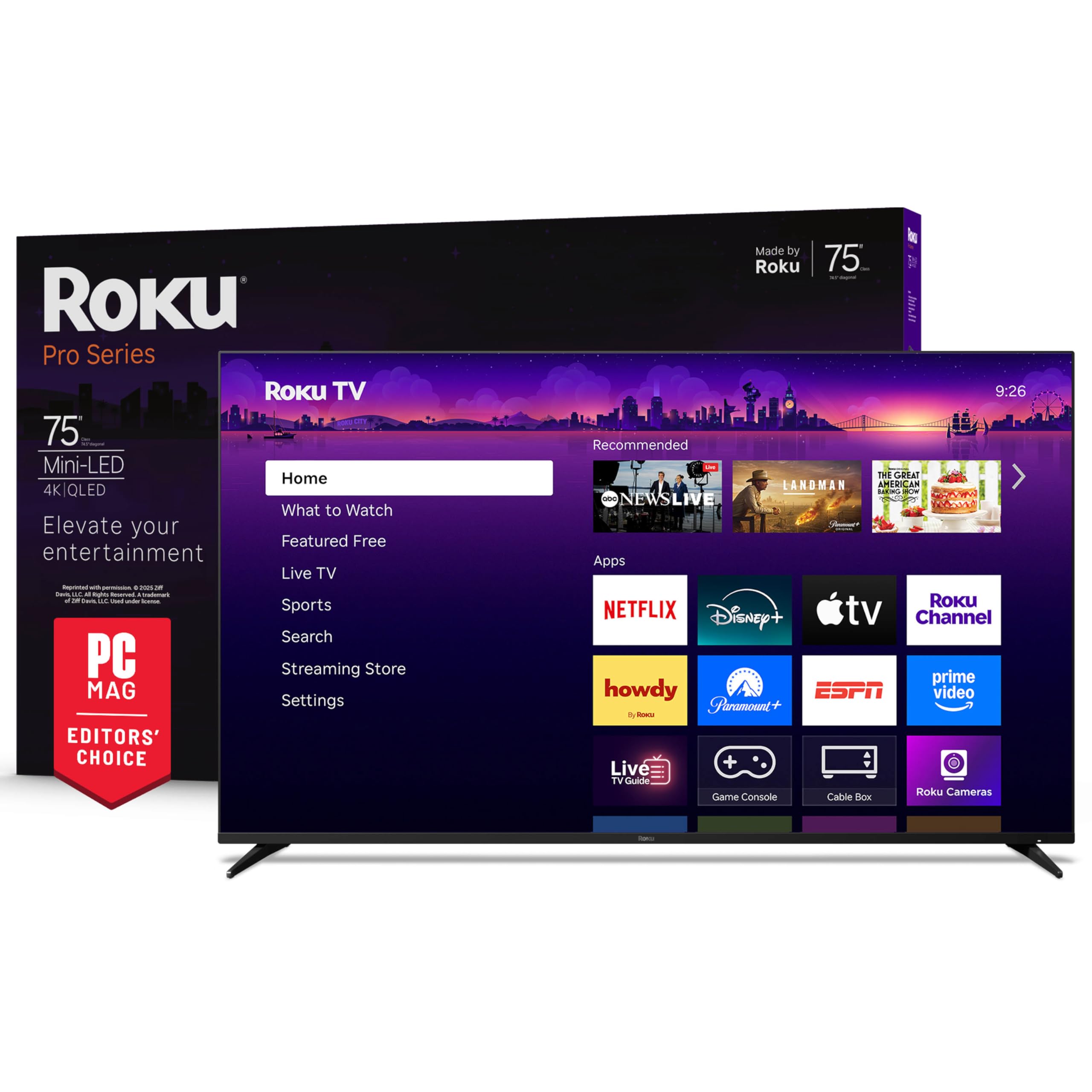
The Roku Pro Series takes a different approach — it prioritizes a clean, intuitive interface over raw gaming specs, while still delivering strong performance. The 120Hz native panel with FreeSync Premium Pro and VRR ensures smooth gameplay, and the automatic Game Mode drops input lag significantly when a console is detected. For casual and mid-level competitive gamers, the performance is more than adequate.
The Mini-LED backlight with Dolby Vision IQ produces vibrant colors and good contrast, though it doesn’t reach the brightness levels of the TCL QM8K or Hisense U7. Where the Roku shines is the user experience — no cluttered home screen, no ads pushing content you don’t want. The Backlit Voice Remote Pro is rechargeable and includes a remote finder feature, which is surprisingly useful in a dark media room.
Roku Soundstage Audio with side-firing speakers delivers room-filling sound without an external system. Bluetooth Headphone Mode lets you game quietly without waking others — a thoughtful feature for late-night sessions. The tool-less stands with two height options and cable management are genuinely helpful for clean setups. If you value simplicity and a lag-free interface over maximum brightness, this is a smart pick.
Why it’s great
- Clean, ad-free Roku interface with fast navigation
- Rechargeable remote with backlit buttons and finder
- FreeSync Premium Pro with VRR for smooth gaming
Good to know
- Peak brightness is lower than competing Mini-LED sets
- Limited gaming-specific features compared to dedicated gaming TVs
9. Sony BRAVIA 2 65″ (K-65S20M2)

The Sony BRAVIA 2 is the entry point for gamers who want PS5-exclusive features without the OLED price tag. The 4K Processor X1 and 4K XR-Reality PRO upscaling do a solid job improving lower-resolution content, though the LED panel can’t match the contrast of Mini-LED or OLED sets. Motionflow XR handles sports and racing games without noticeable blur, making it a viable option for casual to intermediate gamers.
Exclusive PS5 features — Auto HDR Tone Mapping and Auto Genre Picture Mode — work seamlessly with the console, optimizing picture settings automatically. The Game Menu puts all gaming picture settings in one place for quick adjustments. Google TV with Apple AirPlay 2 and Google Cast support covers all major streaming needs.
The LED panel’s peak brightness is adequate for most rooms, but blacks appear grayish in dark scenes compared to the more expensive options. Some units have reported WiFi dropout issues requiring periodic router resets. For PS5 owners on a tighter budget who still want Sony’s processing and PS5 integration, this fills that specific niche, but gamers sensitive to black levels should look at the Mini-LED options above.
Why it’s great
- PS5 Auto HDR and Genre Picture Mode included
- 4K XR-Reality PRO upscales content well
- Motionflow XR handles fast action smoothly
Good to know
- LED panel has limited contrast and black levels
- Some units experience WiFi connectivity issues
10. LG 83″ OLED G3 (OLED83G3PUA)

The LG G3 with Micro Lens Array (MLA) technology is a flagship OLED that addresses the primary weakness of OLED — brightness. The Brightness Booster Max delivers up to 70% brighter images than standard OLED panels, making HDR gaming in well-lit rooms actually viable. The a9 AI Processor Gen6 handles real-time picture optimization, and the 120Hz native panel with G-Sync and FreeSync Premium Pro ensures tear-free gaming.
The included wall bracket leaves virtually no gap between the screen and wall, and the Always Ready mode lets you display art or information when not gaming. webOS 23 with the Magic Remote provides an intuitive experience, though the interface can feel busy. The 5-year panel warranty provides peace of mind for long-term ownership, which matters given the investment level.
At 83 inches, this is an immersive gaming canvas. The trade-offs are significant: the set includes no stand (wall mount only), and some units have reported quality control issues like dead pixels on arrival. For those who want the best OLED gaming experience at a massive size and can manage the logistics, the G3 is a reference-class performer.
Why it’s great
- MLA technology delivers OLED with high brightness
- 5-year panel warranty for long-term confidence
- Near-flush wall mount design is visually stunning
Good to know
- No stand included — wall mount only
- Some quality control issues reported upon delivery
11. TCL 115″ QM89 QD-Mini LED (115QM891G)

The TCL QM89 is not a typical gaming TV — it’s a statement piece. With 20,000 local dimming zones and 5,000 nits peak brightness, it delivers an HDR experience that no other TV in this list can match. The 120Hz native panel with Game Accelerator 240 VRR means that even at this massive size, fast-paced gaming remains responsive. The QD-Mini LED technology produces colors that approach quantum dot accuracy with brightness that obliterates any ambient light.
The TCL AIPQ ULTRA Processor with deep learning AI handles upscaling of lower-resolution content, which is essential because many games won’t run at native 4K at high frame rates on this screen. Dolby Vision IQ and HDR10+ Adaptive ensure that whatever HDR format your game uses, it looks its best. The Game Accelerator 240 provides up to 240Hz VRR for competitive PC gaming, though you’ll need a powerful GPU to drive that at 115 inches.
The practical considerations are immense: you need a dedicated room, professional installation, and a significant viewing distance. The built-in sound is surprisingly good for such a large panel, but a proper surround system is almost mandatory given the scale. The Google TV interface can feel slow with ads, and the remote lacks a number pad. For gaming enthusiasts who want the largest, brightest, most immersive screen possible, nothing else comes close.
Why it’s great
- 20,000 local dimming zones for near-perfect contrast
- 5,000 nits peak brightness is class-leading
- 240Hz VRR for competitive gaming at massive scale
Good to know
- Requires professional installation and dedicated space
- Google TV interface can feel slow with preloaded ad content
FAQ
Do I need HDMI 2.1 for PS5 or Xbox Series X gaming?
What is the difference between VRR and FreeSync?
Is OLED worth it for gaming over Mini-LED?
What input lag is considered good for competitive gaming?
Final Thoughts: The Verdict
For most gamers, the gaming big screen tv winner is the Hisense 65″ U7 Mini-LED because it combines a native 165Hz refresh rate, wide 330 VRR range, and high brightness at a competitive price point. If you want OLED-level black levels with extreme brightness, grab the TCL 75″ QM8K Mini-LED. And for the best PS5 integration and motion handling, nothing beats the Sony 65″ OLED BRAVIA 8.