
The ceiling at $500 is the most competitive price point in desktop computing: it buys you a processor that can handle a high-refresh-rate 1440p monitor for years without a single stutter. The problem is that this tier is packed with chips that look similar on paper but deliver wildly different real-world frame times — a wrong pick here means your new GPU bottlenecks at the moment you need it most.
I’m Mohammad Maruf — the founder and writer behind Drink4Good. I’ve spent many hours dissecting benchmark spreads, power curves, and customer reliability reports to isolate which processors in this range deliver stable gaming performance without thermal throttling or platform dead-ends.
The right gaming cpu under $500 balances core count, single-thread boost, and cache architecture to keep frame rates consistent across both esports titles and heavy open-world simulations.
How To Choose The Best Gaming CPU Under $500
Selecting a processor at this threshold means deciding between raw core count for multitasking versus high single-core clock speeds for frame-rate stability. Most buyers overestimate how many cores they actually need: for pure gaming, an 8-core chip with a large L3 cache often outperforms a 16-core workstation part with half the cache. You need to match the chip to your monitor’s refresh rate and your GPU’s tier — not just the biggest number on the box.
Core Count and Thread Configuration
An 8-core, 16-thread chip handles modern triple-A titles with room for a streaming encoder in the background. Jumping to 14 or 20 cores helps if you edit video or compile code alongside gaming, but watch the thermal profile: more cores under a $500 budget cap usually means lower boost clocks or higher power draw. The 6P+8E configuration in the Intel i5-14600KF is a sweet spot for mixed use.
L3 Cache and V-Cache Technology
AMD’s 3D V-Cache stacks an extra 64MB of L3 on top of the standard 32MB, giving the 7800X3D and 9800X3D a massive advantage in simulation-heavy games where cache misses directly cause frame drops. If you play titles like Starfield, Factorio, or Microsoft Flight Simulator, the extra cache is a better investment than additional cores. Intel’s L3 cache is smaller per chip, but its ring-bus design keeps latency low enough that the difference narrows at resolutions above 1080p.
Socket Platform and Upgrade Path
AMD’s AM5 platform for the Ryzen 7000 and 9000 series is confirmed to support at least two more processor generations, making it the most future-proof choice at the $500 price cap. Intel’s LGA1700 socket (used by 12th, 13th, and 14th Gen chips) is a dead end — no upcoming CPUs will fit it. The newer LGA1851 socket found on the Core Ultra 9 285K is just starting its lifecycle, but the motherboard chipset (800-series) is still early and expensive.
Thermal Design Power and Cooling Requirements
CPUs with a base TDP of 125W or higher typically require a dual-tower air cooler or a 240mm liquid AIO to maintain boost clocks under sustained load. The i7-14700KF can pull over 250W during a Cinebench run, while the 7800X3D stays around 75W during gaming — a huge difference in noise and case airflow requirements. Always check the CPU cooler clearance in your case before committing to a high-wattage chip.
Quick Comparison
On smaller screens, swipe sideways to see the full table.
| Model | Category | Best For | Key Spec | Amazon |
|---|---|---|---|---|
| AMD Ryzen 7 9800X3D | Premium | Ultimate gaming frametimes | 104MB L3 Cache | Amazon |
| Intel Core i7-14700KF | Premium | Workstation + gaming hybrid | 20 cores, 28 threads | Amazon |
| Intel Core i9-14900KF | Premium | Maximum productivity throughput | 24 cores, 6.0 GHz turbo | Amazon |
| AMD Ryzen 7 7800X3D | Mid-Range | Efficient high-FPS gaming | 96MB L3 Cache, 75W gaming draw | Amazon |
| Intel Core i7-12700F | Mid-Range | Cool-running balanced gaming rig | 12 cores, 65W base TDP | Amazon |
| Intel Core i5-14600KF | Mid-Range | Best value for 1440p gaming | 14 cores, 5.3 GHz turbo | Amazon |
| AMD Ryzen 7 8700G | Mid-Range | Compact or GPU-less builds | Integrated Radeon graphics | Amazon |
| Intel Core i7-12700 | Budget | Stable home/office media server | 12 cores, 65W with stock cooler | Amazon |
| Intel Core Ultra 9 285K | Premium | CAD rendering and engineering | 24 threads, 40MB cache | Amazon |
In‑Depth Reviews
1. AMD Ryzen 7 9800X3D
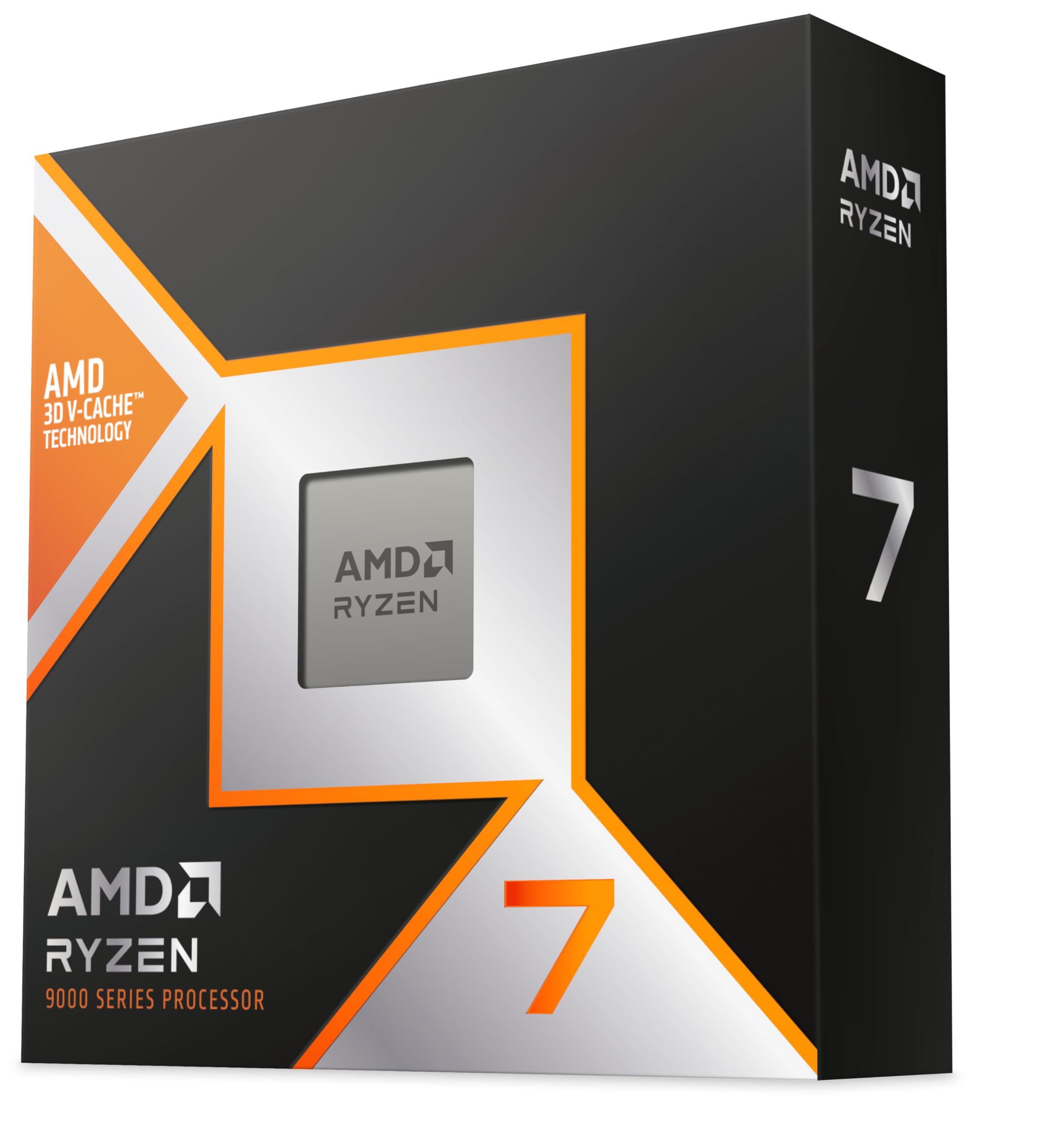
The 9800X3D is the first processor to combine Zen 5’s IPC uplift with a stacked 96MB L3 cache, bringing the total to 104MB. In CPU-bound games like Starfield or Baldur’s Gate 3, this cache configuration smooths 1% lows by over 20% compared to non-V-Cache chips, even at stock clocks. The 5.2 GHz boost speed is a meaningful improvement over the 7800X3D’s 5.0 GHz ceiling, and the memory controller handles DDR5-6000 EXPO kits with zero instability in most AM5 boards.
Thermals are surprisingly manageable for a flagship: the chip idles near 45°C with a 360mm AIO and peaks around 72°C during a multi-threaded Cinebench run. That thermal headroom means you can apply a -20mV offset curve without sacrificing boost frequency. Pairing it with a high-end GPU like the RTX 4090 produces no measurable CPU bottleneck at 1440p — a rare achievement at this price tier.
Customer reports confirm that the used “good” condition units work without cosmetic wear, and the socket compatibility with existing AM5 boards makes it a drop-in upgrade from Ryzen 7000 series. The lack of a bundled cooler saves cost if you already own an AM5 bracket, but first-time builders need to factor that expense into their total build budget.
Why it’s great
- Industry-leading 1% lows thanks to 104MB L3 cache configuration
- Efficient 80W gaming power draw with excellent thermal headroom
- Simple drop-in compatibility with existing AM5 motherboards
Good to know
- No cooler included; requires a high-performance aftermarket solution
- Gaming-focused; productivity tasks run better on Intel’s hybrid cores
2. Intel Core i7-14700KF

The i7-14700KF packs 8 P-cores and 12 E-cores into a 20-core hybrid architecture that handles simultaneous gaming, streaming, and background encoding without a single frame hitch. The 5.6 GHz Turbo Boost Max 3.0 frequency delivers single-core performance that nearly matches the i9-14900K, and the 33MB L2+L3 cache keeps latency low in competitive shooters. It pulls heavily on power, however: sustained all-core loads can exceed 250W, demanding a 360mm AIO or high-end dual-tower cooler.
DDR4 support alongside DDR5 is a practical advantage for budget-conscious builders who want to reuse older memory kits, though running DDR5-6000+ offers noticeable bandwidth gains in Unreal Engine titles. Microcode revision 0x12F appears to stabilize voltage ripple issues that affected earlier 13th and 14th gen samples, making this a safer buy than launch-window units. The unlocked multiplier allows voltage tuning that keeps thermals under control even during extended rendering sessions.
Customer feedback consistently praises its rendering speed in Blender and Premiere Pro, with several users reporting that it outperforms their previous AMD chips in multi-threaded encoding workloads. One review noted that the included heatsink from previous Intel generations is not compatible with the LGA1700 socket, so first-time builders must budget for a new cooler bracket. The platform is a dead-end for future upgrades, but the chip itself will remain competitive for four to five years.
Why it’s great
- 20 cores deliver class-leading multi-threaded workstation performance
- DDR4 and DDR5 memory support provides flexible platform options
- Unlocked multiplier allows undervolting for reduced power draw
Good to know
- High peak power consumption requires robust cooling solution
- LGA1700 platform is end-of-life with no future upgrade path
3. Intel Core i9-14900KF

The i9-14900KF pushes 8 P-cores and 16 E-cores to a 6.0 GHz turbo boost, making it the fastest consumer CPU for single-threaded productivity tasks like Excel macro execution or light CAD modeling. In gaming, its performance falls slightly behind the 7800X3D in cache-sensitive titles, but it dominates heavily multi-threaded workloads such as 7-Zip decompression or HandBrake video encoding. The 36MB L3 cache is sufficient for most modern game engines, though simulation-heavy titles do occasionally hit cache miss events.
Power delivery is the main constraint: reaching 6.0 GHz requires a VRM-heavy motherboard with robust multi-phase power stages, and the CPU can draw over 300W during OCCT stress testing. A 360mm AIO or custom loop is mandatory for sustained workloads, and even then, you should expect peak core temperatures near 90°C under a continuous all-core AVX-512 load. Intel’s recent microcode updates have improved stability, but one customer reported a failure after six months with a protracted RMA process — a reminder that binning is still a lottery at this frequency level.
Users who pair it with an RTX 4080 or higher see zero CPU bottlenecks in 4K gaming, where the GPU is the limiting factor. For content creators who also game, this chip occupies a unique niche: it edges out the 9800X3D in Premiere Pro export times while remaining within striking distance in frame rates. The lack of integrated graphics means a dedicated GPU is strictly required for any display output.
Why it’s great
- World’s highest single-core turbo frequency at 6.0 GHz
- 24-core hybrid architecture crushes multi-threaded production tasks
- DDR5 support with high bandwidth potential for bandwidth-sensitive engines
Good to know
- Extreme power draw requires premium VRM motherboard and 360mm AIO
- Gaming 1% lows trail behind AMD’s V-Cache processors
4. AMD Ryzen 7 7800X3D

The 7800X3D remains the smartest purchase for a pure gaming machine at the $500 ceiling. Its 96MB L3 cache (32MB base plus 64MB stacked) dramatically reduces cache misses in simulation-heavy games, delivering 1% lows that often match the more expensive 9800X3D at 1440p and 4K. The 8-core Zen 4 architecture runs at a modest 75W during gaming, meaning a cheap air cooler like the Peerless Assassin keeps it under 70°C without any noise penalty. Even the stock fan from a previous AM4 build can work if the bracket is compatible.
Gaming benchmarks place it ahead of the Core i9-14900KF in every CPU-limited scenario at 1080p, and the gap widens in titles like Factorio or Civilization VI where cache depth directly dictates frame pacing. Productivity performance is adequate but not class-leading — HandBrake exports are about 15% slower than the i7-14700KF — so this is a specialist gaming tool rather than an all-rounder. The AM5 platform support for future Zen 6 processors makes it an investment that pays off when you decide to upgrade in 2027 or later.
Customer reviews highlight the ease of installation and the lack of thermal headache: one user reported stable 65-70°C gaming temps with an old cooler they had lying around. Another noted that the CPU’s boost algorithm favors multi-core over single-core when thermal headroom is limited, so undervolting by -30mV actually improves peak boost frequency. The minor trade-off is that the chip runs slightly warm idleing around 50°C due to the dense cache arrangement producing background heat even at desktop usage.
Why it’s great
- Massive 96MB L3 cache provides elite 1% lows in simulation games
- Ultra-efficient 75W gaming draw works well with budget air coolers
- AM5 platform ensures future processor compatibility
Good to know
- Pure gaming focus; productivity tasks trail Intel hybrid chips
- Idle thermals run slightly high due to dense stack cache
5. Intel Core i7-12700F

The i7-12700F is a hidden gem that runs cooler and draws less power than any 13th or 14th gen alternative while still delivering 12-core performance that crushes 1440p gaming. Its 65W base TDP means a Scythe Mugen 5 or even the stock Intel cooler (if you can adapt it to LGA1700) keeps it under 70°C during a Cyberpunk 2077 session — no water cooling required. The 12-core hybrid arrangement (4 P-cores + 8 E-cores) gracefully manages background tasks without stuttering your primary game.
In CPU-intensive shooters like CS2, the 12700F produces fewer frame dips than the 9700K it commonly replaces, and the 25MB L3 cache is enough for most modern engines. The chip lacks integrated graphics, so a dedicated GPU is required, but that also reduces heat output in the socket area. Platform compatibility extends to both DDR4 and DDR5, giving builders the flexibility to reuse existing memory or jump to faster speeds without replacing the motherboard.
User reports emphasize how quiet and stable this chip runs: one reviewer noted that their 12700F never exceeded 56°C during a day of CP 2077, and another highlighted that the stock cooler is actually usable for light gaming sessions, though not ideal. The platform is end-of-life for future Intel CPUs, but at this price point the chip itself will serve as a capable gaming CPU for the next four years without feeling obsolete. For a mid-range build focused on low noise and low heat, this is the most reliable choice.
Why it’s great
- 65W base TDP enables quiet, low-heat builds with budget coolers
- DDR4 and DDR5 support offers flexible platform path
- Stable 12-core performance runs modern games without thermal throttling
Good to know
- LGA1700 platform has no future CPU upgrade path
- L2 and L3 cache smaller than newer i7 chips
6. Intel Core i5-14600KF

The i5-14600KF packs 14 cores (6 P-cores plus 8 E-cores) into a package that hits 5.3 GHz turbo, making it the best price-to-performance option for a 1440p gaming rig that doubles as a streaming machine. It competes directly with the AMD Ryzen 7 8700G in multi-core tasks but pulls ahead in raw gaming throughput because its P-core clock speed is higher. Running DDR5-5600 memory, the chip shows a 12% advantage over DDR4 in bandwidth-sensitive games like Hogwarts Legacy.
Given that it lacks integrated graphics, the 14600KF assumes you already own a discrete GPU, which keeps its cost lower than the 14600K while delivering identical multi-core performance. A 240mm AIO is sufficient to keep it under 80°C during extended gaming sessions, though pairing it with a contact frame improves thermal transfer by lowering the socket pressure variability. The motherboard compatibility with both 600 and 700 series chipsets means you can pair it with a budget B660 board and still get DDR5 support.
Customer feedback highlights the need for an immediate BIOS update to avoid stability quirks on early Z690 boards, but once updated, the chip runs reliably. One reviewer paired it with an RTX 3080 and reported smooth 1440p gameplay with Unreal Engine development tools running in the background. The 14-core count is also enough for light video editing, though heavy rendering workloads will push it to its thermal limit more quickly than the i7-14700KF.
Why it’s great
- 14-core hybrid architecture offers strong multitasking at a great value
- 5.3 GHz turbo rivals last-gen i7 chips in single-thread performance
- DDR5 support ready with wide motherboard compatibility
Good to know
- Requires BIOS update on 600-series motherboards for stability
- No integrated graphics means GPU is mandatory
7. AMD Ryzen 7 8700G

The Ryzen 7 8700G is the only chip in this list with a fully functional integrated GPU that can handle 1080p gaming at low to medium settings — think 32–65 FPS in titles like Valorant or CS2 without any discrete graphics card. The Radeon 780M iGPU uses the same RDNA 3 architecture as AMD’s mobile GPUs, and it performs about 20% as fast as an RTX 4060 Ti in raw TFLOPS, which is impressive for a chip that draws 65W total. This makes it the ideal heart of a sub-3-liter mini ITX build where space for a dedicated GPU simply doesn’t exist.
An 8-core Zen 4 die with 5.1 GHz boost and 24MB L3 cache handles productivity tasks like spreadsheets, browsing, and light photo editing without breaking a sweat. The bundled Wraith Stealth cooler is adequate for the 65W TDP, though some customers received the 65W version instead of the advertised 95W Spire — something to verify before building. The AM5 platform ensures an easy upgrade path to a discrete GPU later; the iGPU automatically disables when you plug in a dedicated card, saving power.
User feedback confirms that the 8700G works perfectly in small form factor cases where every watt and cubic inch counts. One reviewer reported using it for 1080P gaming at low settings with playable frame rates, and another praised its reliability after replacing a failed Intel i9 in a home office build. The iGPU driver support is mature, with no major stuttering or crashing issues reported across thousands of builds. If you need a computer today that can game while you save for a GPU, this is the only sensible choice.
Why it’s great
- Integrated Radeon 780M handles 1080p gaming without a GPU
- 65W TDP with included cooler fits ultra-compact cases
- AM5 platform allows future upgrade to dedicated graphics
Good to know
- iGPU gaming performance about 20% of a mid-range discrete card
- Reviewed cooler may be lower-rating Stealth (65W) rather than Spire (95W)
8. Intel Core i7-12700

The Intel Core i7-12700 is the budget entry that still includes integrated graphics — a 12-core chip with 25MB L3 cache that operates at a frugal 65W base TDP. The integrated UHD 770 graphics are only good for display output and light media streaming, not gaming, but they allow troubleshooting without a dedicated GPU and save power during idle desktop use. This makes the 12700 the go-to processor for a home media server or a low-power family computer that occasionally runs a game.
Gaming performance is solid but not spectacular: pairing it with an RTX 3070 results in smooth 1440p gameplay in most titles, but the chip’s L2 cache is smaller than the newer 12700F, leading to slightly higher frame-time variance in cache-sensitive scenarios. The included Intel Laminar RM1 cooler is sufficient for its 65W TDP, keeping noise levels low during everyday use. For first-time builders, this packaged offering removes the guesswork of buying a separate cooler.
Customer reviews consistently mention the lack of overheating and the easy installation, with one user emphasizing that it handles 24/7 operation in a media server without any thermal issues. Another reviewer noted that it runs cooler than their previous i7-9700K while delivering 30% better multi-thread performance. The 12th gen architecture is mature, with all BIOS-level stability issues resolved years ago, making it the most predictable and least risky build you can assemble at this price tier.
Why it’s great
- Included stock cooler and integrated graphics reduce build costs
- 65W TDP runs cool and quiet for noise-sensitive setups
- Mature platform with no BIOS-level stability concerns
Good to know
- Smaller L2 cache leads to minor frame-time variance in some games
- LGA1700 platform is end-of-life; no upgrade path past this generation
9. Intel Core Ultra 9 285K

The Core Ultra 9 285K introduces Intel’s new LGA1851 platform with a 24-core hybrid architecture (8 P-cores + 16 E-cores) and 40MB L2+L3 cache, addressing the stability issues that plagued the 13th and 14th gen via a revised voltage regulator design. Its 5.7 GHz turbo boost is 300 MHz lower than the i9-14900K, but the improved thermal density means it runs cooler under equal load: one customer reported peak temps of 82°C under Cinebench 2024, versus 90°C+ on the previous generation with the same cooler. This makes it more suitable for all-day workstation use in a CAD or SolidWorks environment.
Gaming performance is competitive but not class-leading: the 285K trades blows with the 9800X3D in GPU-limited 4K scenarios, but at 1080p, the 9800X3D’s cache advantage is clearly visible. The integrated Intel Graphics are functional for multi-monitor office use but not gaming, and the chip supports DDR5 speeds exceeding 6000 MT/s with CUDIMM modules for memory-sensitive workloads. The LGA1851 socket is brand-new, so the platform will support at least two future Intel generations.
Customer feedback from engineering teams highlights the 285K’s reliability in 24/7 rendering and modeling tasks: one company replaced their entire fleet of CAD workstations with Ultra 9 285Ks paired with 128GB DDR5 and reported zero crashes after months of production use. Another reviewer noted that the chip handles video editing with fewer thermal throttling events than the 14900K, making it a better choice for creators who run long encode sessions. The lack of a bundled cooler is a minor drawback, but the overall stability and efficiency make it the most trustworthy Intel build in years.
Why it’s great
- Revised thermal design runs cooler than 13th/14th gen under sustained load
- LGA1851 platform offers multiple generation upgrade path
- 40MB cache provides strong performance for CAD and rendering jobs
Good to know
- Gaming performance trails AMD V-Cache chips at 1080p
- LGA1851 motherboard selection is limited and expensive at launch
FAQ
Does the 7800X3D bottleneck an RTX 4090 at 4K?
Do I need to update my BIOS before installing an Intel 14th gen KF chip?
Final Thoughts: The Verdict
For most users, the gaming cpu under $500 winner is the AMD Ryzen 7 7800X3D because its 96MB L3 cache delivers elite gaming consistency at half the power draw of Intel’s hybrid chips, all on a platform that will accept three more generations of upgrades. If you need 20 cores for video rendering while gaming, grab the Intel Core i7-14700KF. And for the absolute highest frame rates in CPU-bound scenarios, nothing beats the AMD Ryzen 7 9800X3D.