
Your squad hears every mechanical key press, every chair creak, every plastic wrapper crinkle — and your voice sounds like you’re talking through a pillow. A headset mic won’t fix it, but a dedicated desk mic will. The problem is that most consumer mics pick up your whole room, not just your mouth.
I’m Mohammad Maruf — the founder and writer behind Drink4Good. I’ve analyzed the lamination specs, driver configurations, and background noise rejection claims across dozens of gaming desk mics to separate marketing fluff from real audio improvement.
Whether you’re dropping into a ranked lobby, recording a podcast, or trying to sound professional on stream, the best gaming desk mic needs to reject room noise while capturing the natural warmth and presence of your voice without distortion.
How To Choose The Best Gaming Desk Mic
Picking a desk mic for gaming isn’t the same as picking one for music recording. You need a mic that rejects background noise — keyboard clatter, PC fans, room echo — while focusing on your voice. Three specifications define that performance: capsule type, polar pattern, and audio processing features.
Dynamic vs. Condenser Capsules
Dynamic capsules are less sensitive to ambient sound and handle high sound pressure levels without distortion, making them ideal for gaming rooms. Condenser capsules capture more detail and frequency range but pick up everything around you. For a standard gaming desk setup, dynamic mics deliver cleaner results without requiring acoustic treatment.
Polar Pattern: Cardioid, Supercardioid, and Omnidirectional
A cardioid pattern rejects sound from the rear and sides, focusing on what’s directly in front. Supercardioid narrows that focus further, great for noisy spaces but stricter about positioning. Omnidirectional captures sound from all directions — only useful in a quiet, treated room. For gaming, cardioid or supercardioid is the practical choice.
Audio Processing and Noise Rejection Features
Beyond the capsule, look for features like AI noise cancellation, analog limiters that prevent clipping during loud moments, and downward expanders that mute low-level background sounds between your sentences. Software suites like Blue VO!CE, Sonar, or Wave Link give you control over filters, compression, and EQ without needing external hardware.
Quick Comparison
On smaller screens, swipe sideways to see the full table.
| Model | Category | Best For | Key Spec | Amazon |
|---|---|---|---|---|
| SteelSeries Alias | USB Dynamic | Noise cancellation dominance | 3x bigger capsule & AI noise cancellation | Amazon |
| Elgato Wave:3 | USB Condenser | Studio clarity & software mixing | 24-bit/96kHz ADC & Clipguard anti-distortion | Amazon |
| Logitech G Yeti GX | USB Dynamic | Supercardioid rejection + RGB | Supercardioid dynamic capsule with Smart Audio Lock | Amazon |
| HyperX QuadCast 2 | USB Condenser | Vibration isolation & metal build | Aluminum body & removable shock mount | Amazon |
| FIFINE AM8PROT | XLR/USB Dynamic | Dual connectivity value | Dynamic capsule with 115dB SPL & 75dB SNR | Amazon |
| Blue Yeti Nano | USB Condenser | Compact broadcast sound | 2 custom condenser capsules with cardioid/omni | Amazon |
| Abel Gaming Streaming Kit | USB Condenser Kit | All-in-one starter bundle | 1080p webcam + LED light + USB condenser mic | Amazon |
In-Depth Reviews
1. SteelSeries Alias USB Mic

The SteelSeries Alias uses a dynamic capsule three times larger than standard gaming mics, which translates to a wider vocal frequency capture while maintaining excellent off-axis rejection. The built-in AI noise cancellation is aggressive enough to filter out a 70 dB music track playing in the background, letting you run speakers without a headset. The LED ring on the mic body provides green-to-red level monitoring, so you always know if your audio is clipping or muted without glancing at software.
Sonar, SteelSeries’ free audio suite, adds drag-and-drop app routing, a broadcast-optimized EQ, and AI-powered voice filtering that automatically adjusts for background noise consistency. The integrated shock mount sits on the included desk stand, though the mic performs significantly better when mounted to a boom arm — the manual includes a dedicated boom arm mode that disables the base’s onboard shock absorption. USB-C connectivity and plug-and-play operation mean zero driver setup on PC or Mac.
At this tier, the Alias delivers the strongest noise rejection in its class, but the capsule is less sensitive than a condenser, meaning subtle vocal nuances get smoothed over. The cardioid polar pattern is fixed — no omnidirectional option for roundtable podcast recordings. If your gaming environment is noisy (roommates, fans, mechanical switches), this mic is your best upgrade path under mid-range pricing.
Why it’s great
- AI noise cancellation filters out music and ambient room noise effectively.
- 3x larger dynamic capsule captures full vocal range without distortion.
- Sonar software adds routing, EQ, and broadcast-level voice filters.
Good to know
- Best performance requires a boom arm — included desk stand picks up vibrations.
- Fixed cardioid pattern; not suitable for omnidirectional group recordings.
2. Elgato Wave:3

The Elgato Wave:3 pairs a professional-grade condenser capsule with a 24-bit/96kHz analog-to-digital converter, producing broadcast-level clarity that your stream audience will notice immediately. The defining feature here is Clipguard, proprietary circuitry that routes the audio signal through a second, lower-gain path when the primary path distorts, effectively eliminating peaking no matter how loud you get during a clutch moment. The cardioid polar pattern focuses sharply on your voice while reducing background keyboard and fan noise.
The Wave Link software is the strongest mixer companion in this category, letting you control the Wave:3 plus up to eight independent audio sources with two separate mixes — perfect for sending game audio to your stream while keeping chat separate in your headphones. The headphone output on the bottom edge provides real-time monitoring with near-zero latency, and the physical capacitive mute button is responsive enough for fast cuts. The included boom arm adapter and desktop stand offer immediate mounting flexibility.
Because the Wave:3 is a condenser mic, it will naturally pic up more room noise than a dynamic alternative, especially if your desk sits near a PC fan or open window. The tall profile can block the bottom of your monitor when placed on a desk stand — pairing it with a boom arm solves that issue. For streamers who prioritize crisp, present voice clarity and need advanced audio routing, the Wave:3 justifies its cost through software ecosystem depth.
Why it’s great
- Clipguard makes distortion virtually impossible during loud vocal peaks.
- Wave Link mixes up to 8 audio sources with independent outputs.
- 24-bit/96kHz conversion delivers studio-grade vocal detail.
Good to know
- Condenser capsule captures more ambient room noise than dynamic mics.
- Taller body can block monitor bottom — best paired with a boom arm.
3. Logitech G Yeti GX Dynamic RGB Gaming Microphone

The Yeti GX is a dynamic USB microphone built specifically for gamers, using a broadcast-style supercardioid capsule that ignores off-axis sound more aggressively than standard cardioid patterns. This means mechanical keyboard clicks, mouse rattles, and PC fan hum from the sides get heavily attenuated while your voice remains front and center. Smart Audio Lock combines an analog limiter to prevent clipping from sudden loud exclamations with a downward expander that subtly mutes the space between your sentences.
Dual-zone LIGHTSYNC RGB allows you to sync the mic’s glow with your Logitech G keyboard, mouse, and headset through G HUB for a fully unified setup aesthetic. Blue VO!CE software integration gives you access to studio-grade filters — compressor, noise gate, EQ, de-esser — that would normally require a separate audio interface. The supercardioid pattern does demand more precise positioning; if you shift your head off-axis, the volume drops more noticeably than with a cardioid mic.
The metal and plastic build feels premium but weighs only 616 grams, making it light enough for thin boom arms without sagging. USB-C connectivity keeps it future-proof, and the 3.5 mm headphone jack provides monitoring with adjustable volume via the scroll wheel on the front. For gamers who want dynamic noise rejection, RGB integration, and software-deep audio control, the Yeti GX delivers a cohesive package that rewards time spent tuning the settings.
Why it’s great
- Supercardioid pattern rejects keyboard and mouse noise from sides.
- Smart Audio Lock prevents clipping and mutes background gaps.
- Dual RGB zones sync with Logitech G HUB ecosystem.
Good to know
- Supercardioid requires precise on-axis positioning to avoid volume dips.
- Best audio performance requires G HUB software configuration.
4. HyperX QuadCast 2

The HyperX QuadCast 2 builds on its predecessor with an all-aluminum body that feels dense and durable enough to survive a drop from desk height — a common real-world stress test for streamers. The built-in removable shock mount is one of the best in this category, isolating the mic from desk thumps and keyboard vibrations that would otherwise travel up the stand. The tap-to-mute sensor on top is responsive and the LED status ring confirms mute state with a red glow change.
The internal anti-vibration suspension works well with the included heavy base, but the mic’s weight (335 grams) is light enough to relocate to a boom arm without overloading a standard clamp. USB-C connectivity and plug-and-play simplicity mean zero driver installation for PC, Mac, PS5, or PS4. The cardioid polar pattern delivers focused voice capture, and the 20 Hz to 20 kHz frequency response covers the full range of spoken word without artificial boosting.
The QuadCast 2 is a condenser mic, so it picks up more ambient noise than a dynamic alternative like the Yeti GX or FIFINE AM8PROT. The single red LED color may clash with non-red RGB setups, and there is no brightness adjustment — a minor aesthetic consideration for themed builds. For gamers who prioritize build quality, vibration isolation, and console compatibility, the QuadCast 2 delivers a confident, reliable package that sounds consistent out of the box.
Why it’s great
- Removable shock mount isolates desk vibrations and keyboard thumps.
- Aluminum build is durable and premium-feeling.
- Plug-and-play on PC, Mac, PS5, and PS4 with USB-C.
Good to know
- Condenser capsule will pick up more room noise than dynamic mics.
5. FIFINE AmpliGame AM8PROT
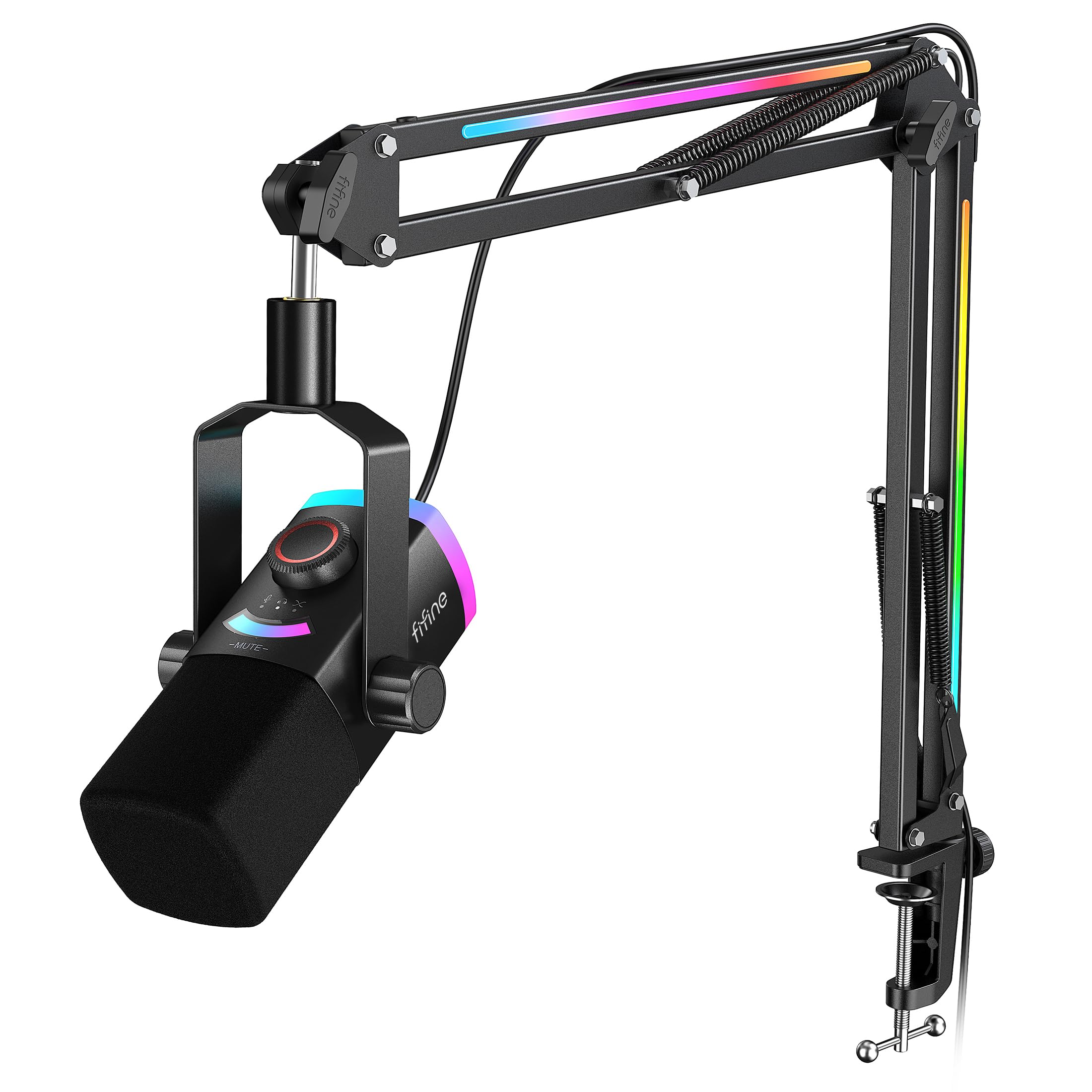
The FIFINE AM8PROT offers a rare combination at its tier: a dynamic capsule with both USB and XLR connectivity, giving you a path to upgrade to an audio interface later without replacing the mic. The dynamic cardioid design delivers the core benefit of noise rejection — it naturally ignores side and rear sound, making it effective for mechanical keyboards and nearby PC fans. The 115dB SPL handling and 75dB SNR rating mean your voice comes through cleanly even in louder gaming environments.
The included thickened boom arm is a standout component — it’s sturdier than most arms at this level, minimizing wobble noise entering the mic. The arm extends to 30 inches and rotates with multi-angle joints, saving desk space. The 240+ RGB combo lighting is controlled via on-board buttons and syncs the mic body with the boom arm lights for a cohesive glow. The 3-in-1 silent knob handles gain, headphone volume, and mix control, while the tap-to-mute LED gives visual confirmation without software.
The FIFINE Genie software adds EQ and background noise filtering, but the XLR audio path bypasses USB features (lights, mix control) when used with an interface, so plan your workflow accordingly. The foam windscreen is effective against plosives but hides the mic’s appearance. For streamers on a budget who want dynamic noise rejection now and XLR flexibility later, the AM8PROT is the most versatile value proposition in this list.
Why it’s great
- Dual USB/XLR connectivity for future audio interface upgrade path.
- Thickened boom arm included — reduces wobble noise effectively.
- Dynamic capsule naturally rejects keyboard and fan background noise.
Good to know
- XLR mode disables USB features like RGB and mix control.
- Foam windscreen covers mic body — visual preference factor.
6. Logitech for Creators Blue Yeti Nano

The Blue Yeti Nano is the smaller sibling of the iconic Yeti line, pairing two custom condenser capsules with selectable cardioid and omnidirectional polar patterns. In cardioid mode, it focuses on your voice for streaming and gaming; switch to omni for roundtable podcasts or multi-person recordings. The Yeti Nano connects via standard USB and is recognized instantly by Windows, Mac, and PS4/PS5 without any driver installation — true plug-and-play operation.
Blue VO!CE software integration (available through Logitech G HUB) adds broadcast-grade effects, advanced modulation, and HD audio samples that can be triggered for live streaming entertainment. The onboard headphone output provides zero-latency monitoring with independent volume control, which is essential for hearing your mic feed in real time. The compact circular base and low-profile body save significant desk space compared to full-size Yeti models.
As a condenser mic, the Yeti Nano picks up more background noise than dynamic alternatives — the integrated stand also transmits desk vibrations directly into the capsule. A shock mount or boom arm is a worthwhile investment if you want to eliminate thumps from typing or mouse clicks. For users who want the proven Blue broadcast sound signature in a smaller, budget-friendly package, the Yeti Nano delivers reliability without much learning curve.
Why it’s great
- Dual pattern cardioid/omni flexibility for solo or group recording.
- Zero-latency headphone monitoring with independent volume dial.
- Compact form factor saves desk space while delivering broadcast sound.
Good to know
- Condenser capsule sensitive to background noise without a boom arm.
- Desk stand transmits vibrations — shock mount recommended for clean audio.
7. Abel Gaming Streaming Kit
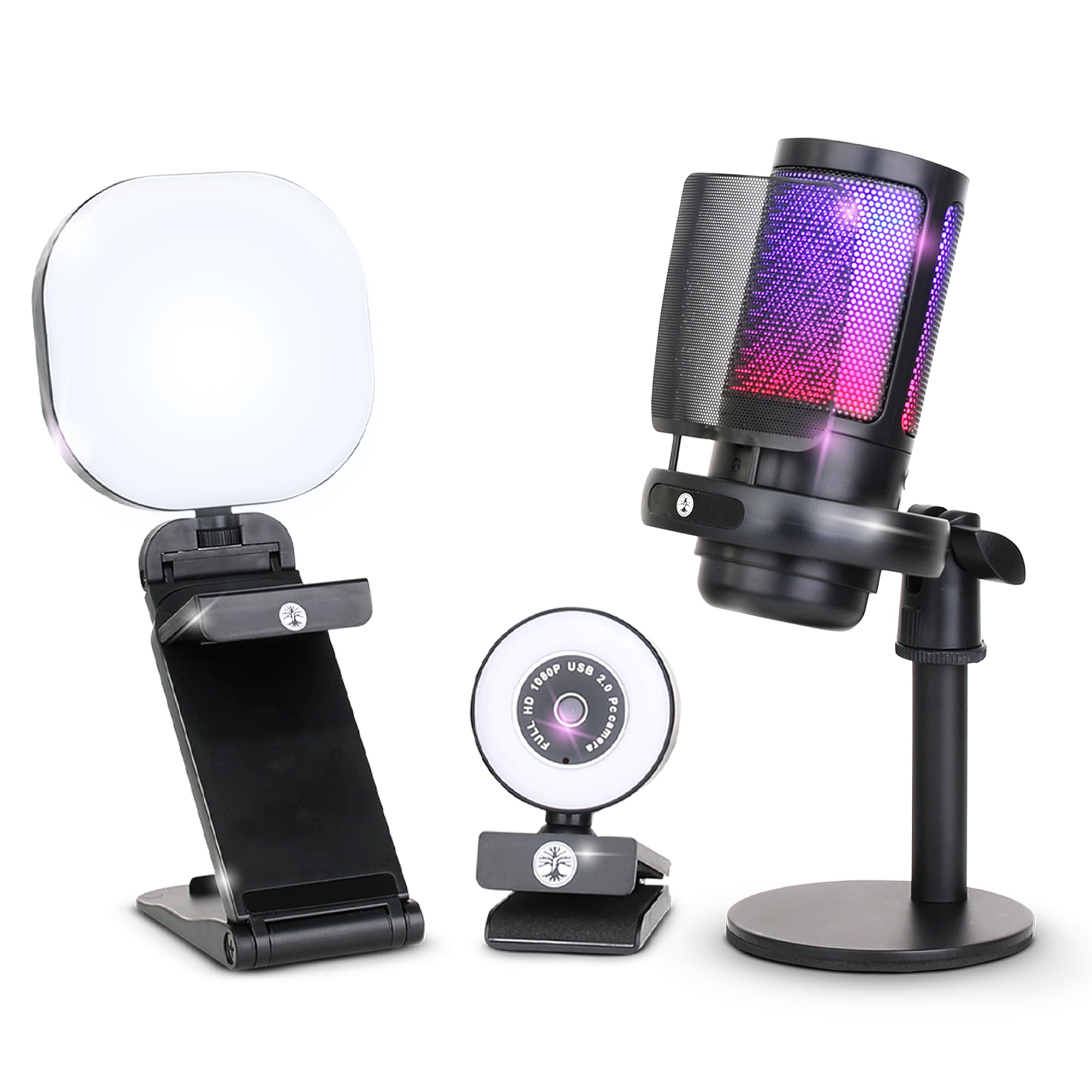
The Abel Gaming Streaming Kit bundles a USB condenser microphone, a 1080p 30fps webcam, and a multi-mode LED light into a single box, designed for absolute beginners entering Twitch or YouTube. The microphone features built-in noise suppression that reduces ambient room sound enough for casual gaming chat, and it connects via standard USB for instant plug-and-play compatibility with Windows, Mac, Android, and iOS. The included LED light offers warm, cool, and mixed modes with a flexible stand for positioning.
The 1080p webcam delivers decent sharpness for the price point and works well in well-lit conditions — the bundled LED light helps compensate for darker rooms. The microphone’s RGB breathing light adds visual flair to your desk setup, and the braided USB cable is a quality touch at this entry-level tier. Setup takes about 15 minutes out of the box.
Build quality reflects the budget pricing — the mic stand feels somewhat unstable, and the webcam autofocus can hunt in low light. The kit is not compatible with consoles like PS5 or Xbox without a PC and capture card, so it’s limited to PC streaming. For the gamer or content creator buying their very first gear bundle, this kit provides functional audio and video without the cost of buying components separately, but the mic alone won’t match the noise rejection of dedicated dynamic options.
Why it’s great
- All-in-one bundle saves cost for beginners who need mic, camera, and light.
- Plug-and-play works across PC, Mac, Android, and iOS devices.
- Multi-mode LED light improves webcam quality in poor room lighting.
Good to know
- Mic stand feels unstable — can tip with cable movement.
- Not console-compatible without a PC and capture card.
FAQ
Should I pick a dynamic or condenser mic for a noisy gaming room?
What polar pattern works best for a desk mic used during gaming?
Do I need a boom arm for a gaming desk mic?
Final Thoughts: The Verdict
For most users, the best gaming desk mic winner is the SteelSeries Alias because its dynamic capsule and AI noise cancellation deliver the cleanest vocal isolation without requiring acoustic treatment or a silent room. If you want studio-level clarity and advanced software mixing, grab the Elgato Wave:3. And for a budget-friendly dynamic mic with XLR upgrade potential, nothing beats the FIFINE AM8PROT.