
Every footstep, reload, and environmental cue is a data point in competitive gaming. A wireless headset that introduces audio delay, muddies directional sound, or dies mid-match is a liability, not a tool. The market is flooded with options claiming low latency and immersive audio, but the distinction between a headset that sounds good on paper and one that performs under pressure comes down to driver engineering, codec handling, and wireless architecture.
I’m Mohammad Maruf — the founder and writer behind Drink4Good. I’ve spent years analyzing wireless audio hardware, dissecting latency figures, battery chemistries, and driver topology to understand what separates a momentary distraction from a genuine competitive advantage.
After filtering through dozens of models across budget, mid-range, and premium tiers, I’ve built a tight, category-specific guide to help you identify the best gaming headset pc wireless for your setup, playstyle, and session length without wasting time on marketing fluff.
How To Choose The Best Gaming Headset PC Wireless
Selecting a wireless gaming headset for PC involves balancing three critical axes: connection stability, audio fidelity, and endurance. The wrong trade-off can leave you tethered to a charging cable mid-raid or missing audio cues that cost you the round. Here’s what to look for.
Wireless Protocol: Why 2.4 GHz Dominates
Bluetooth is convenient for mobile use, but it introduces noticeable latency in gaming scenarios — typically 100-200 ms even with aptX Low Latency. 2.4 GHz wireless, using a dedicated USB dongle, delivers sub-20 ms latency that stays frame-synced with your display. Every headset in this guide uses 2.4 GHz as its primary gaming connection. Some add Bluetooth for pass-through calls or Discord chat, but the gaming backbone is always the low-latency link.
Driver Architecture and Soundstage
Driver diameter matters — 40 mm is standard, 50 mm offers more air displacement for bass impact — but diaphragm material and chamber design are what separate muddy audio from precise positional cues. Titanium-plated diaphragms (seen in the ASUS ROG Pelta) resist breakup at higher volumes, while dual-chamber designs (HyperX Cloud Alpha) physically separate bass frequencies from mids and highs to prevent distortion. For competitive shooters, a driver that resolves footstep direction without overwhelming gunfire noise is the priority.
Battery Life vs. Weight: The Real Trade-off
Battery capacity directly adds grams. A 300-hour battery (HyperX Cloud Alpha Wireless) sounds incredible, but the headset weighs roughly 330 grams. A lighter 270-gram headset (Razer BlackShark V3 X) offers 70 hours — still enough for multiple weeks of daily use. The sweet spot for marathon gamers is a headset under 300 grams with at least 40 hours of rated life. Anything above 330 grams starts to create fatigue during sessions longer than four hours, regardless of padding quality.
Quick Comparison
On smaller screens, swipe sideways to see the full table.
| Model | Category | Best For | Key Spec | Amazon |
|---|---|---|---|---|
| SteelSeries Arctis Nova Pro Wireless | Premium | Multi-platform with ANC | Hot-swap batteries + GameDAC | Amazon |
| Logitech G522 Lightspeed | Premium | RGB style + broadcast mic | 48 kHz/24-bit PRO-G drivers | Amazon |
| Sony INZONE H5 | Mid-Range | PC/PS5 with spatial audio | 40 mm + 360 Spatial Sound | Amazon |
| ASUS ROG Pelta | Mid-Range | Tri-mode versatility | 50 mm titanium-plated drivers | Amazon |
| HyperX Cloud Alpha Wireless | Mid-Range | Extreme battery life | 300-hour battery + DTS | Amazon |
| SteelSeries Arctis Nova 3P | Mid-Range | Multi-platform value | 40-hour battery + 200+ presets | Amazon |
| Razer BlackShark V3 X HyperSpeed | Budget | Lightweight entry-level | 70-hour battery, 270 grams | Amazon |
In‑Depth Reviews
1. SteelSeries Arctis Nova Pro Wireless

This is the headset every other wireless model is measured against. The Infinity Power System — two swappable batteries living inside the GameDAC base station — means you never have to plug the headset in. One battery charges while the other powers the headset, giving you effectively infinite uptime. The base station also serves as a dual-input hub, letting you switch between PC and PlayStation (or any USB-C device) with a button press.
Audio is driven by premium high-fidelity drivers tuned through the Sonar software’s pro-grade parametric EQ. The 4-mic hybrid ANC system is tuned for gaming environments — it cuts fan hum and HVAC noise without the pressure-cabin feeling of high-end ANC headphones. The ClearCast Gen 2 retractable mic uses AI algorithms to isolate your voice from keyboard clatter and room reverb. At 36 hours per battery, you get 72 hours runtime out of the two-pack.
The main caveat is weight — the headset sits at roughly 340 grams, which is noticeable during sessions past the three-hour mark. Some users report the internal plastic ear cup housing presses against the ear cartilage, though aftermarket thicker pads solve this. The base station RF transceiver has been reported to fail after 12-18 months in a small number of units, so a multi-year warranty or protection plan is worth considering.
Why it’s great
- Infinity hot-swap batteries eliminate charging downtime entirely
- GameDAC base station with dual USB-C ports for multi-system switching
- Retractable ClearCast Gen 2 mic with AI noise cancellation
Good to know
- At 340 grams, it’s heavier than many competitors for long sessions
- Base station longevity concerns reported after 12-18 months
2. Logitech G522 Lightspeed Wireless

The G522 is Logitech’s mid-cycle refresh that nails the fundamentals. Its PRO-G drivers deliver 48 kHz/24-bit synchronized audio — that means the left and right channels are phase-aligned at the hardware level, eliminating the subtle timing smear that makes some headsets sound “blurry” during fast directional shifts. The result is crisp, separated sound staging where footsteps register with clear left-right positioning.
The full-bandwidth 48 kHz/16-bit boom mic is best-in-class for this tier. Blue VO!CE software processing provides noise gate, compressor, and EQ filters that make your voice sound broadcast-ready without a separate mic arm. The headset uses LIGHTSPEED wireless — Logitech’s proprietary 2.4 GHz protocol — delivering the same sub-millisecond latency found in their esports mice. Battery life hits 60 hours with RGB off, and the suspension band is machine-washable.
The design is entirely plastic, which keeps weight down to 280 grams but sacrifices the premium feel of metal-reinforced competitors. The ear cushions are rounded rather than oval, which may feel snug for larger ears. Audio quality is optimized for gaming — music reproduction is competent but lacks the bass extension and soundstage width of dedicated music headphones at similar price points.
Why it’s great
- 48 kHz/24-bit PRO-G drivers with hardware phase alignment
- Full-bandwidth mic with Blue VO!CE processing for streaming-grade voice
- Washable suspension band, 280-gram lightweight build
Good to know
- Fully plastic construction; no metal reinforcement in the headband
- Music playback is adequate but not reference-quality
3. Sony INZONE H5

Sony brings its audio engineering pedigree to the gaming space with the INZONE H5. The headline feature is the personalized 360 Spatial Sound for Gaming — you upload a photo of your ear to the companion app, and Sony’s algorithm generates a custom HRTF (head-related transfer function) that places audio objects in a 3D sphere around you. In practice, this means you can distinguish not just left and right, but elevation — footsteps above or below your position register with uncanny precision.
The 40 mm drivers are tuned for clarity over bass emphasis. They resolve mid-range detail well — dialogue, reload clicks, and environmental ambience stay separated without muddying together. The AI-based noise canceling on the bidirectional boom mic extracts keyboard and fan noise from your voice feed. Battery life is rated at 28 hours, which is below the category average, but the headset charges to full in 3.5 hours via USB-C.
The H5 has no Bluetooth — it uses only 2.4 GHz wireless via the included USB transceiver and a 3.5 mm wired option. This limits its versatility for mobile use but ensures zero latency competition on PC and PS5. The ear pads are on the smaller side, and some users report tightness around the jaw after extended wear. The design is also heavily PS5-oriented, with automatic game/chat balance and on-screen settings that only work on Sony’s console.
Why it’s great
- Personalized 360 Spatial Sound with custom ear-profile HRTF
- AI-based mic noise cancellation for clear comms
- Automatic game/chat balance when connected to PS5
Good to know
- No Bluetooth — 2.4 GHz and 3.5 mm only
- Ear pads are tight for larger ears; 28-hour battery is below average
4. ASUS ROG Pelta

The ROG Pelta punches above its price tier by combining 50 mm titanium-plated drivers with tri-mode connectivity that covers every scenario. The 2.4 GHz connection via ROG SpeedNova technology delivers 20 ms latency — indistinguishable from wired. Bluetooth 5.0 handles mobile and Discord calls, and USB-C wired mode provides backup for when batteries run dry. This flexibility makes it the most versatile headset in its segment for gamers who switch between PC, PS5, and Switch.
The 10 mm super-wideband boom microphone captures a frequency range significantly wider than the standard gaming mic, resulting in voice transmission that sounds closer to a dedicated XLR mic than a typical headset. The 309-gram weight, combined with a breathable three-level elastic headband and memory foam ear cushions, makes it easy to forget you’re wearing it during long sessions. Battery life reaches 70 hours in 2.4 GHz mode with RGB off, and a 15-minute quick charge delivers 3 hours of play.
The default EQ profile is heavily bass-boosted for gaming, which makes music reproduction sound boomy and imprecise — the titanium drivers can distort on complex tracks before EQ adjustment. The Aura Sync RGB lighting resets its configuration every time the headset is powered off, requiring re-integration with the software each session. The elastic headband design also takes some getting used to compared to traditional padded bands.
Why it’s great
- Tri-mode (2.4 GHz, Bluetooth, USB-C) covers all platforms
- 50 mm titanium-plated drivers with 20 ms low latency
- Super-wideband 10 mm mic for near-broadcast voice quality
Good to know
- Default music EQ is bass-heavy and can distort complex tracks
- RGB lighting config resets each power cycle; elastic band feels unusual
5. HyperX Cloud Alpha Wireless

The headline number — 300 hours of battery life — is not an exaggeration. In real-world mixed use (gaming, voice chat, music at moderate volume), you can go two to three weeks without charging. If you forget to charge overnight, the headset still has enough reserve for multiple full gaming sessions the next day. The 4.5-hour full recharge time is the only concession, but it’s a reasonable trade for that endurance.
HyperX’s dual-chamber driver design physically separates the bass chamber from the mids and highs chamber inside each ear cup. This prevents the low-end from bleeding into and distorting the mid-range frequencies where footsteps and dialogue sit. DTS Headphone:X Spatial Audio adds 3D positioning that works across any game engine that supports spatial sound. The aluminum frame adds structural rigidity without significant weight, and the memory foam ear cushions are plush without being overly warm.
The lack of Bluetooth is the biggest omission — this headset uses 2.4 GHz wireless exclusively. There’s no mobile app for EQ adjustment, and the software customization via the HyperX NGENUITY app is limited compared to competitors. The microphone is detachable and noise-canceling, but captured voice sounds slightly thin compared to the full-bandwidth mics found on the Logitech G522 or ASUS ROG Pelta. This unit is often sold as renewed/refurbished, so check the condition listing carefully.
Why it’s great
- 300-hour battery life — weeks of use between charges
- Dual-chamber drivers keep bass from distorting mids and highs
- Durable aluminum frame with plush memory foam cushions
Good to know
- No Bluetooth — 2.4 GHz wireless only
- Mic voice quality is adequate but not competitive with premium models
6. SteelSeries Arctis Nova 3P
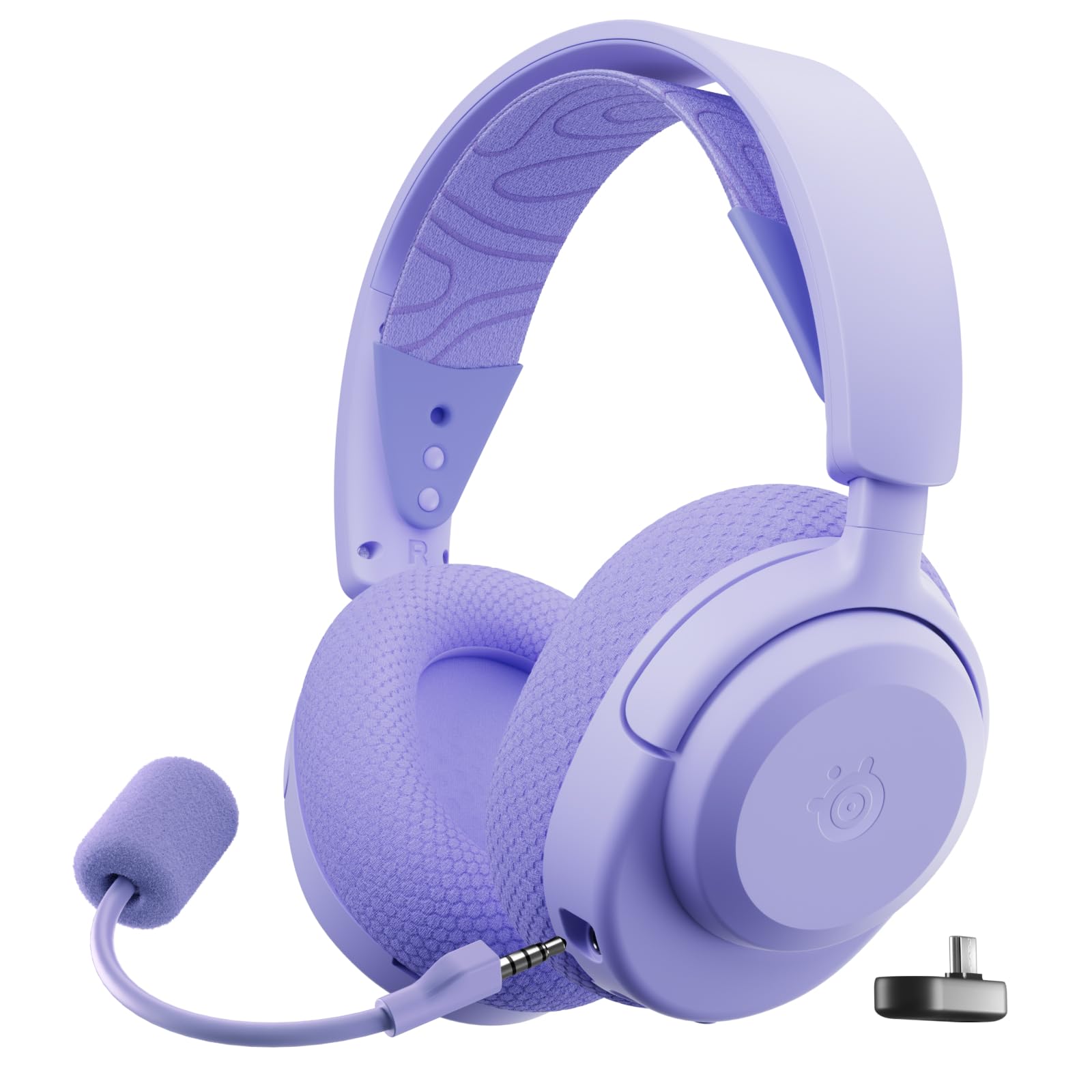
The Arctis Nova 3P is the best-looking headset in this roundup, with a lavender colorway that stands out from the sea of black and red gaming peripherals. Under the surface, it uses custom-designed neodymium magnetic drivers that deliver a wide frequency response up to 22 kHz with clear highs, pinpoint mids, and deep bass that doesn’t bloom into the upper registers. The sound signature is slightly brighter than the HyperX Cloud Alpha, making it excellent for competitive shooters where footstep treble matters.
SteelSeries’ Arctis Companion app provides over 200 game-specific EQ presets for titles like Call of Duty, Fortnite, and Valorant, each tuned to emphasize the audio cues relevant to that game. The stretchy fabric headband distributes weight across the crown, preventing the hotspot pressure that traditional padded headbands create on the top of the skull. At 260 grams, it’s the lightest headset in this guide, and the fast-charge feature gives 9 hours of playback from a 15-minute charge.
The build quality is entirely plastic — the dual-hinge design is durable but lacks the metal reinforcement of the HyperX Cloud Alpha or ASUS ROG Pelta. The microphone noise cancellation is excellent, blocking ambient room noise for clear voice transmission, but the mic itself sounds slightly compressed compared to the full-bandwidth mics on more expensive models. The Mac Engine software for the Arctis line has been broken on Apple Silicon for years, so Mac users should verify compatibility before purchasing.
Why it’s great
- Ultra-light 260-gram design with stretchy fabric headband for zero hotspot
- 200+ game-specific EQ presets via mobile app
- Fast charge: 15 minutes gives 9 hours of playback
Good to know
- Fully plastic build; no metal reinforcement in hinges
- Mac Engine software incompatible with Apple Silicon
7. Razer BlackShark V3 X HyperSpeed
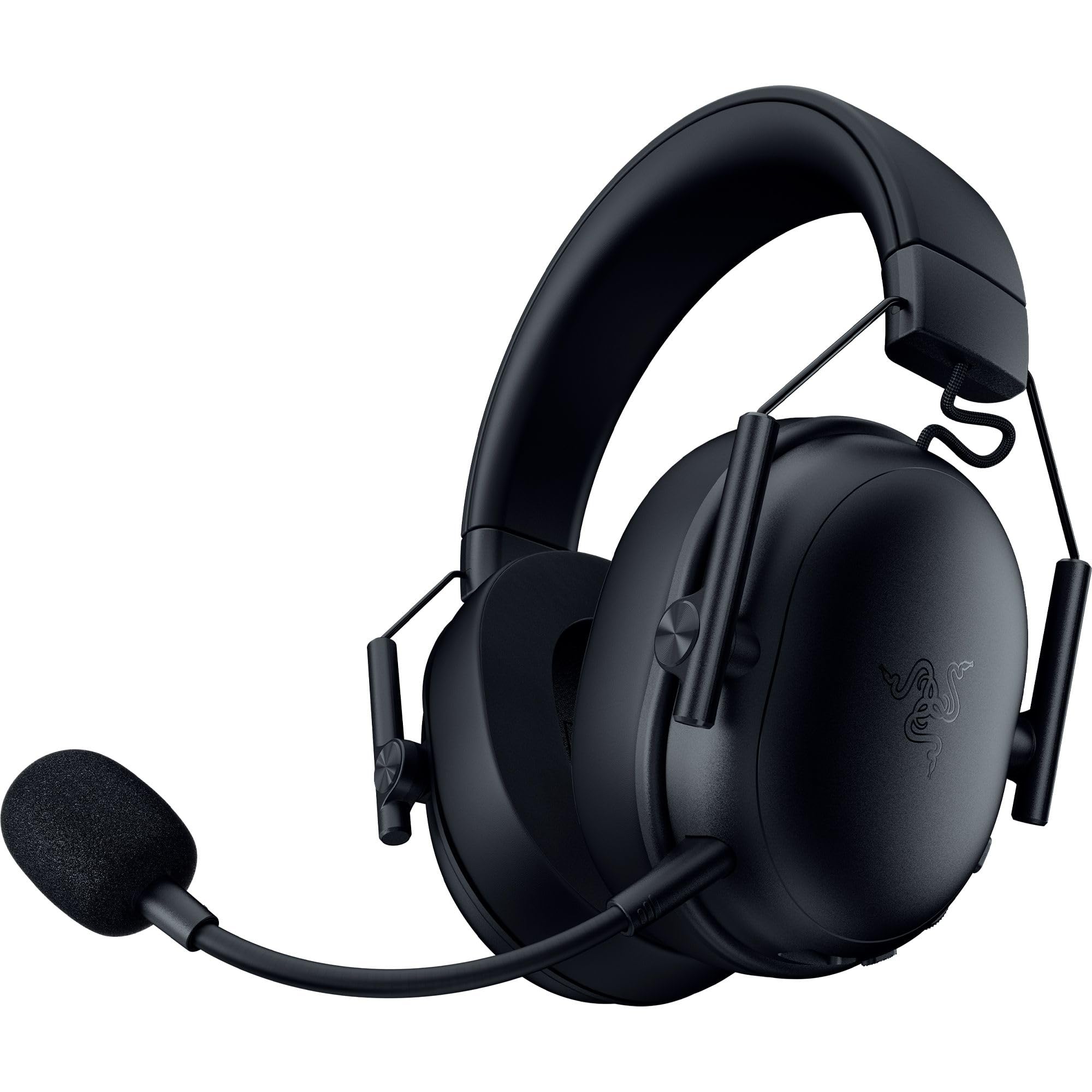
The BlackShark V3 X HyperSpeed proves that a budget-friendly wireless headset doesn’t have to sacrifice competitive audio. Razer’s Gen-2 TriForce 50 mm drivers use a three-part design that tunes the highs, mids, and lows through separate porting within the driver housing, reducing distortion at the source. The result is surprisingly good directional audio for a headset at this price tier — footsteps have clear right-left orientation, and gunfire doesn’t cause the driver to lose control.
HyperSpeed wireless delivers the low-latency 2.4 GHz connection that competitive players need, and the SmartSwitch Dual Wireless lets you toggle between 2.4 GHz and Bluetooth 5.3 without re-pairing. The 70-hour battery life is exceptional for the weight — the headset tips the scales at just 270 grams, making it one of the lightest options here. The detachable HyperClear Cardioid 9.9 mm mic has a unidirectional pickup pattern that rejects side and rear noise effectively, keeping your voice clear even in a loud room.
The ear cushions are thin — some users report their ears touching the speaker grills after extended wear, which can cause discomfort. The microphone volume is lower than most competitors; you’ll need to position it close to your lips for optimal pickup, and it doesn’t perform as well on PlayStation as it does on PC despite multi-platform compatibility claims. The lack of onboard EQ controls means you’re dependent on Razer’s Synapse software for sound adjustments, and the ear cushion foam compresses faster than memory foam alternatives.
Why it’s great
- Gen-2 TriForce 50 mm drivers with separate porting for clean separation
- Ultra-light 270-gram build with 70-hour battery life
- SmartSwitch Dual Wireless (2.4 GHz + Bluetooth 5.3) for multi-device
Good to know
- Thin ear cushions; ears may contact driver grills during long sessions
- Mic volume is lower than average; requires close proximity for best results
FAQ
Can I use Bluetooth headphones for competitive PC gaming without lag?
What battery life is considered good for a wireless gaming headset in 2025?
Final Thoughts: The Verdict
For most users, the best gaming headset pc wireless winner is the SteelSeries Arctis Nova Pro Wireless because the hot-swap battery system and GameDAC base station solve the two biggest pain points of wireless gaming — downtime and multi-platform switching — while delivering premium audio and ANC. If you want maximum battery endurance without compromise, grab the HyperX Cloud Alpha Wireless for its 300-hour runtime and dual-chamber driver clarity. And for the best value-to-feature ratio, nothing beats the ASUS ROG Pelta, which brings 50 mm titanium drivers and tri-mode connectivity at a mid-range price point.