
Waiting for a game level to load isn’t a technical limitation—it’s a direct failure of your storage. The difference between a generic SATA SSD and a high-end M.2 drive is the difference between a minute of staring at a progress bar and a nine-second sprint into the action. For gaming, the read speed is the only spec that truly matters, and anything below a PCIe Gen 4 interface leaves performance on the table.
I’m Mohammad Maruf — the founder and writer behind Drink4Good. After analyzing terabytes of benchmark data, controller specifications, and real-world game load tests across seven different drives, the patterns separating genuine gaming performance from marketing claims become brutally clear.
Finding the right gaming m.2 ssd means understanding that raw sequential speed is only half the battle—random IOPS, thermal throttling under sustained load, and the quality of the NAND controller determine whether your drive stays fast after five minutes of intense gameplay.
How To Choose The Best Gaming M.2 SSD
Choosing a drive for gaming feels simple—pick the fastest number on the box—but the real-world difference comes down to sustained performance under load, not peak sequential benchmarks. Here are the three factors that separate a good gaming drive from a great one.
Interface Generation: Gen 4 vs Gen 5
PCIe Gen 4 offers up to 7,000-7,500 MB/s read speeds, which is enough to eliminate load times in nearly every current game. Gen 5 drives push past 10,000 MB/s, but they require compatible motherboards and beefier heatsinks to avoid thermal throttling. For most gamers today, Gen 4 provides the best balance of cost and performance, while Gen 5 offers serious future-proofing for DirectStorage-intensive titles.
DRAM vs HMB Architecture
Drives with a dedicated DRAM cache maintain consistent random read/write speeds under heavy multitasking. Host Memory Buffer (HMB) technology uses system RAM instead, which works well for gaming scenarios but can show latency during simultaneous file transfers or when running multiple applications. For a pure gaming rig, HMB is fine; for streaming, recording, and gaming simultaneously, DRAM helps maintain stability.
Thermals and Sustained Performance
A drive that runs hot will throttle its speed down after five minutes of sustained reads, negating any peak benchmark advantage. Look for drives with nickel-coated controllers or graphene heat spreaders. If your motherboard lacks a built-in heatsink for the M.2 slot, an aftermarket thermal solution becomes mandatory—especially for Gen 5 drives that run significantly hotter under load.
Quick Comparison
On smaller screens, swipe sideways to see the full table.
| Model | Category | Best For | Key Spec | Amazon |
|---|---|---|---|---|
| WD Black SN8100 | Gen 5 | High-end gaming & editing | 14,900 MB/s read speed | Amazon |
| Crucial P510 | Gen 5 | Fast Gen5 value | 11,000 MB/s read speed | Amazon |
| Samsung 990 EVO Plus | Gen 4/5 | Reliable all-around performer | 7,250 MB/s read speed | Amazon |
| Crucial T500 | Gen 4 | Creative and gaming hybrid | 7,400 MB/s read speed | Amazon |
| WD Blue SN5100 | Gen 4 | Daily driver & AI workflows | 7,100 MB/s read speed | Amazon |
| Fanxiang S880E | Gen 4 | PS5 storage expansion | 7,000 MB/s read speed | Amazon |
| Kingston NV3 | Gen 4 | Budget secondary drive | 6,000 MB/s read speed | Amazon |
In-Depth Reviews
1. WD Black SN8100 1TB
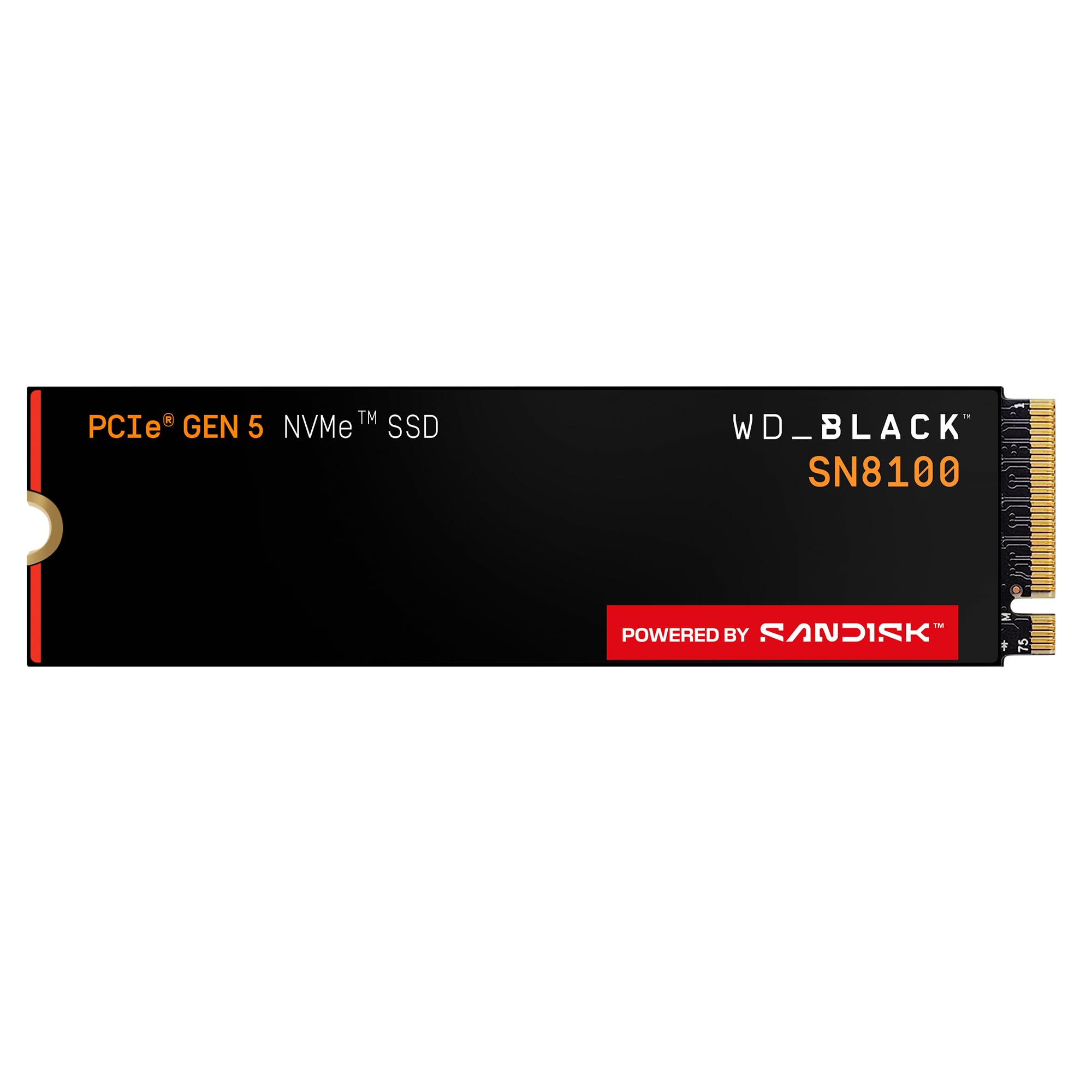
The SN8100 delivers the highest sequential read speeds in this lineup at 14,900 MB/s, paired with a write speed of 11,000 MB/s on the 1TB model. That data rate is more than double what any Gen 4 drive can achieve, making it the clear choice for gamers who also edit video or move large project files regularly. The TLC 3D CBA NAND combined with Sandisk’s latest controller ensures random IOPS exceed 2.3 million, which effectively eliminates microstutters in open-world titles.
Thermals stay manageable thanks to the nickel-coated controller, though a motherboard-integrated heatsink or quality aftermarket solution is still recommended to keep speeds stable during extended sessions. One reviewer noted that after upgrading from a Gen 3 RAID 0 array, the 4TB version registered over 14,000 MB/s on CrystalDiskMark and completely removed previously annoying texture pop-in.
The five-year warranty with a 4,800 TBW endurance rating on the 8TB model reflects confidence in long-term reliability. For those building a future-proof Gen 5 rig right now, this is the drive to beat.
Why it’s great
- Industry-leading 14,900 MB/s read speed
- Over 100% better power efficiency than Gen 4 predecessors
- High endurance ratings across all capacities
Good to know
- Requires Gen 5 motherboard slot to achieve full speed
- Best performance needs a dedicated heatsink
2. Crucial P510 1TB

The P510 brings Gen 5 performance—11,000 MB/s read and 8,500 MB/s write—without the premium pricing of the flagship SN8100. Using Micron’s advanced G8 NAND and a TLC controller, this drive delivers a noticeable leap over Gen 4 drives for boot times, game level loading, and large file transfers. It’s backward compatible with Gen 4 slots, though you’ll only see its full potential on a Gen 5 motherboard.
Thermal management is handled well by the drive’s controller design, but users consistently report the need for a robust heatsink under sustained write loads. The drive ships with Acronis True Image cloning software and a one-month Adobe Creative Cloud subscription, adding genuine value for content creators who also game.
Customer reviews highlight the P510’s excellent price-to-performance ratio relative to other Gen 5 drives. The 5-year warranty and 600 TBW endurance provide good peace of mind for a primary drive.
Why it’s great
- Fastest Gen 5 for the price point
- Includes cloning software and Adobe bundle
- Backward compatible with Gen 4 systems
Good to know
- Requires strong heatsink to avoid throttle
- 1TB capacity may fill quickly for large game libraries
3. Samsung 990 EVO Plus 2TB

Samsung’s 990 EVO Plus uses Host Memory Buffer architecture combined with Intelligent TurboWrite 2.0 to deliver 7,250 MB/s read and 6,300 MB/s write speeds. It’s compatible with both PCIe 4.0 x4 and PCIe 5.0 x2 interfaces, giving it a unique flexibility for future motherboard upgrades. The nickel-coated controller improves thermal efficiency, keeping the drive cool enough for laptop upgrades without extra cooling.
Gamers upgrading from SATA or low-end Gen 3 NVMe drives report Cyberpunk 2077 load times dropping from over 30 seconds down to about 9 seconds. The drive uses Samsung’s latest V-NAND and features a polished Magician Software suite for firmware updates and health monitoring. It lacks a dedicated DRAM cache, relying on HMB, which works well for gaming but may show slight latency under heavy multitasking.
The 2TB capacity provides ample room for a large game library, and customer feedback consistently emphasizes the snappy, reliable nature of Samsung’s SSDs. For a balanced, future-ready gaming drive, the 990 EVO Plus is a strong contender.
Why it’s great
- Compatible with both Gen 4 and Gen 5 motherboards
- Excellent power efficiency and thermal control
- Reliable Samsung brand with proven controller
Good to know
- No dedicated DRAM cache
- Heatsink not included in the package
4. Crucial T500 2TB

The Crucial T500 is built around a TLC NAND with a dedicated DRAM cache, offering 7,400 MB/s read and 7,000 MB/s write speeds. The inclusion of DRAM gives it an edge in sustained random IOPS—rated at 1.18M/1.44M—which directly benefits both gaming and content creation workloads like video rendering and large batch file processing.
It runs remarkably cool for a high-performance Gen 4 drive, with users reporting idle temperatures between 34 and 39 degrees Celsius. The Momentum Cache feature uses system RAM for small operations, further boosting responsiveness in day-to-day use. Crucial bundles Acronis cloning software and a one-month Adobe Creative Cloud subscription, making it especially attractive for gamers who also edit or stream.
The 2TB capacity and 1200 TBW endurance rating support years of heavy use. One reviewer noted that real-world speeds reach about half of the max theoretical throughput, which is typical for NVMe drives, but the snappy feel in both game loading and video editing is immediately noticeable.
Why it’s great
- Dedicated DRAM cache for consistent IOPS
- Runs cool without aggressive throttling
- Great for both gaming and creative work
Good to know
- Expensive relative to other Gen 4 drives
- Large file performance exceeds small file performance
5. WD Blue SN5100 1TB
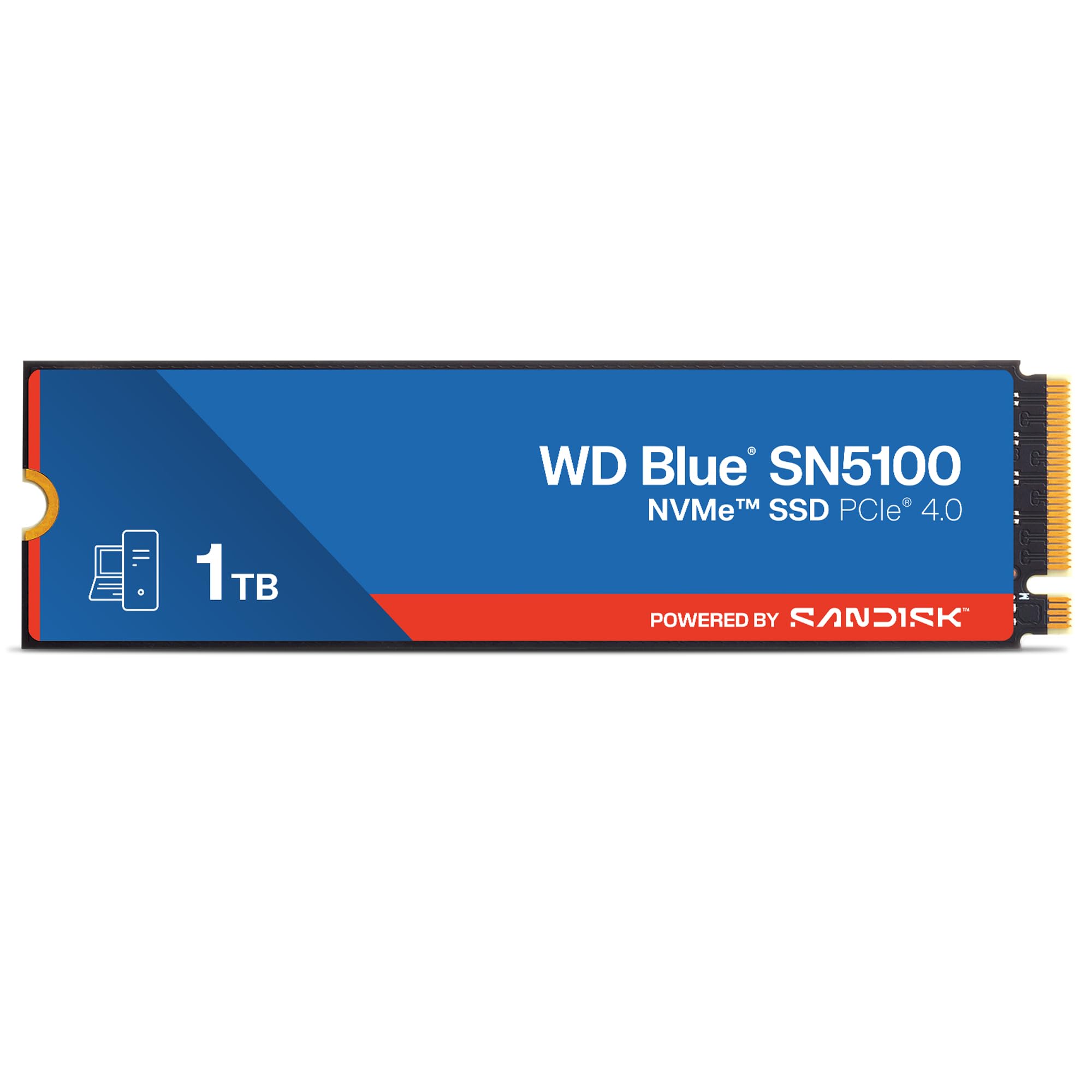
The SN5100 uses Sandisk’s 3D CBA NAND and nCache 4.0 technology to reach 7,100 MB/s read speeds, making it a solid mid-range Gen 4 option. The drive is optimized for AI-enabled workflows as well as gaming, with the nCache accelerating large file transfers. It’s 30% faster than its previous-generation SN5000 series, although sustained performance depends on proper motherboard configuration.
Customer reviews highlight its easy plug-and-play installation and compatibility with older 3×4 PCIe slots, where it still delivers smooth game loading without stuttering. The drive is single-sided, which improves compatibility with laptops and tight desktop spaces. It comes with a 5-year limited warranty, backed by Sandisk’s reliability reputation.
The main consideration is that it performs best on a dedicated PCIe Gen 4 slot with the BIOS set to Gen 4 speed. When limited to Gen 3, it still provides snappy boot times, but the full sequential throughput won’t be realized.
Why it’s great
- Solid 7,100 MB/s Gen 4 performance
- nCache 4.0 accelerates large file transfers
- 5-year warranty from a trusted brand
Good to know
- Best performance requires Gen 4 slot configuration
- No dedicated DRAM cache
6. Fanxiang S880E 1TB

The Fanxiang S880E is a Gen 4 drive with sequential read speeds up to 7,000 MB/s and write speeds of 3,000 MB/s. It’s explicitly marketed for PS5 expansion, and customer reviews confirm it works smoothly with Sony’s console, providing ample storage for modern game installs. The drive also fits gaming PCs and NAS units, with one user reporting two installed in a Ugreen NAS that maxed out the NAS transfer rate.
Thermal management is handled by a graphite-coated copper foil layer and an aluminum foil layer on the sticker, which helps maintain performance during extended gaming sessions. The drive uses high-quality 3D NAND and supports NVMe 2.0. Fanxiang includes a 5-year after-sales service and lifetime technical support, which is generous for the price tier.
The write speed is lower than some competitors—3,000 MB/s sequential—which isn’t an issue for gaming loads but would be noticeable in content creation. For gamers focused on read performance and storage expansion, particularly for PS5, the S880E delivers excellent value.
Why it’s great
- Compatible with PS5 for storage expansion
- Effective graphite-copper foil thermal solution
- 5-year service and lifetime support
Good to know
- Write speed limited to 3,000 MB/s
- Not compatible with Mac OS
7. Kingston NV3 1TB
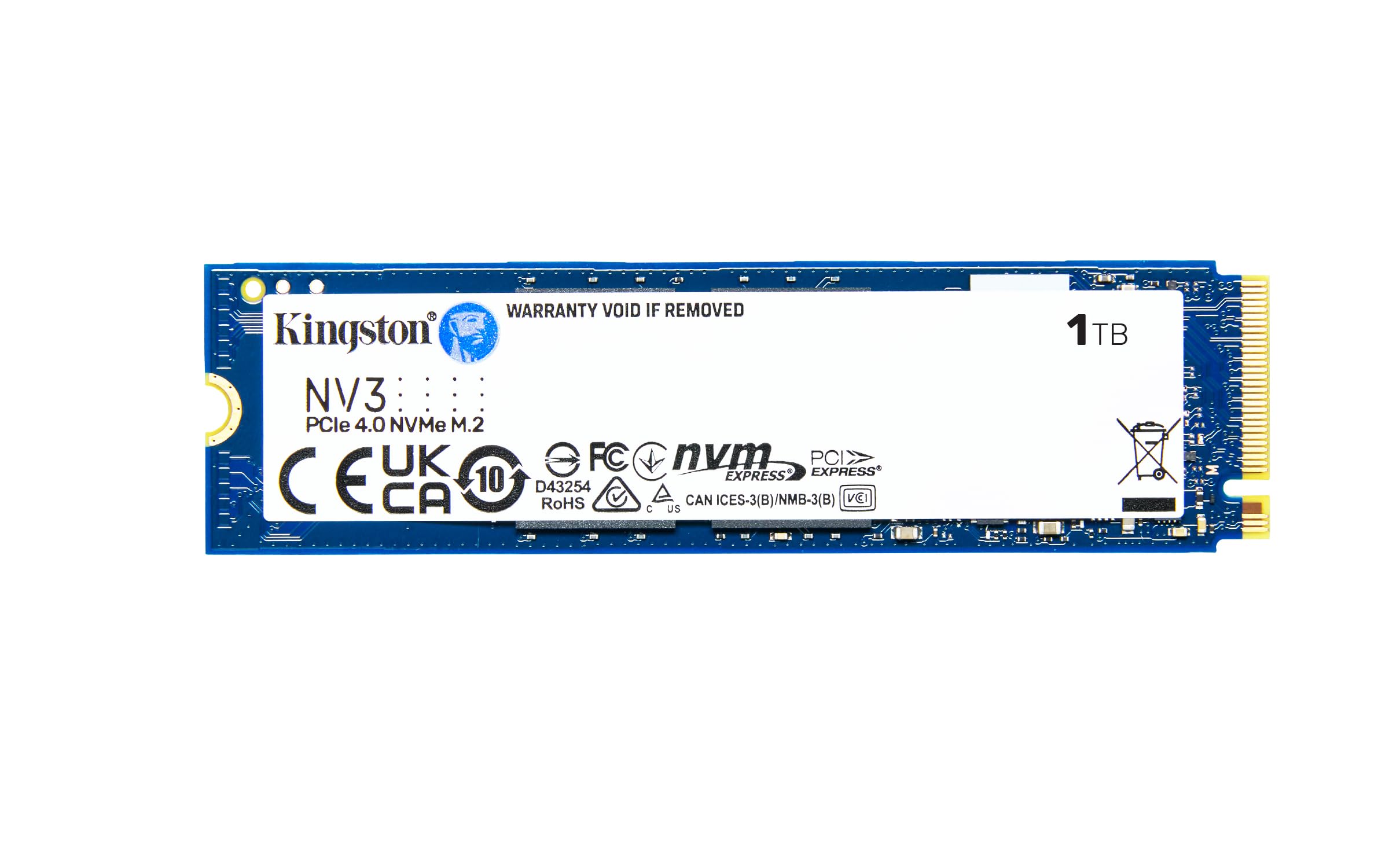
The Kingston NV3 is a Gen 4 drive with 6,000 MB/s read speeds, positioned as an affordable entry point into NVMe gaming storage. It uses a Gen 4×4 interface with capacities up to 4TB, and its shock-resistant design makes it durable for both desktop and laptop use. The blue PCB is a distinctive aesthetic touch, though it’s hidden inside the system.
Customer feedback confirms it offers a significant speed upgrade over SATA SSDs, with boot times and game loading both improving noticeably. However, one reviewer noted that speed slows down after 5-10 minutes of sustained use, which suggests some thermal throttling or cache exhaustion under heavy loads. It works best as a secondary game drive rather than a primary OS drive for intense workflows.
The NV3 is a reliable, no-nonsense drive for budget-conscious gamers who want Gen 4 speeds without the premium cost. It’s simple to install and compatible with most desktops and laptops that have an M.2 2280 slot.
Why it’s great
- Affordable entry into Gen 4 speeds
- Shock resistant and durable
- Capacities up to 4TB for game storage
Good to know
- Speed drops under sustained load
- Best suited as a secondary drive
FAQ
Will a Gen 5 M.2 SSD work in a Gen 4 motherboard slot?
Is a DRAM cache necessary for gaming or is HMB enough?
How hot does a Gen 5 gaming SSD get under load?
Final Thoughts: The Verdict
For most gamers, the best gaming m.2 ssd winner is the WD Black SN8100 because it delivers unmatched Gen 5 read speeds for both current and future DirectStorage titles, with strong endurance and excellent thermal efficiency. If you want a great balance of speed and value, grab the Samsung 990 EVO Plus with its unique Gen 4/5 flexibility. And for an affordable Gen 5 entry point without sacrificing performance, the Crucial P510 delivers impressive speed at a mid-range price point.