
Your squad hears every keyboard clack, every fan hum, and every breath between callouts. A headset mic won’t cut it when you need your voice to cut through the chaos of a firefight without broadcasting your entire room. The difference between a good gaming session and a great one often comes down to how clearly your team hears your callouts — and that starts with the right microphone setup.
I’m Mohammad Maruf — the founder and writer behind Drink4Good. I’ve spent years analyzing the acoustic engineering, polar patterns, and sample rate specs across PC gaming microphones to separate genuine performance from marketing hype.
Whether you’re streaming on Twitch, coordinating in Discord, or recording voiceovers, your choice of best gaming mic for pc determines whether you sound like a pro or a potato to your audience.
How To Choose The Best Gaming Mic For PC
A gaming microphone isn’t just about recording volume — it’s about isolating your voice from the mechanical rattle of your keyboard, the hum of your PC fans, and the echo of your room. Here are the critical factors that separate a livestream-ready microphone from a desk ornament.
Polar Patterns: The Direction Your Mic Listens
Cardioid and supercardioid patterns capture sound from the front while rejecting noise from the sides and rear. This is the single most important spec for a gamer — a good polar pattern eliminates the need for heavy software filtering. Omni-directional mics pick up everything, which ruins voice chat clarity unless you’re in a treated room.
Sample Rate and Bit Depth
24-bit / 48kHz is the baseline for clear voice communication. At 24-bit / 96kHz, you double the frequency capture range, preserving vocal sibilance and warmth. Entry-level mics at 16-bit / 44.1kHz can sound muddy when compressed by streaming software. Higher bit depth also gives you more headroom to EQ your voice without introducing noise.
Connection Type: USB vs. XLR
USB mics offer plug-and-play simplicity with built-in preamps — perfect for most gamers. XLR mics require an external audio interface but deliver cleaner signal paths and upgrade potential. For pure gaming and streaming, USB is the practical choice. XLR belongs in the hands of podcasters and recording artists who need studio-grade isolation.
Built-in Controls and Muting
Tap-to-mute with clear LED indicators prevents accidental hot-mic moments on stream. Physical gain knobs let you adjust sensitivity without alt-tabbing into software. A mute button located on the mic body is non-negotiable for live gaming where you need to cough, sip water, or talk off-mic without disrupting the broadcast.
Quick Comparison
On smaller screens, swipe sideways to see the full table.
| Model | Category | Best For | Key Spec | Amazon |
|---|---|---|---|---|
| Shure SM4 | XLR Studio | Professional recording | 1-inch dual-diaphragm capsule | Amazon |
| SteelSeries Alias | USB Premium | Streaming with AI noise cancel | 3x bigger capsule | Amazon |
| Sennheiser Profile | USB Cardioid | Natural voice reproduction | 60 dB noise floor | Amazon |
| HyperX QuadCast 2 | USB Premium | All-round streaming | Aluminum enclosure | Amazon |
| Blue Yeti | USB Multi-Pattern | Versatile recording | 4 pickup patterns | Amazon |
| Razer Seiren V2 X | USB Supercardioid | Competitive gaming | Integrated digital limiter | Amazon |
| HyperX SoloCast 2 | USB Budget | Budget-friendly gaming | 24-bit / 96kHz capture | Amazon |
In‑Depth Reviews
1. Shure SM4

The Shure SM4 is a professional-grade XLR condenser microphone that brings studio-quality capture to your gaming setup. Its 1-inch brass dual-diaphragm capsule delivers smooth low-end and detailed highs, with a uniform cardioid pattern that rejects room noise and keyboard chatter exceptionally well. The included detachable magnetic pop filter and shock mount reduce plosives and vibration noise right out of the box.
What sets the SM4 apart is its patent-pending interference shielding that blocks RF noise from cell phones, Wi-Fi routers, and laptops — a genuine problem in a typical gaming desk environment. It handles SPL up to 140 dB, meaning loud screamers and explosion-heavy streams won’t clip or distort. The all-metal stainless steel construction ensures this mic survives years of daily use.
The trade-off is that you need an XLR audio interface to use it, adding cost and complexity to your setup. It also has high sensitivity, so a sound-treated room or careful positioning is necessary to avoid capturing echo and ambient noise. For the serious streamer or content creator who wants mix-ready audio, this is an investment that pays off.
Why it’s great
- Exceptional RF interference shielding for clean audio
- Robust all-metal build with included pop filter and shock mount
- High SPL handling prevents distortion on loud takes
Good to know
- Requires XLR audio interface — not plug-and-play
- High sensitivity demands a quiet recording environment
- No XLR cable included in the package
2. SteelSeries Alias

The SteelSeries Alias is purpose-built for gamers, featuring a capsule three times larger than typical USB mics for broader vocal capture. Its cardioid polar pattern is tuned for gaming environments, and the integrated shock mount reduces desk vibrations that plague competitive setups. The free Sonar software adds AI noise cancellation that filters out mechanical keyboards and fan noise without degrading voice clarity.
LED monitoring on the body shows audio levels in green-to-red, so you see when you’re peaking before anyone hears it. The RGB downlight adds ambiance for streamers who want visual flair, and the plug-and-play USB-C connection means zero driver hassle. Users report excellent noise cancellation that allows playing music at 70 dB while the mic only captures the speaker’s voice — a game-changer for open-back headphone users.
For full access to the AI noise cancellation and mixing features, you need the SteelSeries GG software suite. The mic can pick up desk bumps in stand mode, so using the boom arm mode is recommended. For the gamer who wants premium USB convenience with software-enhanced noise control, this is the top-tier pick.
Why it’s great
- AI noise cancellation effectively silences keyboard and fan noise
- 3x larger capsule captures full vocal range
- LED level monitoring prevents audio clipping
Good to know
- Advanced features require SteelSeries GG software
- Boom arm recommended to avoid desk vibration pickup
- Not studio-grade — optimized for gaming, not critical recording
3. Sennheiser Profile

The Sennheiser Profile delivers the audio refinement and natural voice reproduction that the German brand is known for, in a clean, no-nonsense USB package. Its cardioid condenser capsule is engineered for warm, present vocal capture that accentuates body without harshness. With a noise floor of just 60 dB, it’s one of the quietest USB mics available — background hiss is virtually absent.
Plug-and-play simplicity is a core design philosophy here. There’s no required software — the Profile uses universal USB standards so it works on Windows, MacOS, and Linux without drivers. The physical controls for gain, mix, volume, and mute are all on the body, giving you real-time adjustments without alt-tabbing. The built-in headphone jack with direct monitoring ensures zero-latency voice tracking.
The included table stand is compact but low — a boom arm is recommended for optimal positioning. It lacks XLR output, so it’s USB-only. For the gamer or streamer who wants studio-level natural sound without software dependencies, the Sennheiser Profile is a refined, reliable choice.
Why it’s great
- Ultra-low noise floor of 60 dB for clean recordings
- No software required — true plug-and-play on all platforms
- Physical controls for gain, mix, and mute on the mic body
Good to know
- USB-only — no XLR option for future upgrades
- Low stand height requires boom arm for best positioning
- No included pop filter or internal shock mount
4. HyperX QuadCast 2

The HyperX QuadCast 2 is a premium USB microphone wrapped in a full aluminum enclosure, giving it a dense, durable feel that resists the wear of daily gaming. Its built-in anti-vibration shock mount minimizes table bumps and keyboard rattles, while the tap-to-mute with bright LED indicator provides instant visual confirmation of your mic status. The frequency response spans 20 Hz to 20 kHz, covering the full vocal range with clarity.
Connectivity is via USB-C with a 9.84-foot cable, offering plenty of reach for larger setups. The cardioid polar pattern is standard for front-address capture, and the 32-ohm impedance ensures clean signal output to your PC. Users consistently praise its clear, crisp sound for streaming, gaming, and podcasting right out of the box with no software tuning required.
The single red LED color scheme may not match all RGB setups, and at this price point, some users may prefer XLR flexibility. The shock mount is effective but adds bulk to the already substantial build. For the gamer who wants a rugged, plug-and-play USB mic with premium materials and reliable performance, the QuadCast 2 delivers.
Why it’s great
- Full aluminum construction for durability and weight stability
- Effective built-in anti-vibration shock mount
- Long 9.84-foot USB-C cable for flexible placement
Good to know
- Red LED color may clash with non-red RGB themes
- Bulky design takes up significant desk space
- Premium price for a USB-only microphone
5. Blue Yeti (Blackout)

The Blue Yeti remains a staple in the gaming and streaming community for good reason — its custom three-capsule array enables four selectable polar patterns: cardioid, omni, bidirectional, and stereo. This flexibility means one mic handles solo gaming, two-person podcasts, and even small instrument recording without swapping hardware. The onboard controls for headphone volume, pattern selection, mute, and gain keep all adjustments at your fingertips.
The Yeti’s metal enclosure and heavy desktop stand give it a professional weight that stays planted during intense gaming sessions. The Blue VO!CE software adds broadcast-style effects and EQ shaping, though it does require the Logitech G Hub app. With a frequency response of 20 Hz to 20 kHz and 16-ohm impedance, it delivers clear, broadcast-quality sound that’s been the benchmark for years.
The rear-mounted controls can be awkward to reach in a tight desk setup, and the mic is not portable due to its weight and size. Background noise pickup is noticeable in omni mode — cardioid is recommended for gaming. For the creator who records multiple types of content, the Yeti’s pattern versatility is unmatched at this tier.
Why it’s great
- Four selectable polar patterns for different recording scenarios
- Solid metal build with stable, weighty desktop stand
- Onboard gain, mute, and headphone volume controls
Good to know
- Rear controls can be hard to access in tight setups
- Heavy and bulky — not portable
- Picks up background noise in omni mode without software filtering
6. Razer Seiren V2 X

The Razer Seiren V2 X is designed specifically to suppress the background noise that plagues gaming sessions — its supercardioid pickup pattern narrows the capture angle, rejecting more sound from the sides and rear than a standard cardioid mic. The 25 mm condenser capsule delivers accurate vocal capture, particularly at higher frequencies where sibilance and clarity matter most for callouts and commentary.
An integrated digital limiter automatically prevents clipping and peaking during loud moments, so you don’t need to ride gain mid-stream. The built-in shock absorber dampens accidental desk knocks and bumps before they reach your audience. Physical gain control and mute buttons are located on the front of the mic for easy access, and the tap-to-mute feature with bright red LED provides clear status feedback.
The plastic enclosure feels less premium than metal-body competitors, and the USB-C port on the lower back may dislodge with movement if not secured with a cable tie. It lacks onboard headphone monitoring. For the competitive gamer who prioritizes background noise rejection and wants Razer Synapse integration with RGB lighting, this is a targeted, effective tool.
Why it’s great
- Supercardioid pattern offers superior side and rear noise rejection
- Integrated digital limiter prevents audio clipping
- Built-in shock absorber dampens desk vibrations
Good to know
- Plastic build feels less durable than metal alternatives
- USB-C port on lower back may unplug with movement
- No built-in headphone jack for direct monitoring
7. HyperX SoloCast 2
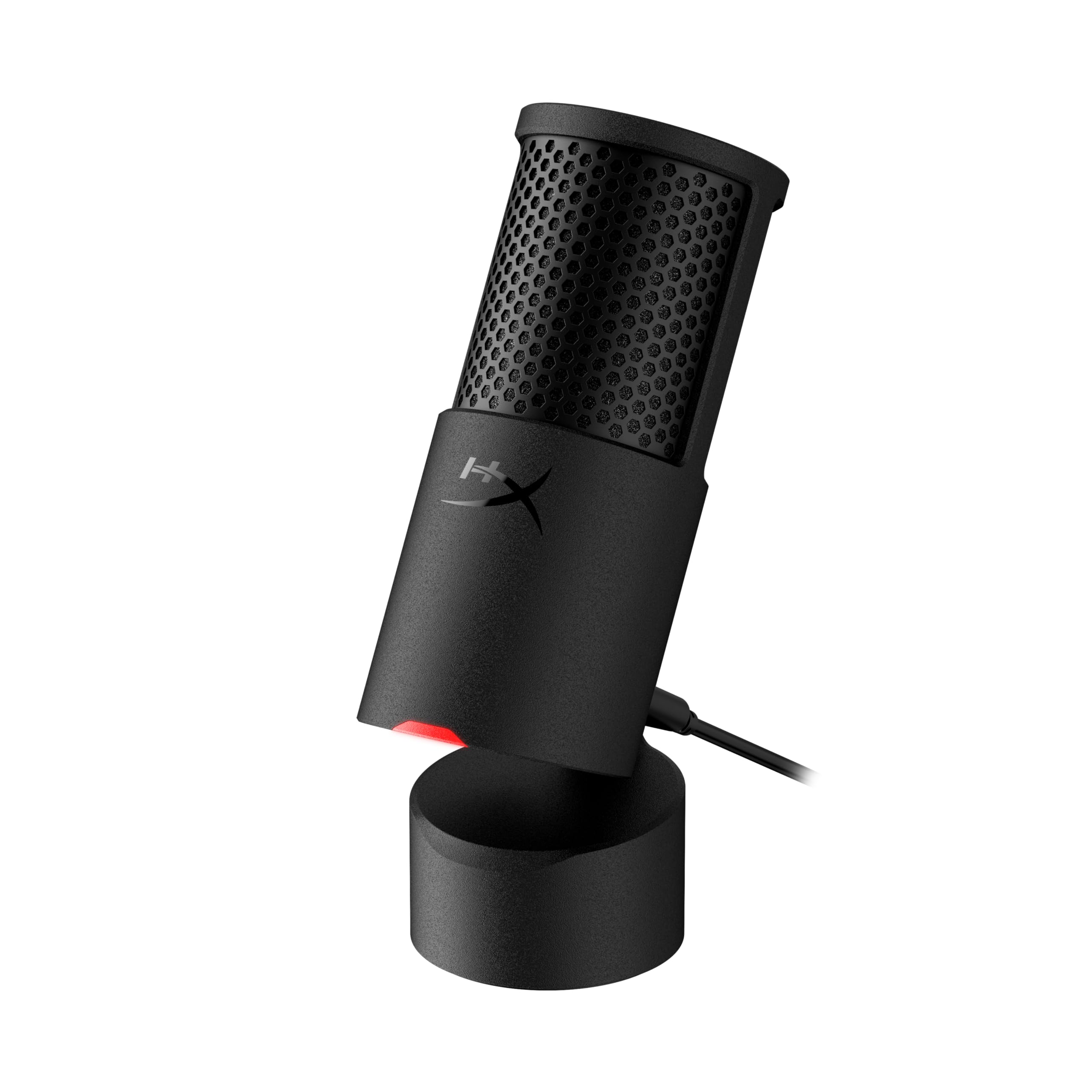
The HyperX SoloCast 2 punches well above its price class by offering 24-bit / 96kHz studio-quality capture in a compact, tiltable desktop body. Its built-in suspension system acts as an internal shock mount, reducing vibrations from desk bumps without requiring external hardware. The integrated foam pop filter minimizes plosive sounds straight out of the box — no accessories needed.
Tap-to-mute with a clear red LED indicator (lit when live, off when muted) gives instant visual confirmation. The cardioid polar pattern focuses on front-address vocal capture while rejecting side and rear noise effectively for a budget mic. The weighted base keeps the mic stable, and the built-in 3/8″ and 5/8″ threads allow easy mounting to a boom arm when you want to upgrade your setup.
The USB-C connection on the lower back can be insecure if the cable is jostled — a boom arm with cable management solves this. It lacks an onboard gain knob, so sensitivity adjustments require software. For the budget-conscious gamer who wants high sample rate capture and a clean, simple design, the SoloCast 2 is the standout value pick.
Why it’s great
- 24-bit / 96kHz capture rivals mics costing twice as much
- Built-in internal shock mount and foam pop filter included
- Tap-to-mute with clear LED indicator
Good to know
- No onboard gain control — must adjust in software
- USB-C rear port can unplug with movement
- Sensitive — picks up keyboard and fan noise in quiet rooms
FAQ
Does a cardioid mic actually block keyboard noise during gaming?
Is 24-bit 96kHz necessary for gaming or streaming?
Can I use an XLR mic with my PC without an audio interface?
Why does my mic sound muffled even with a good gaming mic?
Does a boom arm improve audio quality compared to a desk stand?
Final Thoughts: The Verdict
For most users, the best gaming mic for pc winner is the SteelSeries Alias because it combines a 3x larger capsule with AI noise cancellation specifically tuned for gaming environments — cleaner comms without requiring a treated room. If you want natural voice reproduction without software dependencies, grab the Sennheiser Profile. And for budget-friendly high-sample-rate capture that punches above its tier, nothing beats the HyperX SoloCast 2.