
Staring at a screen that can’t keep up with your reflexes is the fastest way to lose a round before it starts. The wrong gaming monitor introduces ghosting, tearing, and input delay that blunts your competitive edge, while the right one makes every frame feel like a direct extension of your nervous system. With the sub-$700 price bracket now home to stunning QD-OLED panels, blistering 360Hz refresh rates, and versatile dual-mode 4K/FHD displays, choosing poorly costs more than money—it costs wins.
I’m Mohammad Maruf — the founder and writer behind Drink4Good. I’ve spent countless hours analyzing panel technologies, refresh rate behavior, response time consistency, color gamut coverage, and HDR performance across the current gaming monitor landscape to identify the models that deliver genuine competitive and visual advantages under the $700 threshold.
This guide cuts through the marketing noise to recommend the absolute best gaming monitor under $700 for every play style, from esports domination and immersive 4K AAA adventures to color-critical creative work.
How To Choose The Best Gaming Monitor Under $700
The $700 ceiling unlocks near-flagship performance: 1440p OLEDs with 360Hz, 4K IPS panels with dual-mode switching, and vibrant QD-OLED panels with true HDR. To navigate this crowded field, focus on the specs that directly impact your gameplay and visual experience rather than marketing fluff.
Panel Technology: OLED vs. Fast IPS vs. VA
OLED and QD-OLED panels deliver per-pixel lighting, infinite contrast ratios, and response times as low as 0.03ms—making motion look impossibly clear. Their weakness is lower sustained brightness in HDR and a theoretical burn-in risk, though modern OLED Care features and 3-year warranties from brands like ASUS and Alienware mitigate this. Fast IPS panels, like those found in the LG 27G810A-B, offer high brightness, no burn-in worry, and excellent color accuracy, but their contrast ratio maxes out around 1000:1. Under $700, avoid standard VA panels for competitive gaming due to slower pixel transitions that cause visible dark-level smearing.
Refresh Rate, Response Time, and Resolution Balance
No single monitor under $700 does 4K at a true 240Hz+. The solution is dual-mode (DFR) technology: a 4K 160Hz panel that can downscale to 1080p at 320Hz at the press of a button. This gives you pristine clarity for story-driven titles and esports-level speed for shooters on one screen. For pure competitive gamers, a 1440p 360Hz OLED like the Samsung G6 or MSI MPG 271QRX offers the ideal balance of sharpness and fluidity—360Hz motion is visibly smoother than 240Hz, especially in fast-paced tracking scenarios. Response time below 1ms GTG is table stakes; OLEDs at 0.03ms GTG leave IPS panels (1-0.5ms) behind in perceived clarity.
Connectivity: HDMI 2.1, DSC, and VRR
To hit the maximum refresh rate at 4K or even 1440p, HDMI 2.1 (48Gbps) or DisplayPort 1.4 with Display Stream Compression (DSC) is mandatory. Many monitors, including the Samsung G6, use DSC on DisplayPort to achieve 360Hz at 1440p—this introduces a 1-2 second black screen when alt-tabbing, a trade-off to know. For console gamers (PS5, Xbox Series X), HDMI 2.1 is non-negotiable for 4K/120Hz HDR. Variable Refresh Rate (VRR) via FreeSync Premium Pro or G-Sync Compatible certification ensures tear-free gameplay; OLEDs can exhibit visible flicker with VRR at low frame rates, so check user reports on a specific model.
Quick Comparison
On smaller screens, swipe sideways to see the full table.
| Model | Category | Best For | Key Spec | Amazon |
|---|---|---|---|---|
| Samsung Odyssey G6 G60SD | QD-OLED | 360Hz competitive FPS | 360Hz / 0.03ms / QHD | Amazon |
| Alienware AW2725DF | QD-OLED | 360Hz premium build | 360Hz / 0.03ms / QHD | Amazon |
| MSI MPG 271QRX | QD-OLED | 360Hz gaming & productivity | 360Hz / 0.03ms / QHD | Amazon |
| ASUS ROG Strix XG27AQDMG | WOLED | Glossy OLED for single-player | 240Hz / 0.03ms / QHD | Amazon |
| LG 27GS93QE | WOLED | Bright room OLED gaming | 240Hz / 0.03ms / QHD | Amazon |
| LG 27G810A-B | Fast IPS | Dual-mode 4K/FHD gaming | 180Hz 4K/360Hz FHD | Amazon |
| ASUS ROG Strix XG32UCG | Fast IPS | 32-inch 4K dual-mode | 160Hz 4K/320Hz FHD | Amazon |
| AOC Agon PRO AG276QZD2 | QD-OLED | Entry-level QD-OLED | 240Hz / 0.03ms / QHD | Amazon |
| KTC H27P22S | Fast IPS | Budget-friendly 4K gaming | 160Hz / 1ms / 4K | Amazon |
| Acer Nitro VG270K | Fast IPS | Entry-level 4K/320Hz DFR | 160Hz 4K/320Hz FHD | Amazon |
| KOORUI G2741L | Fast IPS | Budget dual-mode 4K | 160Hz 4K/320Hz FHD | Amazon |
In‑Depth Reviews
1. Samsung Odyssey OLED G6 G60SD

The Samsung Odyssey G6 G60SD is a 27-inch QD-OLED with a 360Hz refresh rate and a 0.03ms GTG response time, making it one of the fastest consumer panels available. Its QD-OLED technology delivers a 1,000,000:1 contrast ratio with zero light bleed, and the 99% DCI-P3 color gamut ensures vibrant, saturated visuals out of the box. Samsung’s Dynamic Cooling System uses a pulsating heat pipe to dissipate heat five times better than graphite sheets, actively reducing burn-in risk during long sessions.
In competitive titles like Call of Duty and Valorant, the 360Hz refresh rate provides a tangible upgrade over 240Hz—motion is so fluid that tracking fast-moving opponents feels effortless. The Glare Free coating significantly reduces reflections in bright rooms, a real advantage over glossy QD-OLED panels. However, the monitor requires DisplayPort DSC to hit 360Hz at 1440p, which triggers a brief black screen (1-2 seconds) when alt-tabbing—a known annoyance users should expect.
Build quality is excellent with a slim 3.9mm profile, and the stand offers height, tilt, and swivel adjustment. The on-board OSD includes Black Equalizer for lifting dark areas without washing out highlights. Color accuracy is strong enough for light creative work, though calibration out of the box leans slightly vibrant. The 3-year warranty covers burn-in, providing long-term confidence.
Why it’s great
- 360Hz refresh rate with 0.03ms response for unmatched motion clarity in competitive games
- Dynamic Cooling System reduces burn-in risk with active heat pipe technology
- Glare Free QD-OLED coating maintains deep blacks even in bright room lighting
- 3-year burn-in warranty and robust OLED Care suite (logo dimming, pixel shift)
Good to know
- Requires DSC on DisplayPort for 360Hz, causing a brief black screen on alt-tab
- HDMI 2.1 port is actually limited to HDMI 2.0 bandwidth (18Gbps), not true 48Gbps
- Brightness in HDR mode (250 nits typical) is lower than premium Mini-LED IPS panels
- Text clarity is slightly reduced due to QD-OLED subpixel layout
2. Alienware AW2725DF

The Alienware AW2725DF is a 26.7-inch QD-OLED panel with a 360Hz refresh rate and a 0.03ms GTG response time, designed as a direct competitor to the Samsung G6. It features an identical 2560×1440 QHD resolution and VESA DisplayHDR True Black 400 certification, ensuring deep blacks and bright highlights simultaneously. Color coverage hits 99.3% DCI-P3 with factory Delta E<2 accuracy, making it one of the most color-accurate gaming monitors under $700.
Motion handling on the AW2725DF is exceptional; the combination of 360Hz refresh and near-instant pixel response eliminates virtually all motion blur. The monitor includes AMD FreeSync Premium Pro and VESA AdaptiveSync certification, and user reports confirm G-Sync Compatibility works without issue across NVIDIA GPUs. The included HDR Peak 1000 mode boosts brightness significantly above the standard True Black 400 mode for supported content, providing a more impactful HDR experience than the Samsung G6’s typical brightness ceiling.
Build quality feels premium with a solid metal stand offering height, tilt, swivel, and pivot adjustment. The rear I/O includes 2x HDMI 2.1, 1x DisplayPort 1.4 with DSC, and a USB 3.2 Gen1 hub. Alienware includes a 3-year burn-in warranty directly from Dell, matching Samsung’s coverage. The main trade-off is the glossy QD-OLED coating that can exhibit a faint purple tint under direct light and collects fingerprints easily; a microfibre cloth is included to manage this. The periodic pixel refresh cycle runs automatically every four hours of cumulative use.
Why it’s great
- Factory color calibration with Delta E<2 accuracy and 99.3% DCI-P3 coverage
- HDR Peak 1000 mode delivers higher sustained brightness than standard True Black 400
- Full ergonomic stand with height, tilt, swivel, and pivot adjustments
- 3-year burn-in warranty and automatic pixel refresh for long-term reliability
Good to know
- Glossy QD-OLED coating shows purple tint in direct light and collects fingerprints
- Requires DSC for 360Hz at 1440p, causing brief black screen on alt-tab
- Text clarity and readability are not as sharp as a high-PPI IPS panel for productivity
- Stand is large and takes up significant desk depth
3. MSI MPG 271QRX QD-OLED

The MSI MPG 271QRX combines a 27-inch QD-OLED panel with a 360Hz refresh rate and 0.03ms GTG response time, positioning it as a direct alternative to the Samsung G6 and Alienware AW2725DF. MSI rates the panel for a 1,000,000:1 contrast ratio and VESA DisplayHDR True Black 400, with Delta E≤2 factory calibration for color-critical use. The monitor includes a full HDMI 2.1 port with 48Gbps bandwidth, enabling 4K/120Hz console gaming without compression artifacts.
In-game performance is virtually indistinguishable from the Alienware or Samsung in motion clarity—360Hz eliminates blurring completely at competitive frame rates. MSI’s Gaming Intelligence app allows for per-game profile switching via software, a feature missing from Samsung’s OSD-only approach. The KVM switch is a standout for mixed productivity and gaming setups, allowing keyboard and mouse control across two devices from the single monitor connection. Text clarity is slightly better than older QD-OLEDs due to MSI’s ClearType optimization, though high-PPI IPS panels still lead for spreadsheet-heavy work.
The stand offers height, tilt, and swivel adjustment but has a relatively large footprint. MSI OLED Care 2.0 includes pixel shift, panel refresh, and static image detection to mitigate burn-in. User feedback confirms the panel firmware has been updated to address HDR washout issues, making the HDR experience punchy and accurate with appropriate content. The maximum SDR brightness sits around 250 nits, which can feel subdued compared to high-end IPS panels in very bright rooms.
Why it’s great
- Native HDMI 2.1 (48Gbps) for uncompressed 4K/120Hz console gaming
- Built-in KVM switch for seamless multi-device productivity
- Delta E≤2 factory calibration for accurate color out of the box
- Gaming Intelligence software for per-game profile switching
Good to know
- Sustained SDR brightness (~250 nits) is modest compared to premium Fast IPS panels
- Large stand base consumes significant desk real estate
- QD-OLED text clarity still trails high-PPI IPS for intensive productivity work
- Requires periodic panel refresh cycles that can take several minutes
4. ASUS ROG Strix XG27AQDMG

The ASUS ROG Strix XG27AQDMG is a 26.5-inch WOLED gaming monitor with a native 240Hz refresh rate and 0.03ms GTG response time. Unlike QD-OLED panels, its glossy WOLED coating delivers pure black levels with zero purple tint in any lighting condition, making it the best choice for dark-room single-player gaming. ASUS includes a custom heatsink and advanced airflow design that keeps the panel temperature low, reducing burn-in risk and enabling higher sustained brightness than passive-cooled OLED monitors.
Color accuracy is excellent with 99% DCI-P3 coverage and factory calibration. The glossy finish means on-screen images look incredibly vibrant and three-dimensional, but it also reflects direct light more strongly than matte alternatives. The OLED Anti-flicker technology effectively reduces the flicker that some OLEDs exhibit during frame rate fluctuations, solving a common complaint with VRR on OLED panels. The uniform brightness setting is useful for productivity tasks where consistent luminance across the screen matters.
The monitor ships with a 3-year warranty that includes burn-in coverage, giving confidence that matches the Samsung and Alienware offerings. The stand supports height, tilt, and swivel adjustments. The on-screen DisplayWidget Center allows settings changes via mouse, a convenience feature missing from many competitors. Peak HDR brightness is lower than the best QD-OLED implementations (around 400 nits), but the infinite contrast makes HDR content look superb. The lack of internal speakers means you need external audio.
Why it’s great
- Glossy WOLED with true black levels and no purple tint in bright light
- Custom heatsink and advanced airflow for higher sustained brightness and reduced burn-in risk
- OLED Anti-flicker technology minimizes VRR flicker during frame rate changes
- 3-year warranty with burn-in coverage and DisplayWidget Center software
Good to know
- Glossy finish reflects direct light strongly, not ideal for bright, uncontrolled rooms
- Peak HDR brightness (~400 nits) is lower than premium QD-OLED Peak 1000 modes
- No built-in speakers require external audio solution
- Stand allows limited height adjustment range compared to premium competitors
5. LG 27GS93QE UltraGear OLED
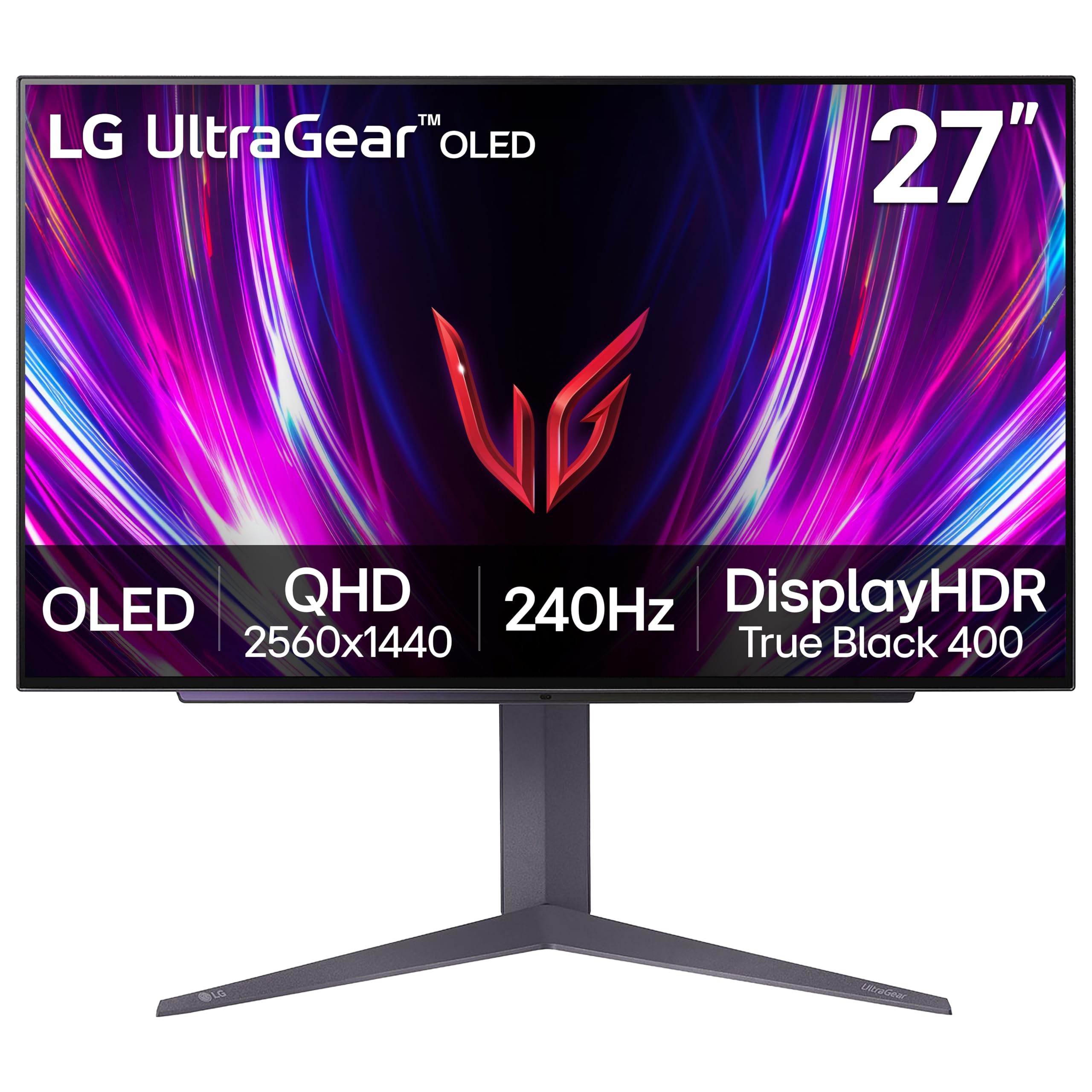
The LG 27GS93QE is a 27-inch WOLED gaming monitor with a 240Hz refresh rate and 0.03ms GTG response time. Its WOLED panel delivers the same per-pixel lighting and infinite contrast as QD-OLED, but with a matte anti-reflection coating that minimizes glare in bright rooms—making it the most practical OLED for mixed-use environments. VESA DisplayHDR True Black 400 certification confirms deep black performance with bright highlights, and the 1.5M:1 contrast ratio ensures no light bleed in dark scenes.
Color accuracy covers 98.5% DCI-P3 out of the box, and the anti-glare coating is near-glossy in clarity, avoiding the graininess that plagued older matte OLED panels. User feedback consistently praises the plug-and-play color performance with no need for calibration. The monitor includes AMD FreeSync Premium Pro and is G-Sync Compatible, providing tear-free gameplay across both GPU ecosystems. The 2-year UltraGear OLED warranty includes the OLED display panel, providing coverage peace of mind.
The stand offers height, tilt, swivel, and pivot adjustments with a stable base. LG includes a slim remote control for navigating the OSD, a thoughtful inclusion. The monitor runs a periodic pixel cleaning routine and supports Dynamic Action Sync and Black Stabilizer for competitive gaming. One caveat: some users report a quiet but audible fan inside the unit, which could be a concern in a dead-silent room. Peak brightness is moderate for HDR, but the deep blacks make the overall HDR experience immersive.
Why it’s great
- Matte anti-glare WOLED with near-glossy clarity and minimal reflections in bright rooms
- 98.5% DCI-P3 color coverage with excellent out-of-box accuracy
- Full ergonomic stand with height, tilt, swivel, and pivot adjustments
- Includes remote control for OSD navigation and 2-year OLED panel warranty
Good to know
- Internal cooling fan produces quiet but audible noise in silent rooms
- Peak HDR brightness is moderate; not suitable for very bright living room setups
- Requires periodic pixel cleaning cycles that can disrupt workflow
- SDR brightness may feel limited compared to high-end IPS alternatives
6. LG 27G810A-B UltraGear
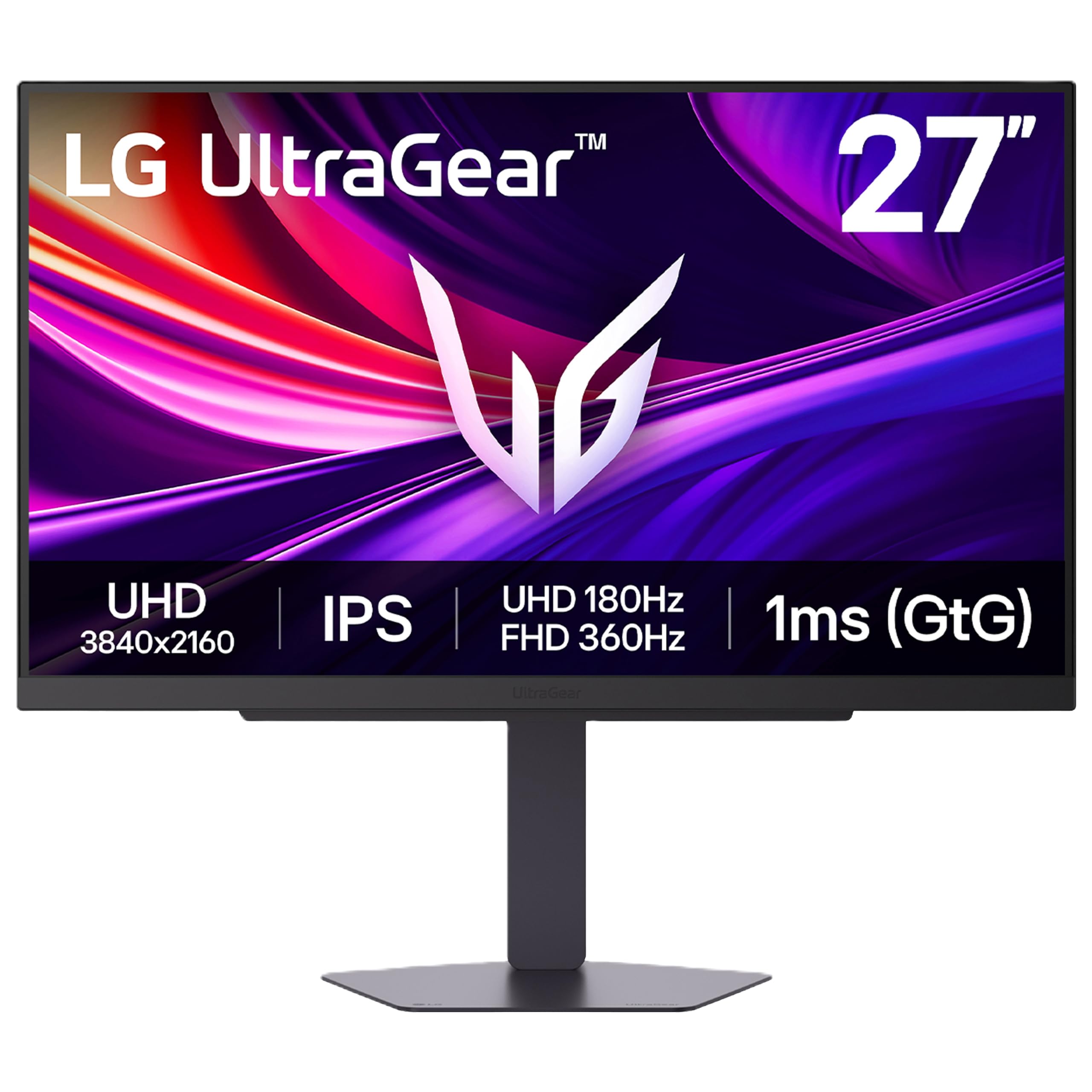
The LG 27G810A-B is a 27-inch Fast IPS monitor with a native 4K UHD (3840×2160) resolution and a dual-mode feature that switches between 4K at 180Hz and Full HD at 360Hz via a hotkey. This makes it arguably the most versatile monitor under $700, serving both story-driven 4K gaming and competitive FPS players in a single device. The IPS panel delivers 95% DCI-P3 color coverage with VESA DisplayHDR 400 certification, providing bright, vibrant visuals with no burn-in worry.
In 4K 180Hz mode, the monitor offers stunning clarity and fluidity for AAA titles like Cyberpunk 2077 and Red Dead Redemption 2. Switching to 360Hz Full HD mode provides the speed needed for esports, though the lower resolution on a 27-inch screen means pixel density drops to 81 PPI—still perfectly playable for competitive gaming. The 1ms GTG response time ensures minimal ghosting, though OLED panels still lead in motion clarity at 0.03ms. The Dynamic Action Sync reduces input lag further, making the monitor feel snappy in all modes.
Build quality is robust with a stable stand supporting height, tilt, swivel, and pivot adjustments. Connectivity includes 2x HDMI 2.1 and 1x DisplayPort 1.4, supporting the full 4K 180Hz bandwidth on compatible GPUs. The Black Stabilizer lifts shadows without washing out highlights, useful for spotting enemies in dark corners. Some users report a quiet fan; it’s not disruptive but exists. The monitor is also an excellent choice for Mac users who need 4K clarity for productivity alongside high-refresh gaming on a Windows PC.
Why it’s great
- Dual-mode (4K 180Hz / FHD 360Hz) covers both AAA and competitive gaming perfectly
- No burn-in risk inherent to IPS technology, suitable for mixed productivity and gaming
- 95% DCI-P3 with DisplayHDR 400 for bright, vibrant colors and good contrast
- Full ergonomic stand and 2x HDMI 2.1 ports for multi-device setups
Good to know
- Native contrast ratio (1000:1) cannot match OLED’s infinite blacks
- Quiet internal fan present; may be audible in silent rooms
- 360Hz mode is 1080p; some users may notice lower pixel density in desktop use
- Not ideal for absolute competitive esports due to 1ms GTG vs. 0.03ms OLED response
7. ASUS ROG Strix XG32UCG
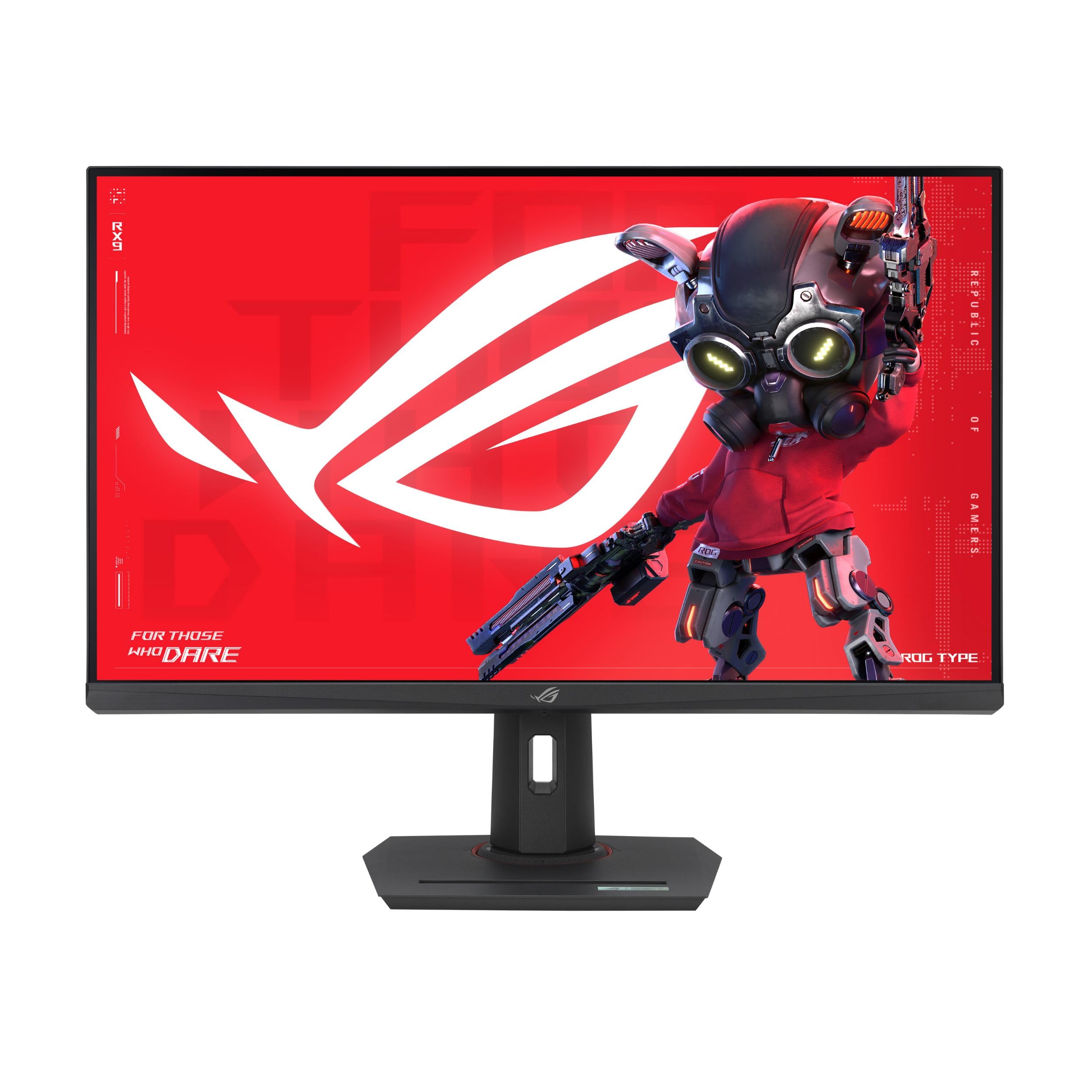
The ASUS ROG Strix XG32UCG is a 32-inch Fast IPS gaming monitor with 4K (3840×2160) resolution and a dual-mode feature that operates at 4K 160Hz or Full HD 320Hz. This gives you the largest usable screen size in this guide while maintaining high refresh rates for both immersive and competitive gaming. The 0.3ms minimum response time (MPRT) claims are aggressive, though real-world GTG performance sits around 1ms—still excellent for IPS technology.
Color accuracy is strong with 95% DCI-P3 coverage and ASUS advanced gray-scale tracking for smooth color gradation. The Extreme Low Motion Blur Sync (ELMB SYNC) technology allows backlight strobing alongside VRR, reducing perceived motion blur without sacrificing tear-free gameplay. The 32-inch size makes 4K content feel truly cinematic, and the semi-gloss screen finish strikes a good balance between glare resistance and image depth. The included DisplayWidget Center software allows OSD adjustments via mouse.
Connectivity is comprehensive with 2x HDMI 2.1, 1x DisplayPort 1.4, and a USB Type-C port with DP Alt Mode. The built-in tripod socket is a unique addition for streamers who mount a camera above the monitor. The stand supports height, tilt, and swivel adjustments. User feedback is overwhelmingly positive, with many noting the screen is a fantastic alternative to OLED for those who prefer larger sizes and don’t want to worry about burn-in. HDR performance is good for an IPS panel but cannot match OLED’s per-pixel lighting.
Why it’s great
- 32-inch screen provides the largest viewing area of any monitor in this guide
- Dual-mode 4K 160Hz / FHD 320Hz with ELMB SYNC for blur reduction and VRR
- USB-C with DP Alt Mode for single-cable laptop connection
- Unique tripod socket for streamers and creators
Good to know
- Large 32-inch size may not fit smaller desk setups or close viewing distances
- IPS contrast ratio (1000:1) cannot match OLED’s deep blacks for HDR content
- 0.3ms MPRT is not real-world GTG; real response is closer to 1ms GTG
- Weight and footprint are substantial; a sturdy desk is recommended
8. AOC Agon PRO AG276QZD2

The AOC Agon PRO AG276QZD2 is a 26.5-inch QD-OLED gaming monitor with a 240Hz refresh rate and 0.03ms GTG response time, offering a more accessible entry point to OLED gaming compared to the 360Hz flagships. It delivers the same infinite contrast, 1500000:1 typical rating, and 101% DCI-P3 color coverage as more expensive QD-OLED models, making it a strong choice for gamers who prioritize visual fidelity over raw competitive refresh rate.
In single-player titles, the AG276QZD2 produces stunning images with deep blacks and vibrant highlights. The 240Hz refresh rate is still extremely smooth for competitive gaming, and the difference from 360Hz is noticeable primarily to esports professionals or players sensitive to micro-stutter. The built-in speakers are a convenience feature, though audio quality is modest—external speakers or headphones are recommended for an immersive experience. The stand provides height and tilt adjustment but is less stable than premium competitors, with some wobble reported in user feedback.
The monitor includes G-Sync Compatible certification and supports FreeSync Premium Pro. AOC’s Shadow Control adjusts dark area visibility without affecting overall image balance. The OSD is simple but functional, and the included calibration report confirms factory color accuracy. The 240Hz refresh rate is slightly more forgiving on GPU requirements than 360Hz, making this a practical choice for mid-to-high-end GPU builds. The lack of USB-C connectivity and a limited ergonomic stand are the main compromises vs. premium-priced OLEDs.
Why it’s great
- Best value QD-OLED under $700 with infinite contrast and 101% DCI-P3
- 240Hz / 0.03ms delivers excellent motion clarity for all but the most competitive players
- Factory calibration report included for verified color accuracy
- Built-in speakers provide basic audio without external setup
Good to know
- Stand is wobbly and has limited adjustment range compared to premium OLEDs
- No USB-C input for single-cable laptop connectivity
- Built-in speakers are low quality; external audio strongly recommended
- 240Hz max refresh rate means you cannot unlock 360Hz or dual-mode for competitive edge
9. KTC H27P22S

The KTC H27P22S is a 27-inch Fast IPS gaming monitor with a native 4K UHD (3840×2160) resolution and a 160Hz refresh rate. It uses an IPS panel with 400 cd/m² brightness, HDR400 certification, and 132% sRGB color coverage. At its price point, it offers dual HDMI 2.1 ports and a DisplayPort 1.4, along with a fully adjustable stand (height, tilt, pivot, swivel) that competes with monitors in higher price tiers.
The 1ms GTG response time is adequate for casual and semi-competitive gaming, though it cannot match the blur-free motion of OLED or 240Hz+ panels. The KTC panel is G-Sync Compatible and supports FreeSync Premium, providing tear-free gameplay across GPU ecosystems. User reviews highlight the excellent value proposition, with many noting the picture quality, easy setup, and responsive customer support for warranty exchanges. The monitor does not include built-in speakers, so external audio is required.
The adjustable stand is a strong feature at this price level, allowing comfortable ergonomic positioning. The anti-glare coating reduces reflections in bright rooms effectively. Color accuracy out of the box is decent for gaming, though professional-grade creative work would benefit from calibration. On the downside, peak brightness at 350-400 nits is solid for an IPS panel, but HDR performance is limited by the 1000:1 contrast ratio—HDR content lacks the punch of OLED or high-end Mini-LED displays.
Why it’s great
- 4K 160Hz Fast IPS with fully adjustable stand at a very competitive price point
- Dual HDMI 2.1 and DisplayPort 1.4 for broad device compatibility
- G-Sync Compatible and FreeSync Premium for tear-free gaming on any GPU
- Responsive customer support reported for warranty exchanges
Good to know
- HDR performance is limited by 1000:1 IPS contrast; lacks OLED’s black levels
- No built-in speakers; external audio is necessary
- Response time (1ms GTG) not as clear as 0.03ms OLED alternatives
- Color accuracy out of box good for gaming but not calibrated for professional creative work
10. Acer Nitro VG270K

The Acer Nitro VG270K is a 27-inch IPS gaming monitor offering dual-mode functionality: 4K UHD at 160Hz or Full HD at 320Hz. This feature, typically found on more expensive monitors, makes the VG270K one of the most affordable ways to access both high-resolution and high-refresh rate gaming on a single screen. The IPS panel covers 90% DCI-P3 and supports HDR10, providing colorful visuals with decent brightness for an entry-level display.
In practice, the 4K 160Hz mode delivers excellent clarity for modern AAA games, while the 320Hz FHD mode offers genuine speed for competitive shooters. The 0.5ms to 1ms GTG response time keeps motion relatively smooth, though not as crisp as higher-end IPS or OLED panels. AMD FreeSync Premium is included, ensuring tear-free gameplay on compatible GPUs. The ZeroFrame design with minimal bezels is ideal for multi-monitor setups, and the built-in speakers, while weak, provide basic audio for desktop use without external speakers.
Build quality feels solid for the price, and the stand offers tilt adjustment but no height or swivel functionality—a compromise at this price point. User feedback highlights strong overall value and good image quality, though a small minority report reliability issues with HDMI ports after extended use. The lack of a full ergonomic stand and the omission of G-Sync hardware compatibility are the main drawbacks. For budget-conscious gamers who want dual-mode flexibility, the VG270K delivers core performance without the premium OLED cost.
Why it’s great
- Dual-mode 4K 160Hz / FHD 320Hz at the lowest price point available
- AMD FreeSync Premium for smooth, tear-free gameplay
- ZeroFrame bezel design ideal for multi-monitor setups
- Built-in speakers provide basic desktop audio
Good to know
- Stand only offers tilt adjustment; no height, swivel, or pivot
- HDR performance is limited to HDR10 certification; lacks DisplayHDR 400 brightness
- Response time (0.5-1ms GTG) is good for IPS but cannot match OLED’s motion clarity
- Some user feedback reports reliability concerns with HDMI ports over long-term use
11. KOORUI G2741L
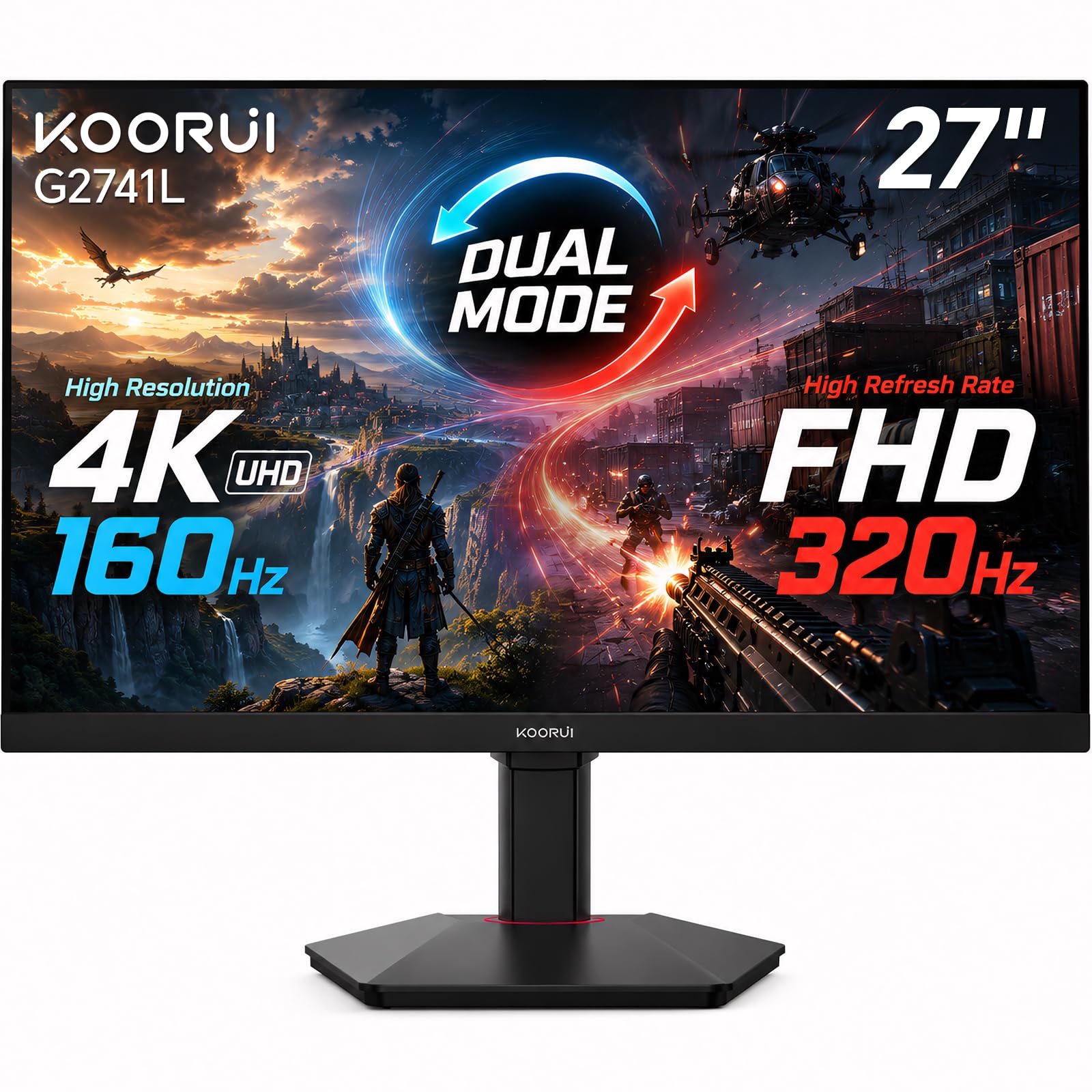
The KOORUI G2741L is a 27-inch Fast IPS gaming monitor with a dual-mode feature: 4K UHD at 160Hz or Full HD at 320Hz. It is functionally very similar to the Acer VG270K but is positioned as the most budget-friendly dual-mode option in this guide. The panel delivers 95% DCI-P3 color coverage, 350 cd/m² brightness, and support for Adaptive Sync (FreeSync and G-Sync Compatible). The adjustable stand includes height, tilt, and pivot adjustments—a surprising spec at this price tier.
The dual-mode functionality allows you to game at 4K for immersive AAA titles and switch to 320Hz for esports at the press of a button. The 1ms GTG response time is adequate for most gamers, though the monitor does not support HDR beyond basic compatibility—HDR content will not produce the visual impact of certified HDR displays. Build quality is decent, with the stand providing better ergonomics than the Acer VG270K. Eye-care features including low blue light and flicker-free backlight are included for extended sessions.
User feedback is mixed: many praise the value and image quality, while a smaller subset report reliability issues including dead pixels and vertical line defects after limited use. Customer support responsiveness varies. The KOORUI G2741L is a compelling option if you need dual-mode functionality on a tight budget, but the reliability risk should be weighed against more established brands. It lacks built-in speakers and has no VESA DisplayHDR certification, two areas where the Acer holds an advantage.
Why it’s great
- Dual-mode 4K 160Hz / FHD 320Hz at the lowest entry price available
- Fully adjustable stand with height, tilt, and pivot—rare at this price point
- 95% DCI-P3 color coverage for a budget panel
- FreeSync and G-Sync Compatible for smooth gaming on both GPU ecosystems
Good to know
- No VESA DisplayHDR certification; HDR content looks flat
- Reliability concerns reported by some users, including dead pixels and vertical lines
- No built-in speakers require external audio solution
- Long-term reliability and support reputation not as established as Acer, LG, or ASUS
FAQ
Is 360Hz OLED worth it over 240Hz OLED for competitive FPS gaming?
What GPU do I need to run a 4K 160Hz or 360Hz QHD gaming monitor?
Does OLED burn-in still happen on modern monitors under $700?
Can I use a 1440p 360Hz OLED for productivity and software development?
What is the difference between G-Sync Compatible and true G-Sync?
Final Thoughts: The Verdict
For most users, the gaming monitor under $700 winner is the LG 27G810A-B because its dual-mode 4K 180Hz / FHD 360Hz Fast IPS panel combines spectacular AAA clarity with genuine esports speed, no burn-in worry, and excellent color accuracy for both work and play. If you want the deepest blacks and fastest pixel response for immersive single-player gaming, grab the Samsung Odyssey OLED G6 G60SD for its 360Hz QD-OLED panel and active cooling. And for absolute competitive advantage where every millisecond counts, nothing beats the Alienware AW2725DF with its factory-calibrated 360Hz QD-OLED, class-leading color accuracy, and comprehensive 3-year burn-in warranty.