
Scrolling through a list of radios while standing in a dusty garage, where concrete floors and metal toolboxes kill sound quality and a single drop of oil can ruin a speaker—that is the real shopping context you need.
I’m Mohammad Maruf — the founder and writer behind Drink4Good. This guide is built from many hours of cross-referencing decibel outputs, battery platform compatibility, ingress protection ratings, and real-user noise-floor complaints to separate legit jobsite performers from fragile shelf units.
Whether you are tuning into AM talk radio or streaming a long playlist from your phone, the right garage radio should survive dust, drops, and long hours without sacrificing sound clarity or runtime.
How To Choose The Best Garage Radio
A garage radio lives in a unique environment: fluctuating temperatures, airborne sawdust, and hard surfaces that reflect sound. Finding one that lasts means looking past basic speaker specs and focusing on build materials, power source flexibility, and reception quality in a metal-and-concrete box.
Battery Platform Alignment
If you already own power tools from a specific brand, a radio that shares that battery system cuts both cost and clutter. Many job-site radios from Milwaukee, Makita, RYOBI, Metabo HPT, and RIDGID accept their respective 18V or 12V slide packs. A radio tool-only (no battery included) costs less upfront if you already have compatible packs on the shelf. For those starting fresh, a hybrid unit that also runs on AC power offers the most flexibility.
AM/FM Reception vs. Bluetooth Streaming
In a garage, metal studs and concrete walls can muffle FM signals. Look for a radio with a flexible or detachable external antenna—some units have only a stub antenna inside the body, which can limit reception in steel-rich buildings. If you primarily stream from a phone, Bluetooth range and version (Bluetooth 5.0 offers better distance and stability) become more important than radio presets.
Ruggedness and Environmental Resistance
A garage radio faces drops from workbenches, splashes from degreasers, and dust from grinding tools. The JIS4 rain-resistance standard found on models like the Sangean TOUGHBOX indicates a unit can handle water spray from any direction. Rubber shock-blocks, roll-cage frames, and thick ABS plastic enclosures add drop protection. Weight can be a clue—heavier units often have thicker plastic and larger drivers that resist vibration damage.
Quick Comparison
On smaller screens, swipe sideways to see the full table.
| Model | Category | Best For | Key Spec | Amazon |
|---|---|---|---|---|
| Milwaukee 2952-20 | Jobsite | Audiophile Shop Sound | Dual 3.5″ woofers + tweeters | Amazon |
| Sangean BB-100 | Ultra-Rugged | Bluetooth + AM/FM Durability | JIS4 rain/dust/shock resistant | Amazon |
| Sangean TB-100 | Industrial AM/FM | AM Reception & Pure Radio | Roll-cage, 5.25″ speaker | Amazon |
| RIDGID R84089B | Hybrid | Battery/AC Flexibility | ABS enclosure, 9.29 lbs | Amazon |
| Metabo HPT UR18DAQ4 | Compact | Lightweight Portability | 4.1 lbs, 15-level EQ | Amazon |
| Makita RM02 | Compact + Aux | 12V CXT System Users | 30-hour runtime (4.0Ah) | Amazon |
| RYOBI B0CMB5DQN2 | Entry-Level | ONE+ Battery Owners | 175 ft Bluetooth range | Amazon |
In‑Depth Reviews
1. Milwaukee M18 Bluetooth Jobsite Radio
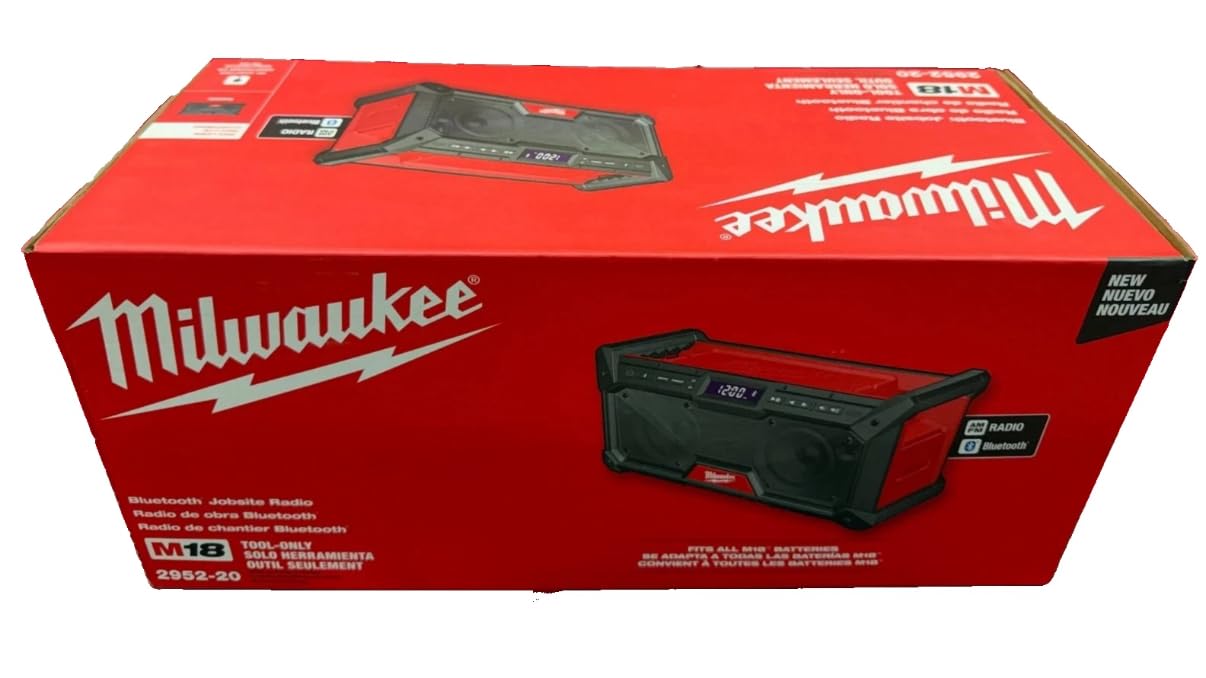
The Milwaukee 2952-20 brings true stereo separation to the garage with its dual 3.5-inch woofers and independent tweeters, producing crisp highs and a balanced midrange that cuts through saw noise without distortion. At 10.8 pounds with a steel-reinforced chassis, it feels dense and planted on a workbench—no rattling or vibration at high volume. Bluetooth 5.0 delivers a full 120 feet of range, so you can leave your phone by the tool chest and still stream uninterrupted.
The unit includes an AC power adapter, but its real strength is integration with the M18 battery ecosystem, giving users who own Milwaukee tools a seamless runtime solution. Users consistently praise the sound clarity for a jobsite radio, noting that the built-in equalizer responds well to phone-based tuning apps. The LED display is bright enough to read in direct sunlight, a practical touch for a garage window sill or work cart.
A small number of early units showed a popping noise at high gain, but minor speaker break-in traces resolved in the most recent production run. The handle is solid and the rubberized base prevents sliding on oily surfaces. If your garage doubles as a workshop where sound quality matters every day, this is the unit that balances durability with genuinely good audio.
Why it’s great
- Dual-driver stereo design with dedicated tweeters for clear highs
- Steel-reinforced body and rubber base handle shop vibration well
- Full 120-ft Bluetooth 5.0 range keeps streaming stable from across a garage
Good to know
- Does not include an M18 battery; requires existing or separate purchase
- Some early units had intermittent popping noise at high volume
- At 10.8 lbs, it is heavier than compact competitors
2. Sangean BB-100 BlueBox

The Sangean BB-100 builds on the TOUGHBOX DNA and adds Bluetooth streaming, giving you both AM/FM radio and phone-based audio in a single rugged package. Its 5.25-inch water-resistant speaker pumps out surprisingly deep bass for a jobsite unit—some describe it as bass-heavy, which works well in a garage where concrete floors absorb low frequencies. The roll-cage plastic shell and rubberized feet meet JIS4 rain-resistance standards, so a splash from a hose or a drizzle through an open bay door does not end the session.
FM reception benefits from a flexible external antenna, while the internal AM ferrite bar pulls in distant stations even in metal-sided buildings. Bluetooth pairing is near-instant with iOS and Android devices, and the LCD display shows station info clearly. The built-in charger handles four rechargeable C cells, which users report lasting through multiple full-day sessions without needing a swap.
The single-speaker design means no true stereo separation—mids and highs can sound slightly masked at maximum volume. In a quiet home garage for hobby work, the bass-forward tuning is pleasant rather than overwhelming. For anyone who wants a do-it-all radio that streams, resists weather, and never sits on a charger platform, the BB-100 is a versatile choice.
Why it’s great
- JIS4 rain, dust, and shock resistance handles harsh garage conditions
- Bluetooth pairs instantly and streams reliably from over 30 feet
- Rich, bass-heavy sound from a large 5.25-inch driver
Good to know
- Single speaker means no stereo separation; mids can wash out at high volume
- Only 5 presets per band, which may feel limiting for frequent station-changers
- Requires C batteries when not on AC; rechargeable cells are not included
3. Sangean TB-100 TOUGHBOX

If your garage listening leans toward AM talk radio or FM sports, the Sangean TB-100 foregoes Bluetooth entirely to focus on what matters most: rock-solid radio reception and industrial-grade toughness. The roll-cage frame and rubber shock-blocks protect the internal electronics from drops off a ladder or a workbench. A magnetically shielded 5.25-inch speaker delivers dynamic loudness that fills a two-car garage without distortion at moderate volume.
The TB-100 stores 10 preset stations (5 AM, 5 FM) and uses a digital PLL synthesizer for drift-free tuning. Its built-in battery charger handles C cells while the radio is plugged into AC, so you always have a charged set ready for cordless use. The flexible FM antenna helps pull in stations even when the radio is tucked between tool cabinets, and the AM ferrite bar surprises owners with its range—users report pulling stations from over 140 miles away in daytime conditions.
The trade-off for its reliability is a lack of streaming options; you cannot Bluetooth pair or plug in a USB drive. At nearly 13 inches wide, it takes up more bench space than a compact pod-style radio. But for the garage purist who just wants to flip on the game or catch morning news without menu-diving, the TB-100 is the most rugged pure radio you can buy.
Why it’s great
- Roll-cage and rubber shock-blocks survive real jobsite drops and impacts
- Excellent AM reception range thanks to a tuned ferrite bar antenna
- Built-in C-cell charger keeps batteries topped up when on AC power
Good to know
- No Bluetooth, USB, or auxiliary input limits connectivity options
- Large footprint takes up significant bench or shelf space
- Battery operation above 75% volume can introduce slight distortion
4. RIDGID 18V Hybrid JOBSITE Radio

The RIDGID R84089B is a hybrid-capable jobsite radio that runs on either a standard 18V RIDGID battery or a plugged AC outlet, making it ideal for garages where power tools are already on the RIDGID platform. The ABS plastic enclosure is thick and impact-resistant, and at just under 7.7 inches in each dimension, it occupies a compact cube footprint that slides easily onto a shelf or under a workbench. Users consistently praise the battery life—an 18V pack can last through a full weekend of moderate-volume streaming.
The sound profile is balanced for a single-driver unit, with enough volume to be heard clearly over a running air compressor or a benchtop sander. Bluetooth pairing is straightforward and holds a stable connection across a typical two-car garage. The integrated USB port provides a convenient way to charge a phone or backup battery while you work.
A notable limitation is the lack of an external antenna jack; the radio relies on an internal antenna for FM reception, which results in weaker station pulling in metal-clad garages compared to the Sangean models. The RIDGID also ships as tool only, so first-time buyers need to factor in the cost of a battery and charger. For anyone already invested in the RIDGID 18V system, though, this is a practical, durable daily driver.
Why it’s great
- Hybrid AC and 18V battery operation covers power-outage and corded scenarios
- Compact cube shape stores easily in tight garage corners
- USB charging port keeps devices powered during long work sessions
Good to know
- No external FM antenna; internal antenna struggles in metal garages
- Tool-only—requires separate purchase of RIDGID battery and charger
- Some users find the internal cord overly thin for heavy-duty job site use
5. Metabo HPT UR18DAQ4

Metabo HPT’s UR18DAQ4 tips the scales at just 4.1 pounds, making it the lightest full-featured jobsite radio in this comparison. Despite its weight, it packs a 15-level bass and treble equalizer that lets you dial in the sound to compensate for garage acoustics—boost the bass if your shop is full of absorbent materials, or cut it to reduce muddiness in a small enclosed space. The unit also comes with an AC adapter, so you can use it corded even without a Metabo HPT battery.
Bluetooth streaming works reliably from a phone or tablet up to 30 feet away, and the illuminated LCD display is readable in low-light corners. Nine AM and FM presets let you save your favorite stations without re-tuning. Users note that while the speaker is not the bassiest option, the EQ adjustments provide enough flexibility to make acoustic and talk radio sound natural. The rubberized handle and light frame make it easy to carry from the garage to the driveway or a tailgate.
The main downside is the lack of a pause button on the radio body when streaming; you must use your phone to stop audio, which is inconvenient if the phone is charging across the room. A few users also mention that the FM reception can be finicky in areas with many stations, requiring antenna repositioning. For anyone wanting a portable, lightweight radio with EQ control, this is a strong contender.
Why it’s great
- 15-level bass and treble EQ fine-tunes sound for specific garage environments
- Only 4.1 lbs with a comfortable rubber handle for easy transport
- AC adapter included; no need to buy a battery just to use it corded
Good to know
- No pause/play button for Bluetooth—control must come from the source device
- FM reception requires careful antenna positioning in dense signal areas
- Speaker lacks deep bass compared to larger, heavier competitors
6. Makita RM02 12V CXT Radio
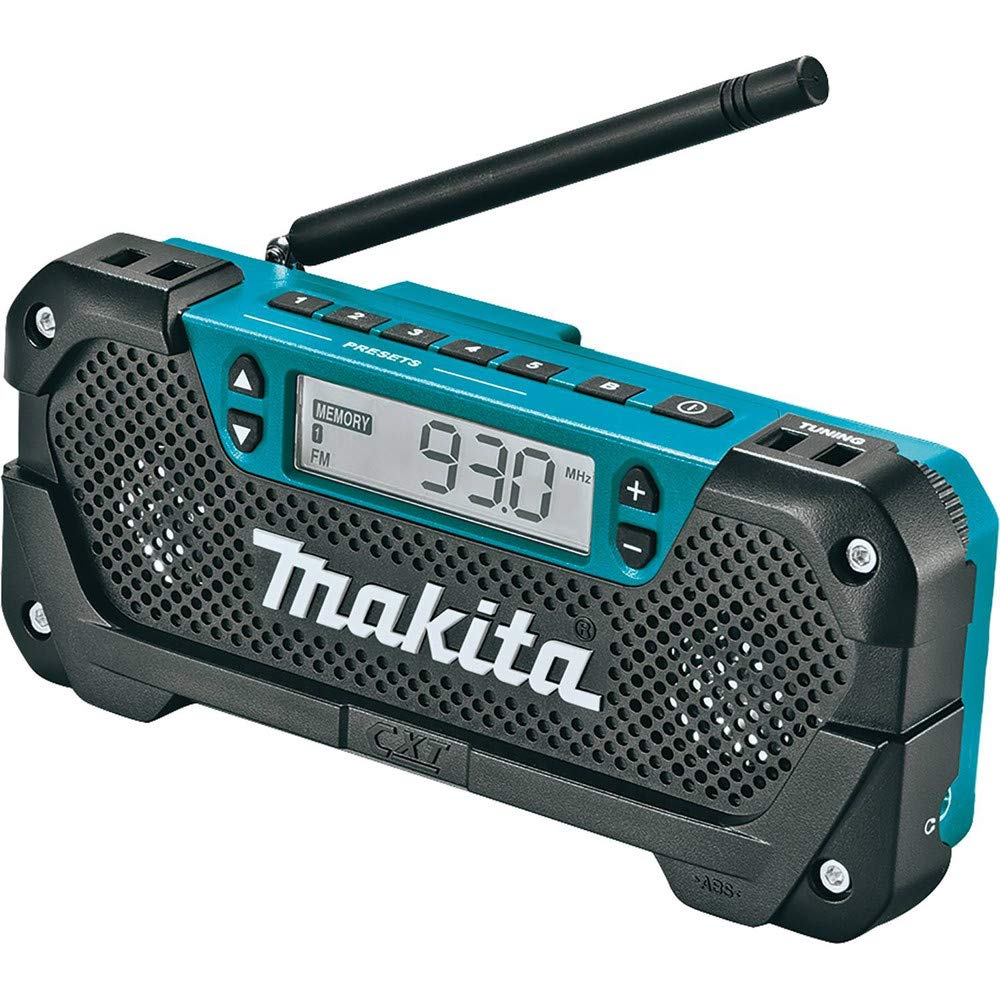
The Makita RM02 operates on the 12V max CXT battery line, a smaller platform than the 18V units, but its efficiency delivers up to 30 hours of continuous use from a 4.0Ah battery. That runtime advantage makes it ideal for light-duty garages or for users who prefer a smaller, less power-hungry radio. Two front-facing speakers produce rich stereo sound for the size, with a clarity that surprises many owners—it sounds like a much larger speaker box. The compact footprint fits on a narrow shelf next to a drill charger or on a windowsill.
Ten preset buttons (FM/AM) allow quick access to favorite stations, and the auxiliary input accepts MP3 players or older smartphones for wired playback. An earphone jack adds privacy for late-night tinkering. The LCD display is simple but readable, and the gray finish hides dust well. Users report that the radio holds up well after years of garage use, with the main complaint being the lack of Bluetooth—streaming requires the aux cord, which is a wired limitation in a wireless era.
The RM02 ships as tool only, so new buyers must budget for a CXT battery and charger. The 12V platform is less common than 18V, so if you do not already own Makita CXT tools, the radio’s battery investment is higher. For existing Makita 12V users, however, this radio pairs perfectly with a compact everyday work setup.
Why it’s great
- 30-hour runtime from a 4.0Ah battery keeps music going for multi-day projects
- Rich stereo sound from two front-facing speakers in a compact frame
- Ten station presets and a simple aux input for quick wired connection
Good to know
- No Bluetooth connectivity; streaming requires a 3.5mm aux cable
- Tool-only; CXT battery and charger sold separately
- 12V platform is less energy-dense than 18V alternatives for volume-heavy listening
7. RYOBI 18V ONE+ Compact Bluetooth Radio

RYOBI’s ONE+ Compact Bluetooth Radio integrates directly into the largest consumer tool battery ecosystem in the US, making it a natural fit for the millions of homeowners and DIYers who already stock 18V batteries. The 3-inch 15W speaker outputs four times the sound clarity of earlier RYOBI radio models, delivering decent mid-range presence for a compact unit. Bluetooth connection range is rated at 175 feet, which gives you the freedom to move around a large garage or property without dropouts. The green-and-black body is lightweight and easily hung on a tool rack hook.
For an entry-level jobsite radio, the sound quality is competent for talk radio and mid-range-heavy music genres. The USB charger on the panel charges devices twice as fast as earlier iterations, a practical detail for keeping a phone topped up during long sessions. Battery life averages 32 hours on a 4.0Ah ONE+ battery, more than enough for a week of weekend projects.
The FM radio reception is the weak spot—some users in urban areas report picking up only one or two stations, and the internal antenna design struggles in garages with metal roofing or siding. Pairing with a smartphone for streaming bypasses that limitation entirely. If your shop already runs on RYOBI tools, this radio is the lowest-friction add-on, but if FM radio performance is critical, you may prefer the Sangean or Milwaukee options.
Why it’s great
- Seamless compatibility with the vast RYOBI ONE+ battery system
- Bluetooth range of 175 feet covers a large garage and yard without signal loss
- USB charging is twice as fast as previous RYOBI radio models
Good to know
- FM reception is weak in metal garages; internal antenna is not user-serviceable
- Sound quality is adequate for talk but lacks bass depth for music
- Does not include a battery; requires ONE+ battery from existing collection
FAQ
Can I use a garage radio without buying a new battery platform?
Why does my FM radio sound fuzzy inside my metal workshop?
Is Bluetooth 5.0 necessary in a garage radio?
How long should a garage radio battery last on a single charge?
Final Thoughts: The Verdict
For most users, the garage radio winner is the Milwaukee 2952-20 because its dual-woofer stereo setup and Bluetooth 5.0 range set the standard for shop audio without compromising durability. If you want a weatherproof all-rounder with both streaming and radio, grab the Sangean BB-100. And for pure AM/FM radio performance in a near-indestructible shell, nothing beats the Sangean TB-100.