
Finding a garage welder that balances raw amperage with a stable duty cycle is the dividing line between a hobby that sticks and a tool that collects dust. An underpowered 120V-only unit will burn through thin sheet metal but struggle on a 1/4-inch trailer tongue, while a high-end inverter can handle both if you know the specs that actually matter.
I’m Mohammad Maruf — the founder and writer behind Drink4Good. I’ve spent the last 15 years deep in market research and hardware analysis, comparing inverter topology, duty cycle ratings, and wire feed consistency across the garage-welder segment so you don’t have to guess what a 60% duty cycle at 200A really looks like in practice.
Whether you’re repairing farm equipment, fabricating automotive brackets, or learning TIG on aluminum, this roundup of the best garage welder options will help you match the right multi-process machine to your specific shop voltage and material thickness without overpaying for features you’ll never use.
How To Choose The Best Garage Welder
Garage welding is a wide umbrella that covers everything from patching a rusty fender with flux-core wire to TIG-welding an aluminum intake manifold. The right machine for your shop depends on three fixed variables: your incoming power (110V or 220V), the thickest material you’ll ever weld, and whether you’re willing to swap polarity and gas between processes.
Duty Cycle & Real-World Output
Manufacturers quote “250A” but the fine print often shows a 60% duty cycle at 200A, meaning you can weld for six minutes before the machine needs a four-minute cool-down. For garage work on 1/4-inch steel, a machine that holds 60% at 180A is far more useful than one that peaks at 250A but drops to 20% duty cycle at that setting. Look for a 40–60% duty cycle at your target amperage range — that’s the true measure of a welder’s ability to handle real projects without tripping thermal protection.
Multi-Process Versatility vs. Single-Process Simplicity
A 4-in-1 or 6-in-1 machine adds MIG, flux-core, stick, lift TIG, and sometimes spot welding or spool-gun compatibility to a single chassis. This flexibility is ideal for a homeowner who doesn’t want to buy three separate units. The trade-off is that a dedicated TIG welder will always have cleaner AC waveform control for aluminum than a multi-process box that includes TIG as an afterthought. If you plan to weld aluminum often, prioritize a unit with AC balance and pulse settings rather than a basic lift-TIG mode.
Synergic vs. Manual Control
Synergic control automatically adjusts wire speed and voltage when you set the amperage or wire diameter. This is a massive time-saver for beginners who don’t yet know that 0.030-inch wire at 18 volts feeds differently on 24-gauge steel versus 1/8-inch angle iron. Experienced welders prefer manual control to override the presets. Many of the machines reviewed here offer both modes — a smart middle ground that serves the learning curve without capping advanced users.
Dual-Voltage (110V/220V) Flexibility
A garage welder that can run on a standard household 110V outlet is convenient for quick repairs and thin sheet metal, but stepping up to 220V is necessary for penetrating 3/8-inch plate or running a 200-amp DCEP stick bead. Machines with automatic voltage detection — like the AHP AlphaTIG 203Xi and the LOTOS TIG220ACDCP — switch seamlessly between the two without a manual tap. If your garage has both outlets, or if you plan to bring the welder to a friend’s shop, dual-voltage capability is a non-negotiable feature.
Quick Comparison
On smaller screens, swipe sideways to see the full table.
| Model | Category | Best For | Key Spec | Amazon |
|---|---|---|---|---|
| ARCCAPTAIN iControl MIG205 Pro | Multi-Process Inverter | Tech-forward hobbyists who want app control | 205A / 640 IPM max wire speed | Amazon |
| Weldpro 200A AC/DC TIG | AC/DC TIG with Pulse | Aluminum TIG & precision sheet metal work | 200A / 40% duty cycle | Amazon |
| LOTOS TIG220ACDCP | AC/DC TIG with 3 Waveforms | Versatile AC TIG with customizable wave shapes | 220A / 3 AC waveforms | Amazon |
| AHP AlphaTIG 203Xi | AC/DC TIG with Pulse | Dedicated TIG welders who need a heavy-duty unit | 200A / 60% duty cycle at 155A | Amazon |
| ARCCAPTAIN MIG Welder 200A 6-in-1 | Multi-Process Inverter | Versatile MIG/Stick/Spot with inductance control | 200A / 60% duty cycle | Amazon |
| Lincoln Electric 90i FC Weld-PAK | Flux-Core Only | Ultra-portable flux-core for thin metal & DIY | 90A / 1/4-in capacity on 120V | Amazon |
| FEMEROL 250A MIG Welder 6-in-1 | Multi-Process Inverter | Budget-friendly multi-process with spool gun support | 250A / 60% duty cycle | Amazon |
| AZZUNO 200A MIG Welder 4-in-1 | Multi-Process Inverter | Entry-level MIG/Stick on a tight budget | 200A / up to 8mm material thickness | Amazon |
| YESWELDER 160A MIG Welder 4-in-1 | Multi-Process Inverter | Budget-friendly dual-voltage for beginners | 160A / 110V/220V dual voltage | Amazon |
In‑Depth Reviews
1. ARCCAPTAIN iControl MIG205 Pro
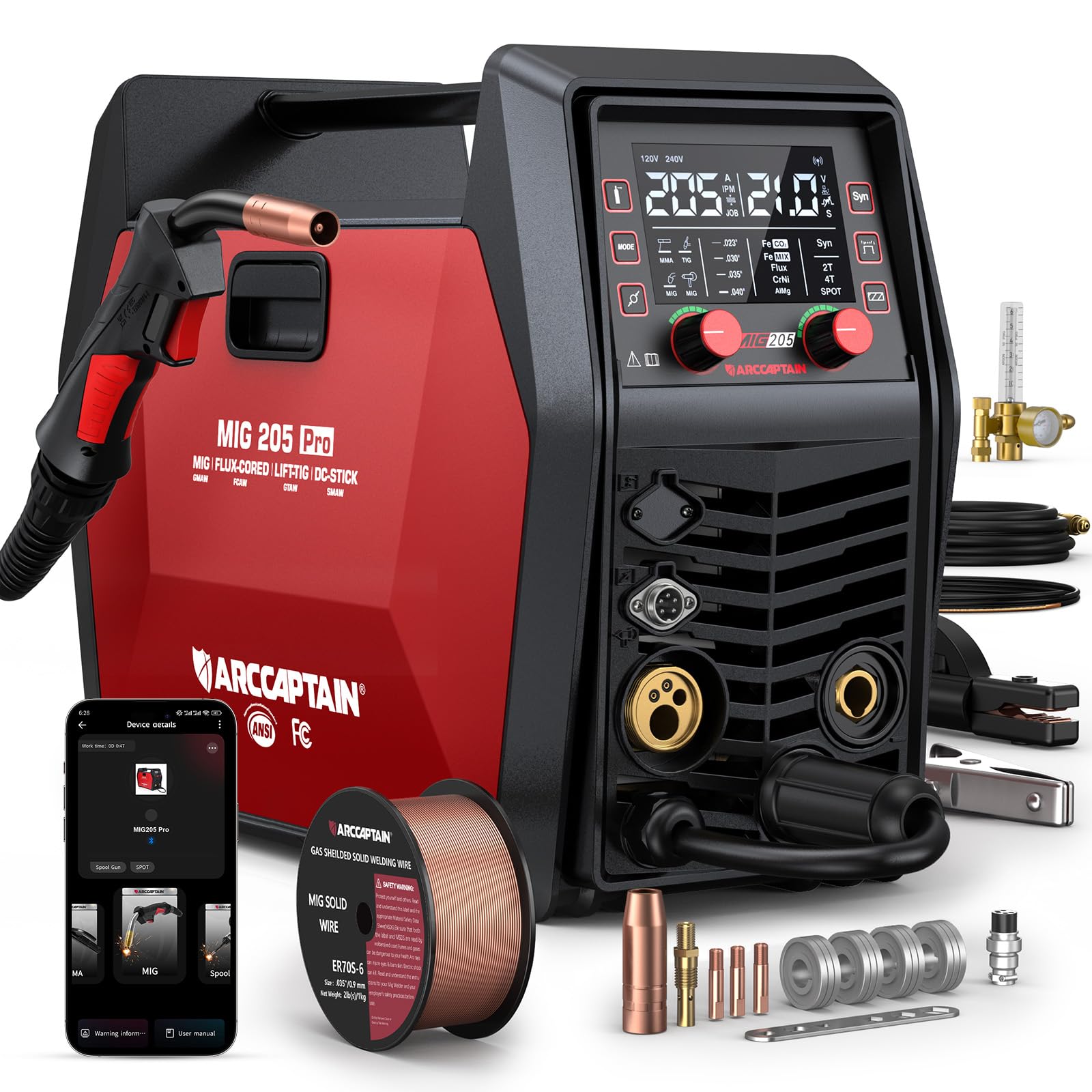
The ARCCAPTAIN iControl MIG205 Pro takes the top spot because it brings a 205-amp rating, 640 inches-per-minute wire speed, and an innovative smartphone app for adjusting parameters without walking back to the machine. The 40W wire feeder delivers consistent MIG beads even when pushing 0.035-inch wire through a 10-foot gun, and the dual-fan cooling system keeps the duty cycle steady during longer garage sessions. The large LED display is readable through a welding helmet, and the synergic mode (called “Syn” on the dial) does a credible job of setting voltage and wire feed automatically for beginners.
What pushes this ahead of similarly priced competition is the burn-back adjustment range (0.15–0.5ms) and the inductance control from -10 to +10, which lets you fine-tune arc softness from a sharp dig for thin sheet to a broad puddle for thicker steel. The 2T/4T/Spot trigger modes add flexibility for tacking and long continuous beads. The entire machine weighs only 10 pounds, making it one of the lightest multi-process units at this amperage, so carrying it from garage to driveway is effortless.
Downsides include a plastic case that doesn’t inspire the same tank-like confidence as the AHP or LOTOS units, and the app, while nice, isn’t essential once you dial in your favorite 10 presets. Some users note that the included torch is adequate but not premium — upgrading to a better gas lens for lift TIG improves AC aluminum performance. Overall, it is the best-rounded package for a modern garage where portability and connectivity matter.
Why it’s great
- Smartphone app control for remote parameter tweaking
- 40W wire feeder pushes wire smoothly through long guns
- Extremely light at 10 pounds for a 205A machine
Good to know
- Plastic housing lacks the mechanical robustness of metal-cased alternatives
- Basic TIG torch may need upgrading for serious AC aluminum work
2. Weldpro 200A AC/DC TIG Welder with Pulse
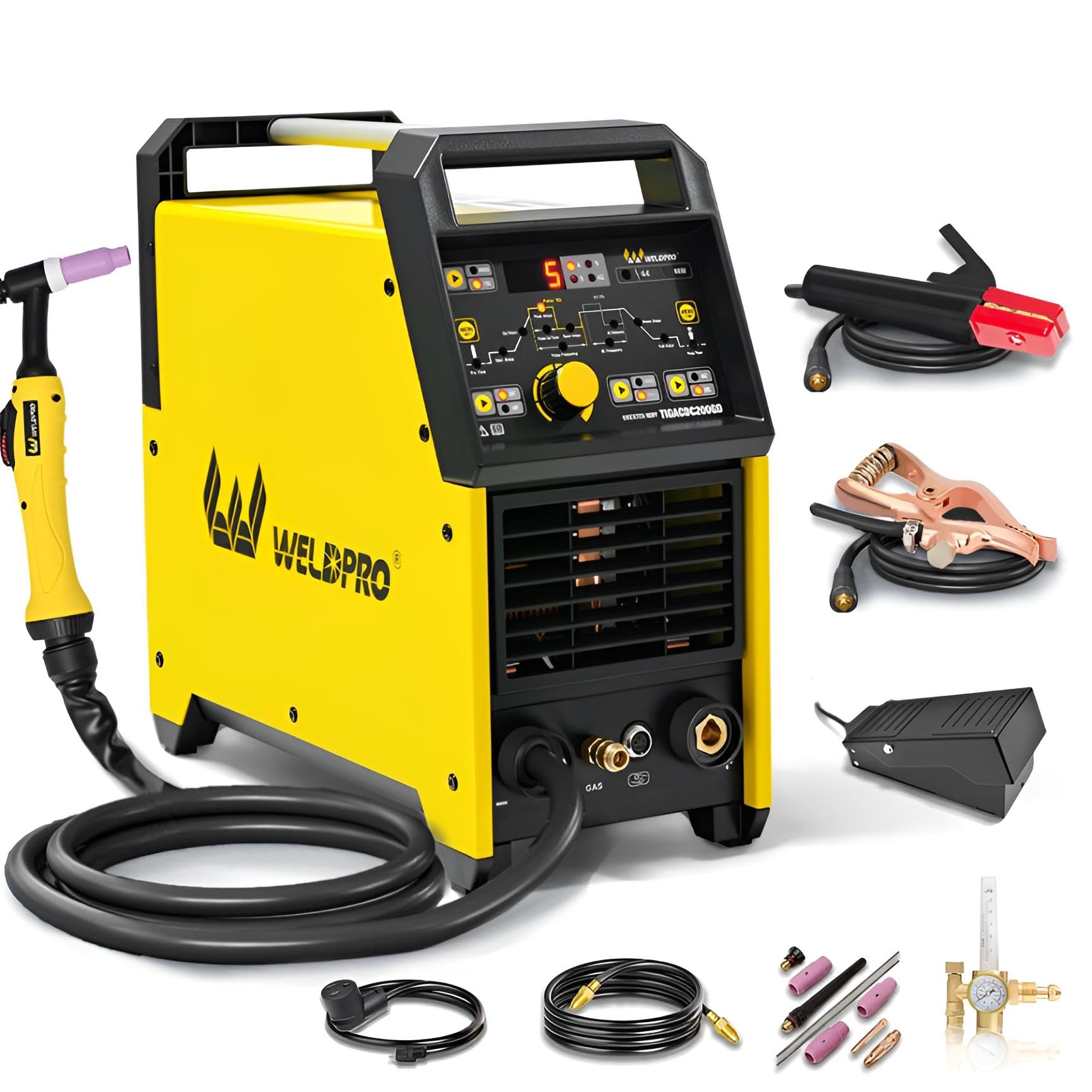
The Weldpro 200A sets the standard for garage TIG welders that must handle aluminum, stainless, and mild steel with precision. The AC balance adjustment (adjustable from 30% to 70% EN) lets you clean the oxide layer on aluminum without overheating the tungsten, and the three AC wave options — square, sine, and triangle — give you deep penetration for thick plate or soft starts for 1/16-inch sheet. The high-frequency start is reliable and doesn’t erode the tungsten tip over repeated strikes, which is a common complaint with cheaper DC-only TIG units.
The included CK17 flex-head torch is a genuine step above the average bundled torch: the flexible neck bends into tight exhaust manifolds and chassis rails, and the gas lens provides argon coverage that reduces weld discoloration. The rocker-style foot pedal feels solid under a boot and lets you feather the amperage from 5A to 200A smoothly, which is crucial when you’re stacking dimes on a thin-wall stainless tube. The built-in memory slots (10 total) store your favorite TIG and stick settings so you don’t have to re-enter AC frequency, balance, and pulse parameters every time you switch from aluminum to steel.
The only catch is the 40% duty cycle at full 200A — you get four minutes of welding before a six-minute cooldown. This isn’t a production machine, but for a garage fabricator working on one-off brackets and repairs, it’s rarely an issue. The included argon regulator had some accuracy complaints from early users, though the seller replaced them promptly. If aluminum TIG is your primary goal, this machine offers controls that rival units costing hundreds more.
Why it’s great
- CK17 flex-head torch and genuine rocker foot pedal included out of the box
- Adjustable AC balance and three waveforms for aluminum mastery
- 10 memory slots store multi-process profiles
Good to know
- 40% duty cycle at 200A requires longer cooldowns for heavy production runs
- Included argon regulator may need replacement for consistent flow
3. LOTOS TIG220ACDCP 220A AC/DC TIG Welder

The LOTOS TIG220ACDCP is a 13-in-1 AC/DC TIG welder that offers three distinct AC waveforms — square, sine, and triangle — a feature usually reserved for industrial units over . Square wave delivers the deep penetration needed for 3/8-inch aluminum brackets; sine wave quiets the arc and reduces noise for thin-wall tubing; triangle wave minimizes heat input for 1/16-inch aluminum sheet, virtually eliminating warpage. This machine runs on both 110V (140A max) and 220V (220A max) with automatic voltage compensation, so you can plug it into a standard garage outlet for light work and switch to a 50A circuit for thick plate.
The digital interface uses a single knob and an LCD screen to navigate slope, start/end amps, pre/post flow, AC balance, and pulse frequency. It supports HF start and lift start in both AC and DC modes, and the adjustable pulse frequency (0.5–200 Hz with adjustable base amps and peak time) allows tacking thin-gauge stainless without burn-through. The 10 memory slots are a godsend for recalling tuned TIG profiles.
Reviewers consistently praise the LOTOS customer support — the US-based team responded quickly with updated instructions when the manual was unclear. The included torch is adequate for most garage work. One caution: the machine requires inverter-compatible tungsten (gray or purple), not common green. Also, a small number of users reported issues with the save/recall function on early units, which was resolved with a firmware-related manual correction. Overall, it is the most flexible AC/DC TIG platform in this price range for garage welders who weld both steel and aluminum.
Why it’s great
- Three AC waveforms (square/sine/triangle) give unmatched control on aluminum
- Auto-voltage compensation works smoothly between 110V and 220V
- Excellent US-based customer support
Good to know
- Requires inverter-compatible tungsten (gray/purple) not standard green
- Save/recall function may need updated instructions for proper use
4. AHP AlphaTIG 203Xi Amp IGBT AC DC Tig/Stick Welder

The AHP AlphaTIG 203Xi is a garage institution — a yellow box that has been the go-to AC/DC TIG for home shop fabricators for years. The 2024 update introduces HV Start (solid-state simulated HF, eliminating the need for a physical point gap), along with the existing pulse, AC frequency control (20–200 Hz), and upslope/downslope timers. The unit delivers a 60% duty cycle at 155A, which is significantly better than most competitors at the same price point, and it handles 1/4-inch aluminum and 3/8-inch mild steel with ease. The included Nova foot pedal (25-foot cord) and Nova Rotaflex 9/17 TIG torch (12.5 feet) are respectable out-of-the-box accessories.
What separates the AlphaTIG from the pack is its stick welding performance. Users consistently report that the stick mode on this machine rivals dedicated Stick welders — it runs 6011, 6013, 7018, and 308L rods without the arc instability that plagues many multi-process inverters. The AC stick mode with adjustable frequency is especially useful for overhead or vertical-up beads that require precise puddle control. The 3-year warranty (1 year full replacement) adds a layer of confidence that the cheaper brands don’t offer.
The significant downside is the unit’s weight — 69 pounds makes it less portable than the ARCCAPTAIN or LOTOS options. The ground clamp is a weak point (many users replace it immediately), and the digital readout doesn’t display the actual amp cap, which requires some trial and error. Some newer users found the manual sparse, but the AHP community online is active and helpful. If you want a TIG machine that you can also use for heavy stick welding, this is the one.
Why it’s great
- Outstanding stick welding performance with 6011 and 7018 rods
- 60% duty cycle at 155A — class-leading for this price tier
- 3-year warranty with dedicated support
Good to know
- Very heavy at 69 pounds, not suited for frequent travel
- Ground clamp is cheap and should be replaced immediately
5. ARCCAPTAIN MIG Welder 200A 6-in-1
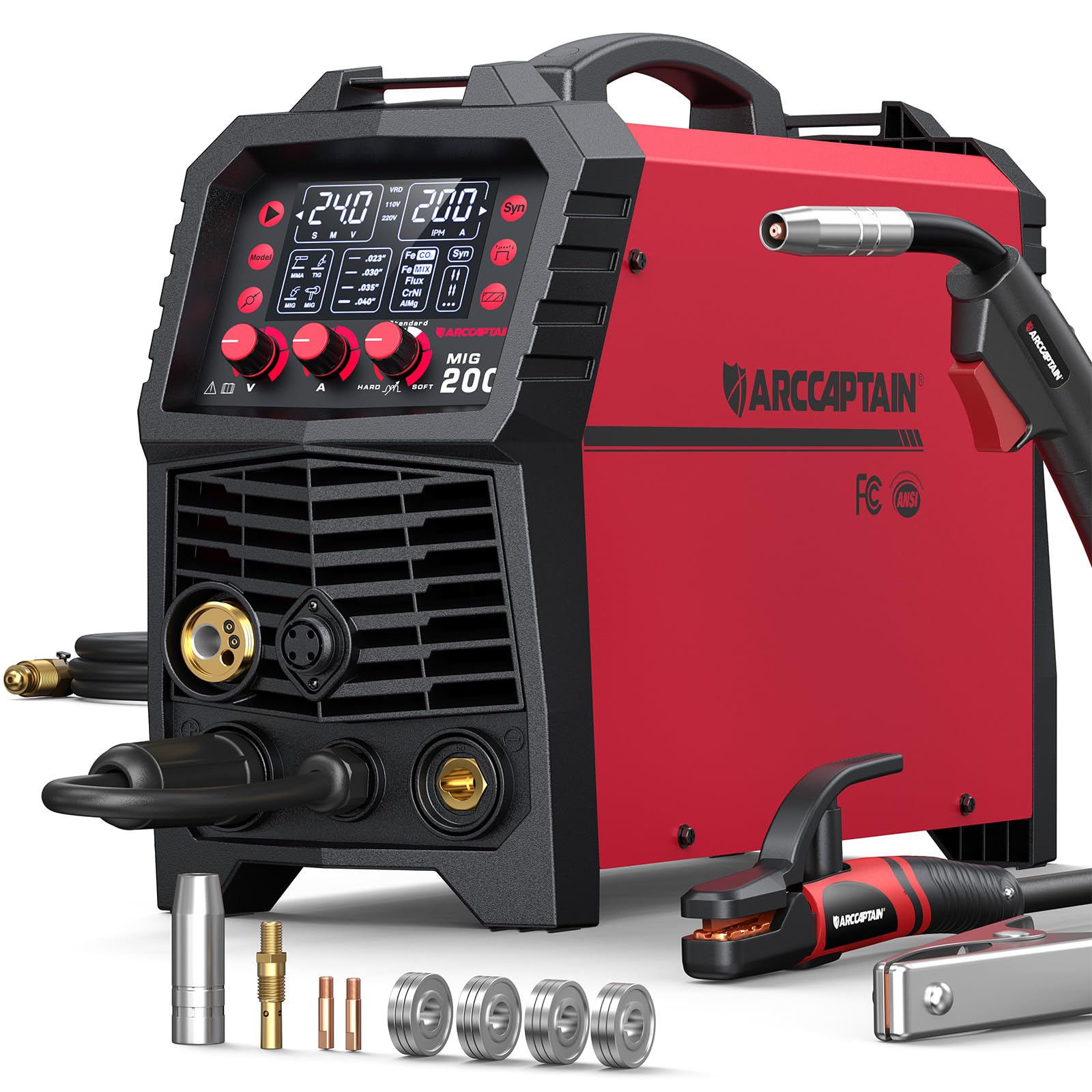
The ARCCAPTAIN 200A 6-in-1 (model MIG200) was a trailblazer in bringing features like adaptive crater fill, burn-back adjustment, and pre-flow/post-flow timing to the sub- price bracket. The synergy mode automatically matches wire speed to amperage based on the wire diameter you select, making it easy for a beginner to lay a clean MIG bead on 1/8-inch steel. The spot welding mode — activated by a toggle on the panel — is surprisingly useful for tacking panels before final welding, and the spool gun compatibility (gun not included) opens up aluminum welding without the need for a push-pull gun.
The large LED display uses a human-computer interaction design that shows exactly what parameter you’re adjusting without taking off your helmet. The variable inductance control from -10 to +10 lets you fine-tune the arc from a cold, tight puddle for thin metal to a hot, fluid puddle for thicker joints. The shoulder strap and relatively compact chassis (about 20 x 8 x 16 inches) make it easy to carry around a garage or load into a truck bed for on-site repairs. The cooling fan runs only when needed, which keeps the shop quiet during setup.
The main shortcoming is that the 110V plug is physically the same as the 220V plug design, which some users say can be confusing. A few reviewers noted that the 0.035-inch drive rollers weren’t included, so you may need to buy a separate drive roll kit. The build quality is good for a plastic-case inverter, but it doesn’t feel as overbuilt as the Lincoln or LOTOS units. For the price, however, the feature list is hard to beat.
Why it’s great
- Adaptive crater fill and burn-back adjustment for pro-quality welds
- Inductance control allows precise arc tuning for different material thicknesses
- Spool gun compatibility for aluminum welding in MIG mode
Good to know
- 110V and 220V plug design is the same, causing confusion for some users
- 0.035-inch drive rollers not included, must be bought separately
6. Lincoln Electric 90i FC Flux Core Wire Feed Weld-PAK

The Lincoln Electric 90i FC Weld-PAK is a dedicated flux-core wire welder that trades multi-process versatility for sheer portability and simplicity. At 15 pounds with a shoulder strap, it’s the smallest welder in this roundup, and the inverter power source delivers smooth, low-spatter welding characteristics that older transformer-based flux-core machines simply can’t match. The infinite voltage adjustment dial (1–10) allows fine-tuning that a two-position rocker switch can’t approach, letting you dial in a quiet, consistent arc on 14-gauge stainless table legs just as easily as on 1/4-inch mild steel brackets. It welds up to 1/2-inch plate with enough penetration for hobbyist ironwork, according to multiple verified buyers.
Lincoln includes a metal carrying case that protects the welder from weather, dust, and bumps — a thoughtful touch for a machine that will likely migrate between garages, barns, and truck beds. The included torch is high-quality, and the cold feed switch lets you change wire spools without worrying about electrical contact. The self-shielding flux-core eliminates the need for a gas cylinder, argon regulator, and gas hose, making this the most hassle-free setup in the guide. For auto restoration work — especially thin sheet metal — the 90i FC’s gentle arc is a delight.
The major compromises are that it only accepts 1-pound spools (no 2-pound or 10-pound spools), so you’ll change wire frequently on bigger projects. It also lacks MIG, TIG, and stick modes — this is a single-process machine. And while the shoulder strap works, many users wish it had a conventional handle. If you already own a multi-process welder and need a dedicated lightweight flux-core unit for thin materials or on-site repairs, the 90i FC is a polished choice from a trusted brand.
Why it’s great
- Extremely portable at 15 pounds with shoulder strap and metal case
- Infinite voltage dial (1–10) allows precise arc tuning
- High-quality Lincoln torch and cold feed switch for safety
Good to know
- Accepts only 1-pound spools, not larger 2 or 10-pound rolls
- Single-process flux-core — no MIG, TIG, or stick modes
7. FEMEROL 250A MIG Welder 6-in-1

The FEMEROL 250A MIG Welder delivers a staggering 250A maximum output with a 60% duty cycle at that rating — a spec that usually costs twice as much. The 6-in-1 capability covers gas MIG, gasless flux-core, stick, lift TIG, spot welding, and spool gun compatibility (teflon liner included for feeding aluminum wire through the standard gun). The synergic control automatically sets feed speed and voltage when you select wire diameter, and the manual override allows experienced welders to fine-tune. The burn-back adjustment and 2T/4T trigger modes add professional-level control for a machine in this price bracket.
User feedback consistently highlights the FEMEROL’s surprising performance: it runs 0.030-inch flux-core beautifully out of the box, produces great MIG beads on 1/4-inch steel with CO2/argon mix, and even tackles 0.035-inch aluminum wire with the spool gun. The large LED display is clear and responsive, and the unit includes a MIG gun, ground clamp, electrode holder, and brush. The 110V/220V dual voltage means you can run it on a standard household outlet for small jobs or switch to 220V for the full 250A potential.
There are clear corners cut to hit the low price point. The continuous fan runs loudly even when idle, the gas inlet is a barbed fitting rather than a standard threaded connection, and the 120V plug is undersized for sustained high-amp work on 110V. The instruction manual is sparse, and the unit’s overall fit and finish doesn’t match the ARCCAPTAIN or LOTOS machines. However, for a weekend welder who needs high amperage on a budget and is willing to make a few small upgrades, the FEMEROL offers incredible bang for the buck.
Why it’s great
- 250A output with 60% duty cycle — highest raw power in its price class
- Spool gun compatible with teflon liner for aluminum wire
- Synergic control eases setup for beginners
Good to know
- Continuous fan is loud even when machine is idle
- Gas inlet uses a barbed fitting instead of a standard threaded connection
- 120V plug is undersized for sustained high-amp work
8. AZZUNO 200A MIG Welder 4-in-1

The synergic control simplifies the learning curve by automatically setting voltage and wire feed speed after you dial in the amperage. It can weld up to 5/16-inch (8mm) mild steel, and the dual voltage (110V/220V) gives you the flexibility to plug into regular outlets for thinner work or step up to 220V for deeper penetration. The unit is relatively compact at 23.8 pounds, though the printed dimensions in the manual are wrong — the actual chassis is larger than stated.
Customer reviews highlight the responsive after-sales support: several users reported that AZZUNO quickly sent updated PDF manuals and replaced units with cosmetic damage, which is a strong sign for a budget brand. The digital readouts are crisp, the torch is decent for the price, and it handles 10-pound spools without issue. The gas MIG mode produces clean beads on mild steel with a 75/25 argon-CO2 mix, and the stick mode runs 6013 rods reliably.
On the downside, the control panel uses a membrane keypad that feels less durable than physical knobs, and the wire feed speed is displayed in meters per minute rather than inches per minute — a nuisance for users accustomed to imperial units. The gas inlet is a hose barb, not threaded, and the manual is genuinely poor. If you’re patient and willing to learn by trial and error, this welder offers decent value. But for the same price range, you can get a FEMEROL 250A with more features.
Why it’s great
- Synergic control simplifies MIG setup for first-timers
- Responsive customer support with quick replacement and manual updates
- Handles 10-pound wire spools
Good to know
- Membrane keypad less durable than physical knobs
- Wire feed speed displayed in meters per minute, not inches per minute
- Poor instruction manual, quality of included accessories is basic
9. YESWELDER 160A MIG Welder 4-in-1
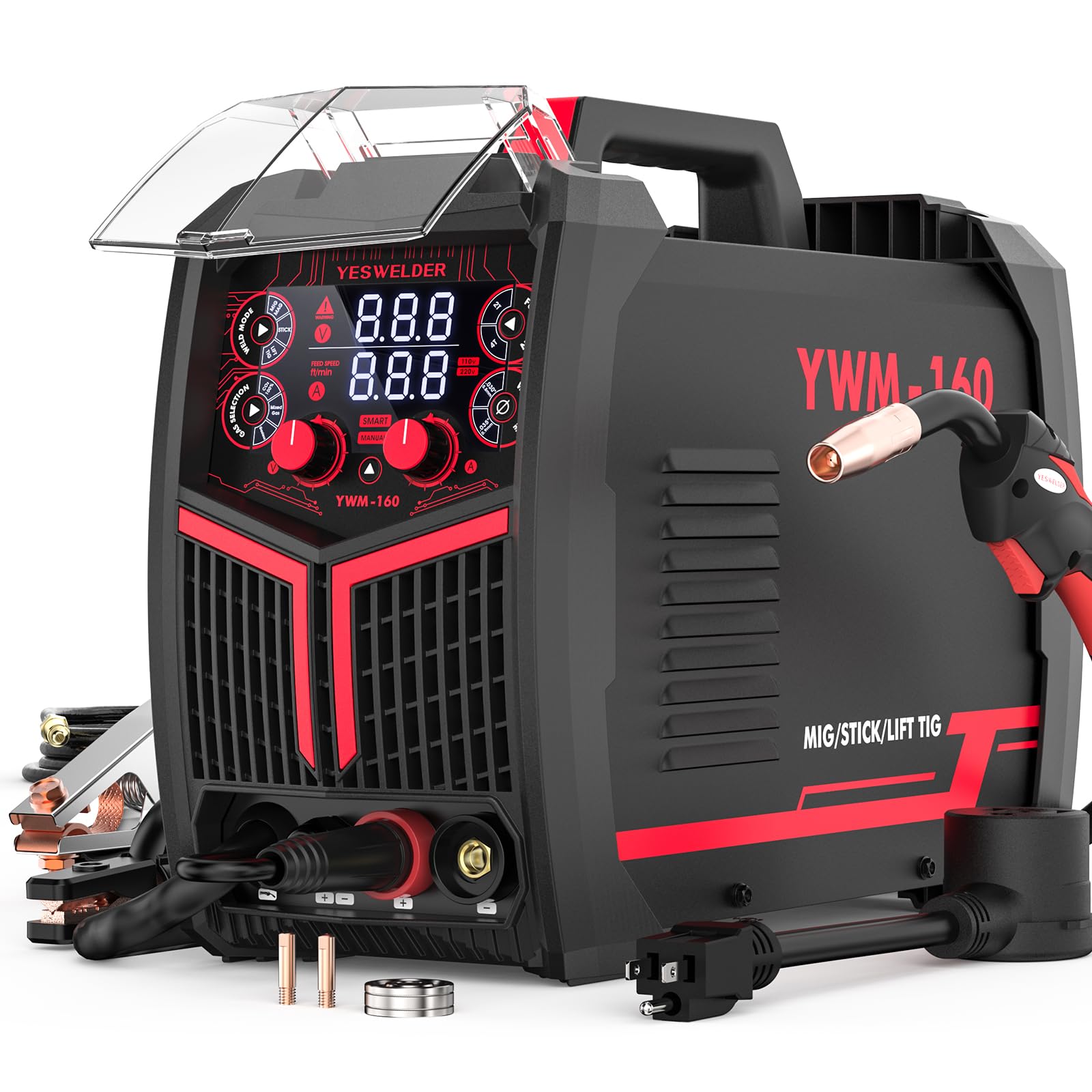
The YESWELDER 160A 4-in-1 is the most affordable multi-process welder in this guide, designed for someone who needs a capable dual-voltage machine for light-duty MIG, flux-core, lift TIG, and stick welding. At just 19.6 pounds, it’s one of the lightest true multi-process units, and the dual voltage (110V/220V) lets you weld on a standard outlet or upgrade to 220V for deeper penetration. The synergic control offers four levels for 0.030-inch flux-core and solid wire, which removes most of the guesswork for beginners. The LED display is bright and straightforward, with large digits that are visible through a standard welding helmet shade.
User reviews are overwhelmingly positive for a machine in this price tier — many experienced welders describe it as “incredible workhorse,” with some reporting completing multiple 11-pound wire spools without any mechanical failure. The stick mode runs 6010, 6011, 6013, and 7018 rods, though starting a 6010 requires more skill than on a high-end machine. The gas MIG mode works well for exhaust work and thin sheet metal, and the kit includes a 220V-to-110V adapter, gas hose, drive rollers, ground clamp, and electrode holder.
The limitations are predictable for a 160A machine: it won’t handle thick plate penetration on 110V (you’ll max out at about 1/8-inch mild steel on that setting), and the lift TIG mode requires buying a separate TIG torch. The torch and ground clamp are adequate but not premium. The included manual is basic, and the wire feed tension adjustment can feel finicky. If your garage projects rarely exceed 1/8-inch steel, the YESWELDER 160A offers incredible value for the money. For heavier work, the extra investment in the FEMEROL 250A or ARCCAPTAIN 200A would pay off.
Why it’s great
- Extremely light at 19.6 pounds for a multi-process dual-voltage machine
- Synergic control removes the guesswork for beginners
- Reliable workhorse reputation with users reporting high wire consumption
Good to know
- Limited to 1/8-inch capacity on 110V; needs 220V for thicker steel
- Lift TIG torch not included, must be purchased separately
- Basic torch and ground clamp quality
FAQ
Can a 160A garage welder handle 1/4-inch steel?
Is flux-core wire better than gas MIG for a garage?
Do I really need AC/DC TIG for aluminum, or can I use a spool gun?
What gauge wire should I use for a 50A 220V garage welder circuit?
Final Thoughts: The Verdict
For most users, the best garage welder winner is the ARCCAPTAIN iControl MIG205 Pro because it combines a 205A output, synergic MIG, smartphone app control, and 6-in-1 versatility at a weight that anyone can move around a shop. If you want a dedicated AC/DC TIG platform for aluminum and stainless with real pulse control, grab the Weldpro 200A AC/DC TIG. And for a true stick-friendly heavy-duty TIG machine that can also weld AC aluminum, nothing beats the AHP AlphaTIG 203Xi.