
A garden hoe is the difference between an afternoon of frustrated effort and a clean bed of soil ready for planting. The right blade geometry and handle length turn a tedious chore into a smooth, rhythmic motion that breaks crust, severs roots, and clears rows without jarring your joints. The wrong choice leaves you with a bent blade, a wobbly handle, and a sore lower back.
I’m Mohammad Maruf — the founder and writer behind Drink4Good. I’ve spent years analyzing garden tool metallurgy, handle ergonomics, and real-user feedback to separate the hoes that actually cut from those that just look the part in a shed.
Whether you’re maintaining a raised bed or taming an overgrown plot, the best garden hoe comes down to blade sharpness, handle stability, and the weight balance that lets you work longer without fatigue.
How To Choose The Best Garden Hoe
Not all hoes work the same way. The blade profile, handle construction, and overall weight determine whether a hoe makes your work lighter or adds resistance. Here are the critical factors to evaluate before buying.
Blade Shape and Material
Triangle hoes use three sharp edges to slice through soil in both directions, making them ideal for close weeding around plants. Stirrup hoes (or hula hoes) rock back and forth to cut weeds at the root zone without dragging soil. Standard draw hoes chop on the pull stroke. Blade material matters: carbon steel holds a sharper edge longer than stainless but requires occasional oiling. Stainless steel resists rust but may arrive less sharp out of the box.
Handle Length and Grip
A handle between 56 and 62 inches lets you work standing upright, reducing back strain during extended sessions. Adjustable handles accommodate different user heights and storage constraints. Look for padded or non-slip grips on the upper section — bare metal or wood becomes slippery when your hands sweat or after rain.
Weight and Balance
Heavier hoes (around 3 pounds) drive through hard-packed clay and rocky soil with less effort from your arms. Lighter hoes (under 2 pounds) reduce fatigue during long weeding sessions but require more technique in compacted ground. The balance point should fall near the blade-head connection, not at the handle midpoint, or the tool will feel front-heavy and unwieldy.
Quick Comparison
On smaller screens, swipe sideways to see the full table.
| Model | Category | Best For | Key Spec | Amazon |
|---|---|---|---|---|
| BARAYSTUS 4-in-1 | Mid-Range Heavy Duty | Hard soil and trench work | 0.12-inch thick stainless steel | Amazon |
| COCONUT Stirrup Hoe | Premium Stirrup | Weeding without disturbing roots | 62-inch adjustable handle | Amazon |
| YEELOR Triangle Hoe (60-inch) | Premium Triangle | Lightweight all-day weeding | 2.4 pounds, stainless handle | Amazon |
| Japanese Triangle Hoe | Hand Tool | Precision weeding in tight spaces | 9.1 ounces, razor-sharp blade | Amazon |
| YEELOR Triangle Hoe (57.5-inch) | Budget Triangle | Entry-level push-pull weeding | Carbon steel, adjustable handle | Amazon |
In‑Depth Reviews
1. BARAYSTUS Garden Hoe Tool and Weeder

The BARAYSTUS 4-in-1 is built around a 0.12-inch-thick stainless steel blade that stands up to rocky clay without bending. Every edge arrives beveled and sharp, so you can slice through weed crowns, break crusted soil, and even trench for drip irrigation in a single pass. The head functions as a hoe, rake, cultivator, and digger depending on the angle and stroke you use.
The handle splits into three sections with a threaded connection, letting you adjust the overall length to match your height — a real advantage if multiple people share the tool. At 3.3 pounds, the head carries enough momentum to crack dry soil on the downstroke, yet the weight stays balanced near the blade so your wrists don’t fatigue early.
Some users report the handle threads loosen during aggressive use; a drop of thread-locking compound solves it permanently. The included extra bolt shows the manufacturer anticipated this wear point.
Why it’s great
- Thick stainless steel head handles the toughest soil without flexing
- Three adjustable handle sections fit different user heights
- Sharp beveled edges work as hoe, rake, cultivator, and digger
Good to know
- Handle sections can unscrew during heavy use — use Loctite for a permanent fix
- Heavier than aluminum hoes, which may tire some users
2. COCONUT Stirrup Hoe / Hula Hoe

The stirrup (or hula) hoe design uses a looped steel blade that cuts weeds just below the soil surface without dragging the root zone. This makes it the best choice for working around established plants where you want to disturb as little earth as possible. The COCONUT version adds a cultivator tine on the reverse side — a simple flip of the handle switches between weeding and soil breaking.
The 62-inch adjustable handle is the longest in this roundup, letting tall gardeners work fully upright. The blade is sharp on both the push and pull stroke, so you cover more ground with less effort. Users in their seventies report being able to maintain their gardens with this tool where a standard draw hoe would be too jarring.
The attachment screw can loosen over time; the manufacturer includes a spare nut and bolt in the package. The blade works best in soft to medium soil — very hard clay may require an initial pass with a heavier tool.
Why it’s great
- Stirrup action cuts weeds without disturbing root zones of nearby plants
- 62-inch handle keeps tall gardeners from hunching
- 2-in-1 design switches to cultivator with a handle flip
Good to know
- Not ideal for breaking hard-packed clay on the first pass
- Attachment screw may need periodic retightening
3. YEELOR Garden Hoe (60-Inch Handle)
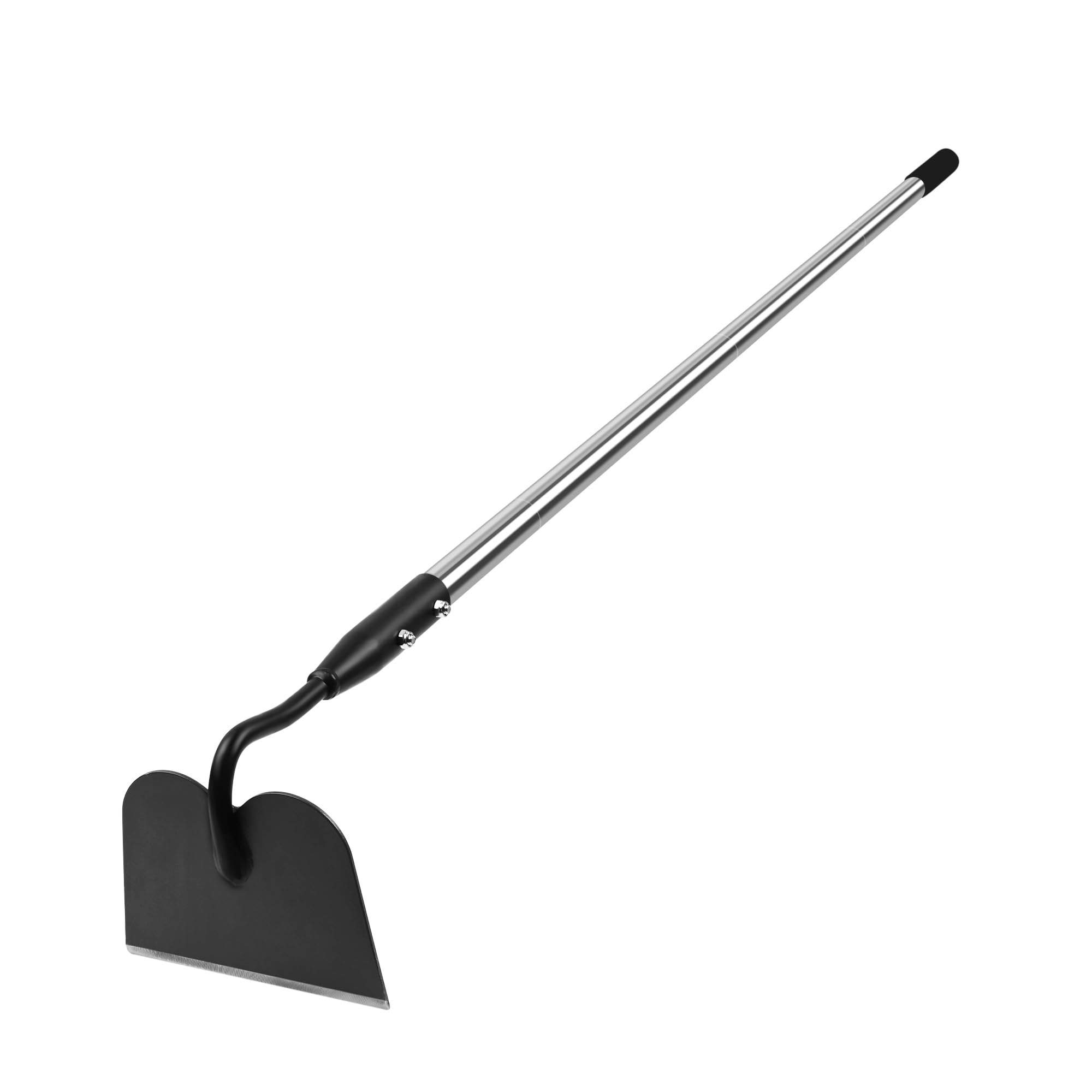
At 2.4 pounds, this YEELOR hoe strikes a nearly ideal balance between enough heft to cut into compacted soil and light enough weight for all-day use. The forged steel head receives a rust-proof treatment that holds up in damp garden conditions, and the stainless steel handle screws together with a lathe-threaded connection that resists loosening during work.
The non-slip soft grip on the upper handle reduces hand fatigue, and the 60-inch length spares your lower back during long weeding sessions. The blade arrives functional but not razor-sharp — several users report filing the three edges to enhance its slicing ability. After that quick treatment, it shaves weeds at the surface like a razor.
The segmented handle breaks down for compact storage, though assembly requires care to ensure the threaded inserts are fully seated before tightening. Once properly assembled, the connection stays solid with no wobble.
Why it’s great
- Lightweight 2.4-pound design reduces arm fatigue during extended use
- Non-slip soft grip and 60-inch handle promote upright posture
- Rust-resistant coating on forged steel head for wet conditions
Good to know
- Blade is dull out of the box — a quick sharpening session transforms it
- Handle assembly requires careful threading to avoid cross-threading
4. Japanese Stainless Steel Triangle Hoe

This Japanese-made triangle hoe weighs only 9.1 ounces, yet its heat-forged stainless steel blade arrives sharper than any other tool in this lineup. The ultra-thin triangular head slices through weed roots and clay soil with minimal downward pressure, making it the go-to choice for precision work in raised beds, around drip lines, and between tight plantings.
The short handle (13 inches) keeps you close to the soil, which is ideal for seated weeding or for gardeners who prefer to work on their knees. The balance is exceptional — the lightweight head lets you control the angle and depth of each cut without forearm fatigue. Users report that it trenches for drip irrigation lines faster than an asparagus knife and cleans up stubborn roots in clay where heavier tools just bounce off.
The trade-off is reach. At this handle length, you cannot work standing upright, so it is not a replacement for a full-length hoe. It complements a long-handled tool for detail work.
Why it’s great
- Exceptionally sharp Japanese stainless steel blade cuts through roots with ease
- Ultra-light 9.1-ounce design prevents arm fatigue during detailed weeding
- Excellent balance and control for precision work around plants
Good to know
- Short handle requires squatting or kneeling — not for upright use
- Best used as a secondary detail tool alongside a long-handled hoe
5. YEELOR Triangle Garden Hoe (57.5-Inch)

The entry-level YEELOR uses neutral carbon steel for the blade with an anti-rust coating, giving you a durable cutting edge at a lower weight than stainless alternatives. The triangular head works on both push and pull strokes, shaving off weed tops just below the soil line. The 57.5-inch stainless steel handle telescopes together for compact storage and includes a padded cover at the grip end for comfort.
At 1.85 pounds, this is the lightest long-handled hoe in the group. That makes it a strong option for gardeners who prioritize maneuverability over raw chopping force. The head is fixed to the handle with screws that hold firmly when torqued correctly. Users who filed all three edges report using it as a primary weeding tool for the entire season.
The blade arrives noticeably dull and needs sharpening before it performs well in compacted soil. The threaded handle connection requires careful attention during assembly to avoid wobble.
Why it’s great
- Lightweight 1.85-pound design is easy to handle for extended sessions
- Adjustable 57.5-inch handle reduces back strain and stores compactly
- Carbon steel blade with anti-rust coating offers solid durability for the price
Good to know
- Blade requires sharpening out of the box for effective cutting
- Handle assembly needs care to prevent loosening during use
FAQ
What is the difference between a stirrup hoe and a triangle hoe?
How do I keep my garden hoe blade sharp?
Is a heavier hoe always better for hard soil?
Final Thoughts: The Verdict
For most users, the best garden hoe winner is the BARAYSTUS 4-in-1 because its thick stainless steel head cuts through hard soil and its adjustable handle fits gardeners of different heights. If you want a stirrup hoe that protects plant root zones while you weed, grab the COCONUT Hula Hoe. And for precision work in tight raised beds, nothing beats the Japanese Triangle Hoe.