
Nothing draws the life out of a garden faster than watching Japanese beetles skeletonize your roses or cabbage loopers shred your kale overnight. The right spray or granular treatment stops the damage at the source — whether that is a caterpillar chewing through a leaf mid-bite or a grub colony waiting underground to emerge next season. Choosing a formula that matches your specific pest and crop is the difference between a thriving harvest and a season of frustration.
I’m Mohammad Maruf — the founder and writer behind Drink4Good. I spend my time digging through the chemistry and real-world application data behind lawn and garden pest controls to separate the treatments that actually work from the ones that just sound good on the bottle.
If you are searching for a reliable garden insecticide that aligns with your growing methods and pest pressure, this guide walks you through the exact options that deliver measurable results.
How To Choose The Best Garden Insecticide
The right garden insecticide depends entirely on what you are growing and which pest is causing the damage. A broad-spectrum pyrethroid will clear out every bug in sight, but it may also eliminate the ladybugs and bees your garden relies on. Narrowing your choice to a targeted biological or carefully formulated multi-purpose spray gives you control without collateral damage.
Match the Active Ingredient to the Pest
Bacillus thuringiensis (B.t.) is your go-to for leaf-eating caterpillars, loopers, and worm-type larvae. It is a bacteria that paralyzes the gut of the pest within hours, yet it leaves bees, earthworms, and ladybugs completely unharmed. Neem oil extract works differently — it smothers eggs, larvae, and soft-bodied adults like aphids and spider mites while also suppressing fungal diseases such as powdery mildew. For soil-dwelling grubs, especially Japanese beetle larvae, milky spore powder (Bacillus popilliae) is a one-time biological treatment that can last 15 years.
Consider Concentration and Coverage Area
Concentrates offer the best value per square foot but require accurate mixing. A 32-ounce concentrate that dilutes to 6.4 gallons of finished spray will cover far more ground than a ready-to-spray bottle of the same size. If you are spraying a large vegetable patch or multiple fruit trees, a concentrate with a hose-end or tank sprayer is the practical choice. Ready-to-spray formulas are ideal for quick spot treatments on a small flower bed or a couple of rose bushes.
Quick Comparison
On smaller screens, swipe sideways to see the full table.
| Model | Category | Best For | Key Spec | Amazon |
|---|---|---|---|---|
| Monterey B.t. | Biological | Caterpillars & worms | 8 oz concentrate | Amazon |
| Bonide Captain Jack’s Orchard Spray | Multi-purpose | Fruit trees & vegetables | 32 oz concentrate | Amazon |
| Cyonara Lawn & Garden RTS | Synthetic | Mosquitoes & grasshoppers | 32 oz ready-to-spray | Amazon |
| Garden Safe Fungicide3 | Organic | Aphids, mildew & mites | 1 gallon ready-to-use | Amazon |
| St. Gabriel Organics Milky Spore | Biological | Japanese beetle grubs | 15 lb granules | Amazon |
In‑Depth Reviews
1. Monterey B.t. Bundled with Measuring Spoon
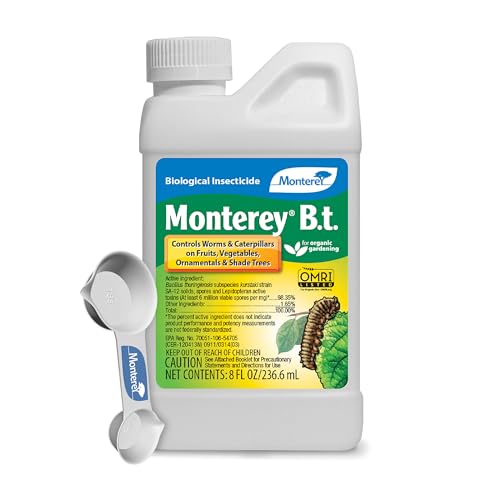
Monterey B.t. uses Bacillus thuringiensis var. kurstaki, a naturally occurring soil bacterium that stops caterpillar-type pests by disrupting their digestive system within hours of ingestion. This 8-ounce concentrate treats cabbage loopers, bagworms, gypsy moth larvae, and tomato armyworms without affecting earthworms, honeybees, or ladybugs — making it one of the safest biological options for an organic vegetable garden.
The concentrate mixes instantly with water and is best applied through a trigger sprayer or pressure tank. A single bottle of the 8-ounce size goes a long way for a mid-sized raised bed, and the included measuring spoon takes the guesswork out of dilution ratios. Users in Southern California report that it stopped cabbage loopers on cilantro seedlings after just one application, and Texas mountain laurel owners confirmed it eliminated caterpillar infestations without harming the tree.
The main downside is the odor — undiluted B.t. concentrate has a strong smell that some find unpleasant, and occasional packaging issues (arriving unsealed) have been noted with certain batches. Once properly sealed and stored, the product stays effective, but it is worth checking the cap before first use.
Why it’s great
- Zero impact on bees, birds, and beneficial insects
- OMRI Listed for organic gardening under USDA standards
- Comes with a measuring spoon for accurate mixing
Good to know
- Strong odor when concentrated
- Some reports of bottles arriving unsealed
2. Bonide Captain Jack’s Citrus, Fruit & Nut Orchard Spray

Bonide Captain Jack’s Orchard Spray is a three-in-one concentrate that functions as a fungicide, insecticide, and miticide. It controls beetles, fruit flies, caterpillars, mealybugs, spider mites, thrips, and scale while also preventing powdery mildew, rust, blight, brown rot, and leaf spots. One 32-ounce pint dilutes to 6.4 gallons of finished spray — enough to cover a large home orchard of apples, avocados, citrus, or stone fruit.
The active ingredient is a sulfur-and-oil blend that works both on contact and as a protective barrier. Users in New Hampshire noted it killed Japanese beetles on apple and cherry trees within an hour, and after two applications it eliminated white flies on potatoes and cucumber beetles on squash. The product can be used up to the day before harvest on edible crops, which gives it an edge for vegetable gardeners who need tight pre-harvest intervals.
Because it is a multi-site fungicide and insecticide, this formula is non-persistent — you will need to reapply after heavy rain. Some users with sensitive ornamentals reported slight leaf spotting if applied during high heat, so early morning or evening spraying is recommended.
Why it’s great
- Controls both insects and fungal diseases with one product
- Economical concentrate makes over 6 gallons of spray
- Safe to use on edibles up to one day before harvest
Good to know
- Needs reapplication after rain
- Can cause leaf burn if sprayed in direct sunlight
3. Control Solutions Cyonara Lawn & Garden RTS

Cyonara Lawn & Garden RTS is a ready-to-spray insecticide that uses lambda-cyhalothrin, a synthetic pyrethroid for fast knockdown of mosquitoes, grasshoppers, spiders, and a wide range of lawn and garden pests. The 32-ounce bottle connects directly to a garden hose for instant mixing and application — no measuring, no concentrate handling. It is labeled to cover up to 16,000 square feet, making it one of the broadest-coverage ready-to-spray options on the market.
Real-world results from users battling lubber grasshoppers in Texas confirmed that it killed the majority of the infestation and stopped further plant damage after a single application. Another user found it effective against springtails and noted a measurable reduction in dead spiders on the patio after treatment. The hose-end delivery system is particularly convenient for large lawns and perimeter treatments where you want to cover ground fast.
The synthetic nature of lambda-cyhalothrin means it is non-selective — it will kill beneficial insects along with pests, so it is not suitable for flowering vegetable gardens during bloom. Some users experienced grass browning when they overdosed the product on smaller areas, and springtail control required multiple applications over two weeks.
Why it’s great
- Instant knockdown on grasshoppers, mosquitoes, and spiders
- Hose-end sprayer covers up to 16,000 sqft
- No mixing or measuring required
Good to know
- Non-selective; kills beneficial insects
- Can brown grass if over-applied on small areas
4. Garden Safe Fungicide3 with Neem Oil Extract
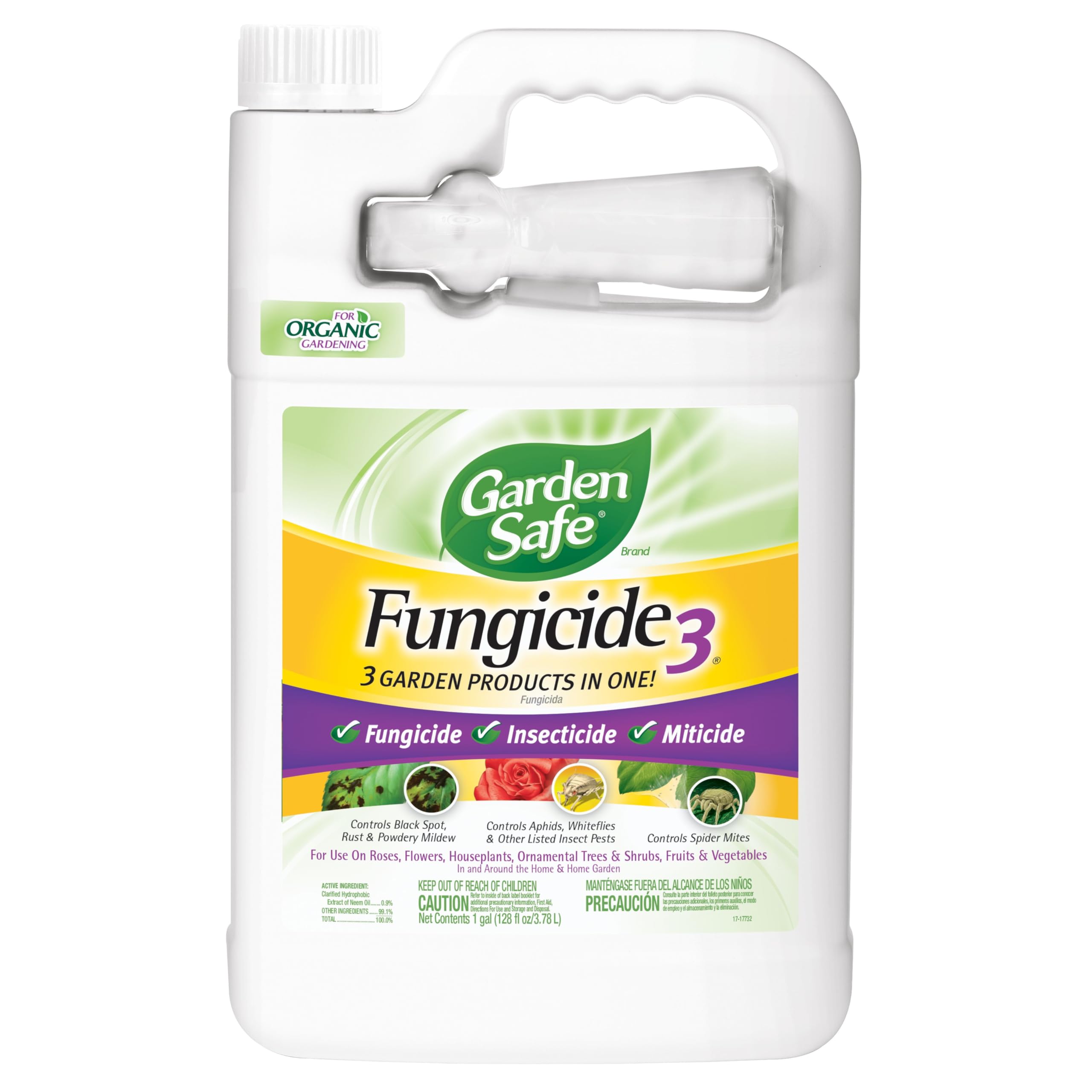
Garden Safe Fungicide3 combines clarified hydrophobic neem oil extract in a ready-to-use formula that functions as a fungicide, insecticide, and miticide. It controls black spot, rust, powdery mildew, aphids, whiteflies, and spider mites by smothering eggs, larvae, and soft-bodied adults. The one-gallon jug includes an integrated sprayer that makes it simple to apply directly onto roses, houseplants, ornamentals, and vegetables without mixing or dilution.
Gardeners using this product on hibiscus, roses, tomatoes, and blueberries noted that weekly application resulted in greener foliage, more blossoms, and increased fruit set. While it does not heal existing powdery mildew, it prevents new fungal growth after infected leaves are removed. The neem oil formula is OMRI Listed for organic gardening and is EPA-registered, so it is safe for use on edible crops.
The built-in sprayer has a very short pickup tube — about four inches — which forces you to tilt the jug awkwardly as the level drops. A few users reported that the sprayer design caused minor plant burn when applied during the heat of the day, so early morning or evening spraying is recommended for sensitive foliage.
Why it’s great
- Three actions in one: fungicide, insecticide, miticide
- Safe for organic vegetable gardens and edible crops
- Ready-to-use sprayer eliminates mixing
Good to know
- Sprayer tube is too short for the gallon jug
- Can cause leaf burn if applied in direct sun
5. St. Gabriel Organics Milky Spore Granular

St. Gabriel Organics Milky Spore is a biological granular treatment that targets Japanese beetle grubs in the soil. The active ingredient, Bacillus popilliae, is a naturally occurring bacterium that infects and kills grubs as they feed, then multiplies in the soil environment. Once established, a single application can provide effective grub control for up to 15 years, making it one of the longest-lasting garden insecticide solutions available.
The 15-pound bag is applied with a standard lawn spreader — users recommend a spreader setting of 4 to 5 to avoid clogging. It is best applied before rain or watered in immediately after spreading. Users who applied three times per year for two years reported that by the third year they found only a handful of grubs in over 1,000 square feet of soil. The product is harmless to pets, children, birds, and beneficial insects, and it does not contaminate water sources.
The granular form can clog spreaders if the setting is too narrow, and the initial cost is higher than spray-on treatments. Because milky spore is a biological agent that needs to build up in the soil, it does not provide instant results — you will see a noticeable reduction in adult beetles and grubs over the first two seasons rather than overnight.
Why it’s great
- Single application controls grubs for up to 15 years
- USDA-certified organic and non-toxic to pets and wildlife
- Self-replenishes in the soil after grubs die
Good to know
- Takes 1-2 seasons to reach full effectiveness
- Granules can clog spreader at low settings
FAQ
Can I use B.t. on vegetables right before harvest?
Will neem oil spray hurt my tomato plants?
Final Thoughts: The Verdict
For most users, the best garden insecticide winner is the Bonide Captain Jack’s Orchard Spray because it covers insects, mites, and fungal diseases in a single economical concentrate that works on fruit trees, vegetables, and ornamentals. If you want a targeted biological weapon against caterpillars without harming bees, grab the Monterey B.t.. And for long-term grub control that keeps Japanese beetles away for over a decade, nothing beats the St. Gabriel Organics Milky Spore.