
A gas cultivator needs to rip through compacted clay, chew through roots, and turn hardpan into a seed-ready bed without bogging down. The difference between a weekend-long dig and an afternoon of finished rows comes down to engine displacement, tine steel quality, and how well the machine transfers torque to the soil. Choosing poorly means a machine that bucks, stalls, or fails to penetrate when you need it most.
I’m Mohammad Maruf — the founder and writer behind Drink4Good. I’ve spent years analyzing power-tool hardware specifications, comparing engine torque curves, tine configurations, and gearbox reliability across dozens of gas-powered cultivator models to find what actually works in real garden conditions.
This guide evaluates nine models from compact mini-tillers to wide-bed machines, weighing engine performance, build durability, and practical usability to help you select the right gas cultivator for your property’s specific soil and space demands.
How To Choose The Best Gas Cultivator
Selecting a gas cultivator means matching engine displacement to your soil type, tine design to your plot size, and weight to your mobility needs. The wrong spec leads to a machine that either lacks bite or exhausts you before the first row is done.
Engine Displacement & Cycle Type
Displacement, measured in cubic centimeters (cc), directly determines torque at the tines. A 46cc to 52cc engine suits small gardens and pre-tilled soil, while 99cc engines handle dense clay and root-heavy ground. The 212cc class delivers serious torque for large plots and breaking new sod. Cycle type matters equally: 4-cycle engines run on straight gasoline without mixing oil, offer cleaner emissions, and tend to be quieter. 2-cycle engines are lighter for their power output but require precise fuel mixing and produce more exhaust.
Tine Material, Count & Width Adjustment
Forged steel tines resist bending and hold an edge far longer than stamped steel tines. Count ranges from 4 to 24 depending on working width. Adjustable-width tines — typically offering two or three settings — let you narrow the cut for weeding between rows and widen it for initial bed prep. Forward-rotating tines dig into undisturbed soil, while some models offer reverse rotation for finer tilth in already-worked ground.
Gearbox & Drive System
Chain-driven gearboxes are simpler to maintain and repair, while worm-gear drives tend to be more compact but can be harder to service. Look for sealed gearboxes with oil baths that reduce heat and wear during extended use. A centrifugal clutch engages tines smoothly as RPM rises, reducing shock loads on the driveline during startup.
Weight, Handles & Transport Features
Heavier machines (70+ pounds) dig deeper and stay planted in hard soil but require more effort to maneuver. Foldable handles, adjustable height settings, and integrated transport wheels significantly improve daily usability. Machines that lack a drag bar or depth stake often buck violently — a feature that should not be overlooked for safety and control.
Quick Comparison
On smaller screens, swipe sideways to see the full table.
| Model | Category | Best For | Key Spec | Amazon |
|---|---|---|---|---|
| Earthquake 20015 Versa | Mid-Range | Hard clay & root-heavy soil | 99cc Viper engine, 11-21 in. width | Amazon |
| SPLENDOR 212CC | Premium | Large plots & breaking new sod | 212cc, 33.5 in. max width, 13 in. depth | Amazon |
| BILT HARD 99cc | Premium | Variable-width deep tilling | 99cc, 24 in. width, 11.8 in. depth | Amazon |
| Honda FG110 | Premium | Lightweight precision cultivating | GX25 engine, 29 lbs, 9 in. width | Amazon |
| BILT HARD 46cc | Mid-Range | Compact garden maintenance | 46cc 4-cycle, 16 in. width, 8 in. depth | Amazon |
| GardenTrax 40cc | Mid-Range | All-season tilling with easy start | 40cc 4-cycle, 16 in. max width | Amazon |
| SENIX 4QL 46cc | Mid-Range | Weeding & small-bed prep | 46cc 4-cycle, 15 in. width, 8 in. depth | Amazon |
| SuperHandy 52cc | Budget | Light garden & weed removal | 52cc 2-cycle, 11.8 in. width | Amazon |
In‑Depth Reviews
1. Earthquake 20015 Versa 2-in-1 Tiller Cultivator

The Earthquake Versa packs a 99cc Viper engine into a front-tine frame that converts from a 21-inch tiller to an 11-inch cultivator by removing outer tines and side shields — no tools required. That 11-inch narrow setting lets you work between established rows without damaging root systems, while the full 21-inch width breaks new ground efficiently. The adjustable handlebar height and onboard transport wheels make it practical for moving between plots.
In hard-packed Colorado clay and South Carolina dirt, user reports consistently note first- or second-pull starting, strong torque that cuts through vines and compacted layers, and a depth reach up to 11 inches. The drag bar is essential here: without it engaged, the machine bucks aggressively in dense soil. Bolts on the handlebar assembly can loosen from vibration, so periodic tightening is expected with sustained use.
The 5-year limited warranty is the longest in this comparison, reflecting confidence in the Viper engine’s durability. The 78-pound weight keeps it planted during tilling but requires some effort for transport — the wheels help, but loading into a truck bed solo is a two-hand job. For gardeners with medium to large plots who need one machine that both breaks ground and cultivates between rows, this is the most versatile pick.
Why it’s great
- Tool-less width adjustment from 11 to 21 inches
- 99cc engine delivers excellent torque for clay and roots
- 5-year limited warranty is best in class
Good to know
- Handlebar bolts can loosen from vibration; check periodically
- 78-pound weight makes transport a two-person job
- Drag bar must be used to prevent bucking
2. SPLENDOR Gas Powered Tiller 212CC

The SPLENDOR 212CC is the displacement king of this lineup at 7 HP, with three selectable working widths of 13, 22, and 33.5 inches. The 24 steel tines dig to a maximum depth of 13 inches — deeper than any other model here — making it suitable for breaking new sod, tilling compacted clay, or prepping large vegetable beds. The chain-type gearbox is straightforward to maintain and repair compared to sealed worm-gear units.
Users consistently praise its starting reliability and raw torque. The inclusion of both forward and reverse speeds is a practical convenience for maneuvering in tight spaces or backing out of a finished row. At roughly 80 pounds, this machine does not bounce out of the soil — it stays engaged and pulls forward aggressively, requiring the operator to walk at a good pace at full throttle.
The trade-off is space and weight. The 51-inch handle height combined with the wide tine span demands a storage area roughly 3 feet by 4 feet. The 1-year limited warranty is shorter than some competitors, and isolated reports of tine nuts loosening during first use mean checking bolt torque after the initial run is recommended. For anyone managing a half-acre or larger garden, the speed and depth of this unit reduce tilling time dramatically.
Why it’s great
- 212cc engine provides unmatched torque for deep tilling
- 33.5-inch working width covers ground fast
- Chain gearbox is serviceable and durable
Good to know
- Large footprint requires dedicated storage space
- Tine bolts may need tightening after first use
- 1-year warranty is shorter than mid-range competitors
3. BILT HARD 99cc 4-Cycle Gas Tiller Cultivator
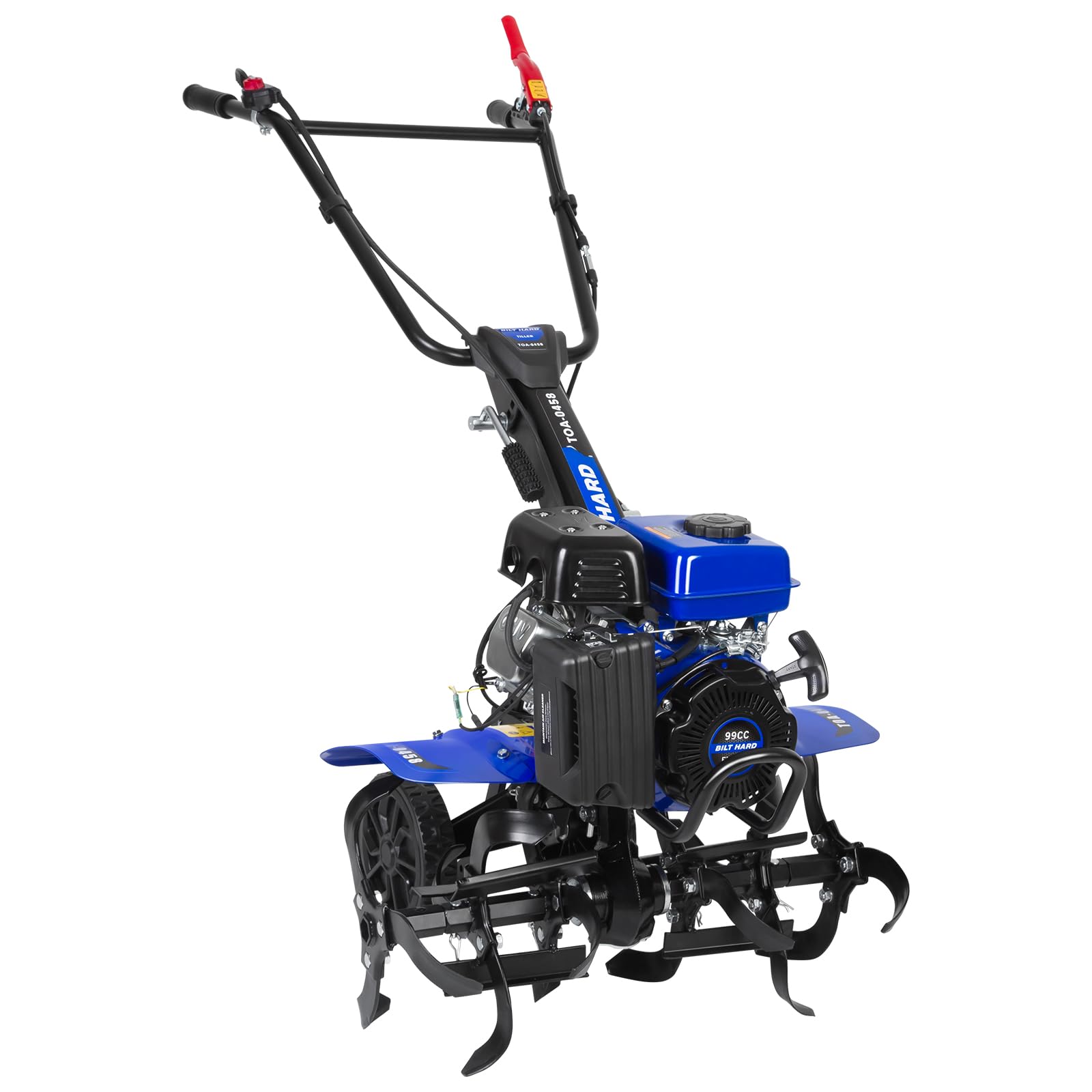
The BILT HARD 99cc model uses a 3 HP EPA-certified 4-cycle engine with a front-rotating tine system that adjusts from 17 to 24 inches in width. The depth range is exceptionally wide: 3.94 inches for light weeding up to 11.8 inches for deep soil preparation. The dual-action safety system stops tine rotation when you release the clutch grip, and a separate throttle switch provides engine shutdown without fumbling for a kill switch.
Assembly takes under 30 minutes, and users report third-pull starting consistently. The adjustable handle (three height positions) and two-position rear wheels make it comfortable for operators of different heights. The machine weighs more than 60 pounds, which helps keep the tines engaged in hard soil, but the wheel system allows smooth transport to the work area.
Build quality is solid for the price point, with steel and iron construction throughout. Some users noted that the manual lacks detailed gear oil specifications, but with standard SAE 80W-90 gear oil, the unit runs smoothly. For gardeners who need a single machine that can switch between shallow cultivation and deep primary tillage without changing hardware, this is a strong mid-range option.
Why it’s great
- Adjustable depth from 3.9 to 11.8 inches covers weeding to deep tillage
- Dual-action safety controls add peace of mind
- EPA-certified 4-cycle engine runs on straight gas
Good to know
- Manual lacks gear oil fill specifications
- Iron/steel construction adds weight for transport
- Customer service responsiveness varies
4. Honda FG110 Mini Tiller Cultivator
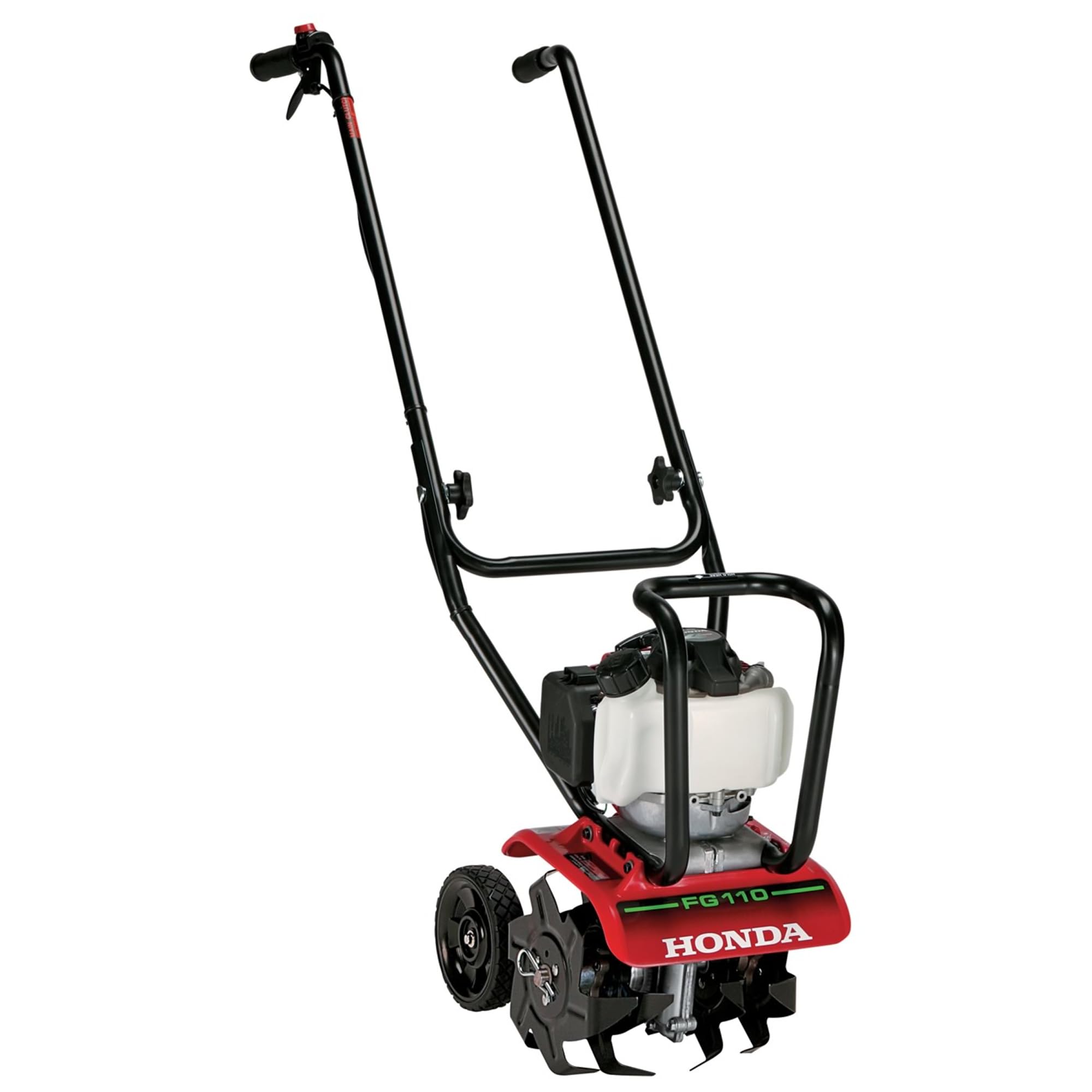
The Honda FG110 weighs 29 pounds — less than half of most other gas cultivators — and fits into raised planter beds, tight flower borders, and pre-plowed rows without effort. The GX25 4-stroke engine starts readily on the first or second pull, runs on straight unleaded fuel, and produces notably low vibration through the handlebars. The hybrid tines combine angled blades for digging with curved blades for cultivating, providing a dual action in a single pass.
At 9 inches of working width (reducible to 6 inches by removing outer tines), this is not a machine for breaking new sod in heavy clay. It excels in softer, prepared soil and for light weed cultivation between established plants. The adjustable depth bar lets you dial in tilling depth precisely, and the two-position transport wheels roll over rough ground without catching.
The Honda name carries a premium price, and the FG110 is the most expensive per-pound option here. The 2-year residential warranty is reasonable, and spare parts availability through Honda dealers is excellent. For gardeners who prioritize precision, light weight, and long-term reliability over raw power, the FG110 is a purpose-built tool that does one thing very well.
Why it’s great
Good to know
5. BILT HARD 46cc 4-Cycle Gas Powered Tiller Cultivator
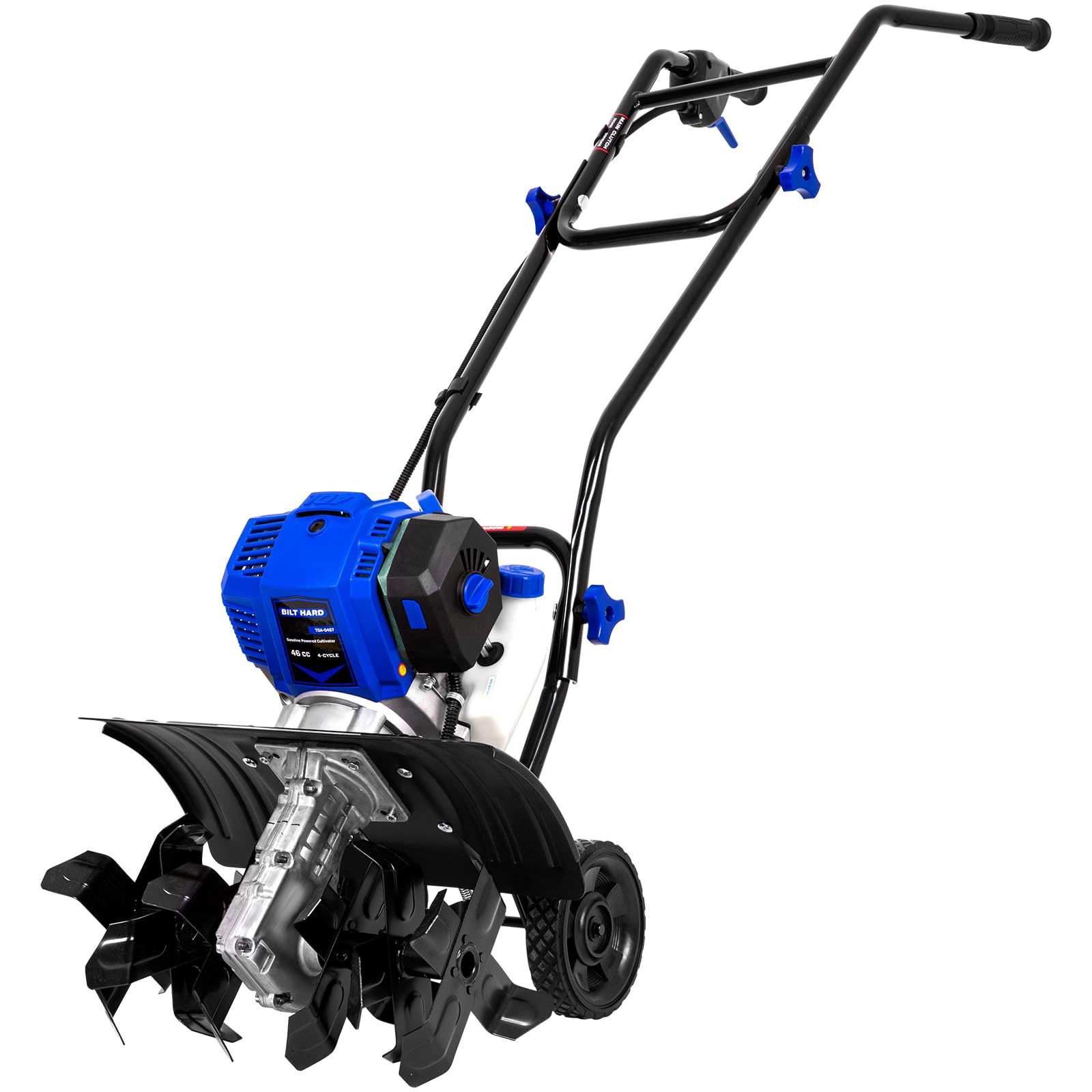
The BILT HARD 46cc runs on a 1.9 HP 4-cycle engine that requires no oil mixing. Six steel forward-rotating blades plus four angled tines create a 16-inch working width with an 8-inch tilling depth. The one-hand thumb throttle and power switch combination simplifies operation, and the automatic reset choke lever aids startup in cooler weather. Assembly takes roughly 20 minutes with the included wing nuts.
Users between 59 and 71 years old report easy solo assembly and starting within four pulls. The machine tilled 120 square feet of packed soil and roots in 20 to 30 minutes without bogging down. The foldable handles reduce storage footprint, and the entire unit stays manageable at roughly 35 pounds. Four-cycle operation means no fuel mixing and less exhaust odor during use.
The 90-day warranty from third-party sellers is short compared to competitors offering 2 or 5 years, though BILT HARD provides a separate 12-month warranty directly. Some users noted difficulty reaching phone support, with email being the reliable contact path. For compact garden maintenance, this machine balances power and weight well for most home gardeners.
Why it’s great
Good to know
6. GardenTrax 40cc 4-Cycle Multi-Function Mini Cultivator

The GardenTrax uses a vertical shaft 4-cycle engine with a lubrication structure that prevents oil leakage at any tilt angle — a genuine advantage when transporting or storing the cultivator in non-level positions. The six forged steel tines rotate at 250 RPM and are reinforced at connection points to reduce metal friction noise and prevent sudden stalls. Width adjusts among 7, 13, and 16 inches with one switch, covering everything from flower bed borders to medium garden plots.
Users with spinal issues report the 45-pound weight is manageable for solo operation, and the 4-cycle engine starts in one pull without requiring fuel mixing. The machine handles tough clay better than expected for its 40cc displacement, though it is not intended for heavy-duty sod busting. The tool-less tine and wheel adjustments simplify configuration changes between tasks.
Reliability reports are mixed: a portion of users experienced hard starting after initial use and difficulty reaching customer support. The packaging quality was flagged in several reviews, though product damage was rare. For gardeners who prioritize lightweight operation and angle-independent storage, this machine offers useful features at a mid-range price point.
Why it’s great
Good to know
7. SENIX 4QL 46cc 4-Cycle Gas Powered Tiller Cultivator

The SENIX 4QL uses patented 4QL Technology that eliminates the need for mixing gas and oil while allowing all-directional use without stalling or oil leakage. The 46cc full-crank engine produces low vibration, and the auto choke with compression release delivers reliable startup in three to five pulls. Six premium steel forward-rotating tines provide a 15-inch working width and 8-inch depth.
Users running this machine through grass, sod, weeds, and rocky soil report surprising power for a 46cc engine. One user described it as a “little beast” that dug one foot deep for a drain field installation. The foldable handles reduce storage footprint to roughly half the assembled size. Assembly takes 10 to 15 minutes, and engine oil is included in the box.
Reports of units failing after 20 minutes exist, though they are outnumbered by positive long-term reviews. The cardboard-like material behind the carburetor is a protective shield, not packing material — removing it will cause starting problems. For residential gardeners who want 4-cycle convenience in a light (31.7-pound) package, the SENIX offers good value with a solid warranty.
Why it’s great
Good to know
8. SuperHandy 52cc 2 Stroke Gas Mini Tiller Cultivator

The SuperHandy 52cc 2-stroke engine delivers 1.3 kW of power at 7,000 RPM with a 30:1 reduction ratio providing 230 RPM at the tines. The four forward-rotating steel tines are replaceable and adjustable, with a working width of 11.8 inches and depth ranging from 3.9 to 5.9 inches. At 34.3 pounds, it sits in the lightweight category for gas cultivators. The EPA certification ensures compliance with emissions standards.
Users consistently praise the power-to-weight ratio, describing it as “chewing up everything it rolls over” and turning hard dirt to powder in minutes. The 2-cycle design produces higher RPM than comparable 4-cycle engines, which helps in weeding and light cultivation tasks. The included transport wheels are a practical addition that many budget models omit.
The main drawbacks are reliability and support. Multiple reports indicate units failing after limited use, with the seller being unresponsive to warranty claims. The assembly instructions are poorly translated, which can frustrate first-time users. For gardeners willing to accept higher risk in exchange for maximum power at the lowest price point, this machine delivers impressive burst performance.
Why it’s great
Good to know
FAQ
Can a gas cultivator break new ground in heavy clay?
How often should I change the gearbox oil in a gas cultivator?
What is the difference between forward and reverse rotating tines?
Final Thoughts: The Verdict
For most gardeners, the gas cultivator winner is the Earthquake 20015 Versa because it combines 99cc torque, tool-less width adjustment from 11 to 21 inches, and a 5-year warranty into a single versatile package. If you need a wide-bed machine for large plots, grab the SPLENDOR 212CC. And for precision weeding and raised bed work, nothing beats the Honda FG110.