
That moment when a standard garden hose just smears the dirt around, leaving a ghost of the stain you tried to wash away, is the exact reason homeowners start looking at gas pressure washers. Unlike electric units that tether you to an outlet and struggle with tough grime, a gas-powered machine delivers the sustained hydraulic muscle needed to strip mold from siding, lift decades of oil from driveway concrete, and blast caked-on mud from patio pavers in a single pass. The trade-off is a heavier, louder machine that demands fuel and oil maintenance — but for anyone with a decent-size property, the cleaning speed advantage is dramatic.
I’m Mohammad Maruf — the founder and writer behind Drink4Good. Over the years I’ve analyzed hundreds of pressure washers across every price tier, focusing on how real-world PSI and GPM numbers translate to actual cleaning speed on home surfaces like cedar fences, stamped concrete, and vinyl siding.
Whether you are washing a two-story house or a long concrete driveway, the right gas pressure washer for home use makes the difference between a weekend chore and a two-minute breeze. After comparing nine models on engine displacement, pump quality, hose reach, and real owner feedback, this guide breaks down which units deliver genuine value for residential buyers who want serious cleaning power without unnecessary complexity.
How To Choose The Best Gas Pressure Washer For Home Use
Home-use buyers often over-buy on PSI while ignoring the flow rate that actually dictates how fast a surface gets clean. Understanding the relationship between pressure, flow, engine power, and pump construction will help you match a machine to your property size and the kinds of grime you face most often.
PSI and GPM — The Cleaning Unit That Matters
PSI (pounds per square inch) determines how aggressively water hits a surface, while GPM (gallons per minute) determines how much water moves across that surface. Multiply the two together for Cleaning Units (CU), the true measure of cleaning speed. A machine with 3000 PSI and 2.5 GPM (7,500 CU) cleans faster than one with 3500 PSI and 2.0 GPM (7,000 CU). For home driveways and siding, a CU of roughly 7,000 to 9,000 is the sweet spot — enough to strip grime without being uncontrollable on wood or painted surfaces.
Engine Displacement and Pump Design
Most gas pressure washers in this price range use OHV 4-stroke engines between 170cc and 212cc. Larger displacement engines (212cc) generally start easier when cold and run more smoothly under sustained load. The pump is equally critical: axial cam pumps are the standard for residential units and are serviceable, while wobble pumps (found on budget units) tend to fail sooner. Look for a maintenance-free axial cam pump with a thermal relief valve — that small feature prevents internal damage when water recirculates during brief pauses.
Hose Length, Wheels, and Portability
A 25-foot hose is the minimum for practical driveway use; anything shorter forces you to drag the entire machine every few feet. The hose diameter (typically 3/8-inch) affects flow restriction — thinner hoses reduce GPM at the gun. Wheels are often overlooked until you try rolling a 60-pound machine across wet grass. Pneumatic tires at least 10 inches in diameter handle uneven terrain much better than hard rubber wheels. Never-flat wheels eliminate the risk of a puncture but ride slightly harder on rough ground.
Nozzle Variety and Onboard Storage
A standard set of quick-connect nozzles (0°, 15°, 25°, 40°, and soap) covers every task from stripping paint to rinsing a car. The 0° nozzle is powerful enough to gouge wood if held too close, so having a wider 40° nozzle for delicate work is essential. Onboard nozzle storage on the frame or handle keeps tips from getting lost in the yard. A built-in soap tank (0.5 to 0.9 gallons) lets you apply detergent without carrying a separate bucket, which speeds up the overall cleaning process considerably.
Quick Comparison
On smaller screens, swipe sideways to see the full table.
| Model | Category | Best For | Key Spec | Amazon |
|---|---|---|---|---|
| Westinghouse WPX3200 | Premium | Balanced home use | 212cc engine, 2.5 GPM | Amazon |
| Simpson CM61456 | Premium | Turbo nozzle cleaning | 174cc engine, Turbo nozzle | Amazon |
| Simpson CM61248-S | Premium | Surface cleaner bundle | 208cc engine, 15″ cleaner | Amazon |
| Toyqqeow 4200PSI | Mid-Range | High-pressure jobs | 212cc engine, 4.0 GPM | Amazon |
| Westinghouse WPX3000 | Mid-Range | Reliable brand value | 212cc engine, 12″ wheels | Amazon |
| PowerSmart DL1034 | Mid-Range | Compact storage | 212cc engine, foldable handle | Amazon |
| AMERISUN AL1038A | Mid-Range | Highest flow rate | 212cc engine, 2.5 GPM | Amazon |
| Ezasin EAPW011 | Budget | Entry-level power | 209cc engine, 2.3 GPM | Amazon |
| Mutaomay MTPW01 | Budget | Basic residential tasks | 209cc engine, 2.3 GPM | Amazon |
In‑Depth Reviews
1. Westinghouse WPX3200 Gas Pressure Washer
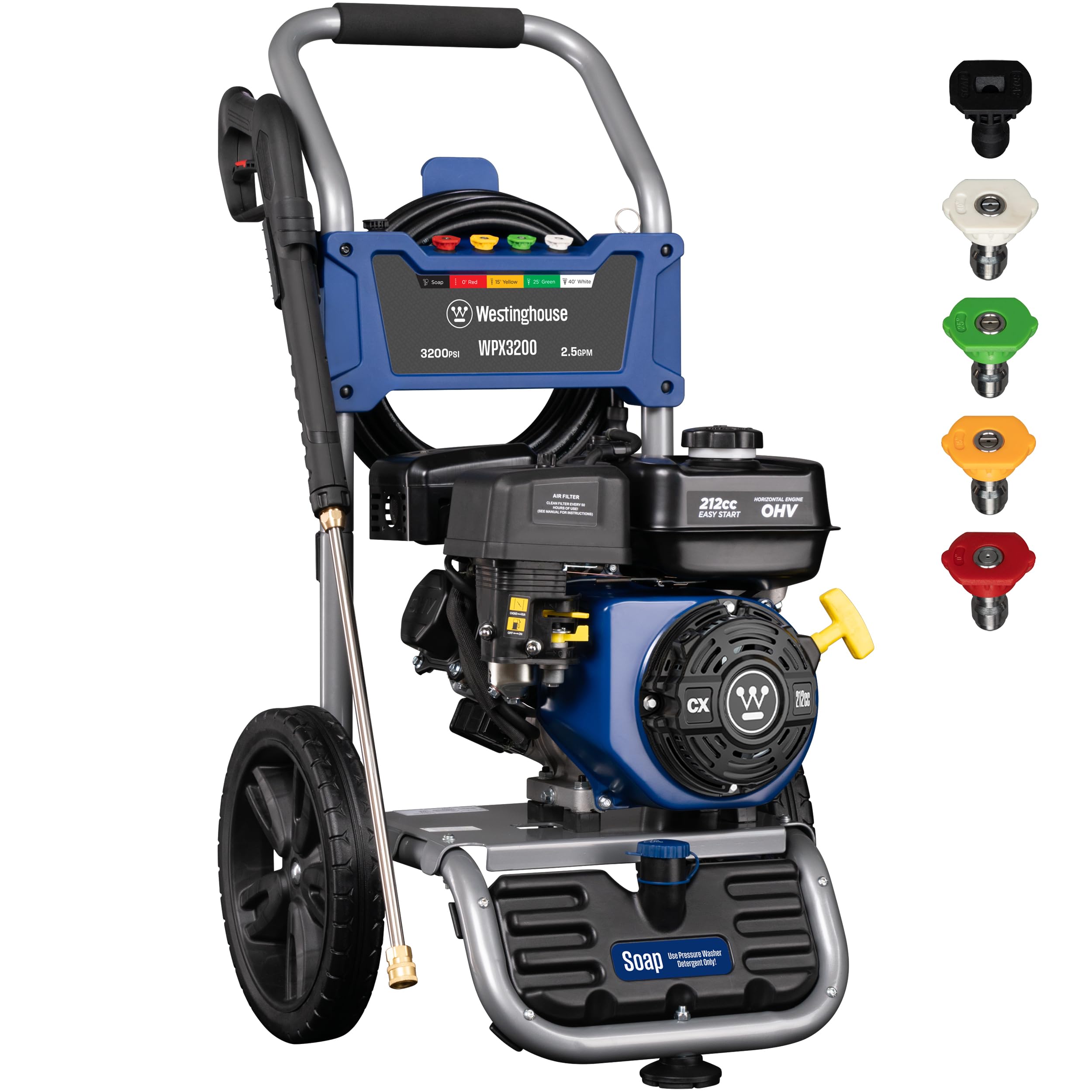
The Westinghouse WPX3200 hits the residential sweet spot with 3200 PSI and 2.5 GPM, producing a cleaning unit count of 8,000 — fast enough to strip moss from a brick patio in one pass but not so aggressive that a 40° nozzle chews through cedar siding. The 212cc OHV engine is the same horizontal-shaft platform used across many premium units, and owners consistently report first-pull starts even after sitting for weeks. The half-gallon onboard soap tank is integrated into the frame rather than dangling on a bracket, which keeps the center of gravity low and reduces tipping risk on uneven ground.
The 12-inch never-flat wheels roll over grass and gravel without sinking, and the welded steel frame has held up well in reports spanning four years of ownership. The 25-foot abrasion-resistant hose is standard, but the M22 fittings are brass rather than plastic, which resists cross-threading. Westinghouse includes a full set of five quick-connect nozzles (including a 15° tip missing from some competitors) and a nozzle cleaner tool stored on the handle. The 3-year limited warranty with national service network adds peace of mind that budget brands cannot match.
One consistent owner complaint is the oil fill cap location — it is tucked behind the engine shroud, making it awkward to top off without a funnel. A few users also note the wand is on the shorter side, causing taller operators to stoop slightly during extended use. Overall, the WPX3200 remains the most balanced gas pressure washer for a homeowner who wants Honda-like reliability without the premium badge markup.
Why it’s great
- Proven 212cc engine starts reliably even in cold weather
- Onboard soap tank and five-nozzle set cover every home cleaning scenario
- Full 3-year warranty with national service network
Good to know
- Oil fill cap is awkwardly positioned behind the shroud
- Standard wand is short for taller users — an extension wand helps
2. Simpson Cleaning CM61456 Gas Pressure Washer
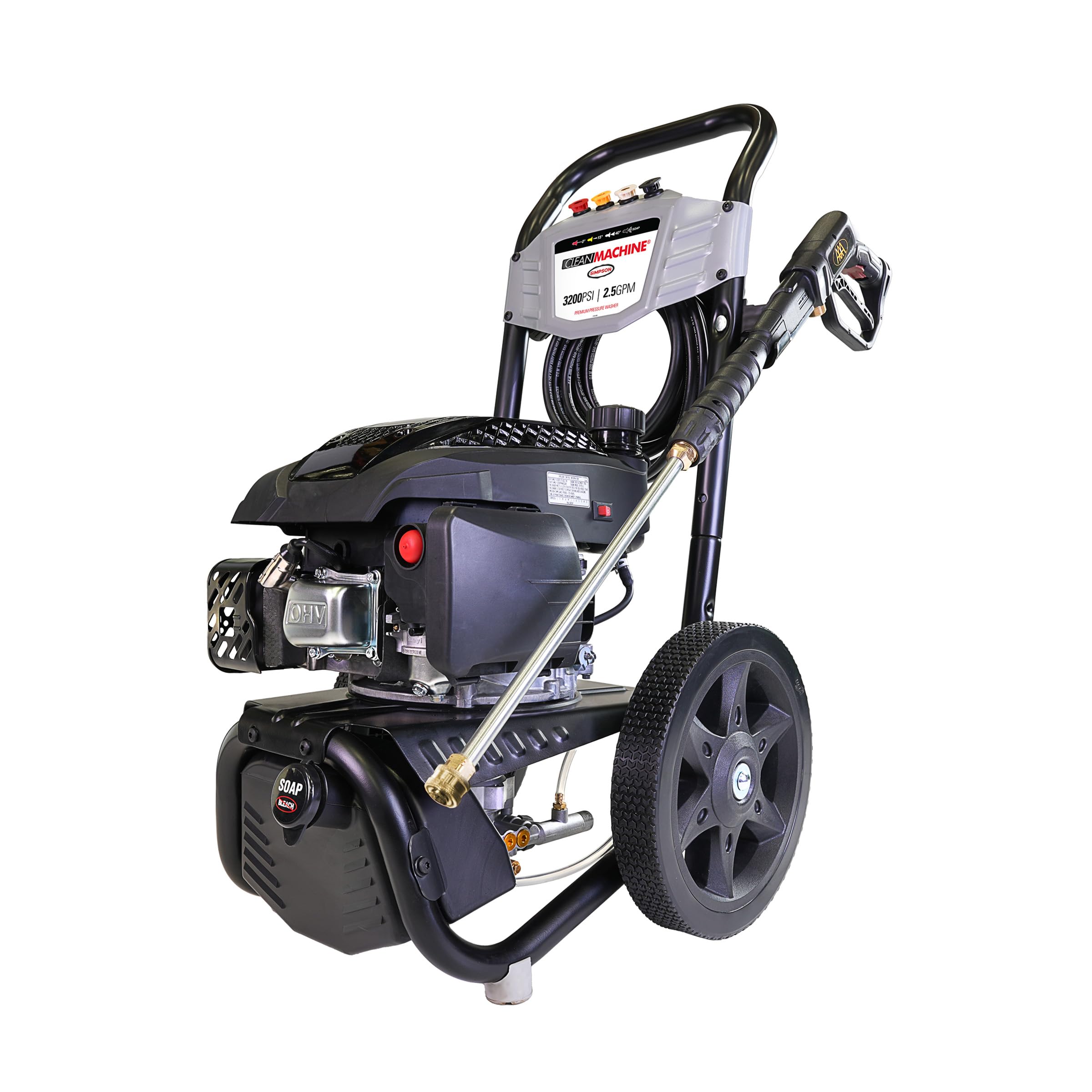
The Simpson CM61456 delivers 3200 PSI and 2.5 GPM from a 174cc engine — slightly lower displacement than some rivals, but the pump tuning means it still produces 8,000 cleaning units. The standout feature is the included turbo nozzle, which oscillates the water stream in a circular pattern. That rotating jet cleans concrete joints and brick mortar lines roughly 40 percent faster than a fixed 0° nozzle because it covers a wider path without losing impact force. For homeowners with large driveways or extensive paver patios, the turbo tip alone justifies this model over cheaper options.
The OEM Technologies axial cam pump includes a thermal relief valve, so brief idle periods (like when repositioning the machine) will not heat-damage the seals. The 12-inch never-flat wheels are the same large-diameter type found on premium units, and the welded steel frame has a powder-coated finish that resists rust far better than painted frames. Simpson packages four standard quick-connect nozzles plus the turbo nozzle, a soap nozzle, a 25-foot hose, and a 16-inch wand. The ergonomic front-load gun uses an M22 connection that makes swapping attachments tool-free.
The trade-off is the 174cc engine size: while adequate for home use, it does not have the torque reserve of a 212cc unit, so sustained high-load work (like running a surface cleaner for hours) may cause more noticeable vibration. Simpson’s warranty structure is tiered — 2 years on the engine, 1 year on the pump, and 5 years on the frame — which reflects the expectation that the pump may be the first component to need replacement under heavy use. For typical weekend driveway and siding cleaning, however, this unit is more than capable.
Why it’s great
- Turbo nozzle cuts concrete cleaning time dramatically
- Never-flat 12-inch wheels roll smoothly over uneven terrain
- Thermal relief valve protects pump during brief idle periods
Good to know
- 174cc engine lacks low-end torque compared to 212cc models
- Pump warranty is only 1 year — consider extended coverage
3. Simpson CM61248-S Gas Pressure Washer with Surface Cleaner
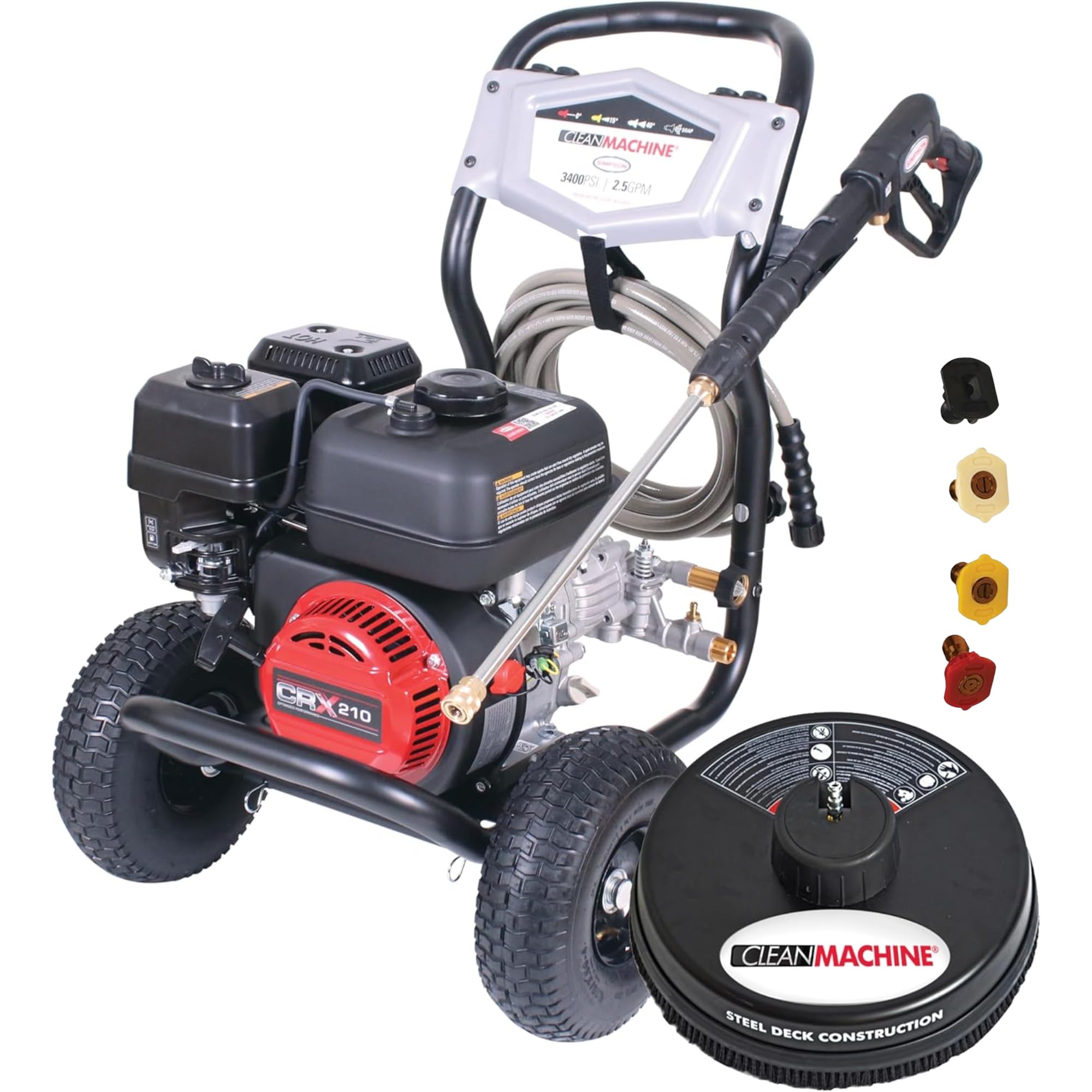
The Simpson CM61248-S bundles a 3400 PSI, 2.5 GPM pressure washer with a 15-inch surface cleaner, making it the most complete kit for homeowners who prioritize flat-surface cleaning. The 208cc CRX engine is slightly smaller than the 212cc units but includes low-oil shutdown — a safety feature that automatically kills the engine before internal damage occurs, which is rare at this price point. The surface cleaner has dual stainless steel nozzles and a powder-coated steel shroud that prevents overspray onto adjacent walls or cars, and its wide deck covers roughly 10 times more area per pass than a standard spray wand.
The OEM Technologies axial cam pump includes a thermal relief valve, and the 25-foot non-marring hose prevents scuff marks on painted surfaces or vinyl fencing. Simpson uses pneumatic 10-inch tires rather than never-flat wheels, providing a slightly softer ride over bumpy ground but introducing a puncture risk if you frequently roll over construction debris. The 64-pound weight is manageable for most homeowners, and the welded steel frame with powder coating has held up well in long-term owner reports. The four standard quick-connect nozzles plus the soap nozzle cover the basics, though the surface cleaner will be the primary tool for most jobs.
The main drawback is that some owners report the surface cleaner stops spinning after a few hours of use — the internal swivel bearing is a wear item that Simpson does not cover under the 90-day accessory warranty. Additionally, the engine can be difficult to start when cold unless the choke is held manually for 30 seconds. For homeowners who plan to clean a long driveway or large patio more than once a year, this kit saves the separate purchase of a surface cleaner (typically to ).
Why it’s great
- Surface cleaner attachment alone is worth the premium over buying separately
- Low-oil shutdown protects the engine from user error
- 3400 PSI provides extra headroom for stubborn stains
Good to know
- Surface cleaner swivel bearing can fail and is not covered under accessory warranty
- Cold-start requires holding the choke manually for best results
4. Toyqqeow 4200PSI Gas Pressure Washer
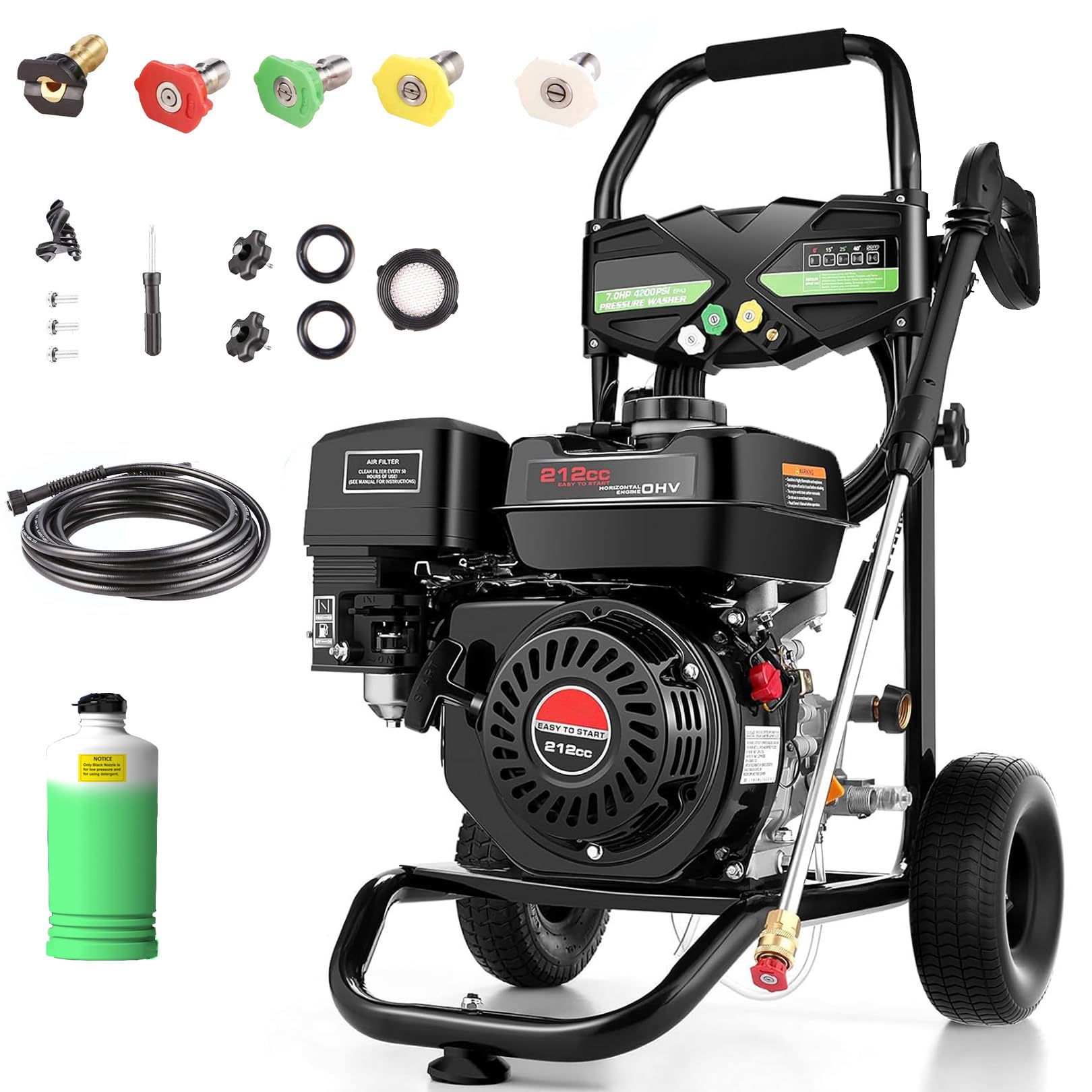
The Toyqqeow 4200PSI machine claims the highest flow rate in this lineup at a theoretical 4.0 GPM, which would produce 16,800 cleaning units — nearly double the output of the Westinghouse 3200. In practice, actual GPM is limited by your garden hose supply and the pump’s internal valving, but even a realistic 2.8 to 3.0 GPM at the gun makes it the fastest rinsing unit here. The 212cc 7.0 HP engine is the same displacement as the premium Simpsons and Westinghouses, and it includes both EPA and CARB compliance, meaning it can be shipped to California without restriction.
The axial cam pump is ETL certified for safety, and the 0.7-liter onboard soap tank is adequate for detergent application on a single vehicle or a small patio. Five quick-connect nozzles (0°, 15°, 25°, 40°, and soap) come stored on the handle, and the 25-foot hose has brass M22 fittings. The never-flat wheels are 10 inches in diameter — slightly smaller than the Westinghouse’s 12-inch wheels, but still capable on grass and gravel. The corrosion-resistant frame adds to the durability profile, and the 60-pound weight is average for this class.
Owner feedback is mixed: several buyers report the hose bursting on the first use, which suggests quality control inconsistencies in the rubber compound or the crimped fittings. A separate thread mentions the machine failing to stay running after the initial break-in period, pointing to possible carburetor tuning issues. For the advertised specifications, this unit offers tremendous theoretical power, but the real-world reliability data is not yet as deep as established brands. Buyers comfortable with potential early warranty claims may find it a compelling high-output option.
Why it’s great
- Highest claimed flow rate in the group for fast rinsing
- EPA and CARB compliant — ships to all 50 states
- 212cc engine provides ample torque for sustained use
Good to know
- Multiple reports of hose bursting on first use
- Carburetor tuning may require adjustment for smooth idling
5. Westinghouse WPX3000 Gas Pressure Washer
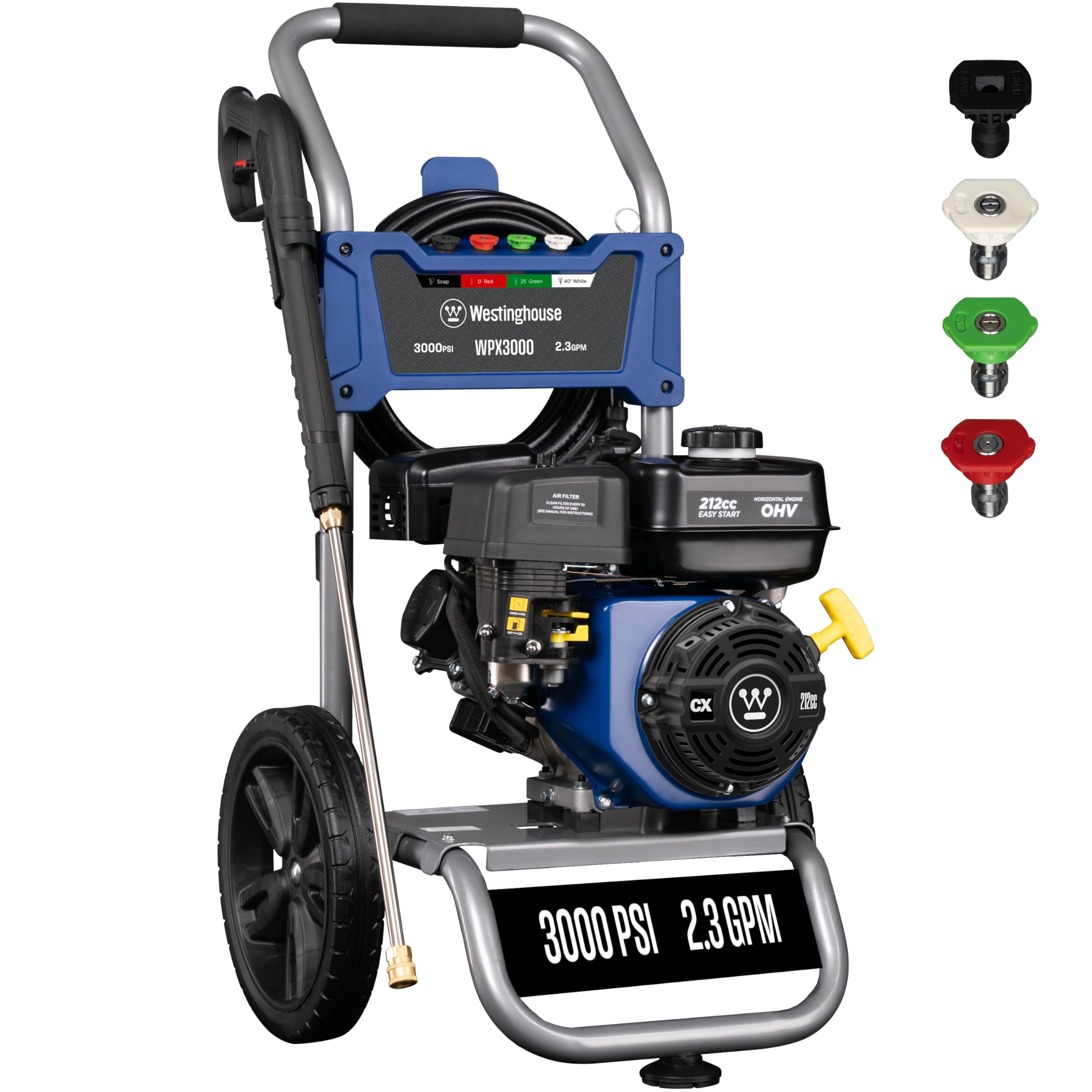
The Westinghouse WPX3000 shares the same 212cc 4-stroke OHV engine platform as the more expensive WPX3200, but with slightly lower pressure output at 3000 PSI and 2.3 GPM. That translates to 6,900 cleaning units — sufficient for most home tasks like washing siding, cleaning a two-car driveway, or prepping a fence for paint, but you will notice the slower pace on larger concrete areas compared to the 2.5 GPM models. The large 0.95-gallon gas tank is a welcome feature, reducing fill-ups during marathon cleaning sessions.
Westinghouse includes the same thoughtful design touches as its sibling: 12-inch never-flat wheels, a maintenance-free axial cam pump, a 25-foot abrasion-resistant hose, and four quick-connect nozzles. The spray gun is lightweight and the M22 connections are brass. The 3-year limited warranty with national service network applies here too, which is a significant advantage over no-name brands that offer minimal post-purchase support. Assembly is straightforward, with most owners reporting they were spraying water within 30 minutes of opening the box.
The main compromise is the 2.3 GPM flow rate. When using a surface cleaner attachment (sold separately), the slower flow means the cleaner rotates more slowly, potentially leaving swirl marks if you move too fast. Some owners also note the air filter can become saturated with oil during shipping, requiring a cleanup before the first start. For buyers on a tighter budget who still want Westinghouse reliability and warranty coverage, the WPX3000 is a smart choice.
Why it’s great
- Same proven 212cc engine as the premium WPX3200
- Large 0.95-gallon gas tank reduces refueling stops
- Comprehensive 3-year warranty with national service network
Good to know
- 2.3 GPM is noticeably slower on large surface areas
- Air filter may arrive oil-soaked and need cleaning before first start
6. PowerSmart DL1034 Gas Pressure Washer

The PowerSmart DL1034 delivers 3400 PSI and 2.5 GPM from a 212cc engine, but it stands out for its compact form factor. The foldable handle reduces the overall footprint for garage or shed storage, and the 31-pound weight ( significantly lighter than the 60-pound Westinghouse units) makes it easier to lift into a truck bed or carry up a flight of stairs. The lightweight construction comes from a minimal steel frame design rather than a full wrap-around cage, which some owners find less rigid but acceptable for home use.
The five quick-connect nozzles (0°, 15°, 25°, 40°, and soap) cover the full range of cleaning patterns, and the 25-foot hose is standard. The 10-inch wheels are pneumatic, providing a smooth ride on pavement but requiring occasional inflation. The OHV engine starts reliably after a few pulls — most owners report success within three pulls on a cold start. The simple housing design keeps the cost down while using the same 212cc engine found in more expensive machines, making this a compelling option for budget-conscious buyers who prioritize a small storage footprint.
Several owners report issues with the soap dispenser having a hole or the engine failing to stay running after the first use, suggesting inconsistent assembly quality. The lightweight frame also means the machine can tip over on uneven ground if the hose is pulled taut. For intermittent use on small driveways and patios, the PowerSmart delivers good power in a small package, but it may not withstand the same abuse as a heavier, more robustly framed unit.
Why it’s great
- Compact and lightweight design for easy storage and transport
- Full-size 212cc engine provides genuine 2.5 GPM flow
- Five-nozzle set covers all common cleaning tasks
Good to know
- Soap dispenser and engine reliability have been inconsistent in some units
- Lightweight frame is prone to tipping on uneven ground
7. AMERISUN AL1038A Gas Pressure Washer
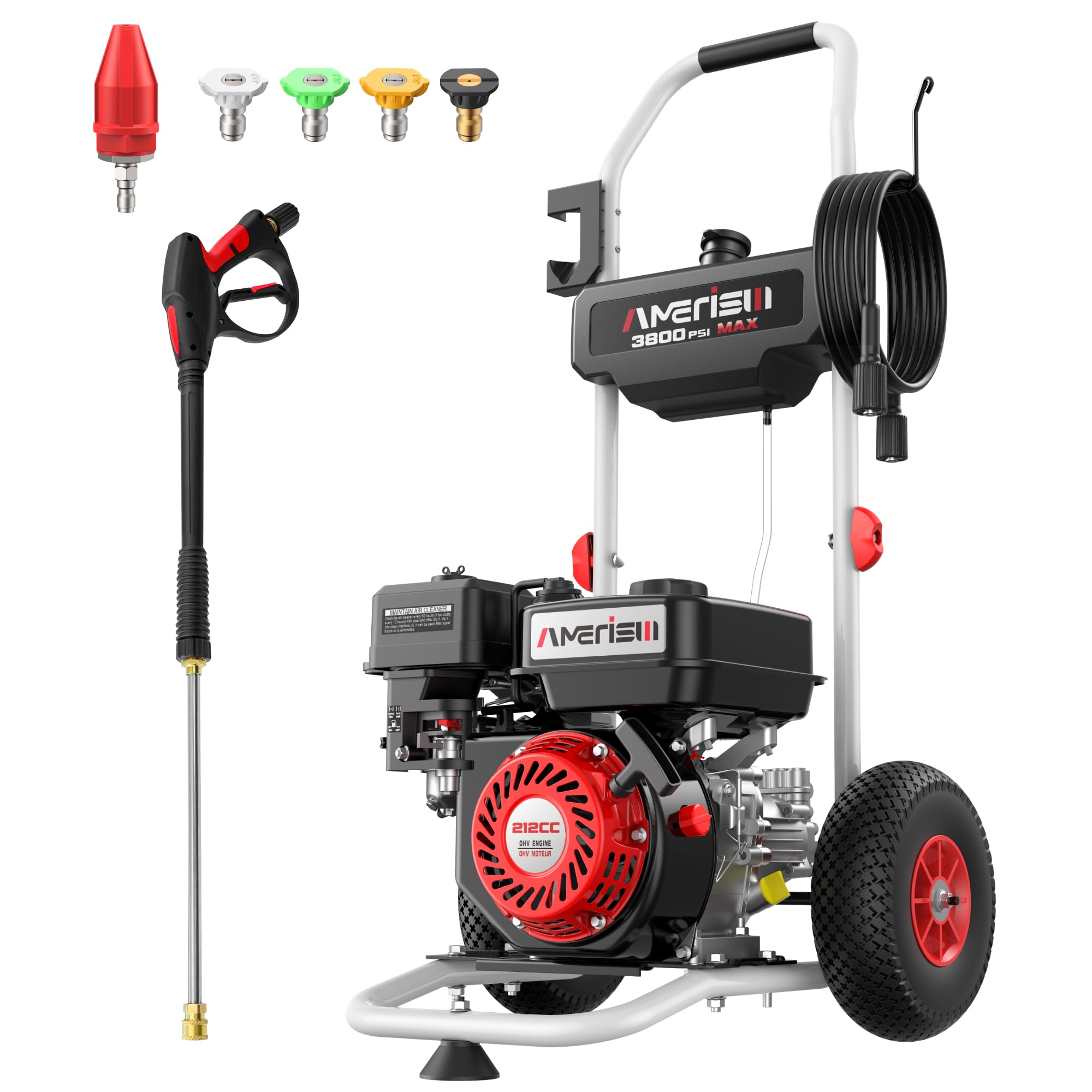
The AMERISUN AL1038A pushes 3800 PSI and 2.5 GPM, producing 9,500 cleaning units — the highest cleaning speed among the standard-frame units here. The 212cc 4-stroke OHV engine is paired with an axial cam pump that includes a thermal relief valve, and the air cooling system helps maintain consistent pressure during extended runs. The extra 400 PSI over the Westinghouse WPX3200 is noticeable on old concrete stains and thick moss, making this a good choice for homeowners with heavily soiled surfaces.
The five quick-connect nozzles (0°, 15°, 25°, 40°, and soap) are stored on the handle, and the 26-foot hose provides slightly more reach than the standard 25-foot hose. The 10-inch never-flat wheels are durable and puncture-proof, though they ride slightly harder than pneumatic tires on rough ground. The reinforced steel frame feels solid, and the 68-pound weight gives it a planted feel during operation. Assembly is straightforward, with most parts fitting without tools.
The biggest concern from owners is the hose bursting on the first use — the included hose appears to have quality control issues that AMERISUN customer support has not always resolved promptly. The engine can also be difficult to start when cold, with some owners resorting to starter fluid. For the price, the power output is impressive, but the reliability questions make it a higher-risk choice than a Westinghouse or Simpson at a similar price point.
Why it’s great
- Highest cleaning unit count in this group at 9,500 CU
- Never-flat wheels eliminate puncture risk on job sites
- Reinforced steel frame feels robust and stable
Good to know
- Multiple reports of hose bursting on first use
- Customer support response can be slow for warranty issues
8. Ezasin EAPW011 Gas Pressure Washer
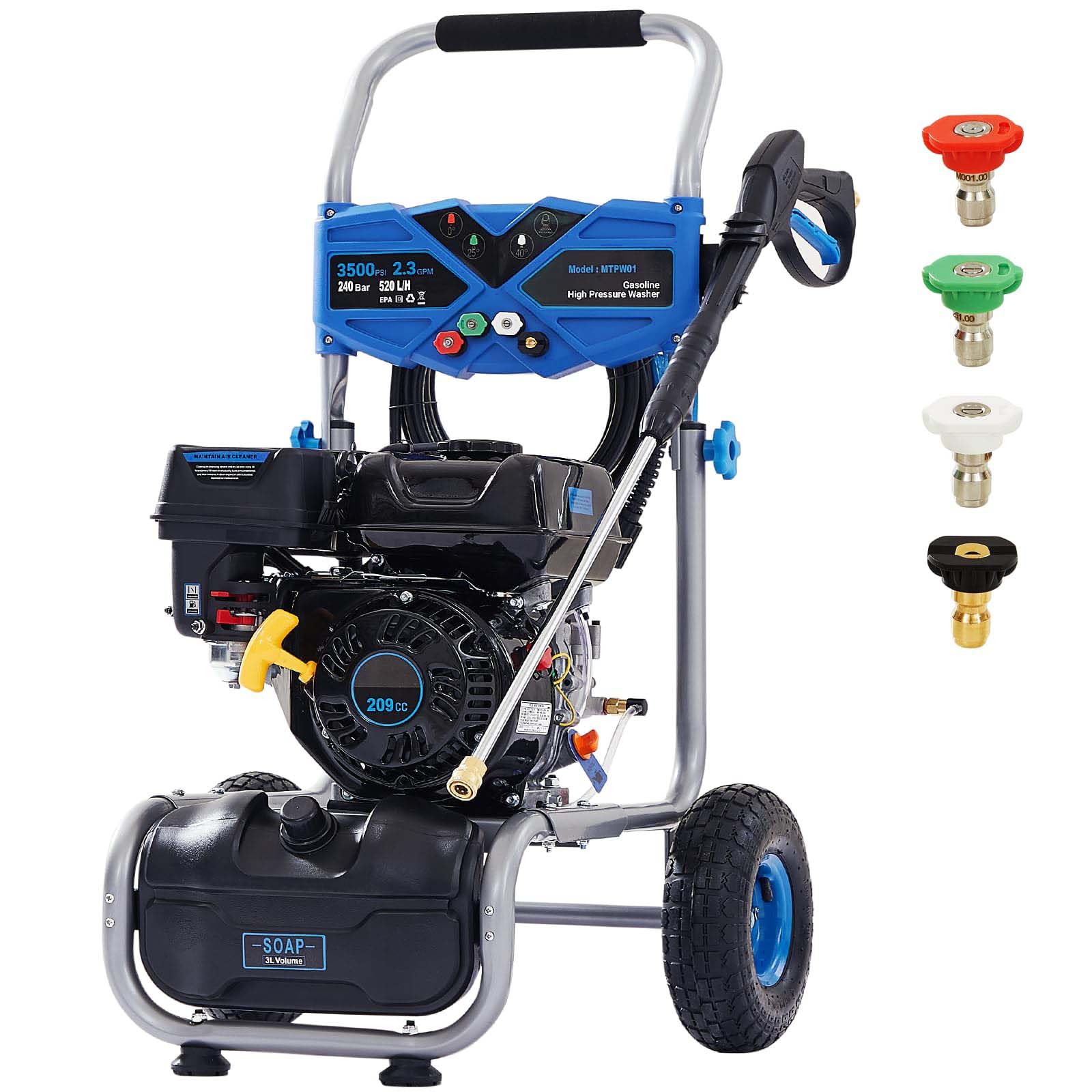
The Ezasin EAPW011 offers 3500 PSI and 2.3 GPM from a 209cc 7HP engine at a budget-friendly price point that undercuts most competitors. For homeowners who need a gas pressure washer for occasional use — cleaning a driveway once a season, washing the house before painting, or blasting mud off construction equipment — this unit delivers adequate power without the upfront investment of premium brands. The axial cam pump is the same design used in more expensive machines, and the 25-foot hose with brass M22 fittings provides a solid connection point.
The 10-inch pneumatic tires roll well on flat ground, and the 63-pound weight is typical for this class. Four quick-connect nozzles (0°, 25°, 40°, and soap) cover the basics, though there is no 15° intermediate tip. The dual front rubber pads add stability and protect the frame from vibration damage. Owner reviews highlight easy assembly and powerful cleaning performance, with several noting that the engine starts within one or two pulls after initial setup. The company offers responsive customer service, including replacement units for defective products even outside the standard return window.
The main trade-offs are lower build refinement and a small number of quality control issues. Some units arrive with a thermal switch that prevents starting in direct sunlight — the engine must cool down before it will crank. The instructions also contain errors regarding the starting procedure, and the oil capacity recommendations can lead to overfilling if followed blindly. For the price, the Ezasin is a capable entry-level gas pressure washer, but buyers should budget for potential minor issues that require customer service contact.
Why it’s great
- Excellent value for the PSI and GPM output
- Responsive customer service with replacement options
- Axial cam pump provides reliable long-term performance
Good to know
- Thermal switch can prevent starting in hot, direct sunlight
- Manual contains errors on oil quantity and starting procedure
9. Mutaomay MTPW01 Gas Pressure Washer
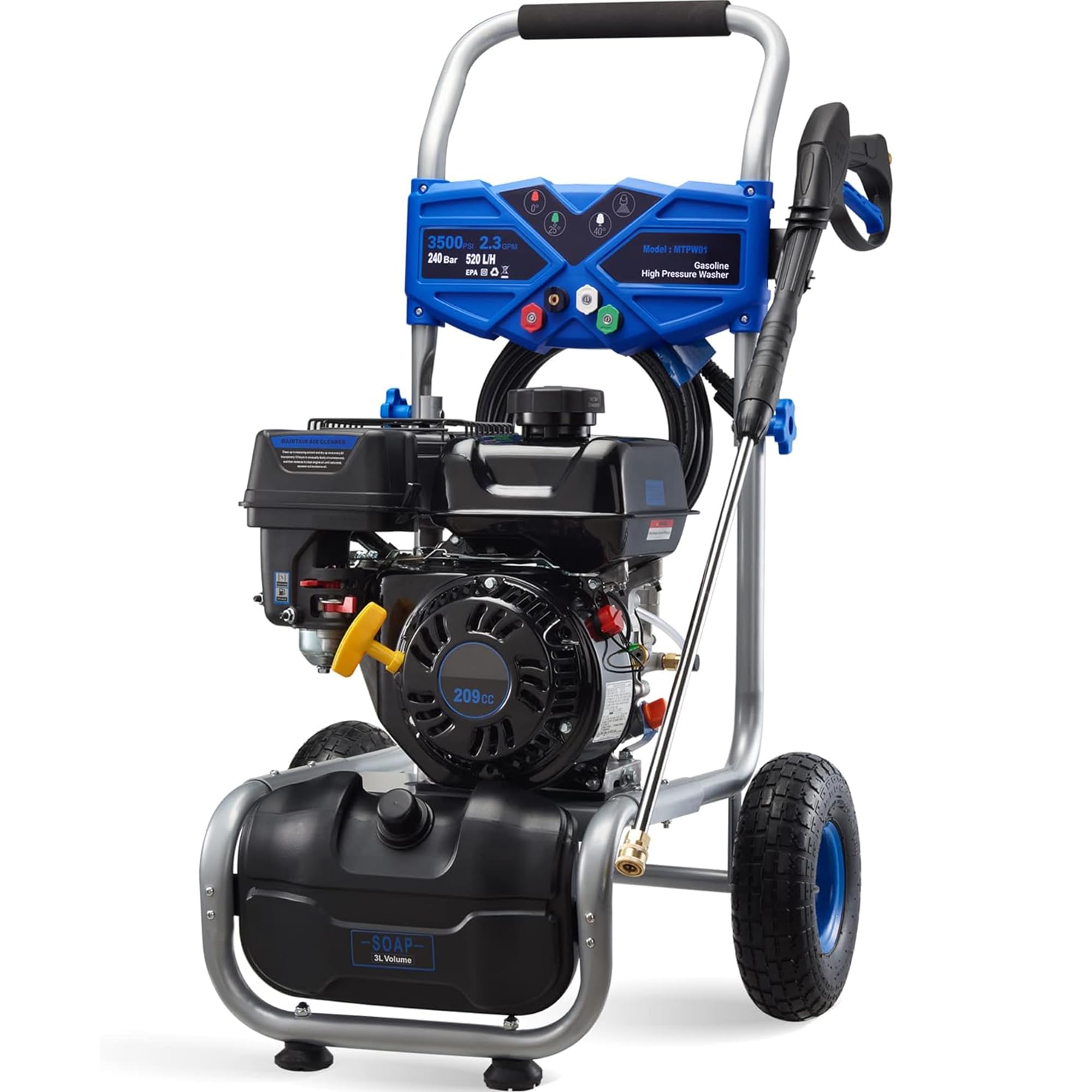
The Mutaomay MTPW01 matches the Ezasin on paper — 3500 PSI, 2.3 GPM, and a 209cc 7HP engine — but adds CARB compliance, making it a viable choice for California residents who need a gas-powered cleaner for home use. The 25-foot hose, four quick-connect nozzles (0°, 25°, 40°, and soap), and 16-inch wand cover the essential toolset. The rugged steel frame with corrosion-resistant coating and 10-inch pneumatic tires provide adequate mobility on flat driveways and patios.
Owner feedback is largely positive, with multiple reports of the engine starting on the first pull from cold. The machine handles typical home tasks well — cleaning wooden fences with the 25° nozzle, washing sidewalk grime with the 40° tip, and applying detergent on vehicles with the soap nozzle. Assembly is straightforward, and the build quality feels solid for the price point. The CARB certification is a real advantage for buyers in restricted states who want gas power rather than electric.
The primary limitation is the 2.3 GPM flow rate, which slows down surface cleaning compared to 2.5 GPM models. Some owners also note the 25-foot hose feels short when working on larger properties — a 35-foot hose would be more practical. A few isolated reports mention the machine not starting after sitting for months, which points to the importance of using fuel stabilizer during storage. For the money, the Mutaomay offers a solid entry into gas pressure washing with the added benefit of CARB compliance.
Why it’s great
- CARB compliant — ships to California without restrictions
- Reliable first-pull starting in cold conditions
- Solid build quality for the budget-friendly price point
Good to know
- 2.3 GPM is slower on large flat surfaces than 2.5 GPM alternatives
- 25-foot hose may be too short for larger properties
FAQ
How often should I change the oil in my gas pressure washer?
Can I use a gas pressure washer on my car without damaging the paint?
What octane fuel should I use in a gas pressure washer?
Why won’t my gas pressure washer start after sitting for months?
Is a gas pressure washer worth it if I only clean my driveway twice a year?
Final Thoughts: The Verdict
For most homeowners, the gas pressure washer for home use winner is the Westinghouse WPX3200 because it combines a proven 212cc engine, true 2.5 GPM flow, a useful onboard soap tank, and a 3-year warranty that no budget brand matches. If you prioritize a turbo nozzle for concrete cleaning, grab the Simpson CM61456. And for the complete kit that includes a 15-inch surface cleaner, nothing beats the Simpson CM61248-S for homeowners with large driveways or extensive patios.