
Gasoline siphons used to mean a mouthful of fuel and the very real risk of inhaling toxic vapors. Modern gas siphon pumps have eliminated that danger entirely, using shaker mechanisms, manual pumps, or squeeze bulbs to start a flow safely. The challenge now is picking a model that actually primes every time, moves fuel fast enough, and handles gasoline without degrading or kinking.
I’m Mohammad Maruf — the founder and writer behind Drink4Good. My method for evaluating these tools combines material chemistry (petroleum-safe PVC vs. polypropylene), flow rate testing under real head-height conditions, and a close look at the fittings where leaks most often start.
After testing the leading options across price tiers, I’ve narrowed the field to five models that perform consistently. This guide covers the best gas siphon pump for emergency roadside refueling, generator maintenance, RV winterizing, and heavy shop use — each chosen for real-world reliability, not just packaging claims.
How To Choose The Best Gas Siphon Pump
Not all siphon pumps transfer fuel the same way. The mechanism that starts the flow, the hose’s inside diameter, and the materials that touch the gasoline all determine whether your siphon works on the first try — or leaves you stranded with a dead battery and a mouthful of fumes. Here are the three specs that separate a useful tool from a frustration.
Prime Mechanism: Shaker vs. Pump vs. Squeeze Bulb
Shaker-style siphons use a weighted ball and a quick up-down motion to create the initial vacuum. They have no batteries and no plastic gears to break, and they never require mouth suction. Manual pump units (the kind with a hand-operated piston) give you more control over flow rate but add parts that can fail when gasoline attacks the seals. Squeeze bulbs are the simplest but often struggle to generate enough vacuum for thicker fluids like cold engine oil. For straight gasoline transfer, a shaker or a robust manual pump is the most dependable choice.
Flow Rate and Hose Diameter
Flow rate is measured in gallons per minute (GPM), and for fuel transfer, anything below 3 GPM feels painfully slow when you are draining a 20-gallon tank. The limiting factor is almost always the hose’s inside diameter. A 1/2-inch ID hose is the standard for automotive fuel ports — it pushes 3 to 4 GPM under good head pressure. A 3/8-inch hose moves fuel slower but fits into tighter filler necks. Match the hose diameter to the smallest opening you plan to use, and do not oversized if you primarily work with lawn equipment and motorcycles.
Material Compatibility with Gasoline
PVC that is not rated for hydrocarbons will yellow, harden, and eventually crack within weeks of contact with gasoline. The best fuel siphons use petroleum-resistant PVC, often reinforced with a spring coil to prevent kinking. The priming end (the nozzle that goes into the fuel source) should be metal — brass or lead-free copper — because plastic nozzles can soften or swell in gasoline. Also check the ball inside a shaker siphon: industrial-grade glass survives years of use, whereas cheap plastic or hollow metal balls crack or lose their seal quickly.
Quick Comparison
On smaller screens, swipe sideways to see the full table.
| Model | Category | Best For | Key Spec | Amazon |
|---|---|---|---|---|
| FlowPro Shaker Siphon | Shaker | Fast fuel transfer | 4 GPM, 8 ft length | Amazon |
| SMART JERRY Pump Kit | Manual Pump | Multi-fluid transfers | 2.9-3.2 GPM, shark-bite | Amazon |
| MADHOLLY Hand Transfer Pump | Manual Pump | RV winterizing | 3/4″ NPT brass adapter | Amazon |
| NATIONAL STANDARD Shaker 2-Pack | Shaker | Multi-location or backup | 3.5 GPM, 6 ft, 2 pack | Amazon |
| Vila Manual Fuel Pump Kit | Manual Pump | Compact emergency kit | 100 CFH flow | Amazon |
In‑Depth Reviews
1. FlowPro 1/2” x 8’ Self-Priming Shaker Siphon

The FlowPro Shaker is the highest-flow unit in this lineup, rated at 4 gallons per minute. That translates to draining a standard 20-gallon boat tank in about five minutes without any pumping — just a rapid up-down shake to start the siphon, and gravity does the rest. The 8-foot length gives enough reach to go from a gas can on the ground into a truck bed tank, which shorter hoses struggle with.
The build quality centers on a lead-free copper nozzle and an industrial-grade glass ball inside the priming chamber. Copper resists gasoline degradation far better than any plastic, and the glass ball holds a seal that cheap metal or plastic balls lose after a few uses. The PVC tubing is petroleum-safe and resists kinking, though a few user reports mention that aggressive storage coiling can eventually create memory bends.
Where the FlowPro trips up is consistency: some units prime instantly with five shakes, while others require persistent shaking or fail to prime at all if the ball sticks. The risk of a stuck ball is real, and it appears more often in the 1/2-inch size than in the larger 1-inch version. If you get a functional unit — and most do — this is the fastest gas siphon on the list.
Why it’s great
- Fastest flow rate at 4 GPM
- Copper nozzle resists gasoline damage
- 8-foot hose reaches distant tanks
Good to know
- Priming ball can occasionally stick
- Some units arrive with kinked tubing
- Not suitable for small fuel filler necks
2. SMART JERRY Siphon Pump Kit
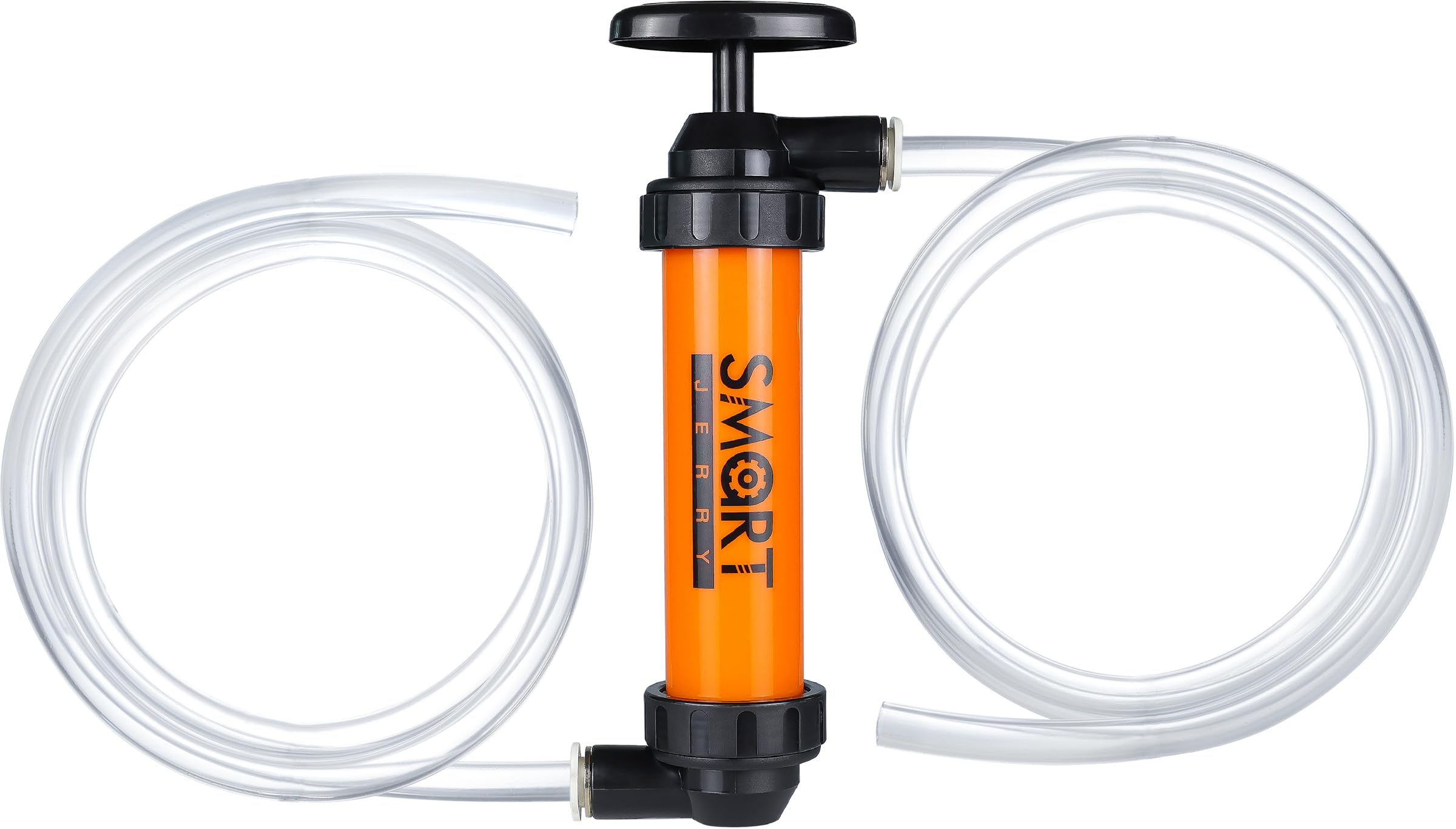
The SMART JERRY introduces a shark-bite fitting that locks the hose onto the pump body without clamps or tools. This is a meaningful upgrade over traditional barb-and-clamp connections, which loosen over time and drip gasoline. Assembly takes under ten seconds, and disassembly is equally fast for cleaning or storage. The pump body is plastic, but the shark-bite mechanism uses a brass insert that holds up well to fuel contact.
Flow rate falls between 2.9 and 3.2 GPM in repeated tests — slightly slower than the FlowPro but still fast enough to empty a 5-gallon gas can in under two minutes. The kit includes a balloon inflation needle, which is a niche bonus for using the pump as an air compressor for sports balls, though the primary function remains fluid transfer. Users report that the pump works well for gasoline, diesel, and water.
The main limitation is hose diameter: the included tubing is on the larger side, which makes it difficult to reach the bottom of a transmission pan or a narrow fuel cell. For standard gas cans, boat tanks, and generator fuel rotation, the SMART JERRY delivers a clean, leak-free experience. The 180-day manufacturer warranty is better than most in this category.
Why it’s great
- Shark-bite connection prevents fuel leaks
- Tool-free assembly in seconds
- Versatile for gasoline, diesel, and water
Good to know
- Large hose may not fit small fill ports
- Plastic pump body less durable than metal
- Not self-priming; requires manual pumping
3. MADHOLLY Hand Fuel Transfer Pump
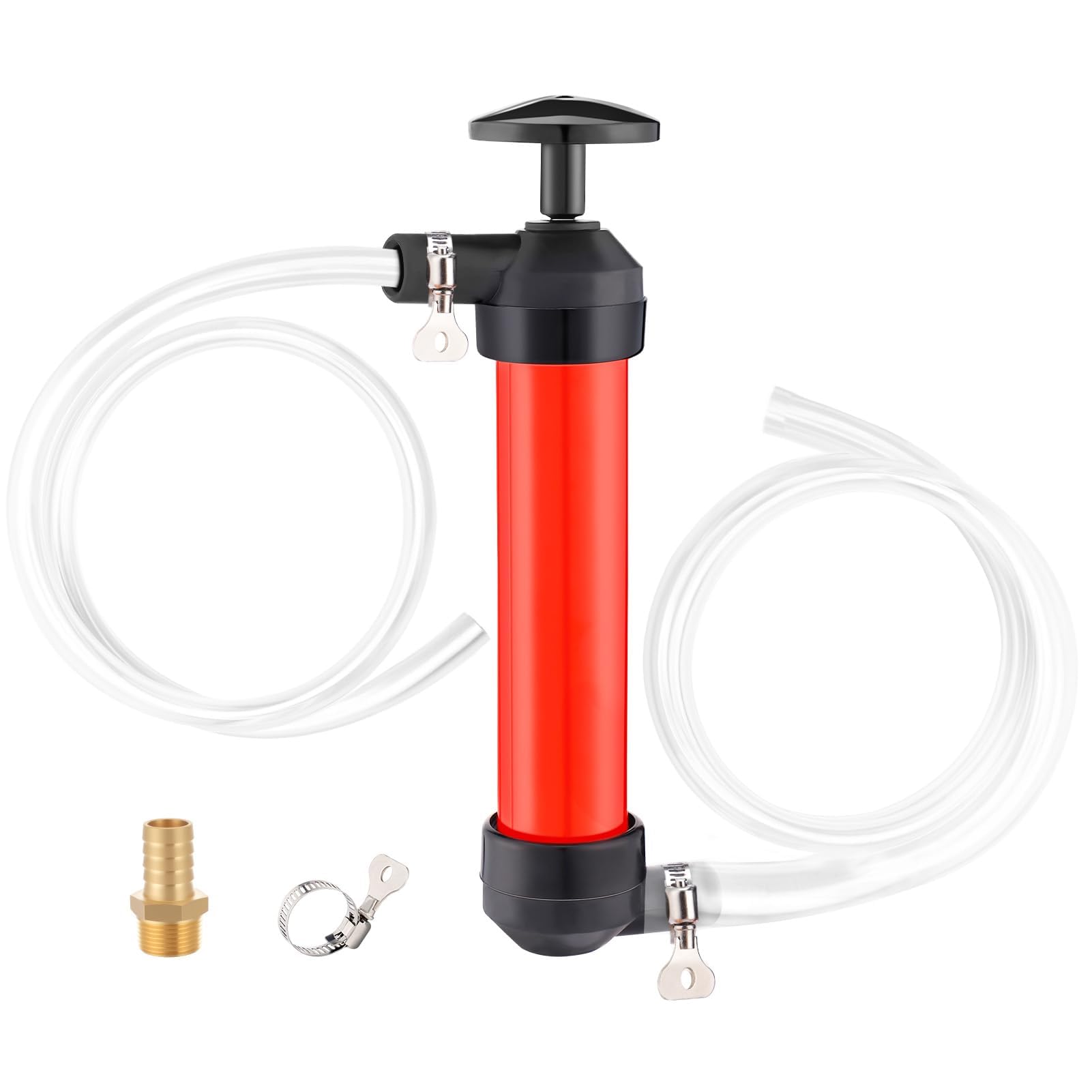
The MADHOLLY kit is built around a specific use case: RV winterization. It includes a 3/4-inch NPT brass connector that threads directly into an RV’s city water inlet, allowing you to pump antifreeze through the system without spilling. That same brass connector works for standard garden hose threads, making it useful for other fluid transfer tasks like filling a camper’s fresh water tank.
The pump itself is a manual piston style, and users report it moves more liquid per stroke than expected — roughly half a gallon per cycle with a steady hand. The kit comes with two hoses, three stainless steel leakproof clamps, and the brass adapter. The clamps are a critical feature: they secure the hose-to-pump connection tightly enough to prevent the dripping that plagues cheaper kits with plastic pinch clamps.
The single asterisk here is the thread type on the included brass adapter. Some units ship with a pipe thread (NPT) rather than a garden hose thread (GH), which means it will not seal on a standard hose bib without a second adapter. If your primary need is RV winterizing, verify your inlet thread type before buying. For general fuel transfer, the kit performs well, though the outlet hose is large enough that you may need a reducer for a kerosene heater or small engine.
Why it’s great
- 3/4″ NPT brass adapter suits RV systems
- Leakproof stainless steel clamps included
- High volume per pump stroke
Good to know
- Brass adapter may use wrong thread type
- Large outlet hose needs adapter for small ports
- Smaller inlet hose can leak at connection
4. NATIONAL STANDARD Shaker Siphon 2-Pack
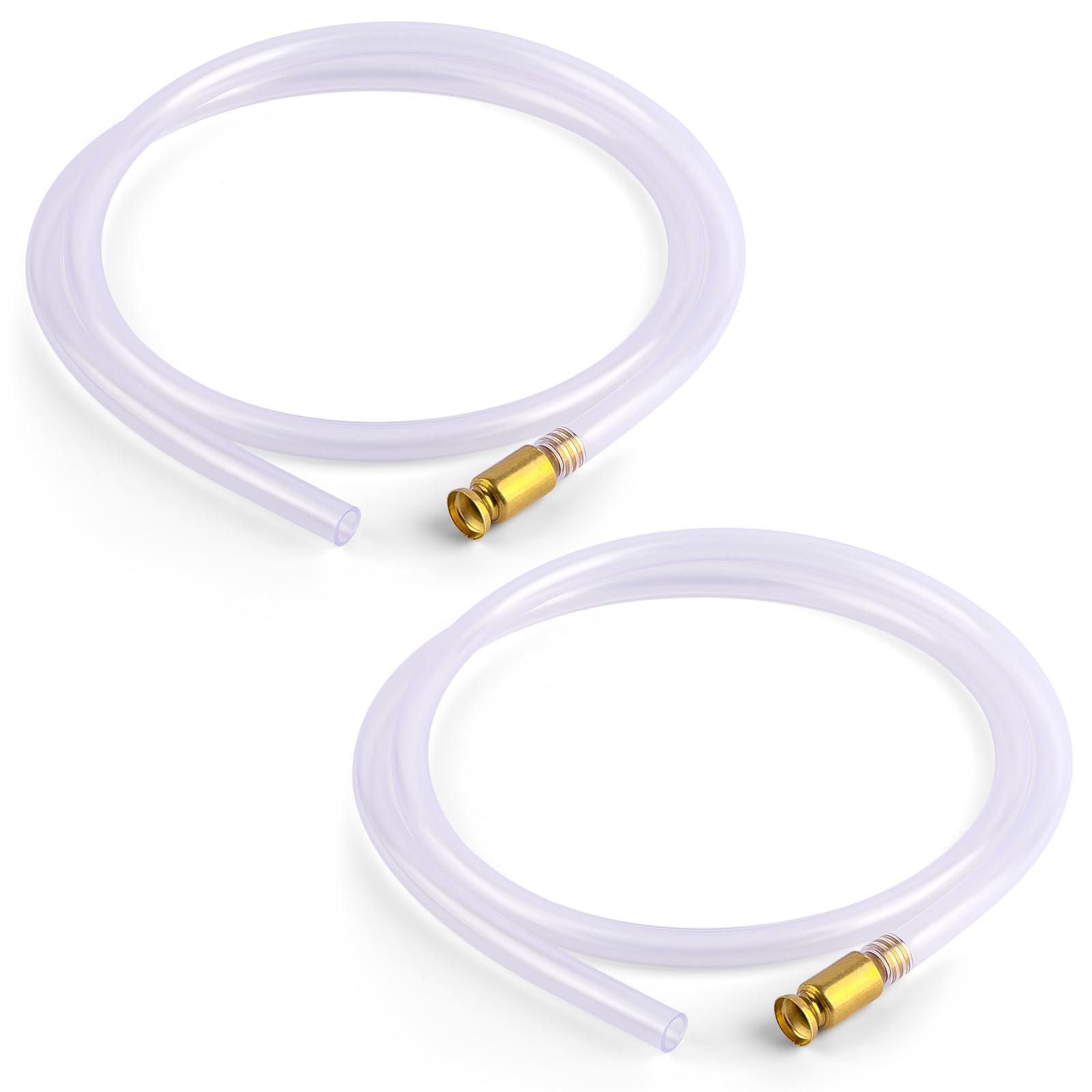
The NATIONAL STANDARD 2-pack delivers two fully independent shaker siphons at a combined price that beats most single-unit competitors. Each hose is 6 feet long with a 1/2-inch inside diameter and a copper priming nozzle. The rated flow is 3.5 GPM, which is realistic under a decent height differential — think gas can on a tailgate draining into a truck tank, not a level transfer.
What sets this kit apart is the tubing quality: the PVC arrives straight and unkinked in the packaging. Many shaker siphons ship coiled so tightly that the hose develops permanent memory bends that restrict flow. The NATIONAL STANDARD hoses lie flat and maintain their shape. The copper pump body and stainless steel spring inside the priming chamber resist gasoline degradation, and the industrial glass ball creates a reliable seal.
Having two siphons means you can keep one in the truck and one in the garage, or dedicate one to gasoline and one to water so you never risk cross-contamination. The only downside is the 6-foot length — it is slightly short for reaching from a ground-level gas can into a lifted truck bed. For most passenger cars, small boats, and lawn equipment, the length works fine.
Why it’s great
- Two siphons for the price of one
- Copper nozzle resists fuel damage
- Tubing arrives straight, not kinked
Good to know
- 6-foot length may be short for tall trucks
- Not ideal for thick fluids like cold oil
- Some units require many shakes to prime
5. Vila Multi-use Manual Fuel Transfer Pump Kit

The Vila kit is the most compact option here — the hand pump and suction tube combine for 24 inches of reach, with a separate 39-inch discharge hose. This is not a tool for draining a fuel tank from ground level; it is built for close-quarters work like transferring fuel from a generator tank into a car, or siphoning water out of a self-watering planter. The small size makes it easy to store in a glove box or emergency kit.
Construction is all PVC plastic, including the pump body. That keeps weight down to 1.2 pounds, but it also means the pump lacks the chemical resistance of copper or brass. Vila states the pump works with gasoline, diesel, kerosene, thinners, and detergents — but explicitly warns against caustic acids or thick fluids. The flow rate is listed at 100.12 cubic feet per hour, which translates to roughly 12.5 GPM under ideal conditions, but real-world pumping is slower because the hand pump requires continuous manual effort.
Durability is the biggest unknown: PVC exposed to gasoline will eventually stiffen and crack, especially if the pump is stored with residual fuel inside. Rinsing with soapy water after each use extends the life, but this remains a budget-tier tool best reserved for occasional emergency use rather than weekly fuel rotation. For the price, it is a functional backup that fits in a door pocket.
Why it’s great
- Very compact for emergency car storage
- Works for water, gasoline, and diesel
- Easy to rinse and maintain
Good to know
- PVC construction less durable than metal
- Short reach limits use to close containers
- Flow slows significantly with continuous use
FAQ
Will a shaker siphon work with diesel fuel?
Can I leave gasoline inside the siphon hose after use?
Why does my shaker siphon stop flowing mid-transfer?
Are shaker siphons safe for transferring gasoline near a hot engine?
How do I clean a gas siphon pump after use?
Final Thoughts: The Verdict
For most users, the best gas siphon pump winner is the FlowPro Shaker Siphon because it delivers the fastest flow rate at 4 GPM with a durable copper nozzle, making quick work of boat tanks, gas cans, and truck fuel transfers. If you want a leak-free pump that assembles in seconds and handles multiple fluids, grab the SMART JERRY Siphon Pump. And for RV winterization or situations where you need a standard threaded connection, nothing beats the MADHOLLY Hand Fuel Transfer Pump with its included 3/4-inch brass adapter and leakproof clamps.