
The faint green glow under a blacklight can be intoxicating, but the only way to know for sure if that thrift-store vase is genuine uranium glass is to measure the gamma it emits. A standard visual inspection is useless for the deep green or yellow pieces that lack the classic Vaseline look, and guessing based on age alone leads to buying modern reproductions. A reliable radiation detector removes all doubt, turning a casual browse into a confident treasure hunt.
I’m Mohammad Maruf — the founder and writer behind Drink4Good. I’ve spent years analyzing detector hardware, from pancake tube sensitivity to scintillator energy resolution, specifically for identifying uranium-infused glassware in the field.
Whether you are a weekend flea-market scout or a serious collector building a verified shelf, the right tool matters. This guide breaks down the nine best contenders for your next hunt to help you find the geiger counter for uranium glass that fits your style and budget.
How To Choose The Best Geiger Counter For Uranium Glass
Uranium glass emits gamma and beta radiation at relatively low levels — far below dangerous amounts, but enough that a sensitive detector will register a clear spike above background. Choosing the right device means balancing portability, sensitivity, and the ability to deliver a quick, unambiguous reading without requiring a PhD in radiation physics.
Gamma Sensitivity Is Everything
Uranium glass primarily emits gamma rays and hard beta particles. Most standard Geiger-Müller tubes detect gamma well but may miss lower-energy beta emissions. A pancake-style tube, like the LND 7317, offers a large surface area that catches beta emissions more efficiently, making it ideal for glassware that is painted or coated. Scintillator-based detectors, such as those using GAGG(Ce) crystals, provide even higher gamma sensitivity and can resolve energy spectra to identify the isotope.
Display Readability in Sunlight and Dim Light
Flea markets and antique shops vary wildly in lighting. A transflective LCD or a bright color screen that stays readable under direct sunlight is a major advantage. Some units offer multiple display modes — curve, large font, or classic click-rate — that help you see the trend at a glance without fumbling with menus.
Alarm and Alert Feedback
When you are walking through a crowded aisle, you want an audible click or a vibration pulse that tells you radiation levels have spiked without forcing you to stare at the screen. Adjustable alarm thresholds let you set a CPM level that indicates a likely positive hit on uranium glass, filtering out normal background fluctuations.
Portability and Durability
A pocket-sized device that slips into a jacket or cargo pocket is far more useful than a bench-top unit. Look for models that survive a drop from waist height and offer a wrist strap or belt clip. Battery life measured in days rather than hours means you won’t be caught dead mid-hunt.
Quick Comparison
On smaller screens, swipe sideways to see the full table.
| Model | Category | Best For | Key Spec | Amazon |
|---|---|---|---|---|
| Radiacode-102 | Scintillator | Isotope identification | GAGG(Ce) crystal, 9.5% FWHM | Amazon |
| GQ 600 PRO | Pancake Tube | Alpha/Beta/Gamma detection | LND 7317 pancake tube | Amazon |
| RDX-2 | Analog GM | Instant analog reading | Halogen-quenched GM tube | Amazon |
| Better Geiger S-2 | Solid-State | High-range emergency use | Solid-state sensor, 3x sensitivity | Amazon |
| GQ GMC-500+ | Dual Tube | Data logging and mapping | Dual GM tubes, WiFi ready | Amazon |
| GQ GMC-320 Plus | Digital GM | Budget-friendly thrifting | 180° swivel display | Amazon |
| GQ-800 | Digital GM | User-friendly interface | Large TFT color LCD | Amazon |
| FNIRSI GC-03 | 3-in-1 | Multipurpose home monitoring | EMF + radiation detection | Amazon |
| Forensics Detectors FD-5000 | Digital GM | Entry-level with test card | 10ft drop test pass | Amazon |
In‑Depth Reviews
1. Radiacode-102

The Radiacode-102 is a gamma spectrometer disguised as a pocket-sized Geiger counter. Instead of a classic GM tube, it uses a GAGG(Ce) scintillation crystal that delivers 20 times the gamma sensitivity of a standard detector, allowing it to pick up even faint emissions from a small uranium glass bead. The free mobile app provides real-time spectrum visualization, so you can identify whether that glowing pitcher is likely U-238 or something else entirely.
For glassware collectors, the isotope identification feature is transformative. You can point the device at a piece and see a spectral peak that matches uranium, which removes all guesswork. The GPS mapping function tracks your finds on a map, which is useful for documenting which shops consistently carry genuine pieces. The 2.36-ounce weight makes it comfortable to carry all day without fatigue.
It detects gamma, X-ray, and hard beta, but not alpha emissions directly. The screen is transflective and works well in both direct sunlight and low light, and the USB-C charging means one less cable to pack. The seven alarm modes — including vibration and app-based alerts — ensure you never miss a hit while browsing.
Why it’s great
- 20x faster detection than standard GM tubes
- Isotope identification via energy spectrum
- Ultra-light and pocket-friendly
- GPS radiation mapping in mobile app
Good to know
- Does not detect alpha radiation
- App QR code setup can be finicky early on
- No built-in data logging without phone connection
2. GQ 600 PRO

The LND 7317 pancake tube in the GQ 600 PRO is the gold standard for detecting alpha, beta, gamma, and X-ray emissions. This wide-surface tube catches particles that a side-window GM tube would miss, making it noticeably more sensitive when scanning painted glass or ceramics with uranium glazes. Users report seeing a tenfold increase in counts on uranium glass compared to their previous GMC-500+ units, which is exactly the kind of real-world performance you want when hunting for subtle radioactive pieces.
Built-in WiFi enables automatic data logging to the GQ Geiger Counter World Map, which sounds niche but is actually practical for documenting your collection or comparing readings across different sourcing locations. The display rotates 180 degrees, which is handy when you are holding the device upside down to get the window close to a shelf edge. The rechargeable battery lasts for months of normal use — not hours or days — which is a massive relief for anyone who has been stranded by a dying lithium pack mid-afternoon.
The 1.6-pound weight makes it the heaviest unit in this list, but the trade-off is a tough plastic housing that survived a 4-foot drop onto concrete without damage. The UI is menu-driven and occasionally non-intuitive, so spending 15 minutes with the manual on day one is recommended. The included demo software on PC works well for export analysis, though the suite is stuck in demo mode until you enter your serial number.
Why it’s great
- LND 7317 pancake tube detects alpha emissions
- Tenfold higher counts on uranium glass vs standard GM
- Months-long battery life
- WiFi data upload with cloud storage
Good to know
- Heavier than pocket-sized units
- PC software can be clunky
- UI has a learning curve
3. RDX-2

The RDX-2 is a classic analog meter that completely skips digital complexity. Press the button, and the needle swings as the audio clicks rise — that is the entire interface. It uses a halogen-quenched Geiger-Müller tube with 28 mg/cm² density, which is sensitive enough to register a clear burst on uranium glass within seconds. There is no pairing, no app, and no menu diving; the analog meter and rising chirp rate give you all the information you need to decide if that platter is worth buying.
The included test sample of Fiestaware pottery lets you verify the unit works out of the box, and users confirm it picks up uranium glass strongly. The 9-volt battery lasts about 1.5 days of continuous use but weeks if you only turn it on for short thrifting sessions. The logarithmic scale covers 0-1000 µSv/hr and 0-100 mR/hr, which is more than sufficient for the modest activity levels of uranium glass.
Being analog, it offers zero data logging, no dosimeter function, and no visual history. You get a reading in real time and nothing more. For collectors who want a simple, reliable, and instantly readable device that will never suffer from firmware bugs or dead screens, the RDX-2 is a rugged choice. The US-made build quality and EMP resistance add confidence for emergency preparedness use as well.
Why it’s great
- Instant analog reading with no setup
- Included test sample for verification
- EMP-proof and rugged
- Made in USA with robust build
Good to know
- No data logging or digital history
- 9V battery burns in continuous use
- Not suitable for isotope identification
4. Better Geiger S-2

The Better Geiger S-2 uses a solid-state scintillator design that is roughly three times more sensitive to gamma and X-ray radiation than a typical Geiger-Müller tube. This means it will register uranium glass from a greater distance and more quickly than most GM-based units, which is useful when you are scanning a crowded shelf from arm’s length. The automatic energy correction adjusts the measured dose rate based on the energy of the incoming photon, improving accuracy across different source types.
It runs on two AA batteries for over 50 hours of typical use, which is a deliberate design choice to avoid the planned obsolescence of proprietary lithium packs. The included rubber shock protector and sealed case make it genuinely rugged for field use. The buttons and menu are straightforward — set your dose rate and total dose alarms, then forget about it. The audible click response is immediate and satisfying, with a clear pitch shift as radiation increases.
There is no graphing, no data logging, and no WiFi. This is a purpose-built instrument for getting a fast, accurate reading without distractions. It also handles radiation levels up to 100 times higher than standard GM tubes, which makes it future-proof for emergency scenarios, though that capability is overkill for typical uranium glass hunting. US design and manufacturing add a layer of quality assurance that cheaper imports cannot match.
Why it’s great
- 3x more gamma sensitive than standard GM tubes
- 50+ hour battery life on standard AA
- Rugged with sealed case and shock protector
- Made in the USA
Good to know
- No data logging or graphing
- No app connectivity
- Premium price reflects US manufacturing
5. GQ GMC-500+
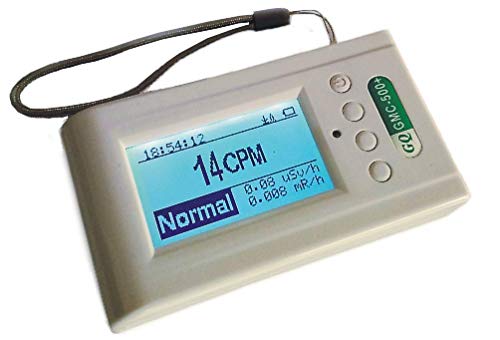
The GQ GMC-500+ features two Geiger-Müller tubes working in parallel, which improves accuracy and widens the measurable count range compared to single-tube designs. For uranium glass hunters, this means more reliable readings on both low-activity pieces and heavily uranium-laden items without saturating the tube. The bright, multi-format display shows readings in CPM, µSv/h, and mR/h, and you can switch between text, graph, and large font modes.
Built-in WiFi capability lets you upload readings to the GQ Geiger Counter World Map for unlimited online storage and trend analysis. The free data processing software works on Windows and supports export to Excel and CSV. At 5.8 ounces, it is light enough to carry in a jacket pocket alongside your wallet and keys. The rechargeable lithium battery provides solid runtime, and the unit includes a carrying case to protect it in a bag.
Some users report that the first unit failed after about two years, and GQ Electronics does not offer repair service — they recommend replacement instead. The WiFi setup can be finicky if you have a mesh network, and the PC software is dated. For the price, the dual-tube design and mapping features make this a strong mid-range option for collectors who want to document and share their finds.
Why it’s great
- Dual GM tubes for broader range and accuracy
- WiFi data upload with cloud storage
- Lightweight at 5.8 ounces
- Includes carrying case
Good to know
- No repair service available
- WiFi setup can be tricky
- PC software is dated
6. GQ GMC-320 Plus
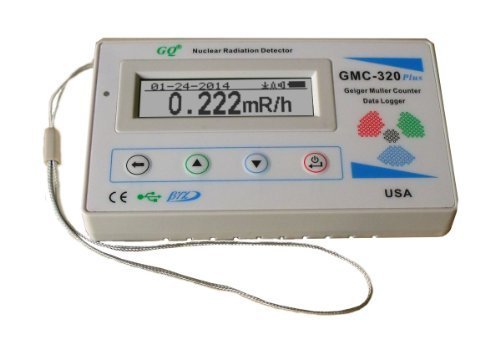
The GMC-320 Plus is one of the most popular entry-level Geiger counters among uranium glass enthusiasts, and for good reason. The 180-degree auto-swivel display solves a practical problem: when you hold the unit upside down to get the sensor close to a shelf, the screen rotates to stay readable. The text, graphic, and large font modes give you flexible ways to view the data, and the rechargeable battery keeps you going through a full day of shopping.
Users consistently report that it picks up Vaseline glass and uranium-infused pottery reliably, with readings that are accurate enough for confident identification. The audible click sound is adjustable, and you can set alarm thresholds for your preferred CPM level. The unit is lightweight at only 6 ounces and has survived occasional drops over years of use without issues. The data recorder logs readings for later playback, which helps when you want to compare items across different stores.
The main drawback is screen readability in bright sunlight — the LCD washes out, requiring you to shade it with your hand. The glass Geiger-Müller tube is fragile by nature, so dropping it directly onto the sensor face could be expensive. For the price, however, it offers the best balance of sensitivity, portability, and ease of use for casual to intermediate collectors.
Why it’s great
- Auto-swivel display for upside-down readings
- Reliable detection of Vaseline glass
- Rechargeable battery with long runtime
- Data recorder with multiple display modes
Good to know
- Screen hard to read in direct sunlight
- GM tube is fragile
- Wrist strap may break early
7. GQ-800
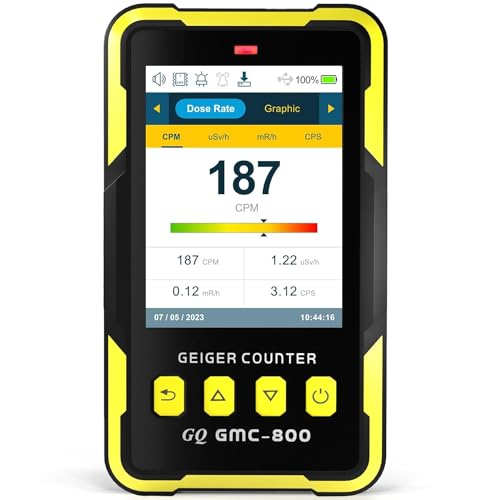
The GQ-800 is the latest upgrade from GQ Electronics, featuring a large TFT color LCD that remains readable under direct sunlight — a direct improvement over the GMC-320 Plus screen. It detects beta, gamma, and X-ray radiation with a quick response time that shows a reading immediately upon power-on. The user interface is designed to shorten the learning curve, with one-button shortcuts between four function screens: instantaneous flux, real-time timeframe, dosimeter, and monitoring mode.
Five alarm types — visual LED, audio, vibration, voice, and a combined mode — ensure you never miss a detection, which is especially useful for hearing-impaired users or when the environment is noisy. The built-in clock and memory store up to 10 years of data, and the free data processing software supports firmware updates and open protocol for custom integration. At only 0.7 inches thick, it slides into a shirt pocket comfortably.
Some users note that the readings are not as precise as a Radeye unit, which is expected at this price tier. The software lacks Mac support and the Windows utility feels outdated with occasional driver issues. For uranium glass hunting, the fast response, color display, and multiple alarm feedback make it a very capable daily driver that is easier to navigate than the more menu-heavy GMC-500+.
Why it’s great
- Sunlight-readable TFT color LCD
- Five alarm types including voice
- Ultra-slim at 0.7 inches thick
- Long battery life with replaceable cell
Good to know
- No native Mac software support
- PC software feels dated with driver quirks
- Less accurate than professional-grade units
8. FNIRSI GC-03
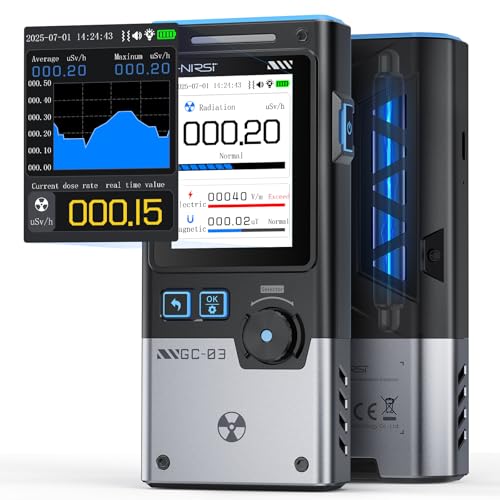
The FNIRSI GC-03 is a three-in-one detector that combines a Geiger counter for gamma, beta, and X-ray with electric field and magnetic field measurement. This extra versatility is helpful if you also want to check for EMF from appliances or wiring in old buildings. The glass GM tube inside is sensitive to gamma, and it does not pick up low-energy alpha or beta very well, but for uranium glass — which emits mostly gamma — it performs adequately for establishing a baseline.
Three display modes — curve, professional, and quick view — let you see radiation changes over time or get a fast numerical reading. The day and night theme display adapts to your lighting conditions. Visual, audible, and vibration alerts activate when radiation exceeds safety thresholds, and the device logs up to 50 alarm history entries. At 11.3 ounces, it is mid-weight but still pocketable in a larger jacket.
The magnetic field sensor only measures flux changes, not static fields, so do not expect it to read a permanent magnet. The screen is less colorful than product photos suggest, though it remains fully functional. For a uranium glass hunter who also wants a general-purpose environmental meter, the GC-03 provides good value, but dedicated Geiger counters will offer higher sensitivity and simpler operation for glass-specific scanning.
Why it’s great
- Three-in-one: radiation, electric field, magnetic field
- Day and night display themes
- Three distinct display modes
- Rechargeable with included battery
Good to know
- Magnetic sensor only reads flux changes
- Limited sensitivity to low-energy beta/alpha
- Screen looks plainer than advertised
9. Forensics Detectors FD-5000
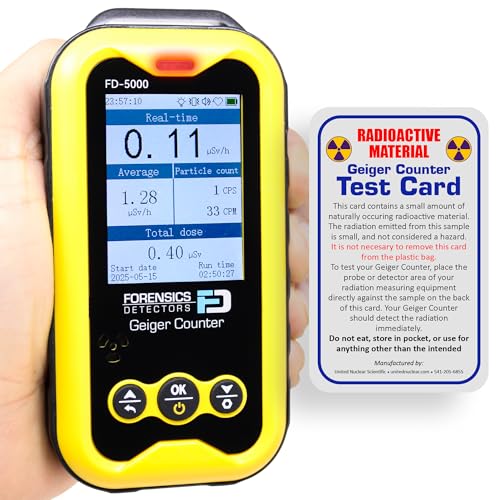
The FD-5000 comes with an included radiation test card that lets you verify the unit is working immediately — a thoughtful addition for first-time buyers. The ABS housing passed a 10-foot drop test, giving it the best durability claim in this price tier. It detects beta, gamma, and X-ray radiation, and the large color LCD shows readings in dosimeter mode, CPM count mode, and graph mode for visual trend tracking.
At around 7 inches tall, it has a substantial hand feel but remains portable enough to carry in a bag. Users report it works well for thrifting and detecting uranium glass, though there is a slight learning curve to understanding the units displayed. The 1-year warranty and US-based customer support in Los Angeles add peace of mind that is rare at this price point.
A few isolated reviews mention accuracy concerns and difficulty obtaining refunds, which suggests some batch variance. The 20-year sensor life claim is reassuring if it holds up over time. For an entry-level device that includes everything you need to start hunting immediately — test card, clear display, and durable build — the FD-5000 is a solid gateway into uranium glass detection without a big financial commitment.
Why it’s great
- Includes radiation test card for instant verification
- ABS housing passes 10-foot drop test
- Large color LCD with graph mode
- 20-year sensor life and 1-year warranty
Good to know
- Some reports of accuracy inconsistency
- Small learning curve for units
- Refund process can be difficult
FAQ
Can any Geiger counter detect uranium glass, or do I need a special model?
What CPM reading should I expect from a piece of uranium glass?
Is it safe to carry a Geiger counter in my pocket all day?
Why does my Geiger counter show a reading when nothing is near it?
Final Thoughts: The Verdict
For most users, the geiger counter for uranium glass winner is the Radiacode-102 because its scintillator crystal offers 20x faster detection and actual isotope identification, turning a simple counter into a full spectrum analyzer that fits in a pocket. If you want a pancake tube with alpha detection and WiFi data logging, grab the GQ 600 PRO. And for a rugged, no-nonsense analog reading that works every time without batteries or Bluetooth, nothing beats the RDX-2.