
Getting a good night’s sleep at the campsite often comes down to one decision: the hum of your power source. A generator that rattles the trees or struggles to run a CPAP machine can ruin the solitude you drove hours to find. The trick is balancing clean sine wave output, decibel ratings that won’t draw ranger visits, and enough runtime to get through a weekend without topping off the tank at midnight.
I’m Mohammad Maruf — the founder and writer behind Drink4Good. For this guide, I’ve spent weeks parsing the specs, customer longevity reports, and real-world noise measurements across dozens of portable models to find the ones that genuinely deliver on their promises for life under canvas.
Whether you need to keep a RV air conditioner cycling or just want to charge phones and run a coffee maker without the drone of a construction site, this breakdown of the generator for camping market will help you pick the right balance of portability, power, and peace.
How To Choose The Best Generator For Camping
Camping generators sit at a different intersection than home standby units. You are trading raw wattage for portability, noise control, and fuel efficiency. The wrong choice means either lugging a 100-pound brick across a trail or running out of power halfway through the second night. Here are the three specs that separate a campsite companion from a regret.
Noise Floor: Decibels at 23 Feet
Most campgrounds enforce a quiet-hours rule around 10 PM, and many have a hard limit of 60 to 65 dBA for generator use. A generator rated at 53 dBA from 23 feet — like the Champion 2500-watt — will let you run a fridge without earning sideways glances. Anything above 60 dBA is audible across multiple sites. Always check the rating distance; some brands cite measurements at 7 feet, which can be 5 to 7 dBA louder than the 23-foot standard.
THD and Clean Power for Sensitive Electronics
Inverter generators produce electricity with less than 3% total harmonic distortion (THD), which is safe for laptops, CPAP machines, and modern refrigerator control boards. Non-inverter models often push THD above 6%, which can damage sensitive electronics over time. When your gear costs hundreds of dollars, the extra cost of an inverter model is cheap insurance. Look for explicit THD ratings under 3% — ideally under 1.5% — if you rely on medical devices or charge expensive batteries.
Runtime and Fuel Flexibility
Runtime at 50% load tells you how long the generator will run before a refill, which can mean the difference between a full night’s sleep and a 2 AM gas station run. Dual-fuel models add propane as an option, which burns cleaner and stores indefinitely. Also consider the tank size: a 1.1-gallon tank running at half load for 5.5 hours might be enough for a weekend, while an 8-hour tank gives you a full sleep cycle plus morning coffee on a single fill.
Quick Comparison
On smaller screens, swipe sideways to see the full table.
| Model | Category | Best For | Key Spec | Amazon |
|---|---|---|---|---|
| Honda EU2200i | Inverter | Ultra-quiet campsites | 48-57 dBA, 8.1 hrs runtime | Amazon |
| Champion 2500W | Inverter | Lightweight portability | 39.7 lbs, 53 dBA | Amazon |
| Westinghouse iGen2800DFc | Dual Fuel | Gas/propane flexibility | 45 lbs, 52 dBA | Amazon |
| WEN DF360iX | Dual Fuel | RV power with propane | 3600 surge / 2900 run watts | Amazon |
| Pulsar PGD40ISCO | Inverter | Budget-friendly 4000W | 47.3 lbs, 59 dBA | Amazon |
| PowerSmart 3800W | Inverter | Mid-range quiet power | 52 lbs, 59 dBA | Amazon |
| ERAYAK 4500W | Inverter | High wattage / ECO mode | 55 lbs, 60.5 dBA | Amazon |
| Generac GP3300i | Inverter | PowerRush starting capacity | 59.5 lbs, COsense | Amazon |
| WEN 56360i | Inverter | Light RV / camp power | 46 lbs, RV-ready | Amazon |
| BILT HARD 2500W | Inverter | Entry-level quiet inverter | 42.6 lbs, 67.2 dBA | Amazon |
| Jackery Explorer 2000 v2 | Solar/Battery | Zero-emission quiet power | 2042Wh, 2200W inverter | Amazon |
In‑Depth Reviews
1. Honda EU2200i
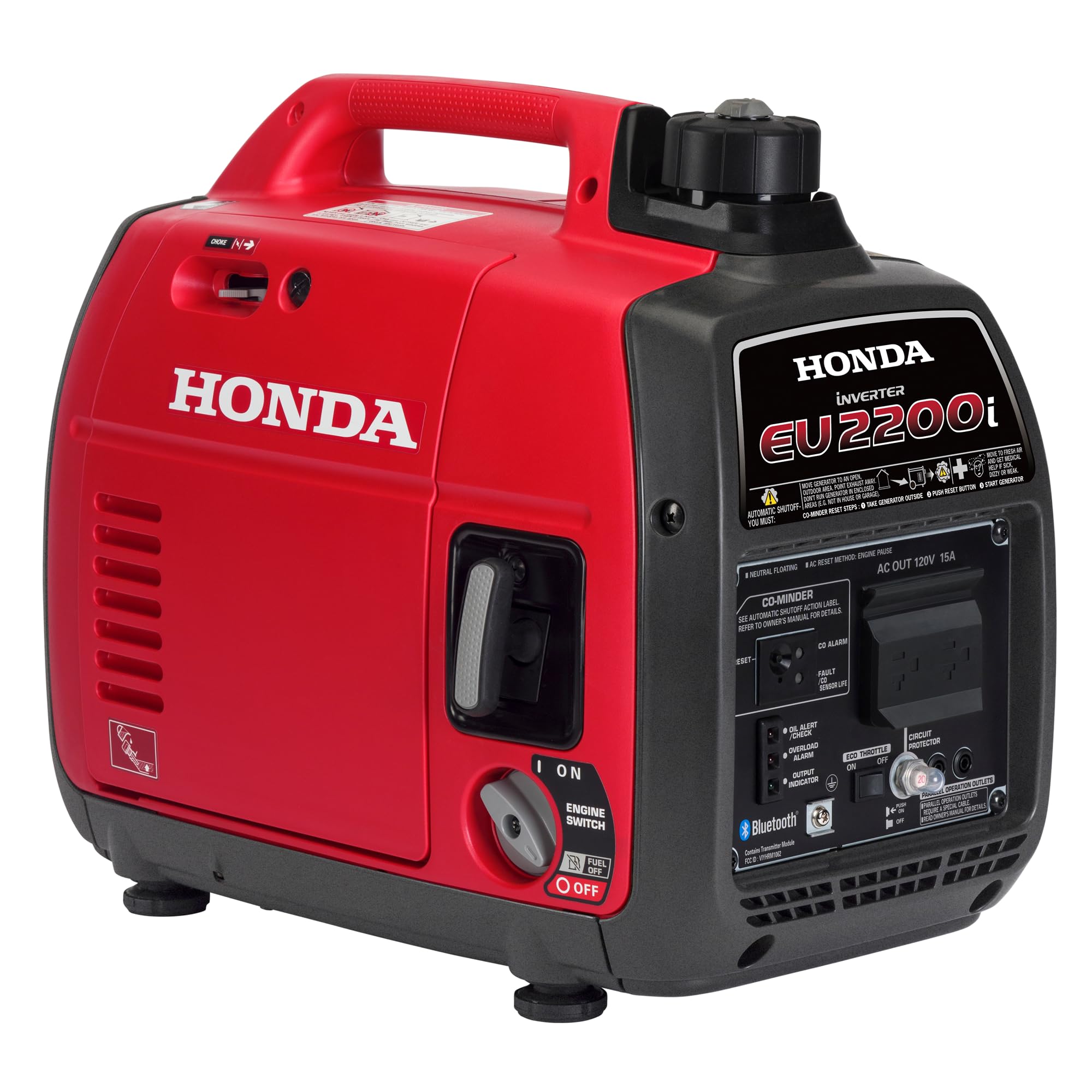
The Honda EU2200i sets the benchmark for campsite-friendly generators. Its 48-to-57 dBA noise floor at rated load is quieter than a normal conversation, which means you can run it through quiet hours without annoying neighboring tents. The 2200 surge watts and 1800 running watts are enough for a small RV refrigerator, a microwave, lights, and phone charging — all through a clean inverter waveform with THD well under 3%.
Honda’s Eco Throttle system automatically adjusts engine speed to match the load, stretching the 0.95-gallon tank to 8.1 hours at quarter load. Bluetooth connectivity through the My Generator app lets you monitor runtime and fuel level from your phone, and the CO-MINDER sensor shuts the unit down before dangerous carbon monoxide levels accumulate. At 51 pounds, it is not the lightest in this class, but the built-in handle and compact dimensions make it easy to load into a truck bed.
Real-world owners report 10-plus hours on a single gallon in eco mode while powering a fridge and fan, and many cite owning multiple units over two decades with only routine oil changes. The trade-off is the premium price tier, but the resale value and reliability track record make it a investment that a serious camper buys once.
Why it’s great
- Industry-leading quietness (48 dBA at idle)
- Bluetooth app for remote monitoring and fuel tracking
- CO-MINDER auto shutdown for safety
- Eco Throttle delivers up to 8.1 hrs runtime
Good to know
- Higher upfront cost than comparable wattage units
- Oil fill access is tight — a flexible funnel helps
- Not available for sale in California
2. Champion Power Equipment 2500-Watt Inverter Generator

At 39.7 pounds, the Champion 2500-watt inverter is one of the lightest units in its class — light enough that a single person can lift it into the back of an SUV without strain. The 53 dBA noise rating from 23 feet means it blends into the background noise of a busy campground, and the 1850 running watts handle a fridge, chest freezer, and several LED lamps simultaneously, as confirmed by owners who ran it for 26 to 30 hours straight during outages.
Champion’s CO Shield carbon monoxide auto-shutoff adds a layer of safety for tent or RV use, and the parallel-ready outlets let you pair it with another 2500-watt Champion for 5000 surge watts down the line. The 79cc engine sips fuel — owners report over 7.5 hours on a full tank at half load, and the 11.5-hour max runtime at quarter load covers a full weekend without a refill.
The included oil, funnel, and spark-plug wrench mean you can do the initial setup without a trip to the hardware store. A few owners noted blue smoke on cold starts during break-in, which cleared after the first oil change. Overall, it’s a strong mid-range pick for anyone who prioritizes easy handling over raw wattage.
Why it’s great
- Sub-40-pound weight for true one-person portability
- 53 dBA noise — quiet enough for most campground rules
- CO Shield auto-shutdown for safety
- Parallel-ready for future power expansion
Good to know
- 1850 running watts limit simultaneous large appliances
- Plastic housing clips feel less rugged than metal-frame rivals
- Blue smoke on initial startup until oil change
3. Westinghouse iGen2800DFc
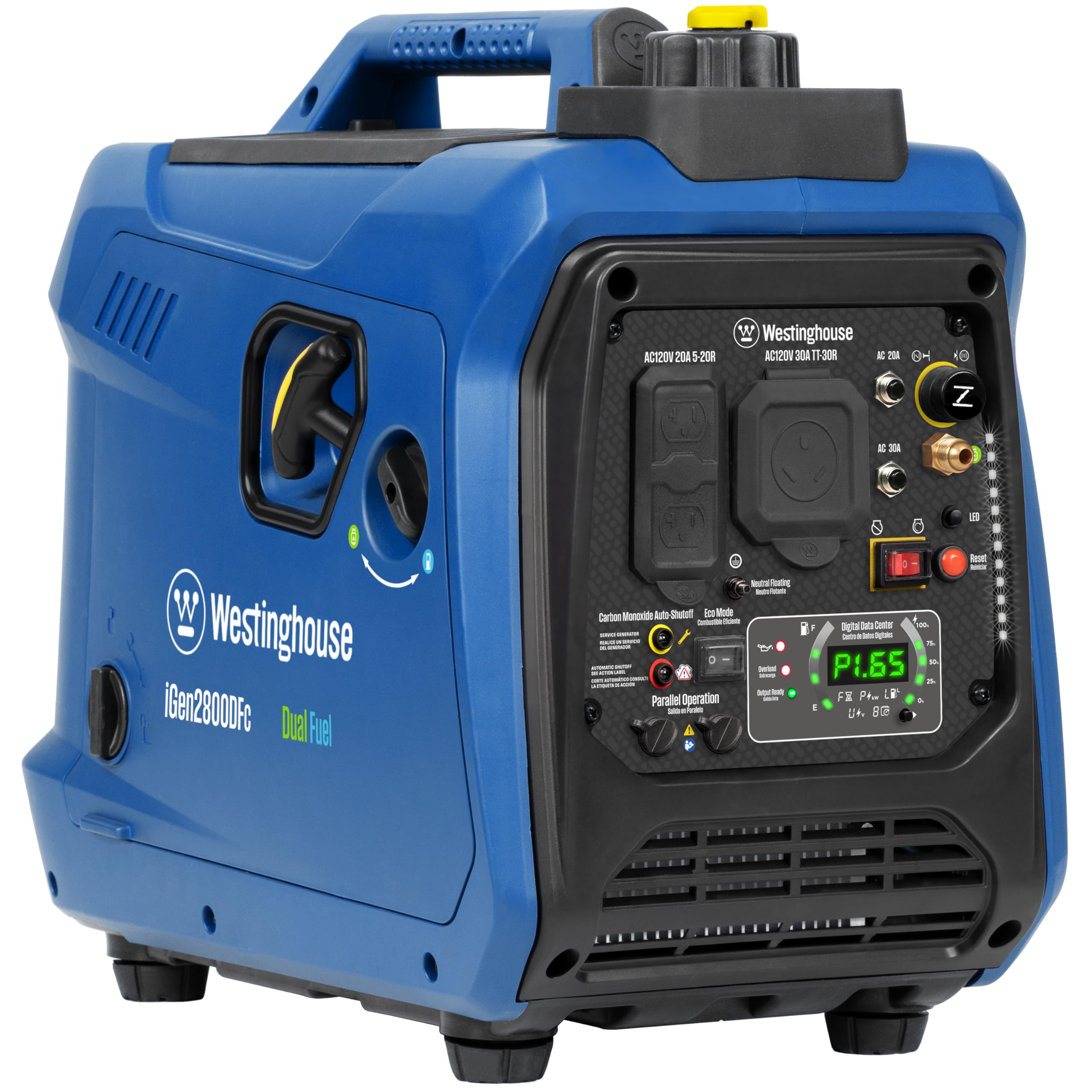
The Westinghouse iGen2800DFc brings dual-fuel flexibility — gasoline and propane — into a compact 45-pound chassis that hits just 52 dBA. Gasoline mode delivers 2800 surge watts and 2200 running, while propane drops to 2520 surge and 1980 running, both with clean inverter power under 3% THD. The TT-30R outlet is a direct fit for RV power cords, so you can plug in a small travel trailer without adapters.
Eco Mode reduces engine speed to match the load, cutting fuel consumption by up to 50% compared to fixed-speed generators. On gasoline, the tank lasts up to 12 hours at 25% load — enough for two full nights of lights and a fridge. The LED display shows fuel level and remaining runtime, a feature owners consistently praise for eliminating guesswork.
User reports call it a perfect companion for hurricane backup and weekend camping, with easy first-pull starts even after storage. The main caveat is customer support reachability; some users found the website for parts ordering non-functional. Still, for the combination of weight, noise, and dual-fuel capability, it is a well-balanced option in the mid-range tier.
Why it’s great
- 52 dBA — one of the quietest in its power class
- Dual fuel with included propane hose
- TT-30R RV outlet for direct camper hookup
- LED display shows fuel level and remaining runtime
Good to know
- Customer support and parts website reported as difficult to reach
- Initial startup may require spark plug check on some units
- Propane output is roughly 12% lower than gasoline
4. WEN DF360iX (Dual Fuel)

The WEN DF360iX packs 3600 surge watts and 2900 running on gasoline (3500 surge / 2600 running on propane) into a 49-pound frame that remains manageable for one person to move. The 149cc engine delivers output comparable to units that weigh 10 pounds more, making it one of the lighter dual-fuel options for RV use. The TT-30R receptacle lets you power a camper’s AC unit, microwave, and outlets without a separate adapter.
Clean inverter power with THD below 3% protects laptops, CPAP machines, and battery chargers. WEN’s Watchdog CO Shutdown Sensor automatically kills the engine if carbon monoxide levels get dangerous — a critical feature when running close to a tent or RV. The fuel shut-off valve lets you drain the carburetor before storage, which reduces gumming and extends engine life between seasons.
Owners note that the unit starts within one or two pulls on both fuels and runs quietly enough to hold a conversation next to it. The built-in display shows voltage, frequency, runtime, and load percentage, giving you real-time feedback on power draw. A few users reported that the 20A outlets hold plugs a bit loosely, but the overall build quality and dual-fuel flexibility make it a strong contender for RV-heavy camping.
Why it’s great
- Dual-fuel with tool-free LPG quick-connector
- TT-30R RV outlet included
- Fuel shut-off for carburetor preservation
- CO Watchdog auto-shutdown for safety
Good to know
- Some 20A outlets hold plugs loosely
- Propane regulator can arrive damaged — inspect packaging carefully
- Heavier than single-fuel rivals in same wattage range
5. Pulsar PGD40ISCO

The Pulsar PGD40ISCO delivers 4000 peak watts and 3200 running watts from a 145cc engine, all in a 47.3-pound package that is among the lightest for its output class. The 59 dBA noise rating keeps it under most campground generator limits, and the parallel-ready design lets you pair two units for up to 6000 running watts if your power needs grow. The 1-gallon tank provides about 4 hours of runtime at half load — enough for an evening and morning routine.
Clean inverter power with THD under 3% makes it safe for sensitive electronics, and the 13,500 BTU AC support allows it to run many RV air conditioners when paired with a soft start. Owners who have logged over 400 hours across multiple summers report consistent starts and no major mechanical issues when using ethanol-free fuel and regular oil changes.
The white color scheme and compact dimensions make it easy to store inside an RV compartment. The main complaints center on the lack of built-in wheels — moving it on rough terrain requires a separate dolly. A few users also noted that the fuel cap can vapor-lock in hot weather, requiring a slight crack to relieve pressure. For the price-to-wattage ratio, it is a strong budget-to-mid-range pick for campers who need more than 3000 watts without paying the premium tier.
Why it’s great
- 47.3 pounds at 4000 peak watts — excellent power-to-weight
- 59 dBA fits most campground noise rules
- Parallel-ready with two-unit compatibility
- Clean THD under 3% for sensitive electronics
Good to know
- No built-in wheels — needs a separate dolly
- Fuel cap can vapor-lock in high heat
- 4-hour runtime at half load requires planning for full-day use
6. PowerSmart 3800W Inverter Generator
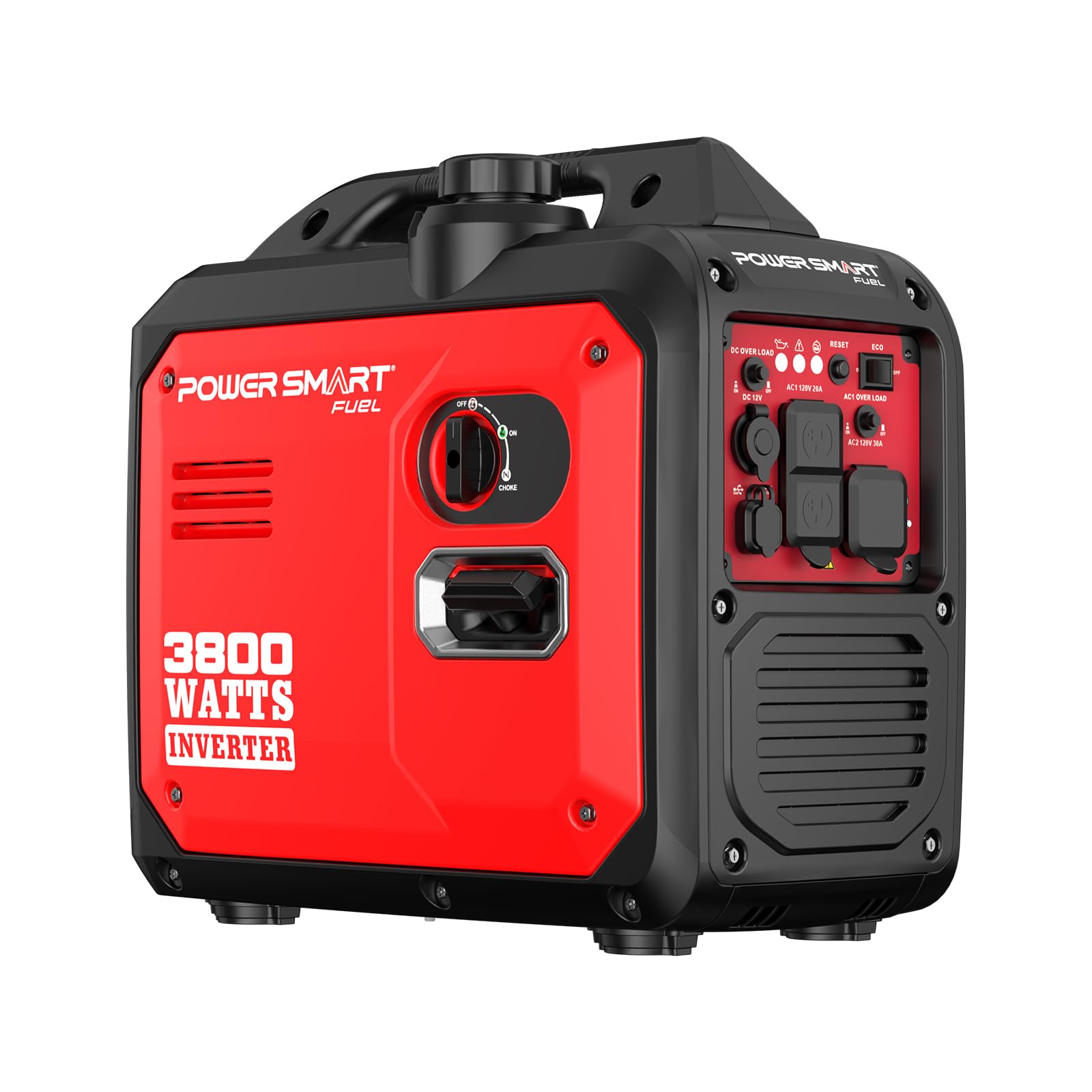
The PowerSmart 3800W inverter generator balances 3800 surge watts and 3200 running watts with a 59 dBA noise floor that won’t disturb neighboring sites. The 143cc 4-stroke OHV engine powers the 1.19-gallon tank to 4.5 hours of runtime at half load, and the economy mode further reduces fuel consumption when running light loads. At 52 pounds with an ergonomic handle, it is easy to wheel around a campsite.
Clean sine wave output with less than 3% THD protects laptops, tablets, and phones, and the two 120V 26.7A outlets plus a 5V USB port cover most camping appliance needs. The recoil start system is responsive — owners report first or second-pull starts even after storage. Parallel capability lets you connect two units for double the power output.
User feedback highlights its reliability as a sole power source for remote cabins, running lights, TV, fridge, and even small window AC units continuously for over 24 hours. The main downside is the lack of an integrated fuel shut-off valve, which means you need to run the carburetor dry manually for long-term storage. Overall, it’s a dependable mid-range option that prioritizes ease of use and quiet operation.
Why it’s great
- 3800 surge watts with quiet 59 dBA operation
- Economy mode for extended runtime at light loads
- Easy pull-start even after storage
- Parallel-ready for expansion
Good to know
- No fuel shut-off valve; must drain carburetor manually
- 1.19-gallon tank limits continuous runtime to ~6.5 hours at idle
- Heavier than some 2000W-class rivals
7. ERAYAK 4500W Portable Inverter Generator

The ERAYAK 4500W delivers 4500 peak watts and 3500 running watts from a 208cc engine, making it one of the highest-output portable inverter generators in its weight class at 55 pounds. ECO Mode drops engine speed to match the load, resulting in fuel consumption as low as 0.21 gallons per hour at 25% load — an impressive efficiency that stretches the tank across long weekends. The THD range of 0.2% to 1.2% is among the cleanest inverter output available, safe even for sensitive CPAP machines and medical devices.
The unit includes a TT-30R RV outlet, two 120V AC household outlets, a 12V cigarette lighter port, and USB-A/USB-C ports, eliminating the need for multiple adapters. Electric start with recoil backup adds convenience, and the 30A and 20A circuit breakers provide overload protection. The 50A parallel-ready capability means two units can combine for 7000 running watts — enough for a larger RV or dual-zone AC.
Owner experiences are mixed: many report reliable startup and clean power after 50+ hours, while a smaller subset cite early failures with the pull cord and auto-shutdown under load. The warranty support response has been inconsistent. For buyers who need high wattage in a compact footprint and are willing to check initial quality, the ERAYAK offers a lot of power per pound at the mid-range price point.
Why it’s great
- THD as low as 0.2% — exceptionally clean inverter power
- ECO Mode uses only 0.21 gal/hr at 25% load
- 50A parallel-ready for 7000W combined output
- TT-30R, USB-A, and USB-C outlets included
Good to know
- Some units experienced early pull-cord and shutdown issues
- Customer service responsiveness reported as inconsistent
- Heavier than 3500W competitors by 8-10 pounds
8. Generac GP3300i

The Generac GP3300i brings PowerRush Advance Technology, which delivers over 50% more starting capacity for motor-driven loads like RV air conditioners and well pumps. The 439cc engine generates 3300 surge watts and 3000 running watts, with clean power via TruePower Technology — THD under 3% — ensuring safety for laptops and medical devices. The 59.5-pound weight is reasonable for its output class, and the built-in handle helps with maneuvering.
Economy Mode reduces fuel consumption by automatically adjusting engine RPM. The COsense Technology monitors carbon monoxide levels and shuts down the generator before dangerous accumulation occurs. LED indicators for low oil, overload, and ready status give quick visual feedback, and the two USB ports let you charge devices without an adapter. Parallel-ready capability allows doubling output with a second GP3300i.
Owners report reliable first-pull starting after initial setup and note that the unit runs quietly enough for suburban tailgates and overnight camping. Some users at high altitude (above 5000 feet) found the actual continuous output closer to 2500 watts, which is typical for carbureted engines. A few long-term users experienced failures after 1000+ hours and found parts support limited. For those who need the extra starting surge for an RV AC or power tools, the GP3300i delivers where standard inverters fall short.
Why it’s great
- PowerRush delivers 50% more starting capacity for motor loads
- TruePower technology for clean electricity under 3% THD
- COsense auto-shutdown for carbon monoxide safety
- Parallel-ready with Economy Mode for fuel savings
Good to know
- Output drops at altitudes above 5000 feet
- Long-term parts availability and support can be limited
- 59.5 pounds is heavier than many 3000W-class inverters
9. WEN 56360i

The WEN 56360i weighs just 46 pounds while putting out 3600 surge watts and 2900 running watts from a 149cc engine. That power-to-weight ratio makes it one of the easiest 3600W-class inverters to load into a vehicle or carry into a campsite. The unit includes a TT-30R RV receptacle alongside two 120V household outlets, a 12V DC outlet, and two 5V USB ports, covering everything from an RV AC unit to phone charging.
The fuel shut-off feature lets you drain the carburetor before storage, reducing ethanol-related gumming and extending engine life. Clean inverter power with THD under 3% protects sensitive electronics, and the enclosed design keeps noise levels low — owners consistently describe it as quieter than comparable Predator models. The 1.1-gallon tank provides about 4 to 5 hours of runtime when powering a 13,000 BTU RV AC continuously.
Users highlight reliable cold-weather starting (as low as 14°F) and easy one- or two-pull starts after break-in. The three-year warranty adds peace of mind. The main limitation is the 2900 running watts, which may not handle a microwave and AC simultaneously without tripping the breaker. For campers who need to run an AC unit or power multiple devices in a small RV, this is a strong mid-range choice.
Why it’s great
- 46 pounds — very light for 3600 surge watts
- TT-30R RV outlet included for direct camper hookup
- Fuel shut-off for extended carburetor life
- Quiet operation with enclosed design
Good to know
- 2900 running watts limits simultaneous high-draw appliances
- Needs frequent oil changes (every 25 hours recommended)
- No parallel kit included for doubling
10. BILT HARD 2500W Gas Generator
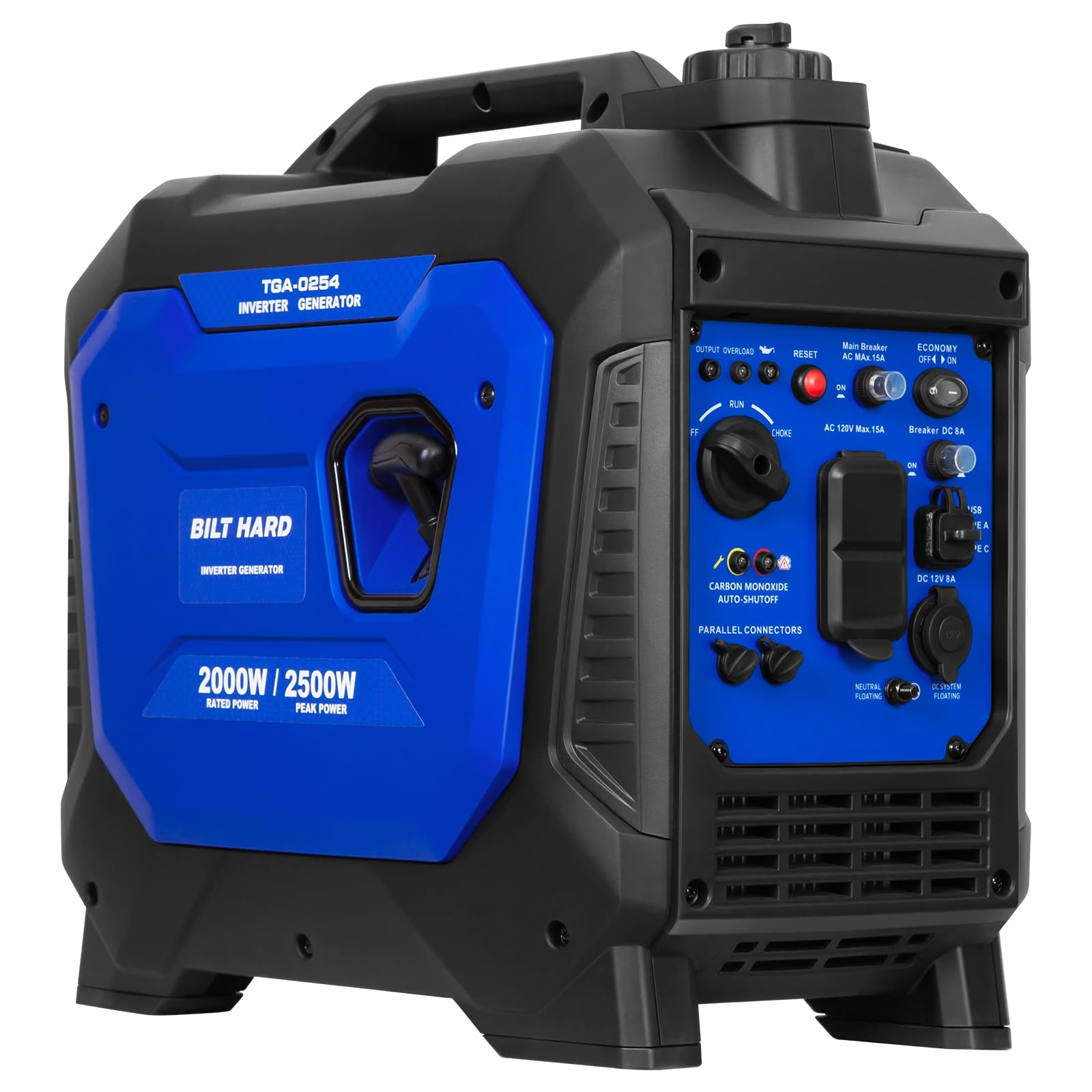
The BILT HARD 2500W inverter generator offers a budget-friendly entry point into clean inverter power for camping. The 80cc engine produces 2500 surge watts and 2000 running watts with pure sine wave output under 3% THD, making it safe for laptops and phone charging. At 42.6 pounds and with dimensions similar to a medium cooler, it fits easily into a car trunk or RV storage compartment.
It comes with two 120V 15A AC outlets, a 12V 8A DC output, and a USB port, plus circuit breakers on each outlet. The 1.11-gallon tank provides up to 5.5 hours of runtime at 50% load, and the parallel-ready design allows connecting two units for double output. The integrated CO sensor automatically shuts down the engine if carbon monoxide builds up — a valuable safety feature at this price tier.
Owners report quiet operation (measured around 47 dBA inside a cabin) and easy setup, with the included tool kit and charging cable covering basic needs. Some users note that the instructions are sparse, and the 42.6-pound weight feels manageable for most adults. For car campers and weekend warriors who need clean power on a tight budget and don’t require high continuous wattage, the BILT HARD delivers solid value.
Why it’s great
- Entry-level pricing for clean inverter power
- CO sensor auto-shutdown for safety
- Parallel-ready for future expansion
- 5.5-hour runtime at half load
Good to know
- 2000 running watts limits appliance options
- Instruction manual is sparse
- Requires 10W-30 oil and fuel stabilizer for warranty
11. Jackery Explorer 2000 v2 Solar Generator
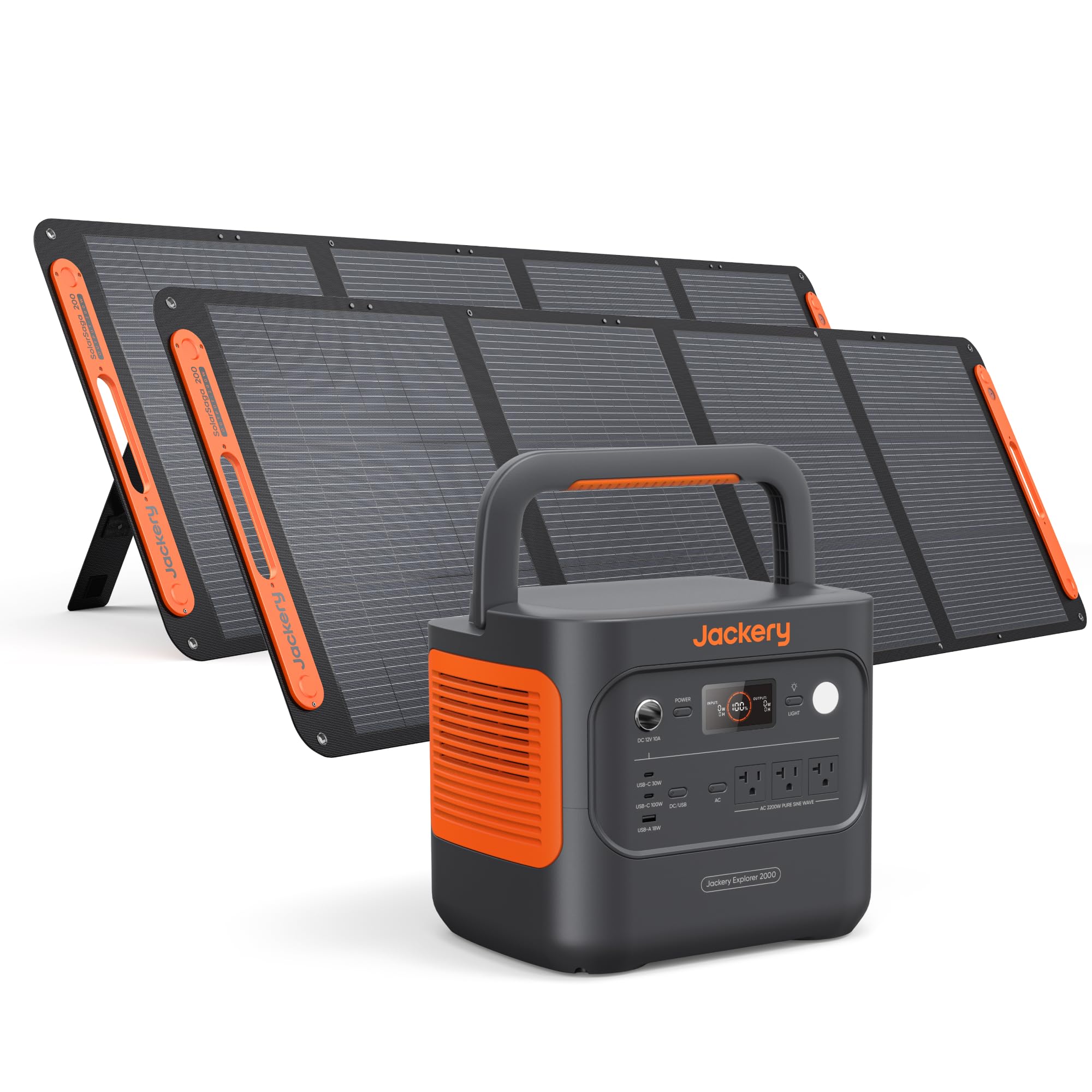
The Jackery Explorer 2000 v2 represents a completely different approach to camping power — a 2042Wh LiFePo4 battery paired with dual 200W solar panels for emission-free, silent electricity. The 2200W pure sine wave inverter delivers clean power for CPAP machines, laptops, and small appliances, and the 20ms UPS switching keeps devices running during grid interruptions. At 39.5 pounds, it is lighter than many gas generators with similar sustained output.
AC charging reaches 80% in 66 minutes, and the app-activated Emergency Super Charging mode hits full charge in 102 minutes. Solar recharging with both 200W panels takes about 6 hours in full sun. The CTB (Cell-to-Body) technology, borrowed from electric vehicles, packs the cells tightly, resulting in a unit that is 41% lighter and 34% smaller than conventional 2kWh power stations. Silent Charging mode operates at just 30 dBA, low enough to use inside a tent while you sleep.
Owners praise the zero-fume operation, long LiFePo4 lifespan (up to 10 years), and reliable pass-through charging. The main limitation is the 2200W inverter ceiling: you cannot run a large RV AC or high-draw appliances. Also, solar output varies with weather. For car campers, van-lifers, and anyone who prioritizes quiet, clean power over raw wattage, the Jackery 2000 v2 is a premium-tier solution that eliminates gas, oil, and noise entirely.
Why it’s great
- Zero emissions and silent operation (30 dBA in Silent Mode)
- 2042Wh LiFePo4 battery — 10-year lifespan
- 20ms UPS switching for critical electronics
- 39.5 pounds with 2200W inverter output
Good to know
- 2200W inverter cannot power large RV AC units
- Solar recharge time varies with cloud cover
- Premium price tier compared to gas generators of similar output
FAQ
Can I run an RV air conditioner with a 2000-watt camping generator?
How do I maintain a camping generator between trips?
What is the quietest generator for strict campgrounds?
Should I get a dual-fuel generator for camping?
How much power do I actually need for a camping trip?
Final Thoughts: The Verdict
For most campers, the generator for camping winner is the Champion 2500W Inverter because it delivers the best power-to-weight ratio at 39.7 pounds with 53 dBA noise, making it easy to carry and quiet enough for most campgrounds. If you want dual-fuel flexibility and a direct RV hookup, grab the Westinghouse iGen2800DFc at 45 pounds with 52 dBA operation. And for campers who need total silence and zero emissions, nothing beats the Jackery Explorer 2000 v2 solar generator — it runs completely silently and produces no fumes for use inside a tent or RV.