
Your welding arc demands a smooth, steady stream of 240-volt power—anything less and you’re staring at a bird’s nest of wire or a stuck rod. A generator that can’t maintain stable voltage under load will ruin your weld puddle, burn through tips, and waste hours of setup time. The difference between a clean bead and a spatter-filled mess often comes down to the generator sitting in your truck bed.
I’m Mohammad Maruf — the founder and writer behind Drink4Good. I’ve spent thousands of hours analyzing generator output curves, inverter THD ratings, and real-world weld tests to separate machines that can actually hold an arc from those that only look good on paper.
Finding a reliable generator for welding means looking past peak wattage and understanding how many continuous 240V amps your machine needs, whether you’re running a buzzing 225-amp transformer box or a modern inverter welder with sensitive electronics.
How To Choose The Best Generator For Welding
Not every generator with a 240V outlet can realistically run a welder. The arc demands a specific combination of continuous running wattage, voltage regulation, and outlet type that most portable generators simply aren’t tuned for. Here are the core specs that matter when you’re shopping for a welding power source.
240V Running Watts & Amperage
The sticker on your welder lists its input amperage at full output—a typical 225-amp AC stick welder pulls around 50 amps at 240V, which translates to roughly 12,000 running watts. An inverter-based welder like a 200-amp MIG machine might only need 6,000 to 7,000 running watts. Always match the generator’s continuous 240V rating to your welder’s maximum input draw, not the peak or surge numbers manufacturers love to advertise.
Inverter vs. Conventional (Open Frame)
Conventional generators produce raw AC power with total harmonic distortion (THD) often above 10%, which can cause modern inverter welders to behave erratically, trip internal protection circuits, or simply refuse to arc. Inverter generators produce clean sine wave power below 3% THD, making them compatible with sensitive electronics—including the circuit boards inside your wire feeder. For stick welding with a basic transformer machine, a conventional generator suffices, but multi-process and TIG welders need inverter-grade power.
Outlet Configuration & Bonded Neutral
Look for an L14-30R or NEMA 14-50R 240V outlet. Many portable generators ship with a floating neutral, which is safe for job-site tools but can create a ground-fault nuisance on welders that are bonded internally. If your welder has a bonded neutral, you may need to lift the ground bond inside the generator. Some units come with a bonded neutral from the factory, so check before wiring into a panel or connecting your welder’s plug.
Fuel Flexibility for Extended Jobs
Dual-fuel and tri-fuel generators let you switch between gasoline, propane, and natural gas. Propane burns cleaner, extends engine life, and stores indefinitely—important for emergency backup or for welders who run generators daily on construction sites. Natural gas is the cheapest long-term option if you have a tap nearby, though it reduces peak output by about 10% compared to gasoline.
Weight, Portability & Stability
A 240-pound generator with a steel cradle and 10-inch wheels is manageable on flat ground but a nightmare in mud or gravel. If you’re hauling to a remote job site, fold-down handles, never-flat wheels, and a drip tray make a difference. A heavier unit with a cast-iron sleeve will outlast a lighter engine under constant welding loads, but you need to balance durability with how often you actually move it.
Quick Comparison
On smaller screens, swipe sideways to see the full table.
| Model | Category | Best For | Key Spec | Amazon |
|---|---|---|---|---|
| Westinghouse iGen8200TFc | Premium Inverter | Inverter welders, THD-sensitive gear | 8,200W peak / 6600W running (gas) | Amazon |
| Champion 201407 | Inverter | Whole-home backup + MIG/TIG | 64 dBA at 23 ft, 459cc engine | Amazon |
| AIVOLT VS12000411 | Dual-Fuel Inverter | Heavy 240V loads, food trucks | 11,250W surge / 9,000W running gas | Amazon |
| DuroMax XP13000HXT | Tri-Fuel | Max power for transformer welders | 13,000W running / 500cc engine | Amazon |
| Generac GP9500 | Tri-Fuel | Natural gas welding setups | 12,500W start / 9500W running (gas) | Amazon |
| Westinghouse WGen12500 | Dual-Fuel | Large stick welders (225+ amps) | 12,500W peak / 9,500W running (gas) | Amazon |
| DuroStar DS13000MX | Dual-Fuel | Mid-size stick/MIG on job sites | 13,000W surge / 500cc engine | Amazon |
| AIVOLT VS8000411 | Dual-Fuel Inverter | Quiet 240V for TIG/inverter welders | 8,000W surge / 6,100W running | Amazon |
| WEN DF680iX | Dual-Fuel Inverter | EV charging + light welding | 6,800W surge / 5,100W running (gas) | Amazon |
| WEN DF480iX | Dual-Fuel Inverter | Portable MIG on propane | 4,800W surge / 4,000W running (gas) | Amazon |
| PowerSmart PS5055C | Value Inverter | Small inverter welders, hobbyists | 7,000W surge / 6,000W rated | Amazon |
In‑Depth Reviews
1. Westinghouse iGen8200TFc
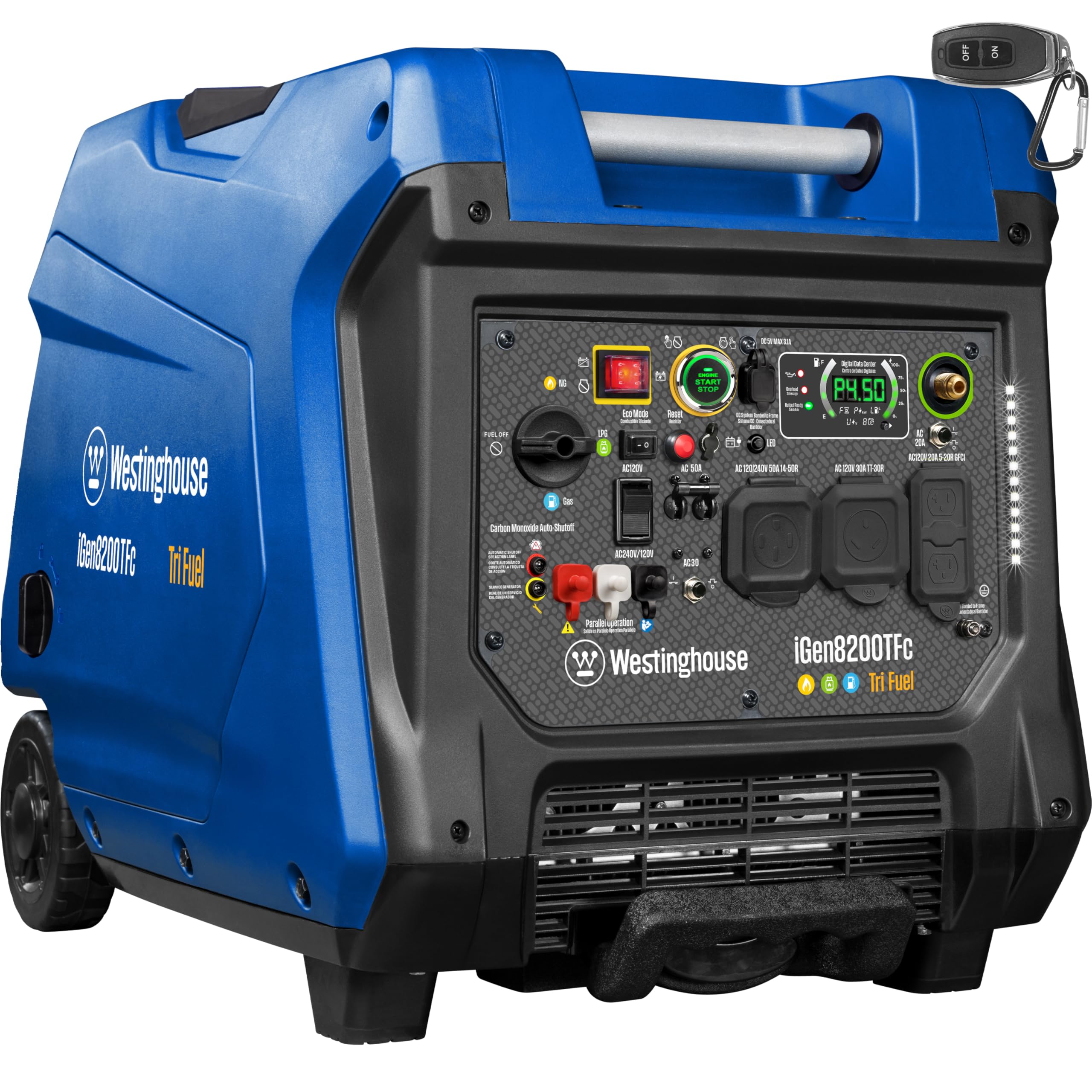
The iGen8200TFc is the rare generator that combines true inverter technology under 3% THD with a 50-amp 240V outlet, making it the best match for modern inverter-based MIG and TIG welders. Its 298cc cast-iron sleeve engine delivers 6,600 running watts on gasoline (5,940 on propane, 5,280 on natural gas) with a bonded-neutral L14-30R and a NEMA 14-50R ready for a transfer switch or direct welder connection. At 134.5 pounds with a telescoping handle and never-flat wheels, it’s the lightest machine on this list that still carries a true 240V load.
Tri-fuel flexibility means you can run the same unit on natural gas for a permanent shop setup or swap to propane for remote site welding without carburetor issues. The inverter engine sips fuel—up to 17 hours at 25% load on a 3.9-gallon tank—and operates around 60 dBA, quiet enough for residential neighborhoods. Copper windings inside the alternator help the unit run cooler and produce cleaner voltage under the sustained draw of a welding arc.
Users note that the included battery maintainer and tool-less access panels simplify maintenance, though the pull-start recoil is stiff on a cold engine. The remote start key fob works reliably up to 80 feet, saving trips across the shop floor to restart after a lunch break. This is the sweet spot for anyone running a 200-amp class inverter welder who wants clean power, three fuel options, and genuine portability.
Why it’s great
- True inverter power (below 3% THD) safe for sensitive welder electronics
- Tri-fuel with natural gas option for permanent shop setups
- Compact and relatively light for a 240V-capable generator
Good to know
- Running watts on natural gas drops to 5,280W—marginal for larger 225-amp machines
- No magnetic dipstick included for oil checks
- Gas cap can interfere with natural gas hose adapter
2. Champion 201407 11,000-Watt Inverter

Champion’s 11,000-watt inverter generator delivers 9,000 running watts with a quiet 64 dBA profile—roughly half the noise of an equivalent conventional generator. The 459cc engine features Cold Start Technology for reliable cranking in sub-freezing temps, and the wireless remote key fob works up to 80 feet away. It produces clean sine wave power under 3% THD, making it fully compatible with inverter welders, TIG machines, and any gear with sensitive circuit boards.
The outlet panel includes a 120/240V 37.5A locking outlet and a 30-amp twist-lock, alongside two GFCI 120V household duplexes. Real-world users report it powers a 3-ton AC unit and a 3/4-horsepower well pump simultaneously without voltage sag, which mirrors the draw profile of a 200-amp MIG welder at full duty cycle. Runtime reaches 15 hours at 25% load on a full gasoline tank, and the fuel gauge is easy to read despite being slightly recessed.
Several buyers mention that the CO Shield carbon monoxide sensor is sensitive and can shut the unit down prematurely if exhaust recirculates in a tight space—a safety feature that works as designed, but something to note for enclosed job sites. The 3-year warranty and free lifetime technical support from Champion’s US-based team add peace of mind. This is the quietest high-output inverter in the class, ideal for welding near occupied spaces or campgrounds.
Why it’s great
- Extremely quiet 64 dBA at 23 feet—neighbor-friendly
- Clean inverter power for TIG and multi-process welders
- Cold Start Technology for reliable winter operation
Good to know
- CO sensor may trigger in partially enclosed areas
- Gasoline only—no dual-fuel option from the factory
- Fuel gauge can be hard to read in direct sunlight
3. AIVOLT VS12000411 11,250W Dual Fuel
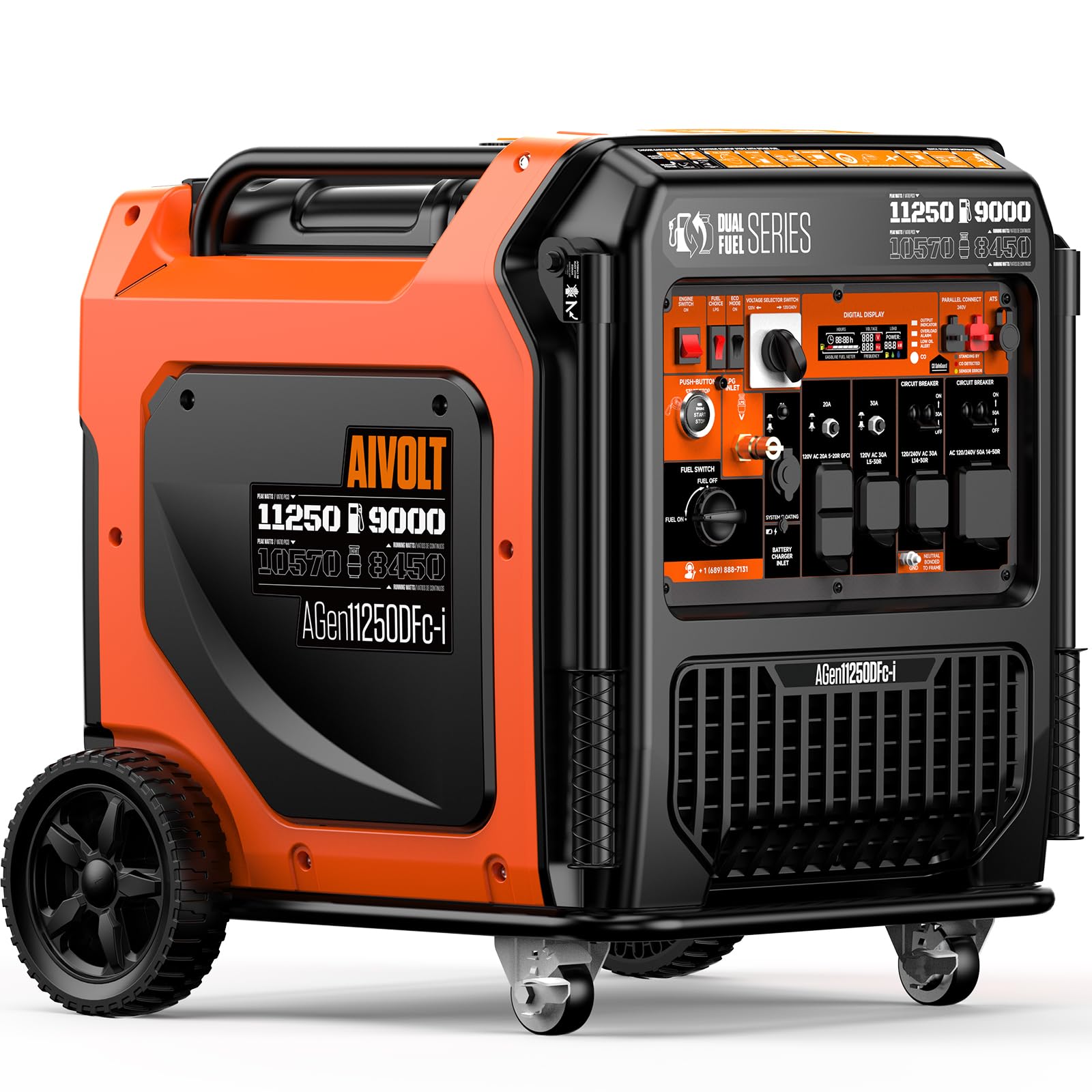
This AIVOLT dual-fuel inverter generator brings 11,250 starting watts and 9,000 running watts on gasoline (10,570/8,540 on propane) in a package rated for 50-state CARB compliance. The 322cc copper-winding engine with automatic fuel switching lets you toggle between gas and propane without stopping the machine—a genuine time-saver when a propane tank runs dry mid-weld. The 50-amp RV-ready outlet doubles as a 240V tap for heavy welders, and the 5-in-1 LCD shows voltage, frequency, and runtime simultaneously.
Eco Mode extends runtime beyond 19 hours at lighter loads, making this one of the most fuel-efficient units capable of driving a 225-amp stick welder. The build quality feels solid with a steel frame and weather-resistant outlet covers. Remote start via key fob, electric push-button, and recoil backup give you three ways to fire it up, and the CO sensor with auto shutdown adds safety margin when working near ventilation openings.
Customer reports indicate the unit runs slightly louder than the advertised 57 dBA—nearer to 72 dBA at close range under load—but still quieter than any open-frame machine of similar wattage. A few isolated cases of early failure were linked to shipping damage or improper break-in, but AIVOLT’s support team has been responsive for most users. If you need 240V output with dual-fuel flexibility at a price below the premium competition, this is the unit.
Why it’s great
- Automatic fuel switching between gas and propane
- 50-amp 240V outlet handles large transformer welders
- 19-hour runtime on eco mode reduces refuel stops
Good to know
- Noise level is higher than advertised under real welding load
- Some users report early failures with support based overseas
- Must cool completely before restart if thermally tripped
4. DuroMax XP13000HXT Tri-Fuel
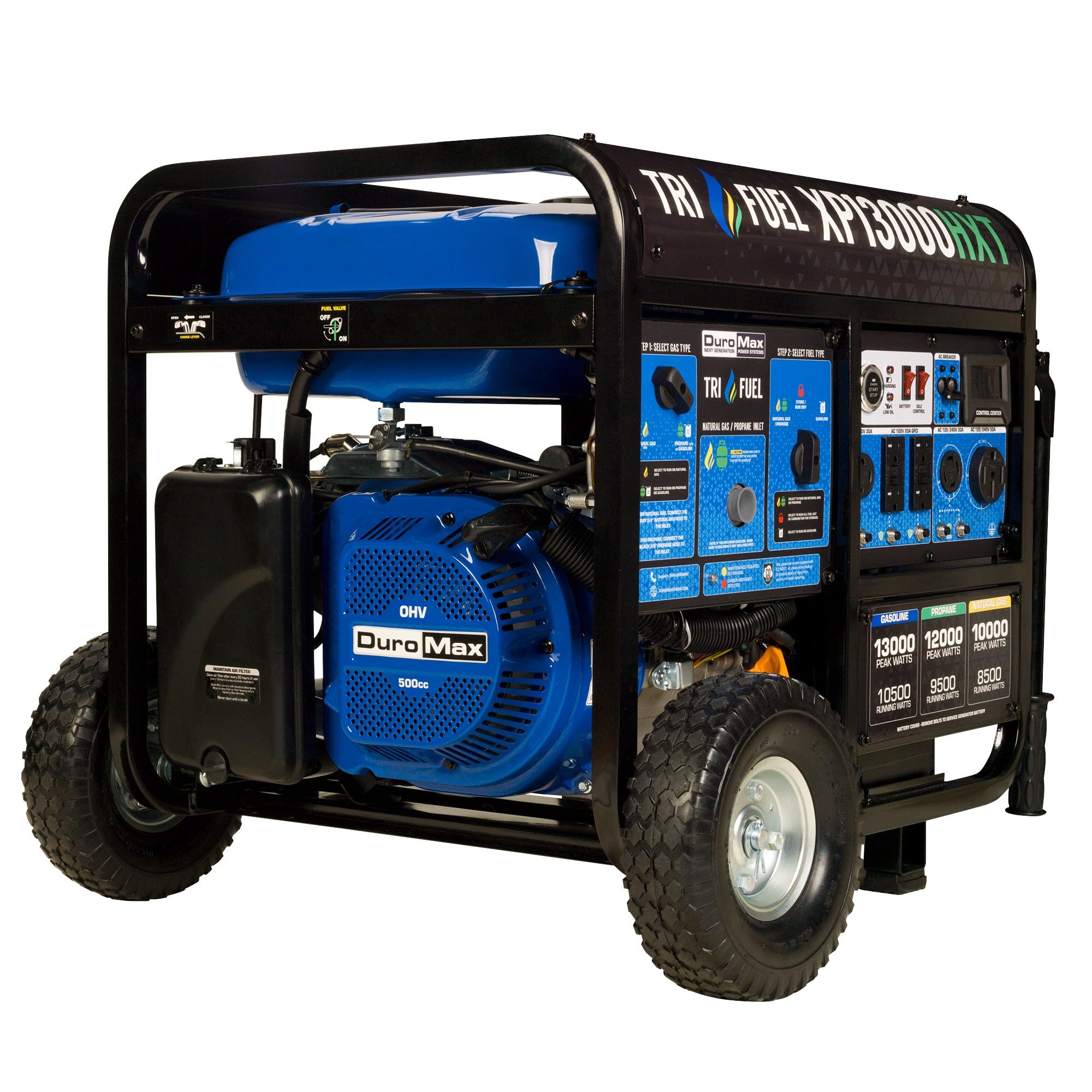
The DuroMax XP13000HXT delivers a genuine 13,000 running watts on gasoline—enough to run a 225-amp AC/DC transformer stick welder at full output and still have overhead for a grinder and lighting. The 500cc OHV engine with cast-iron sleeve is built to endure the sustained high-loads of production welding, and the tri-fuel system lets you feed it gasoline, propane, or natural gas via a front-facing selector dial. A 50-amp NEMA 14-50R outlet is standard, plus a remote start key fob for convenience.
Out of the box, the unit includes a 15-foot natural gas hose, a propane regulator, a wheel kit, and a tool set—genuinely complete assembly. Users report it powers a whole home including AC and furnace during outages, and one verified welder review says it runs a titanium 225 stick welder on 240V without hesitation. The CO Alert system automatically shuts down the engine if carbon monoxide accumulates, and the low-oil shutdown protects the engine from dry starts.
At 240 pounds, this is not a unit you want to move daily. The fuel selector knob can be stiff initially, and the engine is genuinely loud—expect conversation-level noise interruption. A few buyers noted the natural gas hose reducer was stuck on arrival, but customer service resolved it quickly. For welders who park it on a trailer or shop floor and need maximum, non-stop 240V punch, the DuroMax is hard to beat.
Why it’s great
- True 13,000 running watts powers large transformer welders
- Tri-fuel with natural gas hose and propane regulator included
- Remote start key fob for easy operation
Good to know
- Very heavy at 240 pounds—requires trailer or permanent placement
- Loud operation at full load (typical for conventional frame)
- Stiff fuel selector knob on some units
5. Generac GP9500 Tri-Fuel
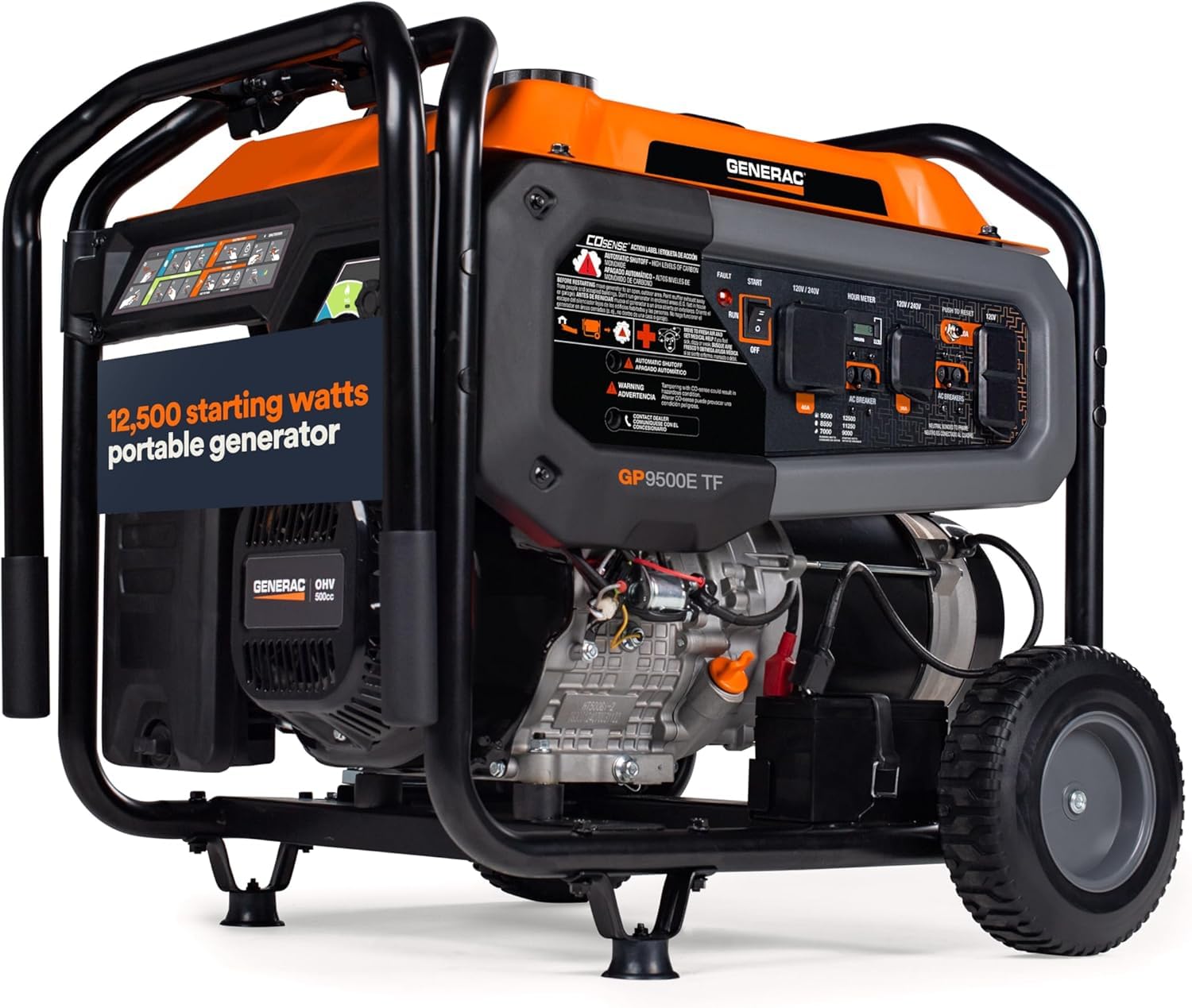
Generac’s GP9500 tri-fuel generator uses a 500cc OHV engine to deliver 9,500 running watts on gasoline (12,500 surge), with seamless switching to propane or natural gas via a simple selector dial. The bonded-neutral configuration means it works directly with transfer switches and welding outlets without ground-loop complications. The 7.5-gallon steel fuel tank provides up to 9.5 hours runtime at 50% load, and the COsense detection system monitors air quality in real-time.
The build quality shows Generac’s decades of experience—the steel tube cradle, weather-resistant covered outlets, and never-flat wheels feel robust compared to lighter imports. Push-button electric start with the included rechargeable battery eliminates pull-start frustration, and the natural gas conversion kit is bundled in the box (though a certified plumber is recommended for permanent hookup). Real-world reviews confirm it powers a full home including well pump, refrigerator, and furnace simultaneously.
One issue: the natural gas hookup requires a separate regulator fitting not included in the box, which caused confusion for buyers expecting a complete plug-and-play package. The engine is not an inverter, so THD runs higher than 3%—fine for transformer welders and lights but not ideal for sensitive TIG inverter units. If you run a traditional AC stick machine and want Generac’s proven reliability with natural gas capability, this is a solid choice.
Why it’s great
- Bonded neutral works directly with transfer switches and welders
- Generac’s reputation for durable, long-lasting engines
- Natural gas hookup with conversion kit included
Good to know
- Conventional alternator (not inverter) may cause issues with TIG welders
- Natural gas fitting requires separate regulator not in the box
- 219 pounds makes one-person moves difficult
6. Westinghouse WGen12500 Dual Fuel

The Westinghouse WGen12500 dual fuel generator is a conventional open-frame machine built around a 457cc 4-stroke OHV engine with a cast-iron sleeve—a proven formula for longevity under heavy load. It delivers 9,500 running watts on gasoline (12,500 peak) and 8,500 running watts on propane, with a 6.6-gallon fuel tank good for up to 12 hours of runtime at 50% load. The outlet panel includes a NEMA 14-50R 50-amp RV receptacle and an L14-30R 30-amp twist-lock, both transfer-switch ready.
Remote start via key fob, electric push-button, and recoil backup give you three layers of starting confidence. The digital hour meter helps track maintenance intervals, and the automatic low-oil shutdown with CO sensor adds safety. One verified owner reported it ran their titanium 225 stick welder on 240V with zero hesitation—right from the first pull. The steel frame and 212-pound weight mean you’ll want the included wheel kit assembled before moving it around a job site.
Noise is a factor—this is a conventional generator, so expect around 74 dBA at full load, comparable to a lawn mower. Some units arrived with minor cosmetic damage from freight shipping, and the dense manual lacks clarity on battery connection details. But for welders who need a reliable 240V source for large transformer machines without paying for inverter technology they don’t need, the WGen12500 delivers proven power.
Why it’s great
- Proven cast-iron sleeve engine built for continuous heavy load
- Remote start key fob plus electric and recoil backup
- NEMA 14-50R 50-amp outlet for large welders
Good to know
- Conventional alternator unsuitable for inverter-based welders
- Loud operation at full load
- Freight delivery can result in cosmetic damage
7. DuroStar DS13000MX Dual Fuel

The DuroStar DS13000MX is a 13,000-watt dual fuel generator that combines a 500cc OHV engine with push-button electric start, CO alert, and a 50-amp outlet ready for transfer switch connection. Unlike inverter models, this conventional machine prioritizes raw power over clean waveform—perfect for 240V stick welders and plasma cutters that aren’t sensitive to THD. Users report it runs a 225-amp AC welder on the 240V setting without any strain, and even struggles only momentarily when a 1.5-ton AC compressor kicks in.
The all-metal construction with a reinforced power panel feels genuinely rugged, and assembly is straightforward with included tools, wheel kit, and oil funnel. The front-facing fuel selector makes switching between gas and propane quick without bending over the control panel. One verified welder review specifically calls out that it runs their titanium 225 stick welder “like it’s nothing,” which is the exact feedback welders need to hear before committing to a purchase.
At 220 pounds, this is a ground-level machine best suited for a garage, shop, or trailer mount. The engine is loud—comparable to other open-frame units in this class—so ear protection is mandatory during extended welding sessions. A handful of units arrived with minor shipping damage, but customer reports suggest DuroStar resolves issues reasonably. If your welder is a basic transformer box and you need affordable 240V punch, this is a top contender.
Why it’s great
- 13,000W surge provides headroom for large AC welders
- Push-button start and CO alert included at a competitive price
- All-metal frame with reinforced panel for job site durability
Good to know
- Conventional alternator—not for inverter-based TIG/MIG welders
- Heavy at 220 pounds, requires wheel kit for movement
- Loud enough to require hearing protection during use
8. AIVOLT VS8000411 8,000W Inverter

The AIVOLT VS8000411 packs 8,000 surge watts and 6,100 running watts into a compact 128-pound inverter frame with 62 dBA noise output—the quietest dual-fuel inverter in the under-8,000-watt class. The 322cc copper-winding engine produces clean sine wave power under 3% THD, making it safe for inverter welders, TIG machines, and sensitive electronics in your welding cart. The 5-in-1 LCD display shows fuel consumption, output voltage, frequency, and runtime at a glance.
The control panel includes a 120V 50A industrial outlet alongside a 240V 30A twist-lock, which covers most 200-amp class inverter welders. The automatic fuel-switching technology lets you swap between gas and propane without touching the carburetor—useful when a job runs long and you need to tap into a bulk propane tank. Eco Mode extends runtime past 10 hours at 25% load, and the CO Alert auto shutdown adds safety margin for enclosed shop use.
A few users note that if the unit is shut off while hot, it may refuse to restart until it cools down—a thermal protection quirk that can cause a 45-minute delay on a hot workday. Noise is slightly above the advertised 57 dBA at close range, but still significantly quieter than any open-frame machine. For the mobile welder running a modern inverter MIG who needs 240V outlet capability in a genuinely portable package, this AIVOLT hits a strong value proposition.
Why it’s great
- Quiet 62 dBA operation—easier on neighbors and ears
- Clean inverter power safe for TIG and multi-process welders
- Automatic fuel switching between gas and propane
Good to know
- Thermal protection can prevent restart on hot engine
- Noise slightly above advertised spec under load
- 240V output maxes out around 6,100 running watts
9. WEN DF680iX Dual Fuel Inverter

WEN’s DF680iX is a 224cc dual-fuel inverter generator that produces 6,800 surge watts and 5,100 running watts on gasoline (6,000/4,500 on propane), with a bonded-neutral 240V L14-30R outlet. The inverter technology keeps THD below 3%, and the unique twist is the 240V bonded-neutral configuration that’s specifically designed for low-power Level 2 electric vehicle charging—but that same outlet works perfectly for smaller inverter-based welders up to around 180 amps.
The Watchdog CO Shutdown Sensor automatically kills the engine if carbon monoxide rises, and the fuel shut-off valve lets you run the carburetor dry before storage, extending lifespan between seasons. The unit includes a telescoping pull handle, onboard wheels, an LPG quick-connector hose, and a six-foot regulator hose. Runtime on propane is notably efficient—one user reported a 40-pound tank lasted two full weekends of off-grid cabin use.
At 99.2 pounds, this is one of the lightest 240V-capable generators on the market, making it feasible for a single person to load into a truck bed. The main trade-off is running watts—5,100 on gas limits you to smaller inverter welders and light MIG tasks. A few users note the non-magnetic dipstick makes checking oil quality harder, and the 240V mode disables the 120V outlets. If your welding needs are moderate and portability matters, this is a smart buy.
Why it’s great
- Only 99 pounds with 240V inverter output
- Bonded-neutral L14-30R outlet for direct welder connection
- Excellent fuel efficiency on propane
Good to know
- Running watts limited to 5,100 on gas—suits only smaller welders
- 240V mode disables 120V outlets
- Non-magnetic dipstick included; upgrade recommended
10. WEN DF480iX Dual Fuel Inverter
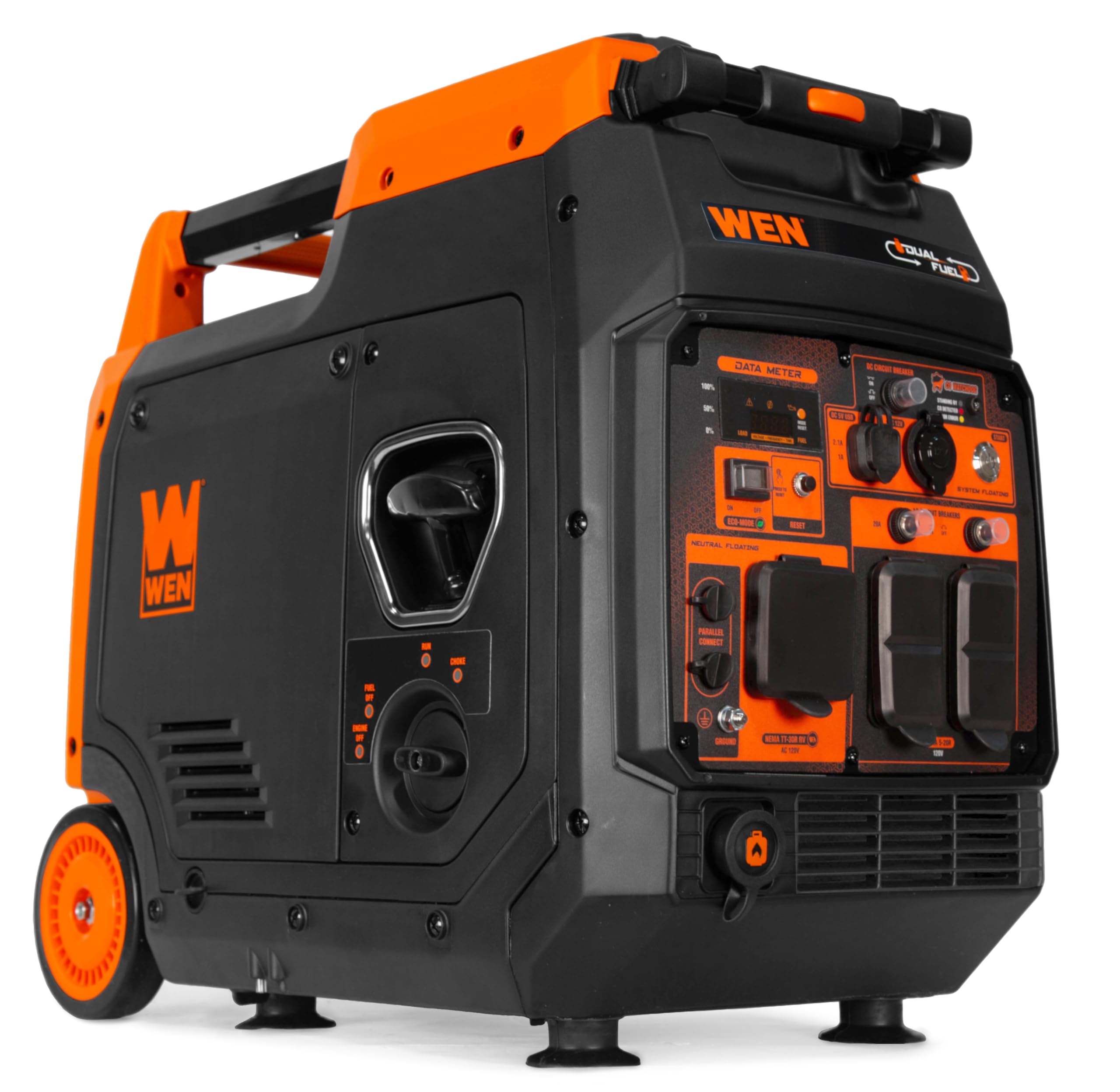
The WEN DF480iX is a 224cc dual-fuel inverter generator that delivers 4,800 surge watts and 4,000 running watts on gasoline (4,320/4,000 on propane) in a compact 78.5-pound package. It produces clean power under 3% THD, making it safe for sensitive 120V MIG and flux-core welders that plug into standard household outlets. The control panel includes four 120V three-prong receptacles, a TT-30R RV outlet, a 12V DC plug, and two USB ports—but no 240V outlet.
Without a 240V output, this unit is limited to 120V welders in the 140-amp class or below. The dual-fuel capability means you can run it on propane for longer storage life and cleaner fuel system, and the included tool-free LPG quick-connector makes switching simple. The Watchdog CO Shutdown Sensor and fuel shut-off are standard. At 64 dBA, it’s noticeably quiet for its class, and the telescoping handle with wheels makes one-person maneuvering easy.
Real-world reviews confirm it runs lights, a refrigerator, and a water pump without issues, but attempt to draw more than 4,000 running watts and the overload protection will trip. A few buyers noted that the battery connection panel is difficult to reattach after initial setup, and the wheels can rattle over rough terrain. For light-duty 120V welding, camping, or job-site backup power on a tight budget, this is a clean, portable solution.
Why it’s great
- Lightweight 78.5 pounds—genuinely easy to transport
- Clean inverter power for 120V welders and sensitive electronics
- Dual-fuel with propane option for clean, long-term storage
Good to know
- No 240V outlet—limited to 120V welders under 140 amps
- Wheels can rattle, adding noise during transport
- Not designed for continuous high-load welding tasks
11. PowerSmart PS5055C 7,000W Inverter
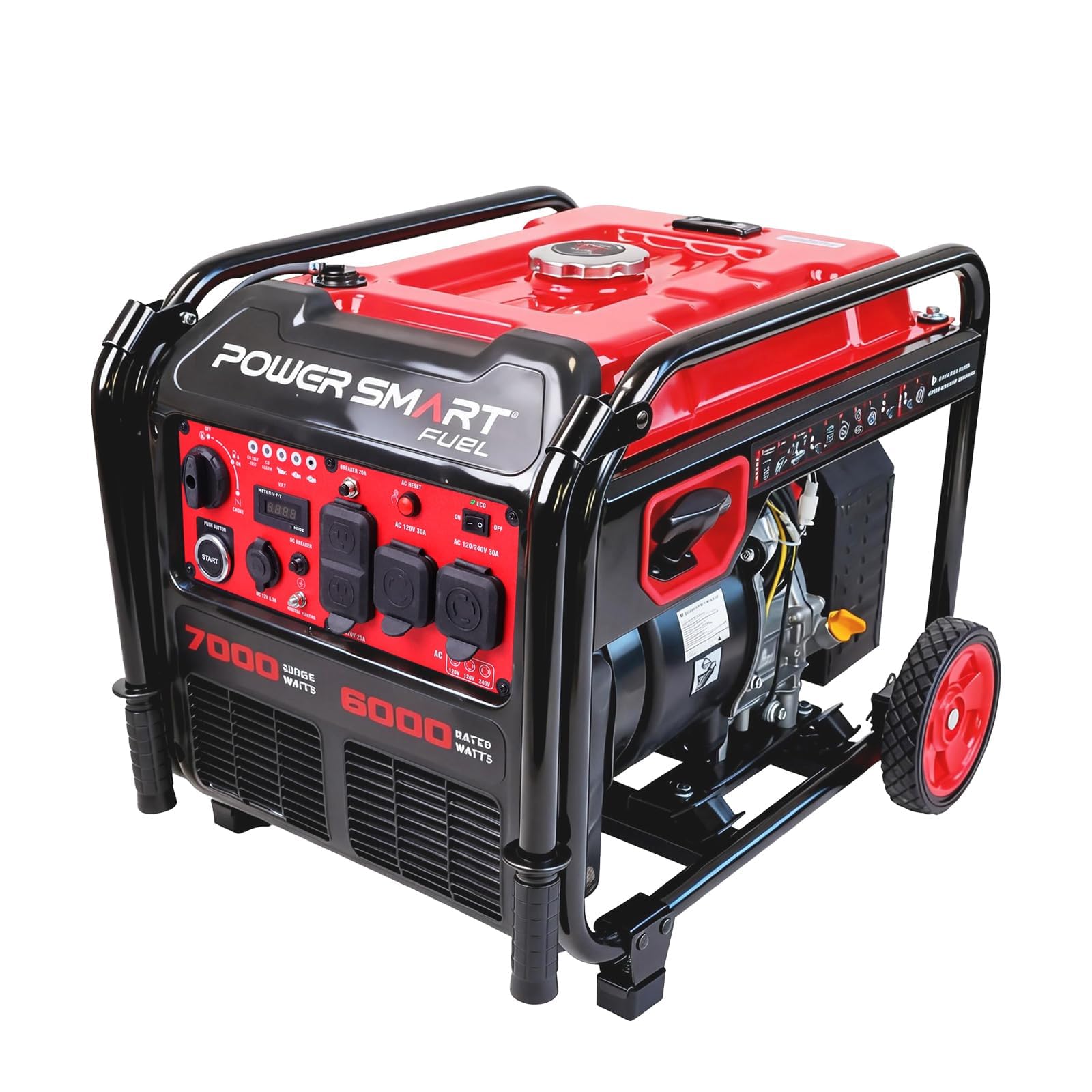
The PowerSmart PS5055C is a 7,000-watt open-frame inverter generator with a 322cc 4-stroke OHV engine, producing 6,000 rated watts and a clean sine wave output below 3% THD. It includes a 120/240V selector switch, an L14-30R twist-lock outlet for 240V connections, and a 12V DC output rated at 25 amps. The electric push-button start with included battery makes cold mornings less frustrating, and the recoil backup ensures you’re never stranded with a dead battery.
At 113.5 pounds and 70 dBA at 23 feet, it’s heavier and louder than enclosed inverter units but still lighter than any open-frame generator in the 7,000-watt class. The 3.2-gallon fuel tank provides about 6 hours of runtime at 50% load, which is acceptable for a day of light welding or farm repair work. The open-frame design improves airflow and cooling under heavy load, which helps prevent thermal shutdown during extended 240V welding sessions.
Real-world feedback is mixed—some users report it runs an 8-inch planer without issues, while others had units fail after just 5 days on a job site. The cheap wheels and handle detract from an otherwise decent build, and the oil air filter issue noted by some suggests quality control varies. For hobby welders on a budget who need 240V inverter output without spending premium money, this is an entry-level stepping stone—but it’s not built for daily professional abuse.
Why it’s great
- 240V inverter output at a budget-friendly price point
- Electric start with recoil backup
- Open-frame design cools well under sustained welding load
Good to know
- Mixed reliability—some units fail within days
- Cheap wheel kit and handle detract from portability
- No dual-fuel option
FAQ
Can I run a 240V welder on a 120V generator outlet?
How many watts do I need for a 200-amp MIG welder?
Does an inverter generator really matter for stick welding?
What does bonded neutral mean for my welder?
Will a generator damage my TIG welder’s high-frequency start?
Final Thoughts: The Verdict
For most users, the generator for welding winner is the Westinghouse iGen8200TFc because it uniquely combines inverter-quality power under 3% THD with tri-fuel flexibility, a 50-amp 240V outlet, and genuine portability under 135 pounds. If you want whisper-quiet operation for a 200-amp inverter MIG welder in a residential area, grab the Champion 201407. And for maximum 240V punch to run a 225-amp transformer stick welder all day on natural gas or propane, nothing beats the DuroMax XP13000HXT.