
A generator welder combo is not two machines sharing a garage—it’s a single ecosystem where stable AC waveform directly determines bead quality. A sagging sine wave under the arc load creates spatter, porosity, and stuck rods, while a clean waveform lets you burn 6010s and 7018s with passenger-car smoothness. The market currently splits between inverter-based multiprocess welders paired with low-THD power sources and traditional engine-driven units, and the margin between success and frustration lives in the crossover point between the generator’s voltage regulation and the welder’s arc-force compensation. Picking the wrong pairing means chasing settings all day; picking the right one means the machine disappears and you just weld.
I’m Mohammad Maruf — the founder and writer behind Drink4Good. Over the last several years, I’ve analyzed more than two hundred generator and welding units, breaking down duty-cycle curves, inverter THD ranges, arc-start algorithms, and real-world amperage stability across dual-voltage inputs to separate the pairings that truly work from the ones that only look good on paper.
This guide examines thirteen of the most compelling options available, from portable multiprocess stations to heavy tri-fuel backup generators engineered to run a welder and a worksite simultaneously. Each review focuses on the specific specs that matter—waveform purity, dual-voltage flexibility, duty cycle at rated amperage, and fuel-source compatibility—so you can confidently select a generator welder combo that matches your shop floor or job site demands without guesswork.
How To Choose The Best Generator Welder Combo
The right generator welder combo lives at the intersection of three variables: the generator’s waveform quality, the welder’s arc-start tolerance, and the fuel logistics of your work environment. A mismatch in any one of these forces compromises either portability or weld consistency. Understanding each parameter before you buy prevents the common trap of pairing a high-output welder with a generator that drops voltage the moment the rod strikes.
Total Harmonic Distortion and Arc Stability
Total harmonic distortion directly governs arc behavior. A generator with THD above 6% introduces voltage irregularities that confuse the welder’s inverter, causing the arc to flutter, spatter excessively, or extinguish mid-bead. Inverter generators typically deliver THD under 3%, producing sine-wave quality that mimics utility power. For stick welding with electrode types like 6010 that demand a stiff arc, lower THD is non-negotiable. For MIG and TIG processes, waveform distortion shows up as inconsistent wire burn-back and erratic puddle control. Always prioritize a generator rated below 5% THD if you plan to weld sensitive materials or run digital controls.
Dual-Voltage Input and Job-Site Flexibility
A welder that accepts both 120V and 240V input expands the range of generators and wall outlets it can connect to without an adapter. Dual-voltage machines auto-sense the incoming line and adjust their internal power supply, allowing you to run lighter 120V circuits for thinner materials at a job site with limited power, then switch to 240V for full amperage on thicker plate. The catch is that amperage output typically halves on 120V—a 200A machine on 240V might top out around 90A-110A on 120V. Check the manufacturer’s derating curve to confirm the 120V ceiling matches your typical material thickness before relying on it as your primary mobile mode.
Duty Cycle and Continuous Weld Time
Duty cycle describes how many minutes out of a ten-minute window the welder can operate at a given amperage before thermal protection kicks in. A machine rated 60% at 200A means six minutes of welding followed by four minutes of cooling. For repair work on thick structural steel or long passes on farm equipment, a lower duty cycle forces frequent stops that extend project time. Conversely, thin-gauge automotive or sheet-metal work rarely taxes the duty cycle, making higher-cycle machines unnecessary for light fabrication. Match the duty cycle at your most-used amperage to the longest continuous weld you expect to lay in a typical session.
Quick Comparison
On smaller screens, swipe sideways to see the full table.
| Model | Category | Best For | Key Spec | Amazon |
|---|---|---|---|---|
| Millermatic 211 PRO | MIG Welder | Beginner-friendly shop MIG | Dyna-Pulse MIG, 30% duty @ 175A | Amazon |
| Lincoln Power MIG 215 MPi | Multi-Process | Versatile shop-to-truck use | Built-in TIG solenoid, 120/230V | Amazon |
| Miller Multimatic 220 AC/DC | Multi-Process | Pro-grade AC/DC TIG + MIG | QuickTech auto-polarity, 56 lb | Amazon |
| Weldpro Omni210 | Multi-Process | AC/DC TIG on aluminum | 200A output, pulse TIG | Amazon |
| Lincoln Power MIG 211i | MIG Welder | Lightweight daily MIG | 41 lb, auto-sense 120/230V | Amazon |
| ESAB Miniarc Rogue 180i | Stick Welder | Portable stick for remote sites | 18 lb, 6010 mode, 180A | Amazon |
| Everlast PowerTIG 200DV | AC/DC TIG | Home-shop AC/DC TIG | 5A low-start TIG, 110/220V | Amazon |
| ARCCAPTAIN MIG205MP | Multi-Process | Integrated plasma + welder | 9-in-1, iControl app, 60% duty | Amazon |
| Westinghouse iGen11000DFc | Inverter Generator | Clean power for sensitive welders | <3% THD, dual fuel, 9000W run | Amazon |
| Gidrox 11000W Tri-Fuel | Inverter Generator | Quiet tri-fuel home + shop | <3% THD, 62-65 dB, ATS port | Amazon |
| Westinghouse WGen14500TFc | Tri-Fuel Generator | Large-home backup + welding | 18K peak, V-twin, <5% THD | Amazon |
| WEN TF1450 Tri-Fuel | Tri-Fuel Generator | Budget whole-house backup | 14.5K surge, electric start | Amazon |
| Honda EU3200i | Inverter Generator | Ultra-portable welder power | 65 lb, clean sine, 3200W peak | Amazon |
In‑Depth Reviews
1. Millermatic 211 PRO MIG Welder
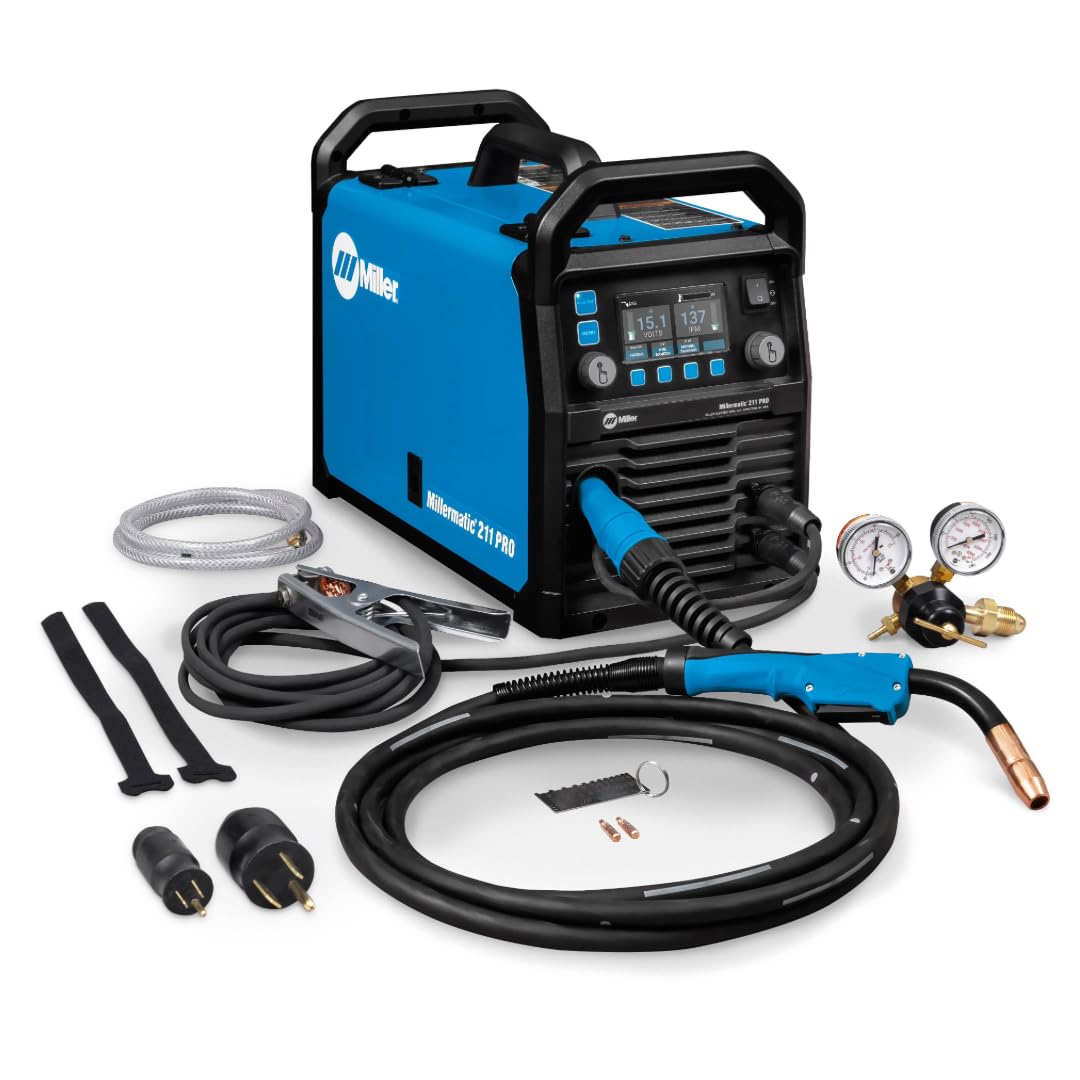
The Millermatic 211 PRO is the modern benchmark for the portable MIG category, wrapping Dyna-Pulse MIG capability into a 46-pound package that runs equally well on 120V and 240V with zero-tool MVP plugs. The pulse mode transforms how thin-gauge and out-of-position welds behave—dropping heat input while maintaining deposition, which is exactly what you need when the generator is feeding marginal line voltage. The Auto-Set Elite function calculates starting parameters from material thickness and wire diameter, removing the guesswork that wastes rods during generator voltage fluctuations.
What sets the 211 PRO apart from its own predecessor is the USB-upgradable software and Program Memory function. You can dial in a pulse MIG schedule for 0.035 mild steel on 240V, save it, and pull it back up months later without re-tuning. The 30% duty cycle at 175A is honest for its class—enough for structural brackets, trailer repairs, and fence work without thermal shutdown interrupting your rhythm. The included 15-foot MDX-100 gun tracks well through tight engine bays and undercarriage positions.
The spool-gun readiness is a differentiator for field aluminum work. Pair it with a Miller Spoolmate and the machine auto-detects the gun, adjusting drive-roll tension and polarity. On generator power, the internal line-voltage compensation keeps the arc stable even when the generator sees load spikes from compressor kick-on. The price entry is mid-range, but the feature density—pulse MIG, auto-sense, digital memory, and real-time bead monitoring—justifies the position as the top pick for anyone welding across steel, stainless, and aluminum on the move.
Why it’s great
- Dyna-Pulse MIG reduces spatter and heat input on thin material significantly
- Auto-Set Elite removes setup guesswork, especially useful with varying generator voltage
- Program Memory saves custom weld schedules for repeat jobs
Good to know
- Amperage output derates noticeably on 120V—full 211A requires 240V input
- Spool gun is sold separately, adding cost for aluminum capability
2. Lincoln Electric Power MIG 215 MPi

The Lincoln Power MIG 215 MPi occupies the sweet spot between a dedicated shop machine and a truck-bed unit that sees weekly road time. Its multi-process capability covers MIG, flux-cored, stick, and DC TIG with a built-in TIG solenoid and foot pedal adapter—no separate module purchase needed. The 120V/230V dual-voltage input with the included adapter cord means you can run it from a campground generator outlet for light repairs as easily as from a shop’s 230V welder plug. The robust wire drive system delivers steady feed through 0.025 to 0.045 wire without birds-nesting, even with long gun cable runs.
The distinctive advantage of the 215 MPi is the industrial-grade case design with multiple lift points, making solo loading into a pickup bed manageable without a dolly. The included Magnum PRO 175L gun features an over-molded handle that reduces hand fatigue during extended MIG passes on thicker section steel. The TIG side benefits from the pre-installed gas solenoid, so you simply connect the torch, set post-flow, and weld without external gas switching. The presets for wire type and material thickness are accurate enough that most users run the factory recommendations with minimal fine-tuning.
At 230V and full output, the 215 MPi handles up to 3/8-inch single-pass MIG comfortably on a 60% duty cycle. On 120V, expect roughly half the amperage, sufficient for automotive sheet metal and thin-wall tube. The three-year manufacturer warranty aligns with the price position, and the included canvas cover is a practical addition for job-site dust and rain protection. For the mobile fabricator who needs one machine that migrates between shop power and generator supply without compromise, this Lincoln is the strongest mid-range option in the list.
Why it’s great
- Built-in TIG solenoid and foot pedal adapter eliminates separate module cost
- Ergonomic case with multiple lift points simplifies transport between sites
- Preset weld schedules are accurate for both MIG and DC TIG processes
Good to know
- Unit weight and dimensions require two-person lift for truck loading
- 120V output is limited to roughly half the 230V amperage ceiling
3. Miller Multimatic 220 AC/DC

The Miller Multimatic 220 AC/DC is the do-everything machine that eliminates the need for three separate welders in a single shop. It handles MIG, flux-cored, stick, DC TIG, and—critically—AC TIG for aluminum, all from a 56-pound chassis that runs on both 120V and 240V. The QuickTech system automatically detects the connected process and sets polarity, wire-feed speed, and voltage without requiring the user to open the side panel and swap leads. For TIG work, the included heavy-duty foot control and the HF arc start produce consistent AC aluminum beads down to thin-wall tube without tungsten contamination.
Auto-Set Elite and Pro-Set features are the real productivity multipliers here. Auto-Set calculates parameters from material thickness and wire diameter for MIG, while Pro-Set provides expert-level fine-tuning for advanced TIG pulsing and stick arc force. The machine remembers the last-used settings per process, so switching from MIG trailer repair to TIG bicycle frame work takes seconds. The built-in gas solenoid supports both MIG and TIG from a single gas source, and the digital display shows actual amperage and voltage in real time, giving immediate feedback when generator voltage sags under load.
The premium price reflects Miller’s industrial warranty support and the machine’s ability to weld aluminum with AC TIG out of the box—no spool gun required. The duty cycle is rated at 25% at 220A on 240V, which is lower than some competitors but accurate for a portable unit this size. Pair it with a generator rated above 10,000 watts running output to maintain full AC TIG performance. For the professional who regularly switches between materials and processes in a single day, the Multimatic 220 AC/DC justifies its position as the most capable single-unit solution on this list.
Why it’s great
- AC/DC TIG capability for aluminum without a spool gun upgrade
- QuickTech auto-polarity eliminates manual lead swapping between processes
- 56-pound weight with multi-voltage plug enables true portable multi-process welding
Good to know
- Premium price places it at the high end of the portable multi-process market
- Requires a 10kW+ generator to maintain full AC TIG output without voltage drop
4. Weldpro Omni210 Multi-Process Welder
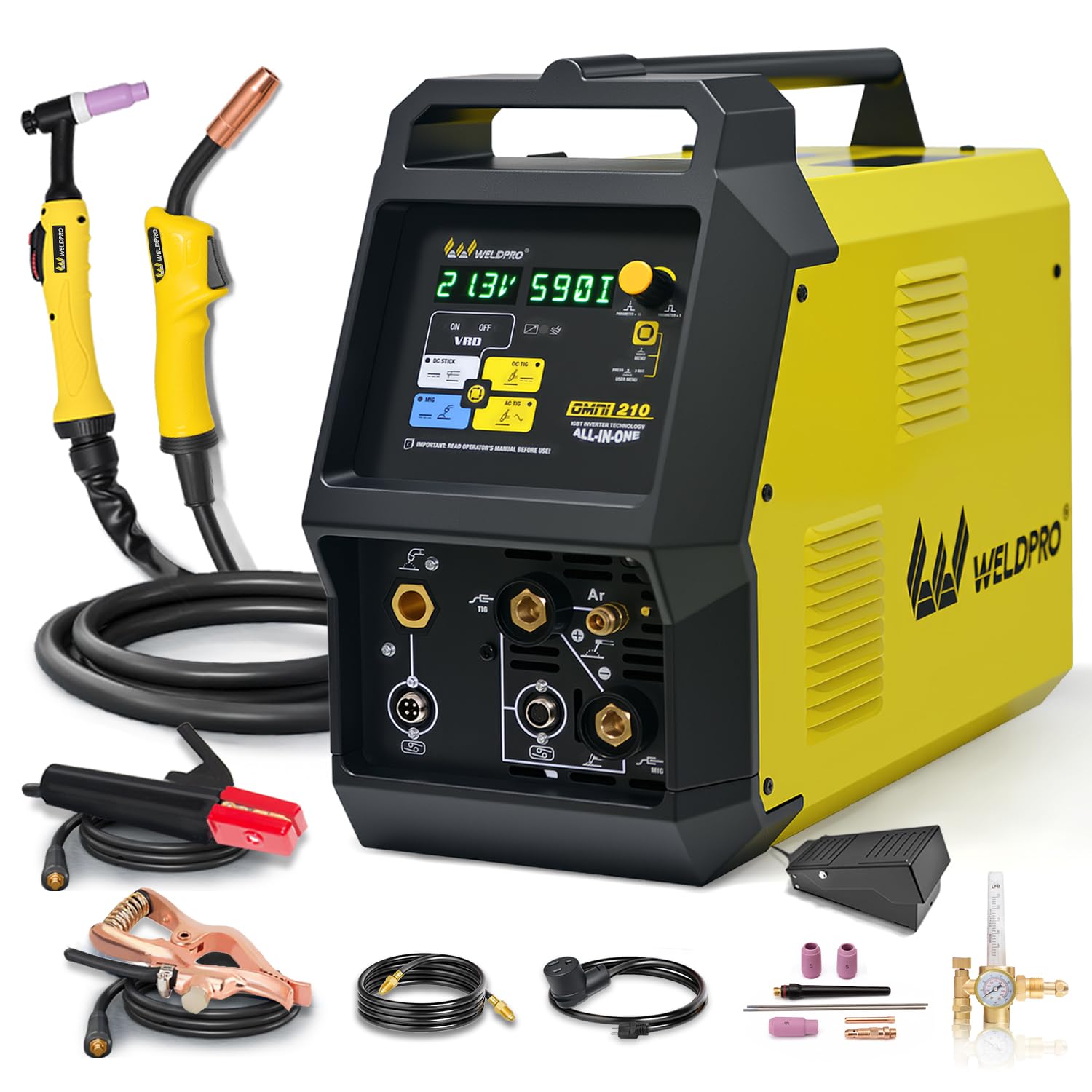
The Weldpro Omni210 brings AC TIG aluminum capability and pulse welding into the mid-range price bracket with a 6-in-1 configuration that includes MIG, flux core, stick, AC/DC HF TIG, spool gun, and pulse frequency control. The 200A output rating is consistent across MIG, TIG, and stick processes, which is unusual for multi-process machines that often sacrifice TIG amperage. The included KT26 TIG torch with independent trigger switch and the professional rocker-style foot pedal give the TIG setup a feel comparable to dedicated shop machines costing twice as much.
The multi-function digital display shows actual welding parameters in real time, and the synergic MIG auto-set function adjusts voltage and wire feed based on material selection, reducing setup time. The industrial-grade digital control system includes customizable VRD for stick safety, hot start, arc force, and post-flow settings for TIG. The dual-voltage operation at 110V and 220V ensures compatibility with standard household outlets and generator outputs, though full 200A requires the 220V connection. Users consistently note that the AC aluminum TIG performance on the Omni210 rivals machines in a higher price tier, producing clean, stable puddles on extrusions and sheet.
One practical consideration is the fan-on-demand cooling system that only runs when the internal temperature reaches a threshold, keeping noise low during light duty cycles. The 12-pound wire spool capacity reduces changeover frequency on longer MIG runs. The argon gauge that ships with the unit has been reported to fail prematurely in a small number of units, so verifying the regulator performance early in the ownership period is wise. For the fabricator who wants aluminum AC TIG without stepping into the luxury price bracket, this Weldpro delivers the most value per dollar in the mid-range category.
Why it’s great
- AC TIG pulse capability on aluminum at a mid-range price point
- Professional KT26 torch and foot pedal included in the package
- Fan-on-demand cooling keeps noise low during intermittent work
Good to know
- Included argon gauge may require replacement within the first few tank changes
- TIG learning curve is steeper for beginners compared to synergic MIG mode
5. Lincoln Electric Power MIG 211i

The Lincoln Power MIG 211i strips away complexity without sacrificing weld quality, packing MIG and flux-cored capability into a 41-pound chassis that is the lightest dual-voltage MIG machine in this lineup. The auto-sensing input voltage detects whether you plug into a 120V household outlet or a 230V welder receptacle and configures the internal power supply automatically—no adapters, no switching. The seven-segment digital display and two easy-turn knobs for voltage and wire speed make it the fastest machine to set up for a quick repair job, especially when the generator is already running.
The cast-aluminum wire drive handles 0.025 to 0.045 inch wire without slipping, and the Magnum PRO 100L gun included in the package reduces hand fatigue during long beads. The 30% duty cycle at 175A on 230V is honest for its weight class, meaning you can run full-thickness welds on 3/8 steel for three minutes before needing a cooldown. On 120V, the machine still produces enough amperage for 1/8-inch material, making it viable for farm calls and light fabrication where only a standard outlet is available.
Spool-gun compatibility is built in, allowing aluminum MIG with the optional Lincoln Spool Gun without any additional interface modules. The ergonomic case with multiple lift points and a centered handle makes one-handed carry natural, and the machine fits easily across the seat of a full-size truck cab. For the user whose primary process is MIG and who values portability above multi-process capability, the Power MIG 211i offers the lightest daily-carry package without stepping down to hobby-grade internals.
Why it’s great
- 41-pound weight with auto-sensing dual voltage is the most portable MIG in class
- Magnum PRO 100L gun delivers smooth wire feed and reduced operator fatigue
- Simple two-knob interface allows sub-30-second setup from generator startup
Good to know
- No AC/DC TIG or stick capability—MIG and flux core only
- Spool gun for aluminum is sold as a separate accessory
6. ESAB Miniarc Rogue 180i

The ESAB Miniarc Rogue 180i is the answer for anyone who needs a stick welder that fits in a backpack and runs reliably from a generator with as little as 7,000 watts of power. Weighing only 18 pounds, this dual-voltage machine delivers 180 amps of stick welding with an arc characteristic that ESAB engineered specifically to run 6010 electrodes—the rod type that trips up lower-end inverter machines due to its demanding arc-force requirements. The adjustable hot start and arc force controls allow fine-tuning for 7018, 6013, and 7024 rods across varying metal thicknesses.
The generator-compliant design is the standout feature here. ESAB specifically engineered the Rogue 180i to tolerate the voltage fluctuations common with portable generators, maintaining a stable arc even when the generator sees load spikes from other tools. The 6010 mode produces a digging, driving arc that cuts through rust and paint on farm equipment and structural steel without the arc stuttering or extinguishing. The IP23S rating means the unit sheds water spray and dust ingress, making it suitable for outdoor work in wet conditions where a shop machine would fail.
Practical downsides include the lack of a carrying case—the machine is sold as a bare unit without a shoulder strap or storage bag—and the need to purchase a Dinse-style connector adapter for certain electrode holders. The duty cycle of 25% at 180A is typical for stick inverters this size, requiring cooldown pauses during heavy multi-pass welding. For the mobile welder who primarily runs stick for repair and structural work and needs the lightest possible package that still handles 6010, the ESAB Rogue 180i is the category leader by a wide margin.
Why it’s great
- 18-pound weight with generator-compliant design makes it the ultimate field stick welder
- Dedicated 6010 mode produces stable digging arc for dirty steel repair
- IP23S ingress protection enables safe outdoor and wet-condition operation
Good to know
- No carrying case or storage bag included with the unit
- Duty cycle of 25% at 180A requires cooldown breaks on multi-pass work
7. Everlast PowerTIG 200DV

The Everlast PowerTIG 200DV has been a staple in the home-shop TIG category for years precisely because it offers AC/DC TIG, DC stick, and a 5-amp TIG starting floor on 110V/220V input at a price that undercuts most competitors by several hundred dollars. The ability to strike a TIG arc at just 5 amps in DC mode makes it suitable for thin-gauge automotive work and precision hobby fabrication where amperage control below 20 amps is critical. The pre-flow and post-flow gas control settings allow fine-tuning the gas coverage for reactive materials like titanium and stainless, even with a basic argon setup.
The 200DV includes a lift-start TIG function for situations where high-frequency starting is undesirable—outdoor work near sensitive electronics or in damp conditions. The built-in pulse TIG controls for DC and AC enable stitch welding on thin aluminum without heat buildup, reducing distortion on sheet metal repairs. The fan-on-demand cooling only runs when the internal temperature reaches a threshold, keeping the shop quiet during light TIG passes and preventing dust from being drawn into the unit continuously.
The single weak point reported across user history is the technical support responsiveness, with some users describing multi-week turnaround times for warranty issues. The machine does not include a foot pedal or argon regulator in the base package, so those costs must be factored into the total investment. For the budget-conscious home fabricator who needs AC/DC TIG for occasional aluminum and stainless projects, the Everlast 200DV delivers features typically found at twice the price, provided you are comfortable with the support trade-off.
Why it’s great
- 5-amp TIG start floor enables precision work on thin-gauge materials
- AC/DC TIG and pulse functionality at a price well below market average
- Fan-on-demand cooling reduces noise and dust ingress during shop use
Good to know
- Technical support and warranty turnaround times are frequently cited as issues
- Foot pedal and argon regulator are not included and must be purchased separately
8. ARCCAPTAIN MIG205MP 9-in-1

The ARCCAPTAIN MIG205MP is the most feature-dense machine in the mid-range bracket, combining nine processes—MIG, pulsed MIG, flux core, DC HF TIG, DC lift TIG, stick, plasma cutting, spot welding, and spool-gun aluminum—in a 46-pound package with a 60% duty cycle at rated output. The inclusion of a functional plasma cutter that handles quality cuts on 10mm steel and maximum cuts to 18mm makes this a true two-for-one station for the small shop or mobile repair truck. The iControl smartphone app connects within a 10-meter range and allows parameter adjustment, preset memory saving, and real-time monitoring, which is genuinely useful when you are on the opposite side of a workpiece and need to bump the amperage without walking back to the machine.
The large LED display with smart synergic parameter matching reduces setup time significantly. Selecting metal type and electrode size triggers an autopilot that adjusts current and voltage, while advanced users can still manually override inductance, burn-back, welding speed, pulse frequency, and arc force through the app. The dual cooling fans and comprehensive protection systems against overcurrent, overvoltage, overload, and overheating make the machine durable for extended use in non-temperature-controlled environments. The dual-voltage 120V/240V input adds job-site flexibility that matches the generator-focused use case.
The plasma cutter function is not a token add-on—users report clean cuts on 1/4-inch steel without dross buildup, and the gouging capability is functional for removing old welds. The app-controlled memory function saves and names custom settings, which is a convenience advantage over any competitor in this price range. The ground clamp included with the unit is the clear weak point, described as feeling cheap compared to the rest of the build. For the mobile operator who needs one machine that welds MIG, TIG, and stick and also cuts metal, the MIG205MP eliminates the need for a separate plasma cutter and generator pairing.
Why it’s great
- Built-in plasma cutter handles 10mm quality cuts and 18mm maximum
- iControl app enables parameter tuning and preset saving from across the shop
- Nine welding processes in one machine at a price below dedicated single-process units
Good to know
- Included ground clamp feels lower quality than the machine’s overall build standard
- App functionality requires smartphone pairing and initial setup time
9. Westinghouse iGen11000DFc Inverter

The Westinghouse iGen11000DFc bridges the gap between a portable generator and a welding power source by delivering inverter-grade power with less than 3% total harmonic distortion at a peak capacity of 11,000 watts. For welder pairing, the clean sine wave output eliminates the arc flutter and setting drift that plagues cheaper open-frame generators when running inverter-based welders like the Millermatic 211 or the Lincoln 215 MPi. The dual-fuel capability runs on gasoline for 9,000 running watts or propane for 8,100 running watts, and the 9.8-gallon tank provides up to 17 hours of runtime at quarter load.
The remote electric start with key fob is a genuine convenience for the welding environment where the generator is isolated from the work area—you can fire it up from fifty feet away before walking back to the machine. The LED data center shows remaining run time, power output, voltage, and lifetime hours, giving real-time feedback on how much reserve capacity is available before the welder draws down the available wattage. The 50-amp 14-50R outlet provides the 240V supply that most professional welders require for full output, and the L14-30R outlet covers secondary equipment like grinders and plasma cutters.
At 187 pounds with wheels and a fold-down handle, the iGen11000DFc is not truly portable in the one-person sense, but it rolls across gravel and shop floors without difficulty. The CO sensor and automatic low-oil shutdown provide safety redundancy in enclosed shop environments. The 3-year warranty and nationwide service network are reassuring for the price. For the welder who needs a dedicated generator that simultaneously powers a 200-amp class MIG welder and shop lights without waveform degradation, the iGen11000DFc is the benchmark inverter generator in the premium portable class.
Why it’s great
- Under 3% THD inverter power ensures clean arc starts and zero electronic interference
- Remote start key fob allows generator activation from the welding position
- 50-amp 240V outlet supplies full power for professional-class MIG and TIG welders
Good to know
- 187-pound weight limits one-person portability despite wheel kit
- Propane runtime is approximately 10% less than gasoline at equivalent load
10. Gidrox 11000W Tri-Fuel Inverter

The Gidrox 11,000-watt tri-fuel inverter generator enters the market with a noise rating of 62 to 65 decibels, making it the quietest unit in its output class and a strong candidate for residential welding environments where noise complaints are a concern. It runs on gasoline, propane, and natural gas with a dial-start system that switches fuels in seconds without stalling, and it includes both the NG and LPG hose kit in the box—a practical value add that eliminates a separate hardware store trip. The pure sine wave output with less than 3% THD means it is safe for Miller and Lincoln inverter welders that can be damaged by dirty power.
The power hub features a dedicated ATS port for automatic transfer switch integration, a 50-amp 14-50R RV outlet, and a 30-amp L14-30R 240V outlet for whole-house backup. For welding use, the 50-amp outlet delivers the continuous 240V supply needed to run a 210-amp MIG welder at full duty cycle without voltage sag. The 8.7-gallon tank achieves up to 21 hours of runtime at quarter load on gasoline, and the ECO mode adjusts engine speed to match the load, further improving fuel efficiency during light welding tasks.
The push-button electric start with remote and manual pull-backup gives redundancy on the job site. One reported issue involves the manual pull-start handle detaching on the first few pulls in a small number of units, though the electric start continues to function normally in those cases. The dimensions are larger than the Westinghouse competitor, measuring 32.5 inches long by 27.5 inches tall and weighing 258 pounds empty, so planning for dolly transport or a permanent mounting location is necessary. For the user who prioritizes tri-fuel flexibility and quiet operation at the same output level, the Gidrox offers a compelling noise advantage that few competitors match.
Why it’s great
- 62-65 dB noise level is significantly quieter than comparable tri-fuel generators
- Tri-fuel operation with NG and LPG hoses included eliminates additional purchase costs
- 50-amp ATS-ready outlet provides full 240V supply for professional welding equipment
Good to know
- 258-pound weight and larger dimensions require dedicated transport planning
- Manual pull-start handle has reported detachment in isolated early-use cases
11. Westinghouse WGen14500TFc Tri-Fuel
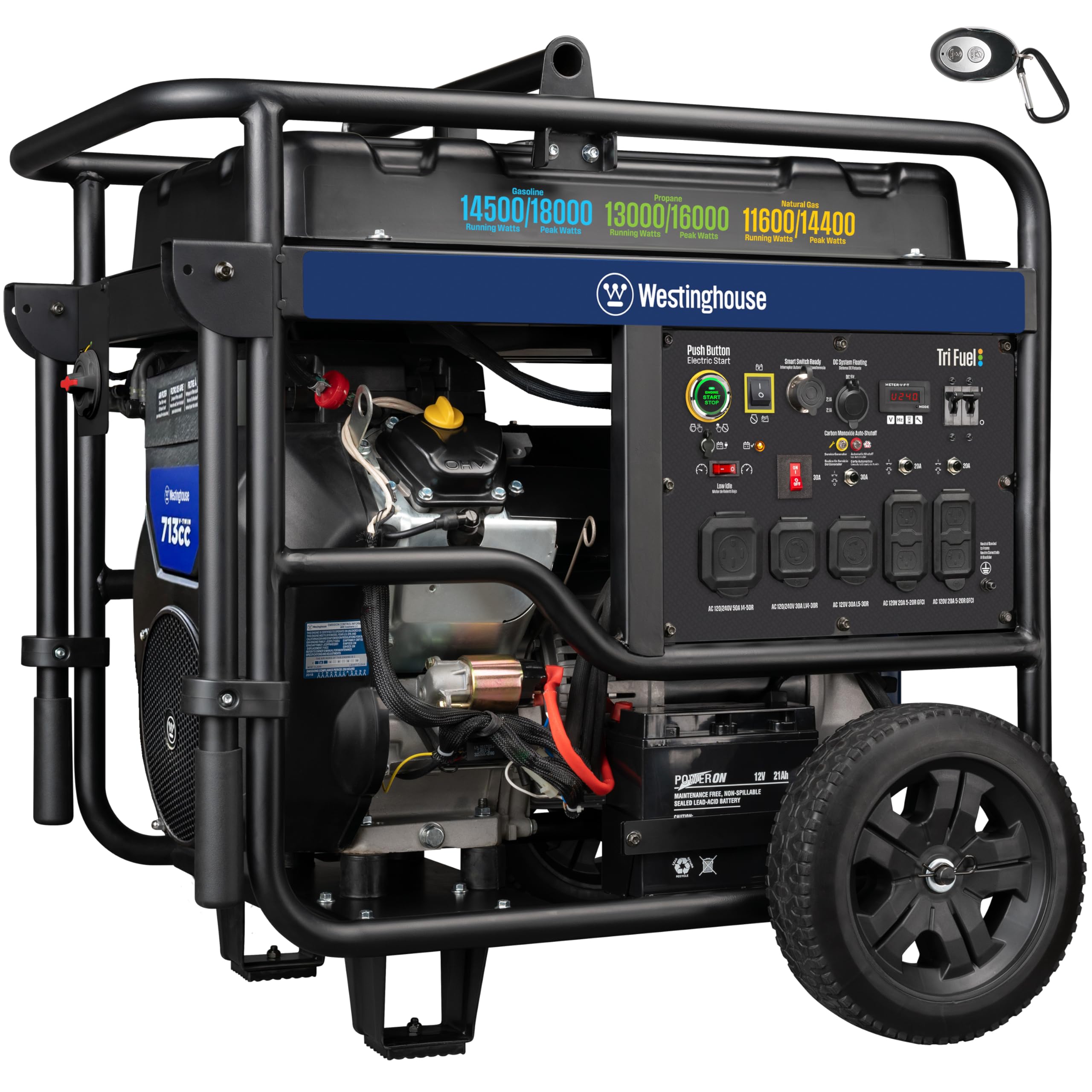
The Westinghouse WGen14500TFc is the heavy lifter of this list, delivering 18,000 peak watts on gasoline, 16,000 on propane, and 14,400 on natural gas from a 713cc V-twin OHV engine. For welding, this generator can run a full-size multi-process welder at maximum output while simultaneously powering a plasma cutter, compressor, and lights—no load-balancing compromise required. The total harmonic distortion is rated below 5%, which is acceptable for welding inverters and sensitive electronics, though the iGen11000DFc’s sub-3% THD is cleaner for digital-controlled TIG machines.
The V-twin engine is the standout feature here, providing smoother power delivery and lower vibration than single-cylinder units of similar output. The 10.5-gallon fuel tank delivers up to 16 hours of runtime at 25% load on gasoline, and the low-idle mode reduces engine speed when no load is present, cutting fuel consumption during breaks. The VFT data center displays voltage, frequency, and lifetime hours, giving real-time insight into power quality as the welding load fluctuates. The push-button electric start with remote key fob and recoil backup ensures reliable startup after extended storage.
The main trade-off is the noise output, measured at 74 decibels, which is significantly louder than the inverter-class generators on this list. The weight of 348 pounds and the large footprint mean this is not a job-site runner; it belongs on a trailer or a permanent pad with a transfer switch. The fuel shut-off solenoid has been reported to stick in a small number of units, causing gasoline startup issues that are resolved by manually freeing the plunger. For the operator who needs maximum power across three fuel types to run a heavy-duty welder plus auxiliary equipment simultaneously, the WGen14500TFc is the most capable non-inverter generator in this list.
Why it’s great
- 18,000 peak watts from a 713cc V-twin runs a welder plus heavy shop equipment simultaneously
- Tri-fuel capability with natural gas connectivity provides unlimited run time for long operations
- Low-idle mode reduces engine speed and fuel consumption during break periods
Good to know
- 348-pound weight and 74 dB noise output limit job-site mobility and residential hours
- 5% THD is acceptable but not as clean as inverter generators for precision TIG
12. WEN TF1450 Tri-Fuel Generator
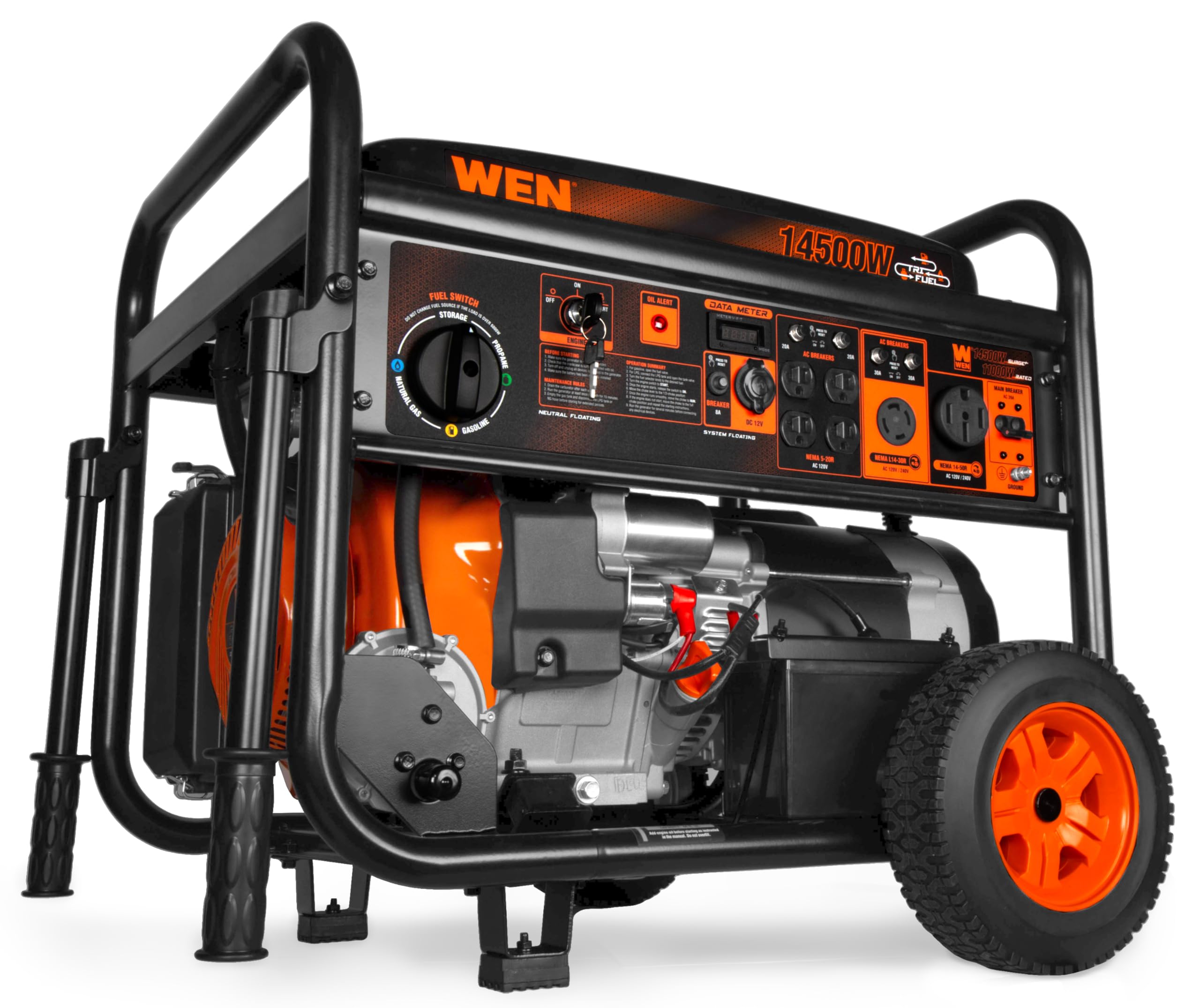
The WEN TF1450 brings tri-fuel capability—gasoline, propane, and natural gas—to a price point that undercuts the Westinghouse and Gidrox competitors by a significant margin, making it the entry-level choice for budget-conscious buyers who need whole-house backup capacity plus 240V welding power. The 500cc 4-stroke OHV engine produces 14,500 surge watts and 11,500 running watts on gasoline, with the expected derating on propane and natural gas. The electric start fires reliably with the turn of a key, and the included wheel kit simplifies positioning around the shop or home.
The outlet panel includes four 120V 5-20R outlets, a 120V/240V L14-30R transfer-switch-ready outlet, a 120V/240V 14-50R outlet for larger welder connections, and a 12V DC automotive outlet. The 8.2-gallon tank provides up to 12 hours of half-load runtime on gasoline, adequate for a full day of intermittent welding. The three-year limited warranty aligns with the budget position, though users should note that the warranty covers parts and labor but requires shipping to a service center for non-trivial repairs.
The notable criticism from verified buyers is the discrepancy between the advertised surge wattage and the main breaker rating—the 39-amp main breaker at 240V limits continuous draw to 9,360 watts, which is significantly below the claimed 11,500 running watts on gasoline. This means the generator can deliver starting surge for motor loads but cannot sustain 11,500 watts continuously through the breaker. For welding use, this still supplies ample power for a 200-amp class MIG welder drawing around 7,000 to 8,000 watts at full output, but operators should verify their specific welder’s running draw against the breaker limit before committing to heavy continuous work.
Why it’s great
- Tri-fuel flexibility at the lowest entry price in this comparison
- 14-50R outlet provides direct 240V connection for full-size welders
- Electric start and included wheel kit simplify setup and positioning
Good to know
- 39-amp main breaker limits continuous 240V draw to 9,360 watts despite higher surge rating
- Runtime reduces to approximately 8 hours at continuous half-load welding conditions
13. Honda EU3200i Inverter Generator
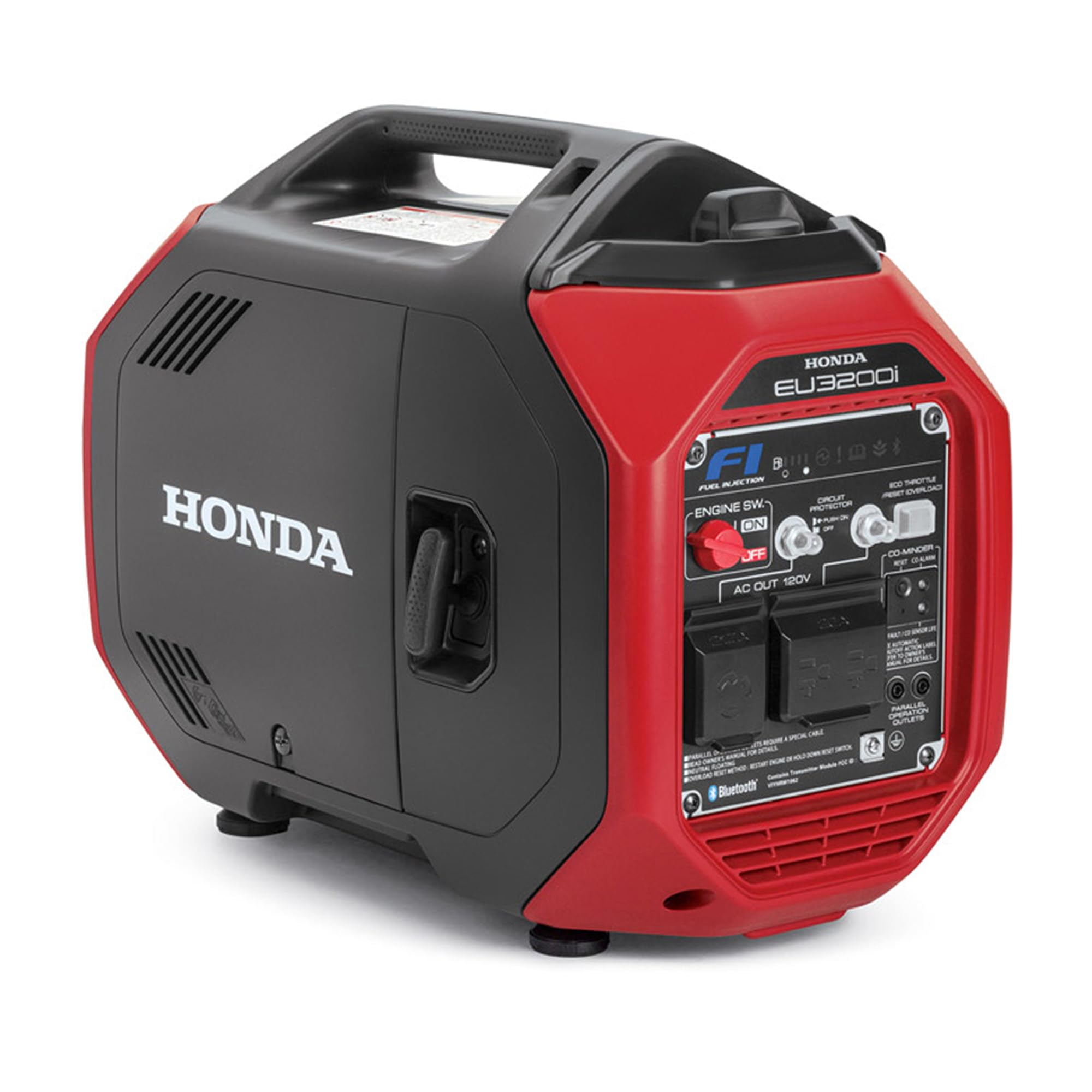
The Honda EU3200i occupies a distinct niche on this list: it is not a primary welder power source for full-output shop work, but it is the perfect companion generator for inverter-based stick and TIG welders on remote job sites where weight and noise are the primary constraints. At 65 pounds with Honda’s legendary inverter technology producing clean sine-wave power at less than 3% THD, this generator can run a 180-amp stick welder like the ESAB Rogue 180i or a 200-amp TIG machine like the Everlast 200DV at reduced amperage. The 3,200 peak watts and 2,800 running watts translate to approximately 23 amps at 120V, sufficient for light MIG on 1/8-inch material and stick welding with 1/8-inch 7018 rods at 110-130 amps.
The CO-MINDER system automatically shuts down the generator if carbon monoxide reaches unsafe levels, a critical safety feature when operating in partially enclosed spaces like trailer beds or barn corners. The Eco Throttle system adjusts engine RPM to match the load, extending fuel efficiency and reducing noise to conversation-level volume during light welding tasks. The parallel capability allows pairing a second EU3200i to double the available wattage for larger multifunction welding machines, effectively creating a 6,400-watt inverter bank that rivals the output of the Westinghouse iGen while maintaining Honda’s reliability and weight advantage.
The Honda EU3200i is the most expensive generator per watt on this list, and it requires fuel management—gasoline only, no dual-fuel or tri-fuel option. The runtime of 8.6 hours at quarter load is respectable but trails the dual-fuel generators by half. For the welder who primarily works off-grid on thin to medium materials and values long engine life, quiet operation, and one-person portability above raw power capacity, the Honda EU3200i is the standard by which portable generator reliability is measured.
Why it’s great
- 65-pound weight with clean inverter power is the most portable generator for welding duty
- Parallel capability enables scaling to 6,400W with a second unit for larger welders
- Honda reliability record and CO-MINDER safety system set the durability benchmark
Good to know
- 3,200 peak watts limit welder amperage to approximately 130A on stick and 120V MIG
- Gasoline-only fuel source with no dual-fuel or tri-fuel option available
FAQ
Can I run a 200-amp MIG welder on a 9,000-watt generator?
What happens if I use a generator with THD above 10% for TIG welding?
Why does my welder output less amperage on 120V than 240V?
Is a spool gun necessary for aluminum MIG with a generator welder setup?
Final Thoughts: The Verdict
For most users, the generator welder combo winner is the Millermatic 211 PRO because its Dyna-Pulse MIG, Auto-Set Elite, and USB-upgradable software deliver professional-grade bead quality across steel, stainless, and aluminum from a 46-pound chassis that runs on any 240V generator with sub-5% THD. If you want clean inverter generator power with tri-fuel flexibility and the lowest noise in its class, grab the Gidrox 11000W Tri-Fuel Inverter. And for the mobile fabricator who needs an integrated plasma cutter plus nine welding processes in a single dual-voltage machine, nothing beats the ARCCAPTAIN MIG205MP.