
You are deep in the woods, the app on your phone has frozen, and the cache is supposedly within ten feet. That moment, when your smartphone’s battery is draining and the signal is bouncing between trees, defines why you need a dedicated device. A geocaching GPS locks onto satellites with purpose-built antennas and runs for days, not hours, ensuring you never lose the trail between the parking lot and the prize.
I’m Mohammad Maruf — the founder and writer behind Drink4Good. I’ve spent years analyzing the market for handheld GPS units, comparing satellite constellations, battery chemistries, and screen technologies to help outdoor enthusiasts pick the tool that actually works when they’re miles from the nearest cell tower.
Whether you are a weekend hobbyist or a hardcore cacher chasing FTF in rugged terrain, choosing the right best geocaching gps means weighing screen readability against battery endurance and map detail against satellite reception.
How To Choose The Best Geocaching GPS
Selecting a geocaching GPS is not about picking the most expensive unit on the shelf. It is about matching the device’s strengths to your typical caching environment, your tolerance for menu complexity, and the kind of maps you need to find that micro hidden under a pile of sticks.
Satellite Channels: Beyond Basic GPS
A unit that only uses the standard GPS network struggles in deep forests or narrow canyons where the sky is partially blocked. Multi-GNSS support — adding GLONASS, Galileo, BeiDou, and QZSS — gives the receiver more signals to lock onto, cutting acquisition time and maintaining accuracy under leaf cover. For serious cachers, a device that tracks four constellations is a clear upgrade over a single-system unit.
Battery Architecture: AAs vs. Internal Lithium
Two AA batteries might sound old-fashioned, but they let you swap in fresh cells instantly on a multi-day hunt. Internal lithium packs recharge via USB-C but leave you stranded if the battery dies mid-trail. The best choice depends on whether you cache near a power source or carry spare AAs in your pack as a matter of habit.
Preloaded Maps vs. Coordinate-Only Screens
Some budget-friendly handhelds display only latitude and longitude on a blank screen, forcing you to visualize the terrain from a list of numbers. Units with preloaded topo maps show contour lines, water features, and trails, helping you plan your approach to a cache without switching to a phone. If you cache in unfamiliar backcountry, a map-enabled unit reduces the risk of walking into a ravine.
Quick Comparison
On smaller screens, swipe sideways to see the full table.
| Model | Category | Best For | Key Spec | Amazon |
|---|---|---|---|---|
| Garmin inReach Messenger | Satellite Communicator | Remote expeditions with 2-way messaging | 28 days battery in tracking mode | Amazon |
| Garmin Montana 680 | Touchscreen Navigator | All‑terrain with camera & turn-by-turn | 4” sunlight‑readable touchscreen | Amazon |
| Garmin GPSMAP 62St | Rugged Handheld | Users wanting preloaded 100k topo maps | 2.6” transflective 65K‑color TFT | Amazon |
| Garmin eTrex 32x | Mid‑Range Handheld | Preloaded topo maps & 3‑axis compass | 8 GB memory + microSD slot | Amazon |
| Garmin eTrex SE | Entry‑Level Handheld | Geocaching Live integration with app | 168‑hour standard battery life | Amazon |
| Bushnell BackTrack Mini | Compact Waypoint Tracker | Simple point‑to‑point return navigation | 35‑hour rechargeable battery | Amazon |
| NiesahYan 3.2” GPS | Map‑Enabled Handheld | Budget buyers wanting USA topo maps | 32 GB internal memory | Amazon |
| NiesahYan A6 | Basic Coordinate GPS | Ultra‑compact track recording | 20‑hour rechargeable battery | Amazon |
| Spot Gen 4 | Satellite Messenger | Safety communication beyond cell range | Globalstar satellite network | Amazon |
In‑Depth Reviews
1. Garmin inReach Messenger

During a two-week expedition in Madagascar, users confirmed the device delivers reliable message delivery even under partial canopy, and the 28-day battery life in 10-minute tracking mode eliminates the need to carry spare power banks. The interactive SOS feature connects directly to a 24/7-staffed response center, which alone justifies the premium for anyone caching in remote backcountry.
Pairing the Messenger with the Garmin Explorer app unlocks group messaging, location sharing, and weather forecasts without burning through your text allotment. The device itself is compact — 3.1 by 2.5 by 0.9 inches — and the internal rechargeable battery also provides safety charging to revive a depleted smartphone. Users noted that the unit handles extreme heat well and intelligently uses cellular signals when available to avoid satellite fees.
The drawback is the required active satellite subscription, which adds a recurring cost. Some buyers received units with previous owners’ emergency contacts still stored, suggesting quality control on returned stock is inconsistent. The on-board screen is monochrome, so navigation is best done through the app rather than the device alone.
Why it’s great
- Global two-way messaging without cell service
- Outstanding battery endurance in tracking mode
- Safety charging port can boost a dead phone
Good to know
- Requires an active monthly satellite subscription
- Monochrome screen limits on-device map detail
- Some units have arrived with pre-owned data still loaded
2. Garmin Montana 680

The Montana 680 arrives with 250,000 preloaded geocaches from Geocaching.com and a one-year BirdsEye Satellite Imagery subscription, making it the most cache-ready unit out of the box. The 4-inch, 272 by 480 pixel touchscreen is exceptionally bright in direct sunlight, and the interface is fast and responsive even with gloved fingers. It supports both GPS and GLONASS, achieving a lock in under a minute even inside heavy canopy, and the 8-megapixel camera automatically geotags photos with coordinates — a neat bonus for cache documentation.
Motorcyclists and overlanders praise the Montana 680 because it doubles as a vehicle navigator with turn-by-turn voice directions when paired with a RAM mount. The Track Manager is vastly improved over earlier Oregon units, allowing you to start and stop recording track logs without diving through nested menus. The internal lithium-ion battery lasts over a full day of continuous use, and the device recharges via a standard USB cable.
The barometric altimeter can show large swings — up to 275 feet — even after calibration, which frustrates cachers who rely on precise elevation data for puzzle caches. At 0.33 kilograms, it is heavier than the eTrex series, so ultralight packers may find it bulky for a day hike. Proximity to an AC charger is a minor inconvenience compared to AA-powered alternatives.
Why it’s great
- 250,000 preloaded geocaches eliminate manual data entry
- Large 4-inch touchscreen excels in direct sunlight
- Dual-purpose for hiking and vehicle navigation with voice prompts
Good to know
- Altimeter readings can swing significantly after calibration
- Heavier than dedicated handheld units
- Internal battery requires AC charging, not field-swappable AAs
3. Garmin GPSMAP 62St

The GPSMAP 62St stands out for its built-in 100K topographic data for the continental United States, which means you get contour lines, water features, and trails without downloading anything. The quad-helix antenna delivers a remarkably fast cold start to 6-10 foot accuracy, and the device maintains lock in environments where lesser units lose signal — inside heavy timber or narrow ravines. The three-axis tilt-compensated electronic compass and barometric altimeter provide bearing and altitude readings even when standing still, which is essential for final cache approach.
Physical buttons are a deliberate design choice: they work reliably with gloves, in rain, and in cold temperatures where touchscreens become unresponsive. The 2.6-inch transflective color TFT display at 160 by 240 pixels is sharp enough for trail-level map reading, and the unit is fully waterproof to IPX7, surviving submersion in one meter of water for 30 minutes. The microSD card slot allows you to add BirdsEye satellite imagery or additional map sets without replacing the device.
Several users reported that the Trip Computer consistently overestimates distance by about 19 percent when set to one-second recording, which inflates track logs. The electronic compass can require frequent recalibration, and some firmware updates have broken track-saving functionality. The included 100K topo maps are non-routable, so you cannot ask the device for turn-by-turn directions on trails.
Why it’s great
- Preloaded 100K topo covers the entire continental U.S.
- Quad-helix antenna provides rapid, stable satellite lock
- Three-axis compass works accurately when stationary
Good to know
- Trip Computer overestimates distance at high recording rates
- Electronic compass needs periodic recalibration
- Firmware updates have occasionally broken track saving
4. Garmin eTrex 32x

The eTrex 32x delivers an exceptional balance of map detail and field endurance, running up to 25 hours on two AA batteries in GPS mode, and stretching beyond 50 hours in Battery Save mode with WAAS disabled. It is preloaded with Topo Active maps that include routable roads and trails, making it a reliable companion for both hiking and cycling approaches to caches. The 2.2-inch sunlight-readable color display at 240 by 320 pixels is crisp enough to distinguish trail junctions at a glance.
Unlike the entry-level eTrex SE, the 32x adds a three-axis compass and barometric altimeter, giving you bearing and elevation data without needing to move. The 8 GB of internal memory plus a microSD card slot allow you to load BirdsEye satellite imagery or additional map tiles without sacrificing onboard storage. Hunters and anglers particularly value the non-touch button interface, which operates flawlessly in subzero temperatures without removing gloves.
A critical bug affects units loaded with OpenStreetMap .img files on the microSD card — the device bricks until the card is removed, a significant frustration for users who rely on custom maps. The screen refresh rate is noticeably laggy when panning across detailed topo maps, and the instruction manual is sparse enough that most users turn to YouTube for setup guidance. The menus are not intuitive for first-time GPS owners.
Why it’s great
- Exceptional battery life with field-swappable AA cells
- Preloaded routable Topo Active maps for trails and roads
- Three-axis compass and altimeter built in
Good to know
- OpenStreetMap .img files on SD card can brick the device
- Screen refresh is slow when zooming across maps
- Must watch online tutorials for proper setup
5. Garmin eTrex SE

The eTrex SE brings Geocaching Live integration to the entry-level segment, automatically pushing updated cache descriptions, logs, and hints directly to the device when paired with the Garmin Explore app on your smartphone. The 2.2-inch sunlight-readable display is functional for coordinate navigation, and the Multi-GNSS support — covering GPS, GLONASS, Galileo, BeiDou, and QZSS — provides solid positional accuracy even in mixed deciduous forest cover. Battery life is the headline feature: 168 hours in standard mode and up to 1,800 hours in expedition mode, all from two field-replaceable AA batteries.
Pairing with the Explore app unlocks Active Weather forecasts and smart notifications, plus wireless firmware updates that eliminate the need for a computer cable. The IPX7 water-resistant rating means the unit survives unexpected rain or stream crossings without a dry bag. The digital compass provides an accurate heading even when you are standing still, which is useful for the last ten feet of a cache search.
The unit automatically starts tracking when powered on but does not auto-end the track, adding an unwanted waypoint at home if you forget to stop it. Navigation is limited to breadcrumb-style track-back rather than map-based routing, so you cannot see your position relative to trails or roads unless you are viewing tracks on the phone app after the fact. The back cover that houses the USB-C port can be fiddly to reseal, risking water ingress if not fully closed.
Why it’s great
- Automatic cache updates via Geocaching Live integration
- Exceptional battery life in both standard and expedition modes
- Multi-GNSS support for reliable lock under tree cover
Good to know
- No built-in maps; navigation relies on tracked breadcrumbs
- Auto-start tracking can log unwanted waypoints at home
- USB port cover is finicky to seal properly
6. Bushnell BackTrack Mini

The Bushnell BackTrack Mini is a straightforward point-to-point navigation tool designed to get you back to your trailhead or basecamp without the complexity of a full map system. It captures your starting position with GPS technology and then guides you back, showing distance and direction on an easy-to-read LCD screen. The battery lasts up to 35 hours on a single charge via the included Micro USB cable, and the device is rugged and waterproof to handle the bumps of daily hiking.
Bluetooth connectivity lets you sync trips and waypoints to the Bushnell Connect app, where you can view elevation gain and decline, barometric pressure, and sunrise/sunset times. The large, glove-friendly buttons are designed for use in cold conditions, and the display shows bearing, distance, and elevation at a glance. It also provides moonrise and moonset data, which is a thoughtful addition for night caching.
The companion app has been reported as non-functional on some Android devices, notably the Samsung S22 Ultra, rendering the sync feature useless. Buttons are stiff and require multiple presses to register, making track recording a frustrating experience. Several users noted that the distance readings can overestimate by as much as 60 percent compared to GPS track logs from other devices, and elevation readings have been off by over 200 feet.
Why it’s great
- Simple interface for navigation back to start point
- Long 35-hour battery life on rechargeable cell
- Glove-friendly buttons for cold-weather use
Good to know
- Companion app is unreliable on recent Android phones
- Distance and elevation readings are often inaccurate
- Buttons are stiff and require firm presses
7. NiesahYan 3.2” GPS with USA Topo Maps
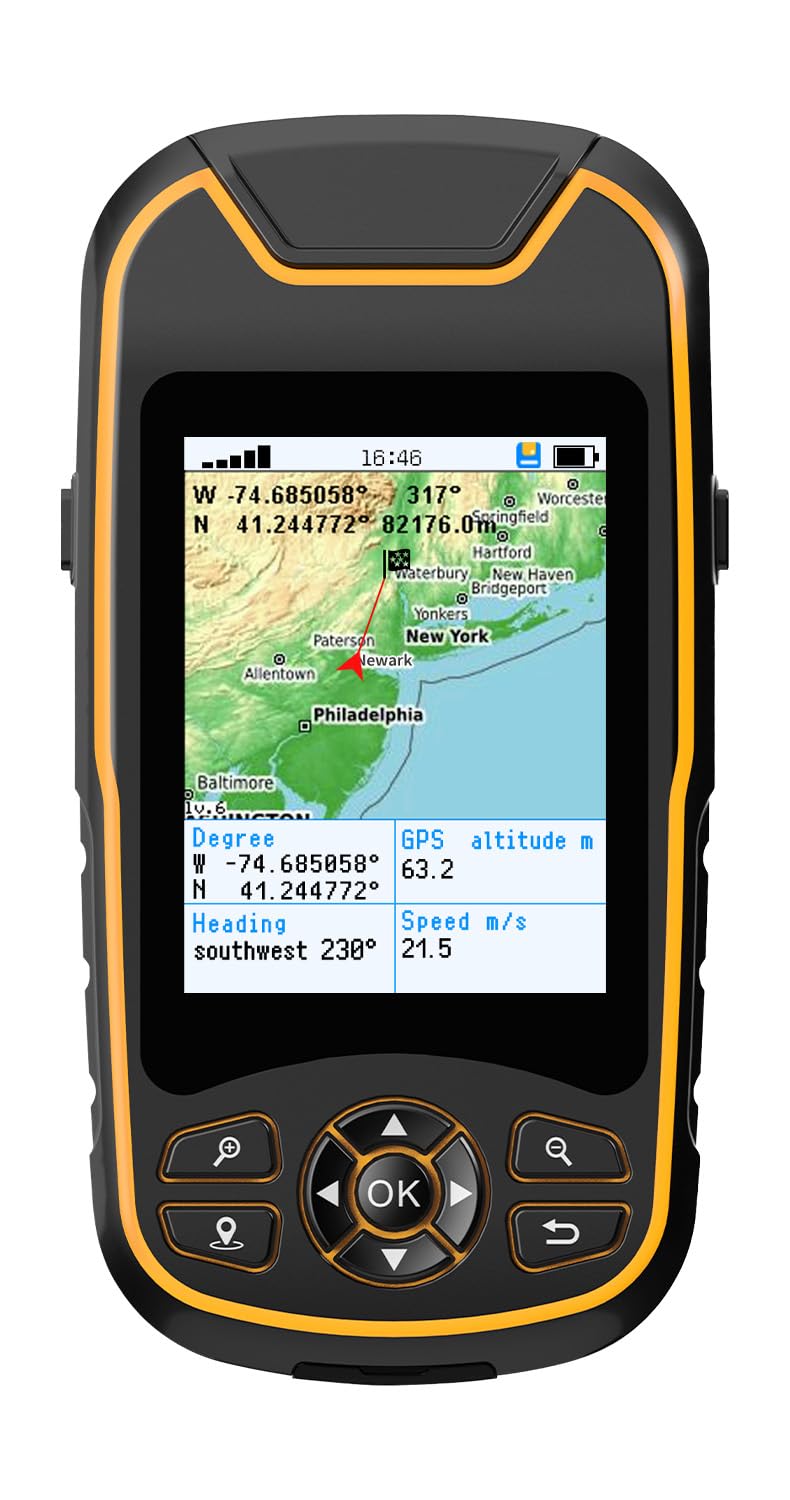
This NiesahYan model is a rare entry in the budget segment that includes preloaded USA topo maps, giving you contour lines and terrain features without needing a phone or computer download. The 3.2-inch sunlight-readable screen is the largest in its price tier, and the anti-slip exterior with physical buttons makes it easy to operate in wet conditions. Multi-GNSS support (GPS, Galileo, BeiDou, QZSS) provides positional accuracy within six feet, and the rechargeable battery claims 36 hours of run time on a full charge via USB-C.
The unit includes a three-axis compass and barometric altimeter, providing bearing and altitude readings when stationary. The 32 GB of internal memory allows you to load additional map tiles without worrying about storage limits. The track navigation feature records your path as you hike and can guide you back to your starting position if you lose orientation, a basic but essential function for any caching GPS.
Several units have suffered a fatal boot-loop failure after the first field test, rendering the device unusable. The UTM coordinate grid has been reported as inaccurate, with incorrect zone data and mirrored waypoint plots that defeat the purpose of precision navigation. The device only accepts GPX 1.0 files, a primitive format that many modern cache databases do not export natively.
Why it’s great
- Preloaded USA topo maps at a budget-friendly price
- Large 3.2-inch screen with anti-slip body
- 32 GB internal memory for additional map tiles
Good to know
- Fatal boot-loop failures reported after first outdoor use
- UTM coordinate system accuracy is questionable
- Only accepts legacy GPX 1.0 file format
8. NiesahYan A6
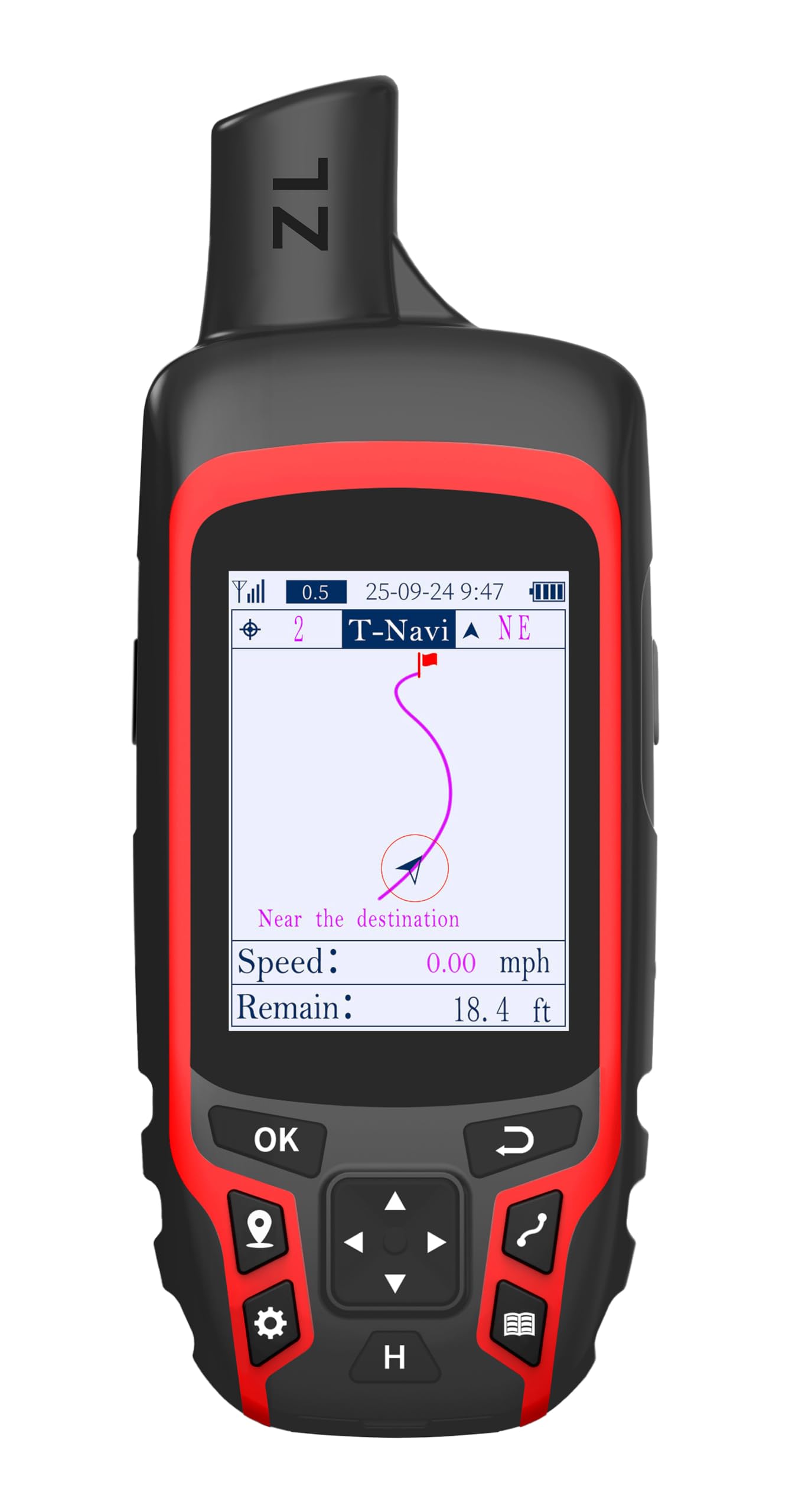
The NiesahYan A6 is a compact, lightweight GPS that supports four satellite constellations — GPS, Galileo, BeiDou, and QZSS — for fast acquisition and reliable accuracy. The 2.4-inch sunlight-readable color screen is bright enough to read in direct sunlight, and the physical button interface allows operation with gloves. The rechargeable battery provides up to 20 hours of continuous use and charges via a standard USB-C cable, which is convenient for field recharging from a power bank.
The device functions as a coordinate tracker, recording your track and storing waypoints along a route. It includes a GPS compass that provides an accurate heading and a barometric altimeter for elevation data, plus sunrise and sunset times for trip planning. The track navigation feature can guide you back to your starting position when you lose orientation, which is a critical safety net for unfamiliar terrain.
There are no preloaded maps on this unit — the screen displays only coordinates, compass bearing, and elevation. That makes it unsuitable for cachers who rely on visual terrain recognition. The menu system is non-intuitive, requiring manual study before field use, and accuracy degrades noticeably on steep, winding trails compared to flat terrain. Several users found the device frustratingly limited when compared to map-equipped units.
Why it’s great
- Multi-GNSS support provides fast satellite lock
- Lightweight and compact for pocket carry
- USB-C charging is convenient in the field
Good to know
- No preloaded maps; shows coordinates only
- Accuracy drops on steep, winding trails
- Menu navigation requires a learning curve
9. Spot Gen 4

The Spot Gen 4 is engineered for one primary purpose: keeping you alive when you are beyond cell phone range. It uses the Globalstar satellite network to transmit your GPS coordinates to emergency responders with a single press of the SOS button, and it allows you to send custom check-in messages to let family know you are safe. The magnetic SOS and HELP buttons reduce the risk of accidental activation, and the device is compact enough to clip onto a backpack strap or belt loop.
The tracking feature transmits location updates at regular intervals, allowing contacts to follow your progress on a web-based map. Longtime users report that message delivery is fast and reliable for check-ins, and the Flex subscription pricing offers more flexibility compared to rigid annual plans. The unit weighs only 142 grams and runs on field-replaceable AA batteries, which is a distinct advantage over sealed lithium packs for long expeditions.
The Gen 4 removed the USB power option that previous generations offered, meaning you are locked into disposable or rechargeable AA cells. The battery cover is secured by four tiny screws instead of thumbscrews, making field battery swaps a tool-requiring chore. Firmware updates require removing four screws to access the circuit board, an archaic process in an era of wireless updates, and a poorly seated weather seal can allow moisture intrusion.
Why it’s great
- Dedicated SOS button connects to emergency responders
- Reliable Globalstar satellite network for remote messaging
- AA batteries are field-replaceable without specialized tools
Good to know
- No USB power option; only AA batteries
- Battery cover requires a screwdriver for replacement
- Firmware updates require disassembling the device
FAQ
What is the minimum battery life I should look for in a geocaching GPS?
Do I need a subscription for preloaded geocaches?
Final Thoughts: The Verdict
For most users, the best geocaching gps winner is the Garmin inReach Messenger because it combines satellite communication with two-way messaging, exceptional battery endurance, and reliable SOS capability for serious backcountry caching. If you want preloaded topo maps with direct geocache support, grab the Garmin Montana 680. And for an entry-level option that leverages your phone for map data while keeping your GPS running for days, nothing beats the Garmin eTrex SE.