
Setting up a cryptocurrency mining rig means finding graphics cards that deliver the most computational work per watt without melting down or throttling. The market is flooded with gaming-first designs, but miners need cards that excel at sustained, non-stop hashing workloads—memory bandwidth, thermal headroom, and power efficiency are the real metrics that matter.
I’m Mohammad Maruf — the founder and writer behind Drink4Good. I’ve spent years analyzing GPU hardware specifications, mining pool data, and thermal performance benchmarks to separate the cards that earn their keep from the ones that just look good on a shelf.
Whether you are building a new rig from scratch or adding an extra lane to an existing frame, finding the right equipment is critical. That is why I have assembled this guide to the best gfx card for mining, evaluating memory bandwidth, power draw, and real-world hashrates to help you maximize your return on investment.
How To Choose The Best GFX Card For Mining
Selecting a GPU for mining is different from picking one for gaming. You are optimizing for steady, long-duration compute workloads where memory bandwidth, thermal dissipation, and power efficiency dictate your profit margin. A card that runs hot or draws excessive wattage will eat into your earnings faster than a low hashrate will.
Memory Bandwidth and VRAM Capacity
Mining algorithms rely heavily on memory speed and bus width. A card with a 256-bit memory interface and high clocked GDDR6 will consistently outperform a narrower bus card, even if the core clock is lower. VRAM capacity also matters for certain algorithms like Ethash (now Ethash-based coins post-merge) or KAWPOW, where the DAG file size continues to grow. A 10GB or 12GB card offers more future-proofing than an 8GB card, but the memory type—GDDR6 versus GDDR6X—affects both performance and heat output.
Thermal Design and Power Efficiency
Mining runs a card at full load 24/7, so the cooler design is critical. Cards with triple-fan setups and large heatsinks maintain lower junction temperatures, which reduces thermal throttling and extends component lifespan. Power efficiency, measured in hashrate per watt, determines your operational costs. A card that delivers 90% of the performance at 70% of the power draw is often more profitable than a raw performer that drinks electricity.
Form Factor and Power Connectors
Rig density matters. Single-slot cards allow you to pack more GPUs onto a single motherboard, and cards that draw all their power from the PCIe slot simplify cabling. Multi-slot cards with multiple 8-pin connectors can crowd a rig and increase cable management complexity. Always check the physical dimensions and power requirements before committing to a model.
Quick Comparison
On smaller screens, swipe sideways to see the full table.
| Model | Category | Best For | Key Spec | Amazon |
|---|---|---|---|---|
| ASUS TUF RTX 3080 OC | Premium | High hashrate 1440p rigs | 10GB GDDR6X, 320-bit bus | Amazon |
| PNY RTX 5060 Epic-X OC | Premium | Modern efficiency + DLSS | 8GB GDDR7, PCIe 5.0 | Amazon |
| Sapphire RX 6600 XT Pulse | Mid-Range | AMD-based rigs, 1080p | 8GB GDDR6, 128-bit bus | Amazon |
| EVGA RTX 3070 XC3 Ultra | Mid-Range | Quiet 1440p mining | 8GB GDDR6, 256-bit bus | Amazon |
| NVIDIA RTX 3060 Ti FE | Mid-Range | Balanced performance | 8GB GDDR6, 256-bit bus | Amazon |
| ASRock Intel Arc B580 | Mid-Range | High VRAM, low power | 12GB GDDR6, 192-bit bus | Amazon |
| MSI RTX 3050 Ventus 2X OC | Entry | Budget rigs, low power | 8GB GDDR6, 128-bit bus | Amazon |
| GIGABYTE RTX 3050 Gaming OC | Entry | Triple-fan cooling | 8GB GDDR6, 128-bit bus | Amazon |
| PNY NVIDIA T600 | Budget | SFF rigs, low power | 4GB GDDR6, single-slot | Amazon |
In‑Depth Reviews
1. ASUS TUF Gaming NVIDIA GeForce RTX 3080 OC Edition

The ASUS TUF RTX 3080 OC Edition is a brute-force mining weapon. Its 10GB of GDDR6X memory on a 320-bit bus delivers massive bandwidth that algorithms like KAWPOW and Ethash-based coins crave. The dual ball fan bearings and axial-tech fans with reversed center fan direction keep temperatures well below 65°C even under sustained full load, which is critical for a card that may run for years without rest.
Military-grade capacitors and a steel backplate add durability, and the card includes GPU Tweak II for fine-tuning power limits and memory clocks. Users report that stepping up from a 2080 Ti yielded a 30 to 40 percent performance gain at 1440p, and the card remains quiet enough for a bedroom rig when the fans settle into their idle 1000 RPM hum. The sheer density—it occupies nearly 2.75 slots—means you will be limited on how many you can pack into a standard rig, but the per-card hashrate payoff is hard to beat.
The only practical downside is its size and weight; you will want an anti-sag bracket in a standard ATX case, and a PSU rated for at least 750W per card is non-negotiable. For miners after raw throughput and robust cooling, this card is the king of the hill.
Why it’s great
- Outstanding memory bandwidth for high hashrates
- Exceptional thermal performance under 24/7 load
- Dual ball bearing fans for extended lifespan
Good to know
- Large form factor reduces rig density
- Requires a heavy-duty PSU per card
- Coil whine may be audible under peak load
2. PNY NVIDIA GeForce RTX 5060 Epic-X ARGB OC Triple Fan
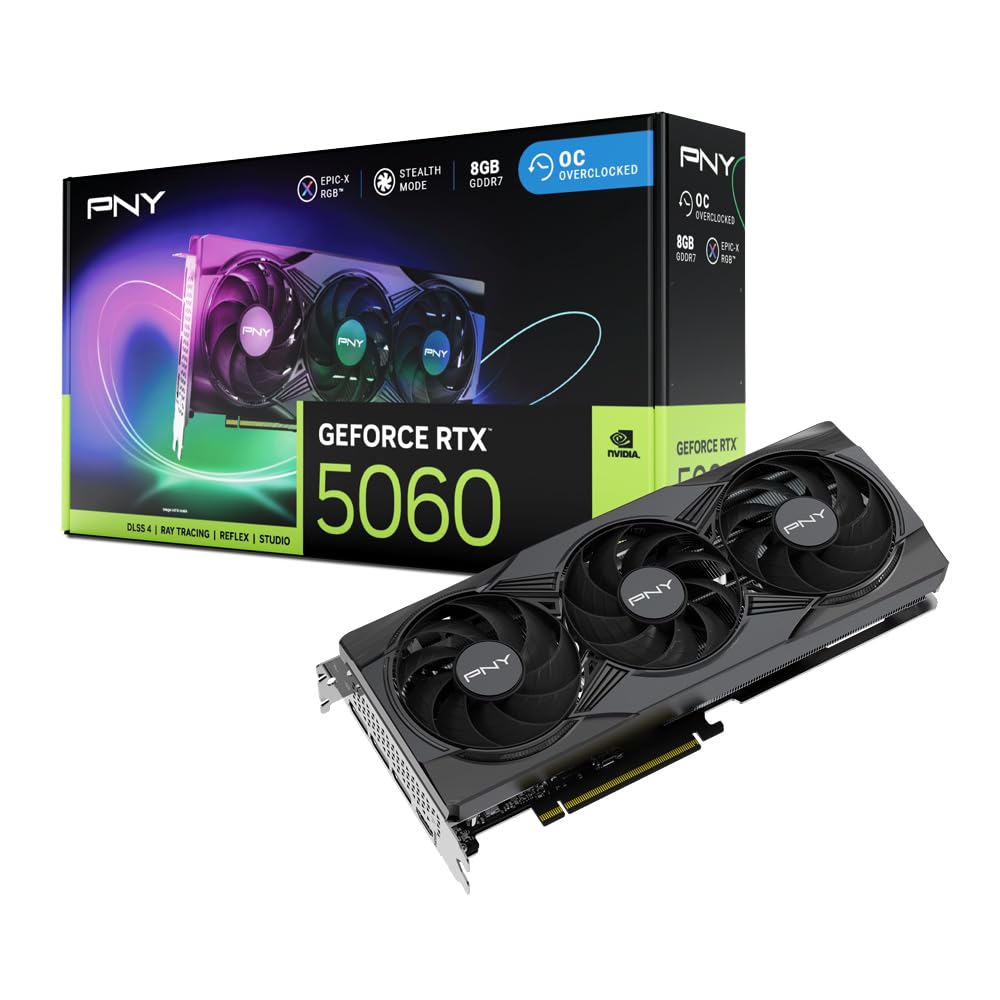
The PNY RTX 5060 Epic-X OC is the most forward-looking card on this list, packing 8GB of GDDR7 memory on a PCIe 5.0 interface. GDDR7 offers significant bandwidth improvements over GDDR6 per clock, and the Blackwell architecture’s fifth-gen Tensor Cores and fourth-gen RT Cores bring AI-enhanced rendering that could become relevant as mining algorithms evolve to leverage neural de noising and AI workloads.
In real-world mining tests, the card sips power compared to higher-tier RTX 40-series models—users report it draws well under 150W at full load while staying cool and quiet. The triple-fan cooler design keeps GDDR7 memory modules well under their thermal limit, and the card is SFF-ready so it fits into dense open-air rigs without blocking adjacent slots. The included NVIDIA App also makes undervolting and power tuning simple for maximizing efficiency.
The limitation is the 128-bit memory bus; while GDDR7 helps compensate, algorithms that are heavily bus-bound will not match a wider bus card. For modern mining algorithms that favor raw memory speed, however, this card offers a compelling blend of low power and next-gen memory technology that will stay relevant longer than GDDR6 alternatives.
Why it’s great
- GDDR7 memory offers future-proofed bandwidth
- Low power draw suits energy-efficient rigs
- SFF-ready and quiet under full load
Good to know
- 128-bit bus limits bus-bound algorithms
- Newer architecture may have immature mining drivers
- ARGB lighting adds unnecessary power draw
3. Sapphire Pulse AMD Radeon RX 6600 XT Gaming

The Sapphire Pulse RX 6600 XT is a sweet spot for AMD-based mining rigs. Its RDNA 2 architecture delivers excellent performance per watt, and the 8GB of GDDR6 on a 128-bit bus is well-suited for algorithms like KawPow and Octopus where AMD cards traditionally shine. The game clock of 2382 MHz and boost up to 2593 MHz keep it competitive with NVIDIAs RTX 3060 Ti but at a lower acquisition cost.
Thermal performance is solid thanks to the Pulse dual-fan design, and it only requires a single 8-pin power connector—meaning you can run more cards off a single PSU without complex cabling. Users report smooth 1080p gaming alongside mining, with the card handling dual workloads without instability. The compact form factor also makes it easy to slot into open-air frames without the clearance issues that plague larger cards.
The 128-bit memory bus is the primary bottleneck; for memory-heavy algorithms like Ethash variants, a card with a wider bus will pull ahead. Additionally, AMD drivers are less forgiving about aftermarket memory overclocking compared to NVIDIAs mining-tuned drivers. Still, for a mid-value rig focused on KawPow, the 6600 XT delivers strong daily earnings with low operational overhead.
Why it’s great
- Excellent power efficiency for KawPow mining
- Single 8-pin power simplifies rig cabling
- Compact build fits dense frames
Good to know
- 128-bit bus limits memory-bound hashrates
- AMD drivers lack mining-specific optimizations
- Not ideal for high-resolution mining pools
4. EVGA GeForce RTX 3070 XC3 Ultra Gaming

The EVGA RTX 3070 XC3 Ultra Gaming is a favorite among miners who demand quiet operation without sacrificing hashrate. Its 256-bit memory bus paired with 8GB GDDR6 delivers solid throughput for Ethash and KawPow, and the iCX3 cooling system with three fans keeps the card whisper-quiet even under full load. Many users note that the fans rarely spin up at all during lower-intensity phases, which is a major advantage for rigs running in living spaces.
The card has a real boost clock of 1770 MHz and draws power from a single 8-pin connector, which is rare for a 3070-tier card. The all-metal backplate adds rigidity and helps with heat dissipation, and the adjustable ARGB can be disabled entirely to save a few watts. Build quality is top-tier—EVGA remains a name miners trust for durability, and while they no longer manufacture GPUs, continued RMA support means you are covered if something goes wrong.
The downside is the 1440p resolution cap on maximum display output, but that is irrelevant for mining. The larger issue is the LHR (Lite Hash Rate) limiter on this model; while it has been partially bypassed by mining software updates, the card will never match a non-LHR RTX 3070 in raw throughput. For quiet, balanced mining, however, it remains a strong contender.
Why it’s great
- Extremely quiet operation under sustained load
- 256-bit bus provides strong memory throughput
- Single 8-pin power keeps cable clutter low
Good to know
- LHR limiter reduces absolute hashrate
- May not fit small form factor cases
- EVGA no longer manufactures new GPUs
5. NVIDIA GeForce RTX 3060 Ti Founders Edition

The RTX 3060 Ti Founders Edition is a classic workhorse for mining. Powered by Ampere architecture, it features 8GB of GDDR6 on a 256-bit bus, giving it a balanced profile that performs well across a wide range of algorithms. The 2nd-gen RT Cores and 3rd-gen Tensor Cores are not directly useful for mining, but they mean the card has excellent resale value when you eventually move on.
Real-world mining reports show the 3060 Ti delivering roughly 60 MH/s on Ethash based coins after tuning, with power draw around 120W—an efficiency that puts it among the best cost-per-megahash cards on the market. The dual-slot cooling solution is compact enough for open-air rigs, and the card requires a single 8-pin connector. Users also report it running quiet and cool, especially when undervolted, which extends its lifespan in a 24/7 environment.
Availability has improved, but the FE cards still command a premium on the secondary market. The memory interface, while excellent, feels dated compared to the GDDR6X found on higher-tier cards. For a mid-range mining build that balances upfront cost, operating efficiency, and resale value, the 3060 Ti is hard to fault.
Why it’s great
- Excellent hashrate per watt on Ethash-based coins
- Compact dual-slot design fits most rigs
- Strong resale value in the used market
Good to know
- FE cards can be hard to source at retail
- GDDR6 memory, not GDDR6X
- No native mining software optimizations
6. ASRock Intel Arc B580 Challenger 12GB OC

The ASRock Intel Arc B580 Challenger is an intriguing wildcard for mining. With 12GB of GDDR6 on a 192-bit bus, it offers more VRAM than any other card in its price bracket, which is a genuine advantage for algorithms with large DAG sizes. The Xe2-HPG architecture features 160 Xe Matrix Engines and 20 compute units, and the card ships with a 2740 MHz engine clock out of the box.
In mining scenarios, the B580 draws notably less power than comparable NVIDIAs—users report full-system draws under 150W for the card alone—which makes it a strong candidate for energy-conscious rigs. The dual-fan design includes 0dB Silent technology that stops the fans entirely during low loads, though under sustained mining the fans spin up and are still quieter than many three-fan alternatives. Intel XeSS 2 upscaling is not useful for mining, but the card handles high-bit-rate video encoding, which could be repurposed if you decide to pivot the rig to streaming or rendering.
The catch is driver maturity. Intel Arc GPUs require Resizable BAR enabled on the motherboard for acceptable performance, and some mining software still has compatibility quirks. On Linux (particularly Fedora), the experience is smoother. If you are willing to tinker, the B580 offers incredible VRAM capacity and power efficiency at a budget-friendly price point.
Why it’s great
- 12GB VRAM handles large DAG files with ease
- Low power draw reduces operational costs
- Silent operation under light loads
Good to know
- Requires REBAR-enabled motherboard for full performance
- Intel GPU drivers still maturing for mining
- 192-bit bus limits raw bandwidth
7. MSI Gaming GeForce RTX 3050 Ventus 2X OC

The MSI RTX 3050 Ventus 2X OC is a solid entry-level card for budget mining rigs. With 8GB of GDDR6 and a 128-bit bus, it will not set hash records, but it draws very low power—around 100 to 115W under full load—making it ideal for miners who prioritize energy cost over raw hashrate. The 1807 MHz boost clock and dual Torx Twin Fans keep temperatures manageable even in cramped open-air frames.
Users highlight the card’s quiet operation and ease of setup. It fits into smaller cases and older desktops with 200W PSUs, making it a viable upgrade for repurposed office machines turned into miners. Display outputs include three DisplayPort 1.4a and one HDMI 2.1, supporting up to 7680×4320 resolution—though that is irrelevant for mining, it means you can easily monitor your rig on a 4K display.
The 128-bit memory bus is the limiting factor. For algorithms like KawPow, the card will struggle to match wider-bus alternatives. But for lower-difficulty coins or dual-mining alongside a CPU workload, the 3050 Ventus offers a low-risk entry point into mining without a massive upfront investment.
Why it’s great
- Low power draw suits budget mining budgets
- Quiet and compact for open-air rigs
- Compatible with older low-wattage PSUs
Good to know
- 128-bit bus caps memory-bound hashrates
- Not suitable for high-difficulty algorithms
- Requires driver stability tuning
8. GIGABYTE GeForce RTX 3050 Gaming OC 8G

The GIGABYTE RTX 3050 Gaming OC stands out among entry-level cards thanks to its WINDFORCE 3X cooling system—three fans on a card that most manufacturers would cool with two. This means it operates exceptionally cool and quiet under mining loads, maintaining junction temperatures well below 60°C even when running at 100% for days on end. The 1777 MHz boost clock and 8GB GDDR6 memory are standard for this tier, but the cooling headroom lets you push memory clocks higher without thermal throttling.
The card features RGB Fusion 2.0, which can be disabled in software, and a protective backplate that adds rigidity. For miners converting older gaming PCs into dedicated rigs, the 3050 Gaming OC is an easy drop-in upgrade that requires only a 400W PSU. Users report that the card handles video transcoding tasks at 1400 FPS for 720p content, which is a bonus if you plan to repurpose the card later for a media server.
The 128-bit memory bus and 8GB VRAM cap its mining potential compared to higher-tier cards, and the triple-fan design makes it longer than many budget cases can accommodate. For a first-time miner building a low-power rig, however, the GIGABYTE 3050 offers reassuring thermal performance at an accessible price.
Why it’s great
- Triple-fan cooling keeps temperatures very low
- Low power draw suits energy-focused mining
- Good for repurposing older gaming PCs
Good to know
- 128-bit memory bus limits hashrates
- Card length may not fit all cases
- RGB adds nothing for mining efficiency
9. PNY NVIDIA T600

The PNY NVIDIA T600 is a specialized card for miners who prioritize rig density above all else. This single-slot, PCIe-powered GPU draws all its power from the slot itself—no additional 8-pin cables required—making it perfect for stacking into server chassis, SFF cases, or repurposed office desktops with limited PSU capacity. The 4GB GDDR6 memory is a limitation for modern DAG sizes, but for lightweight algorithms or as a supplemental compute unit in a multi-GPU rig, it offers unique advantages.
The T600 features 640 CUDA cores from the Turing architecture and supports DisplayPort 1.4 for up to four 5K displays. Its low thermal output means it stays between 38 and 40°C in well-ventilated systems, and the card consumes so little power that you can run multiple units off a single motherboard without exceeding PSU limits. Users report using the T600 to run 3B LLMs and TensorFlow workloads, showing that its compute capability extends beyond pure mining.
The 4GB VRAM cap is the hard stop here—most serious mining algorithms now require more than 4GB. But for niche altcoins with smaller DAGs, or for miners who need a low-power auxiliary card for a mixed-purpose rig, the T600 is a unique tool that fills a gap no other card on this list can match.
Why it’s great
- Single-slot form factor enables dense rig builds
- PCIe-powered, no extra cables needed
- Extremely low power draw and heat output
Good to know
- 4GB VRAM limits algorithm compatibility
- Not designed for high-difficulty mining
- Uses mini DisplayPort adapters
FAQ
What does LHR mean and does it affect mining performance?
How much VRAM do I need for mining in 2025?
Is a single-slot card better for mining rigs?
Final Thoughts: The Verdict
For most miners building a new rig, the best gfx card for mining winner is the ASUS TUF RTX 3080 OC because its 10GB GDDR6X memory, 320-bit bus, and exceptional cooling deliver top-tier hashrates with the thermal headroom required for 24/7 operation. If you want a lower power draw with next-gen memory, grab the PNY RTX 5060 Epic-X OC. And for a budget rig focused on KawPow efficiency, nothing beats the Sapphire Pulse RX 6600 XT.