
The age between four and six is a whirlwind of rapid motor development, burgeoning imagination, and a fierce desire for independence — yet many toys marketed to this group either bore them within minutes or frustrate them with tiny pieces and complex steps. The best gifts bridge the gap between structured learning and free-form play, giving kids the tools to create, build, and role-play without needing constant adult intervention. This guide focuses on toys that survive the daily energy of this age group while genuinely engaging their growing minds.
I’m Mohammad Maruf — the founder and writer behind Drink4Good. I’ve spent countless hours researching the toy market for this specific age bracket, analyzing material safety, age-grading accuracy, and the real-world durability that separates a one-day hit from a long-term favorite.
Whether you are shopping for a birthday, a holiday, or just because, finding the right gifts for 4-6 year olds means looking past flashy packaging and focusing on what actually holds a child’s attention and withstands daily play.
How To Choose The Best Gifts For 4-6 Year Olds
The 4-to-6 age bracket spans a wide developmental range — a four-year-old may still mouth toys while a six-year-old is building complex structures. The key is to look for gifts that offer adjustable difficulty, durable construction, and genuine replay value that doesn’t rely on batteries or screens. The best choices encourage the child to drive the play, not passively consume it.
Prioritize Open-Ended Play Over Prescribed Outcomes
Toys that have a single correct answer — like a puzzle with a fixed image or an electronic toy that only does one thing — often lose their appeal after the first or second use. Building sets, role-play costumes, and science kits with multiple experiment variations keep a child’s interest alive because the child creates the outcome. Look for sets with at least 50 pieces or 10+ activity options to ensure the toy doesn’t become stagnant.
Check Safety Certifications and Material Quality
At this age, kids still test boundaries by throwing, dropping, and occasionally chewing on toys. ASTM F963-17 certification is the gold standard for U.S. toy safety, covering lead and cadmium limits, sharp edges, and small-part choking hazards. For soft toys, look for non-toxic dyes and machine-washable fabrics. For building toys, ABS plastic is far more durable than cheap PP plastic, which can crack or leave sharp shards.
Match the Toy to the Child’s Current Skill Level, Not Their Age
Age ranges on boxes are guidelines, not rules. A four-year-old who has been building with Duplo may be ready for a 150-piece set with small connectors, while a six-year-old with limited fine motor experience may still benefit from larger snap-together pieces. Read the “About This Item” sections and customer reviews carefully — parents often mention whether their younger or older children within the age range were able to use the toy independently or needed help.
Quick Comparison
On smaller screens, swipe sideways to see the full table.
| Model | Category | Best For | Key Spec | Amazon |
|---|---|---|---|---|
| Butterfly EduFields Girls Science Kit | STEM Kit | Science-loving girls aged 4-8 | 100+ experiments included | Amazon |
| National Geographic Junior Chemistry Set | Chemistry Lab | First-time young scientists | 50 experiments with 20+ tools | Amazon |
| Caferria 170-Piece Building Toys | Building Blocks | Independent builders aged 4-8 | 170 pieces with 18+ designs | Amazon |
| hahaland Unicorns Ballerina Set | Role-Play Doll | Imaginative play and dress-up | 15.75-inch doll with 3 outfits | Amazon |
| PlayZap Hopper Balls for Kids | Active Play | Physical energy release and balance | 18-inch bouncy ball with handle | Amazon |
In‑Depth Reviews
1. Butterfly EduFields 100+ Girls Science Kit

This kit pushes well beyond the typical 20-experiment starter set by offering over 100 activities, ranging from fizzy volcano eruptions to making safe perfumes and rainbow experiments with Skittles. The 20+ included lab tools — test tubes, measuring cups, goggles, gloves, and a volcano mold — are made from durable plastic that survived the drop tests mentioned in customer feedback. The instruction booklet is designed with step-by-step visuals so that a 5- or 6-year-old can follow along with minimal help, making it an excellent choice for fostering independence in a structured activity.
The kit is specifically marketed toward girls aged 4-8, but the experiments are gender-neutral in content — the pink packaging and “Girls in STEM” angle simply target a demographic that has historically been underserved in science toys. The bonus experiment booklet adds longevity, ensuring the kit doesn’t feel exhausted after the first weekend. Parents reported that the included food coloring did leak in a few cases, but that is a minor packaging issue that doesn’t affect the core play value.
Given the sheer quantity of experiments, the quality of the included tools, and the ASTM F963-17 safety certification, this kit delivers more replay value per dollar than almost any other single gift in this category. It is equally suited for a 4-year-old with adult supervision and a 7-year-old working semi-independently, making it a safe bet for a mixed-age playdate or a gift for a child whose exact developmental stage you are unsure of.
Why it’s great
- Over 100 experiments means months of new activities
- High-quality lab tools that don’t feel flimsy
- Clear visuals allow near-independent use by age 5-6
Good to know
- Food coloring bottles can leak during shipping
- Requires common household items like baking soda and vinegar for many experiments
2. National Geographic Junior Chemistry Set

This set, developed by Blue Marble under the National Geographic brand, is a curated introduction to chemistry that uses common pantry staples — namely baking soda and vinegar — to demonstrate cause-and-effect reactions that captivate the 4-6 age group. The 50 experiments are spread across a well-organized manual with full-color illustrations, and the 20+ lab tools include test tubes, a plastic beaker, safety goggles, and a mixing tray. The goggles are a nice touch for building the “real scientist” experience, which adds to the role-play excitement.
The packaging is compact, and the tools are made of thick, child-safe plastic that held up well in customer reports. The set ranks #44 in Educational Science Kits on Amazon, and parent reviews highlight that the instructions are genuinely easy for a 4-year-old to follow with minimal assistance. The kit does rely heavily on baking soda and vinegar, which are not included, so you will need to have those on hand before the first experiment session. The food coloring included in the set is in small dropper bottles that are easy for small hands to squeeze.
What separates this set from cheaper alternatives is the brand’s reputation for quality control and the fact that Blue Marble is a Toy of the Year Award winner. The experiments are carefully chosen to avoid frustration — no multi-step procedures that lose a child’s attention. It is a smaller set than the Butterfly EduFields kit in terms of experiment count, but it is more tightly focused and arguably easier for a first-time young scientist to complete successfully, which builds confidence.
Why it’s great
- Well-illustrated instructions built for independent use by age 4-5
- Durable plastic tools that withstand drops and spills
- Trusted National Geographic brand with award-winning design
Good to know
- Requires baking soda and vinegar — not included in the box
- Only 50 experiments, fewer than some competing kits
3. Caferria 170-Piece Building Toys with Storage Box

This 170-piece set uses ABS plastic — a more durable and safer material than the cheap PP plastic found in many discount building kits — and includes 20 removable wheels, allowing kids to build rolling vehicles, robots, and animals. The pieces come in six colors (gray, yellow, blue, red, green, plus wheels) and are designed to snap together easily and pull apart without requiring adult strength. Parents of 5- and 6-year-olds consistently report that their children can build the 18 suggested models from the instruction manual without help, then move on to free-form creations.
The included plastic storage box is a practical addition that addresses a major pain point for parents: the mess. The box is sturdy enough for travel and has a locking lid, which encourages the child to develop clean-up habits. The set is certified free of lead, cadmium, and BPA, and the round-edge design eliminates sharp points that could cause injury during rough play. The instruction manual includes 18 design ideas, but the real value is in the open-ended nature of the pieces — kids can build anything they imagine, which keeps the toy relevant for years.
At a count of 170 pieces, this set is large enough to allow multiple children to play together, making it a solid choice for siblings or playdates. The pieces are compatible with many other standard building block brands, so the set can be combined with existing collections. The lack of an electronic component means zero battery costs and no screen time — a pure construction experience that exercises spatial reasoning and fine motor coordination.
Why it’s great
- ABS plastic is more durable than cheap alternatives and BPA-free
- Storage box promotes clean-up habits and is portable for travel
- Wheels and varied colors support vehicle and robot builds
Good to know
- Small pieces could be a choking hazard for children under 3
- Some kids may need help separating tight connections at first
4. hahaland Unicorns Ballerina Doll Set
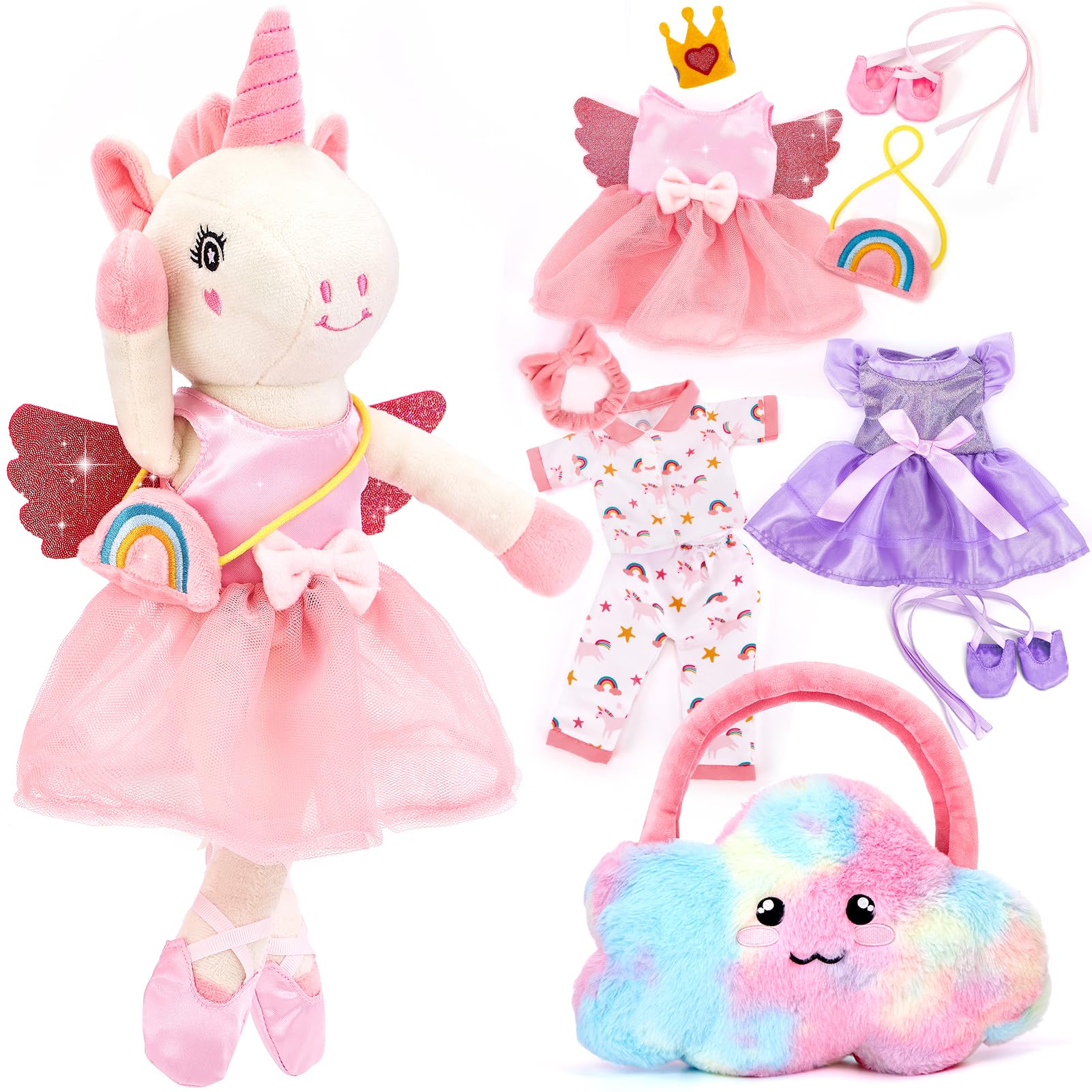
This 10-in-1 set centers on a 15.75-inch plush unicorn doll dressed as a ballerina, accompanied by three interchangeable outfits (including ballet shoes) and a soft, plush carry bag for storage and transport. The outfits use hook-and-loop fasteners that are easy for small hands to manipulate, which builds fine motor skills and gives the child a sense of independence — they can dress and undress the doll without adult help. The doll is ultra-soft and made from non-toxic materials, meeting safety standards for the 3-8 age range.
Customer feedback highlights this as a top-tier gift for dance recitals, birthdays, and holidays, especially for children who are already drawn to unicorn or ballet themes. The plush carry bag is not just a storage solution — it becomes part of the play scenario, allowing the child to take the doll on imaginary trips or to sleepovers. The set includes a variety of accessories beyond the three outfits, adding to the role-play depth. The doll has a sweet, calm expression that avoids the overly cartoonish look that some children outgrow quickly.
One of the strongest selling points is the built-in replay value: kids can mix and match outfits, create different characters, and invent stories. This is a screen-free, open-ended role-play toy that encourages narrative thinking and social play. The absence of batteries is a plus, and the plush material means the doll is suitable for both active play and bedtime cuddling, making it a versatile companion rather than a single-purpose toy.
Why it’s great
- Easy hook-and-loop fasteners empower independent dress-up for ages 4-6
- Plush carry bag makes the set portable and adds to role-play scenarios
- Soft, non-toxic materials are safe for cuddling and sleepovers
Good to know
- Primarily appeals to children interested in unicorns, ballet, or princess themes
- No batteries or electronic features — purely for imaginative, physical play
5. PlayZap Hopper Balls for Kids 3-8

This 18-inch inflated bouncy ball with a handle — often called a hopper ball or hippity-hop — is a classic active toy that builds balance, coordination, and gross motor skills. Made from thickened PVC material, it holds inflation well over time (parents report it stays firm for months between refills) and is designed to support children from age 3 up to about 8 years old. The included hand pump makes setup a quick 3-minute task, and the vibrant color options add visual appeal for younger kids.
The handle is comfortable for small hands to grip securely, and the 18-inch diameter is scaled for children aged 4-6 — large enough to provide stability but not so large that a small child struggles to mount it. Customer reviews note that kids as young as 4 can hop independently after a few tries, and even older siblings up to age 10 have been seen enjoying it. The one caveat is that the handle is a bit small for bigger kids, so a 10-year-old may find it awkward to grip. But for the target 4-6 age range, the proportions are ideal.
This is an excellent choice for burning off the physical energy that accumulates indoors during bad weather or in small spaces. It works well both indoors (on carpet or a rug) and outdoors on grass. The educational benefit is in the physical development — hopping strengthens leg muscles and improves balance in a way that a static toy cannot. At its price point, it offers tremendous value as a single-focus toy that reliably delivers active entertainment without batteries, screens, or complicated assembly.
Why it’s great
- Promotes balance, coordination, and gross motor development through active play
- Thickened PVC holds inflation well for months without leaking
- Quick setup with included hand pump — ready in under 3 minutes
Good to know
- Handle size may be small for kids over 8 years old
- Requires adult supervision to prevent falls on hard surfaces
FAQ
Is a 100-experiment science kit too overwhelming for a 4-year-old?
Can a 4-year-old use a 170-piece building set without frustration?
How long does a hopper ball typically hold air before needing a refill?
Final Thoughts: The Verdict
For most users, the gifts for 4-6 year olds winner is the Butterfly EduFields 100+ Girls Science Kit because it delivers the highest experiment count per dollar, uses certified safe materials, and offers enough variety to keep a child engaged for months rather than days. If you want a toy that encourages independent creative construction, grab the Caferria 170-Piece Building Toys. And for active physical play that burns off energy while building motor skills, nothing beats the PlayZap Hopper Ball.