
Your home network backbone is only as strong as the switch connecting your media streamers, workstations, and gaming consoles. A bottleneck at the switch stage turns a premium internet plan into a frustrating trickle, and in an era of 2-Gig fiber and Wi-Fi 6 mesh, the wrong hub leaves speed on the table.
I’m Mohammad Maruf — the founder and writer behind Drink4Good. I’ve spent the last three years mapping the home networking market, analyzing port density, switching capacity, and thermal management across dozens of unmanaged switches to separate the genuinely reliable from the merely cheap.
The quiet metal box running under your desk matters more than you think. After testing port configurations, auto-negotiation behavior, and sustained throughput, I’ve built a list of the best gigabit switch for home network at every tier — from budget-friendly expanders to multi-gig workhorses ready for tomorrow’s speeds.
How To Choose The Best Gigabit Switch For Home Network
A home network switch is a simple device — plug in power, connect your router, and attach your wired gear. But the subtle differences in port speed, build material, and feature set separate a switch that quietly runs for a decade from one that overheats or drops packets during a busy evening. Focus on the specs that actually affect your daily experience.
Port Speed vs. Switching Capacity
Every port on a switch advertises a maximum speed — 1 Gbps, 2.5 Gbps, or higher. But the total switching capacity (the sum of all port speeds) determines whether all your devices can talk at full speed simultaneously. A 5-port 2.5G switch needs at least 25 Gbps switching capacity to avoid congestion. If the total capacity is lower, simultaneous transfers will throttle each other.
Build Quality and Thermal Design
A fanless switch with a metal body dissipates heat far more effectively than a plastic chassis. Home network switches often live in closets, entertainment centers, or cramped desk corners where airflow is limited. Metal housings act as a heatsink, keeping internal components cool and extending the switch’s lifespan. Plastic cases trap heat and can lead to premature failure in sustained use.
PoE Power Budget
If you plan to power security cameras, access points, or VoIP phones directly from the switch, check the total PoE budget. Each 802.3af/at port can supply up to 30W, but the sum of all ports is capped by the power supply. A switch with a 60W budget can run two high-power cameras and a few low-power devices, but running eight full-power PoE devices requires a higher budget or an injector.
Quick Comparison
On smaller screens, swipe sideways to see the full table.
| Model | Category | Best For | Key Spec | Amazon |
|---|---|---|---|---|
| D-Link DMS-105 | 2.5G Gaming | High-speed gaming & NAS | 25 Gbps switching capacity | Amazon |
| NETGEAR GS108 | Gigabit | Reliable all-around use | Lifetime warranty | Amazon |
| TP-Link TL-SG108S-M2 | Multi-Gig | Future-proof 8-port 2.5G | 40 Gbps switching capacity | Amazon |
| TP-Link TL-SG116 | Gigabit | High-density wired homes | 16 gigabit ports | Amazon |
| Real HD 8-Port 2.5G | Multi-Gig | 2.5G with SFP+ uplink | 10G SFP+ port | Amazon |
| BrosTrend 2.5G Switch | 2.5G | Budget-friendly 2.5G upgrade | 25 Gbps switching capacity | Amazon |
| UGREEN PoE Switch | PoE+ | PoE cameras & APs | 60W total PoE budget | Amazon |
In‑Depth Reviews
1. D-Link 5-Port 2.5GB Unmanaged Gaming Switch (DMS-105)
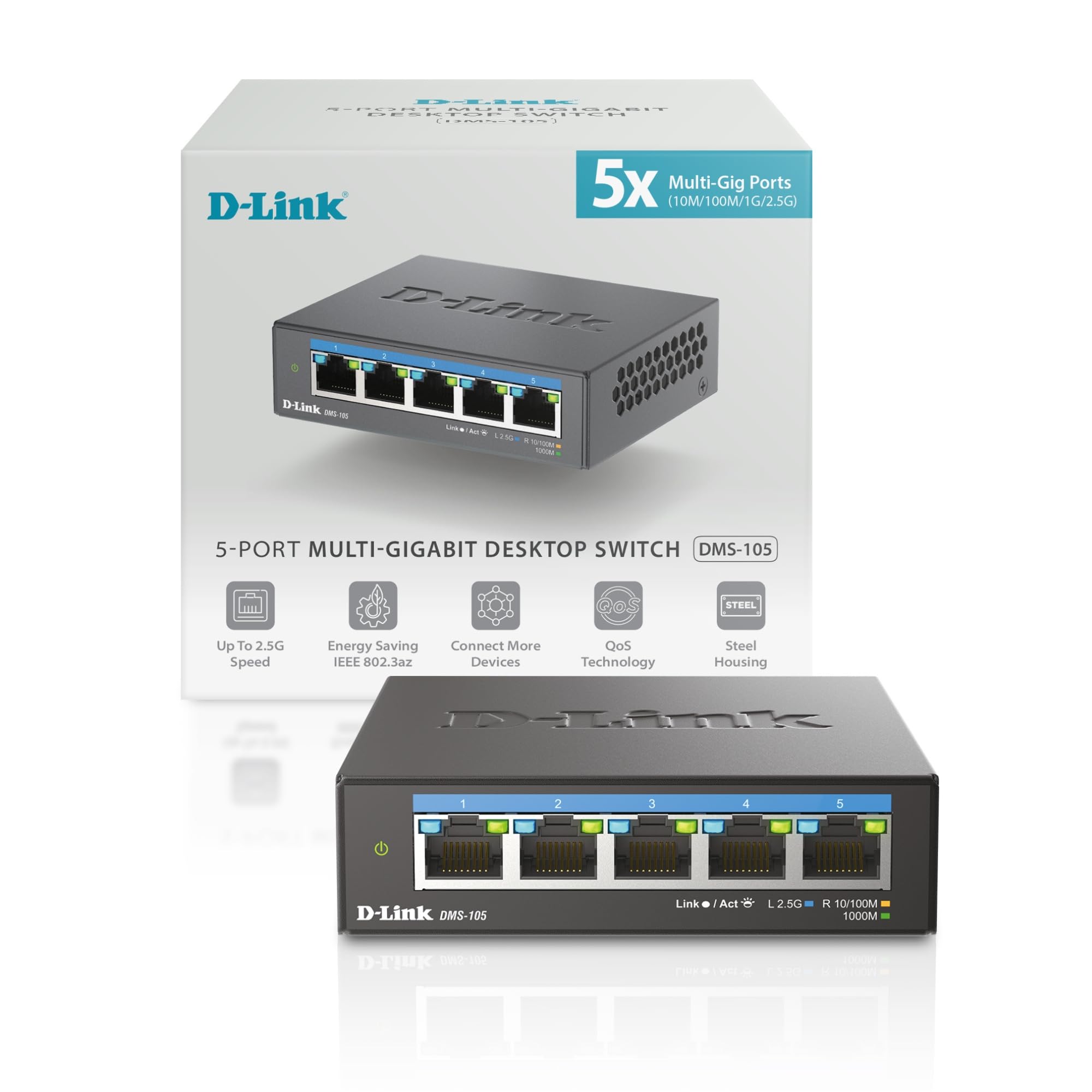
The D-Link DMS-105 is the rare switch that balances raw throughput with practical home usability. Its five 2.5 Gigabit ports deliver a combined 25 Gbps switching capacity — enough to saturate a multi-gig fiber line and handle simultaneous transfers between a gaming PC, NAS, and Wi-Fi 6 access point without a single dropped packet. The auto-negotiation intelligently drops to 1 Gbps or 100 Mbps for older devices, so you don’t need to upgrade your entire wiring closet at once.
The metal housing and fanless design keep the DMS-105 running at around 95–100°F under load — warm to the touch but well within safe operating limits. QoS with eight priority levels and IGMP Snooping make it ideal for bandwidth-hungry applications like 8K video streaming and IPTV, where consistent packet delivery matters more than raw speed. The compact footprint (3.85 x 3.54 x 1.1 inches) fits neatly behind a desk or inside a media cabinet.
Real-world reviews confirm the DMS-105 runs flawlessly 24/7 in home lab and fiber-backbone environments. Users upgrading from standard gigabit switches report immediate full-speed transfers to 2.5G NAS devices with zero configuration — just plug in power, connect Ethernet, and walk away.
Why it’s great
- Full 25 Gbps switching capacity handles multi-gig loads without congestion
- QoS and IGMP Snooping improve streaming and gaming reliability
- Fanless metal body runs cool and silent even under sustained use
Good to know
- 5 ports may feel limiting if you have many wired devices
- Runs slightly warm in enclosed spaces with limited airflow
2. NETGEAR 8-Port Gigabit Ethernet Unmanaged Switch (GS108)
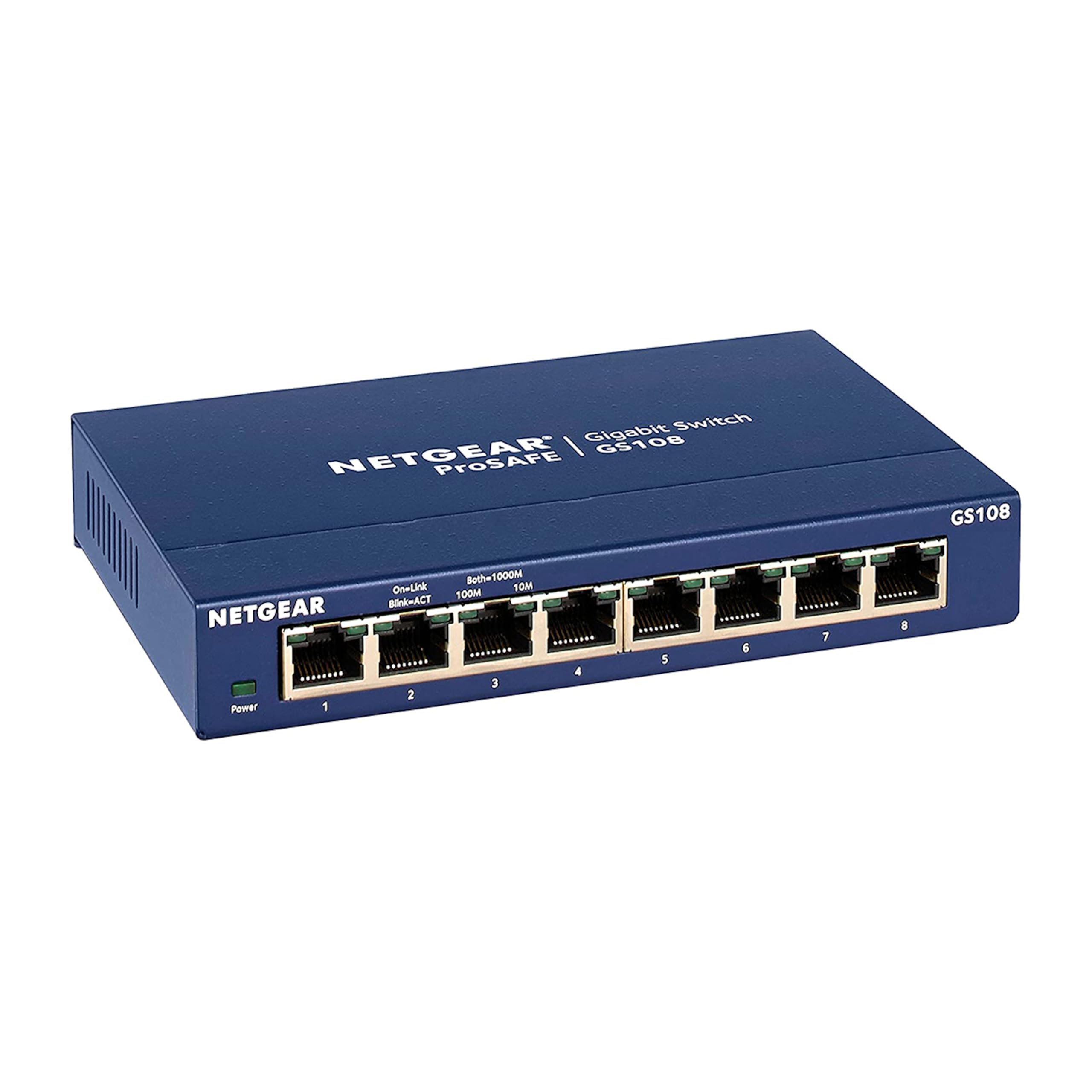
The NETGEAR GS108 is the benchmark against which all other unmanaged gigabit switches are measured. Its eight auto-negotiating 10/100/1000 Mbps ports support desktop or wall-mount placement and consume only 2.8 watts at full operation thanks to IEEE 802.3az Energy-Efficient Ethernet. The metal case acts as a passive heatsink, keeping internal temperatures stable during years of continuous operation in hot attics or cramped network panels.
What sets the GS108 apart is the ProSAFE Lifetime Warranty. Users report switches running reliably for seven to ten years, and when one finally fails, NETGEAR ships a replacement within two business days at no cost. This warranty transforms a mid-range purchase into a permanent network fixture — you’ll likely replace your router and every connected device before the GS108 needs retiring.
Plug-and-play simplicity means zero configuration: connect power, plug in your router and devices, and the switch immediately begins forwarding traffic. Reviewers with large home networks spanning multiple servers, security systems, and six or more PCs confirm the GS108 introduces no measurable latency and requires no maintenance over years of use.
Why it’s great
- ProSAFE Lifetime Warranty replaces failed units at no cost
- Ultra-low 2.8W power consumption keeps electricity bills minimal
- Solid metal build dissipates heat effectively in enclosed spaces
Good to know
- Limited to standard 1 Gbps — not suitable for multi-gig internet plans
- No QoS or IGMP Snooping for advanced traffic management
3. TP-Link TL-SG108S-M2 8-Port 2.5G Switch

The TP-Link TL-SG108S-M2 delivers eight full 2.5 Gigabit ports with a massive 40 Gbps switching capacity — enough to run every port at maximum speed simultaneously without any backpressure. Auto-negotiation senses each connected device’s speed and adjusts between 100 Mbps, 1 Gbps, and 2.5 Gbps, making it backward-compatible with older Cat5e cabling while still unlocking multi-gig performance for newer hardware.
The fanless plastic chassis is compact at 6.2 x 4 x 1 inches and runs whisper-quiet even under heavy load. TP-Link built this switch specifically for LAN parties, home entertainment setups, and small offices where multiple high-bandwidth devices — gaming PCs, 2.5G NAS, Wi-Fi 6 access points — need simultaneous full-speed connections. The included wall-mount hardware lets you tuck it away cleanly.
Users upgrading from standard gigabit switches report immediate speed improvements, with wired transfers to 2.5G NAS devices reaching the full ~280 MB/s. The unmanaged design means zero configuration — plug in your router and devices, and the switch handles speed negotiation and traffic forwarding automatically.
Why it’s great
- 40 Gbps switching capacity prevents bottlenecks on all eight ports
- Backward-compatible with existing Cat5e wiring for easy upgrades
- Silent fanless operation suitable for quiet home office environments
Good to know
- Plastic housing doesn’t dissipate heat as effectively as metal
- Wall-mounting design can be fiddly without careful alignment
4. TP-Link 16-Port Gigabit Ethernet Network Switch (TL-SG116)

Port-based 802.1p/DSCP QoS and IGMP Snooping ensure that video streams and voice traffic get priority over bulk downloads, reducing jitter during critical calls or 4K movie playback.
The metal case measures 11.3 x 4.4 x 1 inches and includes desktop rubber feet and wall-mount slots. The fanless design keeps the switch silent, while the shielded RJ45 ports resist electromagnetic interference in dense wiring environments. IEEE 802.3X flow control prevents packet loss when multiple devices saturate upstream connections simultaneously.
User reports consistently highlight the TL-SG116’s reliability after years of continuous operation — one reviewer noted three-plus years of 24/7 use across eight devices with zero slowdowns or failures. The 3-year warranty backs a design that clearly exceeds that timeframe in real-world conditions.
Why it’s great
- Sixteen ports provide enough capacity for heavily wired smart homes
- QoS and IGMP Snooping improve voice and video reliability
- Shielded metal ports resist EMI in crowded network racks
Good to know
- Limited to 1 Gbps — not suitable for multi-gig internet connections
- Wall-mount slots require precise screw placement; some users modify the housing
5. Real HD 8-Port 2.5G Ethernet Switch with 10G SFP+
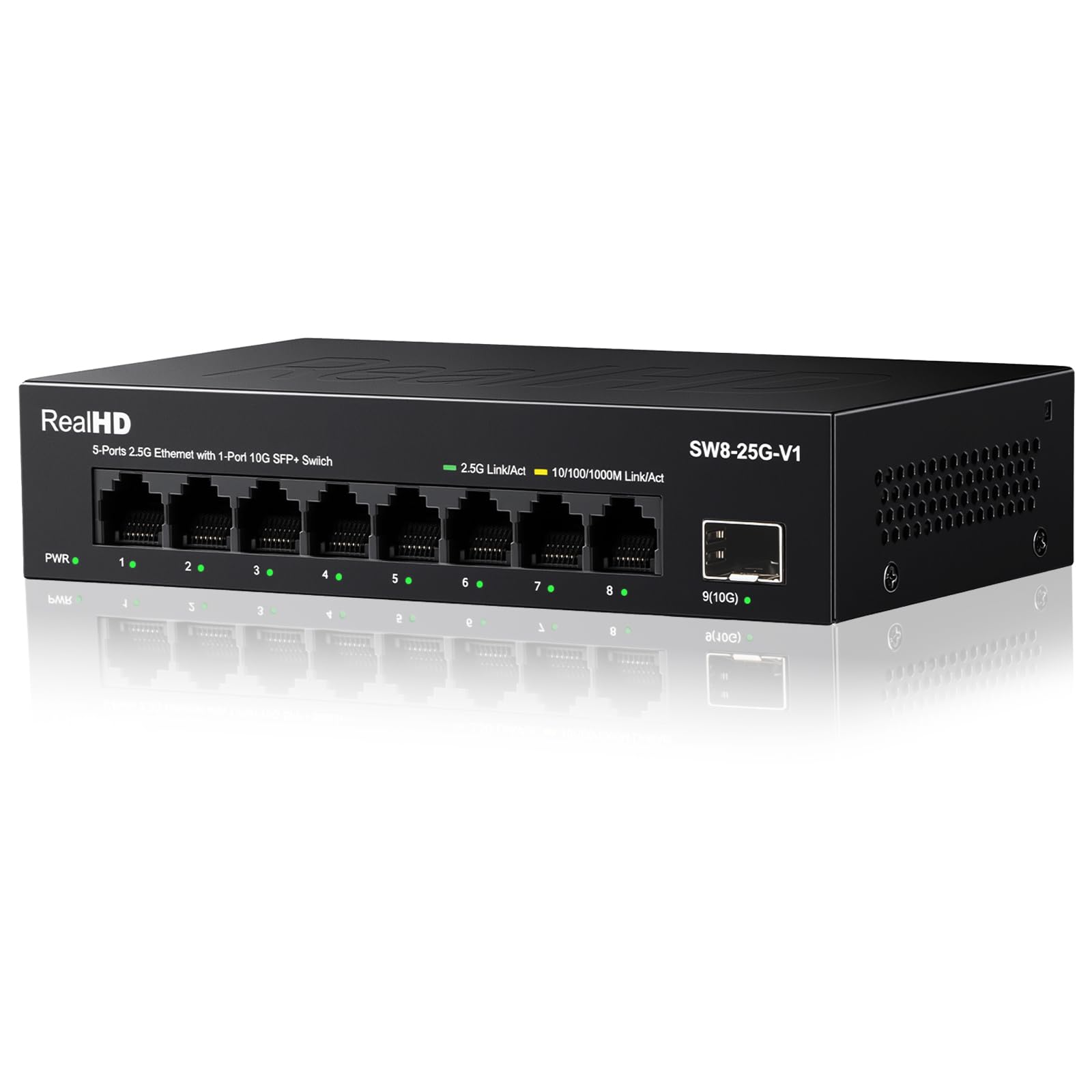
The Real HD 8-Port 2.5G Switch distinguishes itself with a dedicated 10G SFP+ uplink port alongside eight 2.5G RJ45 ports, offering 60 Gbps total bandwidth. The SFP+ port lets you daisy-chain switches over fiber or 10GBase-T without consuming a 2.5G port, making this a natural choice for homes with fiber backbone runs or plans to upgrade to a 10G core network.
The metal body features 4KV lightning protection and operates in a wide temperature range of -20 to 50°C, giving it resilience in unconditioned spaces like garages or attics where security camera switches often live. The fanless design keeps operation silent, and the compact 7.5 x 3.9 x 1.1-inch footprint fits standard wall-mount brackets.
Users with AT&T Fiber backbone networks report the Real HD switch delivers full 2.5 Gbps throughput with no negotiated speed drops, even after months of continuous operation. The SFP+ port is particularly valued for connecting to a central 10G switch or NAS without creating a bottleneck for the entire subnet.
Why it’s great
- 10G SFP+ uplink enables future-proof fiber or 10G backbone integration
- 4KV lightning protection adds durability in unconditioned spaces
- 60 Gbps total bandwidth handles full port saturation without congestion
Good to know
- Requires Cat6 or better cabling to reach full 2.5 Gbps speeds
- Some users report slightly lower performance than premium brands under extreme load
6. BrosTrend 5-Port 2.5GB Switch

The BrosTrend 5-Port 2.5GB Switch brings multi-gig connectivity to the entry-level segment without cutting corners on switching capacity. Its five 2.5 Gbps ports deliver a full 25 Gbps switching capacity, matching the D-Link DMS-105 in raw throughput at a significantly lower investment. The plastic chassis keeps weight down to 180 grams, making it easy to mount on a wall with the included hardware or simply rest on a desk.
The fanless design ensures silent operation even during sustained high-throughput tasks like 2.5G NAS backups or simultaneous gaming and 4K streaming. The switch auto-negotiates link speeds down to 1 Gbps and 100 Mbps, so you can mix multi-gig devices with older hardware without compatibility headaches. BrosTrend backs the unit with lifetime protection, signaling confidence in its reliability.
Users pairing this switch with 2-Gig fiber connections report full line-rate throughput on all ports simultaneously, with no speed drops after months of 24/7 operation. The compact form factor (5.6 x 3.5 x 0.9 inches) is small enough to tuck behind a TV unit or inside a network cabinet.
Why it’s great
- Full 25 Gbps switching capacity at a budget-friendly price point
- Ultra-compact and lightweight for flexible placement options
- Lifetime protection warranty provides long-term peace of mind
Good to know
- Plastic housing runs cooler than metal but offers less physical durability
- No QoS or IGMP Snooping for advanced traffic prioritization
7. UGREEN 10-Port PoE Switch (8 PoE+ @60W + 2 Uplink)

The UGREEN 10-Port PoE Switch solves two problems at once — expanding your wired network and powering remote devices over a single Ethernet cable. Eight PoE+ ports deliver up to 30W each with a total budget of 60W, enough for four power-hungry PTZ cameras or a mix of access points and security cameras. Two dedicated gigabit uplink ports keep the PoE ports free for device connections.
The one-button mode switching is the standout feature. In Standard mode, all ports operate as a normal unmanaged switch. Port Isolation (VLAN) mode separates ports 1–8 to prevent broadcast storms — critical for securing camera traffic from your main network. Extend mode pushes PoE transmission beyond the standard 328-foot limit to 820 feet, ideal for wiring detached garages or long driveway cameras.
PoE Auto Recovery in Extend mode automatically detects and power-cycles frozen PoE devices without manual intervention — a genuine time-saver for remote installations. The metal housing includes 19-inch rack-mount brackets, making it equally at home in a network rack or mounted in a security cabinet.
Why it’s great
- Port Isolation mode segments camera traffic from main network to prevent storms
- PoE Auto Recovery remotely restarts frozen devices without site visits
- Extend mode reaches 820 feet for long-distance cable runs
Good to know
- 60W total budget may be tight for eight high-power PoE devices simultaneously
- Port Isolation disables communication between isolated ports completely
FAQ
Do I need a managed or unmanaged switch for my home network?
Will a 2.5G switch work with my existing Cat5e cables?
Final Thoughts: The Verdict
For most users, the gigabit switch for home network winner is the NETGEAR GS108 because its ProSAFE Lifetime Warranty and rock-solid gigabit performance make it a permanent fixture that outlasts every other network component. If you want multi-gig speed for a NAS or gaming PC, grab the D-Link DMS-105. And for powering security cameras and access points over long cable runs, nothing beats the UGREEN PoE Switch with its automated device recovery and Port Isolation modes.