
The difference between a good gig and a great one often comes down to how much clean headroom your amp has before it breaks up and how well its voicing cuts through a dense stage mix. A guitar amp built for live performance needs to project clear, articulate tone across a venue without disappearing under the drums or battling the bass player for sonic real estate.
I’m Mohammad Maruf — the founder and writer behind Drink4Good. I’ve spent countless hours analyzing hardware specs, comparing power amp designs, speaker configurations, and effects architectures across the current market to separate the true stage-ready workhorses from the glorified practice amps.
Whether you need a lightweight combo for club dates or a high-headroom platform for a pedalboard, this guide to the best gigging amp focuses on real-world reliability, tonal versatility, and the specific wattage and speaker configurations that actually translate to a venue.
How To Choose The Best Gigging Amp
Selecting a live-performance amplifier isn’t about buying the loudest model on the shelf. A truly great gigging amp balances stage volume, tonal flexibility, portability, and connectivity in a way that matches the venues you actually play. Here are the critical specifications to evaluate before you commit.
Wattage and Speaker Configuration
For small clubs and bars, 30 to 50 watts through a single 12-inch speaker is often the sweet spot: loud enough to be heard over a drummer without a PA, yet manageable enough that you can push the power tubes into natural breakup at reasonable stage volume. A 100-watt head with a 4×12 cabinet gives you massive clean headroom and low-end punch, but the physical weight and transportation hassle make it overkill for any venue smaller than a theater stage. Pay attention to power scaling or attenuators — they let a high-wattage amp behave like a lower-wattage one at bedroom levels.
Headroom and Clean Tone
Clean headroom — the point at which the preamp or power section begins to distort — defines your amp’s dynamic range. If you play with a clean pedal platform and rely on outboard effects for dirt, you need an amp that stays pristine up to high volume levels. Solid-state and digital modeling amps generally offer more clean headroom than tube amps at the same wattage because they don’t compress as early. Tube amps, on the other hand, produce a more dynamic, touch-sensitive break-up that many players prefer for rock and blues.
Effects Loop and Direct Outputs
A series effects loop lets you place time-based effects like delay and reverb after the preamp stage rather than in front of it, preserving clarity at high gain. A balanced XLR direct output with a speaker-emulated signal is essential for sending your tone to the front-of-house mixer without miking the cabinet — critical for quick stage setups and in-ear monitor systems. Make sure the cab sim on the line out sounds natural; bad emulation ruins an otherwise stellar live tone.
Portability and Build Quality
Weight matters when you are loading in and out of a venue three times a week. A 40-pound combo amp with a handle on top and casters on the bottom is infinitely more practical than a 70-pound behemoth, even if the latter sounds marginally better. Look for metal-jacketed input jacks, reinforced corners, and a grille that can withstand a bump against a doorframe. An amp that fails mid-set is a nightmare — prioritize reliability and serviceability as much as tone.
Quick Comparison
On smaller screens, swipe sideways to see the full table.
| Model | Category | Best For | Key Spec | Amazon |
|---|---|---|---|---|
| Boss Katana-50 Gen 3 | Digital Modeling | Versatile gigging on a budget | 50W, 12″ custom speaker, 5 effects sections | Amazon |
| Orange Crush 35 | Solid State | High-gain rock tones | 35W, 4-stage preamp, cab sim headphone out | Amazon |
| HeadRush FRFR112 MKII | FRFR Speaker | Modeler pedalboard users | 2500W, 12″ woofer, 1″ HF driver, Bluetooth | Amazon |
| Fender Mustang GTX50 | Digital Modeling | Players who want deep preset control | 50W, 12″ Celestion, WiFi, Bluetooth | Amazon |
| Boss Katana-50 EX Gen 3 | Digital Modeling | Live performers needing stereo expand | 50W, upgraded custom 12″ speaker, line out | Amazon |
| Yamaha THR10II WL | Desktop Modeling | Ultra-portable practice and small gigs | Wireless, rechargeable battery, 15 amp models | Amazon |
| Fender Mustang GTX100 | Digital Modeling | Versatile gigging with included footswitch | 100W, 12″ Celestion G12FSD-100, 200 presets | Amazon |
| Yamaha THR30II WL | Desktop Modeling | Premium desktop sound with line outputs | Wireless, rechargeable battery, 15 amp models | Amazon |
| Roland Cube Street EX | Battery PA/Amp | Busking and battery-powered gigs | 50W stereo, 4 channels, 8xAA battery | Amazon |
| Roland JC-40 Jazz Chorus | Solid State | Pristine clean pedal platform | 40W stereo, dual 10″ speakers, chorus/vibrato | Amazon |
| EVH 5150 Iconic 40W | Tube Combo | High-gain hard rock and metal | 40W tube, 1×12″, noise gate, power reduction | Amazon |
In‑Depth Reviews
1. Boss Katana-50 Gen 3
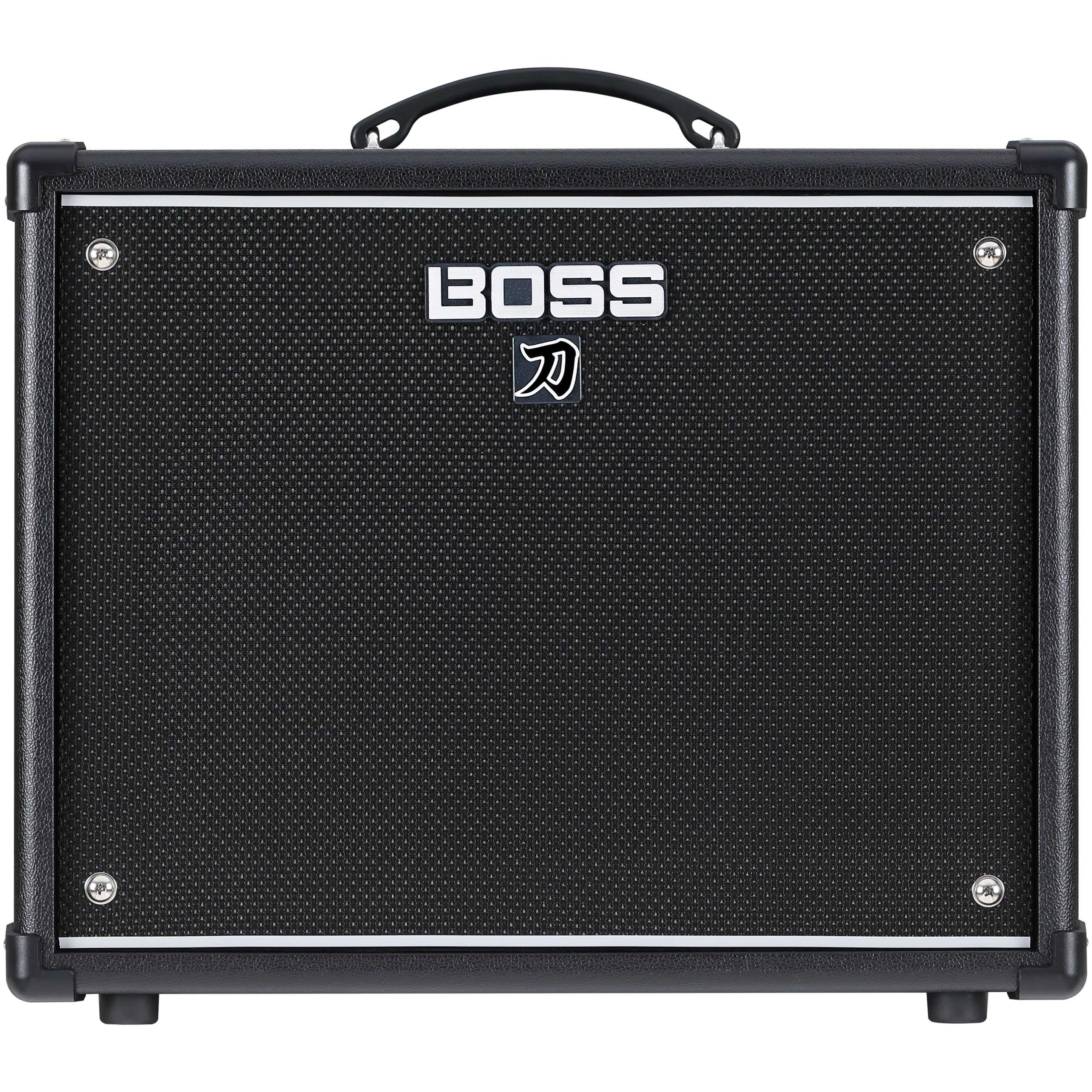
The Boss Katana-50 Gen 3 represents the most refined iteration of a stage amplifier that has dominated the mid-range market for years. Its Tube Logic engine now includes a Pushed amp character that delivers edge-of-breakup tones with a spongy, reactive feel previously missing from earlier generations. The 50-watt Class AB power section drives a custom 12-inch speaker that projects with surprising authority for a compact combo, easily holding its own against a moderate drummer in a small venue.
What sets this amp apart for live use is the five independent effects sections — Booster, Mod, FX, Delay, and Reverb — all simultaneously accessible via the panel or the free Tone Studio editor. You can build a complete gig-ready rig without a single external pedal, though the lack of a built-in effects loop means time-based effects share the signal path with the preamp. The 3.5mm aux input lets you play along with backing tracks during practice, and the USB connectivity works for silent recording into a DAW.
Customer feedback consistently praises the Katana-50 Gen 3 for its ability to emulate tube-like response and dynamics at a fraction of the tube amp weight and cost. The most common criticism involves the absence of Bluetooth audio streaming — you will need a separate adapter for wireless phone connectivity. For players transitioning from practice amps to small-stage gigging, this is the most complete package in the sub-50-watt category.
Why it’s great
- Excellent tube-like feel and response from Tube Logic engine
- Five simultaneous on-board effects sections save pedalboard space
- Lightweight design makes load-in effortless
Good to know
- No built-in Bluetooth for music streaming
- No series effects loop for time-based pedals
2. Orange Crush 35

Orange’s Crush 35 delivers a four-stage, all-analog preamp distortion that rivals many entry-level tube amps in punch and texture. The dirty channel is the star here — it maintains note definition and string-to-string articulation even at high gain settings, a rare characteristic in solid-state circuitry. The clean channel is serviceable rather than pristine, but the amp compensates with a transparent, fully buffered effects loop that keeps delay and reverb tails clean.
The 35-watt rating drives a single 10-inch speaker, which limits low-end thump compared to 12-inch combos, but the enclosure design focuses the midrange frequencies that cut through a live mix. The built-in chromatic tuner is a practical convenience for quick stage tuning, and the Cab Sim loaded headphone output lets you practice silently with a speaker-emulated signal. The footswitchable channel switching (sold separately) is essential for live use — without it, you lose the ability to toggle between clean and dirty on the fly.
Users consistently note that the Crush 35 is loud enough for small club gigs and rehearsals, and that its distortion character holds its own against vintage British voiced amps. The main trade-off is weight: at 29 pounds, it is heavier than some 50-watt digital combos, but the stainless-steel enclosure and rugged construction inspire confidence for regular touring.
Why it’s great
- Exceptional high-gain articulation and tube-like punch
- Fully buffered effects loop keeps time-based effects clean
- Cab Sim headphone jack for silent practice
Good to know
- Footswitch for channel switching sold separately
- 10-inch speaker offers less bass than 12-inch alternatives
3. HeadRush FRFR112 MKII

The HeadRush FRFR112 MKII is not a traditional guitar amp — it is a full-range, flat-response powered speaker designed to reproduce exactly what your modeler or multi-FX unit sends it. This approach gives you pristine cleans at any volume, zero frequency coloration from a guitar-voiced speaker, and compatibility with simulated cabinets and microphone positions. The 2500-watt Class-D amplifier drives a 12-inch woofer and a 1-inch high-frequency compression driver, producing enough output to serve as a stage wedge for a loud band.
The HPF EQ switch is a practical tool for live sound: it rolls off low-end mud when you are on a reflective stage or playing with a bassist, helping your guitar cut through without additional EQ sculpting. The Ground-Lift switch eliminates the ground-loop hum that often plagues modeler-based rigs connected to multiple power sources. Two XLR/TRS combo inputs with independent level controls mean you can wirelessly stream backing tracks via Bluetooth from your phone while your guitar plays through the second input.
Musicians using Fractal, Line 6 Helix, or Kemper units report that the FRFR112 MKII translates their patches accurately without harshness or phase cancellation. Some users noted that the titanium tweeter can sound brittle on overdriven tones at close range, but this is resolved by positioning the wedge for ear-level coverage rather than flooding the room from the floor. At 34.7 pounds, it is manageable for one person to carry, and the pole-mount socket adds flexibility for larger venues.
Why it’s great
- Flat frequency response preserves modeler cabinet tones accurately
- Bluetooth input for backing tracks during rehearsal or set breaks
- Lightweight and portable for a PA-grade speaker
Good to know
- Titanium tweeter can sound shrill on high-gain patches at close range
- Requires an external modeler pedal to produce guitar tones
4. Fender Mustang GTX50

Fender’s Mustang GTX50 packs 40 amplifier models and over 70 effects into a 50-watt combo, anchored by a newly designed 12-inch Celestion speaker that provides a full, authoritative low-end response. The WiFi and Bluetooth connectivity let you download user-created presets from the Fender Tone cloud, edit parameters from your smartphone, and stream audio wirelessly during practice breaks. The full-color display on the panel makes real-time tweaking intuitive without needing to memorize knob positions.
The star of the show is the Celestion speaker: it handles both sparkling Fender cleans and high-gain British models with balanced projection. The GTX50 supports stereo XLR line outputs, a stereo effects loop, and USB audio interface functionality for recording directly into a DAW. The headphone jack is an 1/8-inch format, requiring an adapter for standard 1/4-inch studio headphones.
Users applaud the GTX50 for its massive library of usable presets and the ease of importing new tones wirelessly. The Bluetooth and WiFi connectivity, however, can be inconsistent — some customers report pairing failures and dropouts that require a power cycle to resolve. The smartphone app provides convenient control, but its reliability remains the most polarizing aspect of an otherwise versatile stage amp. For players who want deep modeling without the complexity of a separate pedalboard, this is a compelling package.
Why it’s great
- 40 authentic amp models cover virtually every guitar tone style
- WiFi and Bluetooth for cloud presets, editing, and audio streaming
- Celestion 12-inch speaker delivers balanced, full-bodied projection
Good to know
- Wireless connectivity can be finicky and unreliable
- No footswitch included with the 50-watt model
5. Boss Katana-50 EX Gen 3

The Katana-50 EX Gen 3 is the expanded version of the standard Katana-50 Gen 3, designed specifically for musicians who need to take their amp to actual gigs rather than just the practice room. The most significant upgrade is the stereo line output — a balanced connection that sends your tone directly to the PA system or recording interface without miking the cabinet. This feature alone makes the EX model a better choice for venues with front-of-house systems compared to the standard Katana-50.
The upgraded custom 12-inch speaker handles the extra live duties with a tighter low-end and an improved transient response compared to the previous generation. The distinctive gray-and-black matrix grille adds a rugged stage aesthetic while protecting the speaker from transportation wear. The GA-FC and GA-FC EX foot controller compatibility allows hands-free access to all channels, effects, and the built-in looper — a transformative upgrade for live performance compared to bending down to twist knobs mid-song.
Players who have upgraded from older Katana models report that the EX Gen 3 sounds more open and less boxy, with a noticeably improved stereo spread when running two EX units in stereo expand mode. The reduced weight (just over a pound according to spec, though real-world weight is closer to 30 pounds) remains a strong selling point for regular load-ins and load-outs. One user noted that while the acoustic setting is excellent for amplified acoustic guitars, the default EQ voicings may require a bit of tweaking to sit perfectly in a full-band mix.
Why it’s great
- Stereo line output for direct PA connection without a mic
- GA-FC foot controller support for hands-free live control
- Stereo expand capability for full-stage stereo sound
Good to know
- More expensive than the standard Katana-50 Gen 3
- Some users find the default EQ a bit boxy out of the box
6. Yamaha THR10II WL

The Yamaha THR10II WL is a desktop amplifier that reimagines the practice amp for the modern musician. Rather than trying to fill a venue with raw speaker volume, it uses a bi-amped stereo speaker system, extended stereo technology, and 15 guitar amp models to produce a room-filling sound that is ideal for quiet stage monitoring, recording demos, or practicing with bandmates in a small space. The built-in wireless receiver works with the optional Line 6 Relay G10T transmitter, letting you play cable-free from anywhere in the room.
The 15 guitar amp models cover everything from pristine cleans to saturated high-gain tones, and the dedicated bass and acoustic models mean you can use the same amp for multiple instruments without losing character. Bluetooth audio streaming allows you to play along with tracks or stream music during breaks, and the free THR Remote editor on desktop and mobile gives you deep control over the parameters and signal chain. The rechargeable battery lasts several hours, making the THR10II WL perfect for busking, outdoor rehearsals, or any gig where mains power is unreliable.
Users consistently rank the THR10II WL above competitors like the Positive Grid Spark for its superior sound quality at low volumes, lack of muddiness, and robust build. The main trade-off for live use is the limited maximum output — it cannot compete with a heavy-handed drummer in a room without PA support. At 3.2 kg, it is the most portable option in this guide, and the vintage-inspired design looks as good on a coffee table as it does on a stage side table.
Why it’s great
- Bi-amped stereo system delivers exceptional low-volume sound quality
- Built-in wireless receiver and rechargeable battery for untethered play
- Models for guitar, bass, and acoustic cover multiple instruments
Good to know
- Low wattage limits use in loud band contexts without PA
- Expensive compared to similarly powered desktop amps
7. Fender Mustang GTX100
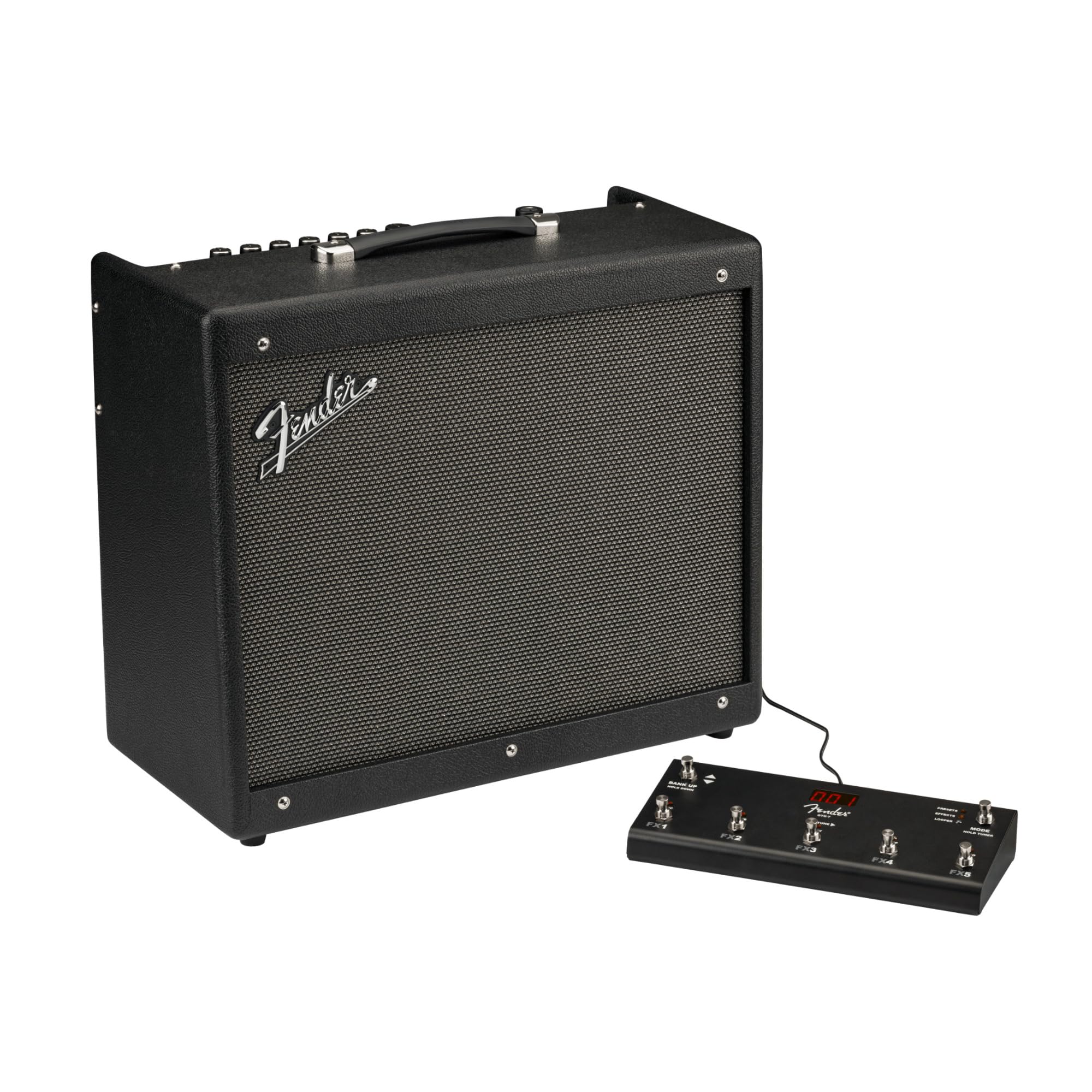
The Fender Mustang GTX100 is a 100-watt digital modeling combo that skips the compromises smaller siblings make. The specially designed Celestion G12FSD-100 speaker handles the full power range with authority, delivering tight low-end punch and clean headroom that easily fills a medium-sized venue without stressing the amplifier. The 200 modifiable onboard presets — covering everything from Fender’s own Blues Jr. and Vibro King to Marshall-inspired tones — give you an enormous palette to work with straight out of the box.
The included 7-button footswitch is the deciding factor over the GTX50: it unlocks bank up/down control, tap tempo, a 60-second looper, and direct access to the tuner, freeing your hands for playing rather than menu-diving. The stereo XLR line outputs, stereo effects loop, and USB audio interface complete the professional connectivity suite. WiFi firmware updates keep the amp’s library current, and the Fender Tone app allows preset sharing from your smartphone during soundcheck.
Experienced users highlight the intuitive on-amp interface and the sheer number of usable factory presets as the amp’s greatest strengths, noting that with very little tweaking you can find a usable tone for any genre. The main criticism revolves around the preset count itself — of the 200 total, only 11 slots are empty for your own creations, which feels restrictive for power users who want to build a library of custom sounds. At 28.5 pounds, it is heavier than the GTX50 but still lighter than a comparable tube combo.
Why it’s great
- Celestion G12FSD-100 speaker delivers massive clean headroom and punch
- Included 7-button footswitch with looper, tap tempo, and bank control
- 200 presets cover a vast range of genres and tones
Good to know
- Only 11 empty preset slots limit user customization
- Bluetooth connectivity can be unreliable for some users
8. Yamaha THR30II WL

The Yamaha THR30II WL is the larger, more powerful sibling of the THR10II WL, offering the same award-winning amp models and wireless functionality with upgraded output and professional connectivity. The 30-watt stereo bi-amp system fills a room more convincingly than the THR10II, and the addition of 1/4-inch line outputs means you can send your tone to a PA system or recording interface without relying on the built-in speakers. The built-in wireless receiver works seamlessly with the Line 6 Relay G10T transmitter for cable-free play.
The sonic character of the THR30II WL is noticeably warmer and more three-dimensional than its smaller sibling, with a fuller low-end that handles palm-muted riffing and bass parts without distortion. The 15 guitar amp models, 3 bass amp models, 3 acoustic models, and flat mode cover all bases, and the extended stereo technology creates a spacious soundstage that is particularly impressive in a desktop setting. The rechargeable battery offers extended playtime, and the THR Remote app provides deep editing capabilities on both desktop and mobile platforms.
Musicians who compared the THR30II WL to the Positive Grid Spark 2 consistently preferred the Yamaha’s more authentic tube-like response and lack of distortion in the Bluetooth audio playback. The main trade-off is the absence of an effects loop — a limitation shared by all THR-series amps that may bother players who rely on external pedals for time-based effects. For a high-end practice and small-stage amplifier that doubles as a premium speaker for music playback, the THR30II WL is the most refined option on the market.
Why it’s great
- 1/4-inch line outputs for direct connection to PA or recording gear
- Warmer, fuller sound with extended stereo imaging
- Premium build and vintage design look great anywhere
Good to know
- No effects loop for external pedal integration
- High price point for a desktop amplifier
9. Roland Cube Street EX
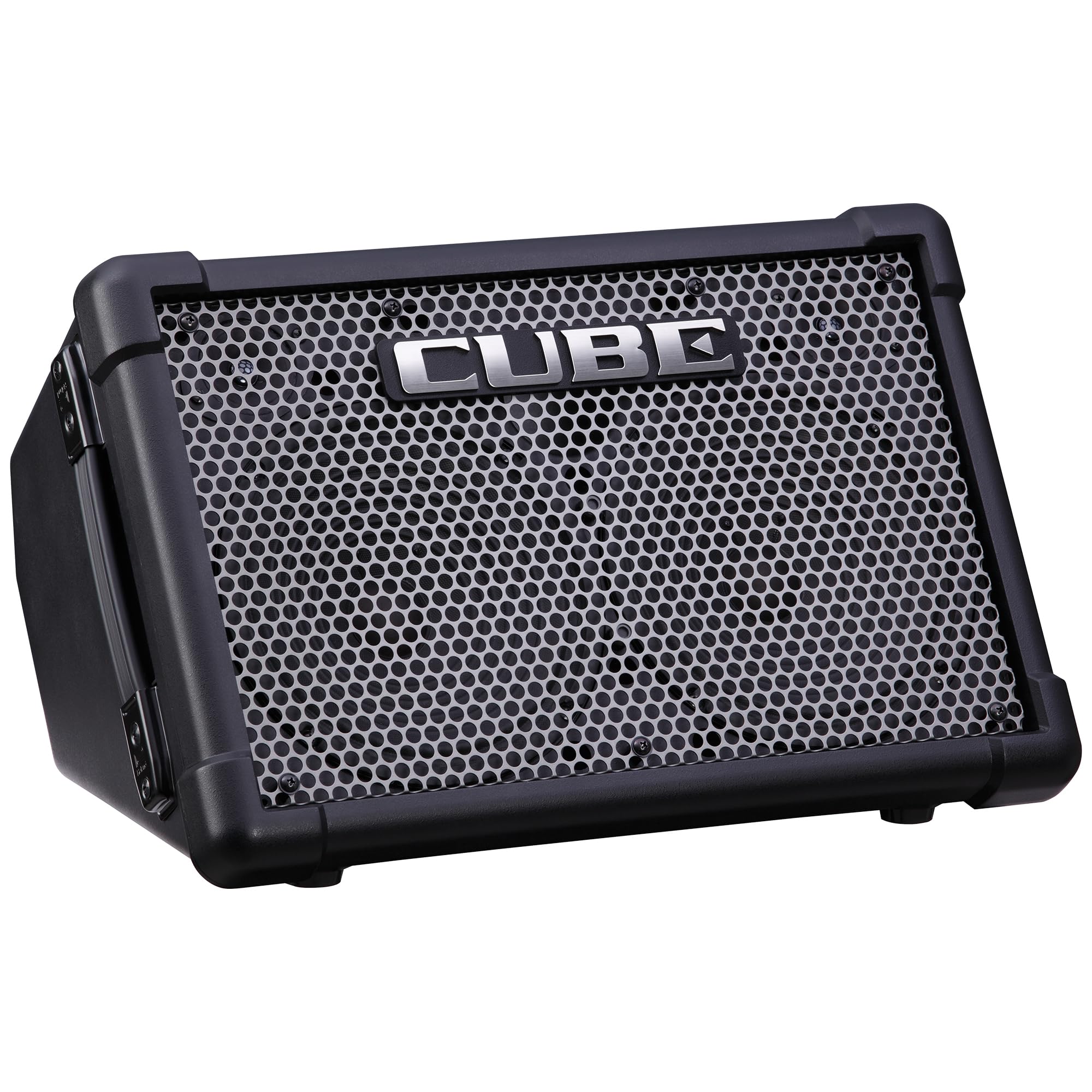
The Roland Cube Street EX is a battery-powered 50-watt stereo amplifier designed for performers who need PA-like coverage without access to mains power. Four independent channels accommodate a microphone, an electric guitar, an acoustic guitar, and a line-level device like a phone or MP3 player simultaneously, making it a complete self-contained PA system for busking, outdoor parties, and solo acoustic sets. The COSM digital modeling provides dedicated Clean, Crunch, and Lead tones for electric guitar, as well as a preamp optimized for acoustic guitar.
The three selectable power modes let you balance volume against battery life: Max delivers 50 watts for about 5 hours, Normal provides 25 watts for 10 hours, and Eco gives you 10 watts for 20 hours, all from eight standard AA batteries. The angled back doubles as a stage monitor wedge, and the mounting hole on the bottom accepts an optional speaker stand for elevated coverage. The i-CUBE Link output lets you record directly into an iPhone or iPad using Roland’s free CUBE JAM app.
Street performers praise the Cube Street EX for its loud, clear output and long battery runtime on quality rechargeable cells. The frequency response has noticeable dips around 2250 Hz and 7000 Hz, which can affect vocal clarity and high-harmonic detail, but for spoken word and acoustic guitar it is more than adequate. Users also note the absence of Bluetooth — you will need a separate adapter for wireless audio streaming. At just over 16 pounds, it is the easiest amp in this guide to carry to any gig.
Why it’s great
- Battery-powered 50W stereo operation for off-grid performances
- Four independent channels support mic, guitar, and line-level devices
- Multiple power modes optimize battery life for any gig duration
Good to know
- No Bluetooth streaming — requires external adapter
- Frequency response has gaps affecting vocal warmth and high detail
10. Roland JC-40 Jazz Chorus

The Roland JC-40 delivers the legendary JC Clean tone in a compact 40-watt stereo combo with dual 10-inch speakers. This is the definitive pedal-platform amplifier: the pristine, noise-free solid-state preamp offers massive headroom, zero compression, and a flat frequency response that reveals every nuance of your pedals without coloration. The stereo input accepts TRS cables from stereo modelers, and the stereo effects loop (switchable between series and parallel) lets you integrate external effects without disrupting the internal chorus and reverb.
The signature Dimensional Space Chorus remains one of the most iconic modulation effects in guitar history — it creates a wide, immersive stereo swirl that sounds three-dimensional in a live mix. The built-in vibrato and reverb are equally musical, though the on-board distortion is basic and better replaced by a dedicated overdrive pedal. The two 10-inch speakers produce a fast, articulate sound with a tight low-end, though they sacrifice some low-frequency weight compared to a 12-inch configuration.
Gigging musicians consistently choose the JC-40 for its ability to cut through a dense mix with clean, chiming tones that never break up. The headphone jack and stereo line outputs are handy for silent practice and direct recording, though the absence of XLR outputs limits its direct-to-PA versatility without an external DI box. At 39.6 pounds, it is heavier than many contemporary modeling combos, but the sound is timeless and the reliability is legendary. For players whose identity depends on clean tones and stereo effects, the JC-40 is worth every pound of weight.
Why it’s great
- Pristine JC Clean tone with massive headroom and zero compression
- True stereo input and effects loop for wide, immersive sound
- Dimensional Space Chorus is an iconic, unbeatable modulation effect
Good to know
- Onboard distortion is poor — best used as a pedal platform
- Dual 10-inch speakers lack the low-end of a 12-inch cab
11. EVH 5150 Iconic 40W
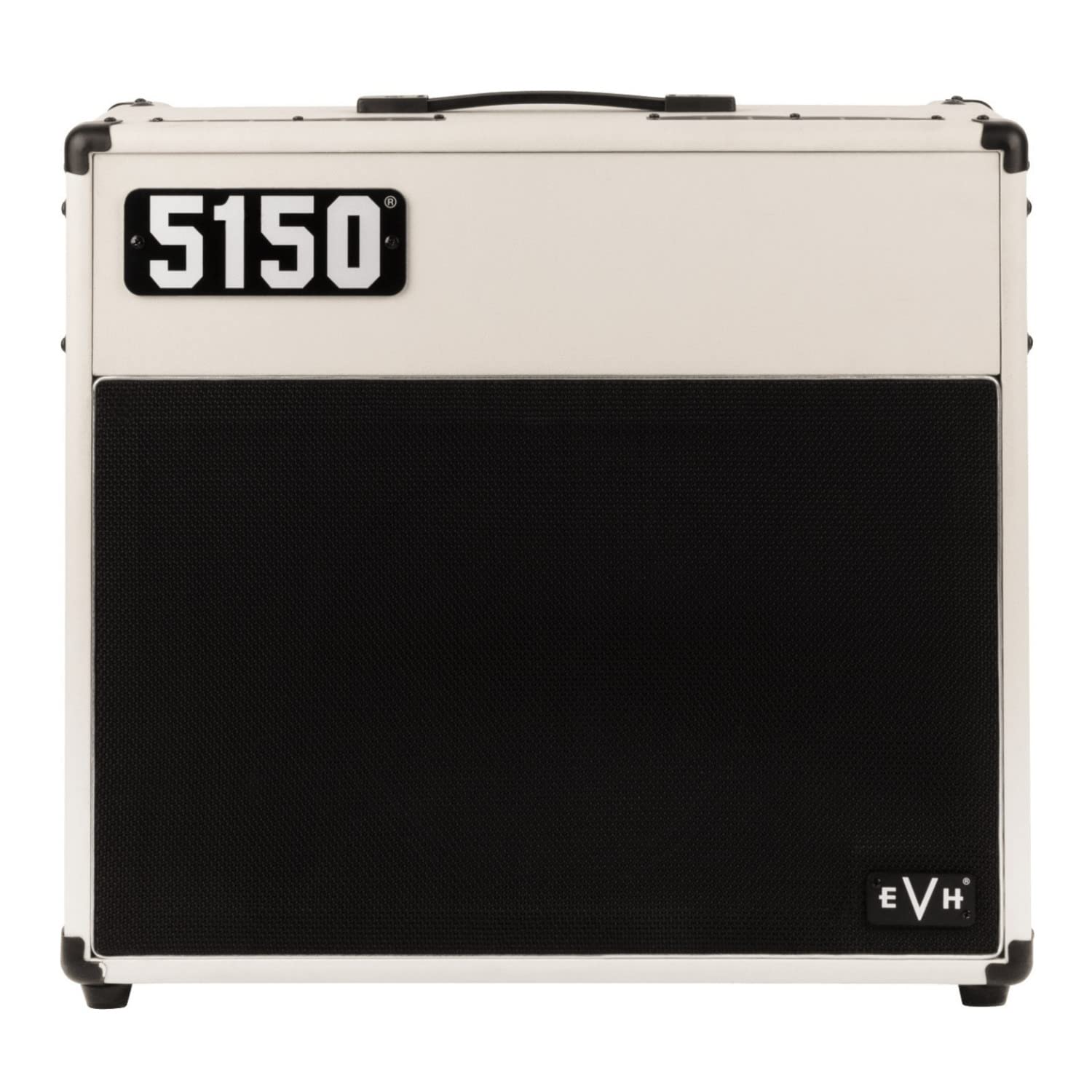
The EVH 5150 Iconic 40W is a tube combo built for players who want the iconic high-gain tone of Eddie Van Halen’s arena-filling rig in a portable 1×12 format. Powered by a pair of JJ 6L6 power tubes and a 12AX7 preamp tube, the 5150 Iconic delivers a saturated, aggressive distortion that remains tight and articulate even at high gain settings. The two-channel layout — clean and overdrive — is designed for hard rock and metal, with the overdrive channel providing the signature 5150 crunch that has been a studio staple for decades.
The built-in noise gate is a practical necessity for high-gain playing, effectively silencing the hum and hiss between chords without choking sustain. The power reduction circuit lets you crank the power tubes to their sweet spot for natural compression and harmonic saturation while keeping the overall volume manageable — essential for smaller club stages where you cannot run the amp at full tilt. The speaker-emulated output lets you send a direct signal to the PA or recording interface without miking the cabinet.
Experienced players report that the 5150 Iconic 40W is loud enough for rehearsals and small to medium gigs, and that the power reduction switch makes it usable for bedroom practice. The clean channel, however, is voiced with a notable midrange push that many players do not consider truly clean — it works well for slightly gritty rhythm parts but does not match the pristine headroom of dedicated clean amps. At 60.8 pounds, this is the heaviest combo in the guide, but for high-gain devotees, the iconic tone justifies the weight.
Why it’s great
- Authentic, saturated high-gain tone that is legendary in hard rock and metal
- Power reduction circuit enables cranked tube tone at lower volumes
- Built-in noise gate keeps high-gain play hiss-free
Good to know
- Clean channel is not pristine — more of a pushed, slightly gritty tone
- Heavy weight (60.8 lbs) makes transport a challenge
FAQ
Can I use a modeling amp like the Katana for live gigs without a pedalboard?
Is 50 watts loud enough for a small club gig with a drummer?
What is the advantage of a full-range flat-response speaker for modelers?
How do I choose between a tube amp and a solid-state amp for gigging?
Does an effects loop matter for live use?
Final Thoughts: The Verdict
For most players building their first serious live rig, the best gigging amp is the Boss Katana-50 Gen 3 because it combines versatile Boss effects, a reactive tube-like feel, and a built 12-inch speaker in a lightweight package that fits almost any small to medium venue. If you want a pristine pedal platform with iconic chorus and unmatched clean headroom, grab the Roland JC-40 Jazz Chorus. And for high-gain hard rock and metal tones that sound like the studio records you grew up on, nothing beats the EVH 5150 Iconic 40W.