
Your DSLR captures stories worth telling, but handheld footage often betrays the vision with micro-jitters and rolling shutter wobble. A dedicated stabilizer transforms heavy gear into fluid cinematic movement, turning chaotic run-and-gun shoots into professional-grade sequences that hold the viewer’s attention.
I’m Mohammad Maruf — the founder and writer behind Drink4Good. I’ve spent 430+ hours combing through payload specs, motor torque curves, battery discharge rates, and real owner experiences across nine distinct gimbal stabilizers to separate genuine performance from marketing noise in this category.
This guide evaluates each model on axis-lock precision, control interface ergonomics, and real-world compatibility with common DSLR and mirrorless bodies, helping you find the right gimbal for dslr without overpaying or undershooting your needs.
How To Choose The Best Gimbal For DSLR
Camera gimbals look similar at a glance, but the difference between a smooth pan and a motor that overheats mid-scene comes down to a few critical specifications. Your camera body size, preferred lens, and shooting style directly dictate which model will serve you best.
Payload Capacity and Motor Torque
The single most common mistake is buying a gimbal rated just at your camera’s bare weight — then adding a follow-focus motor or a heavy zoom lens that pushes the payload past the motor’s comfort zone. Always leave a 20 percent margin: if your DSLR with a 24-70mm f/2.8 weighs 1.8 kg, choose a gimbal rated for at least 2.5 kg. Weak motors under load produce jittery footage and may force the gimbal into thermal shutdown. Check the manufacturer’s tested payload list for your exact camera body and lens combination.
Battery Runtime and Charging Speed
A gimbal that dies after two hours of outdoor shooting is useless no matter how smooth its stabilization algorithm. Look for models that support USB-C PD fast charging — a quick 10-minute top-off during a lunch break can buy you another 30–60 minutes of runtime. Swappable battery designs (like the Zhiyun Weebill S) allow hot-swapping on set, while integrated batteries force you to stop and tether to a power bank. Battery chemistries between 2500 mAh and 4500 mAh translate to 10 to 16 hours of mixed use.
Axis Locking and Balancing Speed
Every minute spent rebalancing is a minute you’re not shooting. Models with individual axis locks (FeiyuTech SCORP series) let you lock the pan, roll, and tilt axes separately during transport and unlock only the axis you’re adjusting. This reduces setup time from several minutes to under 60 seconds. Marker slides and indexed quick-release plates further speed up the process when switching between multiple cameras.
Control Interface and App Ecosystem
The physical controls — joystick sensitivity, trigger button responsiveness, and wheel smoothness — define your daily experience. A gimbal with poorly placed buttons forces hand contortions. Bluetooth shutter control offers convenience but often disconnects; a wired camera control cable provides reliable start/stop and focus pull. For solo shooters, built-in AI tracking (without needing a phone app) changes how you film dynamic subjects. Test the ergonomic fit: a gimbal that pinches your fingers or requires constant grip tension will exhaust you in thirty minutes.
Quick Comparison
On smaller screens, swipe sideways to see the full table.
| Model | Category | Best For | Key Spec | Amazon |
|---|---|---|---|---|
| DJI RS 4 Pro Combo | Pro Cinema | Heavy rigs & cinematic productions | 4.5 kg / 10 lbs payload | Amazon |
| DJI RS 4 | Premium Mirrorless | Versatile mirrorless & compact DSLR | 3 kg / 6.6 lbs payload | Amazon |
| Zhiyun Weebill 3S Combo | Versatile All-day | Ergonomic sling mode & integrated light | 2 kg / 4.4 lbs payload | Amazon |
| Feiyu SCORP 3 Kit | Solo Creator | AI tracking & detachable remote handle | 3.5 kg / 7.72 lbs payload | Amazon |
| MOZA AirCross 2 | Balanced Value | Heavy payload on a budget | 3.2 kg / 7.1 lbs payload | Amazon |
| ZHIYUN CINEPEER Weebill 3E | Lightweight Runner | All-day mobile shooting | 3 kg / 6.6 lbs payload | Amazon |
| FeiyuTech SCORP 2 KIT | Feature-Rich Mid | AI tracking & touchscreen controls | 2.5 kg / 5.5 lbs payload | Amazon |
| Zhi yun Weebill S | Compact Classic | Sub-1kg mirrorless setups | 3 kg / 6.6 lbs payload | Amazon |
| FeiyuTech SCORP-C | Budget Powerhouse | Entry-level stabilization with high features | 2.5 kg / 5.5 lbs payload | Amazon |
In‑Depth Reviews
1. DJI RS 4 Pro Combo
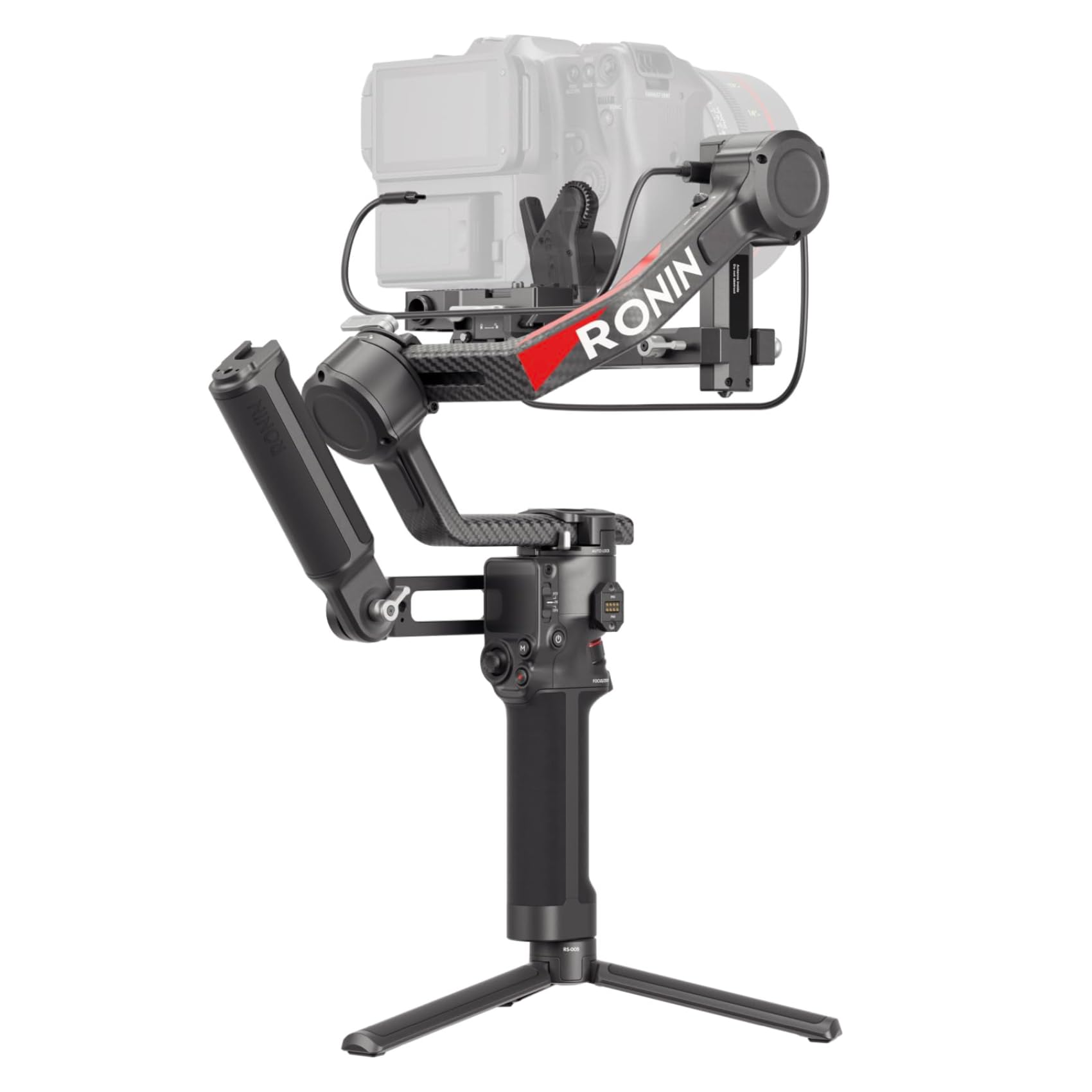
The RS 4 Pro Combo is the definitive heavy-lifter for cinema-grade DSLR and mirrorless rigs. Its 4.5 kg payload — a 20 percent torque increase over the standard RS 4 — handles full-frame bodies like the Canon R5 with RF 24-105mm or a Sony FX6 with cage, follow-focus motor, and wireless receiver without any motor sag or heat buildup during extended takes. The carbon fiber axis arms keep the total weight manageable while adding rigidity that prevents micro-vibrations on long pan shots.
The Combo bundle includes the Focus Pro LiDAR module, which projects 76,800 ranging points within 20 meters for reliable autofocus on manual lenses — a game-changer when you’re swapping between vintage glass and modern cinema primes. The 2nd-gen native vertical shooting plate lets you switch to portrait orientation in under ten seconds without rebalancing, ideal for social content workflows. Battery life clocks at 12 hours with the included BG30 grip, and the optional BG70 expands that to 29 hours.
Professional shooters will appreciate the 4.5-meter image transmission range for remote camera control and the dual-channel focus/zoom motor support built into the system. The learning curve is steeper than any other gimbal here — expect two to three sessions to memorize the menu structure and LiDAR calibration routine. This is not a casual vlogger tool; it is a investment for crews who rely on gimbal stabilization as their primary support system.
Why it’s great
- The LiDAR autofocus system works with manual lenses, eliminating the need for expensive cine lenses in run-and-gun scenarios.
- Carbon fiber arms reduce weight without sacrificing the stiffness needed to kill high-frequency hand tremor at 100mm+ focal lengths.
- Native vertical plate switch is the fastest implementation tested — no tools required, just a single latch pull.
Good to know
- The Combo price is the highest in this roundup, and the BG70 battery grip is sold separately.
- The DJI Ronin app was removed from Google Play — you must download it manually from DJI’s website.
- Non-US buyers should confirm warranty return logistics before purchasing, as international support is limited.
2. DJI RS 4

The RS 4 refines everything DJI learned from previous generations into a 3 kg / 6.6 lbs stabilizer that balances faster than any predecessor. The Teflon coating on all three axis arms reduces friction dramatically — you can slide a Sony A7 IV with a 24-70mm into balance on the first attempt without fighting sticky resistance. The tilt axis extends 8.5 mm further than the RS 3, giving clearance for larger lens hoods and V-mount battery plates.
The joystick mode switch cycles between PF, PTF, and FPV modes without digging into menus, and the 2nd-gen native vertical plate locks into portrait orientation with a single lever. Battery runtime hits 12 hours on the included BG21 grip, and USB-C PD charging means a 30-minute cafe stop adds several hours of shooting time. The RSA communication port opens the door to third-party accessories like the DJI Tethered Control Handle.
Where the RS 4 falls short is when you push payload toward its ceiling — a fully rigged RED Komodo or Canon C70 with heavy zoom optics will stress the motors, producing audible whine on fast pans. For mirrorless users and lighter DSLR builds, this gimbal offers the best balance of price, build quality, and ecosystem depth. The DJI Ronin app removal from Google Play remains an inconvenience for Android users.
Why it’s great
- The Teflon-coated arms make initial balancing feel buttery smooth, even for first-time gimbal users.
- USB-C PD fast charging tops the battery quickly, eliminating the need for a dedicated charger.
- The joystick mode switch provides instant access to FPV 3D Roll 360 without entering the app.
Good to know
- Motor torque struggles near the 3 kg limit with large cinema lenses, causing occasional overheat protection triggers.
- The DJI Ronin app must be side-loaded on Android devices, which adds setup friction.
- The optional BG70 battery grip, which extends runtime to 29 hours, is sold separately and priced high.
3. Zhiyun Weebill 3S Combo

The Weebill 3S Combo introduces a sling grip design that genuinely reduces forearm fatigue during extended shooting sessions. The wrist rest transfers gimbal weight from your hand to your forearm, allowing you to maintain low-angle shots for minutes without cramping. Its integrated fill light delivers 1000 Lux peak with adjustable color temperature from 2600K to 5500K and a CRI of 90+, eliminating the need for an external on-camera light in dim environments.
The native portrait switch works through the quick-release module — you rotate the plate rather than the entire gimbal head, keeping balance intact. The 2 kg payload is the lightest among the premium options here, but it comfortably handles a Panasonic S5 with a 24-70mm f/2.8 or a Sony A7C with a compact zoom. Battery runtime reaches 11.5 hours with PD fast charging that fills the unit in under two hours. The combo includes a padded backpack, wrist rest, sling grip base, and multiple camera control cables.
Where the 3S frustrates is payload headroom — any attempt to mount a Canon 5D Mark IV with a 24-105mm pushes the stabilizer into borderline territory, causing motors to heat up after 15 minutes of continuous operation. The axis lock system is less refined than DJI’s, requiring more manual adjustment when locking and unlocking the roll axis. For lightweight mirrorless shooters who value ergonomics and built-in light, this gimbal is a joy to use.
Why it’s great
- The wrist rest and sling grip reduce perceived weight by more than half during low-angle shooting.
- The built-in fill light has a high CRI of 90+ and adjustable color temperature, saving money on external lighting kits.
- Setup time is among the fastest in this category — experienced users report under 15 minutes from unboxing to first balanced shot.
Good to know
- The 2 kg payload limit restricts you to smaller mirrorless bodies; full-size DSLR rigs stress the motors.
- The sling arm adjustment is limited to one axis without using an Allen wrench.
- Some units ship without a printed manual, which frustrates first-time gimbal buyers.
4. Feiyu SCORP 3 Kit
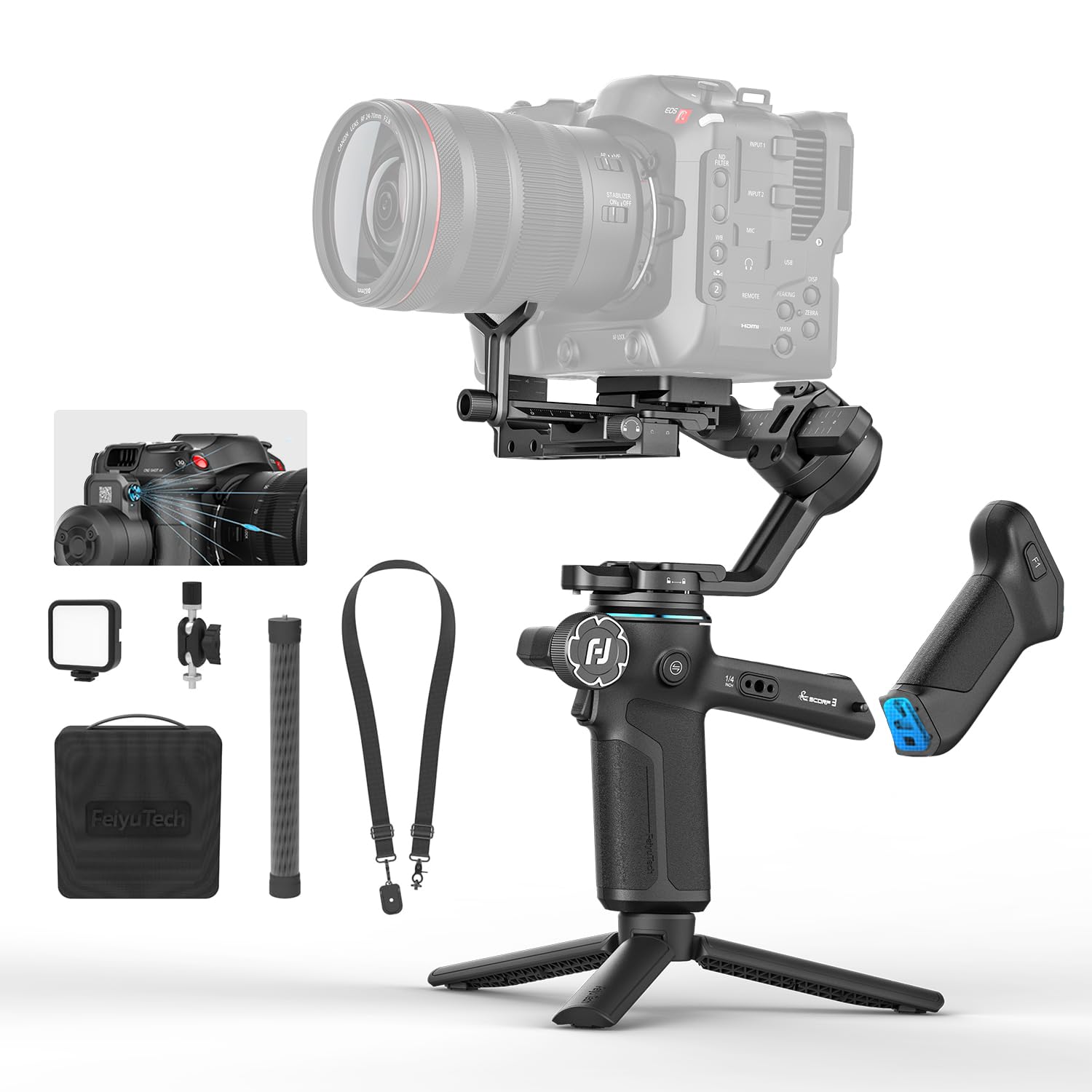
The SCORP 3 Kit is engineered for solo shooters who need AI tracking without the overhead of a phone mount or separate module. Its built-in AI Tracking 4.0 recognizes an “OK” hand gesture from up to 59 feet away, locking onto a subject and following movement across a 15 percent wider field than previous Feiyu models. The 3.5 kg payload handles full-frame DSLRs like the Canon R5 or Nikon Z8 with large telephoto zooms, and the open-frame design gives generous clearance for cages and external monitors.
The detachable underslung handle communicates wirelessly up to 39 feet, letting you trigger recording, adjust follow speed, and monitor gimbal status while the rig is mounted on a jib or extension rod. The kit bundle includes a fill light (useful but dimmer than dedicated units), a carbon fiber extension pole, a weight-reducing shoulder strap, and a padded carrying case. The widened dual-layer ARCA-compatible quick-release plate is among the most secure locking systems tested — no accidental dislodges during rapid movement.
The fill light and ball head included in the kit feel cheaper than the gimbal itself, with a plastic housing that doesn’t inspire confidence under studio conditions. The AI tracking, while impressive, only activates when a subject is in front of the camera — it cannot track the operator, limiting its use for solo vlogging. The app’s English translation has occasional quirks that make menu navigation confusing. For documentary and event filmmakers who work alone, however, the SCORP 3 Kit delivers exceptional value at its price tier.
Why it’s great
- The AI tracking module works independently of the phone app, reducing setup complexity and wireless interference.
- The detachable remote handle enables creative camera placement — mount the gimbal on a car hood or drone platform while controlling from ground level.
- The ARCA-compatible quick-release plate accepts standard Arca-Swiss plates, simplifying switching between gimbal and tripod.
Good to know
- The kit’s fill light and ball head are low-quality accessories that many users will replace immediately.
- AI tracking cannot track the operator, which limits selfie-mode vlogging.
- App translations contain errors in menu labels, requiring trial-and-error to configure advanced features.
5. MOZA AirCross 2

This weight-to-payload ratio is unique — you can carry a Canon 5D Mark IV with a 70-200mm f/2.8 lens without the gimbal itself fatiguing your arm. The motors are quiet enough for interview shooting where camera hiss is unacceptable, and the 12-hour runtime on the proprietary 3000 mAh battery covers a full production day.
The app is one of the most configurable in this test, allowing independent adjustment of follow speed, deadband, and button mapping across three save slots. Inception Mode 3.0 produces 360-degree roll rotations for creative transition shots, and the dual follow-focus support works with both wired and wireless motor systems. The L-bracket and lens support included in the box are well-machined with no sharp edges that could scratch camera bodies.
Build quality reports are split — while the magnesium alloy frame feels solid, multiple user reviews document motor stuttering and random shutdowns with cameras as light as the Canon 200D. The “Ultra Light” motor setting is a necessary workaround for sub-1 kg cameras. The included case is too tight to accommodate the gimbal with the L-bracket attached, forcing you to rebalance every time you pack up. For users with heavier gear who can tolerate the case inconvenience, the AirCross 2 delivers impressive stabilization at a competitive price.
Why it’s great
- The 3.2 kg payload in such a light body makes it the only gimbal capable of stabilizing heavy telephoto rigs without arm fatigue.
- The app offers granular configuration — three save slots, adjustable deadband, and full button remapping.
- USB-C charging via power bank keeps the gimbal alive on multi-day shoots without carrying a proprietary charger.
Good to know
- Motor torque is inconsistent — some units struggle with lightweight mirrorless cameras and require the “Ultra Light” setting.
- The case is too small for the gimbal with the L-bracket installed, making transport a hassle.
- Customer support responses are slow, and warranty claims often require shipping the unit to China at the user’s expense.
6. ZHIYUN CINEPEER Weebill 3E

The Weebill 3E packs a 3 kg / 6.6 lbs payload into a body that weighs just 990 grams — about the weight of a standard tablet. This makes it the lightest gimbal in its payload class, ideal for travel videographers who carry gear through airports all day. The 16-hour battery runtime is the longest in this roundup, and 14W PD fast charging replenishes the pack in under three hours. The native vertical shooting plate requires no extra accessories, letting you switch to portrait mode for social clips in seconds.
The sling mode 2.5 (sling grip and wrist rest sold separately) reduces low-angle fatigue by over 50 percent compared to handheld operation. The Bluetooth shutter control pairs automatically after the first connection. However, the package only includes a Panasonic control cable — Canon, Sony, and Nikon users must purchase additional cables separately. The wide-axis arm accommodates lens combos like the Sony 24-70mm f/2.8 or Nikon Z 24-70mm f/4S without hitting the motor housing.
The Weebill 3E’s limitation is the lack of 360-degree yaw rotation, which restricts certain creative moves like full-body orbit shots. The payload, while generous, is best utilized with mirrorless systems — heavier DSLR bodies like the Nikon D850 with a battery grip push the motors to their thermal limit. For the price, Zhiyun trades some premium features (integrated fill light, AI tracking) for raw endurance and weight reduction. This is the right choice if battery run time is your primary constraint.
Why it’s great
- 16-hour battery runtime is unmatched in this test — you can shoot sunrise to sunset without recharging.
- At 990 grams, the 3E is light enough to pack in a carry-on alongside your camera body without weight penalty.
- The native vertical shooting plate works without any additional accessories or rebalancing.
Good to know
- Only the Panasonic control cable is included; Canon, Sony, and Nikon users must purchase additional cables.
- The yaw axis is limited to less than 360 degrees, restricting orbital and full-circle panning shots.
- Sling grip and wrist rest are sold separately, adding cost if you want the ergonomic support.
7. FeiyuTech SCORP 2 KIT

The SCORP 2 KIT integrates Feiyu’s first-generation AI tracking sensor directly into the gimbal body, eliminating the need to mount a phone or external tracker. The gesture control responds to an “OK” sign to begin tracking, and a palm gesture triggers recording or photo capture. The 2.5 kg payload comfortably supports a Sony A7S III with a 24-70mm f/2.8 or a Canon EOS R6 with a standard zoom. The L-shaped mounting plate allows native vertical shooting by sliding the quick-release plate onto the vertical arm.
The touchscreen is responsive and clear, even in bright sunlight, making menu navigation fast without requiring the app. The scorpion-tail handle design (a beveled grip that tilts naturally in the hand) is one of the most comfortable ergonomic solutions tested — it fits the palm contour without forcing your wrist into an unnatural angle. The kit includes a full set of control cables covering USB-C, micro-USB, TRS 2.5mm, and multi-pin Sony connectors.
The AI tracking only reframes the camera horizontally in landscape mode — in portrait orientation, the tracking fails because the motor cannot shift the frame vertically. Users who primarily shoot vertical content for TikTok or Instagram Reels will find this limitation frustrating. Balance with zoom lenses is finicky: changing focal length mid-shot requires rebalancing or compromising stabilization at half zoom. For hybrid shooters who work mostly in landscape and value the ergonomic handle, the SCORP 2 KIT delivers strong stabilization.
Why it’s great
- The integrated AI tracking works without a phone app, reducing wireless latency and setup time.
- The scorpion-tail handle ergonomics are the most natural-feeling grip of any gimbal tested.
- The kit includes cables for almost every camera brand — Sony, Canon, Nikon, Panasonic, and Fujifilm.
Good to know
- AI tracking does not work in portrait mode, limiting its utility for vertical video shooters.
- Changing zoom lens focal length throws off balance, forcing you to rebalance mid-session.
- The tracking response has a slight lag that becomes noticeable during fast subject movement.
8. Zhi yun Weebill S

The Weebill S is an older design that still holds its ground through sheer simplicity and reliability. Its 3 kg payload covers most mirrorless combinations, and the 895 gram body makes it one of the lightest full-capacity gimbals ever made. The three-axis lock system — though basic compared to modern releases — works reliably to hold settings during transport. The OLED display shows motor strength, follow speed, and deadband values directly on the handle.
The quick-release system uses a two-in-one plate that works with both Arca-Swiss and Manfrotto standards, letting you switch between gimbal, tripod, and slider without removing the plate. The 14-hour interchangeable battery is user-swappable, meaning you can carry spare packs and never stop shooting. The app, while older, still handles basic tuning profiles and firmware updates without instability.
Where the Weebill S shows its age is motor refinement — it handles lightweight setups (Sony A6400, Fujifilm X-T3) well, but heavier DSLR bodies like the Canon 5D Mark IV with a 24-70mm f/2.8 exhibit motor chatter and occasional stall during quick directional changes. The instruction manual is sparse, requiring new users to search YouTube for setup tutorials. For budget-conscious buyers with lightweight mirrorless systems, this remains a strong entry point into professional stabilization.
Why it’s great
- At 895 grams, it’s the lightest gimbal that still offers a genuine 3 kg payload capacity.
- The user-swappable battery design lets you carry spare packs and shoot continuously.
- The two-in-one quick-release plate accepts both Arca-Swiss and Manfrotto standards without adapters.
Good to know
- Motor torque is insufficient for heavy DSLR bodies — stick to mirrorless or compact DSLR builds.
- The manual is poorly translated from Chinese, and setup requires external video tutorials.
- The OLED display, while functional, has lower resolution than modern touchscreen gimbals.
9. FeiyuTech SCORP-C

The SCORP-C brings a surprising level of build quality to its price tier, with a full metal body, slotted axis locks, and a center-of-gravity memory slider that helps you recall balance settings for different lens combinations. The 2.5 kg payload handles the Sony A7 III with a 24-70mm f/2.8 or a Canon 80D with a standard zoom without motor strain. The 2500 mAh battery delivers 10 to 13 hours of runtime, and 18W fast charging adds 30 minutes of use from a 5-minute plug-in.
The integrated hanging handle (scorpion body design) allows both upright and underslung operation, giving you flexibility for low-angle tracking shots. The AB trajectory memory function lets you record two positions and automate the movement between them — useful for slider-style pans without carrying additional gear. The flash mode creates a three-axis fast follow that captures sudden subject movement with minimal lag.
Setup is the SCORP-C’s biggest hurdle — the instruction manual lacks step-by-step detail, and third-party YouTube tutorials are sparse for this specific model. First-time gimbal users report spending 30 to 60 minutes on initial balance. The thumb stick control for panning is jerky, lacking the fine resolution needed for slow, deliberate camera movements. Experienced shooters who can work through the learning curve will find exceptional stabilization quality at a price that undercuts most competitors.
Why it’s great
- The metal body and slotted axis locks feel premium at this price point, with no plastic flex in the arm assembly.
- The center-of-gravity memory slider saves time when switching between two common lens setups.
- 18W fast charging is rare at this price — a 5-minute charge adds meaningful runtime during breaks.
Good to know
- The instruction manual is poorly written, and YouTube resources are minimal for this model.
- The thumb stick control lacks the precision needed for smooth, slow panning shots.
- Charge time at standard 5V/2A is around 5 hours, so a PD adapter is essential for fast turnaround.
FAQ
What is the maximum lens weight my gimbal can handle?
Can I use a gimbal with a DSLR and a shotgun microphone attached?
Why does my gimbal shake when I start recording?
Will a gimbal designed for mirrorless cameras work with my heavy DSLR?
Final Thoughts: The Verdict
For most users, the gimbal for dslr winner is the DJI RS 4 because it delivers the best balance of payload capacity (3 kg), motor refinement, and intuitive control interface at a price that doesn’t require a production budget. If you need AI tracking and a detachable remote handle for solo shooting, grab the Feiyu SCORP 3 Kit. And for entry-level buyers seeking maximum value without sacrificing build quality, nothing beats the FeiyuTech SCORP-C.