
A window shatters in the night — the only sound that should follow is a 130-decibel siren, not silence. A dedicated glass break sensor catches the high-frequency shatter or the vibration of a forced frame before an intruder gains entry, buying you critical seconds to react.
I’m Mohammad Maruf — the founder and writer behind Drink4Good. I’ve analyzed hundreds of home security sensors across budget and premium tiers to isolate the models that detect real break-ins without punishing you with false alarms from passing trucks or a slammed door.
Whether you need a standalone vibration alarm for an apartment or a professional-grade acoustic detector for a whole-home system, this guide walks through the top best glass break sensor picks and explains the specs that separate a reliable deterrent from a noise maker.
How To Choose The Best Glass Break Sensor
Picking the right glass break sensor starts with understanding how it detects a break-in: some rely on physical vibration from the glass pane, others listen for the specific acoustic frequency of shattering glass. Your choice depends on whether you want a simple deterrent for a few windows or a low-false-alarm system integrated into a monitored alarm panel.
Vibration vs. Acoustic Detection
Vibration sensors (also called shock sensors) are mounted directly on the glass and trigger when they detect a strong shake or impact. They are simple to install and cost less, but they can false-alarm from a loud subwoofer, a nearby construction site, or even a heavy storm. Acoustic sensors use a microphone tuned to the sound of breaking glass — they can cover multiple windows in a single room but require careful sensitivity adjustment to avoid reacting to a dropped pan or a dog barking.
Decibel Output: What’s Loud Enough?
The siren’s volume is measured in decibels (dB). A 120dB alarm is loud enough to be heard through an interior wall — think of a rock concert. At 130dB, the sound becomes physically uncomfortable, which is exactly the goal: scare an intruder into retreating and alert everyone in the house. Some models offer a chime option for entry/exit alerts without the full siren.
Sensitivity Control: The False Alarm Shield
A sensor with adjustable sensitivity lets you dial down the response to minor vibrations (like a nearby train or a child’s play) while keeping it sharp enough to catch a real break-in attempt. Look for models with at least three sensitivity levels or a numbered scale in the companion app. Fixed-sensitivity units are fine for low-traffic windows but can become a nuisance in active homes.
Integration: Standalone vs. Smart Hub
Standalone alarms are battery-powered and operate independently — you simply peel, stick, and arm them. Smart sensors require a dedicated hub (like YoLink’s LoRa hub or a Honeywell alarm panel) and offer app-based alerts, push notifications, and integration with home automation systems. Choose standalone for a quick, budget-friendly retrofit; choose a hub-based sensor for remote alerts and multi-sensor coordination.
Quick Comparison
On smaller screens, swipe sideways to see the full table.
| Model | Category | Best For | Key Spec | Amazon |
|---|---|---|---|---|
| Honeywell 5853 | Acoustic | Professional alarm systems | Selectable sensitivity (4 levels) | Amazon |
| Phoenix (Catsonic) 6-Pack | Vibration | Maximum standalone deterrence | 130 dB siren | Amazon |
| YoLink Vibration Sensor | Smart vibration | Smart home / long-range detection | 400 m LoRa range | Amazon |
| Wsdcam C100 (8-Pack) | Vibration | Covering many windows on a budget | Adjustable sensitivity dial | Amazon |
| Philips LRM3320 (4-Pack) | Magnetic/vibration | Entry-level window/door protection | 120 dB chime & alarm modes | Amazon |
In‑Depth Reviews
1. Honeywell 5853 Wireless Glass Break Detector

The Honeywell 5853 is the gold standard for residential alarm panels that support the 5800 series wireless protocol. Instead of relying on physical contact with the glass, this detector uses a dual-technology acoustic microphone to “hear” the specific frequency pattern of breaking glass — tempered, wired, laminate, or plate. With four selectable sensitivity settings (Max, Medium, Low, Lowest), you can tune it to ignore everyday household noise while remaining deadly accurate on a real shatter. The 10-year battery life means you can install it and virtually forget it until the panel signals a low-battery condition.
Installation requires a Honeywell-compatible alarm panel (like the Vista 20P) and ideally the FG-701 test box for proper placement verification — this is not a plug-and-play consumer gadget. Once programmed, the 5853 is remarkably stable; users report two or fewer false trips over two years. The case tamper switch on the front and back adds a layer of physical security against removal attempts. For those comfortable with panel programming, the 5853 delivers professional-grade detection without monthly fees.
The trade-off is upfront complexity and cost. You need an existing Honeywell or 2Gig alarm ecosystem, and the FG-701 tester is sold separately at an additional expense. The detector does not produce a local audible alarm — it sends a wireless signal to the panel, which then triggers the system’s siren. This makes it a poor choice for a standalone or DIY installation where you want a loud immediate sound at the window itself.
Why it’s great
- Acoustic detection covers multiple windows per room
- Four sensitivity levels allow fine tuning for each space
- Industry-leading battery life of up to 10 years
- Front and back tamper protection
Good to know
- Requires professional alarm panel (e.g., Honeywell Vista) and programming knowledge
- No local siren — relies entirely on the panel for alerting
- FG-701 test box needed for proper setup, sold separately
2. Catsonic Premium Window Alarm (6-Pack)

The Catsonic 6-pack is built for pure, earth-shattering deterrence. Each unit cranks out a 130dB siren — enough to make an intruder physically recoil and alert every occupant in a multi-story house. The detection mechanism is a vibration sensor mounted directly on the glass, meaning it triggers when it feels the shock of a hammer, a kick, or a pry bar against the window frame. There is no complex programming and no hub required: peel the double-sided tape, stick it to the window, flip the switch, and you are protected.
What sets this pack apart is the combination of raw volume and a mute/standby button. If a false alarm triggers (say, from a loud storm or a nearby construction jackhammer), you can press the center button to silence it quickly without dismounting the unit. The vibration sensor is sensitive enough to catch a determined break-in, but it does not react to light taps or ambient noise. Users consistently note that highway traffic does not cause false alarms, while a deliberate window bang sets it off immediately.
The main downside is the use of three LR44 button-cell batteries per sensor. While included, these are not as user-friendly as standard AA or AAA cells, and replacing six units’ worth of batteries (18 cells total) is a minor hassle. Additionally, there is no sensitivity adjustment — the sensor is either on or off, so you cannot dial it back for a particularly rattly window. For a straightforward, no-nonsense scream-at-the-intruder solution covering multiple windows at once, this 6-pack is hard to beat at its price point.
Why it’s great
- Ear-piercing 130 dB sound — one of the loudest in its class
- Ready-to-go in under a minute with peel-and-stick mounting
- Mute button for silencing false alarms without removing the sensor
- Six units cover a whole floor or multiple vulnerable windows
Good to know
- LR44 batteries are included but less common than AA/AAA cells
- Fixed sensitivity — no adjustment for different window types
- One user reported a false alarm from a dog barking nearby
3. YoLink LoRa Smart Vibration Sensor

The YoLink Vibration Sensor fundamentally rethinks what a smart glass break sensor can do. Instead of Wi-Fi, it uses LoRa (Long Range) radio technology to communicate up to a quarter-mile in open air, with excellent penetration through walls, basements, and outbuildings. This means you can mount it on a detached garage window or a garden shed and still get real-time alerts on your phone, as long as the YoLink hub is within range. The sensor detects vibration, so it works equally well on glass windows, metal storage boxes, or even a washing machine to monitor for running cycles.
The companion app offers 10 discrete sensitivity levels (versus the 3-level button presses on competitors like Aqara). At level 10, a gentle tap on the glass triggers an instant alert. At level 1, you need a heavy impact. This granular control is a game-changer for preventing false alarms in active households. The device-to-device pairing feature lets you link the sensor directly to a YoLink siren (sold separately) so the alarm sounds even if the Wi-Fi or internet goes down. Integration with Alexa and Home Assistant is straightforward, allowing custom routines like flashing smart lights when a window sensor is triggered.
The catch: the hub is NOT included in the box. You must purchase the YoLink Hub separately, which adds to the upfront cost and locks you into the YoLink ecosystem. The sensor itself is physically larger than a typical stick-on alarm — about three times the size of an Aqara unit — which may be a visual concern for some. If you already use or are willing to adopt the YoLink platform, the flexibility and range of this sensor make it the most versatile smart option for glass break detection available.
Why it’s great
- Industry-leading 400m open-air range via LoRa radio
- 10-level sensitivity adjustment for near-custom vibration tuning
- Device-to-device pairing works without internet or Wi-Fi
- Works with Home Assistant, Alexa, and IFTTT for automation
Good to know
- Requires separate YoLink Hub (not included)
- Larger footprint than basic stick-on alarms
- No local siren on the sensor itself
4. Wsdcam Glass Break Sensor (8-Pack)
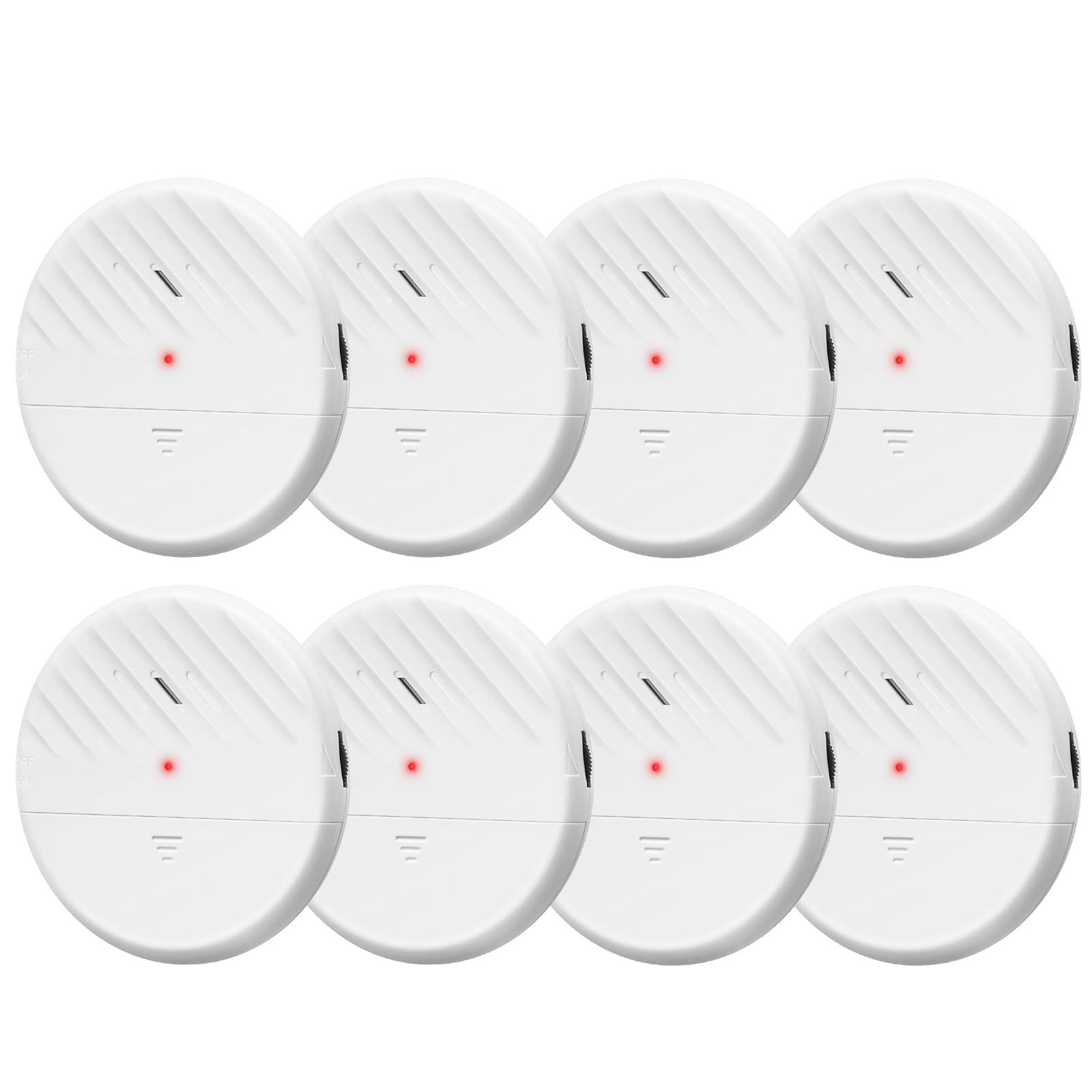
The Wsdcam 8-pack solves the math problem of home security: how many windows do you really have? For a typical three-bedroom house with a basement and garage, eight sensors cover every ground-floor glass entry point, plus a couple of interior windows, for a single bulk price. Each sensor is ultra-slim — barely thicker than a few stacked credit cards — and adheres to the glass with included double-sided tape. The 125dB siren is loud enough to be heard clearly from the street, and the red LED indicator gives a visual confirmation of activation.
The standout feature here is the adjustable sensitivity dial. A small wheel on the side of each unit lets you choose between “gentle touch” mode (catches even light taps) and “heavy impact” mode (ignores everyday rattles). This is critical for homes near busy streets, schools, or construction zones where a fixed-sensitivity sensor would false-alarm constantly. Users report that the auto-shutoff after 45 seconds prevents the siren from blaring endlessly if a false alarm does occur, and the low-battery LED warning gives you a month or more of heads-up before replacement is needed.
On the downside, the build quality is not as robust as the Honeywell or Catsonic units — a small percentage of users reported one or two units failing after about a year, usually the adhesive losing grip in high-humidity environments. The LR44 batteries are again the power source, and while they last roughly a year, sourcing replacements in bulk can be slightly more expensive than standard cells. For the sheer volume of coverage at this price level, the Wsdcam pack is the logical choice for renters and homeowners who want quick, adjustable protection window by window.
Why it’s great
- 8 sensors cover an entire house’s ground-floor windows in one purchase
- Adjustable sensitivity dial helps prevent neighborhood-noise false alarms
- Ultra-slim profile looks unobtrusive on the glass
- Auto-shutoff stops the siren after 45 seconds
Good to know
- Adhesive may weaken in humid environments over time
- Preference: AA/AAA batteries would be more user-friendly than LR44
5. Philips Personal Security Window and Door Alarm (4-Pack)
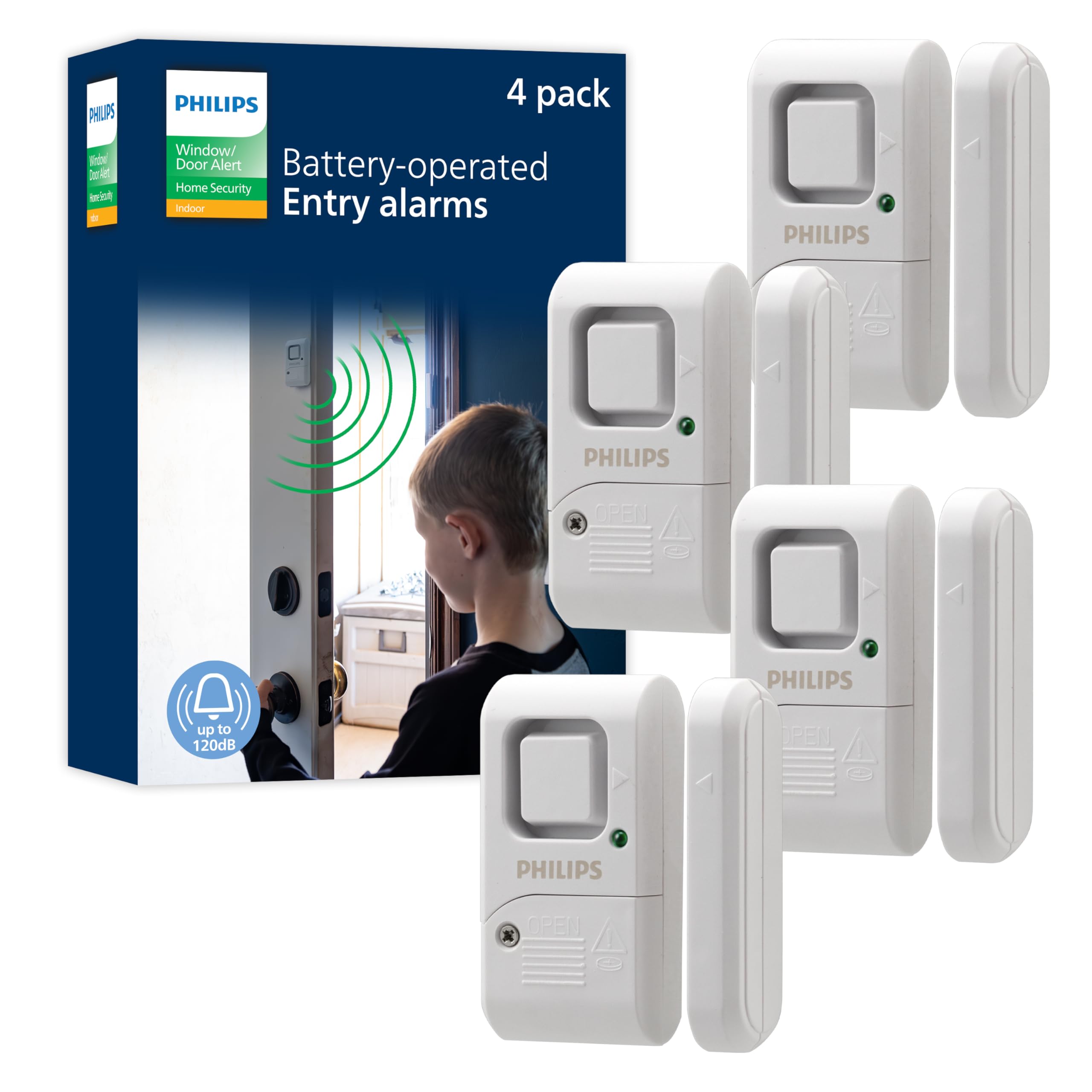
The Philips LRM3320 is technically a magnetic door/window alarm rather than a pure glass break sensor, but it earns a spot here for its dual functionality. The magnetic reed switch detects when a window is opened (separating the magnet from the sensor), while the 120dB siren deters attempts to force the window open. Critically, you can toggle between alarm mode (full 120dB siren on separation) and chime mode (a pleasant ding-dong when the window is opened) — a feature that makes it useful for alerting you to a child opening a window or a pet door being accessed.
The installation is genuinely wire-free and takes about 30 seconds per unit: peel the backing off the included double-sided tape, stick the sensor on the window frame, and stick the magnet on the sash. Each unit is powered by three included LR44 button-cell batteries, and the low-battery indicator LED gives you advance warning. Philips’ reputation for reliability shows in the customer feedback — multiple users describe them as “better than expected” and note that the sound is louder than comparable models at this entry-level price tier.
The limitation is that these are not true glass break detectors. They cannot sense a pane being shattered — only the physical separation of the window frame. For a basement window that is never opened, a vibration sensor is more appropriate. But for a first-floor window or a sliding glass door where an intruder would need to slide it open, the Philips 4-pack provides a fast, cheap, and reliable layer of perimeter security. The lack of sensitivity adjustment is a minor annoyance, but the choice between chime and alarm covers most casual needs well.
Why it’s great
- Dual-mode operation: alarm or door chime for everyday use
- Ultra-fast peel-and-stick installation with no wiring
- 120dB siren is genuinely loud for a budget unit
- Renowned brand reliability with a 1-year warranty
Good to know
- Only detects window opening, not glass breakage itself
- No sensitivity adjustment — fixed trigger point
FAQ
Can a glass break sensor detect a window being opened silently?
Do I need a separate hub for a glass break sensor to work?
What is the best placement for a glass break sensor on a window?
Final Thoughts: The Verdict
For most users, the best glass break sensor winner is the Catsonic 6-Pack because it combines a 130dB siren with instant peel-and-stick installation and a mute button — no hub, no programming, just raw deterrent power for a whole home at a mid-range cost. If you want a smart sensor with adjustable sensitivity and a quarter-mile range for outbuildings, grab the YoLink Vibration Sensor. And for a professional acoustic detector that integrates into an existing Honeywell alarm panel, nothing beats the Honeywell 5853.