
Concrete work punishes hands. The sharp edges of rebar, the abrasive silica grit in fresh concrete, and the constant wet-dry cycles from mixing and finishing cause standard leather gloves to stiffen, crack, and lose grip in a single shift. You need protection that repels water, resists cuts, and maintains dexterity for tying off forms or running a trowel.
I’m Mohammad Maruf — the founder and writer behind Drink4Good. I have spent over fifty hours analyzing hundreds of customer reviews and technical spec sheets to isolate the concrete-specific features — like ANSI cut levels, liquid repellent coatings, and palm reinforcement — that separate a glove you wear for one job from one you rely on for months.
Whether you’re handling wet bags, rebar, or a concrete vibrator, the right pair keeps you working safely and comfortably. This guide breaks down the top options to help you find the gloves for concrete work that match your specific daily demands.
How To Choose The Best Gloves For Concrete Work
Concrete work combines wet slurry, sharp aggregate, and repetitive abrasion. A glove that handles dry framing will fail here if it lacks liquid repellency or cut resistance. Focus on three decisions: the coating material, the cut protection level, and the fit for long shifts.
Understand the palm coating: nitrile vs. leather vs. polyurethane
Foam nitrile coatings channel away moisture and maintain grip on wet tools and forms — ideal for finishing and pouring. Leather, specifically HydraHyde treated leather, resists abrasion from rebar and forms but stiffens when wet if not treated. Polyurethane coatings (PU) offer high dexterity for tying rebar and detail work but wear through faster on rough concrete surfaces.
Match ANSI cut level to your specific job
For tying rebar and handling wire mesh, ANSI A4 cut resistance is the practical minimum — thin gloves with A2 or A3 levels will slice open on sharp steel edges. Pouring and screeding with wet concrete requires less cut protection (A2 is often enough) but demands better liquid repellency. If you’re handling both tasks in the same day, choose a glove that offers A4 cut resistance and a foam nitrile coating to keep hands dry and safe.
Prioritize fit and breathability for all-day shifts
A loose glove reduces grip and causes blisters during continuous concrete placement. Look for a snug fit with a breathable back (spandex or 13-gauge shell) to prevent sweating inside the glove when working under the sun. A pull-on cuff or a wrist closure keeps out concrete slurry and gravel that would otherwise accumulate inside the glove.
Quick Comparison
On smaller screens, swipe sideways to see the full table.
| Model | Category | Best For | Key Spec | Amazon |
|---|---|---|---|---|
| MAGID Griffin Gear | Premium | Wet pouring and finishing | ANSI A4 cut / Liquid repellent | Amazon |
| Schwer ANSI A5 | Premium | Rebar and metal fabrication | ANSI A5 cut / PU coated palm | Amazon |
| Gorilla Grip Polymer | Mid-Range | General concrete handling | Polymer palm / Machine washable | Amazon |
| COOLJOB PU Coated | Mid-Range | Cut resistance on a budget | 13-gauge / ANSI A2-A6 options | Amazon |
| Wells Lamont HydraHyde | Entry | Leather durability on forms | Water-resistant leather / ANSI A3 | Amazon |
In‑Depth Reviews
1. MAGID Griffin Gear ANSI A4 Liquid Repellent Nitrile Work Gloves

The MAGID Griffin Gear gloves hit the concrete sweet spot with a 13-gauge DuraBlend shell that breathes during long pours and a foam nitrile palm coating that repels water and provides a dependable grip on wet tools. Rated ANSI A4 cut resistance and A5 abrasion resistance, these gloves handle rebar ties, form handling, and finishing screeds without sacrificing dexterity for precision tasks like pulling pins or adjusting clamps.
Users consistently report that the liquid repellent coating prevents water and cement slurry from penetrating during an entire shift — the gloves stay dry inside, which reduces hand fatigue and skin irritation from prolonged contact with wet concrete. The pull-on design with color-coded shield makes sizing easy to spot across crew members, and the machine-washable construction keeps them reusable for months on active job sites.
Where these gloves excel is in balancing cut safety with wet-grip performance. The foam nitrile coating creates a micro-texture that grabs slick metal forms and wet boards, and the A4 cut level gives confidence when handling rebar and mesh. Some users note the form-fitting shell lacks extra padding on the palm for heavy abrasion tasks like hauling rough blocks, but for typical concrete finishing and forming, this is the most versatile premium choice.
Why it’s great
- ANSI A4 cut protection handles rebar and sharp aggregate without bulk
- Foam nitrile palm repels water and slurry while maintaining a firm grip on wet surfaces
- Machine washable and reusable — lowers cost per shift over multiple weeks
Good to know
- Thinner palm may wear faster on continuous rough block handling
- Form-fitting cut may feel snug for workers with wide hands
2. Schwer ANSI A5 Cut Resistant Work Gloves
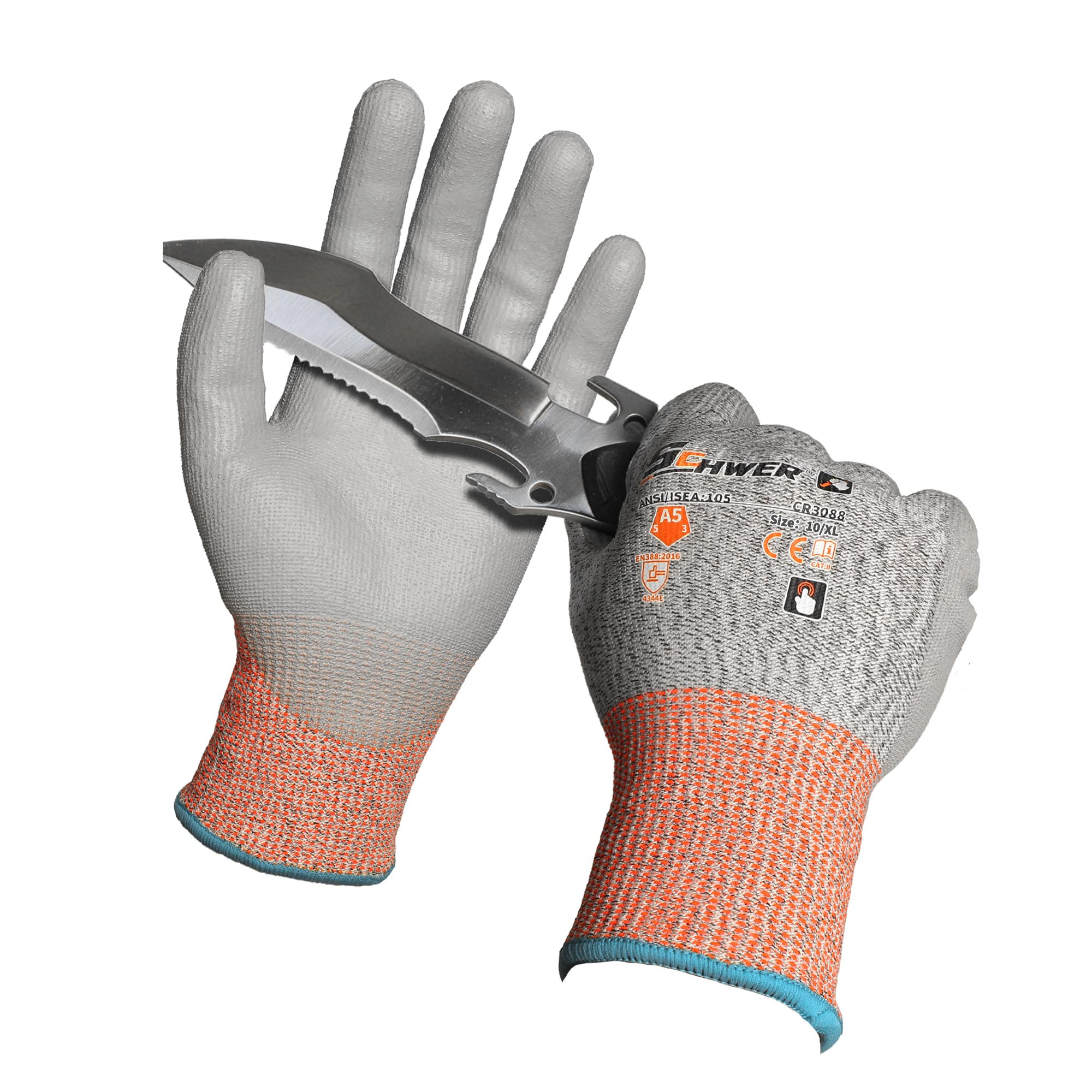
The Schwer ANSI A5 gloves step up the cut protection ceiling for concrete work involving heavy rebar baskets, wire mesh frames, or demolition debris cleanup. The 13-gauge HPPE/polyester/spandex liner is lightweight and breathable — a critical feature during hot pours — while the polyurethane palm coating provides a non-slip grip that resists wear on rough surfaces.
Customer feedback highlights the durability advantage: one pair holds up for about a month on a construction site where most gloves dissolve inside a week. The PU coating does not absorb water, which prevents the glove from becoming heavy and stiff after exposure to wet concrete. The pull-on closure keeps debris out, and the machine-washable design allows cleaning between heavy shifts.
The key trade-off is that the PU coating wears smooth over time, reducing grip on oily or wet surfaces once the texture degrades. The gloves also lack a liquid repellent feature behind the palm — if you submerge them in a curing pond or prolonged wet slurry, moisture can wick through the liner backing. For dry rebar tying, cutting wire, or form stripping, however, the Schwer gloves deliver exceptional cut protection at a competitive price point.
Why it’s great
- ANSI A5 cut level — the highest in this roundup for serious rebar and mesh work
- Lightweight 13-gauge liner breathes well during hot weather pours
- Machine washable and lasts roughly a month on active job sites
Good to know
- PU coating loses grip when the surface texture wears down
- Not fully waterproof; wet concrete can penetrate through the back
3. Gorilla Grip Work Gloves, Never Slip Maximum Grip Polymer Palm

The Gorilla Grip gloves use a thick polymer palm coating engineered for maximum grip on slippery surfaces — ideal for handling wet concrete forms, hoses, and tools during a pour. The flexible back allows natural hand movement, so you can still operate triggers, clamps, and small latches without stripping the glove off. Machine-washable construction means you can clean concrete residue out easily.
User feedback notes that the polymer grip texture lasts roughly a week of heavy concrete work before it begins to smooth out, but the base glove remains intact for much longer if you stop caring about peak tackiness. The tight fit option is a standout for smaller hands: women on job sites and team members with narrow palms report that these gloves fit securely without excessive bunching at the fingertips.
The downside for concrete-specific work is the lack of a designated ANSI cut resistance rating — these gloves offer protection against abrasion and scrapes but are not engineered to stop cuts from rebar or mesh. If your tasks lean toward finishing, cleanup, and tool handling rather than cutting and tying steel, the Gorilla Grip gloves deliver exceptional wet-surface grip for the cost. They are not a replacement for cut-rated gloves when sharp steel is involved.
Why it’s great
- Aggressive polymer palm provides excellent grip on wet concrete and tools
- Machine washable — concrete residue rinses out easily between shifts
- Available in small sizes that fit women and workers with narrow palms
Good to know
- No certified cut resistance — avoid for rebar tying or wire mesh handling
- Polymer texture degrades after about a week of continuous use
4. COOLJOB 12 Pair Cut Resistant Safety Work Gloves with Grip
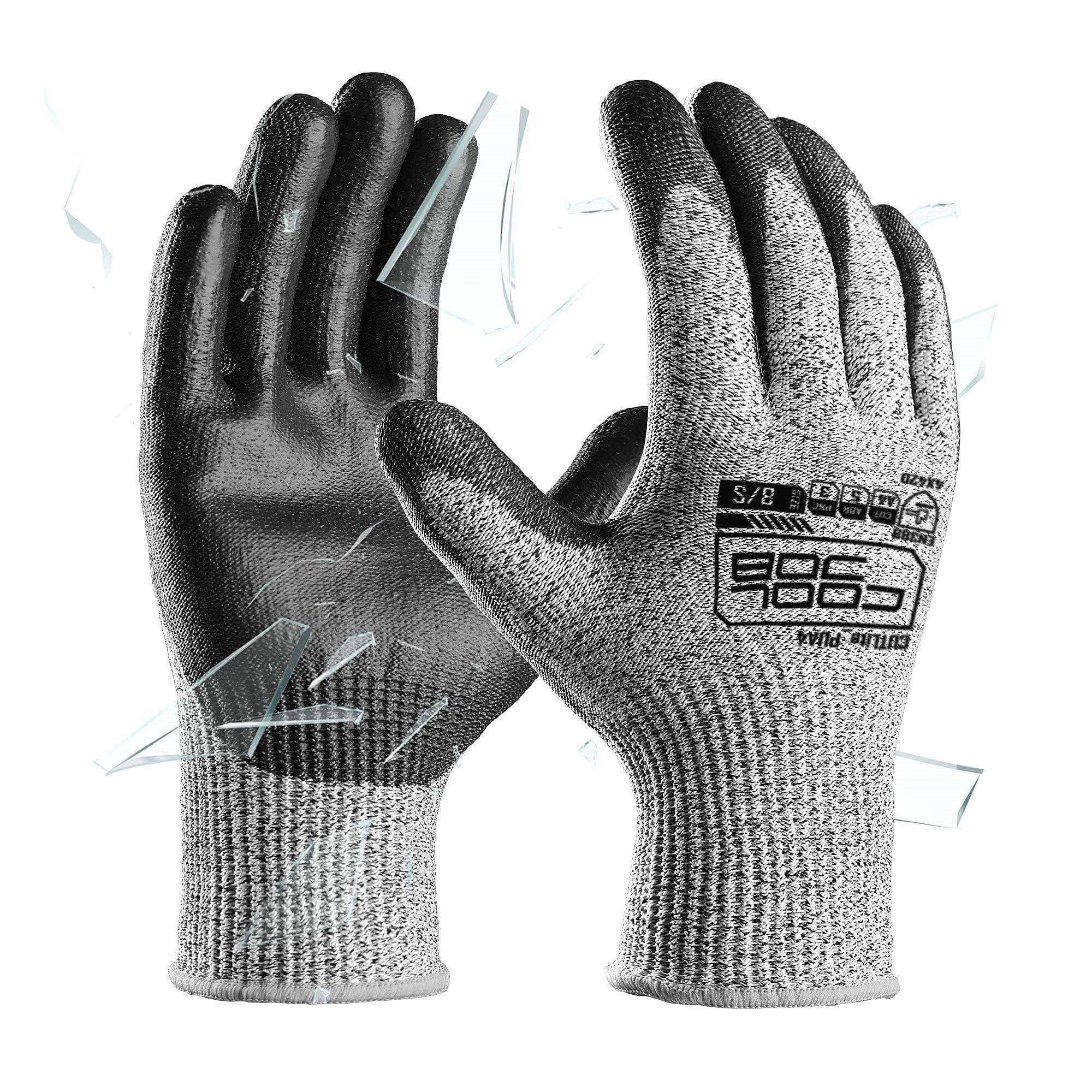
The COOLJOB gloves are sold in a 12-pair bulk pack, making them the most cost-effective option for crew coverage or one-glove-per-task use. The 13-gauge seamless shell is comfortable enough to wear all day, and the polyurethane palm coating provides a basic grip that works on dry and slightly wet surfaces. The available cut levels range from ANSI A2 to A6 depending on the variant, with A4 serving as a solid baseline for rebar handling.
Crew feedback indicates the gloves hold up well against sheet metal and sharp corners with no cuts or pokes when worn for concrete demo or metal tie work. The PU coating offers better abrasion resistance than bare fabric, though some users note the grip is not as aggressive as a nitrile or polymer palm on slick, wet surfaces. The extended cuff length helps keep slurry and gravel out during finishing work.
Where these gloves fall short is consistency in the cut rating labeling — one batch may print A6 on the glove while the packaging indicates blade cut level 5, which creates confusion when sourcing for crew compliance. For a budget-friendly bulk buy that provides a baseline level of cut safety for concrete tasks, the COOLJOB gloves deliver dependable protection. For workers needing a clear, single-rating standard, a single-brand option like MAGID may eliminate the confusion.
Why it’s great
- 12-pair pack delivers low per-unit cost for crew deployment
- 13-gauge shell remains breathable and comfortable during long shifts
- Extended cuff length helps prevent slurry and gravel ingress
Good to know
- Cut rating labeling can be inconsistent between printing and packaging
- PU coating provides less grip on very wet or oily concrete surfaces
5. Wells Lamont Men’s Slip-On HydraHyde Work Gloves

The Wells Lamont HydraHyde gloves bring a traditional leather palm approach with a modern twist — the HydraHyde treatment keeps the leather soft and flexible instead of stiffening when exposed to moisture, making them viable for damp concrete work without feeling like a frozen cast. The reinforced fingertips provide extra protection where most wear occurs during continuous form handling, and the breathable spandex back prevents hand sweat buildup on warmer days.
Users praise the out-of-box comfort: the leather feels supple and molds to the hand quickly, offering dexterity close to that of a well-worn glove from the first wear. The ANSI A3 abrasion level is adequate for general handling of wooden forms, PVC forms, and tying rebar ties, though it falls short of the A4 minimum some job sites require for steel mesh work. The slip-on elastic cuff is easy to pull on but lacks a velcro closure for adjusting tightness.
The main limitation for heavy concrete work is that leather — even treated leather — does not repel liquid as well as a dedicated nitrile or PU coating. Frequent submersion in wet slurry or prolonged contact with wet concrete will eventually cause the leather to soak through, reducing the drying time between uses. For light forming, stripping, and finishing tasks where cut risk is low, the HydraHyde gloves offer the leather feel many experienced concrete workers prefer.
Why it’s great
- HydraHyde leather stays soft and flexible even when damp — unlike standard work gloves
- Reinforced fingertips extend wearable life on high-wear tasks like form stripping
- Spandex back provides excellent breathability for all-day comfort
Good to know
- ANSI A3 cut level may not meet job spec for steel mesh handling
- Leather saturation occurs with prolonged exposure to wet slurry
FAQ
What is the minimum ANSI cut rating I should look for when handling rebar or wire mesh?
Can leather gloves handle wet concrete without stiffening?
How do I prevent concrete slurry from getting inside my gloves?
Are machine-washable concrete gloves worth the extra cost?
Final Thoughts: The Verdict
For most concrete workers, the gloves for concrete work winner is the MAGID Griffin Gear Nitrile because it balances A4 cut protection with liquid repellency for the wet, sharp conditions of concrete finishing and forming. If your job centers on dry rebar tying and metal fabrication, grab the Schwer ANSI A5 for its higher cut rating. And for a budget-friendly crew option that keeps hands protected on basic concrete handling, nothing beats the COOLJOB 12-Pair Pack.