
You know your body is sending signals — afternoon slumps that feel like fog, energy that crashes after a meal, blood work with a borderline A1c that your doctor called “a wake-up call.” The difference between managing prediabetes and ignoring it often comes down to one thing: data. A standard finger-stick test gives you a snapshot, but a proper monitoring system shows you the movie — how your glucose responds to specific foods, exercise, and stress in real time.
I’m Mohammad Maruf — the founder and writer behind Drink4Good. I’ve spent countless hours analyzing glucose monitoring technology, comparing sensor accuracy, app ecosystems, and real-world user feedback to separate the precise tools from the noisy ones.
Whether you value a painless continuous monitor or a reliable Bluetooth meter that tracks trends over weeks, you need the right tool for your body. This guide breaks down the top options to help you find the best glucose monitor for prediabetes that fits your lifestyle and accuracy standards.
How To Choose The Best Glucose Monitor For Prediabetes
Choosing a monitor for prediabetes isn’t the same as choosing one for type 1 diabetes. You don’t need multiple daily emergency alerts — you need trend awareness and behavioral feedback. The core decision is between a flash glucose monitor (CGM) that streams data continuously or a traditional meter with Bluetooth syncing. Focus on three factors: how the data is collected, how long the sensor lasts, and how easy it is to integrate the information into your routine.
Continuous vs. On-Demand Measurement
A Continuous Glucose Monitor (CGM) like the Lingo senses glucose in the interstitial fluid every few minutes, providing a dynamic curve throughout the day and night. A traditional glucometer with Bluetooth stores individual finger-stick readings. For prediabetes, a CGM reveals post-meal spikes you might miss with spot checks, while a meter with a robust app still gives you high-fidelity trend data at a lower upfront cost.
Sensor Life and Data Granularity
Sensor lifespan determines how often you recalibrate or replace hardware. Some CGMs offer a 14-day wear period with readings every 5 minutes, providing 4,000+ data points per sensor. Others capture data only when you scan or test. If catching elusive spikes is your priority, a longer sensor life with higher granularity (every 5 minutes vs. every 15 minutes) is the metric that matters most for pattern recognition.
App Quality and Data Portability
The app is your command center. You want one that automatically logs meals, shows clear glucose trends, and calculates helpful metrics like Time in Range (70–140 mg/dL). Features like exporting reports for your doctor, syncing with Apple Health or cronometer, and automated Lingo Counts (a score for meal impact) turn raw data into actionable decisions. A flawed app can make an accurate sensor almost useless.
Quick Comparison
On smaller screens, swipe sideways to see the full table.
| Model | Category | Best For | Key Spec | Amazon |
|---|---|---|---|---|
| Lingo CGM | CGM | Trend awareness & meal impact | 14-day wear, minute-by-minute readings | Amazon |
| Accu-Chek FastClix | Starter Kit | Reliability & precision | Bluetooth, 6-lancet drum, 720-test memory | Amazon |
| Embrace Talk | Starter Kit | Voice guidance & large kit | 300 strips, 6-second results, voice option | Amazon |
| Metene TD-4116 | Kit + 200 Strips | High-volume testing | 7-second, 0.7µl sample, code-free | Amazon |
| KETO-MOJO GK+ | Dual Meter | Glucose + ketone tracking | Bluetooth, GKI calculator, 10+10 strips | Amazon |
| DARIO Smart Meter | USB-C Meter | Compact Android integration | 6-second, USB-C, 25 strips included | Amazon |
| Verisana HbA1c Test | Lab Test | Quarterly long-term average | CLIA-certified lab analysis | Amazon |
In‑Depth Reviews
1. Lingo Continuous Glucose Monitor
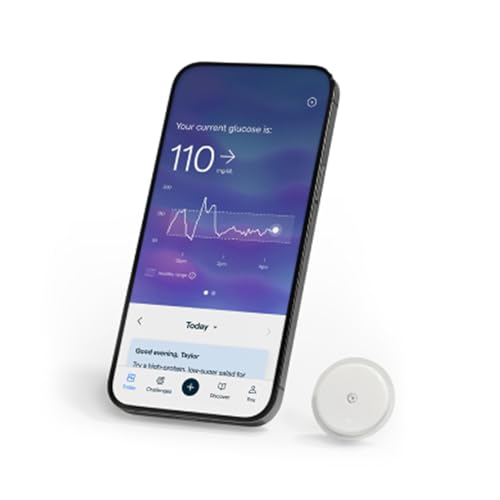
The Lingo CGM from Abbott is the most category-aware tool on this list for prediabetes because it measures your glucose every minute for a full 14 days without any finger pricking. Its biosensor attaches painlessly to the back of your arm and streams real-time data to the Lingo app, where you can see exactly how a bagel versus eggs affects your curve. The app also assigns a “Lingo Count” to each meal, which quantifies glucose impact in a single number — a feature built specifically for people who don’t need alarms but want behavioral insight.
Early adopters report that the absolute accuracy can lag behind a finger-stick meter by 10–20 mg/dL during the first 24 hours, but the trend data is excellent once the sensor stabilizes. The pairing process requires a specific 12-hour rest period before activation for best results, and some users have encountered app connectivity bugs that required sensor replacement. On the positive side, Abbott offers a free replacement if the biosensor fails before 14 days, and the unit is HSA/FSA eligible with no prescription needed.
For the prediabetes buyer, the value is in the data density. You get over 20,000 readings per sensor, revealing the hidden spikes that a traditional meter would miss. The six-second wait for a traditional test strip simply can’t compete with the full-day pattern recognition that Lingo delivers. If you are serious about understanding your glucose dynamics before diabetes sets in, this is the tool to prioritize.
Why it’s great
- Minute-by-minute data for 14 days reveals meal patterns and overnight trends.
- Painless application — no finger sticks required for daily tracking.
- HSA/FSA eligible and does not require a prescription to purchase.
Good to know
- Absolute readings can be low initially compared to blood-based meters.
- App pairing process can be finicky and requires a 12-hour stabilization period.
- Sensor edges may lift by day 3; a third-party overpatch is recommended.
2. Accu-Chek FastClix Glucose Monitor Kit

The Accu-Chek FastClix kit is the gold standard for traditional meter accuracy. The Guide Me meter features a crisp LCD that stores up to 720 test results and syncs automatically with the mySugr app via Bluetooth, making it simple to generate trend reports for your doctor. The real standout detail is the FastClix lancing device, which uses a pre-loaded drum of 6 lancets — you never have to handle a loose needle again, and the 11-depth dial ensures you find the setting that barely registers a sensation.
User reviews consistently praise the Swiss build quality and the meter’s ability to read accurately from an extremely small blood sample. The 100 included Guide test strips have a generous easy-fill area, reducing the chance of a wasted strip. The kit also includes control solutions for verification, a carrying case, and batteries. Some users note that the needle drum insertion requires a firm push on the first try, but after that the mechanism works flawlessly for six tests before a simple rotation reloads it.
For the prediabetes user who prefers the reliability of a meter over a CGM’s guesswork, this kit is the most complete package. The mySugr PRO features unlock with device sync, including personalized challenges and PDF export. The trade-off is the need to consciously test several times per day to build meaningful trend data — but when you do, the accuracy is unshakeable.
Why it’s great
- Swiss engineering delivers fast, accurate results from a tiny blood sample.
- FastClix lancet drum eliminates needle handling and offers 11 depth settings.
- Bluetooth sync with mySugr app enables automatic log and shareable reports.
Good to know
- Upfront cost is higher than most starter kits in this category.
- Requires conscious finger sticking — no passive 24/7 data stream.
- First-time lancet drum insertion requires notable force.
3. KETO-MOJO GK+ Bluetooth Ketone & Glucose Kit

The KETO-MOJO GK+ is the only meter on this list that measures both blood glucose and blood ketones in a single device, which is a critical tool for anyone using a low-carb or ketogenic approach to manage prediabetes. The meter detects which strip is inserted — glucose or ketone — automatically and delivers a reading in seconds. It pairs via Bluetooth with the MyMojoHealth app, which calculates your Glucose Ketone Index (GKI), a metric that indicates metabolic flexibility beyond simple glucose alone.
This unit is trusted in clinical research and used in over 100 studies, which is a strong indicator of accuracy. Users report readings within 5 mg/dL of a standard lab glucose meter. The starter kit includes 10 glucose and 10 ketone strips, a lancing device, control solutions, and an organized case. The strips are individually foil-wrapped to ensure freshness, and the meter is backed by a lifetime warranty with US-based support. A known design quirk: the meter can turn on in the carrying case due to button pressure, so pack it carefully.
For the prediabetes buyer who is also tracking ketosis, this is the only entry that covers both bases with clinical-grade precision. The app integrates with Apple Health, Cronometer, and Carb Manager, making it easy to overlay glucose data with food logs. The only limitation is the need to use blood strips for each test — it is not a CGM — so you must be willing to test multiple times to build your trend picture. If your approach includes carb restriction, this is your best tool.
Why it’s great
- Measures both glucose and ketones in one device for dual biomarker tracking.
- Clinically validated and used in over 100 studies for accuracy.
- App calculates GKI and integrates with Cronometer and Carb Manager.
Good to know
- Not a CGM — requires finger-stick tests for each reading.
- Meter may turn on accidentally if stored without a lock in the case.
- Strip packets are tightly sealed and can be difficult to open without scissors.
4. DARIO Smart Glucose Monitor Kit
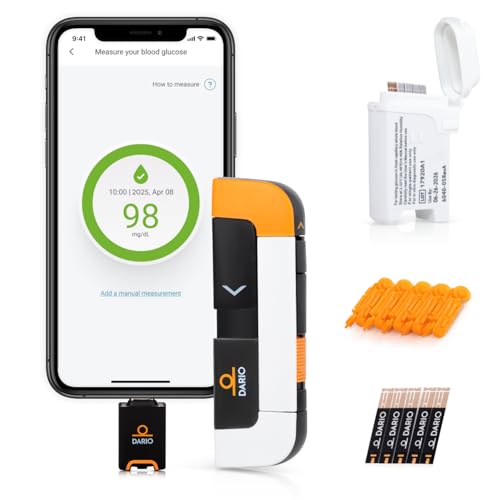
The DARIO kit is unique because it plugs directly into your Android phone’s USB-C port — no separate meter body, no batteries to replace. The entire device is about the size of a car key fob, which makes it the most portable option for a pocket-based prediabetes log. Testing takes 6 seconds with just a 0.3µl sample, and results automatically log into the Dario Health app. The app also tracks diet and exercise, providing trend reports and emergency GPS alerts.
The trade-off is strict Android USB-C compatibility. Some phones, including certain Samsung Note 20 models, have been reported as incompatible despite using USB-C, so check the list before buying. The case lids have a reputation for cracking over time, and users report that starting a test requires pulling the lancet loader back fully before pressing the release button. For drivers who manage their data in-app with email export and doctor sharing, the convenience is high.
For the prediabetes user who wants a minimal, pocket-friendly device that eliminates the need for a separate glucometer, this is a clever solution. The strip subscription model runs -35 per month for unlimited strips, which can help keep testing costs predictable. Just verify your phone model on the compatibility list before committing — the investment is in the ecosystem, not just the hardware.
Why it’s great
- Extremely compact — plugs directly into Android USB-C port, no separate meter needed.
- 6-second test time with a tiny 0.3µl blood sample.
- App-based tracking with diet logs, reports, and emergency GPS sharing.
Good to know
- Strict Android USB-C compatibility — not all models are supported.
- Case lids can crack with regular use over time.
- Requires priming the lancet loader manually; skip this and the lancet may not fire.
5. Embrace Talk Diabetes Testing Kit

The Embrace Talk kit prioritizes volume and accessibility above all else, packing 300 test strips and 300 lancets into a single bundle. The “Talk” feature refers to the voice guidance that reads results aloud in English or Spanish — a genuine help for those with vision challenges or for elderly family members. The meter is auto-coding, stores 300 tests with time and date, and produces results in 6 seconds with a small blood sample.
User feedback is mixed on build quality. While the meter itself is accurate and easy to use with a large screen, the lancet device has been described as flimsy — some units broke on the first use, requiring a cumbersome full-kit return for replacement. The test strips feel thin and can split along the edges when inserted too aggressively. On the plus side, the kit is complete: everything from the meter to the case is included, and the voice option is genuinely useful.
For the prediabetes user who plans to test frequently and wants the maximum number of strips per purchase, this kit provides strong value per test. Just be prepared for the lancet and strip quality to be a step below premium kits. It works best as a reliable backup or for households where more than one person uses the same meter system.
Why it’s great
- Huge supply — 300 strips and 300 lancets included in one purchase.
- Voice guidance reads results in English or Spanish, aiding accessibility.
- Simple auto-coding and 6-second fast results with a large display.
Good to know
- Lancet device build quality is low and prone to breaking on first use.
- Test strips are thin and can split during insertion.
- Stiff buttons require extra force to operate, especially turning off the meter.
6. Metene TD-4116 Blood Glucose Monitor Kit
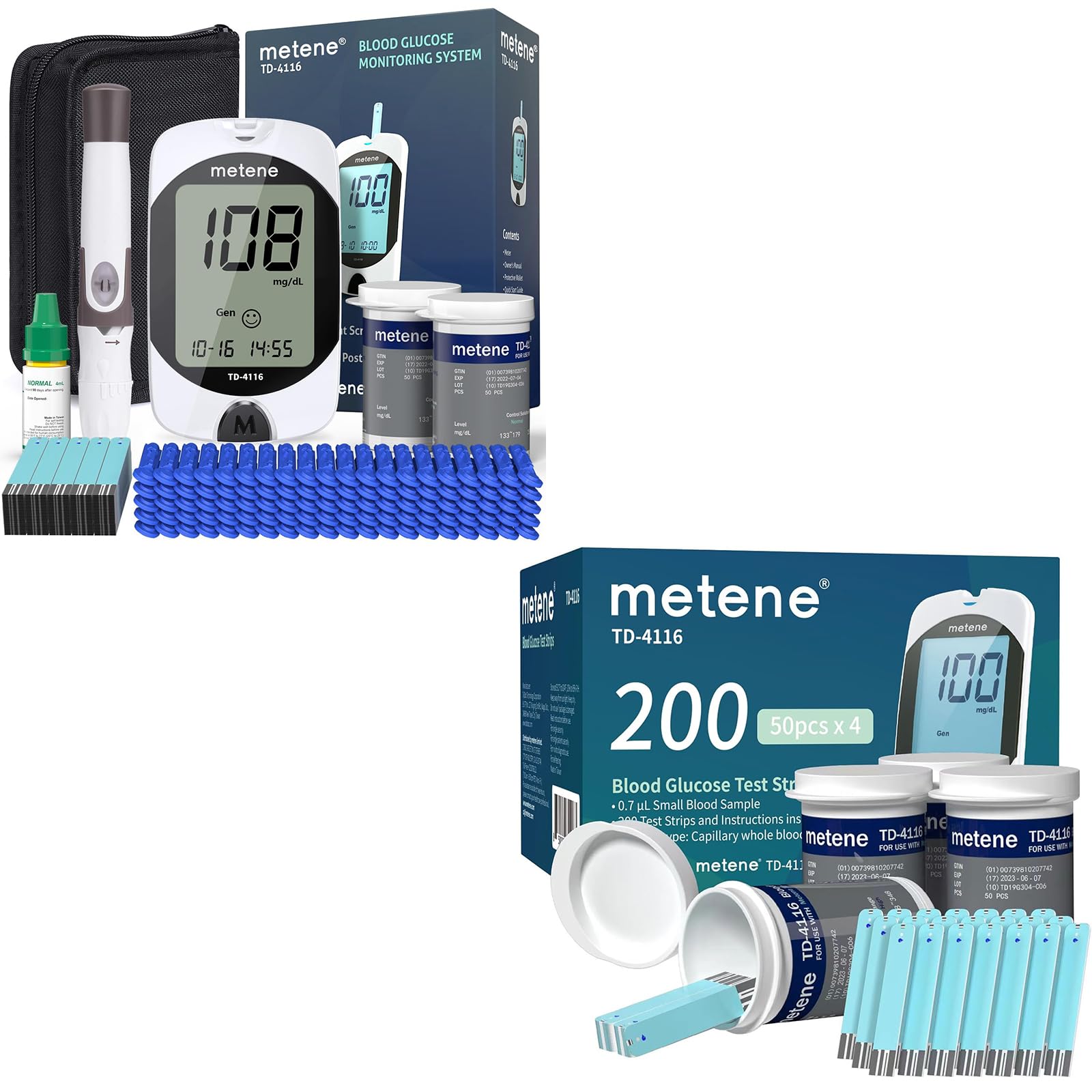
The Metene TD-4116 is a code-free glucometer that pairs with 200 test strips, making it one of the higher-volume bundles for the mid-range segment. It requires only 0.7µl of blood and takes 7 seconds for a result. The meter uses industry-leading biosensor technology that resists interference from galactose, maltose, and fructose — a meaningful spec for prediabetics who monitor sugar intake and don’t want false readings from non-glucose sugars.
The kit includes a control solution for calibration verification, a lancing device with adjustable depth, and a carrying case. The code-free design means you just insert a strip and the meter is ready, eliminating the error-prone step of matching code chips. The included quick guide breaks down the testing procedure step by step, which is helpful for first-time meter users. Some customer feedback notes that carrying case zippers can catch, and the included lancet device is functional but not as refined as the FastClix drum.
For the prediabetes buyer who wants a solid everyday meter with a large supply of interference-resistant strips, this kit balances accuracy and cost well. The strip vial must be closed immediately after removing a strip to preserve reagent quality, but that is standard across the category. If you plan to test 3–5 times daily, the 200-strip count will last roughly 40–67 days, making it a strong long-term value.
Why it’s great
- High strip count — 200 test strips included with the starter kit.
- Interference-resistant sensor prevents false reads from galactose and fructose.
- Code-free design enables immediate testing without coding steps.
Good to know
- Strips are compatible only with the Metene TD-4116 or Metene S meter.
- Lancet device is functional but less refined than premium drum systems.
- Carrying case zippers can occasionally catch on the cloth lining.
7. Verisana HbA1c At-Home Test Kit

The Verisana HbA1c test is fundamentally different from the other entries on this list — it does not give you real-time glucose readings. Instead, it measures your average blood sugar over the past three months by analyzing a dried blood spot in a CLIA-certified lab. For prediabetes monitoring, HbA1c is the clinical benchmark your doctor uses to diagnose the condition (5.7%–6.4%), and this test lets you check it at home between appointments without a prescription.
The test kit includes a sample collection package, easy instructions, and a return envelope for your sample. Users report results arriving within 5–7 days after the lab receives the sample, and the values have matched in-office bloodwork closely. The price for a single test is comparable to a copay for a lab draw but without the need to book an appointment or travel. Note that regulatory restrictions mean this test is not available in New York, New Jersey, Rhode Island, or Maryland.
For the prediabetes buyer, this test is the ideal complement to a CGM or stick meter. Use a daily monitor to track your trends and meal impacts, then use the Verisana test every 90 days to confirm whether your A1c is moving in the right direction. It is not a replacement for continuous tracking, but it is the only affordable way to validate that your daily efforts are producing the long-term change your doctor looks for.
Why it’s great
- CLIA-certified lab analysis provides clinical-grade A1c results from home.
- Measures long-term average blood sugar over 3 months, mirroring doctor’s test.
- Simple blood spot collection with no appointment needed and clear instructions.
Good to know
- Not a daily monitor — provides only a quarterly snapshot, not real-time trends.
- Results can take up to 7–10 days from mailing to receipt of the report.
- Not available in NY, NJ, RI, or MD due to regulatory restrictions.
FAQ
Is a CGM like Lingo worth the cost for prediabetes if I don’t have diabetes?
How often should someone with prediabetes test their glucose using a finger-stick meter?
Why do some meters read higher or lower than my lab results at the doctor’s office?
Can I use any of these monitors if I have poor circulation or vision problems?
Final Thoughts: The Verdict
For most users, the glucose monitor for prediabetes winner is the Lingo CGM because it provides the richest data density with zero finger sticks, revealing the meal patterns and hidden spikes that drive prediabetes progression. If you want the most precise traditional meter with painless lancet handling, grab the Accu-Chek FastClix. And for managing both glucose and ketones in one device with clinical-grade accuracy, nothing beats the KETO-MOJO GK+.